


2 Chronicles 27:8
- בֶּןbena son ofH1121N-mscNoun Singular Masculine Construct
- עֶשְׂרִים'es·RimtwentyH6242N-mpNoun Plural Masculine Absolute
- וְחָמֵשׁve·cha·Meshand fiveH2568Conj-w ¦ N-csNoun Singular common gender Absoluteוְandחָמֵשׁfive
- שָׁנָהsha·Nahyear[s]H8141N-fsNoun Singular Feminine Absolute
- הָיָהha·Yahhe wasH1961V-Qal-Perf-3msVerb Qal Perfect 3rd Singular Masculine
- בְמָלְכוֹve·ma·le·Khowhen he became kingH4427Prep-b ¦ V-Qal-Inf ¦ 3msVerb Qal Infinitive Constructבְwhenמָלְכbecame kingוֹhe
- וְשֵׁשׁve·sheshand six-H8337Conj-w ¦ N-csNoun Singular common gender Absoluteוְandשֵׁשׁsix-
- עֶשְׂרֵה'es·RehteenH6240N-csNoun Singular common gender Absolute
- שָׁנָהsha·Nahyear[s]H8141N-fsNoun Singular Feminine Absolute
- מָלַךְma·Lakhhe reignedH4427V-Qal-Perf-3msVerb Qal Perfect 3rd Singular Masculine
- בִּירוּשָׁלִָםbi·ru·sha·Limin JerusalemH3389Prep-b ¦ N-properNoun Proper LocationבִּinירוּשָׁלִָםJerusalem
English is a literal word-by-word gloss of the Hebrew, not the KJV's wording. Why?
This is the original text the KJV's translators worked from — each Hebrew word with its own literal English meaning in this verse, prepared by scholars at Tyndale House, Cambridge. The KJV translates whole sentences, not word by word, so its wording differs: one Hebrew word can become several English words, and the KJV may choose “the LORD” where the gloss reads “Yahweh”. Both are faithful — they answer different questions. For the KJV's own rendering, switch to the KJV text.
Details
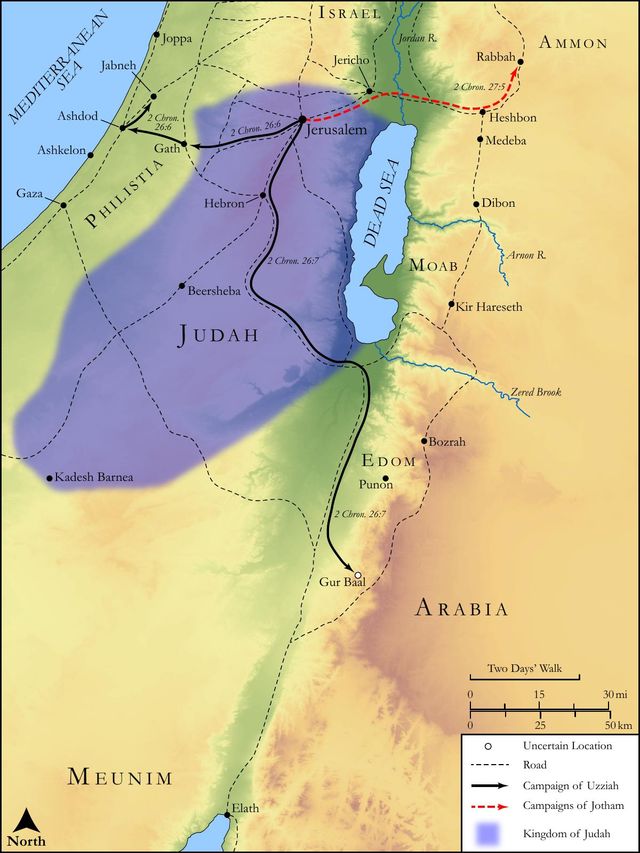
See on the biblical-era map
Study this verse
Public-domain commentary
Matthew Henry
From his Commentary on the Whole Bible. Henry comments on passages, not single verses — this entry covers 2 Chronicles 27:1–9. His two-level outline is real structure in the source text, so it is rendered as structure.
There is not much more related here concerning Jotham than we had before, Kg2 15:32, etc.
I.He reigned well.
He did that which was right in the sight of the Lord; the course of his reign was good, and pleasing to God, whose favour he made his end, and his word his rule, and (which shows that he acted from a good principle) he prepared his ways before the Lord his God (Ch2 27:6), that is, he walked circumspectly and with much caution, contrived how to shun that which was evil and compass that which was good. He looked before him, and cast his affairs into such a posture and method as made the regular management of them the more easy. Or he established or fixed his ways before the Lord, that is, he walked steadily and constantly in the way of his duty, was uniform and resolute in it: not like some of those that went before him, who, though they had some good in them, lost their credit by their inconstancy and inconsistency with themselves. They had run well, but something hindered them. It was not so with Jotham. Two things are observed here in his character: - 1. What was amiss in his father he amended in himself (Ch2 27:2): He did according to all that his father did well and wisely; howbeit he would not imitate him in which he did amiss; for he entered not into the temple of the Lord to burn incense as his father did, but took warning by his fate not to dare so presumptuous a thing. Note, We must not imitate the best men, and those we have the greatest veneration for, any further than they did well; but, on the contrary, their falls, and the injurious consequences of them, must be warnings to us to walk the more circumspectly, that we stumble not at the same stone that they stumbled at. 2. What was amiss in his people he could not prevail to amend: The people did yet corruptly. Perhaps it reflects some blame upon him, that he was wanting in his part towards the reformation of the land. Men may be very good themselves, and yet not have courage and zeal to do what they might do towards the reforming of others. however it certainly reflects a great deal of blame upon the people, that they did not do what they might have done to improve the advantages of so good a reign: they had good instructions given them and a good example set before them, but they would not be reformed; so that even in the reign of their good kings, as well as in that of the bad ones, they were treasuring up wrath against the day of wrath; for they still did corruptly, and the founder melted in vain.
II.He prospered, and became truly reputable.
1.He built. He began with the gate of the house of the Lord, which he repaired, beautified, and raised. He then fortified the wall of Ophel, and built cities in the mountains of Judah (Ch2 27:3, Ch2 27:4), took all possible care for the fortifying of his country and the replenishing of it.
2.He conquered. He prevailed against the Ammonites, who had invaded Judah in Jehoshaphat's time, Ch2 20:1. He triumphed over them, and exacted great contributions from them, Ch2 27:5. He became mighty (Ch2 27:6) in wealth and power, and influence upon the neighbouring nations, who courted his friendship and feared his displeasure; and this he got by preparing his ways before the Lord his God. The more stedfast we are in religion the more mighty we are both for the resistance of that which is evil and for the performance of that which is good.
III.He finished his course too soon, but finished it with honour.
He had the unhappiness to die in the midst of his days; but, to balance that, the happiness not to out-live his reputation, as the last three of his predecessors did. He died when he was but forty-one years of age (Ch2 27:8); but his wars and his ways, his wars abroad and his ways at home, were so glorious that they were recorded in the book of the kings of Israel, as well as of the kings of Judah, Ch2 27:7. The last words of the chapter are the most melancholy, as they inform us that Ahaz his son, whose character, in all respects, was the reverse of his, reigned in his stead. When the wealth and power with which wise men have done good devolve upon fools, that will do hurt with them, it is a lamentation, and shall be for a lamentation.
Continue studying 2 Chronicles 27:8 across the web’s major study libraries — every link below opens this exact verse, chapter, or book on the destination site.
Read & Compare
 BibleGatewayThis verse in more than 200 translations and 70 languages.
 Bible.comThe YouVersion reader — hundreds of translations, reading plans, and highlights.
 ESV.orgCrossway's official English Standard Version reader.
 NET BibleThe NET translation with 60,000+ translators' notes on every rendering decision.
 STEP BibleTyndale House's free study tool — original text, vocabulary, and scholarly resources.
 BibliaLogos Bible Software's free web reader.
 USCCBThe New American Bible (Revised Edition) with the U.S. bishops' study notes.
Commentaries
 BibleHub CommentariesDozens of classic commentaries on this verse, gathered on one page.
 StudyLightMore than 100 commentary sets — the largest collection on the web.
 BibleRefPlain-English commentary on what this verse means, verse by verse.
 Enduring WordDavid Guzik's free commentary on this chapter, widely used by Bible teachers.
 Bible Study ToolsVerse commentary alongside Greek and Hebrew study aids.
Original Language & Research
- BibleHub InterlinearThe verse word by word — original language, transliteration, and English.
- BibleHub LexiconEvery word's original-language definition and Strong's entry.
 Blue Letter BibleDeep-study tools — Strong's numbers, concordance, and word studies.
 SefariaThe Hebrew text with Rashi and centuries of Jewish commentary.
Sermons, Hymns & Audio


TrulyRandomVerse is not affiliated with these sites and doesn’t control their content. They’re linked because they’re genuinely useful.
Summary
2 Chronicles 27:8 serves as a pivotal chronological anchor within the Chronicler's account of King Jotham, succinctly providing the essential data of his age at ascension and the total duration of his reign from Jerusalem. This precise regnal formula, characteristic of biblical historical narratives, not only grounds Jotham's rule within the broader timeline of the Davidic dynasty but also sets the stage for the theological and moral evaluation of his kingship, detailed in the surrounding verses. It encapsulates a period of relative stability and faithfulness for Judah, contrasting with the reigns that preceded and followed.
Context
ShowHideLiterary Context
This verse functions as the concluding biographical summary for King Jotham, immediately following the Chronicler's positive assessment of his character and accomplishments in 2 Chronicles 27:1-7. It adheres to the standardized regnal formula found consistently throughout the books of Kings and Chronicles, providing a structured framework for the reigns of Judah's monarchs. Jotham's reign is presented as a period of relative righteousness and strength, particularly when viewed against the backdrop of his father Uzziah's presumptuous sin and subsequent leprosy (2 Chronicles 26:16-21) and the profound apostasy that would characterize the reign of his son, Ahaz (2 Chronicles 28:1-5). The information in this verse finds a direct parallel in 2 Kings 15:33, underscoring the shared historical traditions and sources utilized by both biblical authors, though the Chronicler often adds theological commentary and details pertinent to the Temple and covenant.
Historical & Cultural Context
Jotham's reign, typically dated from approximately 750 to 735 BC, occurred during a tumultuous period in the ancient Near East. The formidable Assyrian Empire was rapidly expanding its influence, posing an increasing threat to the smaller kingdoms of Judah and Israel. While the verse itself is a concise factual record, it situates Jotham firmly within the unbroken line of Davidic kings, emphasizing the continuity of the covenant promises despite external pressures and internal challenges. The practice of co-regency, where a son assumed administrative duties alongside an ailing or incapacitated father, was a common and practical solution in ancient Judah to ensure a smooth transition of power and maintain stability. This was the case with Jotham, who effectively governed while his father Uzziah was afflicted with leprosy (2 Chronicles 26:21). Jerusalem, as the divinely chosen capital, remained the political, religious, and spiritual heart of the kingdom, signifying the legitimate seat of the Davidic throne and the central location of the Temple.
Key Themes
ShowHideThough brief, 2 Chronicles 27:8 contributes significantly to several overarching themes pervasive throughout the book of 2 Chronicles. Firstly, it powerfully reinforces the continuity of the Davidic covenant and dynasty, demonstrating God's unwavering faithfulness in preserving a legitimate ruler on the throne in Jerusalem, even amidst the moral failings and spiritual lapses of previous kings. Secondly, it highlights the Chronicler's meticulous attention to historical detail and chronological precision, which serves a crucial theological purpose: to validate the divine oversight of Israel's history and to underscore the reliability of God's unfolding plan. Thirdly, by providing the foundational chronological framework for Jotham's reign, the verse indirectly points to the profound theme of righteous leadership and its consequences. While this specific verse is purely factual, the preceding verses (2 Chronicles 27:2-6) emphasize Jotham's general adherence to God's ways, which, for the Chronicler, invariably leads to national prosperity and strength—a core theological principle woven throughout his narrative.
Exposition and Analysis
ShowHideKey Word Analysis
ShowHideA primitive root meaning "to reign; inceptively, to ascend the throne; causatively, to induct into royalty." This verb signifies the exercise of royal authority and the act of ruling as a king. In the context of the Davidic monarchy, it carries profound theological weight, as the king's rule was understood to be divinely appointed and mediated, making the duration of his "reign" a measure of his time of influence, responsibility, and accountability before God and the people.
From a root meaning "to repeat" or "to revolve"; a "year" (as a revolution of time). This word precisely quantifies the duration of Jotham's rule, emphasizing the specific period of time during which he held the royal office. The meticulous counting of "years" underscores the Chronicler's historical precision and the linear progression of God's plan through time.
A dual noun, probably from "founded peaceful"; Jerushalaim or Jerushalem, the capital city of Palestine. This name refers to the capital city of Judah, the divinely chosen seat of the Davidic dynasty, and the location of the Temple. Ruling "in Jerusalem" affirmed the legitimacy of the king's rule, his connection to the Davidic covenant, and the central role of the city in Judah's national and religious identity as the place where God had chosen to establish His name.
Verse Breakdown
ShowHide"He was five and twenty years old when he began to reign"
This clause provides the precise age of King Jotham at the formal commencement of his sole reign. At twenty-five, he was considered a mature adult, likely having gained invaluable administrative and governance experience during his co-regency with his father Uzziah, who was afflicted with leprosy and confined (2 Chronicles 26:21). This detail underscores his preparedness and the smooth, legitimate transition of power within the Davidic line.
"and reigned sixteen years"
This specifies the total duration of Jotham's independent rule as king of Judah. This period, though relatively short compared to some other kings, represents a significant tenure during which he initiated building projects, achieved military successes against the Ammonites, and largely maintained faithfulness to God (2 Chronicles 27:3-6). The number highlights a period of stability and strength for the kingdom under his leadership.
"in Jerusalem"
This final phrase confirms the geographical seat of Jotham's authority. His reign from Jerusalem emphasizes his authentic succession within the Davidic line and the continued centrality of the city as the political, cultural, and spiritual heart of the kingdom of Judah. It signifies the legitimate and divinely sanctioned place of rule for the descendants of David.
Literary Devices
ShowHide2 Chronicles 27:8 primarily employs the Regnal Formula, a standardized literary convention used extensively throughout the historical books of Kings and Chronicles. This formula typically provides concise, essential data about a monarch's reign, including their age at ascension, the duration of their rule, and the capital city from which they reigned. Its use here serves as a precise Chronological Marker, firmly situating Jotham's rule within the broader timeline of Judah's history and providing a consistent framework for comparing and contrasting the various reigns. The verse's notable Conciseness is also a key literary feature, efficiently conveying vital historical information without extraneous detail, allowing the Chronicler to maintain narrative flow and focus on the theological implications and moral evaluations of Jotham's reign elsewhere in the chapter. This brevity ensures that the focus remains on the king's character and actions, rather than mere biographical data.
Theological and Thematic Connections
ShowHideThis seemingly simple historical record carries profound theological weight within the Chronicler's narrative. It underscores God's unwavering sovereignty over human history and the succession of rulers, demonstrating His faithfulness to the Davidic covenant despite the imperfections and moral failures of individual kings. The meticulous recording of Jotham's reign duration and location highlights the Chronicler's concern for historical accuracy, which serves to validate the divine narrative unfolding through the lives of Judah's kings. Jotham's generally righteous reign, encapsulated by this chronological marker, foreshadows the Chronicler's consistent message: obedience to God leads to stability, prosperity, and blessing, while disobedience invites judgment and decline. This verse, therefore, is not merely a historical fact but a foundational piece for understanding the theological framework by which the Chronicler evaluates leadership and demonstrates God's consistent engagement with His covenant people.
Reflection and Application
ShowHideThe concise record of Jotham's reign in 2 Chronicles 27:8, while brief, offers a profound invitation for us to reflect on the significance of our own "reign" or sphere of influence—the time, talents, and opportunities God has entrusted to each of us. Just as Jotham was given a specific tenure and a specific place (Jerusalem) to rule, each of us is given a unique context and duration for our lives, ministries, and callings. This verse challenges us to consider how we are stewarding our time and influence, whether we are beginning our endeavors with integrity and devotion, and how we are using our "reign" to honor God and serve His purposes. Jotham's example, particularly his general righteousness and his commitment to building and strengthening the kingdom, reminds us that faithfulness in our assigned roles, no matter how grand or humble, is what truly matters in God's eyes. It also suggests that even the seemingly small, factual details of our lives are observed and recorded by Him, inviting us to live with intentionality and accountability.
Questions for Reflection
ShowHideFAQ
ShowHideWhy does the Bible record such precise details about kings' ages and reign durations?
ShowHideThe meticulous recording of details like a king's age at ascension and the duration of their reign serves several crucial purposes within the biblical narrative. Firstly, it provides a robust historical and chronological framework, allowing for the accurate dating of events, prophecies, and the overall timeline of biblical history, thereby demonstrating the Bible's grounding in actual historical occurrences. Secondly, it underscores the profound theological principle of divine sovereignty over human rulers and the flow of history; God is actively involved in raising up and bringing down leaders according to His purposes. Thirdly, these consistent details provide a standardized basis for evaluating the kings' reigns in light of their obedience or disobedience to God's covenant, which is a central concern for the Chronicler. Finally, it validates the continuity of the Davidic line, emphasizing God's faithfulness to His promises regarding an enduring dynasty.
What was the significance of Jotham's co-regency before his sole reign?
ShowHideWhile 2 Chronicles 27:8 marks the formal beginning of Jotham's sole reign, the preceding chapter (2 Chronicles 26:21) indicates that Jotham began administering the kingdom while his father Uzziah was still alive but afflicted with leprosy. This co-regency was a practical and necessary arrangement due to Uzziah's ritual impurity, which prevented him from fulfilling his royal duties, particularly those related to the Temple. Its significance lies in several key aspects: it ensured a smooth and stable transition of power within the Davidic dynasty, preventing any vacuum or dispute; it provided Jotham with invaluable administrative and governance experience before assuming full responsibility, preparing him for the demands of kingship; and it demonstrated the resilience and adaptability of the Davidic monarchy in facing unexpected challenges while maintaining legitimate rule from Jerusalem.
Christ-Centered Fulfillment
ShowHideWhile 2 Chronicles 27:8 is a historical record of a human king's reign, it subtly points forward to the ultimate and eternal King, Jesus Christ. Jotham, as a descendant of David, participated in the Davidic line through which the Messiah was promised to come. His "reign" in Jerusalem, though limited in scope and duration, foreshadows the perfect and everlasting reign of Christ. Unlike Jotham, whose "sixteen years" eventually ended, Jesus's kingship is eternal, as powerfully prophesied in Isaiah 9:7 and definitively affirmed in Luke 1:32-33. Jotham's generally righteous conduct as king, which brought stability and strength to Judah, pales in comparison to the perfect righteousness of Christ, who truly "reigns" not just from an earthly Jerusalem but from the heavenly throne, establishing a kingdom that is "not of this world" (John 18:36) and bringing ultimate peace, justice, and salvation. Every earthly king, including Jotham, serves as a faint echo and an imperfect type of the true King, whose "reign" brings salvation and whose dominion is over all creation, having been given "all authority in heaven and on earth" (Matthew 28:18).