


2 Kings 14:16
Bible text: King James Version (1769 Blayney text) · Public domain
Bible text: Berean Standard Bible · Public domain
Bible text: American Standard Version (1901) · Public domain
Bible text: World English Bible, Messianic edition · Public domain
Bible text: Geneva Bible (1599) · Public domain
Bible text: Young's Literal Translation · Public domain
- וַיִּשְׁכַּבvai·yish·Kavand he lay downH7901Conj-w ¦ V-Qal-ConsecImperf-3msVerb Qal Consecutive Imperfect 3rd Singular Masculineוַandיִּשְׁכַּבhe lay down
- יְהוֹאָשׁye·ho·'AshJehoashH3060N-proper-mNoun Proper Masculine
- עִם'imwithH5973PrepPreposition
- אֲבֹתָיו'a·vo·Tavhis ancestorsH1N-fpc ¦ 3msNoun Plural Feminine Constructאֲבֹתָיancestorsוhis
- וַיִּקָּבֵרvai·yi·ka·Verand he was buriedH6912Conj-w ¦ V-Niphal-ConsecImperf-3msVerb Niphal Consecutive Imperfect 3rd Singular Masculineוַandיִּקָּבֵרhe was buried
- בְּשֹׁמְרוֹןbe·Sho·me·Ronin SamariaH8111Prep-b ¦ N-properNoun Proper LocationבְּinשֹׁמְרוֹןSamaria
- עִם'imwithH5973PrepPreposition
- מַלְכֵיmal·Khei[the] kings ofH4428N-mpcNoun Plural Masculine Construct
- יִשְׂרָאֵלYis·ra·'ElIsraelH3478N-properNoun Proper Location
- וַיִּמְלֹךְvai·yim·Lokhand he became kingH4427Conj-w ¦ V-Qal-ConsecImperf-3msVerb Qal Consecutive Imperfect 3rd Singular Masculineוַandיִּמְלֹךְhe became king
- יָרָבְעָםya·ra·ve·'AmJeroboamH3379N-proper-mNoun Proper Masculine
- בְּנוֹbe·Nohis sonH1121N-msc ¦ 3msNoun Singular Masculine Constructבְּנsonוֹhis
- תַּחְתָּיוtach·Tavin place of himH8478N-mpc ¦ 3msNoun Plural Masculine Constructתַּחְתָּיin place ofוhim
English is a literal word-by-word gloss of the Hebrew, not the KJV's wording. Why?
This is the original text the KJV's translators worked from — each Hebrew word with its own literal English meaning in this verse, prepared by scholars at Tyndale House, Cambridge. The KJV translates whole sentences, not word by word, so its wording differs: one Hebrew word can become several English words, and the KJV may choose “the LORD” where the gloss reads “Yahweh”. Both are faithful — they answer different questions. For the KJV's own rendering, switch to the KJV text.
Details
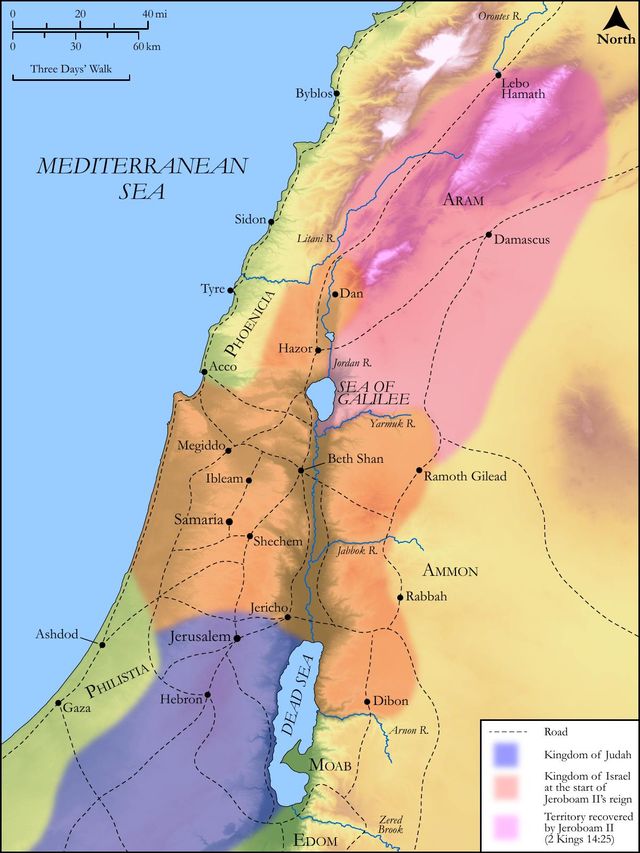
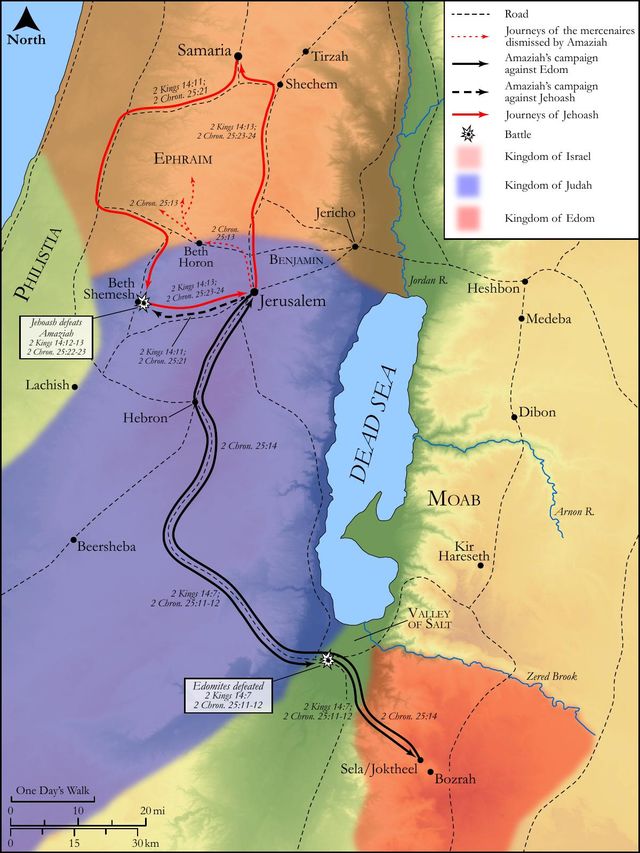
See on the biblical-era maps
Study this verse
Public-domain commentary
Matthew Henry
From his Commentary on the Whole Bible. Henry comments on passages, not single verses — this entry covers 2 Kings 14:15–22.
Here are three kings brought to their graves in these few verses: - 1. Joash king of Israel, Kg2 14:15, Kg2 14:16. We attended his funeral once before, Kg2 13:12, Kg2 13:13. But, because the historian had occasion to give a further account of his life and actions, he again mentions his death and burial. 2. Amaziah king of Judah. Fifteen years he survived his conqueror the king of Israel, Kg2 14:17. A man may live a great while after he has been shamed, may be thoroughly mortified (as Amaziah no doubt was) and yet not dead. His acts are said to be found written in his annals (Kg2 14:18), but not his might; for his cruelty when he was a conqueror over the Edomites, and his insolence when he challenged the king of Israel, showed him void of true courage. He was slain by his own subjects, who hated him for his maladministration (Kg2 14:19) and made Jerusalem too hot for him, the ignominious breach made in their walls being occasioned by his folly and presumption. He fled to Lachish. How long he continued concealed or sheltered there we are not told, but, at last, he was there murdered, Kg2 14:19. No further did the rage of the rebels extend, for they brought him in a chariot to Jerusalem, and buried him there among his ancestors. 3. Azariah succeeded Amaziah, but not till twelve years after his father's death, for Amaziah died in the fifteenth year of Jeroboam (as appears by comparing Kg2 14:23 with Kg2 14:2), but Azariah did not begin his reign till the twenty-seventh of Jeroboam (ch. 15:1), for he was but four years old at the death of his father, so that, for twelve years, till he came to be sixteen, the government was in the hands of protectors. He reigned very long (ch. 15:2) and yet the account of his reign is here industriously huddled up, and broken off abruptly (v. 22): He built Elath (which had belonged to the Edomites, but, it is probable, was recovered by his father, v. 7), after that the king slept with his fathers, as if that had been all he did that was worth mentioning, or rather it is meant of king Amaziah: he built it soon after Amaziah died.
Continue studying 2 Kings 14:16 across the web’s major study libraries — every link below opens this exact verse, chapter, or book on the destination site.
Read & Compare
 BibleGatewayThis verse in more than 200 translations and 70 languages.
 Bible.comThe YouVersion reader — hundreds of translations, reading plans, and highlights.
 ESV.orgCrossway's official English Standard Version reader.
 NET BibleThe NET translation with 60,000+ translators' notes on every rendering decision.
 STEP BibleTyndale House's free study tool — original text, vocabulary, and scholarly resources.
 BibliaLogos Bible Software's free web reader.
 USCCBThe New American Bible (Revised Edition) with the U.S. bishops' study notes.
Commentaries
 BibleHub CommentariesDozens of classic commentaries on this verse, gathered on one page.
 StudyLightMore than 100 commentary sets — the largest collection on the web.
 BibleRefPlain-English commentary on what this verse means, verse by verse.
 Enduring WordDavid Guzik's free commentary on this chapter, widely used by Bible teachers.
 Bible Study ToolsVerse commentary alongside Greek and Hebrew study aids.
Original Language & Research
- BibleHub InterlinearThe verse word by word — original language, transliteration, and English.
- BibleHub LexiconEvery word's original-language definition and Strong's entry.
 Blue Letter BibleDeep-study tools — Strong's numbers, concordance, and word studies.
 SefariaThe Hebrew text with Rashi and centuries of Jewish commentary.
Sermons, Hymns & Audio


TrulyRandomVerse is not affiliated with these sites and doesn’t control their content. They’re linked because they’re genuinely useful.
Summary
Second Kings 14:16 serves as a concise yet profoundly significant historical marker, documenting the conclusion of King Jehoash's sixteen-year reign over the Northern Kingdom of Israel. This pivotal verse records his death, his burial in Samaria alongside his royal predecessors, and the immediate, legitimate succession of his son, Jeroboam II, to the throne. It functions as a crucial narrative pivot, closing one chapter of Israelite history—a period marked by both military resurgence under Jehoash and persistent spiritual compromise—and simultaneously opening another, characterized by the lengthy and unprecedented prosperity of Jeroboam II's rule.
Context
ShowHideLiterary Context
This verse provides the concluding statement for the reign of King Jehoash (also known as Joash), which commenced in 2 Kings 13:10. The preceding narrative details a complex and often contradictory period. While Jehoash "did that which was evil in the sight of the LORD" by perpetuating the idolatrous practices of Jeroboam I (2 Kings 13:11), he also experienced surprising divine favor. Notably, he visited the dying prophet Elisha and, following Elisha's instructions, achieved three significant victories over Aram (Syria), partially fulfilling Elisha's prophetic promise (2 Kings 13:14-19). Immediately prior to this verse, the text recounts Jehoash's decisive victory over King Amaziah of Judah, a conflict initiated by Judah that resulted in the capture of Jerusalem and the plundering of the temple and royal treasuries. Thus, Jehoash's reign concludes on a note of military triumph, yet the verse also acts as a vital narrative bridge, seamlessly setting the stage for the lengthy and prosperous, albeit spiritually problematic, reign of Jeroboam II, whose ascension is formally introduced in the very next verse (2 Kings 14:23).
Historical & Cultural Context
The period of Jehoash's reign (c. 798-782 BC) and the subsequent reign of Jeroboam II (c. 793-753 BC) coincided with a significant decline in the power of the Neo-Assyrian Empire, which had previously exerted heavy pressure on the smaller kingdoms of the Levant. This temporary power vacuum allowed the Northern Kingdom of Israel to experience a remarkable resurgence of political and economic strength, particularly under Jeroboam II. This verse reflects the standard practice of royal succession in the monarchies of Israel and the nations round about, where the transfer of power from father to son was the primary and most legitimate means of maintaining dynastic continuity and stability. The burial in Samaria, the established capital of the Northern Kingdom since the time of Omri, signifies Jehoash's legitimate place among the kings of Israel, reinforcing his status despite the kingdom's frequent dynastic instability and spiritual apostasy. Culturally, the phrase "slept with his fathers" is a widespread and deeply ingrained euphemism for death in the biblical tradition. It emphasizes the deceased's integration into the ancestral lineage and the peaceful cessation of their earthly life, without necessarily making specific theological claims about the afterlife.
Key Themes
ShowHideThis verse, though brief, encapsulates several recurring and significant themes within the broader narrative of the Books of Kings. Firstly, it powerfully underscores the Mortality of Kings, serving as a stark reminder that even the most powerful and successful rulers are ultimately subject to the universal human experience of death. This theme consistently highlights the transience of earthly authority in contrast to the eternal and unchanging sovereignty of God (Psalm 146:3-4). Secondly, it exemplifies the Regnal Formula, a standardized literary device employed throughout Kings to systematically mark the end of each king's reign. This formula typically includes details of their death, burial, and the succession of their heir, providing a consistent chronological framework for the historical narrative and reinforcing the systematic recording of Israel's royal history. Thirdly, the verse signifies a crucial Transition to a New Era, as the passing of Jehoash and the rise of Jeroboam II ushered in a period of unprecedented military and economic prosperity for Israel. However, this material success would later be sharply critiqued by prophets like Amos and Hosea for its accompanying spiritual decline, oppression, and moral decay (e.g., Amos 6:1-7). Finally, it subtly reinforces the overarching theme of Divine Sovereignty over Human Rulers, demonstrating that God's overarching plan for Israel continues to unfold through the succession of kings, regardless of their individual faithfulness or unfaithfulness, orchestrating history toward His ultimate purposes.
Exposition and Analysis
ShowHideKey Word Analysis
ShowHideThis primitive root means "to lie down" for various purposes, including rest, sexual connection, or decease. In the idiom "slept with his fathers," it functions as a common and gentle euphemism for death, signifying the peaceful cessation of earthly life and joining one's ancestors in the grave. It conveys the idea of a final rest, often implying burial in an ancestral tomb, and is devoid of specific theological claims about the afterlife, focusing instead on the physical end of life and integration into the family lineage.
This primitive word refers to a "father," either literally and immediately, or figuratively and remotely, encompassing ancestors or patriarchs. In the phrase "slept with his fathers," it denotes the ancestral line, emphasizing that Jehoash's death was a natural, expected event that integrated him into the long line of deceased kings and patriarchs of Israel. It underscores continuity and lineage, connecting the individual's end to the collective history of their people.
This primitive root means "to reign" or, inceptively, "to ascend the throne." It can also causatively mean "to induct into royalty." Here, it signifies the formal and legitimate assumption of royal authority by Jeroboam II. The use of this verb highlights the transfer of power and the continuation of the monarchy, marking the official commencement of the new king's rule and thus the next phase in the historical record of Israel.
Verse Breakdown
ShowHide"And Jehoash slept with his fathers"
This initial clause definitively states the death of King Jehoash. The use of the well-known euphemism "slept with his fathers" softens the stark reality of death, portraying it as a peaceful rest and emphasizing his joining the long line of deceased Israelite kings and patriarchs. It marks the complete and irreversible end of his personal rule and earthly life.
"and was buried in Samaria with the kings of Israel"
This part specifies the location and nature of Jehoash's burial. Samaria was the established capital city of the Northern Kingdom, and being buried "with the kings of Israel" indicates a legitimate, honorable, and formal interment within the royal necropolis. This detail affirms his recognized status as a monarch of the Northern Kingdom, despite the frequent instability and spiritual unfaithfulness that characterized its rulers, signifying his formal transition from a living ruler to a deceased ancestor within the royal lineage.
"and Jeroboam his son reigned in his stead"
This final clause announces the royal succession, confirming the legitimate transfer of power from Jehoash to his son, Jeroboam II, thereby maintaining the dynastic line. This statement is crucial for the chronological progression of the narrative in the Books of Kings, establishing the beginning of the next significant and indeed, very long, reign in Israelite history, and setting the stage for subsequent events.
Literary Devices
ShowHideThe verse masterfully employs several significant literary devices to convey its meaning and function within the broader narrative. Most prominent is the Regnal Formula, a standardized structural pattern used consistently throughout the Books of Kings to systematically conclude each king's reign. This formula typically includes the king's death ("slept with his fathers"), burial ("was buried"), and the succession of his heir ("reigned in his stead"), providing a consistent chronological framework for the historical narrative. The phrase "slept with his fathers" is a classic example of Euphemism, a figure of speech that replaces a harsh, unpleasant, or impolite reality (death) with a milder, more indirect, or more pleasant expression. This gentle phrasing avoids the bluntness of directly stating "he died" while clearly conveying the king's demise. Additionally, the verse functions as a Narrative Bridge, seamlessly transitioning the reader from the detailed account of Jehoash's reign to the introduction of Jeroboam II's rule. This device maintains the continuous flow of the historical record, ensuring chronological integrity and preparing the audience for the subsequent narrative developments of the next king's era.
Theological and Thematic Connections
ShowHideSecond Kings 14:16, while seemingly a straightforward historical record, carries profound theological implications that resonate throughout the biblical narrative. It powerfully illustrates the transience of all human authority and life. Kings, despite their immense power, wealth, and perceived invincibility, are ultimately mortal and subject to the same end as all humanity. This perspective challenges any tendency to place ultimate trust in human leaders, institutions, or earthly achievements, redirecting focus to the eternal and unchanging reign of God. Furthermore, the verse subtly underscores God's unwavering sovereignty over history and human affairs. Even amidst the often-turbulent successions and the pervasive unfaithfulness of Israel's kings, God's overarching plan for His people continues to unfold. The death of one king and the rise of another are not random events but are woven into a divine tapestry, demonstrating that God remains on His throne, orchestrating events according to His purposes, regardless of who occupies an earthly one. This continuity, even through flawed human leadership, points to God's faithfulness to His covenant promises and His ultimate control over the destiny of nations.
Reflection and Application
ShowHideThe concise record of Jehoash's passing and Jeroboam II's succession in 2 Kings 14:16 serves as a potent and timeless reminder of life's fundamental truths. It compels us to confront the brevity of our own lives and the temporary nature of any earthly power, influence, or possession we might acquire. Just as Jehoash's reign, despite its military successes and periods of divine favor, ultimately concluded with his death and burial, so too will every human endeavor and every life come to an end. This profound truth should cultivate a spirit of humility within us, prompting us to invest our lives in that which is eternal and enduring, rather than in fleeting worldly achievements or accolades. It challenges us to reflect deeply on the legacy we are actively building—not merely in terms of material gain or temporal power, but in terms of faithfulness to God, sacrificial service to others, and the enduring impact of our character shaped by Christ. Moreover, the continuity of God's overarching plan, even through successive generations of flawed and imperfect human leaders, should inspire deep confidence in His enduring faithfulness and unwavering sovereignty. This perspective encourages us to trust in His sovereign hand and perfect wisdom, even when circumstances seem uncertain, human leadership falls short, or the future appears unclear.
Questions for Reflection
ShowHideFAQ
ShowHideWhat does the phrase "slept with his fathers" signify in the Bible?
ShowHideThe phrase "slept with his fathers" (or "slept with his ancestors") is a common and widely understood biblical euphemism for death. It is found extensively throughout the historical books of the Old Testament, particularly in the Books of Kings and Chronicles, used to mark the end of a king's reign. It signifies that the deceased has passed away and joined their forefathers in the realm of the dead or in the grave. This idiom implies a peaceful end to life and emphasizes the continuity of lineage, as well as the integration of the individual into the ancestral line. While it doesn't necessarily convey a detailed theological understanding of the afterlife, it consistently marks the definitive end of a person's earthly existence and their transition from the living to the deceased, often implying a formal and respected burial.
Was King Jehoash (Joash) a good king in the sight of the Lord?
ShowHideAccording to the biblical narrative, King Jehoash of Israel was not considered a "good" king in the sight of the Lord. The text explicitly states in 2 Kings 13:11 that "he did that which was evil in the sight of the LORD; he departed not from all the sins of Jeroboam the son of Nebat, who made Israel sin: but he walked therein." This indicates that he continued the idolatrous practices introduced by Jeroboam I, particularly the worship of golden calves at Bethel and Dan, which were a persistent source of spiritual corruption in the Northern Kingdom. Despite his spiritual failings and adherence to the Jeroboam cult, Jehoash did experience surprising divine favor in certain military campaigns, notably his victories against Aram. These victories were granted in response to his partial humility and in fulfillment of the prophecies of Elisha (2 Kings 13:14-19). His reign, therefore, presents a complex picture of a king who was fundamentally unfaithful to the covenant yet still, at times, a recipient of God's mercy and intervention for the sake of His people Israel.
Christ-Centered Fulfillment
ShowHideThe transient reign of King Jehoash, culminating in his death and the succession of his son, serves as a poignant backdrop against which the eternal, perfect, and ultimate reign of Jesus Christ shines forth in brilliant contrast. Earthly kings, even those granted temporary victories and periods of prosperity, are ultimately subject to mortality, their power fleeting, their legacies often mixed with spiritual compromise, and their rule bound by the limitations of time and human frailty. The "regnal formula" of death, burial, and succession found in 2 Kings 14:16 powerfully underscores the inherent limitations and temporary nature of human kingship. In stark and glorious contrast, Jesus is the King whose reign knows no end, whose kingdom is eternal and everlasting (Luke 1:33; Hebrews 1:8). Unlike Jehoash, who "slept with his fathers" in the finality of death, Christ conquered death itself, rising victorious from the grave on the third day (Romans 6:9; 1 Corinthians 15:20-22). He is not merely buried with his ancestors but has ascended to the highest heaven, where He sits at the right hand of God, exercising all authority in heaven and on earth (Matthew 28:18; Ephesians 1:20-22). The succession in 2 Kings 14:16, while marking the continuity of a human dynasty, ultimately points to the ongoing need for a perfect King, a longing that is definitively and eternally fulfilled not by another fallible human ruler, but by the divine Son of God, who perfectly embodies righteousness, justice, and eternal dominion. His is the kingdom that will never be destroyed, standing in ultimate fulfillment of all earthly kingships and their inherent limitations (Daniel 2:44).