


1 Kings 1:21
- וְהָיָהve·ha·Yahand it will beH1961Conj-w ¦ V-Qal-ConsecPerf-3msVerb Qal Consecutive Perfect 3rd Singular Masculineוְandהָיָהit will be
- כִּשְׁכַבkish·Khavwhen lies downH7901Prep-k ¦ V-Qal-InfVerb Qal Infinitive Constructכִּwhenשְׁכַבlies down
- אֲדֹנִי'a·do·nimy lordH113N-msc ¦ 1csNoun Singular Masculine Constructאֲדֹנִlordיmy
- הַמֶּלֶךְha·Me·lekhthe kingH4428Art ¦ N-msNoun Singular Masculine Absoluteהַtheמֶּלֶךְking
- עִם'imwithH5973PrepPreposition
- אֲבֹתָיו'a·vo·Tavhis ancestorsH1N-fpc ¦ 3msNoun Plural Feminine Constructאֲבֹתָיancestorsוhis
- וְהָיִיתִיve·ha·Yi·tiand I will beH1961Conj-w ¦ V-Qal-ConsecPerf-1csVerb Qal Consecutive Perfect 1st Singular common genderוְandהָיִיתִיI will be
- אֲנִי'a·NiIH589Pro-1csPronoun Personal 1st Singular common gender
- וּבְנִיu·ve·Niand my sonH1121Conj-w ¦ N-msc ¦ 1csNoun Singular Masculine Constructוּandבְנִsonיmy
- שְׁלֹמֹהshe·lo·MohSolomonH8010N-proper-mNoun Proper Masculine
- חַטָּאִיםcha·ta·'ImsinnersH2400Adj-mpAdjective Plural Masculine Absolute
English is a literal word-by-word gloss of the Hebrew, not the KJV's wording. Why?
This is the original text the KJV's translators worked from — each Hebrew word with its own literal English meaning in this verse, prepared by scholars at Tyndale House, Cambridge. The KJV translates whole sentences, not word by word, so its wording differs: one Hebrew word can become several English words, and the KJV may choose “the LORD” where the gloss reads “Yahweh”. Both are faithful — they answer different questions. For the KJV's own rendering, switch to the KJV text.
Details
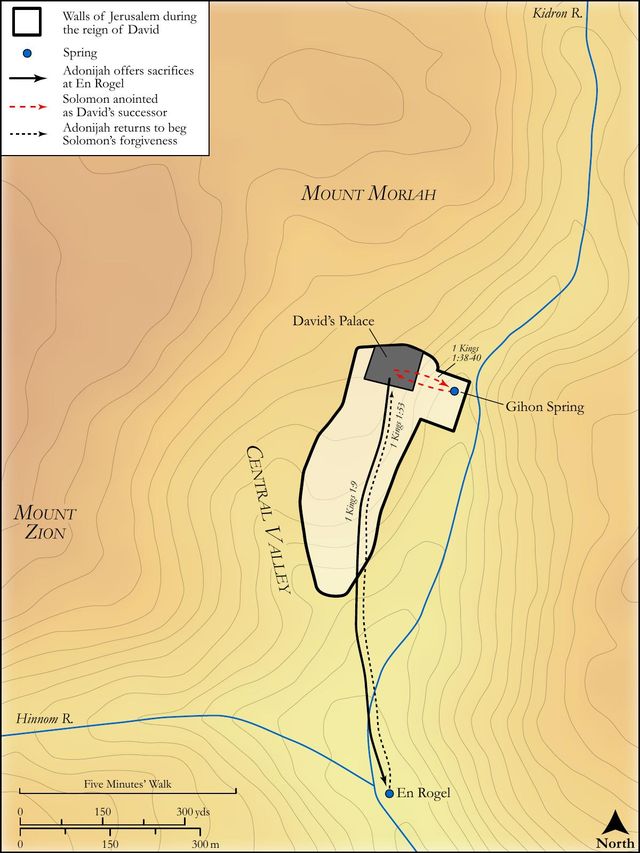
See on the biblical-era maps

Study this verse
Public-domain commentary
Matthew Henry
From his Commentary on the Whole Bible. Henry comments on passages, not single verses — this entry covers 1 Kings 1:11–31. His two-level outline is real structure in the source text, so it is rendered as structure.
We have here the effectual endeavours that were used by Nathan and Bathsheba to obtain from David a ratification of Solomon's succession, for the crushing of Adonijah's usurpation. 1. David himself knew not what was doing. Disobedient children think that they are well enough off if they can but keep their good old parents ignorant of their bad courses; but a bird of the air will carry the voice. 2. Bathsheba lived retired, and knew nothing of it either, till Nathan informed her. Many get very comfortably through this world that know little how the world goes. 3. Solomon, it is likely, knew of it, but was as a deaf man that heard not. Though he had years, and wisdom above his years, yet we do not find that he stirred to oppose Adonijah, but quietly composed himself and left it to God and his friends to order the matter. Hence David, in his Psalm for Solomon, observes that while men, in pursuit of the world, in vain rise early and sit up late, God giveth his beloved (his Jedidiahs) sleep, in giving them to be easy, and to gain their point without agitation, Psa 127:1, Psa 127:2. How then is the design brought about?
I.Nathan the prophet alarms Bathsheba by acquainting her with the case, and puts her in a way to get an order from the king for the confirming of Solomon's title. He was concerned, because he knew God's mind, and David's and Israel's interest; it was by him that God had named Solomon Jedidiah (Sa2 12:25), and therefore he could not sit still and see the throne usurped, which he knew was Solomon's right by the will of him from whom promotion cometh. When crowns were disposed of by immediate direction from heaven, no marvel that prophets were so much interested and employed in that matter; but now that common providence rules the affairs of the kingdom of men (Dan 4:32) the subordinate agency must be left to common persons, and let not prophets intermeddle in them, but keep to the affairs of the kingdom of God among men. Nathan applied to Bathsheba, as one that had the greatest concern for Solomon, and could have the freest access to David. He informed her of Adonijah's attempt (Kg1 1:11), and that it was not with David's consent or knowledge. He suggested to her that not only Solomon was in danger of losing the crown, but that he and she too were in danger of losing their lives if Adonijah prevailed. A humble spirit may be indifferent to a crown, and may be content, notwithstanding the prospect of it, to sit down short of the possession of it. But the law of self-preservation, and the sixth commandment, obliges us to use all possible endeavours to secure our own life and the life of others. Now, says Nathan, let me give thee counsel how to save thy own life and the life of thy son, Kg1 1:12. Such as this is the counsel that Christ's ministers give us in his name, to give all diligence, not only that no man take our crown (Rev 3:11), but that we save our lives, even the lives of our souls. He directs her (Kg1 1:13) to go to the king, to remind him of his word and oath, that Solomon should be his successor; and to ask him in the most humble manner, Why doth Adonijah reign? He thought David was not so cold but this would warm him. Conscience, as well as a sense of honour, would put life into him upon such an occasion as this; and he promised (Kg1 1:24) that, while she was reasoning with the king in this matter, he would come in and second her, as if he came accidentally, which perhaps the king might look upon as a special providence (and he was one that took notice of such evidences, Sa1 25:32, Sa1 25:33), or, at least, it would help to awaken him so much the more.
II.Bathsheba, according to Nathan's advice and direction, loses no time, but immediately makes her application to the king, on the same errand on which Esther came to king Ahasuerus, to intercede for her life. She needed not wait for a call as Esther did, she knew she should be welcome at any time; but it is remarked that when she visited the king Abishag was ministering to him (Kg1 1:15), and Bathsheba took no displeasure either at him or her for it, also that she bowed and did obeisance to the king (Kg1 1:16), in token of her respect to him both as her prince and as her husband; such a genuine daughter was she of Sarah, who obeyed Abraham, calling him lord. Those that would find favour with superiors mush show them reverence, and be dutiful to those whom they expect to be kind to them. Her address to the king, on this occasion, is very discreet.
1.She reminded him of his promise made to her and confirmed with a solemn oath, that Solomon should succeed him, Kg1 1:17. She knew how fast this would hold such a conscientious man as David was.
2.She informed him of Adonijah's attempt, which he was ignorant of (Kg1 1:18): "Adonijah reigns, in competition with thee for the present and in contradiction to thy promise for the future. The fault is not thine, for thou knewest it not; but now that thou knowest it thou wilt, in pursuance of thy promise, take care to suppress this usurpation." She told him who were Adonijah's guests, and who were in his interest, and added, but "Solomon thy servant has he not called, which plainly shows he looks upon him as his rival, and aims to undermine him, Kg1 1:19. It is not an oversight, but a contempt of the act of settlement, that Solomon is neglected." 3. She pleads that it is very much in his power to obviate this mischief (Kg1 1:20): The eyes of all Israel are upon thee, not only as a king, for we cannot suppose it the prerogative of any prince to bequeath his subjects by will (as if they were his goods and chattels) to whom he pleases, but as a prophet. All Israel knew that David was not only himself the anointed of the God of Jacob, but that the Spirit of the Lord spoke by him (Sa2 23:1, Sa2 23:2), and therefore waiting for and depending upon a divine designation, in a matter of such importance, David's word would be an oracle and a law to them; this therefore (says Bathsheba) they expect, and it will end the controversy and effectually quash all Adonijah's pretensions. A divine sentence is in the lips of the king. Note, Whatever power, interest or influence, men have, they ought to improve it to the utmost for the preserving and advancing of the kingdom of the Messiah, of which Solomon's kingdom was a type. 4. She suggested the imminent peril which she and her son would be in if this matter was not settled in David's life-time, Kg1 1:21. "If Adonijah prevail, as he is likely to do (having Joab the general and Abiathar the priest on his side) unless speedily suppressed, Solomon and all his friends will be looked upon as traitors and dealt with accordingly." Usurpers are most cruel. If Adonijah had got into the throne, he would not have dealt so fairly with Solomon as Solomon did with him. Those hazard everything who stand in the way of such as against right force their entrance.
III.Nathan the prophet, according to his promise, seasonably stepped in, and seconded her, while she was speaking, before the king had given his answer, lest. if he had heard Bathsheba's representation only, his answer should be dilatory and only that he would consider of it: but out of the mouth of two witnesses, two such witnesses, the word would be established, and he would immediately give positive orders. The king is told that Nathan the prophet has come, and he is sure to be always welcome to the king, especially when either he is not well or has any great affair upon his thoughts; for, in either case, a prophet will be, in a particular manner, serviceable to him. Nathan knows he must render honour to whom honour is due, and therefore pays the king the same respect now that he finds him sick in bed as he would have done if he had found him in his throne: He bowed himself with his face to the ground, Kg1 1:23. He deals a little more plainly with the king than Bathsheba had done. In this his character would support him, and the present languor of the king's spirits made it necessary that they should be roused.
1.He makes the same representation of Adonijah's attempt as Bathsheba had made (Kg1 1:25, Kg1 1:26), adding that his party had already got to such a height of assurance as to shout, God save king Adonijah, as if king David were already dead, taking notice also that they had not invited him to their feast (Me thy servant has he not called), thereby intimating that they resolved not to consult either God or David in the matter, for Nathan was secretioribus consiliis - intimately acquainted with the mind of both.
2.He makes David sensible how much he was concerned to clear himself from having a hand in it: Hast thou said, Adonijah shall reign after me? (Kg1 1:24), and again (Kg1 1:27), "Is this thing done by my lord the king? If it be, he is not so faithful either to God's word or to his own as we all took him to be; if it be not, it is high time that we witness against the usurpation, and declare Solomon his successor. If it be, why is not Nathan made acquainted with it, who is not only in general, the king's confidant, but is particularly concerned in this matter, having been employed to notify to David the mind of God concerning the succession; but, if my lord the king knows nothing of the matter (as certainly he does not), what daring insolence are Adonijah and his party guilty of!" Thus he endeavoured to incense David against them, that he might act the more vigorously for the support of Solomon's interest. Note, Good men would do their duty if they were reminded of it, and put upon it, and told what occasion there is for them to appear; and those who thus are their remembrancers do them a real kindness, as Nathan here did to David.
IV.David, hereupon, made a solemn declaration of his firm adherence to his former resolution, that Solomon should be his successor.
Bathsheba is called in (Kg1 1:28), and to her, as acting for and on behalf of her son, the king gives these fresh assurances.
1.He repeats his former promise and oath, owns that he had sworn unto her by the Lord God of Israel that Solomon would reign after him, Kg1 1:30. Though he is old, and his memory begins to fail him, yet he remembers this. Note, An oath is so sacred a thing that the obligations of it cannot be broken, and so solemn a thing that the impressions of it, one would think, cannot be forgotten.
2.He ratifies it with another, because the occasion called for it: As the Lord liveth, that hath redeemed my soul out of all distress, even so will I certainly do this day, without dispute, without delay. His form of swearing seems to be what he commonly used on solemn occasions, for we find it, Sa2 4:9. And it carries in it a grateful acknowledgment of the goodness of God to him, in bringing him safely through the many difficulties and hardships which had lain in his way, and which he now makes mention of to the glory of God (as Jacob, when he lay a dying, Gen 48:16), thus setting to his seal, from his own experience, that that was true which the Spirit of the Lord spoke by him. Psa 34:22, The Lord redeemeth the soul of his servants. Dying saints ought to be witnesses for God, and speak of him as they have found. Perhaps he speaks thus, on this occasion, for the encouragement of his son and successor to trust in God in the distresses he also might meet with.
V.Bathsheba receives these assurances (Kg1 1:31),
1.With great complaisance to the king's person; she did reverence to him; while Adonijah and his party affronted him.
2.With hearty good wishes for the king's health; Let him live. So far was she from thinking that he lived too long that she prayed he might live for ever, if it were possible, to adorn the crown he wore and to be a blessing to his people. We should earnestly desire the prolonging of useful lives, however it may be the postponing of any advantages of our own.
Historical interpretation
Historical reception
1 surviving comment on this verse from the historical church.
Thus fathers often call their sons their servants, yet without denying the genuineness of their nature. In fact, they often affectionately call their own servants children, yet without losing sight of the fact they did purchase them originally. For they use the one appellation from their authority as fathers, but in the other they speak from affection. Thus Sara called Abraham lord, although she was not a servant but a wife. And while the Apostle joined Onesimus the servant to Philemon the master as a brother, Bathsheba called her son a servant even though she was his mother when she said to his father, “Your servant Solomon.” Afterwards also Nathan the Prophet came in and repeated her words to David, “Solomon your servant.” Nor did they mind calling the son a servant, for while David heard it, he recognized the nature of what they were referring to, and even while they said it, they did not forget genuineness [of his sonship], praying that the one they called a “servant” might be made his father’s heir; for to David he was his son by nature.So then, when we read this we interpret it fairly without considering Solomon a servant because we hear him called this. Instead we understand him to be a natural and genuine son. In the same way, if the saints, when referring to the Savior who is confessed to be in truth the Son and the Word by nature, say, “Who was faithful to him that made him,” or if he says of himself, “The Lord created me,” and, “I am your servant and the Son of your handmaid,” and the like, no one should on this account deny that he is proper to the father and from him. Rather, as in the case of Solomon and David, let them think properly about the Father and the Son. For if, though they hear Solomon called a servant, they acknowledge him to be a son, are they not deserving of many deaths, who, instead of preserving the same explanation in the instance of the Lord, whenever they hear “Offspring,” and “Word,” and “Wisdom,” forcibly misinterpret and deny the generation, natural and genuine, of the Son from the Father; but on hearing words and terms proper to a work, immediately condescend to the notion of his being by nature a work and deny the Word—doing this even though it is possible, from his having been made man, to refer all these terms to his humanity? And are they not also proven to be “an abomination to the Lord,” when they use “differing weights” with them, using one set of measurements here and another there in order to blaspheme the Lord? But perhaps they grant that the word “servant” is to be understood in a certain way, but lay stress upon the phrase “who made” as some great support of their heresy. But this argument of theirs also is but a broken reed. For if they are aware of the style of Scripture, they must at once condemn themselves. For as Solomon, though a son, is called a servant, so, to repeat what was said above, although parents refer to the sons springing from themselves as “made” and “created” and “becoming”—in none of these do they deny their nature.
Continue studying 1 Kings 1:21 across the web’s major study libraries — every link below opens this exact verse, chapter, or book on the destination site.
Read & Compare
 BibleGatewayThis verse in more than 200 translations and 70 languages.
 Bible.comThe YouVersion reader — hundreds of translations, reading plans, and highlights.
 ESV.orgCrossway's official English Standard Version reader.
 NET BibleThe NET translation with 60,000+ translators' notes on every rendering decision.
 STEP BibleTyndale House's free study tool — original text, vocabulary, and scholarly resources.
 BibliaLogos Bible Software's free web reader.
 USCCBThe New American Bible (Revised Edition) with the U.S. bishops' study notes.
Commentaries
 BibleHub CommentariesDozens of classic commentaries on this verse, gathered on one page.
 StudyLightMore than 100 commentary sets — the largest collection on the web.
 BibleRefPlain-English commentary on what this verse means, verse by verse.
 Enduring WordDavid Guzik's free commentary on this chapter, widely used by Bible teachers.
 Bible Study ToolsVerse commentary alongside Greek and Hebrew study aids.
Original Language & Research
- BibleHub InterlinearThe verse word by word — original language, transliteration, and English.
- BibleHub LexiconEvery word's original-language definition and Strong's entry.
 Blue Letter BibleDeep-study tools — Strong's numbers, concordance, and word studies.
 SefariaThe Hebrew text with Rashi and centuries of Jewish commentary.
Sermons, Hymns & Audio


TrulyRandomVerse is not affiliated with these sites and doesn’t control their content. They’re linked because they’re genuinely useful.
Summary
1 Kings 1:21 captures Bathsheba's urgent and strategically crafted plea to an aging King David, vividly portraying the catastrophic consequences for herself and her son Solomon if David fails to decisively address Adonijah's audacious usurpation. Her words underscore the inherent precariousness of royal succession in the ancient world, serving as a powerful and poignant reminder of David's solemn oath to her regarding Solomon's rightful place on the throne, thereby appealing to his profound sense of responsibility to avert their potential demise as "offenders" in the eyes of a rival king.
Context
ShowHideLiterary Context
This verse is situated at a pivotal moment in the narrative of King David's twilight years, forming a dramatic centerpiece within the opening chapter of 1 Kings. The preceding verses establish David as old, frail, and seemingly disengaged, signaling the imminent end of his illustrious reign. Exploiting this perceived weakness and David's apparent inaction, his ambitious son Adonijah presumptuously proclaims himself king, amassing support from influential figures like Joab, the army commander, and Abiathar, a prominent priest, as detailed in 1 Kings 1:5-10. Recognizing the grave threat to God's established plan for Solomon's succession, the prophet Nathan orchestrates a crucial intervention, first prompting Bathsheba to appeal to David, and then following up with his own corroborating counsel. Bathsheba's impassioned words in this verse are the climax of her appeal, meticulously designed to shock David into immediate action by vividly depicting the personal peril she and Solomon face should Adonijah's coup succeed.
Historical & Cultural Context
Ancient Near Eastern monarchies were frequently characterized by intense and often violent power struggles, particularly during transitions of leadership. Succession was not always strictly linear or based solely on primogeniture; divine favor, a king's personal declaration, or political maneuvering often played significant roles. The death of a reigning monarch commonly ushered in a period of profound instability, during which new rulers would ruthlessly consolidate their power by eliminating potential rivals, including other royal offspring, powerful court officials, or anyone perceived as a threat to their authority. The idiom "sleep with his fathers" was a widely understood and respectful euphemism for death, indicating that David's passing was anticipated and imminent. For Bathsheba and Solomon to be "counted offenders" meant they would be legally and politically branded as traitors, criminals, or enemies of Adonijah's new regime. Such a charge would provide the justification for their imprisonment, exile, or, most likely, execution, thereby ensuring the complete elimination of any challenge to Adonijah's usurped authority and securing his reign.
Key Themes
ShowHideThe chapter, and this verse within it, powerfully illuminates several foundational themes. Foremost is the theme of royal succession, contrasting divine appointment with human ambition. This tension is central to the broader narrative of the Davidic dynasty, emphasizing that God's sovereign choice (as seen in 2 Samuel 7:12-13) ultimately prevails over human machinations. Second, the narrative highlights the consequences of inaction and delayed leadership; David's passivity in his old age permits Adonijah's rebellion to gain dangerous momentum, threatening God's established plan and the lives of his chosen heir and his mother. This underscores the critical importance of decisive and timely leadership. Third, the theme of divine promise and human responsibility is profoundly evident. While God had promised David an enduring dynasty through Solomon, human agents like Nathan and Bathsheba were instrumental in actively navigating the political landscape to ensure that promise was realized amidst the treachery. Finally, the verse speaks to advocacy and justice, as Bathsheba courageously rebukes the powerful, appealing to David's solemn oath and his inherent sense of justice to protect the vulnerable and uphold the divine will.
Exposition and Analysis
ShowHideKey Word Analysis
ShowHideFrom a primitive root meaning "to lie down," this term encompasses various states of rest, including physical repose, sexual connection, and, significantly in this context, decease. When used in the idiom "sleep with his fathers," it respectfully denotes death, implying a peaceful transition and joining one's ancestors. Here, it underscores the imminence of David's death, highlighting the narrow window of opportunity for decisive action before the power vacuum becomes irreversible.
This primitive word refers to a father in both literal and figurative senses, encompassing immediate progenitors, ancestors, and even a chief or principal figure. In the phrase "sleep with his fathers," it emphasizes the continuity of lineage and the idea of being gathered to one's deceased predecessors, a common and reverent biblical euphemism for death, particularly for kings who join the lineage of their royal forebears.
This term, derived intensively from the root ḥāṭāʾ (meaning "to miss the mark," "to sin," or "to be guilty"), denotes a criminal or one who is counted guilty. In the context of a royal succession struggle, it carries the severe connotation of being legally and politically branded as a traitor, enemy, or criminal liable to punishment. Bathsheba's use of this word vividly communicates the extreme peril she and Solomon face, implying that Adonijah would justify their elimination by labeling them as threats to his illegitimate reign.
Verse Breakdown
ShowHide"Otherwise it shall come to pass"
This introductory phrase functions as a solemn warning, signaling the inevitable and dire consequences that will unfold if the current trajectory of Adonijah's usurpation remains unchecked. It imbues Bathsheba's plea with a sense of urgent inevitability, emphasizing that inaction will lead directly to a catastrophic outcome.
"when my lord the king shall sleep with his fathers"
This clause precisely identifies the temporal trigger for the impending crisis: David's death. By employing the respectful idiom for passing away, Bathsheba underscores the king's advanced age and the rapidly approaching moment when the existing power vacuum will be fully exploited. Without a clear, divinely sanctioned successor firmly in place, chaos and extreme danger will engulf those not aligned with the new, self-proclaimed king.
"that I and my son Solomon shall be counted offenders"
This is the stark and compelling core of Bathsheba's appeal, articulating the specific and devastating threat. She makes it unequivocally clear that both she and Solomon will be perceived and treated as criminals or traitors by Adonijah. Once solidified in power, a new ruler in the ancient Near East would ruthlessly seek to eliminate any potential rivals or those associated with the previous, unfulfilled promise of succession. This statement powerfully conveys the ruthless nature of ancient power dynamics and the profound personal stakes involved for the future queen mother and the divinely chosen heir.
Literary Devices
ShowHideThe verse effectively employs several literary devices to convey its urgent and emotionally charged message. Foreshadowing is prominently featured, as Bathsheba's words vividly predict a grim and perilous future for herself and Solomon if King David remains passive, implicitly urging him to intervene and alter that trajectory. The use of the idiom "sleep with his fathers" serves as a gentle yet unmistakable euphemism for death, adding a layer of solemnity and inevitability to David's impending passing while softening the blunt reality. Furthermore, Bathsheba's impassioned plea skillfully utilizes pathos, appealing directly to David's emotions, his sense of paternal responsibility, and his solemn oath. Her stark depiction of their fate as "offenders" functions as a form of intense emphasis or even hyperbole, designed to shock David into fully grasping the extreme danger and the critical urgency of his decision. The entire interaction within this verse acts as a dramatic turning point in the narrative, compelling David to finally take decisive action and secure Solomon's succession.
Theological and Thematic Connections
ShowHide1 Kings 1:21 transcends mere political maneuvering, resonating with profound theological and thematic truths. It powerfully underscores the inherent tension between divine promise and human responsibility. While God had sovereignly chosen Solomon to succeed David and build His temple, as explicitly prophesied in 2 Samuel 7:12-13, human agency was still critically required to navigate the treacherous political landscape and ensure the fulfillment of that divine promise. David's prior oath to Bathsheba, confirmed in 1 Kings 1:30, was a human commitment that aligned directly with God's divine will. Its potential breach threatened not only personal lives but also the very integrity of God's unfolding plan for His people. The verse highlights the perilous consequences of negligence, indecision, or spiritual apathy, particularly for those in positions of authority, serving as a stark reminder that inaction can be as destructive as deliberate wrongdoing in thwarting God's purposes.
Reflection and Application
ShowHideBathsheba's desperate and strategic plea in 1 Kings 1:21 serves as a potent and timeless reminder of the critical importance of decisive action, especially when faced with clear threats to justice, integrity, or established commitments. King David's initial passivity and perceived weakness had created a dangerous power vacuum that Adonijah eagerly exploited, jeopardizing not only Solomon's rightful inheritance but also the very lives of those associated with the divinely appointed heir. This compelling narrative challenges us to introspectively consider areas in our own lives where inaction, delayed decision-making, or a lack of vigilance might inadvertently lead to unintended and severe consequences, whether in personal relationships, professional responsibilities, or our spiritual walk. It also powerfully highlights the profound courage required to rebuke the powerful and advocate for what is right, particularly when the vulnerable are at risk or when divine promises and principles are threatened by human ambition or compromise. Ultimately, the verse encourages us to be vigilant stewards of our responsibilities, to faithfully fulfill our commitments, and to act with wisdom, conviction, and obedience in alignment with God's purposes, trusting that He often works through our courageous and obedient responses to bring about His will.
Questions for Reflection
ShowHideFAQ
ShowHideWhy was Bathsheba so worried about being "counted offenders" if David did not act?
ShowHideBathsheba's profound concern was deeply rooted in the ruthless political realities of ancient Near Eastern monarchies. If Adonijah successfully consolidated his power as king without David's explicit declaration for Solomon, he would immediately view Bathsheba and Solomon as existential threats to his newly seized throne. As rivals to his authority and potential rallying points for opposition, they would be perceived and legally branded as "offenders" or traitors. This label would provide the necessary justification for their swift elimination through execution, imprisonment, or exile, a common and brutal practice for new rulers seeking to secure their reign and prevent any future challenges. Her plea was a desperate, yet strategically brilliant, attempt to protect their lives and ensure Solomon's divinely appointed succession.
What does the phrase "sleep with his fathers" mean in this context?
ShowHide"Sleep with his fathers" is a common and respectful biblical idiom that signifies death and being gathered to one's ancestors. It is a gentle euphemism for passing away, particularly for kings and patriarchs, implying a peaceful transition and joining the lineage of one's predecessors. In 1 Kings 1:21, it underscores David's imminent passing, emphasizing the critical urgency of the situation before the power vacuum could be fully exploited by Adonijah's usurpation.
Was King David aware of Adonijah's actions before Bathsheba's visit?
ShowHideYes, the narrative in 1 Kings 1:6 strongly indicates that David was indeed aware of Adonijah's self-exaltation but had failed to discipline him. The text explicitly states, "And his father had not displeased him at any time in saying, Why hast thou done so?" This suggests a degree of passivity, indulgence, or perhaps a debilitating weakness on David's part in his old age, which allowed Adonijah's rebellion to gain dangerous momentum and threaten the divinely ordained succession. Nathan and Bathsheba's orchestrated intervention was therefore crucial in finally prompting David to act decisively and fulfill his divine and personal commitments.
Christ-Centered Fulfillment
ShowHideThe precariousness of human succession depicted in 1 Kings 1:21, where the very future of the kingdom and the lives of the heir and his mother hang on the decisive action of an aging king, powerfully foreshadows the secure and eternal reign of Christ. Unlike Solomon, whose throne was initially threatened by human ambition and required immediate, human intervention to secure, Jesus Christ's kingship is divinely established, unchallengeable, and perfectly secure. He is the ultimate Son of David, the true and eternal heir to the covenant promises made to David in 2 Samuel 7:12-13, whose kingdom will have no end (Luke 1:32-33). While Bathsheba and Solomon faced the terrifying prospect of being "counted offenders" by a human usurper, believers in Christ are counted perfectly righteous through His atoning sacrifice, eternally secure in His unshakeable kingdom (Romans 5:19). The dramatic tension of 1 Kings 1:21 highlights the fragility of earthly power and the necessity of human intervention to uphold God's plan amidst human failings, contrasting sharply with the absolute sovereignty and eternally secure reign of Jesus, the King of Kings, whose authority is never threatened by human schemes, the passage of time, or the weakness of His subjects (Revelation 19:16).