


2 Samuel 23:1
- וְאֵלֶּהve·'E·lehand theseH428Conj-w ¦ PrtParticle Demonstrativeוְandאֵלֶּהthese
- דִּבְרֵיdiv·Rei[are] [the] words ofH1697N-mpcNoun Plural Masculine Construct
- דָוִדda·VidDavidH1732N-proper-mNoun Proper Masculine
- הָאַחֲרֹנִיםha·'a·cha·ro·Nim<the> lastH314Art ¦ Adj-mpAdjective Plural Masculine Absoluteהָ<the>אַחֲרֹנִיםlast
- נְאֻםne·'Um[the] utterance ofH5002N-mscNoun Singular Masculine Construct
- דָּוִדda·VidDavidH1732N-proper-mNoun Proper Masculine
- בֶּןben[the] son ofH1121N-mscNoun Singular Masculine Construct
- יִשַׁיyi·ShaiJesseH3448N-proper-mNoun Proper Masculine
- וּנְאֻםu·ne·'Umand [the] utterance ofH5002Conj-w ¦ N-mscNoun Singular Masculine Constructוּandנְאֻם[the] utterance of
- הַגֶּבֶרha·Ge·verthe manH1397Art ¦ N-msNoun Singular Masculine Absoluteהַtheגֶּבֶרman
- הֻקַםHu·kam[who] he was raised upH6965V-Hophal-Perf-3msVerb Hophal Perfect 3rd Singular Masculine
- עָל'AlheightH5920N-msNoun Singular Masculine Absolute
- מְשִׁיחַme·Shi·ach[the] [one] anointed ofH4899N-mscNoun Singular Masculine Construct
- אֱלֹהֵי'e·lo·Hei[the] God ofH430N-mpcNoun Plural Masculine Construct
- יַעֲקֹבya·'a·KoJacobH3290N-proper-mNoun Proper Masculine
- וּנְעִיםu·ne·'Imand [the] pleasant [one] ofH5273Conj-w ¦ Adj-mscAdjective Singular Masculine Constructוּandנְעִים[the] pleasant [one] of
- זְמִרוֹתze·mi·Rot[the] songs ofH2158N-fpcNoun Plural Feminine Construct
- יִשְׂרָאֵלYis·ra·'ElIsraelH3478N-properNoun Proper Location
English is a literal word-by-word gloss of the Hebrew, not the KJV's wording. Why?
This is the original text the KJV's translators worked from — each Hebrew word with its own literal English meaning in this verse, prepared by scholars at Tyndale House, Cambridge. The KJV translates whole sentences, not word by word, so its wording differs: one Hebrew word can become several English words, and the KJV may choose “the LORD” where the gloss reads “Yahweh”. Both are faithful — they answer different questions. For the KJV's own rendering, switch to the KJV text.
Details
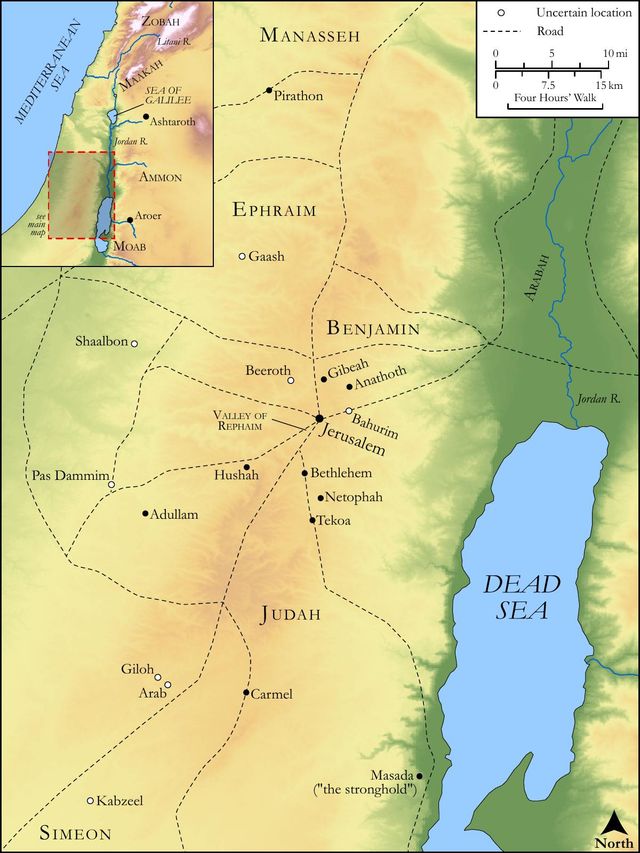
See on the biblical-era map

Study this verse
Continue studying 2 Samuel 23:1 across the web’s major study libraries — every link below opens this exact verse, chapter, or book on the destination site.
Read & Compare
 BibleGatewayThis verse in more than 200 translations and 70 languages.
 Bible.comThe YouVersion reader — hundreds of translations, reading plans, and highlights.
 ESV.orgCrossway's official English Standard Version reader.
 NET BibleThe NET translation with 60,000+ translators' notes on every rendering decision.
 STEP BibleTyndale House's free study tool — original text, vocabulary, and scholarly resources.
 BibliaLogos Bible Software's free web reader.
 USCCBThe New American Bible (Revised Edition) with the U.S. bishops' study notes.
Commentaries
 BibleHub CommentariesDozens of classic commentaries on this verse, gathered on one page.
 StudyLightMore than 100 commentary sets — the largest collection on the web.
 BibleRefPlain-English commentary on what this verse means, verse by verse.
 Enduring WordDavid Guzik's free commentary on this chapter, widely used by Bible teachers.
 Bible Study ToolsVerse commentary alongside Greek and Hebrew study aids.
Original Language & Research
- BibleHub InterlinearThe verse word by word — original language, transliteration, and English.
- BibleHub LexiconEvery word's original-language definition and Strong's entry.
 Blue Letter BibleDeep-study tools — Strong's numbers, concordance, and word studies.
 SefariaThe Hebrew text with Rashi and centuries of Jewish commentary.
Sermons, Hymns & Audio


TrulyRandomVerse is not affiliated with these sites and doesn’t control their content. They’re linked because they’re genuinely useful.
Summary
Second Samuel 23:1 serves as a profound introduction to David's final, divinely inspired prophetic words, encapsulating his identity and God-given roles before his death. This verse presents David not merely as a king, but as "the man who was raised up on high," God's "anointed," and "the sweet psalmist of Israel," setting the stage for a culminating declaration of his faith and understanding of God's enduring covenant.
Context
ShowHideLiterary Context
This verse acts as a solemn preamble to a significant poetic oracle, often referred to as "David's Last Words," found in 2 Samuel 23:2-7. Following this prophetic utterance, the narrative transitions to a detailed list of David's mighty warriors in 2 Samuel 23:8-39, which further highlights the strength and legacy of his reign. Positioned near the conclusion of the book of 2 Samuel and David's life, these "last words" carry immense weight, presented as a final, authoritative testament from a king who has experienced the full spectrum of human triumph and failure, yet remained deeply connected to God's purposes. They are not merely nostalgic reflections but a divinely inspired summary of his life's lessons and the enduring nature of God's covenant with him.
Historical & Cultural Context
In the ancient Near East, the "last words" or "testament" of a prominent figure, especially a king or patriarch, were considered highly significant, often containing prophecies, blessings, or final instructions. David, at the end of his long and eventful reign, is depicted in this verse as delivering such a testament, imbued with divine authority. His identification as "the anointed of the God of Jacob" firmly roots his kingship within the historical and theological lineage of Israel, connecting him directly to the covenant God of the patriarchs—Abraham, Isaac, and Jacob. This emphasizes the continuity of God's redemptive plan through the generations and underscores that David's rule was not a human invention but a divinely ordained institution, a concept foundational to the Israelite monarchy as established by God.
Key Themes
ShowHideThe verse introduces several profound themes central to David's life and the broader biblical narrative. Firstly, it highlights Divine Sovereignty and Election, emphasizing that David was "raised up on high" by God, not by his own merit, echoing his humble beginnings as seen in 1 Samuel 16:1-13. Secondly, the title "anointed of the God of Jacob" underscores Covenant Fidelity and Divine Consecration, signifying David's special setting apart for God's purposes and linking his reign to the unbreakable promises made to the patriarchs. Thirdly, the phrase "the last words of David" points to Prophetic Authority and Enduring Legacy, indicating that what follows is a divinely inspired summary of his life's spiritual wisdom and a look toward the future. Finally, his designation as "the sweet psalmist of Israel" celebrates Worship and Poetic Expression, acknowledging David's unique gift in composing sacred songs that shaped Israel's worship and continue to nourish believers, as exemplified by the rich collection of Psalms.
Exposition and Analysis
ShowHideKey Word Analysis
ShowHideThis highly significant term (H4899) refers to one who has been consecrated by pouring oil on their head, symbolizing divine selection and empowerment for a specific role, typically king, priest, or prophet. David was God's chosen king, "anointed" by Samuel (as recorded in 1 Samuel 16:13), signifying his divine legitimacy and special relationship with God. This term is the root from which "Messiah" (Hebrew) and "Christ" (Greek) are derived, foreshadowing the ultimate "Anointed One" who would come from David's lineage.
This primitive root (H6965) means "to rise" or "to cause to stand." In this context, combined with "on high" (H5920, ʻal), it emphasizes that David's elevation to kingship was not a result of human ambition or political maneuvering, but a sovereign act of God. It highlights God's initiative in choosing and exalting David from his humble position as a shepherd, demonstrating divine power and purpose in shaping human destiny. It underscores that David's authority and success were ultimately derived from God.
This adjective (H5273) describes something delightful, pleasant, or gracious. When applied to David as "psalmist" (H2158, zâmîyr), it beautifully conveys the profound gift he possessed as a composer and performer of sacred songs. It speaks to the beauty, spiritual depth, and inspirational quality of his poetic expressions, which enriched the worship life of Israel and continue to resonate with believers today. It signifies his role as a divinely inspired artist whose music brought comfort, instruction, and praise to God.
Verse Breakdown
ShowHide"¶ Now these [be] the last words of David."
This opening clause immediately establishes the solemnity and significance of the ensuing oracle. It signals a final, authoritative testament from David, carrying the weight of his life's experiences and divine revelation, akin to a patriarch's dying blessing or prophecy.
"David the son of Jesse said,"
This seemingly simple phrase grounds David in his humble origins. By identifying him as "the son of Jesse," the text reminds the audience that this great king, "raised up on high," came from an ordinary, unpretentious family, emphasizing God's sovereign choice to elevate the lowly, as seen in 1 Samuel 16:1-13.
"and the man [who was] raised up on high,"
This descriptor highlights God's active role in David's life. It underscores that David's exalted status as king was not self-achieved but divinely bestowed, a testament to God's power and purpose in selecting and elevating him above his peers.
"the anointed of the God of Jacob,"
This crucial title emphasizes David's divine consecration and legitimate authority. Being "anointed" signifies his special setting apart by God for the office of king. The reference to "the God of Jacob" connects David's kingship directly to the covenant God of Israel's patriarchs, affirming the continuity of God's promises and His faithfulness to His chosen people.
"and the sweet psalmist of Israel, said,"
This final descriptor celebrates David's unique spiritual gift and his profound impact on Israel's worship life. It acknowledges his role as a divinely inspired musician and poet, whose compositions provided a rich tapestry for expressing faith, lament, praise, and wisdom for the entire nation, shaping their spiritual identity and communal worship. The repetition of "said" frames the entire description of David, emphasizing that these titles are the credentials of the one speaking the "last words."
Literary Devices
ShowHideThe verse masterfully employs several literary devices to establish David's authority and the gravity of his words. Epithet is prominently used, with a series of descriptive titles ("the man who was raised up on high," "the anointed of the God of Jacob," "the sweet psalmist of Israel") piling up to create a comprehensive portrait of David's identity and divine credentials. This accumulation of titles serves to underscore the weight and divine inspiration of the "last words" that follow. The structure of the verse also demonstrates a subtle Inclusio, with the repeated "said" at the beginning and end of the descriptive clause, effectively framing David's various roles and emphasizing that these are the authoritative declarations of such a man. Furthermore, the verse contains significant Foreshadowing, particularly through the term "anointed" (mashiach), which points beyond David to the ultimate Messiah, Jesus Christ, who would fulfill the Davidic covenant. The entire verse functions as a powerful Proem or introduction, setting the tone and context for the prophetic utterance that follows.
Theological and Thematic Connections
ShowHideThis verse is rich with theological significance, establishing David's words as divinely authoritative and deeply connected to God's ongoing redemptive plan. It portrays David as a chosen vessel, whose life and words are a testament to God's sovereignty, covenant faithfulness, and the nature of inspired revelation. His anointing signifies not just political appointment but a spiritual consecration, making him a prototype for the ultimate King. The "God of Jacob" reference firmly grounds David's kingship within the historical covenant relationship between God and Israel, emphasizing continuity and the fulfillment of ancient promises. David's role as "psalmist" highlights the importance of worship and inspired expression in the life of God's people, demonstrating how personal devotion can shape national identity and spiritual practice.
Reflection and Application
ShowHideDavid's "last words" serve as a powerful reminder that our identity and significance are ultimately defined by God's call and anointing, not by our achievements or earthly status. Just as David, the "son of Jesse," was "raised up on high" by God, so too does God often choose the humble and unexpected to accomplish His grand purposes. This calls us to a posture of humility and dependence, recognizing that any gifts, talents, or positions we hold are ultimately from Him. Furthermore, David's legacy as the "sweet psalmist" challenges us to consider how we use our unique abilities—whether in art, communication, service, or leadership—to glorify God and bless others. Our lives, like David's, should aim to leave a spiritual impact that points to God's faithfulness, even in our final moments. What will our "last words," or more broadly, the legacy of our lives, declare about God's work in us?
Questions for Reflection
ShowHideFAQ
ShowHideWhy are these called "last words" if David is not yet dead in the narrative?
ShowHideThe phrase "last words" in biblical and ancient Near Eastern contexts often refers to a solemn, authoritative, and culminating testament delivered by a significant figure near the end of their life, rather than necessarily their absolute final utterance. It signifies a spiritual legacy or prophetic declaration that encapsulates their wisdom, experience, and understanding of God's will. These words carry immense weight and are meant to serve as a final instruction or prophetic insight for future generations, much like Jacob's blessings in Genesis 49 or Moses' final addresses in Deuteronomy.
What is the significance of David being called "the anointed of the God of Jacob"?
ShowHideThis title is profoundly significant. "Anointed" (Hebrew: mashiach) signifies divine selection and consecration for a specific role, in this case, kingship. It underscores that David's rule was not merely a human political office but a divinely instituted one, set apart by God. The phrase "God of Jacob" connects David directly to the covenant God of Israel's patriarchs—Abraham, Isaac, and Jacob. This link emphasizes the continuity of God's promises and His faithfulness across generations, affirming that David's kingship is part of God's overarching plan for His people, rooted in the foundational covenants of Israel's history, as seen in Genesis 28:13-15.
How does David's role as "sweet psalmist" relate to his kingship and the overall narrative?
ShowHideDavid's identity as "the sweet psalmist of Israel" highlights his unique spiritual leadership alongside his political and military roles. It demonstrates that true kingship in Israel was not solely about power or governance, but also about leading the people in worship and devotion to God. David's psalms provided the spiritual language and framework for Israel's communal and individual worship, shaping their understanding of God's character and their response to His covenant. This aspect of his life reveals a king whose heart was attuned to God, fostering a culture of worship that transcended his reign and continues to resonate through the Book of Psalms, making him a model of spiritual artistry and devotion for all believers.
Christ-Centered Fulfillment
ShowHideSecond Samuel 23:1, in its description of David, powerfully foreshadows the ultimate "Anointed One," Jesus Christ. David, "the son of Jesse" and "raised up on high," is a type of Christ, who likewise came from humble origins but was divinely exalted. The title "anointed of the God of Jacob" finds its ultimate fulfillment in Jesus, who is the Christ (Messiah), the perfectly anointed King, Priest, and Prophet, chosen by God before the foundation of the world. He is the true heir to David's throne, not just ruling over Israel, but over all creation, establishing an eternal kingdom that will never end, as prophesied in Luke 1:32-33. Furthermore, David as "the sweet psalmist of Israel" points to Jesus, the Word made flesh, whose life, teachings, and atoning work are the ultimate song of redemption and the perfect expression of God's heart. He is the one through whom all things were created and in whom all things hold together, the ultimate source of harmony and truth, as beautifully articulated in Colossians 1:15-20. David's "last words" are but a faint echo of the eternal words of Christ, who is the Alpha and the Omega, the beginning and the end, and whose words bring life and truth to all who believe, as declared in John 6:68.