


Hosea 6:3
Bible text: King James Version (1769 Blayney text) · Public domain
Bible text: King James Version with Strong's numbers · Public domain
Bible text: Berean Standard Bible · Public domain
Bible text: American Standard Version (1901) · Public domain
Bible text: World English Bible, Messianic edition · Public domain
Bible text: Geneva Bible (1599) · Public domain
Bible text: Young's Literal Translation · Public domain
- וְנֵדְעָהve·ne·de·'Ahand let us knowH3045Conj-w ¦ V-Qal-ConjImperf-1cpVerb Qal Conjunction+Imperfect 1st Plural common genderוְandנֵדְעָהlet us know
- נִרְדְּפָהnir·de·Fahlet us pursueH7291V-Qal-Imperf-1cpVerb Qal Imperfect 1st Plural common gender
- לָדַעַתla·Da·'atto knowH3045Prep-l ¦ V-Qal-InfVerb Qal Infinitive Constructלָtoדַעַתknow
- אֶת'et<obj.>H853DirObjMParticle Object Indicator
- יְהוָהYah·wehYahwehH3068N-properNoun Proper Title
- כְּשַׁחַרke·Sha·charlike [the] dawnH7837Prep-k ¦ N-msNoun Singular Masculine Absoluteכְּlikeשַׁחַר[the] dawn
- נָכוֹןna·Khon[is] steadfastH3559V-Niphal-Prtcpl-msVerb Niphal Participle Singular Masculine Absolute
- מוֹצָאוֹmo·tza·'Ohis going forthH4161N-msc ¦ 3msNoun Singular Masculine Constructמוֹצָאgoing forthוֹhis
- וְיָבוֹאve·ya·Vo'so he may comeH935Conj-w ¦ V-Qal-ConjImperf-3msVerb Qal Conjunction+Imperfect 3rd Singular Masculineוְsoיָבוֹאhe may come
- כַגֶּשֶׁםkha·Ge·shemlike the rainH1653Prep-k ¦ N-msNoun Singular Masculine Absoluteכַlike theגֶּשֶׁםrain
- לָנוּLa·nuto usPrep-l ¦ 1cpSuffix Personal 1st Plural common genderלָtoנוּus
- כְּמַלְקוֹשׁke·mal·Ko·oshlike [the] spring rainH4456Prep-k ¦ N-msNoun Singular Masculine Absoluteכְּlikeמַלְקוֹשׁ[the] spring rain
- יוֹרֶהYo·reh[which] it watersH3384V-Hiphil-Imperf-3msVerb Hiphil Imperfect 3rd Singular Masculine
- אָרֶץ'A·retz[the] landH776N-fsNoun Singular Feminine Absolute
English is a literal word-by-word gloss of the Hebrew, not the KJV's wording. Why?
This is the original text the KJV's translators worked from — each Hebrew word with its own literal English meaning in this verse, prepared by scholars at Tyndale House, Cambridge. The KJV translates whole sentences, not word by word, so its wording differs: one Hebrew word can become several English words, and the KJV may choose “the LORD” where the gloss reads “Yahweh”. Both are faithful — they answer different questions. For the KJV's own rendering, switch to the KJV text.
Details
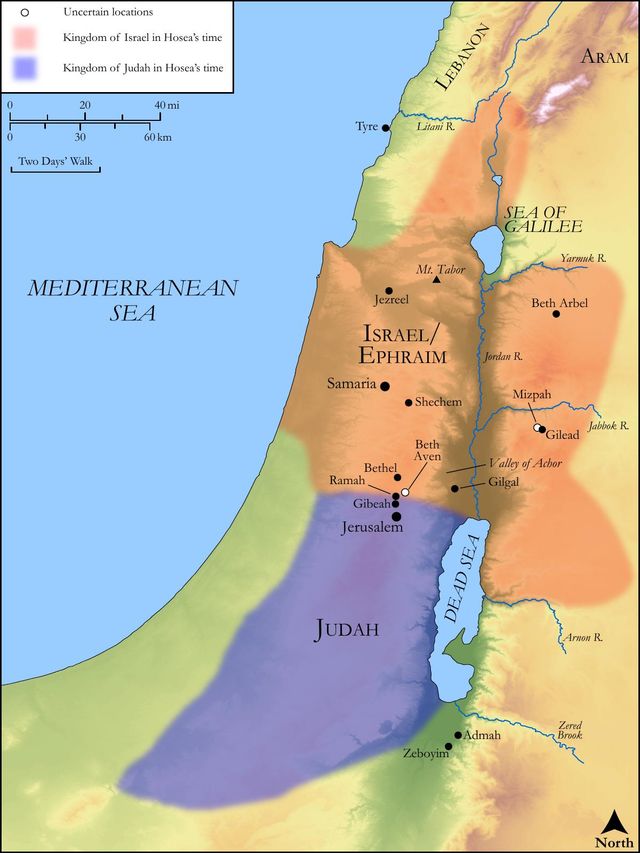
See on the biblical-era map
Study this verse
Public-domain commentary
Matthew Henry
From his Commentary on the Whole Bible. Henry comments on passages, not single verses — this entry covers Hosea 6:1–3. His four-level outline is real structure in the source text, so it is rendered as structure.
These may be taken either as the words of the prophet to the people, calling them to repentance, or as the words of the people to one another, exciting and encouraging one another to seek the Lord, and to humble themselves before him, in hopes of finding mercy with him. God had said, In their affliction they will seek me; now the prophet, and the good people his friends, would strike while the iron was hot, and set in with the convictions their neighbours seemed to be under. Note, Those who are disposed to turn to God themselves should do all they can to excite, and engage, and encourage others to return to him. Observe,
I.What it is they engage to do:
"Come, and let us return to the Lord, Hos 6:1. Let us go no more to the Assyrian, nor send to king Jareb; we have had enough of that. But let us return to the Lord, return to the worship of him from our idolatries, and to our hope in him from all our confidences in the creature." Note, It is the great concern of those who have revolted from God to return to him. And those who have gone from him by consent, and in a body, drawing one another to sin, should by consent, and in a body, return to him, which will be for his glory and their mutual edification.
II.What inducements and encouragements to do this they fasten upon, to stir up one another with.
1.The experience they had had of his displeasure: "Let us return to him, for he has torn, he has smitten. We have been torn, and it was he that tore us; we have been smitten, and it was he that smote us. Therefore let us return to him, because it is for our revolts from him that he has torn and smitten us in anger, and we cannot expect that he should be reconciled to us till we return to him; and for this end he has afflicted us thus, that we might be wrought upon to return to him. His hand will be stretched out still against us if the people turn not to him that smites them," Isa 9:12, Isa 9:13. Note, The consideration of the judgments of God upon us and our land, especially when they are tearing judgments, should awaken us to return to God by repentance, and prayer, and reformation.
2.The expectation they had of his favour: "He that has torn will heal us, he that has smitten will bind us up," as the skilful surgeon with a tender hand binds up the broken bone or bleeding wound. Note, The same providence of God that afflicts his people relieves them, and the same Spirit of God that convinces the saints comforts them; that which is first a Spirit of bondage is afterwards a Spirit of adoption. This is an acknowledgement of the power of God (he can heal though we be ever so ill torn), and of his mercy (he will do it); nay, therefore he has torn that he may heal. Some think this points particularly to the return of the Jews out of Babylon, when they sought the Lord, and joined themselves to him, in the prospect of his gracious return to them in a way of mercy. Note, It will be of great use to us, both for our support under our afflictions and for our encouragement in our repentance, to keep up good thoughts of God and of his purposes and designs concerning us. Now this favour of God which they are here in expectation of is described in several instances: -
(1.)They promise themselves that their deliverance out of their troubles should be to them as life from the dead (Hos 6:2): "After two days he will revive us (that is, in a short time, in a day or two), and the third day, when it is expected that the dead body should putrefy and corrupt, and be buried out of our sight, then will he raise us up, and we shall live in his sight, we shall see his face with comfort and it shall be reviving to us. Though he forsake for a small moment, he will gather with everlasting kindness." Note, The people of God may not only be torn and smitten, but left for dead, and may lie so a great while; but they shall not always lie so, nor shall they long lie so; God will in a little time revive them; and the assurance given them of this should engage them to return and adhere to him. But this seems to have a further reference to the resurrection of Jesus Christ; and the time limited is expressed by two days and the third day, that it may be a type and figure of Christ's rising the third day, which he is said to do according to the scriptures, according to this scripture; for all the prophets testified of the sufferings of Christ and the glory that should follow. Let us see and admire the wisdom and goodness of God, in ordering the prophet's words so that when he foretold the deliverance of the church out of her troubles he should at the same time point out our salvation by Christ, which other salvations were both figures and fruits of; and, though they might not be aware of this mystery in the words, yet now that they are fulfilled in the letter of them in the resurrection of Christ it is a confirmation to our faith that this is he that should come, and we are to look for no other. And it is every way suitable that a prophecy of Christ's rising should be thus expressed, "He will raise us up, and we shall live," for Christ rose as the first-fruits, and we revive with him, we live through him; he rose for our justification, and all believers are said to be risen with Christ. See Isa 26:19. And it would serve for a comfort to the church then, and an assurance that God would raise them out of their low estate, for in his fulness of time he would raise his Son from the grave, who would be the life and glory of his people Israel. Note, A regard by faith to a rising Christ is a great support to a suffering Christian, and gives abundant encouragement to a repenting returning sinner; for he has said, Because I live, you shall live also.
(2.)That then they shall improve in the knowledge of God (Hos 6:3): Then shall we know, if we follow on to know, the Lord. Then, when God returns in mercy to his people and designs favour for them, he will, as a pledge and fruit of his favour, give them more of the knowledge of himself; the earth shall be full of that knowledge, Isa 11:9. Knowledge shall be increased, Dan 12:4. All shall know God, Jer 31:34. We shall know, we shall follow to know, the Lord, (so the words are); and it may be taken as the fruit of Christ's resurrection, and the life we live in God's sight by him, that we shall have not only greater means of knowledge, but grace to improve in knowledge by those means. Note, When God designs mercy for a people he gives them a heart to know him, Jer 24:7. Those that have risen with Christ have the spirit of wisdom and revelation given them. And if we understand our living in his sight, as the Chaldee paraphrast does, of the day of the resurrection of the dead, it fitly follows, We shall know, we shall follow to know, the Lord; for in that day we shall see him be perfected, and yet be eternally increasing. Or, taking it as we read it, If we follow on to know, we have here,
[1.]A precious blessing promised: Then shall we know, shall know the Lord, then when we return to God; those that come to God shall be brought into an acquaintance with him. When we are designed to live in his sight, then he gives us to know him; for this is life eternal to know God, Joh 17:3.
[2.]The way and means of obtaining this blessing. We must follow on to know him. We must value and esteem the knowledge of God as the best knowledge, we must cry after it, and dig for it (Pro 2:3, Pro 2:4), must seek and intermeddle with all wisdom (Pro 18:1), and must proceed in our enquiries after this knowledge and our endeavours to improve in it. And, if we do the prescribed duty, we have reason to expect the promised mercy, that we shall know more and more of God, and be at last perfect in this knowledge.
(3.)That then they shall abound in divine consolations: His going forth is prepared as the morning, that is, the returns of his favour, which he had withdrawn from us when he went and returned to his place. His out-goings again are prepared and secured to us as firmly as the return of the morning after a dark night, and we expect it, as those do that wait for the morning after a long night, and are sure that it will come at the time appointed and will not fail; and the light of his countenance will be both welcome to us and growing upon us, unto the perfect day, as the light of the morning is. He shall come to us, and be welcome to us, as the rain, as the latter and former rain unto the earth, which refreshes it and makes it fruitful. Now this looks further than their deliverance out of captivity, and, no doubt, was to have its full accomplishment in Christ, and the grace of the gospel. The Old Testament saints followed on to know him, earnestly looked for redemption in Jerusalem; and at length the out-goings of divine grace in him, in his going forth to visit this world, were [1.] As the morning to this earth when it is dark for he went forth as the sun of righteousness, and in him the day-spring from on high visited us. His going forth was prepared as the morning, for he came in the fulness of time; John Baptist was his fore-runner, nay, he was himself the bright and morning star. [2.] As the rain to this earth when it is dry. He shall come down as the rain upon the mown grass, Psa 72:6. In him showers of blessings descend upon this world, which give seed to the sower and bread to the eater, Isa 55:10. And the favour of God in Christ is what is said of the king's favour, like the cloud of the latter rain, Pro 16:15. The grace of God in Christ is both the latter and the former rain, for by it the good work of our fruit-bearing is both begun and carried on.
Historical interpretation
Two Centuries of Reception
4 surviving comments on this verse. Each one is dated, so this reads as a timeline rather than a list.
Select a marker to jump to its quote. Markers stagger vertically where authors wrote within a few decades of each other.
Nor is this the only thing that proves the dignity of the water. But there is also that which is more honorable than all—the fact that Christ, the maker of all, came down as the rain, and was known as a spring, and diffused himself as a river, and was baptized in the Jordan. For you have just heard how Jesus came to John and was baptized by him in the Jordan. Oh, things strange beyond compare! How should the boundless river that makes glad the city of God have been dipped in a little water!
His going forth is prepared as the morning light, and he shall come unto us as the rain, as the latter and former rain unto the earth." LXX: "We shall find him ready as the morning, and he shall come to us as the early and the latter rain to the earth." Come, and let us return unto the Lord: for he hath torn, and he will heal us; he hath smitten, and he will bind us up. After two days will he revive us: in the third day he will raise us up, and we shall live in his sight. And let us know, let us follow on to know the Lord: his going forth is prepared as the morning; and he shall come unto us as the rain, as the latter and former rain unto the earth. About which the title of the twenty-first psalm is: "For the morning assumption:" Although it is written in Hebrew: "For the morning deer:" because after death and the twisted ancient serpent he desires to climb towards the mountains, and he, with the darkness dissipated, rises to us the sun of justice, that he may illuminate our blindness. And it is beautifully said, "his going forth is from the end of heaven, and his circuit even to the end of it." concerning which, according to the tropology, we read in the eighteenth psalm: "And he, as a bridegroom, coming out of his bride-chamber." (Ps. XVIII, 5). He who is not only called morning, dawn, and daybreak, but will come to us like a temporary and late rain to the earth. We receive Christ as a temporary (savior), when the foundations of faith have been cast in us, and we will welcome rain in the late season when we will gather eternal crops from the mature crops, and we will be stored in the Lord's granaries. Therefore, you Jews who do not receive temporary rain, and without rains cast seeds, will not receive the fruits of crops in the end times. This is the rain of which the Lord promises, saying: "I will give you rain in due season, and the latter rain" (Deut. 11:14). According to the allegory, rain is given in due season, when we partly know: the latter rain is given when what is perfect comes. And the Lord is always ready for those who rise in the morning, who can say, "I will arise at dawn" (Ps. 56:1). And: "O God, my God, I watch for you at break of day. My soul thirsts for you" (Ps. 62).
[God] is called not only at morning or dawn or daybreak; he will come to us as an early and later rain to earth. We accept Christ as an early rain when the foundations of the faith are laid within us, and we shall take him as a late rain when after the crop is ripened we grasp eternal fruits and store them up in the Master’s barn.
For I suppose that he waters in two ways upon us who received faith and have known rightly his manifestation. On the one hand, he reveals knowledge in the spirit of the old and legal, and in addition to these, prophetic teachings. In my view, this is the early rain. On the other hand, he adds to this the late [rain], the interpretation of the gospel’s teachings and the most desirable grace of the apostolic preachings.
Continue studying Hosea 6:3 across the web’s major study libraries — every link below opens this exact verse, chapter, or book on the destination site.
Read & Compare
 BibleGatewayThis verse in more than 200 translations and 70 languages.
 Bible.comThe YouVersion reader — hundreds of translations, reading plans, and highlights.
 ESV.orgCrossway's official English Standard Version reader.
 NET BibleThe NET translation with 60,000+ translators' notes on every rendering decision.
 STEP BibleTyndale House's free study tool — original text, vocabulary, and scholarly resources.
 BibliaLogos Bible Software's free web reader.
 USCCBThe New American Bible (Revised Edition) with the U.S. bishops' study notes.
Commentaries
 BibleHub CommentariesDozens of classic commentaries on this verse, gathered on one page.
 StudyLightMore than 100 commentary sets — the largest collection on the web.
 BibleRefPlain-English commentary on what this verse means, verse by verse.
 Enduring WordDavid Guzik's free commentary on this chapter, widely used by Bible teachers.
 Bible Study ToolsVerse commentary alongside Greek and Hebrew study aids.
Original Language & Research
- BibleHub InterlinearThe verse word by word — original language, transliteration, and English.
- BibleHub LexiconEvery word's original-language definition and Strong's entry.
 Blue Letter BibleDeep-study tools — Strong's numbers, concordance, and word studies.
 SefariaThe Hebrew text with Rashi and centuries of Jewish commentary.
Sermons, Hymns & Audio


TrulyRandomVerse is not affiliated with these sites and doesn’t control their content. They’re linked because they’re genuinely useful.
Summary
Hosea 6:3 articulates a profound call to diligently pursue an intimate knowledge of the LORD, promising that His divine revelation and life-giving presence are as certain and essential as the dawn and the seasonal rains. This verse serves as both an exhortation to Israel for genuine repentance and a comforting assurance of God's unwavering faithfulness to those who earnestly seek Him, portraying His coming as a source of spiritual refreshment, growth, and restoration, vital for the spiritual vitality of His people.
Context
ShowHideLiterary Context
Hosea 6 opens with a poignant, yet ultimately superficial, call to repentance from the people of Israel (Hosea 6:1-3). Following the LORD's lament over their unfaithfulness and His judgment in Hosea 5, the people express a desire to "return unto the LORD," believing He will heal and restore them. However, the subsequent verses (Hosea 6:4-6) reveal the shallowness of this repentance, as God laments, "What shall I do unto thee, O Ephraim? what shall I do unto thee, O Judah? for your goodness is as a morning cloud, and as the early dew it goeth away!" (Hosea 6:4). Thus, Hosea 6:3, while expressing a hopeful aspiration for knowing God, is immediately juxtaposed with the reality of Israel's fleeting devotion, setting the stage for God's preference for steadfast love over sacrifice.
Historical & Cultural Context
The prophecy of Hosea is set against the backdrop of the declining Northern Kingdom of Israel (Ephraim) in the 8th century BCE, prior to its fall to Assyria in 722 BCE. This period was characterized by political instability, moral decay, and rampant idolatry, particularly the worship of Baal, a Canaanite fertility god. In an agrarian society like ancient Israel, rain was absolutely critical for survival and prosperity. The "former rain" (yoreh) fell in autumn, preparing the soil for planting, while the "latter rain" (malqosh) fell in spring, bringing crops to maturity. The comparison of God's coming to these essential rains would have resonated deeply with the people, signifying His indispensable role in their spiritual and physical well-being, contrasting sharply with the false promises of Baal worship, which claimed to control the rains.
Key Themes
ShowHideHosea 6:3 contributes significantly to several overarching themes in the book. Firstly, it underscores the theme of Knowing God, emphasizing that true knowledge of the LORD is not merely intellectual but involves a deep, covenantal relationship requiring persistent pursuit. This contrasts with Israel's superficial understanding and their pursuit of other gods. Secondly, the verse highlights God's Faithfulness and Reliability, portraying His coming as certain and predictable as the dawn, a stark contrast to Israel's fickle loyalty. Thirdly, it speaks to Divine Provision and Life-Giving Presence, using the imagery of rain to convey God's essential role in bringing spiritual life, growth, and blessing, much like the physical rain sustains the land. This theme is echoed elsewhere, such as in Joel's prophecy of spiritual refreshing. Ultimately, the verse encapsulates the tension between human responsibility to seek God and God's gracious initiative to reveal Himself and sustain His people.
Exposition and Analysis
ShowHideKey Word Analysis
ShowHideThis word signifies far more than intellectual apprehension. It implies an intimate, experiential, and relational knowledge, often used in the context of covenant relationships (e.g., as between husband and wife, or God and His people). To "follow on to know" suggests a continuous, diligent, and active pursuit to deepen this personal, covenantal relationship with the LORD. It involves observation, recognition, care, and a lived understanding of God's character and will.
This word means to be erect, firm, established, or fixed. When applied to God's "going forth," it conveys the idea of certainty, reliability, and an unshakeable order, much like the unfailing appearance of the morning. It speaks to God's steadfastness and the assuredness of His actions and revelations, implying that His coming is not haphazard but divinely ordained and certain.
This refers specifically to the spring rain, crucial for bringing crops to maturity before harvest. Paired with "former rain" (H3384, yârâh'), which prepared the ground for planting, this imagery (along with H1653, geshem' for general "rain") powerfully illustrates God's comprehensive and timely provision. It signifies His work in both initiating spiritual life and bringing it to full fruition, providing all that is necessary for growth and fruitfulness in the lives of His people.
Verse Breakdown
ShowHide"Then shall we know, if we follow on to know the LORD"
This opening clause establishes a conditional promise. The "knowing" (yâdaʻ) is not automatic but contingent upon a diligent, persistent, and active "following on to know" the LORD. It implies a continuous journey of seeking, learning, and deepening one's relationship with God, emphasizing human responsibility in the divine-human encounter.
"his going forth is prepared as the morning"
This phrase describes the certainty and reliability of God's self-revelation and intervention. Just as the dawn (shachar) is an inevitable, predictable, and universally experienced phenomenon that dispels darkness, so God's presence and action are sure and unfailing for those who seek Him. It speaks to His faithfulness and the ordered nature of His divine plan.
"and he shall come unto us as the rain, as the latter and former rain unto the earth."
This final clause employs a powerful agricultural metaphor to illustrate the life-giving, refreshing, and essential nature of God's presence. Like the former rain prepares the ground and the latter rain brings the harvest, God's coming provides spiritual sustenance, growth, and blessing, indispensable for the vitality and fruitfulness of His people. It highlights His role as the source of all spiritual life and flourishing.
Literary Devices
ShowHideHosea 6:3 is rich with Simile and Metaphor, drawing powerful comparisons from the natural world to describe the divine-human relationship. The phrase "his going forth is prepared as the morning" uses Simile to liken God's reliable revelation to the certainty of dawn, emphasizing its predictability and illuminating quality. This is further reinforced by the Metaphorical use of "morning" itself as a symbol of new beginnings, clarity, and the dispelling of darkness. The verse then employs another profound Simile and Metaphorical comparison: "he shall come unto us as the rain, as the latter and former rain unto the earth." Here, God's presence is likened to the essential, life-giving rain—specifically the "former" (autumn) and "latter" (spring) rains—which were critical for agricultural success in ancient Israel. This imagery functions as a Metaphor for spiritual sustenance, growth, and blessing, highlighting God's role as the indispensable provider of life and fruitfulness. The cumulative effect of these devices is to convey God's unwavering faithfulness, His essential nature, and the certainty of His life-giving presence to those who earnestly seek Him.
Theological and Thematic Connections
ShowHideHosea 6:3 presents a foundational theological truth: the pursuit of God is not in vain, for He is faithful to reveal Himself and sustain those who genuinely seek Him. This verse underscores the reciprocal nature of the covenant relationship, where human diligence in seeking is met with divine certainty and provision. It challenges the notion of a passive faith, insisting on an active, continuous "following on to know" the LORD, which leads to an experiential, intimate knowledge. The imagery of morning and rain speaks to God's consistent character as the source of light, life, and growth, contrasting with the fleeting and unreliable nature of human devotion. This divine reliability serves as both an encouragement for repentance and a reminder of the profound blessings available in a right relationship with God.
Reflection and Application
ShowHideHosea 6:3 serves as a timeless call to cultivate a deep, persistent, and intimate relationship with God. In a world full of distractions and fleeting commitments, this verse reminds us that true spiritual vitality comes from consistently "following on to know the LORD." This isn't about intellectual assent alone, but about a lived experience of seeking Him through prayer, diligent study of His Word, obedience to His commands, and active participation in His community. Just as the morning inevitably breaks and the rain faithfully nourishes the earth, God promises to meet us in our pursuit, bringing His light, refreshment, and growth into our lives. Our spiritual flourishing is directly tied to our intentional efforts to draw near to Him, trusting in His unwavering faithfulness to reveal Himself and provide all that we need for life and godliness.
Questions for Reflection
ShowHideFAQ
ShowHideWhat does it mean to "follow on to know the LORD"?
ShowHideTo "follow on to know the LORD" (Hebrew: râdaph H7291, yâdaʻ H3045) implies a continuous, diligent, and active pursuit of an intimate, experiential knowledge of God. It's not a one-time event but an ongoing journey of seeking, learning, and deepening one's relationship with Him. This involves persistent prayer, consistent engagement with His Word, obedience to His commands, and a heart that continually yearns for more of Him. It suggests a relentless pursuit, much like a hunter pursues prey, but in this context, it's a pursuit of divine intimacy and understanding. This active seeking is foundational to experiencing God's presence and blessings, as seen in passages like Jeremiah 29:13, where God promises to be found by those who seek Him with all their heart.
Christ-Centered Fulfillment
ShowHideHosea 6:3 finds its ultimate and most profound fulfillment in Jesus Christ. The promise that God's "going forth is prepared as the morning" and that "he shall come unto us as the rain" is perfectly embodied in the person and work of Christ. Jesus is the definitive revelation of God, the "true light that gives light to everyone" who came into the world (John 1:9). His advent was the dawning of a new day, dispelling the darkness of sin and ignorance, just as the morning light is certain and inevitable. Furthermore, Jesus is the source of life-giving spiritual "rain." He offers "living water" to those who thirst (John 7:37-38), and through the Holy Spirit, whom He sends, He provides constant refreshment, growth, and fruitfulness to believers (John 14:16-17). The "latter and former rain" imagery speaks to God's comprehensive provision for spiritual life from inception to maturity, a provision fully realized through Christ's atoning work and His ongoing ministry as our High Priest and King. To "know the LORD" now means to know Jesus, for "no one knows the Father except the Son and anyone to whom the Son chooses to reveal Him" (Matthew 11:27). Our diligent pursuit of God is thus a pursuit of Christ, in whom all the promises of God find their "Yes" and "Amen" (2 Corinthians 1:20).