


1 Kings 6:9
- וַיִּבֶןvai·Yi·venand he builtH1129Conj-w ¦ V-Qal-ConsecImperf-3msVerb Qal Consecutive Imperfect 3rd Singular Masculineוַandיִּבֶןhe built
- אֶת'et<obj.>H853DirObjMParticle Object Indicator
- הַבַּיִתha·Ba·yitthe houseH1004Art ¦ N-msNoun Singular Masculine Absoluteהַtheבַּיִתhouse
- וַיְכַלֵּהוּvay·kha·Le·huand he finished itH3615Conj-w ¦ V-Piel-ConsecImperf-3ms ¦ 3msVerb Piel Consecutive Imperfect 3rd Singular Masculineוַandיְכַלֵּhe finishedהוּit
- וַיִּסְפֹּןvai·yis·Ponand he coveredH5603Conj-w ¦ V-Qal-ConsecImperf-3msVerb Qal Consecutive Imperfect 3rd Singular Masculineוַandיִּסְפֹּןhe covered
- אֶת'et<obj.>H853DirObjMParticle Object Indicator
- הַבַּיִתha·Ba·yitthe houseH1004Art ¦ N-msNoun Singular Masculine Absoluteהַtheבַּיִתhouse
- גֵּבִיםge·VimbeamsH1356N-mpNoun Plural Masculine Absolute
- וּשְׂדֵרֹתu·se·de·Rotand planksH7713Conj-w ¦ N-fpNoun Plural Feminine Absoluteוּandשְׂדֵרֹתplanks
- בָּאֲרָזִיםba·'a·ra·Zimwith <the> cedar<s>H730Prep-b ¦ N-mpNoun Plural Masculine Absoluteבָּwith <the>אֲרָזִיםcedar<s>
English is a literal word-by-word gloss of the Hebrew, not the KJV's wording. Why?
This is the original text the KJV's translators worked from — each Hebrew word with its own literal English meaning in this verse, prepared by scholars at Tyndale House, Cambridge. The KJV translates whole sentences, not word by word, so its wording differs: one Hebrew word can become several English words, and the KJV may choose “the LORD” where the gloss reads “Yahweh”. Both are faithful — they answer different questions. For the KJV's own rendering, switch to the KJV text.
Details
See on the biblical-era map

Study this verse
Public-domain commentary
Matthew Henry
From his Commentary on the Whole Bible. Henry comments on passages, not single verses — this entry covers 1 Kings 6:1–10. His two-level outline is real structure in the source text, so it is rendered as structure.
Here, I. The temple is called the house of the Lord (Kg1 6:1), because it was, 1. Directed and modelled by him. Infinite Wisdom was the architect, and gave David the plan or pattern by the Spirit, not by word of mouth only, but, for the greater certainty and exactness, in writing (Ch1 28:11, Ch1 28:12), as he had given to Moses in the mouth a draught of the tabernacle. 2. Dedicated and devoted to him and to his honour, to be employed in his service, so his as never any other house was, for he manifested his glory in it (so as never in any other) in a way agreeable to that dispensation; for, when there were carnal ordinances, there was a worldly sanctuary, Heb 9:1, Heb 9:10. This gave it its beauty of holiness, that it was the house of the Lord, which far transcended all its other beauties.
II.The time when it began to be built is exactly set down.
1.It was just 480 years after the bringing of the children of Israel out of Egypt. Allowing forty years to Moses, seventeen to Joshua, 299 to the Judges, forty to Eli, forty to Samuel and Saul, forty to David, and four to Solomon before he began the work, we have just the sum of 480. So long it was after that holy state was founded before that holy house was built, which, in less than 430 years, was burnt by Nebuchadnezzar. It was thus deferred because Israel had, by their sins, rendered themselves unworthy of this honour, and because God would show how little he values external pomp and splendour in his service: he was in no haste for a temple. David's tent, which was clean and convenient, though it was neither stately nor rich, nor, for aught that appears, ever consecrated, is called the house of the Lord (Sa2 12:20), and served as well as Solomon's temple; yet, when God gave Solomon great wealth, he put it into his heart thus to employ it, and graciously accepted him, chiefly because it was to be a shadow of good things to come, Heb 9:9.
2.It was in the fourth year of Solomon's reign, the first three years being taken up in settling the affairs of his kingdom, that he might not find any embarrassment from them in this work. It is not time lost which is spent in composing ourselves for the work of God, and disentangling ourselves from every thing which might distract or divert us. During this time he was adding to the preparations which his father had made (Ch1 22:14), hewing the stone, squaring the timber, and getting every thing ready, so that he is not to be blamed for slackness in deferring it so long. We are truly serving God when we are preparing for his service and furnishing ourselves for it.
III.The materials are brought in, ready for their place (Kg1 6:7), so ready that there was neither hammer nor ax heard in the house while it was in building. In all building Solomon prescribes it as a rule of prudence to prepare the work in the field, and afterwards build, Pro 24:27. But here, it seems, the preparation was more than ordinarily full and exact, to such a degree that, when the several parts came to be put together, there was nothing defective to be added, nothing amiss to be amended. It was to be the temple of God of peace, and therefore no iron tool must be heard in it. Quietness and silence both become and befriend religious exercises: God's work should be done with as much care and as little noise as may be. The temple was thrown down with axes and hammers, and those that threw it down roared in the midst of the congregation (Psa 74:4, Psa 74:6); but it was built up in silence. Clamour and violence often hinder the work of God, but never further it.
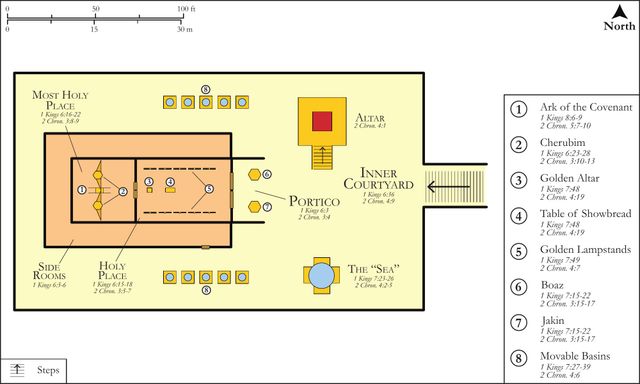
IV.The dimensions are laid down (Kg1 6:2, Kg1 6:3) according to the rules of proportion.
Some observe that the length and breadth were just double to that of the tabernacle. Now that Israel had grown more numerous the place of their meeting needed to be enlarged (Isa 54:1, Isa 54:2), and now that they had grown richer they were the better able to enlarge it. Where God sows plentifully he expects to reap so.
V.An account of the windows (Kg1 6:4):
They were broad within, and narrow without, Marg. Such should the eyes of our mind be, reflecting nearer on ourselves than on other people, looking much within, to judge ourselves, but little without, to censure our brethren. The narrowness of the lights intimated the darkness of that dispensation, in comparison with the gospel day.
VI.The chambers are described (Kg1 6:5, Kg1 6:6), which served as vestries, in which the utensils of the tabernacle were carefully laid up, and where the priests dressed and undressed themselves and left the clothes in which they ministered: probably in some of these chambers they feasted upon the holy things. Solomon was not so intent upon the magnificence of the house as to neglect the conveniences that were requisite for the offices thereof, that every thing might be done decently and in order. Care was taken that the beams should not be fastened in the walls to weaken them, Kg1 6:6. Let not the church's strength be impaired under pretence of adding to its beauty or convenience.
Historical interpretation
Historical reception
2 surviving comments on this verse. Each one is dated, so this reads as a timeline rather than a list.
Ceilings are boardwork constructed and adorned with great beauty and fixed to the beams on the lower side, and because the house of the Lord had been built three times the double height, naturally it had three ceilings. What is more fitting for us to believe than these ceilings signify all the just people of most exalted virtue in the holy church? And their work and teaching is held up as an example to all as being much loftier than any other, and by their intercessions and exhortations they keep the spirits of the weak from failing in temptation. These ceilings are indeed rightly described as being of cedarwood. For cedar is by nature a completely incorruptible tree, of pleasant fragrance and luxuriant appearance, and when it is set on fire it drives away and destroys serpents by its dazzling brightness. These things are an apt figure of all the perfect whose patience is indomitable, whose outstanding reputation for virtue is far more pleasing to the good than that of anyone else, whose powers of refuting and proving wrong those who resist the truth are utterly unshakable, and who, both in this life and the life to come, shine with a resplendence that outshines the rest of the saints.
"He also covered the house with cedar ceilings." [1 Kings 6:9] The term "He also covered the house with cedar ceilings" refers to the timber-frame ceilings that, when fastened with nails, display the wondrous beauty of their paintings to those who behold them. There were three ceilings in the temple. The first had thirty cubits from the floor; the second had sixty cubits, aligned with the height of the porticos; the third had one hundred and twenty cubits at the top of the entire house. For in Palestine, as in Egypt, roofs are not raised high but instead built flat, suitable for sitting or walking. Hence, the Lord says in the Gospel: "And what you hear whispered, proclaim upon the housetops." Such a place is most appropriate for proclaiming the word—to those sitting with the speaker or to listeners below. As Solomon says in Proverbs: "It is better to live in a corner of the housetop than in a house shared with a contentious woman" (Prov. XXI); for what is called "roof" in Latin is "doma" in Greek. Moreover, the porticos around the temple had three levels of ceilings. The first from the ground had twenty cubits, the second forty, and the third sixty. Their roofs were also flat. There were thirty porticos on the lower level, thirty in the middle, and thirty above, not separated by walls but by wooden planks, so each of the ninety porticos measured five cubits in width and length, and twenty in height. These porticos are frequently mentioned in the book of Chronicles. Josephus explains their arrangement in more detail. "And he built a platform over the whole house five cubits high;" this is what Moses commanded in Deuteronomy: "When you build a new house, make a parapet for your roof so that you may not bring the guilt of bloodshed on your house if someone falls from it" (Deut. XXII). This platform at the top of the temple walls acted as a parapet to prevent someone ascending to the roof from falling off carelessly. This is mentioned as the cause of King Ahaziah's death, as he fell through the lattice of his upper chamber and suffered fatal injuries. When these panels, walls, or parapets are placed for safety, the common people call them "lattices." "And he covered the house with cedar wood;" signifies the upper covering of the entire structure, that is, the panel added above those beams on which the uppermost ceilings we mentioned earlier were affixed.
Continue studying 1 Kings 6:9 across the web’s major study libraries — every link below opens this exact verse, chapter, or book on the destination site.
Read & Compare
 BibleGatewayThis verse in more than 200 translations and 70 languages.
 Bible.comThe YouVersion reader — hundreds of translations, reading plans, and highlights.
 ESV.orgCrossway's official English Standard Version reader.
 NET BibleThe NET translation with 60,000+ translators' notes on every rendering decision.
 STEP BibleTyndale House's free study tool — original text, vocabulary, and scholarly resources.
 BibliaLogos Bible Software's free web reader.
 USCCBThe New American Bible (Revised Edition) with the U.S. bishops' study notes.
Commentaries
 BibleHub CommentariesDozens of classic commentaries on this verse, gathered on one page.
 StudyLightMore than 100 commentary sets — the largest collection on the web.
 BibleRefPlain-English commentary on what this verse means, verse by verse.
 Enduring WordDavid Guzik's free commentary on this chapter, widely used by Bible teachers.
 Bible Study ToolsVerse commentary alongside Greek and Hebrew study aids.
Original Language & Research
- BibleHub InterlinearThe verse word by word — original language, transliteration, and English.
- BibleHub LexiconEvery word's original-language definition and Strong's entry.
 Blue Letter BibleDeep-study tools — Strong's numbers, concordance, and word studies.
 SefariaThe Hebrew text with Rashi and centuries of Jewish commentary.
Sermons, Hymns & Audio


TrulyRandomVerse is not affiliated with these sites and doesn’t control their content. They’re linked because they’re genuinely useful.
Summary
1 Kings 6:9 marks a pivotal moment in the construction of Solomon's Temple, signifying the successful completion of its primary structural framework. This verse highlights King Solomon's meticulous diligence and the successful execution of this monumental task, emphasizing that the "house" was not merely erected but brought to a thorough and complete state. The specific mention of "beams and boards of cedar" underscores the use of premium, costly, and durable materials, reflecting a profound commitment to excellence and sacredness in the construction of God's dwelling place on earth.
Context
ShowHideLiterary Context
This verse is intricately woven into the highly detailed narrative of the Temple's construction, which commences at the beginning of 1 Kings 6 and extends into 1 Kings 7. The preceding verses, particularly 1 Kings 6:1-8, meticulously describe the initiation of the work, the precise architectural dimensions, and the unique building methodology that ensured no sound of iron tools was heard on site. Verse 9 serves as a crucial transition point, marking the completion of the main structural shell and setting the stage for the intricate interior finishing and ornamentation, which are elaborately detailed in subsequent passages like 1 Kings 6:14-36. It signifies the successful conclusion of the foundational construction phase, paving the way for the Temple's interior beauty and sacred furnishings.
Historical & Cultural Context
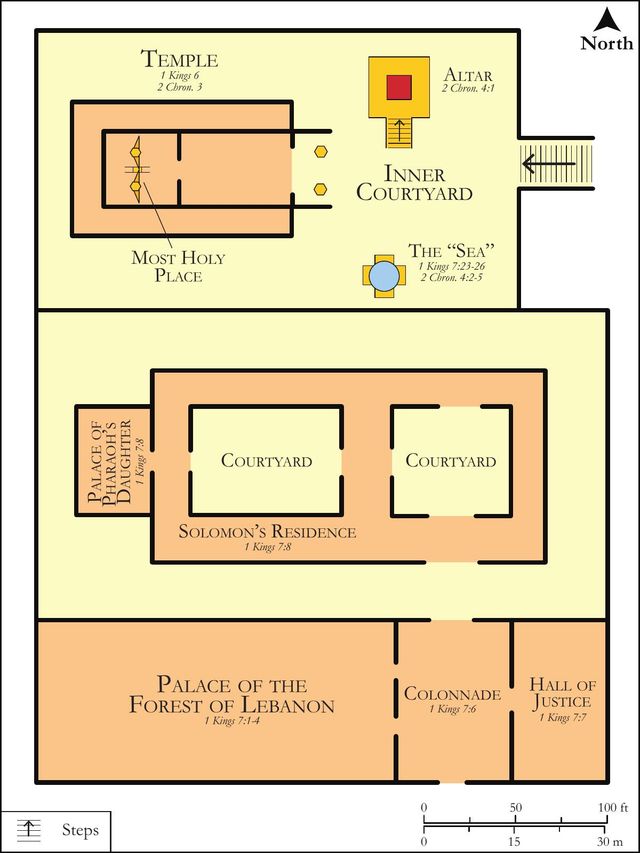
Solomon's Temple represented the pinnacle of Israelite architecture, engineering, and religious devotion, serving as the permanent dwelling place for the Ark of the Covenant and the visible center of the nation's worship. Its construction occurred during a period of unprecedented peace, prosperity, and international influence for Israel under Solomon's reign, as described in 1 Kings 4:20-25. The undertaking was colossal, demanding immense resources, highly skilled labor, and significant international collaboration. The explicit mention of "cedar" is a critical detail, as cedar of Lebanon was the most prized and expensive timber in the ancient Near East, renowned for its exceptional durability, aromatic qualities, and majestic beauty. Its importation from Tyre, facilitated by the strategic alliance with King Hiram as detailed in 1 Kings 5:1-12, underscores the immense cost, logistical complexity, and the international prestige associated with building a structure deemed worthy of the Lord God.
Key Themes
ShowHideThe construction of the Temple, particularly its structural completion highlighted in 1 Kings 6:9, powerfully illustrates several enduring theological and narrative themes. Firstly, it exemplifies the theme of Divine Mandate and Human Obedience, as Solomon faithfully and meticulously executes the detailed plans for the Temple that God had revealed to his father, David (see 1 Chronicles 28:11-19). Secondly, the meticulous attention to detail and the deliberate use of the finest materials, especially "cedar," powerfully convey the theme of Excellence in Worship and Service. Only the absolute best was considered suitable for God's sacred dwelling, symbolizing profound reverence, honor, and devotion to the Almighty. Thirdly, the phrase "finished it" underscores the critical theme of Diligence and Completion in God's work. It is a testament to Solomon's unwavering commitment to seeing this monumental, divinely-inspired project through to its intended and perfect conclusion, a principle echoed in later biblical calls to persevere in faith and service (e.g., Philippians 1:6).
Exposition and Analysis
ShowHideKey Word Analysis
ShowHideThis primitive root signifies bringing something to an end, completing, or consuming. In the context of 1 Kings 6:9, it implies not merely the cessation of work, but the comprehensive and qualitative completion of the Temple's main structure. It denotes that the building was brought to its intended, thorough conclusion, fully erected and structurally sound, ready for the subsequent stages of interior work. The use of kâlâh here emphasizes Solomon's diligence, the successful fulfillment of the building's primary phase, and the high standard to which the work was executed.
Derived from a root meaning "to be firm" or "to be strong," this term specifically refers to the cedar of Lebanon, a highly esteemed and valuable timber in the ancient world. It was prized for its strength, resistance to decay, beautiful grain, and fragrant aroma. Its extensive use for the Temple's roof and interior lining (as seen in later verses) was a clear statement of opulence, permanence, and sacredness. Cedar was considered a royal and divine material, distinguishing the Temple as a structure of unparalleled importance, quality, and enduring beauty, far surpassing common buildings.
Verse Breakdown
ShowHide"So he built the house, and finished it;"
This clause succinctly states King Solomon's primary action and its successful outcome. "The house" unequivocally refers to the Temple, the central edifice dedicated to the Lord. The combined phrase "built... and finished it" highlights Solomon's active and diligent role as the divinely appointed executor of the building project. It emphasizes both the arduous process of construction (building) and the triumphant achievement of its complete and thorough realization (finishing). This signifies a major structural milestone, indicating that the main shell of the Temple was fully erected, structurally sound, and meticulously brought to its intended state of completion.
"and covered the house with beams and boards of cedar."
This second clause provides crucial specific details about the roofing and ceiling materials. "Beams" (Hebrew: gêb) refers to the robust, load-bearing timbers that spanned the width of the building, forming the primary support for the roof structure. "Boards" (Hebrew: sᵉdêrâh) likely refers to the planks or panels used to cover these beams, forming the ceiling and the underlying surface of the roof. The explicit mention of "cedar" underscores the luxurious, durable, and aromatic nature of these materials. This choice of premium timber signifies the Temple's grandeur, its sacred purpose, and the profound reverence with which it was constructed, as only the finest and most enduring resources were dedicated to God's dwelling place.
Literary Devices
ShowHideThe verse employs several effective literary devices to convey its profound message. Conciseness is evident in its brief yet impactful declaration of a major architectural achievement, conveying a sense of efficient, purposeful action and the magnitude of the task completed. The repetition of "the house" (Hebrew: bayith) emphasizes the singular focus and paramount importance of the Temple as the object of Solomon's labor and the narrative's central attention. Most significantly, Symbolism is powerfully at play through the mention of "cedar." Cedar wood is not merely a building material; it symbolizes permanence, strength, beauty, incorruptibility, and the highest quality. Its inclusion underscores the sacredness and the unparalleled value placed upon God's dwelling place, reflecting a commitment to offering the very best to the Divine. The act of "finishing" the house itself can also be seen as a symbol of God's faithfulness in enabling His purposes to be brought to fruition through human effort and diligence.
Theological and Thematic Connections
ShowHideThe completion of the Temple's structural shell with "beams and boards of cedar" carries profound theological weight, extending beyond a mere architectural report. It speaks to the enduring principle that God's work, when undertaken by His people, deserves the utmost diligence, excellence, and dedication. Just as Solomon spared no expense or effort in constructing a physical dwelling worthy of God's manifest presence, so too are believers called to offer their "best" in every aspect of their lives, whether in worship, service, or daily conduct. This commitment to excellence is not about human glory or ostentation, but about honoring the God who is Himself perfect, holy, and worthy of ultimate devotion and the highest quality of offering. The Temple, though a physical structure, was a tangible expression of God's desire to dwell among His people, a profound theme that resonates throughout biblical history, from the wilderness Tabernacle to the Incarnation of Christ, and ultimately to the promise of the New Heavens and New Earth where God will dwell eternally with His redeemed.
Reflection and Application
ShowHideThe meticulous effort and the deliberate use of premium materials in the construction of Solomon's Temple, culminating in its structural completion as described in 1 Kings 6:9, offer timeless and profound lessons for contemporary believers. This passage challenges us to deeply consider the quality and integrity of our own "building" efforts in the spiritual realm. Are we approaching our service to God, our personal spiritual disciplines, our relationships, and our daily vocations with the same diligence, excellence, and commitment to completion that Solomon demonstrated in this sacred task? Just as the Temple was built with the finest cedar, we are called to offer God our "best"—our consecrated time, our unique talents, our material resources, and our sincere, undivided devotion—not merely what is convenient, leftover, or half-hearted. This verse serves as a powerful reminder that true worship extends far beyond formal religious services, permeating every area of life. It urges us to pursue integrity, thoroughness, and a spirit of excellence in all that we do for the Lord, recognizing that our very lives, as temples where God's Spirit dwells, are meant to reflect His glory and worthiness.
Questions for Reflection
ShowHideFAQ
ShowHideWhy was cedar wood so important for the Temple?
ShowHideCedar wood, particularly from Lebanon, was of paramount importance for the Temple due to a confluence of historical, cultural, and theological factors. Historically and culturally, it was universally recognized as the most prized, luxurious, and expensive timber in the ancient Near East, signifying wealth, permanence, and royal status. Its natural properties—exceptional durability, inherent resistance to decay and insects, and a pleasant, enduring aroma—made it an ideal building material for a structure intended to last for centuries and house the sacred presence of God. Theologically, the deliberate use of such a superior and costly material for the "house" of God profoundly underscored the Israelites' deep reverence, honor, and unwavering commitment to offering the absolute best to the Lord. It was a tangible and visible expression of their devotion, emphasizing the Temple's unique sacredness and its status as the central dwelling place for God's presence among His people, a concept rooted in God's initial command for the Tabernacle (e.g., Exodus 25:8).
What does "finished it" imply beyond simple completion?
ShowHideThe phrase "finished it" (Hebrew: kâlâh) in 1 Kings 6:9 implies far more than merely ceasing work or reaching a stopping point. It conveys a profound sense of thoroughness, perfection, and the successful culmination of a complex and divinely mandated project according to its precise, intended design. It signifies that the main structural work of the Temple was not only brought to an end but was completed to its proper, fully established, and structurally sound state, ready for the subsequent phases of interior decoration, furnishing, and consecration. This emphasizes that Solomon's efforts were marked by exceptional diligence, precision, and an unwavering commitment to quality, ensuring that the foundational and structural integrity of God's house was fully established and meticulously met the divine specifications given to David (e.g., 1 Chronicles 28:11-19). It speaks to the high standard of dedication and excellence involved in the sacred work, not just its conclusion.
Christ-Centered Fulfillment
ShowHideWhile 1 Kings 6:9 meticulously describes the completion of a magnificent physical structure, its ultimate Christ-centered fulfillment points to a far greater and more enduring reality: Jesus Christ Himself as the ultimate and perfect Temple. The earthly Temple, built with the finest cedar and meticulous care, served as a profound foreshadowing of God's eternal desire to dwell intimately among His people, a desire perfectly and fully realized in the person of Jesus. As the Incarnate Word, Jesus "tabernacled" among us (as powerfully stated in John 1:14), embodying the very presence, glory, and truth of God in human form. He boldly declared, "Destroy this temple, and in three days I will raise it up," speaking not of the physical edifice, but of the temple of His own body (John 2:19-21). Through His sacrificial death and triumphant resurrection, Christ established a new and living way to God, becoming the true and better Temple, the perfect place where humanity can truly encounter the divine, access God's presence, and find reconciliation. Furthermore, through the indwelling Holy Spirit, believers are now living stones, being built into a spiritual house, with Christ as the indispensable cornerstone (1 Peter 2:5; Ephesians 2:21-22), thereby fulfilling God's ultimate purpose to dwell not in buildings made with human hands, but in the hearts and lives of His redeemed people, the Church. The diligence and excellence exemplified in building the physical Temple thus powerfully prefigure the perfect, completed work of Christ in establishing His Church, the spiritual dwelling place of God for all eternity.