


Nehemiah 2:13
- וָאֵצְאָהva·'e·tze·'Ahand I went out !H3318Conj-w ¦ V-Qal-ConsecImperf-1cs ¦ SfxVerb Qal Consecutive Imperfect 1st Singular common genderוָandאֵצְאָI went outה!
- בְשַׁעַרve·sha·'arby [the] gate ofH8179Prep-b ¦ N-mscNoun Singular Masculine Constructבְbyשַׁעַר[the] gate of
- הַגַּיאha·Gai'the valleyH1516Art ¦ N-csNoun Singular common gender Absoluteהַtheגַּיאvalley
- לַיְלָהLay·lahnightH3915N-msNoun Singular Masculine Absolute
- וְאֶלve·'eland toH413Conj-w ¦ PrepPrepositionוְandאֶלto
- פְּנֵיpe·Nei[the] faceH6440N-mpcNoun Plural Masculine Construct
- עֵין'ein[the] Spring ofH5869N-properNoun Proper Location
- הַתַּנִּיןha·ta·Nin[the] DragonsH8577N-properNoun Proper Location
- וְאֶלve·'eland toH413Conj-w ¦ PrepPrepositionוְandאֶלto
- שַׁעַרSha·'ar[the] gate ofH8179N-mscNoun Singular Masculine Construct
- הָאַשְׁפֹּתha·'ash·Potthe dungH830Art ¦ N-msNoun Singular Masculine Absoluteהָtheאַשְׁפֹּתdung
- וָאֱהִיva·'e·Hiand I wasH1961Conj-w ¦ V-Qal-ConsecImperf-1csVerb Qal Consecutive Imperfect 1st Singular common genderוָandאֱהִיI was
- שֹׂבֵרso·VerexaminingH7663V-Qal-Prtcpl-msVerb Qal Participle Singular Masculine Absolute
- בְּחוֹמֹתbe·cho·Mot<on> [the] walls ofH2346Prep-b ¦ N-fpcNoun Plural Feminine Constructבְּ<on>חוֹמֹת[the] walls of
- יְרוּשָׁלִַםye·ru·sha·LimJerusalemH3389N-properNoun Proper Location
- אֲשֶׁר'a·SherwhichH834RelParticle Relative
- הֵםhem fe·ru·tzimthey [were] broken downH1992Pro-3mp ¦ V-Qal-PassPrtcpl-mpPronoun Personal 3rd Plural Masculineהֵםtheyפְּרוּצִים[were] broken down
- וּשְׁעָרֶיהָu·she·'a·Rei·haand its gatesH8179Conj-w ¦ N-mpc ¦ 3fsNoun Plural Masculine Constructוּandשְׁעָרֶיgatesהָits
- אֻכְּלוּ'u·ke·Luthey had been consumedH398V-Pual-Perf-3cpVerb Pual Perfect 3rd Plural common gender
- בָאֵשׁva·'Eshby <the> fireH784Prep-b ¦ N-csNoun Singular common gender Absoluteבָby <the>אֵשׁfire
English is a literal word-by-word gloss of the Hebrew, not the KJV's wording. Why?
This is the original text the KJV's translators worked from — each Hebrew word with its own literal English meaning in this verse, prepared by scholars at Tyndale House, Cambridge. The KJV translates whole sentences, not word by word, so its wording differs: one Hebrew word can become several English words, and the KJV may choose “the LORD” where the gloss reads “Yahweh”. Both are faithful — they answer different questions. For the KJV's own rendering, switch to the KJV text.
Details
See on the biblical-era map
Study this verse
Public-domain commentary
Matthew Henry
From his Commentary on the Whole Bible. Henry comments on passages, not single verses — this entry covers Nehemiah 2:9–20. His four-level outline is real structure in the source text, so it is rendered as structure.
We are here told,
I.Now Nehemiah was dismissed by the court he was sent from.
The king appointed captains of the army and horsemen to go with him (Neh 2:9), both for his guard and to show that he was a man whom the king did delight to honour, that all the king's servants might respect him accordingly. Those whom the King of kings sends he thus protects, he thus dignifies with a host of angels to attend them.
II.How he was received by the country he was sent to.
1.By the Jews and their friends at Jerusalem. We are told,
(1.)That while he concealed his errand they took little notice of him. He was at Jerusalem three days (Neh 2:11), and it does not appear that any of the great men of the city waited on him to congratulate him on his arrival, but he remained unknown. The king sent horsemen to attend him, but the Jews sent none to meet him; he had no beast with him, but that which he himself rode on, Neh 2:12. Wise men, and those who are worthy of double honour, yet covet not to come with observation, to make a show, or make a noise, no, not when they come with the greatest blessings. Those that shortly are to have the dominion in the morning the world now knows not, but they lie hid, Jo1 3:1.
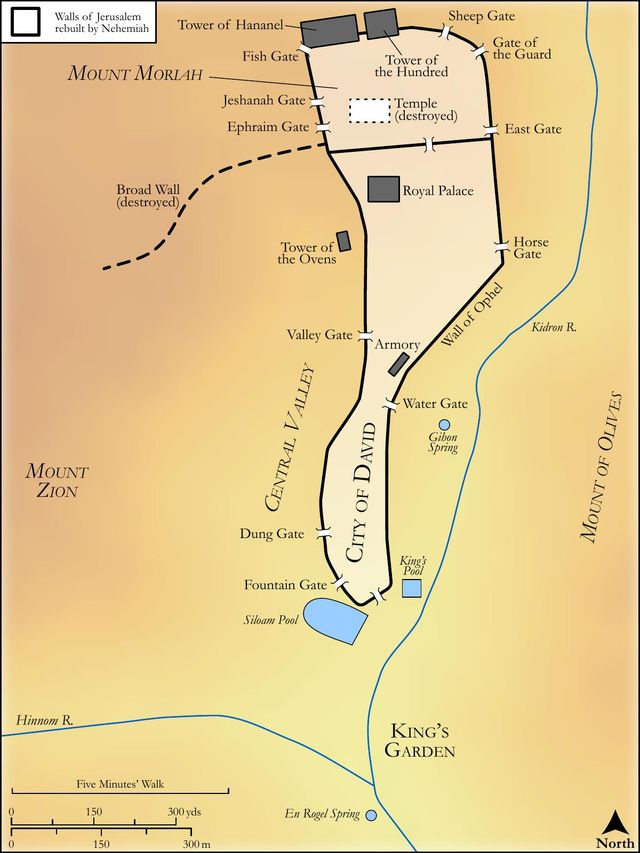
(2.)That though they took little notice of him he took great notice of them and their state. He arose in the night, and viewed the ruins of the walls, probably by moon-light (Neh 2:13), that he might see what was to be done and in what method they must go about it, whether the old foundation would serve, and what there was of the old materials that would be of use. Note,
[1.]Good work is likely to be well done when it is first well considered.
[2.]It is the wisdom of those who are engaged in public business, as much as may be, to see with their own eyes, and not to proceed altogether upon the reports and representations of others, and yet to do this without noise, and if possible unobserved.
[3.]Those that would build up the church's walls must first take notice of the ruins of those walls. Those that would know how to amend must enquire what is amiss, what needs reformation, and what may serve as it is.
(3.)That when he disclosed his design to the rulers and people they cheerfully concurred with him in it. He did not tell them, at first, what he came about (Neh 2:16), because he would not seem to do it for ostentation, and because, if he found it impracticable, he might retreat the more honourably. Upright humble men will not sound a trumpet before their alms or any other of their good offices. But when he had viewed and considered the thing, and probably felt the pulse of the rulers and people, he told them what God had put into his heart (Neh 2:12), even to build up the wall of Jerusalem, Neh 2:17. Observe,
[1.]How fairly he proposed the undertaking to them: "You see the distress we are in, how we lie exposed to the enemies that are round about us, how justly they reproach us as foolish and despicable, how easily they may make a prey of us whenever they have a mind; come, therefore, and let us build up the wall." He did not undertake to do the work without them (it could not be the work of one man), nor did he charge or command imperiously, though he had the king's commission; but in a friendly brotherly way he exhorted and excited them to join with him in this work. To encourage them hereto, he speaks of the design, First, As that which owed it origin to the special grace of God. He takes not the praise of it to himself, as a good thought of his own, but acknowledges that God put it into his heart, and therefore they all ought to countenance it (whatever is of God must be promoted), and might hope to prosper in it, for what God puts men upon he will own them in. Secondly, As that which owed its progress hitherto to the special providence of God. He produced the king's commission, told them how readily it was granted and how forward the king was to favour his design, in which he saw the hand of his God good upon him. It would encourage both him and them to proceed in an undertaking which God had so remarkably smiled upon. Thus he proposed it to them; and,
[2.]They presently came to a resolution, one and all, to concur with him: Let us rise up and build. They are ashamed that they have sat still so long without so much as attempting this needful work, and now resolve to rise up out of their slothfulness, to bestir themselves, and to stir up one another. "Let us rise up," that is, "let us do it with vigour, and diligence, and resolution, as those that are determined to go through with it." So they strengthened their hands, their own and one another's, for this good work. Note, First, Many a good work would find hands enough to be laid to it if there were but one good head to lead in it. They all saw the desolations of Jerusalem, yet none proposed the repair of them; but, when Nehemiah proposed it, they all consented to it. It is a pity that a good motion should be lost purely for want of one to move it and to break the ice in it. Secondly, By stirring up ourselves and one another to that which is good, we strengthen ourselves and one another for it; for the great reason why we are weak in our duty is because we are cold to it, indifferent and unresolved. Let us now see how Nehemiah was received,
2.By those that wished ill to the Jews. Those whom God and his Israel blessed they cursed.
(1.)When he did but show his face it vexed them, Neh 2:10. Sanballat and Tobiah, two of the Samaritans, but by birth the former a Moabite, the latter an Ammonite, when they saw one come armed with a commission from the king to do service to Israel, were exceedingly grieved that all their little paltry arts to weaken Israel were thus baffled and frustrated by a fair, and noble, and generous project to strengthen them. Nothing is a greater vexation to the enemies of good people, who have misrepresented them to princes as turbulent, and factious, and not fit to live, than to see them stand right in the opinion of their rulers, their innocency cleared and their reproach rolled away, and that they are thought not only fit to live, but fit to be trusted. When they saw a man come in that manner, who professedly sought the welfare of the children of Israel, it vexed them to the heart. The wicked shall see it, and be grieved.
(2.)When he began to act they set themselves to hinder him, but in vain, Neh 2:19, Neh 2:20.
[1.]See here with what little reason the enemies attempted to discourage him. They represented the undertaking as a silly thing: They laughed us to scorn and despised us as foolish builders, that could not finish what we began. They represented the undertaking also as a wicked thing, no better than treason: Will you rebel against the king? Because this was the old invidious charge, though now they had a commission from the king and were taken under his protection, yet still they must be called rebels.
[2.]See also with what good reason the Jews slighted these discouragements. They bore up themselves with this that they were the servants of the God of heaven, the only true and living God, that they were acting for him in what they did, and that therefore he would bear them out and prosper them, though the heathen raged, Psa 2:1. They considered also that the reason why these enemies did so malign them was because they had no right in Jerusalem, but envied them their right in it. Thus may the impotent menaces of the church's enemies be easily despised by the church's friends.
Continue studying Nehemiah 2:13 across the web’s major study libraries — every link below opens this exact verse, chapter, or book on the destination site.
Read & Compare
 BibleGatewayThis verse in more than 200 translations and 70 languages.
 Bible.comThe YouVersion reader — hundreds of translations, reading plans, and highlights.
 ESV.orgCrossway's official English Standard Version reader.
 NET BibleThe NET translation with 60,000+ translators' notes on every rendering decision.
 STEP BibleTyndale House's free study tool — original text, vocabulary, and scholarly resources.
 BibliaLogos Bible Software's free web reader.
 USCCBThe New American Bible (Revised Edition) with the U.S. bishops' study notes.
Commentaries
 BibleHub CommentariesDozens of classic commentaries on this verse, gathered on one page.
 StudyLightMore than 100 commentary sets — the largest collection on the web.
 BibleRefPlain-English commentary on what this verse means, verse by verse.
 Enduring WordDavid Guzik's free commentary on this chapter, widely used by Bible teachers.
 Bible Study ToolsVerse commentary alongside Greek and Hebrew study aids.
Original Language & Research
- BibleHub InterlinearThe verse word by word — original language, transliteration, and English.
- BibleHub LexiconEvery word's original-language definition and Strong's entry.
 Blue Letter BibleDeep-study tools — Strong's numbers, concordance, and word studies.
 SefariaThe Hebrew text with Rashi and centuries of Jewish commentary.
Sermons, Hymns & Audio


TrulyRandomVerse is not affiliated with these sites and doesn’t control their content. They’re linked because they’re genuinely useful.
Summary
Nehemiah 2:13 chronicles a pivotal moment in Nehemiah's God-ordained mission: his clandestine, nocturnal reconnaissance of Jerusalem's devastated defenses. Following a prudent three-day period of quiet observation upon his arrival, Nehemiah personally undertakes a meticulous survey of the city's breached walls and fire-ravaged gates. This firsthand inspection reveals the full, stark extent of the devastation, serving as an indispensable foundational step in his divinely appointed task to rebuild and restore the holy city, moving from prayerful discernment to strategic action.
Context
ShowHideLiterary Context
Nehemiah 2:13 is situated immediately after Nehemiah's successful petition to King Artaxerxes, where he secured not only permission for his journey to Jerusalem but also crucial provisions and protective letters (Nehemiah 2:1-8). Upon his arrival in Jerusalem, Nehemiah wisely observes a period of three days (as noted in Nehemiah 2:11) before embarking on this critical nighttime inspection. This strategic delay underscores his prudence, careful planning, and desire to fully grasp the local situation without immediately revealing his intentions to the populace or potential adversaries. The detailed account of his specific route around the city's perimeter in this verse meticulously sets the stage for his subsequent powerful call to action in Nehemiah 2:17-18, where he vividly describes the desperate state of the city and inspires the demoralized people to commence the monumental task of reconstruction.
Historical & Cultural Context
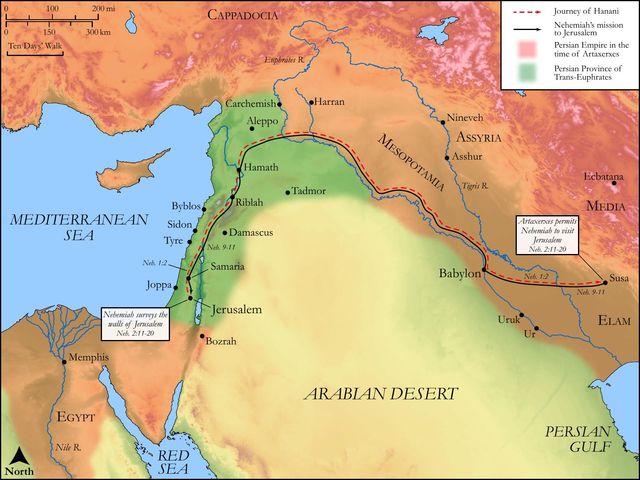
Jerusalem had endured over a century of profound desolation following its catastrophic destruction by the Babylonians in 586 BC (2 Kings 25:8-10). Although earlier waves of exiles had returned under leaders like Zerubbabel and Ezra, their primary focus had been on rebuilding the Temple (Ezra 3) and re-establishing spiritual worship. However, the city's formidable defensive walls remained in a state of utter disrepair, leaving Jerusalem vulnerable to attack and its inhabitants disheartened. Nehemiah, serving as the trusted cupbearer to the powerful Persian king Artaxerxes I (reigned 465-424 BC), was granted an extraordinary and unprecedented commission to rebuild these crucial walls. His arduous journey from Susa to Jerusalem was a significant undertaking, and his arrival would have been met with a complex mixture of hope, skepticism, and perhaps even suspicion. The specific landmarks mentioned—the "gate of the valley," the "dragon well," and the "dung port"—were identifiable features on Jerusalem's western and southern sides, indicating a methodical and comprehensive survey of the most neglected and vulnerable sections of the city's perimeter.
Key Themes
ShowHideThis verse profoundly illustrates several foundational themes central to the book of Nehemiah. Firstly, it exemplifies Diligent and Prudent Leadership, as Nehemiah does not merely rely on secondhand reports but personally assesses the immense challenge before him, embodying a hands-on, meticulous approach to problem-solving. Secondly, it highlights the essential theme of Confronting Reality, as Nehemiah directly faces the stark devastation of Jerusalem's defenses—walls "broken down" and gates "consumed with fire"—a painful but absolutely necessary step before any meaningful restoration can commence. Thirdly, his nocturnal journey underscores Strategic Planning and Discretion, demonstrating a leader who understands the critical need for careful, often discreet, assessment to avoid premature opposition or public alarm, echoing the timeless wisdom found in Proverbs 24:27. Finally, Nehemiah's inspection powerfully foreshadows the overarching theme of Divine Restoration and Rebuilding, setting the stage for the monumental work that will follow, a work driven by his unwavering vision and the undeniable "good hand" of God upon him (Nehemiah 2:8).
Exposition and Analysis
ShowHideKey Word Analysis
ShowHideThis primitive root signifies a deliberate and purposeful departure, often implying a movement from an inner state or location to an outer one. Nehemiah's action of "going out" by night is not casual but intentional, marking his transition from a period of prayerful waiting and observation to active, practical investigation. It highlights his resolve to personally engage with the ruins, initiating the tangible work of his mission.
While the KJV translates this as "viewed," the Hebrew root implies a more intense action: "to scrutinize" or "to expect with hope and patience." Nehemiah was not merely glancing but diligently examining, carefully inspecting every detail of the broken walls and gates. This word emphasizes the meticulous and thorough nature of his reconnaissance, reflecting a leader who seeks a precise understanding of the challenge, imbued with the patient hope for future restoration.
This term describes a violent breach or collapse, indicating not merely decay from neglect but intentional, forceful destruction. It vividly portrays the devastating impact of the Babylonian siege, emphasizing the complete vulnerability of Jerusalem without its protective walls. The word conveys a sense of utter ruin and a massive breach, underscoring the monumental scale of the rebuilding task that lay before Nehemiah.
Verse Breakdown
ShowHide"And I went out by night by the gate of the valley"
Nehemiah's strategic decision to conduct this crucial inspection "by night" reveals his prudence and foresight. This clandestine approach aimed to avoid drawing immediate attention from potential adversaries (such as Sanballat and Tobiah, later introduced in Nehemiah 2:10) and to prevent premature excitement or alarm among the Jewish populace. The "gate of the valley" was likely situated on the western side of Jerusalem, providing access to the Hinnom Valley, and served as a logical starting point for a comprehensive circuit of the city's defenses.
"even before the dragon well, and to the dung port"
These specific landmarks further delineate Nehemiah's methodical route, indicating a thorough survey of the city's southern and southwestern perimeter. The "dragon well" (likely the En-rogel spring or a nearby, perhaps neglected, fountain) and the "dung port" (also known as the "refuse gate," used for waste disposal and located on the southern wall) suggest Nehemiah was systematically examining the most neglected, debris-laden, and vulnerable sections of the city. This detailed itinerary underscores his commitment to a comprehensive assessment, leaving no significant area uninspected.
"and viewed the walls of Jerusalem, which were broken down, and the gates thereof were consumed with fire"
This concluding clause presents the stark and devastating reality Nehemiah personally confronted. The walls were not simply crumbling from age but were "broken down," signifying a violent breach and widespread destruction. Crucially, the gates, which were the primary points of entry and defense, were not merely missing but "consumed with fire," a clear and painful testament to the thoroughness of the Babylonian destruction. This firsthand, visceral observation provided Nehemiah with an undeniable understanding of the immense challenge ahead, solidifying his resolve and directly informing his subsequent strategic plans for the city's reconstruction.
Literary Devices
ShowHideNehemiah 2:13 masterfully employs several literary devices to convey the gravity of Jerusalem's state and the character of its leader. The prominent use of Imagery paints a desolate picture with phrases like "broken down" walls and gates "consumed with fire," allowing the reader to vividly visualize the extent of Jerusalem's ruin and vulnerability. The Contrast between Nehemiah's quiet, solitary, nocturnal journey and the immense, public task of rebuilding that awaits him highlights his personal commitment, strategic discernment, and the profound weight of his mission. The inclusion of specific geographical landmarks such as the "gate of the valley," "dragon well," and "dung port" serves as Topographical Detail, lending authenticity and realism to Nehemiah's account. This meticulous detail not only grounds his spiritual mission in the tangible reality of the devastated city but also underscores Nehemiah's thoroughness and the methodical approach he took to his divinely appointed task.
Theological and Thematic Connections
ShowHideNehemiah's nocturnal inspection of Jerusalem's ruins is a profound act of leadership rooted in a deep sense of divine calling and personal responsibility. Theologically, it powerfully demonstrates the principle that effective action, even divinely inspired action, necessitates a diligent and honest assessment of reality. Nehemiah does not rely on secondhand reports or distant prayers alone; he confronts the brokenness firsthand, a painful but indispensable step for genuine restoration. This act mirrors, in a human way, God's own engagement with humanity's fallen state, where He fully comprehends the depth of sin and brokenness before initiating His grand redemptive plan. Spiritually, this verse serves as a potent metaphor for the essential need to honestly assess areas of spiritual decay, neglect, or unaddressed sin in our own lives, our families, our communities, or our churches before we can truly begin the work of repentance, renewal, and rebuilding. Just as Nehemiah surveyed the physical ruins, we are called to examine our spiritual landscape, acknowledging the "broken down walls" that hinder our walk with God and impede our collective witness to the world.
Reflection and Application
ShowHideNehemiah 2:13 offers profound and timeless wisdom for individuals and communities grappling with daunting challenges. Nehemiah's courageous willingness to personally confront the devastation, even under the cloak of night, teaches us the vital importance of honest self-assessment and courageous engagement with difficult realities. We are often tempted to avoid, minimize, or ignore the "broken down walls" in our own lives—whether they manifest as relational strains, spiritual apathy, unaddressed sin, or pervasive injustices within our communities. Yet, true and lasting progress invariably begins with acknowledging the full, unvarnished extent of the damage. Like Nehemiah, we are called to move beyond mere observation to a diligent, prayerful, and strategic assessment of what truly needs to be rebuilt. This requires profound humility to see our own shortcomings, unwavering courage to face uncomfortable truths, and steadfast faith to believe that God can indeed use us to bring about restoration, even in seemingly impossible or overwhelming situations. Our "night inspections" might involve periods of quiet prayer and introspection, seeking God's illuminating perspective on areas of our lives that desperately need His reconstructive work, or perhaps a sober, compassionate analysis of areas in our communities that cry out for justice, healing, and Christ-centered transformation.
Questions for Reflection
ShowHideFAQ
ShowHideWhy did Nehemiah conduct his inspection at night?
ShowHideNehemiah conducted his inspection at night primarily for strategic and prudential reasons. Firstly, it allowed him to assess the full extent of the damage to Jerusalem's walls and gates without drawing immediate attention from potential adversaries, such as Sanballat the Horonite and Tobiah the Ammonite official, who were already hostile to any efforts to restore Jerusalem (Nehemiah 2:10). Their opposition would become a significant and persistent challenge later in the book. Secondly, a nocturnal survey prevented premature excitement or alarm among the Jewish populace, allowing Nehemiah to formulate a comprehensive and well-considered plan before publicly revealing the immense task ahead and calling the people to action (Nehemiah 2:17-18). This discretion ensured he could gather accurate information and strategize effectively before mobilizing the community for such a monumental undertaking.
What was the significance of the "gate of the valley," "dragon well," and "dung port"?
ShowHideThese were specific, identifiable landmarks around Jerusalem's perimeter, indicating Nehemiah's methodical and comprehensive route. The "gate of the valley" was likely on the western side, near the Hinnom Valley, a common starting point for circuits. The "dragon well" (possibly the En-rogel spring or a nearby, perhaps neglected, fountain) and the "dung port" (or "refuse gate," located on the southern wall and used for waste disposal) were situated in areas that would have been particularly neglected and filled with debris. By visiting these specific points, Nehemiah was not just taking a casual walk but conducting a thorough, systematic survey of the most vulnerable and dilapidated sections of the city's defenses. This meticulous geographical knowledge was crucial for his planning, the effective allocation of resources, and his subsequent ability to motivate the people to rebuild.
How long had Jerusalem's walls been in this state of disrepair?
ShowHideJerusalem's walls had been in a state of profound disrepair for well over a century, specifically since their catastrophic destruction by the Babylonians under Nebuchadnezzar in 586 BC (2 Kings 25:8-10). While some exiles had returned under Zerubbabel and later Ezra, their primary focus had been on rebuilding the Temple and restoring religious life and the law. The city itself, particularly its vital defensive walls, remained largely unprotected and in ruins. Nehemiah's arrival in 445 BC means that the walls had been broken down for approximately 141 years, underscoring the monumental, long-overdue, and seemingly impossible nature of his rebuilding project.
Christ-Centered Fulfillment
ShowHideNehemiah's diligent inspection of Jerusalem's broken walls, though a historical act of physical restoration, finds profound Christ-centered fulfillment in the person and redemptive work of Jesus. Just as Nehemiah surveyed the external ruins of a city, Jesus, the ultimate Builder and Restorer, came to survey the internal brokenness of humanity and the spiritual ruins of a world consumed by sin. He did not merely receive reports of humanity's fallen state but personally entered into it, taking on flesh (John 1:14) to fully comprehend the depth of our spiritual devastation. His earthly ministry was a "night inspection" of sorts, moving through the darkness of human suffering, sickness, and sin, revealing the true extent of spiritual brokenness before embarking on the ultimate work of restoration through His atoning sacrifice. The "broken down walls" and "consumed gates" of Jerusalem prefigure the spiritual barriers that separate humanity from God (Isaiah 59:2) and the vulnerability of a life without divine protection. Christ, through His sacrificial death and glorious resurrection, not only rebuilds these spiritual walls, establishing His church as a fortified, unassailable city (Matthew 16:18), but He also becomes the "gate" (John 10:9) through whom we find salvation and secure access to God. He is the ultimate restorer who takes what is broken and consumed by the fire of sin's judgment and makes it new, offering spiritual security, eternal life, and complete renewal to all who believe (Revelation 21:5).