


Nehemiah 2:9
Bible text: King James Version (1769 Blayney text) · Public domain
Bible text: King James Version with Strong's numbers · Public domain
Bible text: Berean Standard Bible · Public domain
Bible text: American Standard Version (1901) · Public domain
Bible text: World English Bible, Messianic edition · Public domain
Bible text: Geneva Bible (1599) · Public domain
Bible text: Young's Literal Translation · Public domain
- וָאָבוֹאva·'a·Vo'and I wentH935Conj-w ¦ V-Qal-ConsecImperf-1csVerb Qal Consecutive Imperfect 1st Singular common genderוָandאָבוֹאI went
- אֶל'eltoH413PrepPreposition
- פַּחֲווֹתpa·cha·Vot[the] governors ofH6346N-fpcNoun Plural Feminine Construct
- עֵבֶר'E·verbeyondH5676N-mscNoun Singular Masculine Construct
- הַנָּהָרha·na·Harthe RiverH5104Art ¦ N-properNoun Proper LocationהַtheנָּהָרRiver
- וָאֶתְּנָהva·'e·te·Nahand I gave !H5414Conj-w ¦ V-Qal-ConsecImperf-1cs ¦ SfxVerb Qal Consecutive Imperfect 1st Singular common genderוָandאֶתְּנָI gaveה!
- לָהֶםla·Hemto themPrep-l ¦ 3mpSuffix Personal 3rd Plural Masculineלָtoהֶםthem
- אֵת'et<obj.>H853DirObjMParticle Object Indicator
- אִגְּרוֹת'i·ge·Rot[the] letters ofH107N-fpcNoun Plural Feminine Construct
- הַמֶּלֶךְha·Me·lekhthe kingH4428Art ¦ N-msNoun Singular Masculine Absoluteהַtheמֶּלֶךְking
- וַיִּשְׁלַחvai·yish·Lachand he had sentH7971Conj-w ¦ V-Qal-ConsecImperf-3msVerb Qal Consecutive Imperfect 3rd Singular Masculineוַandיִּשְׁלַחhe had sent
- עִמִּי'i·Miwith meH5973Prep ¦ 1csPrepositionעִמִּwithיme
- הַמֶּלֶךְha·Me·lekhthe kingH4428Art ¦ N-msNoun Singular Masculine Absoluteהַtheמֶּלֶךְking
- שָׂרֵיSa·reicommanders ofH8269N-mpcNoun Plural Masculine Construct
- חַיִלCha·yil[the] armyH2428N-msNoun Singular Masculine Absolute
- וּפָרָשִׁיםu·fa·ra·Shimand horsemenH6571Conj-w ¦ N-mpNoun Plural Masculine Absoluteוּandפָרָשִׁיםhorsemen
English is a literal word-by-word gloss of the Hebrew, not the KJV's wording. Why?
This is the original text the KJV's translators worked from — each Hebrew word with its own literal English meaning in this verse, prepared by scholars at Tyndale House, Cambridge. The KJV translates whole sentences, not word by word, so its wording differs: one Hebrew word can become several English words, and the KJV may choose “the LORD” where the gloss reads “Yahweh”. Both are faithful — they answer different questions. For the KJV's own rendering, switch to the KJV text.
Details
See on the biblical-era maps
Study this verse
Public-domain commentary
Matthew Henry
From his Commentary on the Whole Bible. Henry comments on passages, not single verses — this entry covers Nehemiah 2:9–20. His four-level outline is real structure in the source text, so it is rendered as structure.
We are here told,
I.Now Nehemiah was dismissed by the court he was sent from.
The king appointed captains of the army and horsemen to go with him (Neh 2:9), both for his guard and to show that he was a man whom the king did delight to honour, that all the king's servants might respect him accordingly. Those whom the King of kings sends he thus protects, he thus dignifies with a host of angels to attend them.
II.How he was received by the country he was sent to.
1.By the Jews and their friends at Jerusalem. We are told,
(1.)That while he concealed his errand they took little notice of him. He was at Jerusalem three days (Neh 2:11), and it does not appear that any of the great men of the city waited on him to congratulate him on his arrival, but he remained unknown. The king sent horsemen to attend him, but the Jews sent none to meet him; he had no beast with him, but that which he himself rode on, Neh 2:12. Wise men, and those who are worthy of double honour, yet covet not to come with observation, to make a show, or make a noise, no, not when they come with the greatest blessings. Those that shortly are to have the dominion in the morning the world now knows not, but they lie hid, Jo1 3:1.
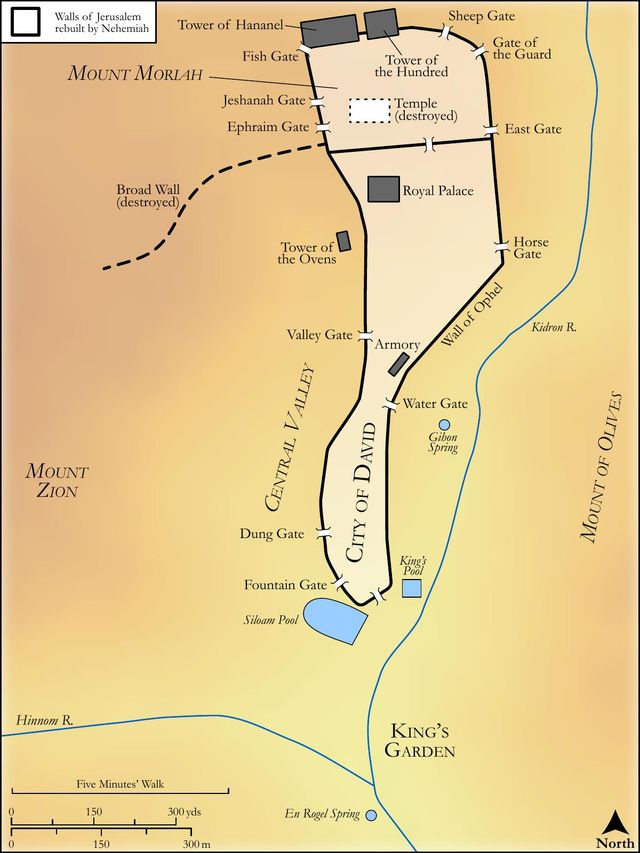
(2.)That though they took little notice of him he took great notice of them and their state. He arose in the night, and viewed the ruins of the walls, probably by moon-light (Neh 2:13), that he might see what was to be done and in what method they must go about it, whether the old foundation would serve, and what there was of the old materials that would be of use. Note,
[1.]Good work is likely to be well done when it is first well considered.
[2.]It is the wisdom of those who are engaged in public business, as much as may be, to see with their own eyes, and not to proceed altogether upon the reports and representations of others, and yet to do this without noise, and if possible unobserved.
[3.]Those that would build up the church's walls must first take notice of the ruins of those walls. Those that would know how to amend must enquire what is amiss, what needs reformation, and what may serve as it is.
(3.)That when he disclosed his design to the rulers and people they cheerfully concurred with him in it. He did not tell them, at first, what he came about (Neh 2:16), because he would not seem to do it for ostentation, and because, if he found it impracticable, he might retreat the more honourably. Upright humble men will not sound a trumpet before their alms or any other of their good offices. But when he had viewed and considered the thing, and probably felt the pulse of the rulers and people, he told them what God had put into his heart (Neh 2:12), even to build up the wall of Jerusalem, Neh 2:17. Observe,
[1.]How fairly he proposed the undertaking to them: "You see the distress we are in, how we lie exposed to the enemies that are round about us, how justly they reproach us as foolish and despicable, how easily they may make a prey of us whenever they have a mind; come, therefore, and let us build up the wall." He did not undertake to do the work without them (it could not be the work of one man), nor did he charge or command imperiously, though he had the king's commission; but in a friendly brotherly way he exhorted and excited them to join with him in this work. To encourage them hereto, he speaks of the design, First, As that which owed it origin to the special grace of God. He takes not the praise of it to himself, as a good thought of his own, but acknowledges that God put it into his heart, and therefore they all ought to countenance it (whatever is of God must be promoted), and might hope to prosper in it, for what God puts men upon he will own them in. Secondly, As that which owed its progress hitherto to the special providence of God. He produced the king's commission, told them how readily it was granted and how forward the king was to favour his design, in which he saw the hand of his God good upon him. It would encourage both him and them to proceed in an undertaking which God had so remarkably smiled upon. Thus he proposed it to them; and,
[2.]They presently came to a resolution, one and all, to concur with him: Let us rise up and build. They are ashamed that they have sat still so long without so much as attempting this needful work, and now resolve to rise up out of their slothfulness, to bestir themselves, and to stir up one another. "Let us rise up," that is, "let us do it with vigour, and diligence, and resolution, as those that are determined to go through with it." So they strengthened their hands, their own and one another's, for this good work. Note, First, Many a good work would find hands enough to be laid to it if there were but one good head to lead in it. They all saw the desolations of Jerusalem, yet none proposed the repair of them; but, when Nehemiah proposed it, they all consented to it. It is a pity that a good motion should be lost purely for want of one to move it and to break the ice in it. Secondly, By stirring up ourselves and one another to that which is good, we strengthen ourselves and one another for it; for the great reason why we are weak in our duty is because we are cold to it, indifferent and unresolved. Let us now see how Nehemiah was received,
2.By those that wished ill to the Jews. Those whom God and his Israel blessed they cursed.
(1.)When he did but show his face it vexed them, Neh 2:10. Sanballat and Tobiah, two of the Samaritans, but by birth the former a Moabite, the latter an Ammonite, when they saw one come armed with a commission from the king to do service to Israel, were exceedingly grieved that all their little paltry arts to weaken Israel were thus baffled and frustrated by a fair, and noble, and generous project to strengthen them. Nothing is a greater vexation to the enemies of good people, who have misrepresented them to princes as turbulent, and factious, and not fit to live, than to see them stand right in the opinion of their rulers, their innocency cleared and their reproach rolled away, and that they are thought not only fit to live, but fit to be trusted. When they saw a man come in that manner, who professedly sought the welfare of the children of Israel, it vexed them to the heart. The wicked shall see it, and be grieved.
(2.)When he began to act they set themselves to hinder him, but in vain, Neh 2:19, Neh 2:20.
[1.]See here with what little reason the enemies attempted to discourage him. They represented the undertaking as a silly thing: They laughed us to scorn and despised us as foolish builders, that could not finish what we began. They represented the undertaking also as a wicked thing, no better than treason: Will you rebel against the king? Because this was the old invidious charge, though now they had a commission from the king and were taken under his protection, yet still they must be called rebels.
[2.]See also with what good reason the Jews slighted these discouragements. They bore up themselves with this that they were the servants of the God of heaven, the only true and living God, that they were acting for him in what they did, and that therefore he would bear them out and prosper them, though the heathen raged, Psa 2:1. They considered also that the reason why these enemies did so malign them was because they had no right in Jerusalem, but envied them their right in it. Thus may the impotent menaces of the church's enemies be easily despised by the church's friends.
Continue studying Nehemiah 2:9 across the web’s major study libraries — every link below opens this exact verse, chapter, or book on the destination site.
Read & Compare
 BibleGatewayThis verse in more than 200 translations and 70 languages.
 Bible.comThe YouVersion reader — hundreds of translations, reading plans, and highlights.
 ESV.orgCrossway's official English Standard Version reader.
 NET BibleThe NET translation with 60,000+ translators' notes on every rendering decision.
 STEP BibleTyndale House's free study tool — original text, vocabulary, and scholarly resources.
 BibliaLogos Bible Software's free web reader.
 USCCBThe New American Bible (Revised Edition) with the U.S. bishops' study notes.
Commentaries
 BibleHub CommentariesDozens of classic commentaries on this verse, gathered on one page.
 StudyLightMore than 100 commentary sets — the largest collection on the web.
 BibleRefPlain-English commentary on what this verse means, verse by verse.
 Enduring WordDavid Guzik's free commentary on this chapter, widely used by Bible teachers.
 Bible Study ToolsVerse commentary alongside Greek and Hebrew study aids.
Original Language & Research
- BibleHub InterlinearThe verse word by word — original language, transliteration, and English.
- BibleHub LexiconEvery word's original-language definition and Strong's entry.
 Blue Letter BibleDeep-study tools — Strong's numbers, concordance, and word studies.
 SefariaThe Hebrew text with Rashi and centuries of Jewish commentary.
Sermons, Hymns & Audio


TrulyRandomVerse is not affiliated with these sites and doesn’t control their content. They’re linked because they’re genuinely useful.
Summary
Nehemiah 2:9 marks a pivotal moment in Nehemiah's divinely ordained mission, signifying his successful arrival in the Persian satrapy of Trans-Euphrates. This verse details his formal presentation of King Artaxerxes' official letters to the regional governors, an act that unequivocally established his authority and the legitimacy of his undertaking. The accompanying military escort, comprising army captains and horsemen, powerfully underscores the king's full backing and the strategic importance of Nehemiah's journey, providing both essential protection and a clear demonstration of royal favor for the daunting task of rebuilding Jerusalem's walls.
Context
ShowHideLiterary Context
This verse is strategically placed at the culmination of Nehemiah's fervent preparations and the active commencement of his arduous journey to Jerusalem. It follows directly from Nehemiah's profound distress over Jerusalem's desolate state, as reported in Nehemiah 1:3, which prompted months of earnest prayer and fasting, seeking God's favor and guidance (Nehemiah 1:4-11). His courageous and audacious request to King Artaxerxes I, risking his life and esteemed position as cupbearer, is meticulously recounted in Nehemiah 2:1-8. The king's surprising and generous response, granting Nehemiah's requests for timber and safe passage, is explicitly attributed to "the good hand of my God upon me" in Nehemiah 2:8. Therefore, Nehemiah 2:9 represents the tangible manifestation of that divine favor and royal authorization, transitioning the narrative from heartfelt petition and strategic planning to the active implementation of the mission on the ground.
Historical & Cultural Context
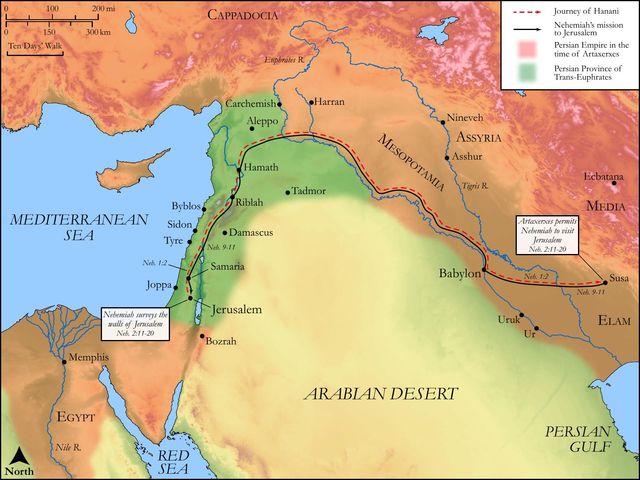
The phrase "governors beyond the river" refers specifically to the Persian satrapy known as Abar-Nahara or Trans-Euphrates, a vast administrative territory situated west of the Euphrates River, encompassing regions like Judah, Samaria, Syria, and Phoenicia. The Persian Empire was renowned for its highly organized and centralized administration, and royal letters, often termed firmans, were official decrees carrying the absolute authority of the Great King. Such documents were indispensable for facilitating travel and operations across provincial boundaries, compelling local authorities to cooperate fully. A military escort, consisting of "captains of the army and horsemen," was far more than a mere ceremonial gesture; it was a practical and strategic necessity for a journey of this magnitude and political sensitivity. This formidable escort provided crucial security against bandits and potential political adversaries, while simultaneously signaling the king's personal endorsement of Nehemiah. This ensured that his mission would be taken with utmost seriousness by provincial governors, some of whom might have harbored hostility towards Jerusalem's resurgence, given its history of rebellion against imperial rule, as seen in earlier opposition to rebuilding (Ezra 4:7-24).
Key Themes
ShowHideNehemiah 2:9 powerfully illustrates several core themes central to the book of Nehemiah and broader biblical theology. Firstly, Divine Sovereignty and Favor, demonstrating how God sovereignly orchestrates events and moves the hearts of even pagan rulers (Proverbs 21:1) to accomplish His redemptive purposes for His people. Nehemiah's remarkable success was not solely due to his diplomatic skill but fundamentally to divine enablement. Secondly, Strategic Leadership and Preparation, as Nehemiah did not embark impulsively but meticulously secured all necessary provisions, authority, and protection before setting out. This highlights the vital importance of combining fervent prayer with wise, diligent planning and practical foresight in God's work, echoing principles found in Luke 14:28-30. Thirdly, Protection and Provision, as the king's letters and the military escort were tangible, providential expressions of God's care for Nehemiah, shielding him from dangers and ensuring access to the resources essential for the monumental task of rebuilding. This reinforces the broader biblical theme that God faithfully provides for and protects those whom He calls and sends (Psalm 121:7-8).
Exposition and Analysis
ShowHideKey Word Analysis
ShowHideThese were high-ranking Persian officials, essentially viceroys or prefects, appointed directly by the king to administer specific provinces or satrapies within the vast empire. They wielded significant political, judicial, and military authority, responsible for maintaining order, collecting taxes, and enforcing royal decrees. Nehemiah's act of presenting the king's letters to these pechâh was a crucial diplomatic protocol, essential for gaining their official recognition and securing their cooperation, as they were the ultimate imperial authority in their respective regions and could either facilitate or obstruct his mission.
This term refers to official royal epistles or decrees, carrying the full weight and authority of the Persian king, Artaxerxes. These were not mere recommendations but binding commands, bearing the king's seal, which mandated safe passage for Nehemiah, instructed provincial officials to provide him with necessary supplies (specifically timber from the king's forests), and authorized his mission to rebuild Jerusalem's walls. Their presentation was a non-negotiable step to validate Nehemiah's credentials and ensure compliance from the local administration, without which his journey and mission would have faced insurmountable bureaucratic and political obstacles.
This primitive root signifies "to send away, for, or out" with a wide variety of applications, emphasizing the act of commissioning or dispatching. In this context, it highlights the king's direct and deliberate action in dispatching the military escort with Nehemiah. This was not a casual accompaniment but a purposeful assignment of royal power and protection, underscoring the king's personal investment in Nehemiah's mission and the gravity with which he viewed the undertaking. The verb implies a formal, authoritative sending, lending immense weight to Nehemiah's journey.
Verse Breakdown
ShowHide"Then I came to the governors beyond the river"
This clause marks Nehemiah's successful and secure arrival in the administrative heart of the Trans-Euphrates satrapy. It signifies the crucial transition from the phase of prayer, petition, and preparation in Susa to the active, on-the-ground execution of his mission within the territories leading to Jerusalem. His presence before these powerful regional rulers demonstrates the initial triumph of his diplomatic efforts and the tangible evidence of God's protective hand guiding his journey thus far, bringing him safely to the threshold of his monumental task.
"and gave them the king's letters"
This action was a formal, indispensable diplomatic procedure. By presenting these royal decrees, Nehemiah officially established his authority and the absolute legitimacy of his mission in the eyes of the Persian provincial administration. These letters were not merely polite introductions but authoritative commands from the Great King, obligating the governors to facilitate Nehemiah's passage, ensure his safety, and provide the necessary resources, particularly the timber crucial for rebuilding Jerusalem's gates and walls. This act secured the necessary political and logistical infrastructure for his work.
"Now the king had sent captains of the army and horsemen with me"
This final clause highlights the extraordinary nature and significance of Nehemiah's escort. The presence of high-ranking military commanders and cavalry unequivocally underscored the king's full, personal endorsement and profound commitment to Nehemiah's mission. This formidable escort served multiple vital purposes: it provided robust physical protection against the inherent dangers of long-distance travel in antiquity (such as bandits or hostile local factions), it lent immense prestige and undeniable authority to Nehemiah, and it sent an unmistakable message to any potential adversaries or reluctant officials that Nehemiah's work was sanctioned and protected by the highest power in the empire, demanding their immediate and full cooperation.
Literary Devices
ShowHideNehemiah 2:9 employs several literary devices to convey its profound meaning. Most prominently, there is Symbolism. The "king's letters" symbolize the legal, political, and divine legitimacy granted to Nehemiah's mission, representing the formal authorization from the highest earthly power, providentially aligned with God's will. The "captains of the army and horsemen" symbolize the raw power, protection, and overwhelming authority of the Persian Empire placed at Nehemiah's disposal. This dual symbolism underscores that Nehemiah was not acting on his own initiative but as a fully authorized agent of a powerful monarch, whose will was being enacted. There is also an element of Foreshadowing, as this impressive display of power and authority, while protective, implicitly hints at the significant opposition Nehemiah would inevitably face. The very necessity of such a formidable escort suggests the inherent dangers, political sensitivities, and the magnitude of the challenges that lay ahead in rebuilding Jerusalem, particularly from figures like Sanballat and Tobiah, who would view this royal backing as a direct threat to their regional influence. The meticulous detail in this verse also functions as Verisimilitude, lending credibility and realism to Nehemiah's account by describing the practicalities of a royal mission in the Persian Empire.
Theological and Thematic Connections
ShowHideNehemiah 2:9 powerfully illustrates the profound theological truth that God sovereignly works through both spiritual and seemingly secular means to accomplish His divine purposes. While Nehemiah's fervent prayer and unwavering reliance on God's "good hand" were absolutely paramount, God's answer manifested through the earthly channels of a pagan king's official decree and the deployment of imperial military might. This demonstrates God's absolute sovereignty over all earthly powers, revealing His ability to use even those who do not acknowledge Him to advance His kingdom and restore His people. It affirms that divine favor often manifests in tangible, practical provisions, such as open doors, strategic connections, and providential protection in the midst of challenging circumstances. For the believer today, this verse serves as a potent reminder to engage in fervent prayer for God's intervention, but also to humbly recognize and wisely utilize the providential means He provides, whether they be official authorizations, strategic partnerships, unexpected resources, or even the cooperation of unlikely individuals, all orchestrated by His unseen hand for His glory.
Reflection and Application
ShowHideNehemiah's journey, so clearly marked by divine favor and practical provision, offers profound and enduring lessons for believers in every generation. Just as Nehemiah did not presumptuously embark on his mission without careful preparation, but diligently sought the king's permission and wisely utilized the provided resources, we are similarly called to combine fervent, persistent prayer with strategic, diligent action. God frequently opens doors and provides the necessary means—be it financial resources, influential connections, protective measures, or even specific skills—for His work to be accomplished through us. This verse profoundly encourages us to be meticulous in our preparation, to respect and work within established authorities where possible, and to trust implicitly that God's "good hand" is actively at work, even in the most mundane, bureaucratic, or seemingly secular details of our lives and ministries. It challenges us to step out in faith and courage, even when the path ahead appears fraught with potential opposition or overwhelming obstacles, confident that if God has called us to a task, He will also faithfully equip, protect, and provide for us, often in ways that far exceed our human expectations or imagination.
Questions for Reflection
ShowHideFAQ
ShowHideWho were the "governors beyond the river" and why were they important for Nehemiah's mission?
ShowHideThe "governors beyond the river" (Hebrew: peḥot ʿēḇer hanāhār) were the high-ranking Persian provincial administrators responsible for the vast satrapy located west of the Euphrates River. This extensive region included significant territories such as Judah, Samaria, Syria, and Phoenicia. They were critically important for Nehemiah's mission because they held ultimate political, military, and administrative authority in their respective provinces, enforcing the king's laws, collecting taxes, and maintaining order. Nehemiah needed their explicit cooperation, recognition, and authorization to travel safely, access vital resources (like timber for rebuilding), and ultimately rebuild Jerusalem's walls without obstruction. Presenting the king's letters to them was a non-negotiable diplomatic step to legitimize his mission and secure their compliance, ensuring that his work would be perceived as an official royal undertaking, rather than a rebellious or unauthorized act. Their potential opposition, as seen later with Sanballat and Tobiah, made their initial cooperation absolutely essential for the project's success.
Why did Nehemiah need "captains of the army and horsemen" for his journey, and what did this signify?
ShowHideThe military escort provided by King Artaxerxes served multiple critical purposes, signifying the immense importance and official backing of Nehemiah's mission. Firstly, it offered essential physical protection against the inherent dangers of long journeys in that day, which were often plagued by bandits and potential local hostilities. Secondly, and perhaps more significantly, it conferred immense authority and prestige upon Nehemiah. The presence of royal troops, led by army captains, signaled unequivocally that Nehemiah was not merely a messenger but a high-ranking official on a mission of paramount importance directly from the king himself. This formidable display of royal backing was crucial for commanding respect and ensuring compliance from the provincial governors and other local authorities, some of whom might have been inclined to obstruct the rebuilding of Jerusalem, a city with a documented history of rebellion against imperial rule (Ezra 4:11-16). The escort thus served as a powerful deterrent to any potential adversaries, demonstrating that Nehemiah's work was under the direct protection and sanction of the highest power in the Persian Empire.
Christ-Centered Fulfillment
ShowHideNehemiah's journey, empowered by royal authority and protected by a formidable military escort, serves as a powerful and poignant foreshadowing of the ultimate mission and supreme authority of Jesus Christ. Just as Nehemiah was sent by an earthly king to rebuild a physical city and its walls, Jesus, the Son of God, was sent by the Heavenly Father with all authority in heaven and on earth (Matthew 28:18) to accomplish a far greater work of spiritual restoration, redemption, and rebuilding. Nehemiah's "king's letters" find their ultimate fulfillment in the divine mandate given to Christ, who came not merely with written decrees but as the living Word of God, embodying divine truth, power, and the very will of the Father (John 1:1-3 and John 14:9). The earthly military escort that protected Nehemiah, while impressive, pales in comparison to the spiritual authority and the countless heavenly hosts that accompany Christ and His church, providing ultimate protection and ensuring the triumphant success of His mission to build His spiritual temple, the church, upon Himself as the cornerstone (Ephesians 2:19-22). While Nehemiah faced significant earthly opposition in his task, Christ triumphed decisively over all spiritual adversaries and the powers of darkness, securing not merely a rebuilt earthly city but the eternal city, the New Jerusalem, where God's redeemed people will dwell in perfect peace and everlasting fellowship with Him (Revelation 21:1-4). Nehemiah's mission was a temporary, physical restoration; Christ's is a permanent, spiritual redemption, making Him the true and ultimate builder of God's eternal kingdom.