


1 Kings 16:29
Bible text: King James Version (1769 Blayney text) · Public domain
Bible text: King James Version with Strong's numbers · Public domain
Bible text: Berean Standard Bible · Public domain
Bible text: American Standard Version (1901) · Public domain
Bible text: World English Bible, Messianic edition · Public domain
Bible text: Geneva Bible (1599) · Public domain
Bible text: Young's Literal Translation · Public domain
- וְאַחְאָבve·'ach·'Avand AhabH256Conj-w ¦ N-proper-mNoun Proper MasculineוְandאַחְאָבAhab
- בֶּןben[the] son ofH1121N-mscNoun Singular Masculine Construct
- עָמְרִי'a·me·RiOmriH6018N-proper-mNoun Proper Masculine
- מָלַךְma·laKhhe became kingH4427V-Qal-Perf-3msVerb Qal Perfect 3rd Singular Masculine
- עַל'aloverH5921PrepPreposition
- יִשְׂרָאֵלYis·ra·'ElIsraelH3478N-properNoun Proper Location
- בִּשְׁנַתbish·Natin yearH8141Prep-b ¦ N-fscNoun Singular Feminine Constructבִּinשְׁנַתyear
- שְׁלֹשִׁיםshe·lo·ShimthirtyH7970N-mpNoun Plural Masculine Absolute
- וּשְׁמֹנֶהu·she·mo·Nehand eightH8083Conj-w ¦ N-csNoun Singular common gender Absoluteוּandשְׁמֹנֶהeight
- שָׁנָהsha·NahyearH8141N-fsNoun Singular Feminine Absolute
- לְאָסָאle·'a·Sa'of AsaH609Prep-l ¦ N-proper-mNoun Proper MasculineלְofאָסָאAsa
- מֶלֶךְMe·lekh[the] king ofH4428N-mscNoun Singular Masculine Construct
- יְהוּדָהye·hu·DahJudahH3063N-properNoun Proper Location
- וַיִּמְלֹךְVai·yim·lokhand he reignedH4427Conj-w ¦ V-Qal-ConsecImperf-3msVerb Qal Consecutive Imperfect 3rd Singular Masculineוַandיִּמְלֹךְhe reigned
- אַחְאָב'ach·'AvAhabH256N-proper-mNoun Proper Masculine
- בֶּןben[the] son ofH1121N-mscNoun Singular Masculine Construct
- עָמְרִי'a·me·RiOmriH6018N-proper-mNoun Proper Masculine
- עַל'aloverH5921PrepPreposition
- יִשְׂרָאֵלYis·ra·'ElIsraelH3478N-properNoun Proper Location
- בְּשֹׁמְרוֹןbe·Sho·me·Ronin SamariaH8111Prep-b ¦ N-properNoun Proper LocationבְּinשֹׁמְרוֹןSamaria
- עֶשְׂרִים'es·RimtwentyH6242N-mpNoun Plural Masculine Absolute
- וּשְׁתַּיִםu·she·Ta·yimand twoH8147Conj-w ¦ N-fdNoun Dual Feminine Absoluteוּandשְׁתַּיִםtwo
- שָׁנָהsha·Nahyear[s]H8141N-fsNoun Singular Feminine Absolute
English is a literal word-by-word gloss of the Hebrew, not the KJV's wording. Why?
This is the original text the KJV's translators worked from — each Hebrew word with its own literal English meaning in this verse, prepared by scholars at Tyndale House, Cambridge. The KJV translates whole sentences, not word by word, so its wording differs: one Hebrew word can become several English words, and the KJV may choose “the LORD” where the gloss reads “Yahweh”. Both are faithful — they answer different questions. For the KJV's own rendering, switch to the KJV text.
Details
See on the biblical-era maps

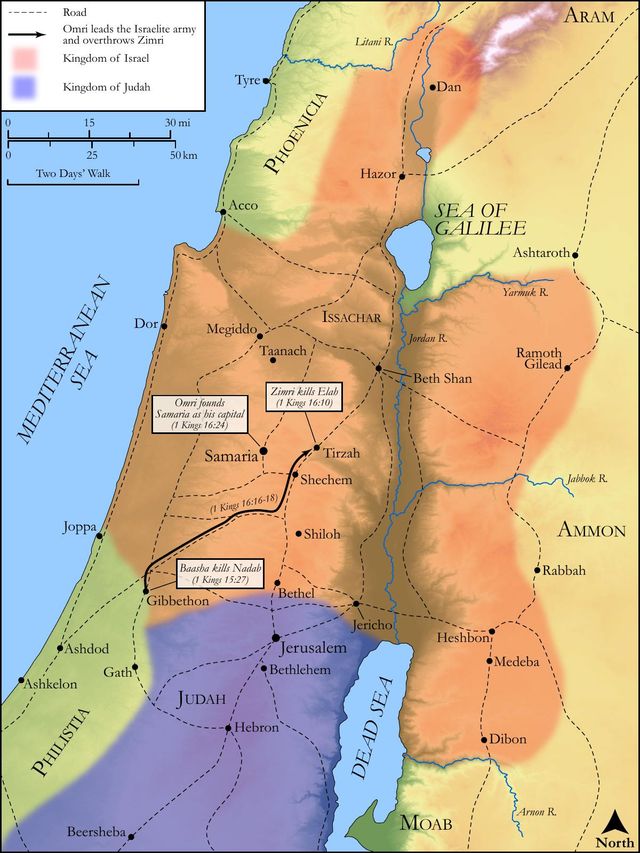
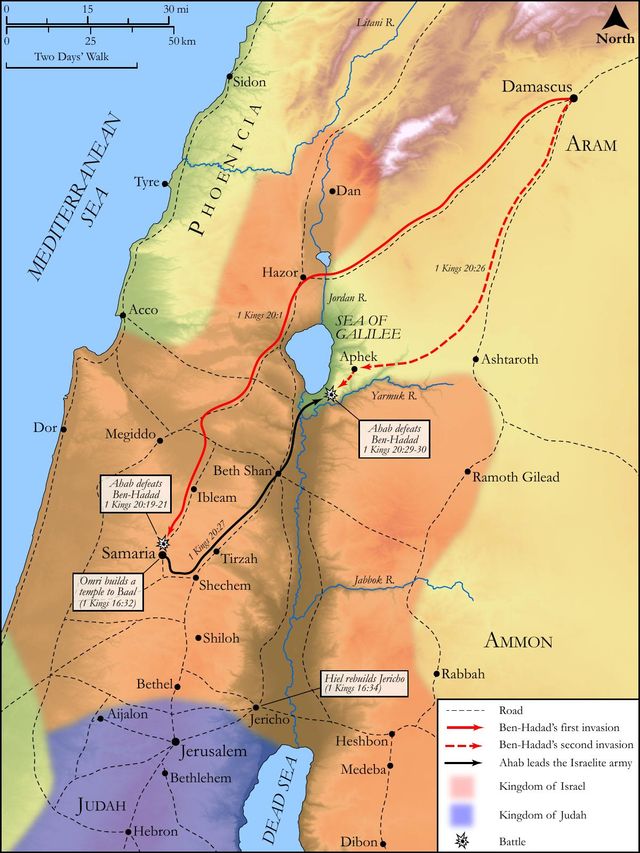
Study this verse
Public-domain commentary
Matthew Henry
From his Commentary on the Whole Bible. Henry comments on passages, not single verses — this entry covers 1 Kings 16:29–34. His two-level outline is real structure in the source text, so it is rendered as structure.
We have here the beginning of the reign of Ahab, of whom we have more particulars recorded than of any of the kings of Israel. We have here only a general idea given us of him, as the worst of all the kings, that we may expect what the particulars will be. He reigned twenty-two years, long enough to do a great deal of mischief.
I.He exceeded all his predecessors in wickedness, did evil above all that were before him (Kg1 16:30), and, as if it were done with a particular enmity both to God and Israel, to affront him and ruin them, it is said, He did more purposely to provoke the Lord God of Israel to anger, and, consequently, to send judgments on his land, than all the kings of Israel that were before him, Kg1 16:33. It was bad with the people when every successive king was worse than his predecessor. What would they come to at last? He had seen the ruin of other wicked kings and their families; yet, instead of taking warning, his heart was hardened and enraged against God by it. He thought it a light thing to walk in the sins of Jeroboam, Kg1 16:31. It was nothing to break the second commandment by image-worship, he would set aside the first also by introducing other gods; his little finger should fall heavier upon God's ordinances than Jeroboam's loins. Making light of less sins makes way for greater, and those that endeavour to extenuate other people's sins will but aggravate their own.
II.He married a wicked woman, who he knew would bring in the worship of Baal, and seemed to marry her with that design.
As if it had been a light thing to walk in the sins of Jeroboam, he took to wife Jezebel (Kg1 16:31), a zealous idolater, extremely imperious and malicious in her natural temper, addicted to witchcrafts and whoredoms (Kg2 9:22), and every way vicious. The false prophetess spoken of Rev 2:20 is there called Jezebel, for a wicked woman could not be called by a worse name than hers; what mischiefs she did, and what mischief at last befel her (Kg2 9:33), we shall find in the following story; this one strange wife debauched Israel more than all the strange wives of Solomon.
III.He set up the worship of Baal, forsook the God of Israel and served the god of the Sidonians, Jupiter instead of Jehovah, the sun (so some think), a deified hero of the Phoenicians (so others): he was weary of the golden calves, and thought they had been worshipped long enough; such vanities were they that those who had been fondest of them at length grew sick of them, and, like adulterers, much have variety. In honour of this mock deity, whom they called Baal - lord, and for the convenience of his worship,
1.Ahab built a temple in Samaria, the royal city, because the temple of God was in Jerusalem, the royal city of the other kingdom. He would have Baal's temple near him, that he might the better frequent it, protect it, and put honour upon it.
2.He reared an altar in that temple, on which to offer sacrifice to Baal, by which they acknowledged their dependence upon him and sought his favour. O the stupidity of idolaters, who are at a great expense to make one their friend whom they might have chosen whether they would make a god of or no!
3.He made a grove about his temple, either a natural one, by planting shady trees there, or, if those would be too long in growing, an artificial one in imitation of it; for it is not said he planted, but he made a grove, something that answered the intention, which was to conceal and so countenance the abominable impurities that were committed in the filthy worship of Baal. Lucus, lucendo, quia non lucet - He that doeth evil hateth the light.
IV.One of his subjects, in imitation of his presumption, ventured to build Jericho, in defiance of the curse Joshua had long since pronounced on him that should attempt it, Kg1 16:34. It comes in as an instance of the height of impiety to which men had arrived, especially at Bethel, where one of the calves was, for of that city this daring sinner was. Observe,
1.How ill he did. Like Achan he meddled with the accursed thing, turned that to his own use which was devoted to God's honour. He began to build, in defiance of the curse well known in Israel, jesting with it perhaps as a bugbear, or fancying its force worn out by length of time, for it was above 500 years since it was pronounced, Jos 6:26. He went on to build, in defiance of the execution of the curse in part; for, though his eldest son died when he began, yet he would proceed in contempt of God and his wrath revealed from heaven against his ungodliness.
2.How ill he sped. He built for his children, but God wrote him childless; his eldest son died when he began, the youngest when he finished, and all the rest (it is supposed) between. Note, Those whom God curses are cursed indeed; none ever hardened his heart against God and prospered. God keep us back from presumptuous sins, those great transgressions!
Historical interpretation
Historical reception
1 surviving comment on this verse from the historical church.
This is that Ahab who thought that he would make little progress in the new religion [i.e., idolatry] if he worshiped only the gods introduced by Jeroboam. Therefore he established rites for Baal, the god of the Sidonians, built his temple in the royal city, erected altars and planted sacred groves. And these actions bitterly enraged the prophets and the other worshipers of the true God.
Continue studying 1 Kings 16:29 across the web’s major study libraries — every link below opens this exact verse, chapter, or book on the destination site.
Read & Compare
 BibleGatewayThis verse in more than 200 translations and 70 languages.
 Bible.comThe YouVersion reader — hundreds of translations, reading plans, and highlights.
 ESV.orgCrossway's official English Standard Version reader.
 NET BibleThe NET translation with 60,000+ translators' notes on every rendering decision.
 STEP BibleTyndale House's free study tool — original text, vocabulary, and scholarly resources.
 BibliaLogos Bible Software's free web reader.
 USCCBThe New American Bible (Revised Edition) with the U.S. bishops' study notes.
Commentaries
 BibleHub CommentariesDozens of classic commentaries on this verse, gathered on one page.
 StudyLightMore than 100 commentary sets — the largest collection on the web.
 BibleRefPlain-English commentary on what this verse means, verse by verse.
 Enduring WordDavid Guzik's free commentary on this chapter, widely used by Bible teachers.
 Bible Study ToolsVerse commentary alongside Greek and Hebrew study aids.
Original Language & Research
- BibleHub InterlinearThe verse word by word — original language, transliteration, and English.
- BibleHub LexiconEvery word's original-language definition and Strong's entry.
 Blue Letter BibleDeep-study tools — Strong's numbers, concordance, and word studies.
 SefariaThe Hebrew text with Rashi and centuries of Jewish commentary.
Sermons, Hymns & Audio


TrulyRandomVerse is not affiliated with these sites and doesn’t control their content. They’re linked because they’re genuinely useful.
Summary
1 Kings 16:29 serves as a crucial chronological and narrative marker, precisely dating the commencement of Ahab's twenty-two-year reign over the northern kingdom of Israel from his capital in Samaria. This verse anchors one of the most spiritually tumultuous and prophetically significant periods in Israel's history within the broader timeline of the divided monarchy, specifically synchronizing it with the thirty-eighth year of King Asa's rule in Judah. It formally introduces a monarch whose unparalleled wickedness would profoundly shape the nation's spiritual trajectory and set the stage for dramatic divine intervention through the prophet Elijah.
Context
ShowHideLiterary Context
This verse seamlessly follows the account of Omri's reign (1 Kings 16:23-28), which describes his rise to power and the establishment of Samaria as the new capital. The book of 1 Kings meticulously chronicles the reigns of both Israelite and Judean kings, consistently evaluating them against their faithfulness to the Mosaic covenant. The introduction of Ahab in this verse is not merely a historical detail but a narrative pivot, signaling the advent of a king whose wickedness would surpass all his predecessors, as the text explicitly states in 1 Kings 16:30. This sets the immediate stage for the extensive and dramatic narratives involving the prophet Elijah, which begin in 1 Kings 17 and dominate the subsequent chapters, highlighting the profound spiritual conflict that characterized Ahab's era.
Historical & Cultural Context
The precise dating to "the thirty and eighth year of Asa king of Judah" underscores the enduring reality of the divided monarchy, a schism that defined Israelite history for centuries after King Solomon's reign. While Judah, under kings like Asa, experienced periods of relative religious reform and adherence to Yahweh worship, the northern kingdom of Israel consistently struggled with idolatry, particularly the state-sponsored worship of golden calves initiated by Jeroboam I (1 Kings 12:28-30). Omri's dynasty, to which Ahab belonged, brought a measure of political stability after a series of short-lived reigns and violent coups. His strategic choice of Samaria as the capital provided a defensible and central location, distinct from the traditional religious centers. However, this political stability was coupled with profound spiritual decline, which Ahab would accelerate through his marriage to Jezebel, a Phoenician princess, and their aggressive promotion of Baal and Asherah worship, directly challenging the worship of Yahweh.
Key Themes
ShowHide1 Kings 16:29 introduces and contributes to several overarching themes within the Deuteronomistic History, particularly the book of Kings. Firstly, it highlights the consequences of leadership, demonstrating how the spiritual choices of a king profoundly impact the entire nation. Ahab's reign serves as a stark example of how royal apostasy leads to widespread national judgment and spiritual corruption. Secondly, the verse underscores the theme of escalating apostasy in the northern kingdom, showing a progression from Jeroboam's initial calf worship to Omri's establishment of a new capital for a corrupt dynasty, culminating in Ahab's unprecedented state-sponsored Baal worship. Thirdly, the precise chronological dating emphasizes the divine oversight of history, reminding the reader that God's narrative unfolds with precision, even amidst human rebellion. This precision sets the stage for God's prophetic intervention through figures like Elijah, who would directly challenge the prevailing idolatry and call the nation back to Yahweh (1 Kings 18:21). Finally, the continuous cross-referencing between the reigns of Israelite and Judean kings reinforces the tragic reality and spiritual implications of the divided monarchy.
Exposition and Analysis
ShowHideKey Word Analysis
ShowHideDerived from "brother" and "father," meaning "brother of (his) father" or "father's brother." While the name itself carries no inherent negative connotation, in the biblical narrative, Ahab becomes synonymous with extreme wickedness. He is portrayed as the most wicked king of Israel up to his time, primarily because he "did more to provoke the Lord God of Israel to anger than all the kings of Israel who were before him" (1 Kings 16:33). His name thus serves as a powerful symbol of national apostasy and the catalyst for divine judgment.
Meaning "heaping," Omri was Ahab's father and the founder of the Omride dynasty. He was a powerful military commander who seized the throne and established a relatively stable, albeit wicked, dynasty. His name is significant not only for his political achievements, such as founding Samaria, but also because his reign, though brief, set the stage for Ahab's even greater wickedness. The phrase "son of Omri" therefore connects Ahab to a legacy of political strength combined with profound spiritual compromise, inheriting and escalating his father's evil ways.
Meaning "watch-station" or "belonging to Shemer" (the original owner of the hill), this city was founded by Omri and served as the capital of the northern kingdom during Ahab's reign. It quickly became the political and spiritual center of Israel. Biblically, Samaria often represents the idolatrous heart of the northern kingdom, a place where Baal worship flourished under Ahab and Jezebel, and later became a frequent target of prophetic condemnation due to its deep-seated apostasy.
Verse Breakdown
ShowHide"And in the thirty and eighth year of Asa king of Judah"
This clause provides a crucial chronological anchor, linking the history of the northern kingdom (Israel) to that of the southern kingdom (Judah). It demonstrates the biblical writers' meticulous attention to historical detail and their method of synchronizing the parallel reigns of the divided monarchy. The mention of Asa, a king who generally "did what was right in the eyes of the Lord" (1 Kings 15:11), subtly contrasts with the character of Ahab, though the verse itself does not explicitly draw a moral comparison.
"began Ahab the son of Omri to reign over Israel"
This introduces the central figure of the subsequent narrative. The phrase "son of Omri" emphasizes dynastic succession and connects Ahab to his father's established power and influence. It signals the continuation of the Omride dynasty, which, despite its political strength, was deeply entrenched in idolatry and set the stage for even greater spiritual deviation under Ahab.
"and Ahab the son of Omri reigned over Israel in Samaria"
This reiterates Ahab's identity and confirms Samaria as the seat of his power. The repetition of "Ahab the son of Omri" reinforces the dynastic connection and the legitimacy of his rule within the political framework of the time. Samaria, as Omri's newly established capital, would become the epicenter of Baal worship and the stage for many of Elijah's confrontations, symbolizing the spiritual corruption of the northern kingdom.
"twenty and two years"
This specifies the duration of Ahab's reign. A twenty-two-year rule is relatively long for a king of the northern kingdom, indicating a period of significant political stability under the Omride dynasty. This extended period allowed Ahab's policies, particularly his aggressive promotion of Baalism, to deeply entrench themselves within Israelite society, leading to widespread spiritual corruption and necessitating drastic prophetic intervention.
Literary Devices
ShowHide1 Kings 16:29 primarily functions as a Chronological Marker and an Introductory Formula. As a chronological marker, it precisely dates Ahab's ascension relative to King Asa's reign in Judah, providing a clear historical anchor for the ensuing narrative. This meticulous dating is characteristic of the book of Kings, which consistently employs synchronistic chronologies to weave together the parallel histories of Israel and Judah. As an introductory formula, the verse formally introduces Ahab, a pivotal figure whose reign marks a significant turning point in Israel's spiritual decline. The repetition of "Ahab the son of Omri" serves as a Dynastic Formula, emphasizing his lineage and the continuation of the Omride dynasty, highlighting the inherited spiritual trajectory. Furthermore, by introducing a king who would become infamous for his wickedness, the verse employs Foreshadowing, subtly hinting at the profound spiritual conflict and divine judgment that will unfold in the chapters to come, particularly with the advent of the prophet Elijah.
Theological and Thematic Connections
ShowHideWhile a seemingly straightforward historical entry, 1 Kings 16:29 is pregnant with profound theological significance. It underscores the biblical emphasis on the critical importance of leadership and its pervasive impact on a nation's spiritual well-being. The introduction of Ahab, a king destined to lead Israel into unprecedented idolatry, highlights the devastating consequences of spiritual rebellion and the breaking of God's covenant. This verse sets the stage for a period where God's faithfulness to His covenant people would be severely tested by their extreme apostasy, yet it also foreshadows God's unwavering commitment to confront sin through His prophets. The precision of the dating reminds us that God is sovereign over history, orchestrating events and raising up figures, even wicked ones, within His overarching plan of redemption and judgment, ensuring that His purposes will ultimately prevail.
Reflection and Application
ShowHide1 Kings 16:29, though brief, serves as a powerful reminder that history is not merely a collection of random events but a divinely ordered narrative. The precise dating of Ahab's reign, juxtaposed with Asa's, emphasizes the meticulous nature of God's record-keeping and His sovereign oversight even in periods of profound human wickedness. For us today, this verse invites reflection on the critical role of leadership, both in secular and spiritual spheres. Ahab's introduction foreshadows a reign of immense spiritual darkness, reminding us that the choices of those in authority have far-reaching consequences, shaping the moral and spiritual climate of entire communities. It challenges believers to discern and pray for righteous leadership, and to recognize that even in times of widespread apostasy, God remains active, preparing to raise up voices of truth and conviction, as He did with Elijah. Understanding this historical context helps us appreciate the depth of God's patience, His ultimate commitment to justice, and His enduring call for His people to remain faithful amidst cultural pressures.
Questions for Reflection
ShowHideFAQ
ShowHideWhy is the reign of Asa of Judah mentioned here?
ShowHideThe mention of Asa's reign in Judah provides a crucial chronological synchronism, a common and vital feature in the books of Kings. Since Israel and Judah were separate kingdoms with their own kings, the biblical writers often linked their timelines to provide a comprehensive and unified historical account. By stating that Ahab began to reign in the "thirty and eighth year of Asa king of Judah," the text precisely anchors Ahab's reign within the broader history of the divided monarchy, allowing readers to understand the contemporary political and spiritual landscape of both kingdoms. This also subtly highlights the continued existence of two distinct entities, even as their histories intersected, often in stark spiritual contrast.
What was Omri's legacy that impacted Ahab's reign?
ShowHideOmri, Ahab's father, left a significant legacy that profoundly impacted Ahab's reign. Firstly, Omri established a relatively stable dynasty after a period of intense political instability and short-lived reigns in Israel (1 Kings 16:15-22). This stability provided the foundation for Ahab's extended rule. Secondly, Omri founded Samaria as the new capital city (1 Kings 16:24), a strategically defensible location that would become the epicenter of the northern kingdom's political and religious life, including its rampant idolatry under Ahab. While Omri himself "did evil in the eyes of the Lord, and did worse than all who were before him" (1 Kings 16:25), his actions paved the way for Ahab to surpass even his father in wickedness, particularly through the aggressive promotion of Baal worship and the marriage to Jezebel.
Christ-Centered Fulfillment
ShowHideThe introduction of King Ahab, a monarch whose reign epitomized Israel's spiritual decline and led the nation into unprecedented idolatry, powerfully underscores humanity's desperate need for a perfect and righteous King. Ahab's rule, characterized by gross apostasy and oppression, stands in stark contrast to the just and redemptive reign of Jesus Christ. While earthly kings like Ahab consistently failed to uphold God's covenant and led their people astray, the New Testament presents Jesus as the true King of Israel, the Son of David, whose kingdom is eternal and whose rule is marked by perfect righteousness and unwavering faithfulness (Luke 1:32-33). The spiritual darkness that enveloped Israel under Ahab, necessitating the dramatic intervention of prophets like Elijah, foreshadows the ultimate confrontation between light and darkness embodied in Christ. Jesus, the Lamb of God who takes away the sin of the world, not only confronts evil but also offers true spiritual liberation and reconciliation with God, unlike any earthly ruler. His reign is not confined to a geographical capital like Samaria but extends universally, bringing redemption and establishing a spiritual kingdom where God's will is perfectly done on earth as it is in heaven (Matthew 6:10). Thus, the historical account of Ahab's failed kingship ultimately points forward to the glorious and redemptive reign of Christ, the only King capable of leading His people in truth and righteousness, fulfilling all the promises that earthly kings could not.