


2 Kings 25:3
Bible text: King James Version (1769 Blayney text) · Public domain
Bible text: Berean Standard Bible · Public domain
Bible text: American Standard Version (1901) · Public domain
Bible text: World English Bible, Messianic edition · Public domain
Bible text: Geneva Bible (1599) · Public domain
Bible text: Young's Literal Translation · Public domain
- בַּחֹדֶשׁba·Cho·deshin the monthH2320Prep-b ¦ N-csNoun Singular common gender Absoluteבַּin theחֹדֶשׁmonth
- בְּתִשְׁעָהbe·tish·'Ahon [day] nineH8672Prep-b ¦ N-csNoun Singular common gender Absoluteבְּonתִשְׁעָה[day] nine
- הָרְבִיעִיha·re·vi·'I<the> fourthH7243Art ¦ Adj-csAdjective Numerical Position Singular common gender Absoluteהָ<the>רְבִיעִיfourth
- לַחֹדֶשׁla·Cho·deshof the monthH2320Prep-l ¦ N-msNoun Singular Masculine Absoluteלַof theחֹדֶשׁmonth
- וַיֶּחֱזַקvai·ye·che·Zakand it was severeH2388Conj-w ¦ V-Qal-ConsecImperf-3msVerb Qal Consecutive Imperfect 3rd Singular Masculineוַandיֶּחֱזַקit was severe
- הָרָעָבha·ra·'Avthe famineH7458Art ¦ N-msNoun Singular Masculine Absoluteהָtheרָעָבfamine
- בָּעִירba·'Irin the cityH5892Prep-b ¦ N-fsNoun Singular Feminine Absoluteבָּin theעִירcity
- וְלֹאve·lo'and notH3808Conj-w ¦ NegParticle Negativeוְandלֹאnot
- הָיָהHa·yahit belongedH1961V-Qal-Perf-3msVerb Qal Perfect 3rd Singular Masculine
- לֶחֶםLe·chemfoodH3899N-msNoun Singular Masculine Absolute
- לְעַםle·'Amto [the] people ofH5971Prep-l ¦ N-mscNoun Singular Masculine Constructלְtoעַם[the] people of
- הָאָרֶץha·'A·retzthe landH776Art ¦ N-fsNoun Singular Feminine Absoluteהָtheאָרֶץland
English is a literal word-by-word gloss of the Hebrew, not the KJV's wording. Why?
This is the original text the KJV's translators worked from — each Hebrew word with its own literal English meaning in this verse, prepared by scholars at Tyndale House, Cambridge. The KJV translates whole sentences, not word by word, so its wording differs: one Hebrew word can become several English words, and the KJV may choose “the LORD” where the gloss reads “Yahweh”. Both are faithful — they answer different questions. For the KJV's own rendering, switch to the KJV text.
Details
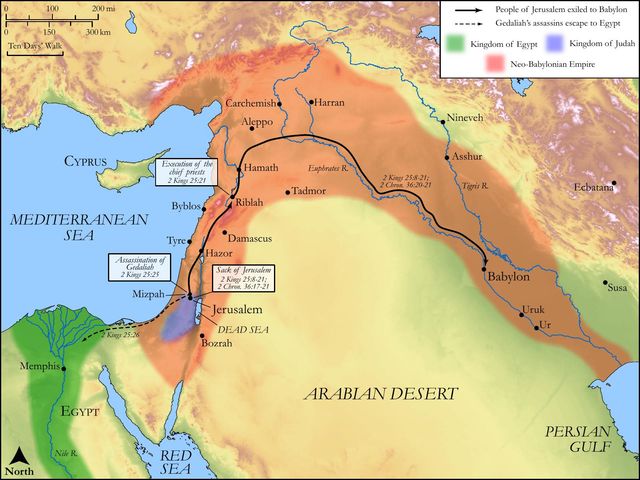
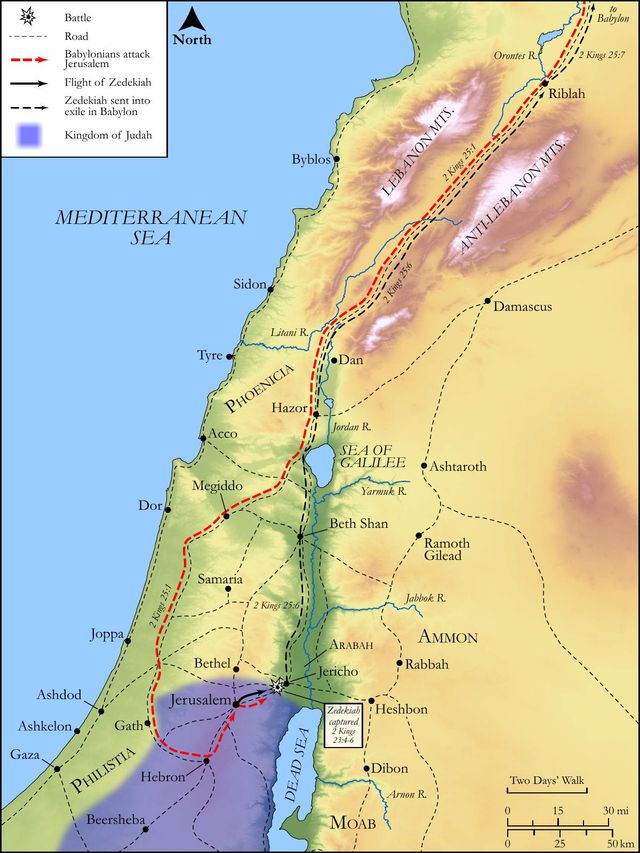
See on the biblical-era maps
Study this verse
Public-domain commentary
Matthew Henry
From his Commentary on the Whole Bible. Henry comments on passages, not single verses — this entry covers 2 Kings 25:1–7. His two-level outline is real structure in the source text, so it is rendered as structure.
We left king Zedekiah in rebellion against the king of Babylon (Kg2 24:20), contriving and endeavouring to shake off his yoke, when he was no way able to do it, nor took the right method by making God his friend first. Now here we have an account of the fatal consequences of that attempt.
I.The king of Babylon's army laid siege to Jerusalem, Kg2 25:1.
What should hinder them when the country was already in their possession? Kg2 24:2. They built forts against the city round about, whence, by such arts of war as they then had, they battered it, sent into it instruments of death, and kept out of it the necessary supports of life. Formerly Jerusalem had been compassed with the favour of God as with a shield, but now their defence had departed from them and their enemies surrounded them on every side. Those that by sin have provoked God to leave them will find that innumerable evils will compass them about. Two years this siege lasted; at first the army retired, for fear of the king of Egypt (Jer 37:11), but, finding him not so powerful as they thought, they soon returned, with a resolution not to quit the city till they had made themselves masters of it.
II.During this siege the famine prevailed (Kg2 25:3), so that for a long time they ate their bread by weight and with care, Eze 4:16.
Thus they were punished for their gluttony and excess, their fulness of bread and feeding themselves without fear. At length there was no bread for the people of the land, that is, the common people, the soldiers, whereby they were weakened and rendered unfit for service. Now they ate their own children for want of food. See this foretold by one prophet (Eze 5:10) and bewailed by another, Lam 4:3, etc. Jeremiah earnestly persuaded the king to surrender (Jer 38:17), but his heart was hardened to his destruction.
III.At length the city was taken by storm:
it was broken up, Kg2 25:4. The besiegers made a breach in the wall, at which they forced their way into it. The besieged, unable any longer to defend it, endeavoured to quit it, and make the best of their way; and many, no doubt, were put to the sword, the victorious army being much exasperated by their obstinacy.
IV.The king, his family, and all his great men, made their escape in the night, by some secret passages which the besiegers either had not discovered or did not keep their eye upon, Kg2 25:4. But those as much deceive themselves who think to escape God's judgments as those who think to brave them; the feet of him that flees from them will as surely fail as the hands of him that fights against them. When God judges he will overcome. Intelligence was given to the Chaldeans of the king's flight, and which way he had gone, so that they soon overtook him, Kg2 25:5. His guards were scattered from him, every man shifting for his own safety. Had he put himself under God's protection, that would not have failed him now. He presently fell into the enemies' hands, and here we are told what they did with him.
1.He was brought to the king of Babylon, and tried by a council of war for rebelling against him who set him up, and to whom he had sworn fidelity. God and man had a quarrel with him for this; see Eze 17:16, etc. The king of Babylon now lay at Riblah (which lay between Judea and Babylon), that he might be ready to give orders both to his court at home and his army abroad.
2.His sons were slain before his eyes, though children, that this doleful spectacle, the last his eyes were to behold, might leave an impression of grief and horror upon his spirit as long as he lived. In slaying his sons, they showed their indignation at his falsehood, and in effect declared that neither he nor any of his were fit to be trusted, and therefore that they were not fit to live.
3.His eyes were put out, by which he was deprived of that common comfort of human life which is given even to those that are in misery, and to the bitter in soul, the light of the sun, by which he was also disabled for any service. He dreaded being mocked, and therefore would not be persuaded to yield (Jer 38:19), but that which he feared came upon him with a witness, and no doubt added much to his misery; for, as those that are deaf suspect that every body talks of them, so those that are blind suspect that every body laughs at them. By this two prophecies that seemed to contradict one another were both fulfilled. Jeremiah prophesied that Zedekiah should be brought to Babylon, Jer 32:5; Jer 34:3. Ezekiel prophesied that he should not see Babylon, Eze 12:13. He was brought thither, but, his eyes being put out, he did not see it. Thus he ended his days, before he ended his life.
4.He was bound in fetters of brass and so carried to Babylon. He that was blind needed not be bound (his blindness fettered him), but, for his greater disgrace, they led him bound; only, whereas common malefactors are laid in irons (Psa 105:18; Psa 107:10), he, being a prince, was bound with fetters of brass; but that the metal was somewhat nobler and lighter was little comfort, while still he was in fetters. Let it not seem strange if those that have been held in the cords of iniquity come to be thus held in the cords of affliction, Job 36:8.
Historical interpretation
Historical reception
1 surviving comment on this verse from the historical church.
What think you of Nebuchadnezzar? Have you not heard from Scripture that he was bloodthirsty, fierce, with the disposition of a lion? Have you not heard that he disinterred the kings? Have you not heard that he brought the people away into captivity? Have you not heard that he put the king’s sons to the sword before Zedekiah’s eyes and then blinded him? Have you not heard that he shattered the cherubim? I do not mean the invisible cherubim—it is blasphemy to think it—but the sculptured images and the mercy seat in the Holy of Holies, from the midst of which God was apt to speak with his voice. He trampled on the veil of sanctification, he took the censer and carried it away to a temple of idols; he seized all the offerings; he burned the temple to its foundations. What punishment did he not deserve for slaying kings, for burning the holy object, for reducing the people to captivity, for putting the sacred vessels in the temples of the idols? Did he not deserve ten thousand deaths?You have seen the enormity of his crimes. Turn now to the loving-kindness of God. Nebuchadnezzar was turned into a wild beast; he dwelled in the wilderness; God scourged him to save him. He had claws like a lion’s, for he had preyed on the saints. He had a lion’s mane, for he had been a ravening, roaring lion. He ate grass like an ox, for he had behaved like a brute beast, not knowing him who had given him his kingdom. His body was drenched with dew, because, after seeing the fire quenched by the dew, he had not believed. And what happened? Afterwards he says, “I, Nebuchadnezzar, raised my eyes to heaven … and I blessed the Most High, and I praised and glorified him who lives forever.” When therefore he acknowledged the Most High, and uttered words of thanksgiving to God, and repented of his past wickedness and recognized his own weakness, in that hour God restored to him his royal dignity.
What then? If God granted pardon and a kingdom to Nebuchadnezzar after such terrible crimes, when he had made confession, will he not grant you the remission of your sins if you repent and the kingdom of heaven if you live worthily? God is merciful and quick to forgiveness but slow to vengeance. Therefore let no one despair of salvation. Peter, the chief and foremost of the apostles, denied the Lord thrice before a little serving maid; but, moved to repentance, he wept bitterly. His weeping revealed his heartfelt repentance, and for that reason not only did he receive pardon for his denial but also retained his apostolic prerogative.
Continue studying 2 Kings 25:3 across the web’s major study libraries — every link below opens this exact verse, chapter, or book on the destination site.
Read & Compare
 BibleGatewayThis verse in more than 200 translations and 70 languages.
 Bible.comThe YouVersion reader — hundreds of translations, reading plans, and highlights.
 ESV.orgCrossway's official English Standard Version reader.
 NET BibleThe NET translation with 60,000+ translators' notes on every rendering decision.
 STEP BibleTyndale House's free study tool — original text, vocabulary, and scholarly resources.
 BibliaLogos Bible Software's free web reader.
 USCCBThe New American Bible (Revised Edition) with the U.S. bishops' study notes.
Commentaries
 BibleHub CommentariesDozens of classic commentaries on this verse, gathered on one page.
 StudyLightMore than 100 commentary sets — the largest collection on the web.
 BibleRefPlain-English commentary on what this verse means, verse by verse.
 Enduring WordDavid Guzik's free commentary on this chapter, widely used by Bible teachers.
 Bible Study ToolsVerse commentary alongside Greek and Hebrew study aids.
Original Language & Research
- BibleHub InterlinearThe verse word by word — original language, transliteration, and English.
- BibleHub LexiconEvery word's original-language definition and Strong's entry.
 Blue Letter BibleDeep-study tools — Strong's numbers, concordance, and word studies.
 SefariaThe Hebrew text with Rashi and centuries of Jewish commentary.
Sermons, Hymns & Audio


TrulyRandomVerse is not affiliated with these sites and doesn’t control their content. They’re linked because they’re genuinely useful.
Summary
Second Kings 25:3 powerfully depicts the dire culmination of the Babylonian siege of Jerusalem, marking a critical and tragic turning point in Judah's history. It describes the overwhelming famine that had gripped the city by the ninth day of the fourth month, leaving its inhabitants utterly without sustenance. This verse serves as a stark testament to the devastating consequences of prolonged warfare and divine judgment against a disobedient nation, setting the immediate stage for Jerusalem's imminent fall, the breaching of its walls, and the subsequent exile, underscoring the profound suffering endured by the people.
Context
ShowHideLiterary Context
This verse is strategically placed within the climactic final chapter of 2 Kings, which meticulously chronicles the complete destruction of Jerusalem and the definitive end of the Kingdom of Judah. Following the account of Nebuchadnezzar's initial siege against King Zedekiah in 2 Kings 25:1, verse 3 shifts the narrative focus from external military pressure to the devastating internal conditions within the besieged city. It functions as a grim prelude to the breaching of the city walls and the subsequent capture of King Zedekiah in 2 Kings 25:4-7, and the eventual destruction of the Temple and the city itself in 2 Kings 25:8-12. The concise and impactful narrative here emphasizes the immediate cause of the city's collapse: the utter exhaustion of its resources and the will of its people. This account finds a close parallel in the prophet Jeremiah's eyewitness testimony, particularly in Jeremiah 52:6, which corroborates the severity of the famine and the specific timing, underscoring the historical accuracy and prophetic fulfillment embedded in this tragic event.
Historical & Cultural Context
The Babylonian siege of Jerusalem, lasting from 588 to 586 BC, represents a brutal and prolonged military tactic common among the nations of that day. Sieges were meticulously designed to starve out a city's inhabitants, forcing surrender without a direct and often costly assault. Jerusalem, a heavily fortified city, relied on its formidable walls and internal provisions for defense. However, a siege extending over two years would inevitably deplete all resources. The precise dating, "the ninth day of the fourth month" (Tammuz in the Hebrew calendar), marks a grim anniversary, highlighting the exact and devastating progression of events leading to the city's demise. "Bread" (Hebrew: lehem) was the foundational staple of the ancient Israelite diet, symbolizing the most basic necessity for survival. Its complete absence signified total deprivation and the collapse of societal order. The historical backdrop is King Zedekiah's ill-advised rebellion against Babylon, his overlord, which provoked Nebuchadnezzar's wrath and led to this ultimate punitive action. The immense suffering described was a direct consequence of this political defiance, interpreted biblically as a result of Judah's persistent covenant unfaithfulness.
Key Themes
ShowHideThis verse powerfully encapsulates several overarching themes prevalent in 2 Kings and the broader Deuteronomistic History. Firstly, it underscores the theme of Divine Judgment and Consequences, portraying the famine as a direct and severe consequence of Judah's prolonged idolatry and disobedience to God's covenant commands, despite repeated warnings from prophets like Jeremiah. The suffering is not random but a precise fulfillment of the curses outlined in Deuteronomy 28. Secondly, the verse highlights the Brutal Reality of Human Suffering in War, particularly the immense toll siege warfare takes on civilian populations. The phrase "the famine prevailed" vividly illustrates starvation as a potent weapon, reducing a once-proud city to utter desperation. This theme resonates profoundly with the laments found in the book of Lamentations, which graphically describes the horrors of the siege. Finally, this verse marks the effective End of an Era – the independent Kingdom of Judah and the Davidic monarchy in Jerusalem. It signifies the culmination of centuries of Israelite history in the land, leading directly into the Babylonian exile, a profound turning point that reshaped the identity and future of God's people, paving the way for a new phase of God's redemptive plan.
Exposition and Analysis
ShowHideKey Word Analysis
ShowHideDerived from a root meaning "to be new," this term refers to the new moon and, by implication, a month. In this context, it precisely dates the progression of the siege, indicating that the famine had reached its peak by the fourth month of the year, a period of prolonged deprivation.
This noun denotes a severe and widespread lack of food, leading to hunger and starvation. In biblical contexts, famine is frequently depicted as a form of divine judgment or a consequence of natural disaster, highlighting human vulnerability and dependence on God's provision. Here, its prevalence signifies a state of utter desperation and the complete breakdown of normal life within the city.
This primitive root means "to fasten upon," "to seize," "to be strong," or "to be mighty." When combined with "famine" (as in "the famine prevailed"), it powerfully conveys that the famine had grown overwhelmingly strong, dominating the city and its inhabitants. It was no longer merely present but had become the defining, inescapable reality, crushing all resistance and hope, emphasizing the absolute and pervasive nature of the deprivation.
This term refers to food in general, but specifically to bread, the most fundamental and universal food staple among the nations. Its complete absence, as stated in the verse, signifies total deprivation of the most basic necessity for survival. This highlights the absolute and universal nature of the famine's impact – not just scarcity, but a complete lack of the most essential food for "the people of the land."
Verse Breakdown
ShowHide"And on the ninth [day] of the [fourth] month"
This precise chronological marker places the events within a specific timeframe, emphasizing the historical accuracy and the culmination of the siege. The "ninth day of the fourth month" (Tammuz) was a significant date, marking the anniversary of the breach of the city walls in Jeremiah 39:2 and Jeremiah 52:6-7. It signifies the final, desperate stage of the siege, just before the city's defenses completely collapsed.
"the famine prevailed in the city"
This clause describes the dire internal conditions of Jerusalem. The use of "prevailed" (Hebrew: chazaq) indicates that hunger was no longer merely a problem but had become the dominant and overwhelming force, debilitating the population and rendering further resistance impossible. It paints a vivid picture of a city consumed by starvation, where the fight for survival against hunger superseded any military defense.
"and there was no bread for the people of the land"
This final clause underscores the absolute and universal nature of the deprivation. "Bread" (Hebrew: lehem) represents the most basic foodstuff, and its complete absence ("no bread") for "the people of the land" (the general populace, not just the soldiers) signifies a total collapse of food supply. This highlights the widespread suffering and the desperate state of the entire population, making the city's fall inevitable.
Literary Devices
ShowHideThe language of 2 Kings 25:3 employs several powerful literary devices to convey the gravity of the situation. Hyperbole is evident in the phrase "the famine prevailed," suggesting an overwhelming and all-encompassing hunger that had utterly conquered the city, rather than merely being present. Similarly, "no bread for the people of the land" emphasizes a complete and absolute lack, perhaps even beyond literal zero, to convey the utter desperation and the universal impact of the famine. Pathos is strongly evoked through the stark description of starvation, appealing directly to the reader's emotions and generating pity for the suffering inhabitants. The verse's concise and direct statement of deprivation also functions as Foreshadowing, signaling the imminent and unavoidable fall of Jerusalem, making the subsequent narrative of destruction feel like an inevitable consequence of the conditions described here. The simple, unadorned language lends a sense of stark realism and tragic finality to the narrative.
Theological and Thematic Connections
ShowHide2 Kings 25:3 stands as a poignant testament to the theological principle of divine judgment and the severe consequences of covenant disobedience. The famine, far from being a random historical event, is presented within the biblical narrative as a direct outcome of Judah's persistent rebellion against God's commands and their rejection of prophetic warnings. It underscores God's sovereignty over history and His unwavering justice, even when it involves severe discipline for His chosen people. This suffering, while immense, serves a profound theological purpose: to humble the nation, to bring them to repentance, and ultimately to prepare them for a future restoration and the fulfillment of God's broader redemptive plan, reminding us that even in judgment, God's ultimate purpose is redemptive and aimed at drawing His people back to Himself.
Reflection and Application
ShowHideThe stark reality of 2 Kings 25:3 serves as a powerful and enduring reminder of the profound consequences that can arise from persistent spiritual rebellion and the neglect of divine warnings. It calls us to reflect on the gravity of our own choices and the importance of heeding God's voice in our lives, recognizing that disobedience, whether individual or corporate, can lead to severe and painful outcomes. Beyond the spiritual, this verse also vividly portrays the devastating human cost of conflict and the immense suffering inflicted upon innocent populations during times of war. It fosters a deep appreciation for peace, stability, and the fundamental human right to sustenance. Furthermore, while the famine represents judgment, it also subtly points to God's ultimate control even amidst chaos; His justice, though severe, is always purposeful and aimed at restoration. For contemporary believers, it challenges us to consider our own spiritual nourishment—are we truly feeding on the "bread of life," or are we experiencing a spiritual famine due to neglect or disobedience?
Questions for Reflection
ShowHideFAQ
ShowHideWhat was the significance of the "ninth day of the fourth month"?
ShowHideThis date, corresponding to the 9th of Tammuz in the Hebrew calendar, was historically significant because it marked the anniversary of the breaching of Jerusalem's walls by the Babylonians. Jeremiah 39:2 and Jeremiah 52:6-7 confirm this date as the point when the city's defenses were finally overcome due to the overwhelming famine and the weakened state of its inhabitants. It signifies the absolute culmination of the siege's devastating effects, just before the final collapse and destruction.
Why did God allow such a severe famine and the destruction of Jerusalem?
ShowHideFrom a biblical perspective, the famine and destruction of Jerusalem were understood as a direct consequence of Judah's persistent idolatry, covenant unfaithfulness, and rejection of God's prophetic warnings. Prophets like Jeremiah had repeatedly called the people to repentance, but they largely refused to heed God's word. This event is presented as a divine judgment, a painful but necessary discipline to purify God's people and fulfill His covenant promises, even through exile. While devastating, it ultimately served to preserve a remnant and set the stage for a future return and restoration, as seen in books like Ezra and Nehemiah.
Christ-Centered Fulfillment
ShowHideThe devastating famine in 2 Kings 25:3, which brought about the physical death and spiritual desolation of Jerusalem, finds profound Christ-centered fulfillment in several ways. This historical "no bread" foreshadows humanity's deeper spiritual famine—a desperate hunger for truth and meaning that cannot be satisfied by worldly provisions. Just as Jerusalem faced physical starvation, humanity, apart from God, faces a spiritual emptiness and a profound need for true sustenance. Jesus Christ declares Himself to be the ultimate "Bread of Life," stating in John 6:35 that "whoever comes to me will never go hungry, and whoever believes in me will never be thirsty." He is the living sustenance that truly satisfies the soul's deepest longings, contrasting sharply with the physical bread that Jerusalem desperately lacked. Furthermore, the judgment and suffering endured by Jerusalem, a consequence of sin and rebellion, point to the ultimate judgment that sin brings. Yet, Christ, the innocent Lamb of God, willingly endured the ultimate suffering and separation from God on the cross, taking upon Himself the spiritual famine and judgment due to humanity (2 Corinthians 5:21). Through His sacrifice, He provides not only spiritual bread but also living water (John 4:14) and eternal life, ushering in a New Covenant where God's people are no longer subject to the curses of the Old Covenant but are nourished by His grace and truth (Hebrews 8:6-13). Thus, the tragedy of 2 Kings 25:3 ultimately magnifies the glorious provision and redemptive work of Christ, who transforms famine into abundant life.