


2 Kings 25:2
Bible text: King James Version (1769 Blayney text) · Public domain
Bible text: Berean Standard Bible · Public domain
Bible text: American Standard Version (1901) · Public domain
Bible text: World English Bible, Messianic edition · Public domain
Bible text: Geneva Bible (1599) · Public domain
Bible text: Young's Literal Translation · Public domain
- וַתָּבֹאva·ta·Vo'and it cameH935Conj-w ¦ V-Qal-ConsecImperf-3fsVerb Qal Consecutive Imperfect 3rd Singular Feminineוַandתָּבֹאit came
- הָעִירha·'Irthe cityH5892Art ¦ N-fsNoun Singular Feminine Absoluteהָtheעִירcity
- בַּמָּצוֹרba·ma·Tzorin <the> state of siegeH4692Prep-b ¦ N-msNoun Singular Masculine Absoluteבַּin <the>מָּצוֹרstate of siege
- עַד'aduntilH5704PrepPreposition
- עַשְׁתֵּי'ash·Teione [plus]H6249N-csNoun Singular common gender Absolute
- עֶשְׂרֵה'es·RehtenH6240N-csNoun Singular common gender Absolute
- שָׁנָהsha·NahyearH8141N-fsNoun Singular Feminine Absolute
- לַמֶּלֶךְla·Me·lekhof the kingH4428Prep-l ¦ N-msNoun Singular Masculine Absoluteלַof theמֶּלֶךְking
- צִדְקִיָּהוּtzid·ki·Ya·huZedekiahH6667N-proper-mNoun Proper Masculine
English is a literal word-by-word gloss of the Hebrew, not the KJV's wording. Why?
This is the original text the KJV's translators worked from — each Hebrew word with its own literal English meaning in this verse, prepared by scholars at Tyndale House, Cambridge. The KJV translates whole sentences, not word by word, so its wording differs: one Hebrew word can become several English words, and the KJV may choose “the LORD” where the gloss reads “Yahweh”. Both are faithful — they answer different questions. For the KJV's own rendering, switch to the KJV text.
Details
See on the biblical-era maps
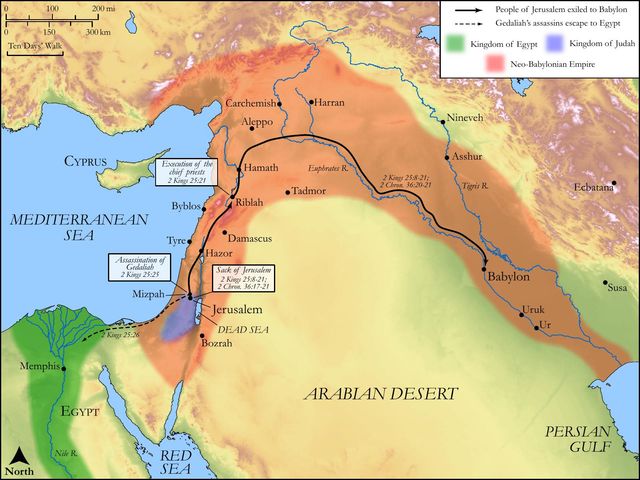
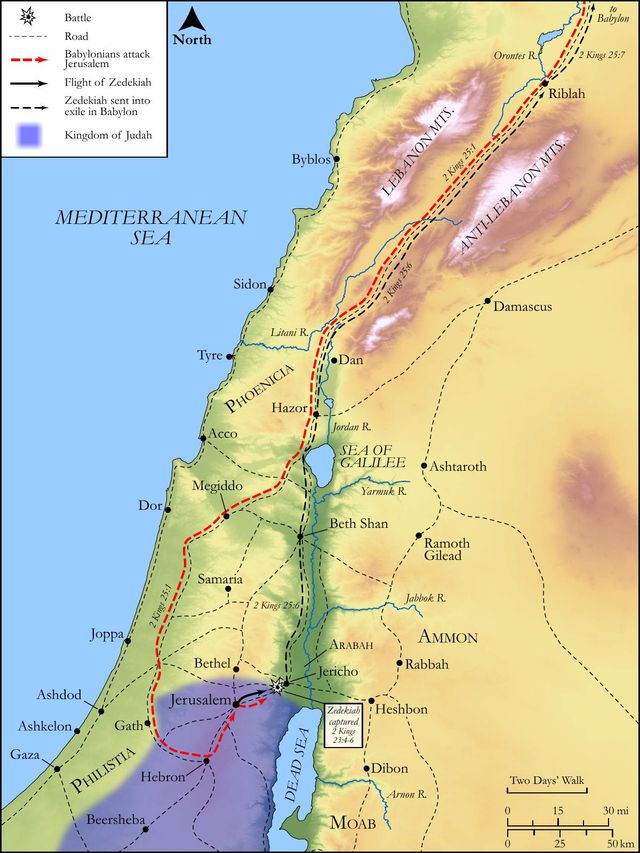
Study this verse
Public-domain commentary
Matthew Henry
From his Commentary on the Whole Bible. Henry comments on passages, not single verses — this entry covers 2 Kings 25:1–7. His two-level outline is real structure in the source text, so it is rendered as structure.
We left king Zedekiah in rebellion against the king of Babylon (Kg2 24:20), contriving and endeavouring to shake off his yoke, when he was no way able to do it, nor took the right method by making God his friend first. Now here we have an account of the fatal consequences of that attempt.
I.The king of Babylon's army laid siege to Jerusalem, Kg2 25:1.
What should hinder them when the country was already in their possession? Kg2 24:2. They built forts against the city round about, whence, by such arts of war as they then had, they battered it, sent into it instruments of death, and kept out of it the necessary supports of life. Formerly Jerusalem had been compassed with the favour of God as with a shield, but now their defence had departed from them and their enemies surrounded them on every side. Those that by sin have provoked God to leave them will find that innumerable evils will compass them about. Two years this siege lasted; at first the army retired, for fear of the king of Egypt (Jer 37:11), but, finding him not so powerful as they thought, they soon returned, with a resolution not to quit the city till they had made themselves masters of it.
II.During this siege the famine prevailed (Kg2 25:3), so that for a long time they ate their bread by weight and with care, Eze 4:16.
Thus they were punished for their gluttony and excess, their fulness of bread and feeding themselves without fear. At length there was no bread for the people of the land, that is, the common people, the soldiers, whereby they were weakened and rendered unfit for service. Now they ate their own children for want of food. See this foretold by one prophet (Eze 5:10) and bewailed by another, Lam 4:3, etc. Jeremiah earnestly persuaded the king to surrender (Jer 38:17), but his heart was hardened to his destruction.
III.At length the city was taken by storm:
it was broken up, Kg2 25:4. The besiegers made a breach in the wall, at which they forced their way into it. The besieged, unable any longer to defend it, endeavoured to quit it, and make the best of their way; and many, no doubt, were put to the sword, the victorious army being much exasperated by their obstinacy.
IV.The king, his family, and all his great men, made their escape in the night, by some secret passages which the besiegers either had not discovered or did not keep their eye upon, Kg2 25:4. But those as much deceive themselves who think to escape God's judgments as those who think to brave them; the feet of him that flees from them will as surely fail as the hands of him that fights against them. When God judges he will overcome. Intelligence was given to the Chaldeans of the king's flight, and which way he had gone, so that they soon overtook him, Kg2 25:5. His guards were scattered from him, every man shifting for his own safety. Had he put himself under God's protection, that would not have failed him now. He presently fell into the enemies' hands, and here we are told what they did with him.
1.He was brought to the king of Babylon, and tried by a council of war for rebelling against him who set him up, and to whom he had sworn fidelity. God and man had a quarrel with him for this; see Eze 17:16, etc. The king of Babylon now lay at Riblah (which lay between Judea and Babylon), that he might be ready to give orders both to his court at home and his army abroad.
2.His sons were slain before his eyes, though children, that this doleful spectacle, the last his eyes were to behold, might leave an impression of grief and horror upon his spirit as long as he lived. In slaying his sons, they showed their indignation at his falsehood, and in effect declared that neither he nor any of his were fit to be trusted, and therefore that they were not fit to live.
3.His eyes were put out, by which he was deprived of that common comfort of human life which is given even to those that are in misery, and to the bitter in soul, the light of the sun, by which he was also disabled for any service. He dreaded being mocked, and therefore would not be persuaded to yield (Jer 38:19), but that which he feared came upon him with a witness, and no doubt added much to his misery; for, as those that are deaf suspect that every body talks of them, so those that are blind suspect that every body laughs at them. By this two prophecies that seemed to contradict one another were both fulfilled. Jeremiah prophesied that Zedekiah should be brought to Babylon, Jer 32:5; Jer 34:3. Ezekiel prophesied that he should not see Babylon, Eze 12:13. He was brought thither, but, his eyes being put out, he did not see it. Thus he ended his days, before he ended his life.
4.He was bound in fetters of brass and so carried to Babylon. He that was blind needed not be bound (his blindness fettered him), but, for his greater disgrace, they led him bound; only, whereas common malefactors are laid in irons (Psa 105:18; Psa 107:10), he, being a prince, was bound with fetters of brass; but that the metal was somewhat nobler and lighter was little comfort, while still he was in fetters. Let it not seem strange if those that have been held in the cords of iniquity come to be thus held in the cords of affliction, Job 36:8.
Historical interpretation
Historical reception
1 surviving comment on this verse from the historical church.
What think you of Nebuchadnezzar? Have you not heard from Scripture that he was bloodthirsty, fierce, with the disposition of a lion? Have you not heard that he disinterred the kings? Have you not heard that he brought the people away into captivity? Have you not heard that he put the king’s sons to the sword before Zedekiah’s eyes and then blinded him? Have you not heard that he shattered the cherubim? I do not mean the invisible cherubim—it is blasphemy to think it—but the sculptured images and the mercy seat in the Holy of Holies, from the midst of which God was apt to speak with his voice. He trampled on the veil of sanctification, he took the censer and carried it away to a temple of idols; he seized all the offerings; he burned the temple to its foundations. What punishment did he not deserve for slaying kings, for burning the holy object, for reducing the people to captivity, for putting the sacred vessels in the temples of the idols? Did he not deserve ten thousand deaths?You have seen the enormity of his crimes. Turn now to the loving-kindness of God. Nebuchadnezzar was turned into a wild beast; he dwelled in the wilderness; God scourged him to save him. He had claws like a lion’s, for he had preyed on the saints. He had a lion’s mane, for he had been a ravening, roaring lion. He ate grass like an ox, for he had behaved like a brute beast, not knowing him who had given him his kingdom. His body was drenched with dew, because, after seeing the fire quenched by the dew, he had not believed. And what happened? Afterwards he says, “I, Nebuchadnezzar, raised my eyes to heaven … and I blessed the Most High, and I praised and glorified him who lives forever.” When therefore he acknowledged the Most High, and uttered words of thanksgiving to God, and repented of his past wickedness and recognized his own weakness, in that hour God restored to him his royal dignity.
What then? If God granted pardon and a kingdom to Nebuchadnezzar after such terrible crimes, when he had made confession, will he not grant you the remission of your sins if you repent and the kingdom of heaven if you live worthily? God is merciful and quick to forgiveness but slow to vengeance. Therefore let no one despair of salvation. Peter, the chief and foremost of the apostles, denied the Lord thrice before a little serving maid; but, moved to repentance, he wept bitterly. His weeping revealed his heartfelt repentance, and for that reason not only did he receive pardon for his denial but also retained his apostolic prerogative.
Continue studying 2 Kings 25:2 across the web’s major study libraries — every link below opens this exact verse, chapter, or book on the destination site.
Read & Compare
 BibleGatewayThis verse in more than 200 translations and 70 languages.
 Bible.comThe YouVersion reader — hundreds of translations, reading plans, and highlights.
 ESV.orgCrossway's official English Standard Version reader.
 NET BibleThe NET translation with 60,000+ translators' notes on every rendering decision.
 STEP BibleTyndale House's free study tool — original text, vocabulary, and scholarly resources.
 BibliaLogos Bible Software's free web reader.
 USCCBThe New American Bible (Revised Edition) with the U.S. bishops' study notes.
Commentaries
 BibleHub CommentariesDozens of classic commentaries on this verse, gathered on one page.
 StudyLightMore than 100 commentary sets — the largest collection on the web.
 BibleRefPlain-English commentary on what this verse means, verse by verse.
 Enduring WordDavid Guzik's free commentary on this chapter, widely used by Bible teachers.
 Bible Study ToolsVerse commentary alongside Greek and Hebrew study aids.
Original Language & Research
- BibleHub InterlinearThe verse word by word — original language, transliteration, and English.
- BibleHub LexiconEvery word's original-language definition and Strong's entry.
 Blue Letter BibleDeep-study tools — Strong's numbers, concordance, and word studies.
 SefariaThe Hebrew text with Rashi and centuries of Jewish commentary.
Sermons, Hymns & Audio


TrulyRandomVerse is not affiliated with these sites and doesn’t control their content. They’re linked because they’re genuinely useful.
Summary
This verse precisely marks the culmination of the prolonged and devastating Babylonian siege against Jerusalem, specifying that the city endured this crushing encirclement until the eleventh year of King Zedekiah's reign. It underscores the immense duration of suffering and the relentless pressure exerted by Nebuchadnezzar's forces, setting the stage for the city's imminent fall and the subsequent exile of Judah, signifying the tragic end of the independent Davidic monarchy in Jerusalem.
Context
ShowHideLiterary Context
This verse immediately follows 2 Kings 25:1, which details the precise commencement of the siege in the ninth year of Zedekiah's reign. Together, these verses establish the critical timeline of Jerusalem's final, agonizing days, highlighting the protracted and relentless nature of the Babylonian assault. The narrative in 2 Kings 25 serves as the somber, climactic conclusion to the historical account of the divided monarchy, demonstrating the irreversible consequences of Judah's persistent apostasy and rebellion against God, compounded by Zedekiah's political miscalculations. It leads directly into the city's breach, the systematic destruction of the Temple, and the mass deportation of the remaining population, thereby fulfilling numerous prophetic warnings issued over generations. This chapter brings to a devastating close the long history of the Israelite monarchy, explaining the reasons for the exile.
Historical & Cultural Context
King Zedekiah, originally named Mattaniah, was made king by Nebuchadnezzar after the first deportation of Judah's elite, including King Jehoiachin and the prophet Ezekiel, in 597 BC. Despite swearing a solemn oath of allegiance to Babylon, Zedekiah rebelled, foolishly seeking alliances with Egypt, a move explicitly and repeatedly condemned by the prophet Jeremiah as contrary to God's will. This act of defiance provoked Nebuchadnezzar's final, decisive invasion and the subsequent siege. The prolonged siege, lasting over two and a half years (from the tenth month of the ninth year to the fourth month of the eleventh year of Zedekiah), was a common ancient military tactic designed to starve a city into submission, breaking its will to resist. During such sieges, inhabitants faced extreme famine, rampant disease, and profound despair, as vividly depicted in prophetic books like Jeremiah and Lamentations. The "eleventh year" thus signifies not merely a point in time, but a period of profound national suffering, utter exhaustion, and the agonizing prelude to utter destruction and the end of an era.
Key Themes
ShowHideThe verse profoundly contributes to several overarching themes within 2 Kings and the broader Deuteronomistic History:
Divine Judgment and Covenant Faithfulness
The protracted siege and the ultimate fall of Jerusalem are presented as the inevitable, just consequences of Judah's pervasive idolatry, their persistent moral corruption, and their repeated rejection of God's covenant and prophetic warnings. This fulfills prophecies from figures like Deuteronomy 28:49-57 and more immediately, Jeremiah 21:4-7 and Ezekiel 4:16-17. It underscores God's unwavering commitment to His word, both in blessing and in judgment, demonstrating that His patience eventually gives way to righteous wrath when His people remain unrepentant.
The Cost of Rebellion and Disobedience
Zedekiah's political rebellion against Babylon, which was simultaneously a spiritual rebellion against God's revealed will through His prophets, brought unprecedented suffering upon his people. The "eleventh year" highlights the devastating price paid for ignoring divine counsel and breaking solemn oaths, leading to national catastrophe and the ignominy of exile. This serves as a powerful cautionary tale about the perils of human pride and self-reliance in the face of divine instruction.
The End of an Era and the Necessity of Exile
The prolonged siege culminating in this year marks the definitive end of the independent Davidic monarchy and the kingdom of Judah. It signifies that the people's sin had reached a point where only radical divine intervention, in the form of exile, could serve as a purifying and refining process. While a time of immense despair, this period of tribulation also implicitly sets the stage for a future, albeit distant, hope of restoration, as seen in later prophetic books like Isaiah and Ezekiel.
Exposition and Analysis
ShowHideKey Word Analysis
ShowHideThis term refers to Jerusalem, the capital of Judah and the spiritual center where the Temple resided. Its use here emphasizes that the siege was not merely against a military outpost but against the very heart of the nation, encompassing its people, its sacred institutions, and its identity. The word conveys the vulnerability of even a fortified city when under relentless assault, highlighting the complete encirclement and isolation that led to its eventual fall.
Derived from a root meaning "to hem in," this noun specifically denotes a siege or a fortified place. In this context, it vividly conveys the complete isolation, relentless pressure, and dire conditions imposed upon Jerusalem by the Babylonian forces. It describes the suffocating reality for the city's inhabitants, cut off from all supplies and communication, enduring famine and despair. The term encapsulates the military strategy employed and the resulting distress.
Meaning "right of Jah" or "Yahweh is my righteousness," this name is tragically ironic for the last king of Judah, whose reign was marked by unrighteousness and rebellion against God's revealed will. His mention here anchors the event to his specific leadership, implicitly holding him accountable for the choices that led to this devastating outcome. His "eleventh year" signifies the impending end of his reign and, by extension, the end of the independent kingdom of Judah under the Davidic monarchy.
Verse Breakdown
ShowHide"And the city was besieged"
This opening clause establishes the central and dire condition of Jerusalem. It signifies the complete encirclement and isolation of the capital, cutting off all external support and supplies. The passive voice emphasizes that Jerusalem was the object of this relentless military action, highlighting its vulnerability and the overwhelming power of the Babylonian aggressors. This phrase immediately conveys the severity of the situation.
"unto the eleventh year"
This phrase precisely specifies the duration of the siege, indicating that the relentless pressure continued for a significant period, up to this particular point in time. It conveys the protracted suffering, the gradual depletion of resources, and the mounting despair within the city walls. This temporal marker underscores the severity and persistence of the judgment, showing that the city endured for a long, agonizing time before its final collapse.
"of king Zedekiah."
This final phrase anchors the event to the reign of the specific monarch under whom this catastrophe occurred. It links the siege directly to Zedekiah's rule, implicitly holding him accountable for the choices that led to this devastating outcome. It also marks the impending end of his reign and, by extension, the end of the independent kingdom of Judah, bringing a poignant historical and theological closure to the narrative of the monarchy.
Literary Devices
ShowHideThe verse primarily employs Chronological Marker to precisely date the culmination of the siege, lending historical accuracy and emphasizing the duration of suffering. The simple, declarative statement "And the city was besieged unto the eleventh year of king Zedekiah" functions as a profound Understatement or Litotes, as the terse description starkly belies the immense suffering, famine, disease, and despair that such a prolonged siege entailed for the city's inhabitants. The mention of "king Zedekiah" at the end of the verse also creates a sense of Irony, as the reign of the last king of Judah is defined not by triumph or stability, but by the agonizing, drawn-out destruction of his kingdom under his watch. Furthermore, the verse serves as powerful Foreshadowing, signaling the imminent fall of Jerusalem and the subsequent exile, which are detailed in the very next verses, building narrative tension towards the climax of Judah's history.
Theological and Thematic Connections
ShowHideThe prolonged siege of Jerusalem, culminating in Zedekiah's eleventh year, stands as a stark testament to God's unwavering justice and the severe consequences of covenant disobedience. It is not merely a historical event but a profound theological statement, demonstrating that God holds His people accountable for their actions, particularly their idolatry, moral corruption, and persistent rejection of prophetic warnings. This extended period of suffering underscores the depth of Judah's rebellion and the patient, yet ultimately decisive, nature of divine judgment. The fall of Jerusalem was the ultimate fulfillment of curses outlined in the Mosaic Covenant for disobedience, serving as a powerful object lesson for future generations about the necessity of national faithfulness to God and the gravity of breaking covenant.
Reflection and Application
ShowHideThe stark reality of Jerusalem's prolonged siege, culminating in its final year of resistance, serves as a powerful reminder of the profound consequences of persistent disobedience and the gravity of rejecting divine warnings. For believers today, this narrative calls us to a posture of humility and responsiveness to God's Word. Just as God sent prophets to Judah, He continues to speak to us through Scripture, through the prompting of our conscience, and through the Holy Spirit. Ignoring these divine promptings, whether individually or corporately, can lead to spiritual desolation and painful consequences, akin to a siege on our souls. The story also highlights the immense responsibility of leadership; Zedekiah's choices, particularly his rebellion against God's clear instruction through Jeremiah, brought untold suffering upon his people. This underscores the perpetual need for leaders, in all spheres—family, church, and society—to seek divine wisdom, to act with integrity, and to understand the far-reaching impact of their decisions on those they lead. Ultimately, even in the midst of judgment and loss, the narrative affirms God's sovereignty, reminding us that He works all things, even adversity and the consequences of sin, according to His ultimate purposes, for His glory and the eventual redemption and refinement of His people.
Questions for Reflection
ShowHideFAQ
ShowHideHow long did the siege of Jerusalem last, according to 2 Kings?
ShowHideAccording to 2 Kings 25:1 and 2 Kings 25:2, the siege began in the ninth year of King Zedekiah's reign and continued "unto the eleventh year." This indicates a duration of approximately two and a half years. Jeremiah 52:4-6 provides a more precise account, stating it began on the tenth day of the tenth month of Zedekiah's ninth year and the city was breached on the ninth day of the fourth month of his eleventh year.
Who was King Zedekiah and what was his role in the siege?
ShowHideKing Zedekiah was the last king of Judah, made king by Nebuchadnezzar of Babylon after the first Babylonian deportation (597 BC). His role in the siege was pivotal and tragic. Despite repeated warnings from the prophet Jeremiah to submit to Babylon as God's instrument, Zedekiah rebelled, seeking an alliance with Egypt. This act of defiance directly provoked Nebuchadnezzar's final, devastating siege of Jerusalem. His reign ended with the destruction of the city, the Temple, and his own capture, blinding, and exile, as detailed in 2 Kings 25:4-7.
Why was Jerusalem besieged by the Babylonians?
ShowHideJerusalem was besieged by the Babylonians primarily due to King Zedekiah's rebellion against Nebuchadnezzar, breaking his oath of allegiance and seeking alliances contrary to Babylon's rule. However, from a theological perspective, the biblical authors consistently present the siege and subsequent destruction as divine judgment for Judah's long history of idolatry, persistent covenant unfaithfulness, and rejection of God's prophets. Prophets like Jeremiah and Ezekiel had repeatedly warned that God would use Babylon as His instrument of judgment against His disobedient people, as seen in passages like Jeremiah 25:8-11.
Christ-Centered Fulfillment
ShowHideThe prolonged siege and ultimate fall of Jerusalem in King Zedekiah's eleventh year, a testament to the devastating consequences of human rebellion and divine judgment, find profound Christ-centered fulfillment. This catastrophic event, which led to the destruction of the physical Temple and the exile of God's people, underscored the inherent inadequacy of human kingship and the fragility of a covenant dependent on human obedience. It pointed forward to the desperate need for a perfect King, one who would not fail, and a new covenant that could not be broken. Jesus Christ is that promised King, the true Son of David, who inaugurates a kingdom that "will never be destroyed" (Daniel 2:44). The destruction of the physical Temple in Jerusalem foreshadowed the coming of Christ as the ultimate Temple, the true dwelling place of God among humanity (John 2:19-21). Furthermore, the exile of Judah, a direct consequence of sin, is ultimately reversed in Christ, who delivers His people from spiritual exile and brings them into an eternal kingdom through His atoning sacrifice (Colossians 1:13-14). The immense suffering endured by Jerusalem's inhabitants during the siege also prefigures the suffering of Christ, who, as the Lamb of God, willingly endured the ultimate spiritual siege of sin and death on the cross to secure salvation for all who believe (Isaiah 53:5; 1 Peter 2:24). Thus, the historical tragedy of 2 Kings 25:2 ultimately points to the triumph of God's redemptive plan in Jesus Christ, the King who truly saves His people from their sins and establishes an everlasting kingdom of peace and righteousness.