


2 Kings 25:1
Bible text: King James Version (1769 Blayney text) · Public domain
Bible text: King James Version with Strong's numbers · Public domain
Bible text: Berean Standard Bible · Public domain
Bible text: American Standard Version (1901) · Public domain
Bible text: World English Bible, Messianic edition · Public domain
Bible text: Geneva Bible (1599) · Public domain
Bible text: Young's Literal Translation · Public domain
- וַיְהִיvay·Hiand it wasH1961Conj-w ¦ V-Qal-ConsecImperf-3msVerb Qal Consecutive Imperfect 3rd Singular Masculineוַandיְהִיit was
- בִשְׁנַתvish·Natin [the] yearH8141Prep-b ¦ N-fscNoun Singular Feminine Constructבִinשְׁנַת[the] year
- הַתְּשִׁיעִיתha·te·shi·'It<of the> ninthH8671Art ¦ Adj-fsAdjective Numerical Position Singular Feminine Absoluteהַ<of the>תְּשִׁיעִיתninth
- לְמָלְכוֹle·ma·le·Khoof reigning hisH4427Prep-l ¦ V-Qal-Inf ¦ 3msVerb Qal Infinitive Constructלְofמָלְכreigningוֹhis
- בַּחֹדֶשׁba·Cho·deshin the monthH2320Prep-b ¦ N-msNoun Singular Masculine Absoluteבַּin theחֹדֶשׁmonth
- הָעֲשִׂירִיha·'a·si·Ri<the> tenthH6224Art ¦ Adj-msAdjective Numerical Position Singular Masculine Absoluteהָ<the>עֲשִׂירִיtenth
- בֶּעָשׂוֹרbe·'a·Soron the tenH6218Prep-b ¦ N-msNoun Singular Masculine Absoluteבֶּon theעָשׂוֹרten
- לַחֹדֶשׁla·cho·Deshof the monthH2320Prep-l ¦ N-msNoun Singular Masculine Absoluteלַof theחֹדֶשׁmonth
- בָּאba'he cameH935V-Qal-Perf-3msVerb Qal Perfect 3rd Singular Masculine
- נְבֻכַדְנֶאצַּרne·vu·khad·ne·TzarNebuchadnezzarH5019N-proper-mNoun Proper Masculine
- מֶלֶךְMe·lekh[the] king ofH4428N-mscNoun Singular Masculine Construct
- בָּבֶלba·VelBabylonH894N-properNoun Proper Location
- הוּאhu'heH1931Pro-3msPronoun Personal 3rd Singular Masculine
- וְכָלve·kholand allH3605Conj-w ¦ N-mscNoun Singular Masculine Constructוְandכָלall
- חֵילוֹchei·Lohis armyH2428N-msc ¦ 3msNoun Singular Masculine Constructחֵילarmyוֹhis
- עַל'alonH5921PrepPreposition
- יְרוּשָׁלִַםye·ru·sha·LimJerusalemH3389N-properNoun Proper Location
- וַיִּחַןvai·Yi·chanand he encampedH2583Conj-w ¦ V-Qal-ConsecImperf-3msVerb Qal Consecutive Imperfect 3rd Singular Masculineוַandיִּחַןhe encamped
- עָלֶיהָ'a·Lei·haon itH5921Prep ¦ 3fsPrepositionעָלֶיonהָit
- וַיִּבְנוּvai·yiv·Nuand they builtH1129Conj-w ¦ V-Qal-ConsecImperf-3mpVerb Qal Consecutive Imperfect 3rd Plural Masculineוַandיִּבְנוּthey built
- עָלֶיהָ'a·Lei·haon itH5921Prep ¦ 3fsPrepositionעָלֶיonהָit
- דָּיֵקda·Yeka siege-wallH1785N-msNoun Singular Masculine Absolute
- סָבִיבsa·Vivall aroundH5439N-csNoun Singular common gender Absolute
English is a literal word-by-word gloss of the Hebrew, not the KJV's wording. Why?
This is the original text the KJV's translators worked from — each Hebrew word with its own literal English meaning in this verse, prepared by scholars at Tyndale House, Cambridge. The KJV translates whole sentences, not word by word, so its wording differs: one Hebrew word can become several English words, and the KJV may choose “the LORD” where the gloss reads “Yahweh”. Both are faithful — they answer different questions. For the KJV's own rendering, switch to the KJV text.
Details
See on the biblical-era maps
Study this verse
Public-domain commentary
Matthew Henry
From his Commentary on the Whole Bible. Henry comments on passages, not single verses — this entry covers 2 Kings 25:1–7. His two-level outline is real structure in the source text, so it is rendered as structure.
We left king Zedekiah in rebellion against the king of Babylon (Kg2 24:20), contriving and endeavouring to shake off his yoke, when he was no way able to do it, nor took the right method by making God his friend first. Now here we have an account of the fatal consequences of that attempt.
I.The king of Babylon's army laid siege to Jerusalem, Kg2 25:1.
What should hinder them when the country was already in their possession? Kg2 24:2. They built forts against the city round about, whence, by such arts of war as they then had, they battered it, sent into it instruments of death, and kept out of it the necessary supports of life. Formerly Jerusalem had been compassed with the favour of God as with a shield, but now their defence had departed from them and their enemies surrounded them on every side. Those that by sin have provoked God to leave them will find that innumerable evils will compass them about. Two years this siege lasted; at first the army retired, for fear of the king of Egypt (Jer 37:11), but, finding him not so powerful as they thought, they soon returned, with a resolution not to quit the city till they had made themselves masters of it.
II.During this siege the famine prevailed (Kg2 25:3), so that for a long time they ate their bread by weight and with care, Eze 4:16.
Thus they were punished for their gluttony and excess, their fulness of bread and feeding themselves without fear. At length there was no bread for the people of the land, that is, the common people, the soldiers, whereby they were weakened and rendered unfit for service. Now they ate their own children for want of food. See this foretold by one prophet (Eze 5:10) and bewailed by another, Lam 4:3, etc. Jeremiah earnestly persuaded the king to surrender (Jer 38:17), but his heart was hardened to his destruction.
III.At length the city was taken by storm:
it was broken up, Kg2 25:4. The besiegers made a breach in the wall, at which they forced their way into it. The besieged, unable any longer to defend it, endeavoured to quit it, and make the best of their way; and many, no doubt, were put to the sword, the victorious army being much exasperated by their obstinacy.
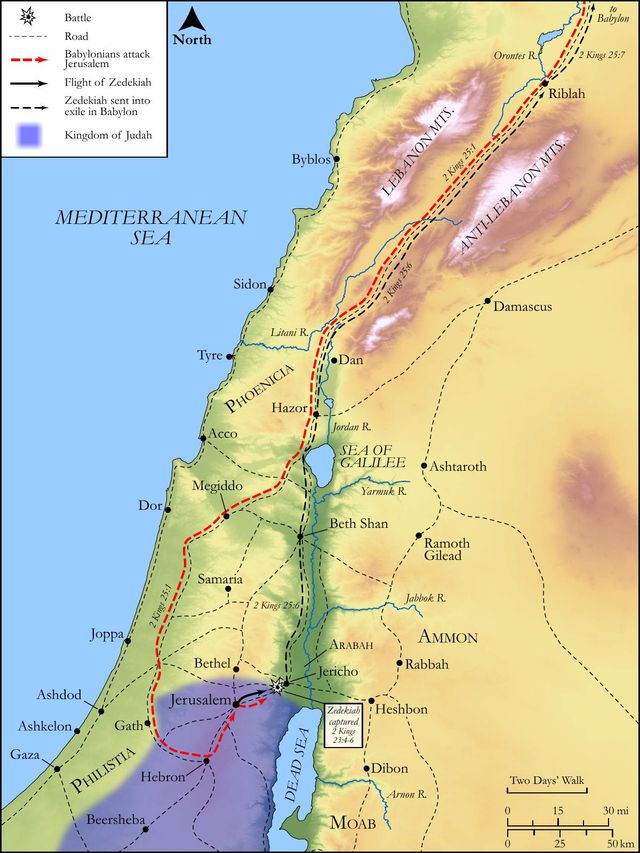
IV.The king, his family, and all his great men, made their escape in the night, by some secret passages which the besiegers either had not discovered or did not keep their eye upon, Kg2 25:4. But those as much deceive themselves who think to escape God's judgments as those who think to brave them; the feet of him that flees from them will as surely fail as the hands of him that fights against them. When God judges he will overcome. Intelligence was given to the Chaldeans of the king's flight, and which way he had gone, so that they soon overtook him, Kg2 25:5. His guards were scattered from him, every man shifting for his own safety. Had he put himself under God's protection, that would not have failed him now. He presently fell into the enemies' hands, and here we are told what they did with him.
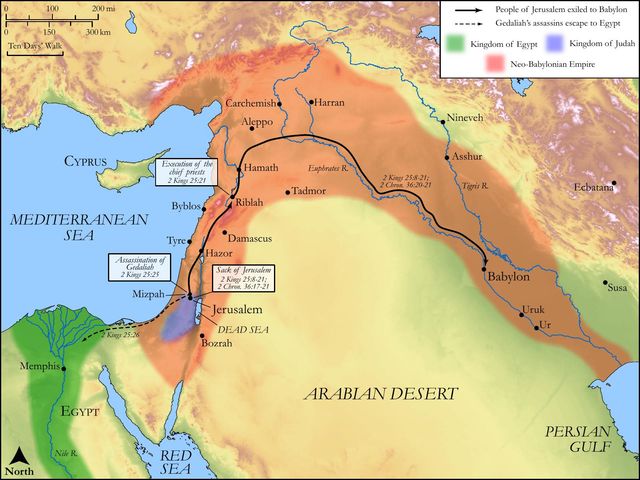
1.He was brought to the king of Babylon, and tried by a council of war for rebelling against him who set him up, and to whom he had sworn fidelity. God and man had a quarrel with him for this; see Eze 17:16, etc. The king of Babylon now lay at Riblah (which lay between Judea and Babylon), that he might be ready to give orders both to his court at home and his army abroad.
2.His sons were slain before his eyes, though children, that this doleful spectacle, the last his eyes were to behold, might leave an impression of grief and horror upon his spirit as long as he lived. In slaying his sons, they showed their indignation at his falsehood, and in effect declared that neither he nor any of his were fit to be trusted, and therefore that they were not fit to live.
3.His eyes were put out, by which he was deprived of that common comfort of human life which is given even to those that are in misery, and to the bitter in soul, the light of the sun, by which he was also disabled for any service. He dreaded being mocked, and therefore would not be persuaded to yield (Jer 38:19), but that which he feared came upon him with a witness, and no doubt added much to his misery; for, as those that are deaf suspect that every body talks of them, so those that are blind suspect that every body laughs at them. By this two prophecies that seemed to contradict one another were both fulfilled. Jeremiah prophesied that Zedekiah should be brought to Babylon, Jer 32:5; Jer 34:3. Ezekiel prophesied that he should not see Babylon, Eze 12:13. He was brought thither, but, his eyes being put out, he did not see it. Thus he ended his days, before he ended his life.
4.He was bound in fetters of brass and so carried to Babylon. He that was blind needed not be bound (his blindness fettered him), but, for his greater disgrace, they led him bound; only, whereas common malefactors are laid in irons (Psa 105:18; Psa 107:10), he, being a prince, was bound with fetters of brass; but that the metal was somewhat nobler and lighter was little comfort, while still he was in fetters. Let it not seem strange if those that have been held in the cords of iniquity come to be thus held in the cords of affliction, Job 36:8.
Historical interpretation
Historical reception
1 surviving comment on this verse from the historical church.
What think you of Nebuchadnezzar? Have you not heard from Scripture that he was bloodthirsty, fierce, with the disposition of a lion? Have you not heard that he disinterred the kings? Have you not heard that he brought the people away into captivity? Have you not heard that he put the king’s sons to the sword before Zedekiah’s eyes and then blinded him? Have you not heard that he shattered the cherubim? I do not mean the invisible cherubim—it is blasphemy to think it—but the sculptured images and the mercy seat in the Holy of Holies, from the midst of which God was apt to speak with his voice. He trampled on the veil of sanctification, he took the censer and carried it away to a temple of idols; he seized all the offerings; he burned the temple to its foundations. What punishment did he not deserve for slaying kings, for burning the holy object, for reducing the people to captivity, for putting the sacred vessels in the temples of the idols? Did he not deserve ten thousand deaths?You have seen the enormity of his crimes. Turn now to the loving-kindness of God. Nebuchadnezzar was turned into a wild beast; he dwelled in the wilderness; God scourged him to save him. He had claws like a lion’s, for he had preyed on the saints. He had a lion’s mane, for he had been a ravening, roaring lion. He ate grass like an ox, for he had behaved like a brute beast, not knowing him who had given him his kingdom. His body was drenched with dew, because, after seeing the fire quenched by the dew, he had not believed. And what happened? Afterwards he says, “I, Nebuchadnezzar, raised my eyes to heaven … and I blessed the Most High, and I praised and glorified him who lives forever.” When therefore he acknowledged the Most High, and uttered words of thanksgiving to God, and repented of his past wickedness and recognized his own weakness, in that hour God restored to him his royal dignity.
What then? If God granted pardon and a kingdom to Nebuchadnezzar after such terrible crimes, when he had made confession, will he not grant you the remission of your sins if you repent and the kingdom of heaven if you live worthily? God is merciful and quick to forgiveness but slow to vengeance. Therefore let no one despair of salvation. Peter, the chief and foremost of the apostles, denied the Lord thrice before a little serving maid; but, moved to repentance, he wept bitterly. His weeping revealed his heartfelt repentance, and for that reason not only did he receive pardon for his denial but also retained his apostolic prerogative.
Continue studying 2 Kings 25:1 across the web’s major study libraries — every link below opens this exact verse, chapter, or book on the destination site.
Read & Compare
 BibleGatewayThis verse in more than 200 translations and 70 languages.
 Bible.comThe YouVersion reader — hundreds of translations, reading plans, and highlights.
 ESV.orgCrossway's official English Standard Version reader.
 NET BibleThe NET translation with 60,000+ translators' notes on every rendering decision.
 STEP BibleTyndale House's free study tool — original text, vocabulary, and scholarly resources.
 BibliaLogos Bible Software's free web reader.
 USCCBThe New American Bible (Revised Edition) with the U.S. bishops' study notes.
Commentaries
 BibleHub CommentariesDozens of classic commentaries on this verse, gathered on one page.
 StudyLightMore than 100 commentary sets — the largest collection on the web.
 BibleRefPlain-English commentary on what this verse means, verse by verse.
 Enduring WordDavid Guzik's free commentary on this chapter, widely used by Bible teachers.
 Bible Study ToolsVerse commentary alongside Greek and Hebrew study aids.
Original Language & Research
- BibleHub InterlinearThe verse word by word — original language, transliteration, and English.
- BibleHub LexiconEvery word's original-language definition and Strong's entry.
 Blue Letter BibleDeep-study tools — Strong's numbers, concordance, and word studies.
 SefariaThe Hebrew text with Rashi and centuries of Jewish commentary.
Sermons, Hymns & Audio


TrulyRandomVerse is not affiliated with these sites and doesn’t control their content. They’re linked because they’re genuinely useful.
Summary
2 Kings 25:1 meticulously records the precise commencement of the final, devastating siege of Jerusalem by Nebuchadnezzar, king of Babylon. This pivotal verse marks the grim beginning of the end for the Kingdom of Judah, detailing the overwhelming military force brought against the city and the initiation of relentless siege operations that would ultimately lead to Jerusalem's destruction, the burning of the First Temple, and the exile of its people, profoundly reshaping Israel's national and religious identity and serving as a stark culmination of divine judgment.
Context
ShowHideLiterary Context
This verse serves as the grim and inevitable climax to a narrative arc of decline, apostasy, and impending judgment that has unfolded throughout the book of 2 Kings. Following the account of King Jehoiachin's deportation to Babylon and the installation of Zedekiah as a puppet king by Nebuchadnezzar in 2 Kings 24:10-17, the narrative immediately shifts to Zedekiah's fatal rebellion against his Babylonian overlord. 2 Kings 24:20 explicitly states that "Zedekiah rebelled against the king of Babylon," setting the stage for the inevitable and severe punitive action described in 2 Kings 25:1. This verse, therefore, is not an isolated incident but the direct, divinely orchestrated consequence of Judah's persistent covenant unfaithfulness and Zedekiah's political miscalculation, leading directly into the detailed and tragic account of the city's fall, the destruction of the Temple, and the subsequent Babylonian exile in the verses that follow.
Historical & Cultural Context
The "ninth year of his reign" refers to King Zedekiah, the last king of Judah, who had foolishly broken his solemn oath of allegiance to Nebuchadnezzar, likely spurred by a misguided alliance with Egypt. This act of defiance provoked the full, overwhelming might of the Neo-Babylonian Empire. Nebuchadnezzar, a formidable military strategist and the most powerful ruler of his time, responded decisively to reassert his dominion. The meticulous dating—"in the tenth month, in the tenth day of the month"—corresponds to January 15, 588 BC, highlighting the historical precision and profound solemnity of this catastrophic event. This was not a quick raid but a full-scale, protracted siege, employing advanced military engineering common among the nations of that day. The Babylonians "pitched against it" (established a fortified encirclement camp) and "built forts against it round about," referring to the construction of massive siege ramps, elevated towers, and circumvallation walls designed to completely isolate the city, prevent supplies or reinforcements from entering, and facilitate a breach of its formidable defenses, a common and highly effective siege tactic of the era.
Key Themes
ShowHideThe commencement of the siege of Jerusalem in 2 Kings 25 powerfully underscores several major themes within 2 Kings and the broader Deuteronomistic History. Firstly, it stands as the ultimate manifestation of Divine Judgment upon Judah for generations of persistent idolatry, covenant unfaithfulness, and pervasive oppression, repeatedly warned against by prophets like Jeremiah and Ezekiel. Secondly, this event represents the dramatic and undeniable Fulfillment of Prophecy, as numerous prophets had foretold this very destruction and exile, validating God's sovereign control over history and nations, even using foreign empires as instruments of His righteous will, as seen in Jeremiah 32:3. Finally, this verse marks The End of an Era—the catastrophic collapse of the independent Davidic monarchy in Judah and the beginning of the Babylonian Captivity, a period of profound theological reorientation, suffering, and a reshaping of the Jewish people's identity, as detailed further in 2 Kings 25:11.
Exposition and Analysis
ShowHideKey Word Analysis
ShowHideThis term, often translated as "army," "force," or "might," signifies not merely a collection of soldiers but a powerful, overwhelming military contingent. It conveys the immense resources, formidable strength, and numerous personnel Nebuchadnezzar commanded, emphasizing the utter futility of Jerusalem's resistance against such a formidable "host." The use of ḥayil here underscores the sheer scale, destructive potential, and comprehensive nature of the Babylonian forces arrayed against Judah.
This verb means "to encamp," "to lay siege," or "to settle down." It describes the strategic and deliberate action of Nebuchadnezzar's army establishing a fortified camp around Jerusalem. This was not a temporary skirmish or a passing raid but a calculated, long-term military operation, indicating the Babylonians' intent to completely encircle, isolate, and systematically prepare for a protracted siege rather than a quick assault. It implies a settled, determined presence.
This rare and specific term refers to siege works, battering-towers, mounds, or circumvallation walls built by besieging armies. These were not merely temporary structures but substantial earthworks and fortifications constructed to prevent anyone from entering or leaving the city, to provide elevated positions for archers and siege engines, and to serve as a base for breaching the city walls. The construction of dâyêq signifies a comprehensive, methodical, and relentless siege strategy designed to starve out and ultimately conquer the city.
Verse Breakdown
ShowHide"And it came to pass in the ninth year of his reign, in the tenth month, in the tenth [day] of the month"
This opening clause provides an exceptionally precise chronological marker, referring to the reign of King Zedekiah of Judah. The specificity of the date (January 15, 588 BC) emphasizes the historical accuracy, solemnity, and gravity of the event. It highlights that this was a documented, significant turning point in Judah's history, not a vague occurrence, underscoring the divine hand in history and the precise fulfillment of prophetic warnings that had been given for generations.
"[that] Nebuchadnezzar king of Babylon came, he, and all his host, against Jerusalem"
This clause identifies both the formidable aggressor and the targeted victim. Nebuchadnezzar, the most powerful monarch of the Neo-Babylonian Empire, personally led this massive military expedition, signifying its paramount importance. The phrase "all his host" underscores the overwhelming numerical, strategic, and logistical superiority of the Babylonian army, indicating that Jerusalem faced an insurmountable and devastating force, leaving no doubt as to the outcome.
"and pitched against it; and they built forts against it round about."
This describes the immediate and strategic actions taken by the Babylonian army upon their arrival. "Pitched against it" signifies the establishment of a vast, fortified siege camp, completely encircling the city and cutting off all access. The subsequent action, "they built forts against it round about," refers to the construction of elaborate and substantial siege works, such as earthen ramps, mobile siege towers, and circumvallation walls. This demonstrates a methodical, comprehensive, and relentless siege strategy designed to starve the city into submission and eventually breach its formidable defenses, ensuring its ultimate fall.
Literary Devices
ShowHideThe verse employs several powerful Literary Devices that enhance its impact and convey its profound significance. The most prominent is Chronological Precision, with the exact dating ("ninth year...tenth month, in the tenth day") lending an air of historical verisimilitude, solemnity, and sober finality to the narrative. This precision underscores the inevitability of the impending doom and the precise fulfillment of divine warnings. There is also a strong sense of Foreshadowing as the meticulous description of the Babylonian forces ("all his host") and their comprehensive siege tactics ("pitched against it; and they built forts against it round about") vividly anticipates the utter destruction, desolation, and prolonged suffering that will inevitably follow. The sheer scale of the attacking force and the methodical nature of their preparations communicate the overwhelming, unstoppable power arrayed against Jerusalem, making the city's fall seem tragically unavoidable. Furthermore, a subtle Irony is present: Zedekiah, who was placed on the throne by Nebuchadnezzar himself, now faces the very power that installed him, a direct and devastating consequence of his own rebellious defiance against the divine will that had ordained submission to Babylon.
Theological and Thematic Connections
ShowHide2 Kings 25:1 is a stark and somber testament to the unwavering principle of divine justice and the absolute reliability of God's prophetic word. It powerfully demonstrates that God's patience, though vast and long-suffering, is not infinite, and persistent, unrepentant disobedience to His covenant commands ultimately leads to severe and inescapable consequences. The impending destruction of Jerusalem and the Temple, the very symbols of God's presence among His people, represented a profound theological crisis for Judah, forcing them to confront the painful reality of their sin and God's absolute sovereignty even over their national destiny. This calamitous event served as a painful but necessary purification, intended to bring about deep repentance and a renewed, exclusive reliance on God alone, highlighting that God uses even powerful pagan empires as instruments of His righteous judgment to achieve His purposes for His people.
Reflection and Application
ShowHideThe commencement of the siege of Jerusalem in 2 Kings 25:1 offers a profound and sobering lesson for believers today. It reminds us that God is utterly sovereign over all nations and the unfolding of human history, and His word, whether in promise or warning, will ultimately be fulfilled with perfect precision. Just as Judah faced the dire consequences of generations of unfaithfulness and covenant breaking, we are called to a life of consistent obedience, humble submission, and unwavering faithfulness to God's revealed will. This passage challenges us to deeply examine our own lives: are we truly heeding God's warnings against sin and rebellion, or are we, like Zedekiah, trusting in futile alliances, self-reliance, or rebellious defiance against divine authority? It underscores the critical importance of genuine repentance and submission to God's lordship, recognizing that God's judgment, though severe and painful, is always righteous and ultimately aimed at bringing His people back into right relationship with Himself. Even in the face of overwhelming adversity and seemingly insurmountable circumstances, God's sovereign purposes prevail, and His people are refined and purified through trials, leading to a deeper reliance on His unfailing grace.
Questions for Reflection
ShowHideFAQ
ShowHideWhy is the specific date of the siege commencement so meticulously recorded?
ShowHideThe meticulous recording of the date—"in the ninth year of his reign, in the tenth month, in the tenth day of the month"—serves several critical purposes. Historically, it underscores the accuracy and reliability of the biblical account, aligning with extra-biblical records that place this event on January 15, 588 BC. Theologically, it emphasizes that this was not a random or unforeseen occurrence but a divinely ordained and precisely timed act of judgment, a direct fulfillment of prophecies delivered by prophets like Jeremiah. This precision highlights God's sovereign control over history and His unwavering commitment to His covenant, both in blessing and in judgment. It also marks a pivotal, unforgettable moment in Israel's national memory, signifying the end of an era and the beginning of the Babylonian exile, a period that profoundly shaped their identity and future.
Christ-Centered Fulfillment
ShowHideWhile 2 Kings 25:1 describes a moment of devastating judgment and the destruction of the earthly temple, it ultimately points forward to Christ in profound and redemptive ways. The fall of Jerusalem and the subsequent exile, though traumatic and a consequence of sin, were not the end of God's covenant promises; rather, they served to purify a faithful remnant and prepared the way for a greater, more enduring salvation. The destruction of the physical temple foreshadows the coming of Jesus, who declared Himself to be the true temple, the living dwelling place of God among humanity, whose body would be destroyed and raised again (John 2:19-21). Just as ancient Jerusalem faced judgment for its rejection of God's repeated warnings and prophetic calls to repentance, Jesus lamented over Jerusalem's continued rejection of Him, foretelling its future destruction in AD 70 as a consequence of its unbelief (Luke 19:41-44). Yet, in Christ, the ultimate Lamb of God, the full weight of divine judgment for sin was borne on the cross, offering a path to reconciliation and restoration that the Old Covenant sacrifices and temple could not fully provide (Isaiah 53:5-6). The exile, a period of brokenness, longing, and spiritual reorientation, cultivated a deep hope for the Messiah, who would ultimately gather God's scattered people from every nation and establish an eternal kingdom, not of this world, where true peace, justice, and perfect communion with God would reign forever (Hebrews 8:1-13). Thus, the historical tragedy of 2 Kings 25:1, while marking the end of an era for Old Covenant Judah, ultimately paves the way for the new covenant and the eternal hope found in Jesus Christ, the true King, the ultimate Temple, and the redeemer of all who believe.