


Jeremiah 52:4
- וַיְהִיvay·Hiand it wasH1961Conj-w ¦ V-Qal-ConsecImperf-3msVerb Qal Consecutive Imperfect 3rd Singular Masculineוַandיְהִיit was
- בַשָּׁנָהva·sha·Nahin the yearH8141Prep-b ¦ N-fsNoun Singular Feminine Absoluteבַin theשָּׁנָהyear
- הַתְּשִׁעִיתha·te·shi·'It<the> ninthH8671Art ¦ Adj-fsAdjective Numerical Position Singular Feminine Absoluteהַ<the>תְּשִׁעִיתninth
- לְמָלְכוֹle·ma·le·Khoof reigning hisH4427Prep-l ¦ V-Qal-Inf ¦ 3msVerb Qal Infinitive Constructלְofמָלְכreigningוֹhis
- בַּחֹדֶשׁba·Cho·deshin the monthH2320Prep-b ¦ N-msNoun Singular Masculine Absoluteבַּin theחֹדֶשׁmonth
- הָעֲשִׂירִיha·'a·si·Ri<the> tenthH6224Art ¦ Adj-msAdjective Numerical Position Singular Masculine Absoluteהָ<the>עֲשִׂירִיtenth
- בֶּעָשׂוֹרbe·'a·Soron the tenH6218Prep-b ¦ N-msNoun Singular Masculine Absoluteבֶּon theעָשׂוֹרten
- לַחֹדֶשׁla·cho·Deshof the monthH2320Prep-l ¦ N-msNoun Singular Masculine Absoluteלַof theחֹדֶשׁmonth
- בָּאba'he cameH935V-Qal-Perf-3msVerb Qal Perfect 3rd Singular Masculine
- נְבוּכַדְרֶאצַּרne·vu·khad·re·TzarNebuchadnezzarH5019N-proper-mNoun Proper Masculine
- מֶלֶךְMe·lekh[the] king ofH4428N-mscNoun Singular Masculine Construct
- בָּבֶלba·VelBabylonH894N-properNoun Proper Location
- הוּאhu'heH1931Pro-3msPronoun Personal 3rd Singular Masculine
- וְכָלve·kholand allH3605Conj-w ¦ N-mscNoun Singular Masculine Constructוְandכָלall
- חֵילוֹchei·Lohis armyH2428N-msc ¦ 3msNoun Singular Masculine Constructחֵילarmyוֹhis
- עַל'alonH5921PrepPreposition
- יְרוּשָׁלִַםye·Ru·sha·LimJerusalemH3389N-properNoun Proper Location
- וַיַּחֲנוּvai·ya·cha·Nuand they encampedH2583Conj-w ¦ V-Qal-ConsecImperf-3mpVerb Qal Consecutive Imperfect 3rd Plural Masculineוַandיַּחֲנוּthey encamped
- עָלֶיהָ'a·Lei·haon itH5921Prep ¦ 3fsPreposition Definiteעָלֶיonהָit
- וַיִּבְנוּvai·yiv·Nuand they builtH1129Conj-w ¦ V-Qal-ConsecImperf-3mpVerb Qal Consecutive Imperfect 3rd Plural Masculineוַandיִּבְנוּthey built
- עָלֶיהָ'a·Lei·haon itH5921Prep ¦ 3fsPreposition Definiteעָלֶיonהָit
- דָּיֵקda·Yeka siege-wallH1785N-msNoun Singular Masculine Absolute
- סָבִיבsa·Vivall aroundH5439N-csNoun Singular common gender Absolute
English is a literal word-by-word gloss of the Hebrew, not the KJV's wording. Why?
This is the original text the KJV's translators worked from — each Hebrew word with its own literal English meaning in this verse, prepared by scholars at Tyndale House, Cambridge. The KJV translates whole sentences, not word by word, so its wording differs: one Hebrew word can become several English words, and the KJV may choose “the LORD” where the gloss reads “Yahweh”. Both are faithful — they answer different questions. For the KJV's own rendering, switch to the KJV text.
Details
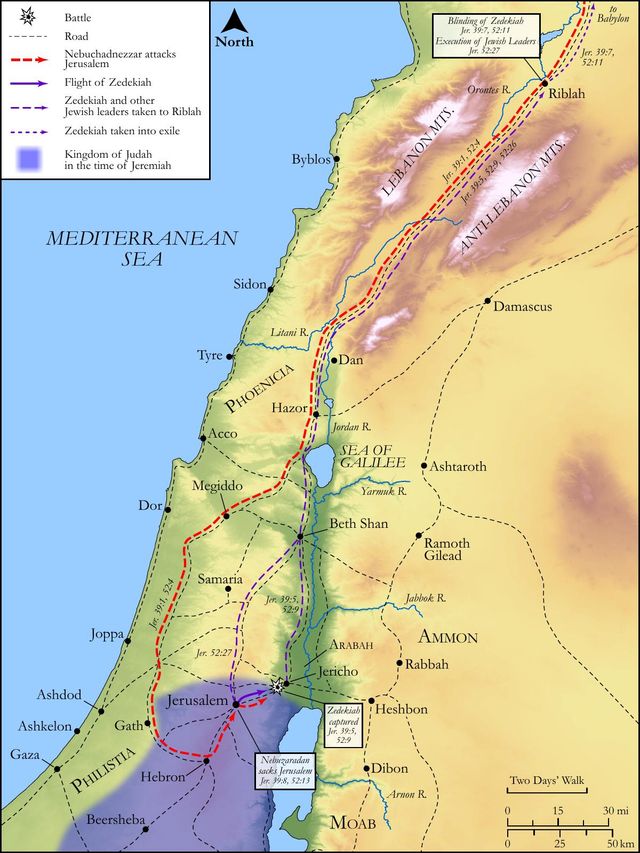
See on the biblical-era map
Study this verse
Public-domain commentary
Matthew Henry
From his Commentary on the Whole Bible. Henry comments on passages, not single verses — this entry covers Jeremiah 52:1–11.
This narrative begins no higher than the beginning of the reign of Zedekiah, though there were two captivities before, one in the fourth year of Jehoiakim, the other in the first of Jeconiah; but probably it was drawn up by some of those that were carried away with Zedekiah, as a reproach to themselves for imagining that they should not go into captivity after their brethren, with which hopes they had long flattered themselves. We have here, 1. God's just displeasure against Judah and Jerusalem for their sin, Jer 52:3. His anger was against them to such a degree that he determined to cast them out from his presence, his favourable gracious presence, as a father, when he is extremely angry with an undutiful son, bids him get out of his presence, he expelled them from that good land that had such tokens of his presence in providential bounty and that holy city and temple that had such tokens of his presence in covenant-grace and love. Note, Those that are banished from God's ordinances have reason to complain that they are in some degree cast out of his presence; yet none are cast out from God's gracious presence but those that by sin have first thrown themselves out of it. This fruit of sin we should therefore deprecate above any thing, as David (Psa 51:11), Cast me not away from thy presence. 2. Zedekiah's bad conduct and management, to which God left him, in displeasure against the people, and for which God punished him, in displeasure against him. Zedekiah had arrived at years of discretion when he came to the throne; he was twenty-one years old (Jer 52:1); he was none of the worst of the kings (we never read of his idolatries), yet his character is that he did evil in the eyes of the Lord, for he did not do the good he should have done. But that evil deed of his which did in a special manner hasten this destruction was his rebelling against the king of Babylon, which was both his sin and his folly, and brought ruin upon his people, not only meritoriously, but efficiently. God was greatly displeased with him for his perfidious dealing with the king of Babylon (as we find, Eze 17:15, etc.); and, because he was angry at Judah and Jerusalem, he put him into the hand of his own counsels, to do that foolish thing which proved fatal to him and his kingdom. 3. The possession which the Chaldeans at length gained of Jerusalem, after eighteen months' siege. They sat down before it, and blocked it up, in the ninth year of Zedekiah's reign, in the tenth month (Jer 52:4), and made themselves masters of it in the eleventh year in the fourth month, Jer 52:6. In remembrance of these two steps towards their ruin, while they were in captivity, they kept a fast in the fourth month, and a fast in the tenth (Zac 8:19): that in the fifth month was in remembrance of the burning of the temple, and that in the seventh of the murder of Gedaliah. We may easily imagine, or rather cannot imagine, what a sad time it was with Jerusalem, during this year and half that it was besieged, when all provisions were cut off from coming to them and they were ever and anon alarmed by the attacks of the enemy, and, being obstinately resolved to hold out to the last extremity, nothing remained but a certain fearful looking for of judgment. That which disabled them to hold out, and yet could not prevail with them to capitulate, was the famine in the city (Jer 52:6); there was no bread for the people of the land, so that the soldiers could not make good their posts, but were rendered wholly unserviceable; and then no wonder that the city was broken up, Jer 52:7. Walls, in such a case, will not hold out long without men, any more than men without walls; nor will both together stand people in any stead without God and his protection. 4. The inglorious retreat of the king and his mighty men. They got out of the city by night (Jer 52:7) and made the best of their way, I know not whither, nor perhaps they themselves; but the king was overtaken by the pursuers in the plains of Jericho, his guards were dispersed, and all his army was scattered from him, Jer 52:8. His fright was not causeless, for there is no escaping the judgments of God; they will come upon the sinner, and will overtake him, let him flee where he will (Deu 28:15), and these judgments particularly that are here executed were there threatened, Jer 51:52, Jer 51:53, etc. 5. The sad doom passed upon Zedekiah by the king of Babylon, and immediately put in execution. he treated him as a rebel, gave judgment upon him, Jer 51:9. One cannot think of it without the utmost vexation and regret that a king, a king of Judah, a king of the house of David, should be arraigned as a criminal at the bar of this heathen king. But he humbled not himself before Jeremiah the prophet; therefore God thus humbled him. Pursuant to the sentence passed upon him by the haughty conqueror, his sons were slain before his eyes, and all the princes of Judah (Jer 52:10); then his eyes were put out, and he was bound in chains, carried in triumph to Babylon; perhaps they made sport with him, as they did with Samson when his eyes were put out; however, he was condemned to perpetual imprisonment, wearing out the remainder of his life (I cannot say his days, for he saw day no more) in darkness and misery. He was kept in prison till the day of his death, but had some honour done him at his funeral, Jer 34:5. Jeremiah had often told him what it would come to, but he would not take warning when he might have prevented it.
Continue studying Jeremiah 52:4 across the web’s major study libraries — every link below opens this exact verse, chapter, or book on the destination site.
Read & Compare
 BibleGatewayThis verse in more than 200 translations and 70 languages.
 Bible.comThe YouVersion reader — hundreds of translations, reading plans, and highlights.
 ESV.orgCrossway's official English Standard Version reader.
 NET BibleThe NET translation with 60,000+ translators' notes on every rendering decision.
 STEP BibleTyndale House's free study tool — original text, vocabulary, and scholarly resources.
 BibliaLogos Bible Software's free web reader.
 USCCBThe New American Bible (Revised Edition) with the U.S. bishops' study notes.
Commentaries
 BibleHub CommentariesDozens of classic commentaries on this verse, gathered on one page.
 StudyLightMore than 100 commentary sets — the largest collection on the web.
 BibleRefPlain-English commentary on what this verse means, verse by verse.
 Enduring WordDavid Guzik's free commentary on this chapter, widely used by Bible teachers.
 Bible Study ToolsVerse commentary alongside Greek and Hebrew study aids.
Original Language & Research
- BibleHub InterlinearThe verse word by word — original language, transliteration, and English.
- BibleHub LexiconEvery word's original-language definition and Strong's entry.
 Blue Letter BibleDeep-study tools — Strong's numbers, concordance, and word studies.
 SefariaThe Hebrew text with Rashi and centuries of Jewish commentary.
Sermons, Hymns & Audio


TrulyRandomVerse is not affiliated with these sites and doesn’t control their content. They’re linked because they’re genuinely useful.
Summary
Jeremiah 52:4 precisely records the commencement of the final, devastating Babylonian siege against Jerusalem. This pivotal event, occurring in the ninth year of King Zedekiah's reign, details the overwhelming arrival of Nebuchadrezzar and his formidable army, who meticulously encircled the city with siege works. This verse marks the beginning of the end for the independent Kingdom of Judah, serving as a solemn fulfillment of generations of prophetic warnings and a stark manifestation of divine judgment against a disobedient people, setting the stage for the city's destruction and the subsequent exile.
Context
ShowHideLiterary Context
Jeremiah 52 functions as a historical appendix to the prophetic book of Jeremiah, primarily serving to authenticate and illustrate the fulfillment of the prophet's dire warnings concerning Judah's impending judgment. While much of the preceding chapters contain Jeremiah's pronouncements, laments, and biographical details, Chapter 52 shifts to a factual historical account, largely paralleling and expanding upon the narrative found in 2 Kings 24-25. This verse, identical in substance to 2 Kings 25:1, establishes the exact chronological starting point of the final siege, transitioning the reader from the realm of prophecy to its grim, undeniable realization. It acts as a concrete historical anchor, confirming the accuracy and divine authority behind Jeremiah's message and the unfolding of God's predetermined plan for Judah.
Historical & Cultural Context
The late 7th and early 6th centuries BC were marked by significant geopolitical upheaval in the Ancient Near East. The Neo-Babylonian Empire, under the formidable leadership of Nebuchadrezzar II, had rapidly ascended to become the dominant regional power, following its decisive defeat of Assyria and Egypt. Judah, a small kingdom strategically located between these empires, had become a vassal state to Babylon after previous campaigns. King Zedekiah, installed by Nebuchadrezzar, foolishly rebelled against his Babylonian overlord, seeking an alliance with Egypt, despite the prophet Jeremiah's consistent and urgent warnings to submit to Babylon as God's instrument of judgment (e.g., Jeremiah 27:8-11). The siege described in this verse was Babylon's inevitable, brutal response to this act of defiance, a standard military practice of ancient empires to crush rebellion and secure their dominion. The "forts" mentioned refer to sophisticated siege engineering, including ramps, towers, and circumvallation lines, designed to isolate, bombard, and ultimately breach the city's formidable defenses.
Key Themes
ShowHideJeremiah 52:4 powerfully underscores several profound themes central to the book of Jeremiah and the broader biblical narrative. Firstly, it highlights the Sovereignty of God over all nations and historical events; Nebuchadrezzar, though a pagan king, was unequivocally God's chosen instrument of judgment against Judah's persistent idolatry and covenant unfaithfulness, a truth emphasized in passages such as Jeremiah 25:9. Secondly, the verse vividly illustrates the severe Consequences of Disobedience and rebellion against God's revealed will; Judah's national catastrophe was not accidental but a direct, divinely ordained outcome of their spiritual apostasy and rejection of prophetic warnings. Thirdly, it serves as a stark demonstration of the Fulfillment of Prophecy, as Jeremiah's dire predictions regarding Jerusalem's destruction (e.g., Jeremiah 21:7) began their final, irreversible unfolding. Finally, this verse initiates the narrative of the Exile, a period of profound theological reflection, purification, and eventual restoration for the remnant of Israel, a theme that finds its promise of return in passages like Jeremiah 29:10.
Exposition and Analysis
ShowHideKey Word Analysis
ShowHideThis specific transliteration and spelling (also seen as Nebuchadnezzar) refers to the formidable king of the Neo-Babylonian Empire (605-562 BC) who was responsible for the destruction of Jerusalem and the Temple. The name, of foreign (Babylonian) derivation, likely means "Nabu protect my firstborn son" or "Nabu protect the crown." His appearance in this verse signifies the arrival of the divinely appointed instrument of judgment, underscoring God's sovereign control over even powerful pagan rulers to achieve His purposes.
This primitive root primarily means "to incline," but by extension, "to decline" (as the sun's rays at evening), and most commonly in military contexts, "to pitch a tent" or "to encamp." When used in relation to an army against a city, it signifies the establishment of a prolonged military camp for the purpose of a siege. Here, it conveys the deliberate, methodical, and determined nature of the Babylonian army's actions, indicating they were settling in for a protracted assault rather than a swift raid, signaling the inevitability of Jerusalem's isolation.
Derived from a root related to "to batter" or "to beat," this term specifically refers to a battering-tower or, more broadly, a siege-work, often implying a circumvallation or siege-wall. These were elaborate structures built by besieging armies to encircle a city, prevent escape or relief, and provide elevated positions for assault. The mention of "forts" highlights the advanced military engineering and thoroughness of Nebuchadrezzar's army, demonstrating their absolute determination to conquer the city by cutting off all external support and preparing for a decisive breach.
Verse Breakdown
ShowHide"And it came to pass in the ninth year of his reign, in the tenth month, in the tenth [day] of the month,"
This opening clause provides an extraordinarily precise chronological marker for the initiation of the siege. "His reign" refers to King Zedekiah of Judah. The date corresponds to the 10th day of the 10th month (Tevet) in Zedekiah's ninth regnal year, which is historically calculated to be January 15, 588 BC. This meticulous dating underscores the historical veracity and divine orchestration of these events, marking a specific, irreversible turning point in Judah's history, a day so significant it would later be commemorated with a fast.
"[that] Nebuchadrezzar king of Babylon came, he and all his army, against Jerusalem,"
This identifies the primary aggressor and the target of this massive military operation. Nebuchadrezzar, the formidable ruler of the Neo-Babylonian Empire, arrived with his entire military force, emphasizing the overwhelming might, vast resources, and absolute determination brought to bear against the relatively small kingdom of Judah. The phrase "all his army" conveys the sheer scale and inevitability of the impending conflict, highlighting that this was not a minor skirmish but a full-scale invasion aimed at total subjugation and the crushing of rebellion.
"and pitched against it, and built forts against it round about."
This final clause describes the immediate and strategic actions taken by the Babylonian army upon their arrival. "Pitched against it" signifies the establishment of a permanent, encircling encampment around Jerusalem, formally initiating the siege. The subsequent construction of "forts" (Hebrew, dâyêq), which included siege ramps, towers, and circumvallation walls, demonstrates a comprehensive and methodical strategy to completely encircle, isolate, and eventually breach the city's defenses. This tactical detail illustrates the Babylonians' unwavering resolve to starve or batter Jerusalem into submission, leaving no hope for relief or retreat for the besieged inhabitants.
Literary Devices
ShowHideJeremiah 52:4 employs several potent literary devices to convey the gravity and inevitability of the events. The most striking is Precision in Dating, which grounds the narrative in verifiable historical time with meticulous detail. This chronological specificity not only lends immense credibility and gravity to the unfolding events but also transforms a mere historical record into a testament of divine providence, showing that God's judgments unfold according to a precise, predetermined timetable. There is also a strong sense of Foreshadowing, as the detailed description of the siege's commencement grimly anticipates the city's inevitable fall, the destruction of the Temple, and the subsequent exile, all of which are fully recounted later in the chapter. Finally, the cumulative effect of phrases like "he and all his army," "pitched against it," and "built forts against it round about" creates vivid Imagery of overwhelming force and inescapable encirclement, powerfully conveying the utter hopelessness of Jerusalem's situation from a human perspective.
Theological and Thematic Connections
ShowHideJeremiah 52:4 stands as a stark testament to the fulfillment of divine judgment and the unwavering sovereignty of God over human history. It marks the culmination of centuries of prophetic warnings, demonstrating that God's patience, while vast, is not infinite. The precise dating and detailed description of the siege underscore that this was not a random geopolitical event, but a meticulously orchestrated act of God, using Nebuchadrezzar as His instrument to chastise Judah for its persistent idolatry, moral corruption, and covenant unfaithfulness. This event serves as a powerful reminder that rebellion against God's revealed will inevitably leads to severe consequences, yet even in judgment, God's ultimate purposes for His people remain intact, setting the stage for future restoration.
Reflection and Application
ShowHideThe precise and somber account of Jerusalem's final siege in Jeremiah 52:4 offers profound lessons for believers today. It serves as a powerful reminder that God's warnings are not idle threats but are ultimately fulfilled, urging us to heed His Word with seriousness and urgency. Just as Judah faced the dire consequences of its persistent rebellion and spiritual apathy, we too must recognize that our choices have real-world and spiritual ramifications. This verse calls us to examine our own lives for areas of disobedience, idolatry, or compromise, prompting us to repent and return to faithful adherence to God's commands. Moreover, it highlights God's absolute sovereignty, even amidst tragic human events; He uses all circumstances, even the actions of powerful, ungodly rulers, to accomplish His divine purposes. This should instill in us a deep trust in His overarching plan, even when circumstances seem chaotic or overwhelming, knowing that He is meticulously working out His will in history and in our individual lives, always moving towards His ultimate redemptive purposes.
Questions for Reflection
ShowHideFAQ
ShowHideWho was Nebuchadrezzar and why was he involved in Jerusalem's destruction?
ShowHideNebuchadrezzar (also widely known as Nebuchadnezzar II) was the most powerful and influential king of the Neo-Babylonian Empire, reigning from 605 to 562 BC. He was a formidable military strategist and empire builder who transformed Babylon into a dominant regional power. His involvement in Jerusalem's destruction was a direct consequence of King Zedekiah of Judah's repeated rebellion against Babylonian suzerainty, despite solemn oaths and warnings. From a biblical perspective, Nebuchadrezzar was not merely a geopolitical actor but was providentially used by God as His instrument of judgment against Judah for its persistent idolatry, covenant unfaithfulness, and rejection of prophetic warnings. Prophets like Jeremiah explicitly declared that God would bring Nebuchadrezzar and his army against Jerusalem as a divine chastisement, as seen in passages such as Jeremiah 25:9.
What was the significance of the specific date mentioned in Jeremiah 52:4?
ShowHideThe verse precisely dates the beginning of the siege to "the ninth year of his reign, in the tenth month, in the tenth [day] of the month." This corresponds to the 10th day of the Hebrew month of Tevet, which is approximately January 15, 588 BC. This date is profoundly significant for several reasons. Firstly, its meticulous precision underscores the historical accuracy and verifiable nature of the biblical account, demonstrating its rootedness in real-world events. Secondly, in Jewish tradition, the 10th of Tevet became a solemn fast day (Asarah B'Tevet) commemorating the beginning of this siege, which ultimately led to the destruction of Jerusalem and the First Temple. This specific date marked the point of no return for Judah, signaling the irreversible unfolding of God's judgment and the end of their independent kingdom.
What were the "forts" that Nebuchadrezzar's army built against Jerusalem?
ShowHideThe "forts" (Hebrew: dâyêq, H1785) refer to the elaborate and sophisticated siege works constructed by ancient armies to conquer heavily fortified cities. These typically included several components: massive siege ramps (earthen mounds built to elevate battering rams and troops to the height of the city walls), siege towers (mobile wooden towers used to assault the walls), and extensive circumvallation lines (a complete ring of walls or earthworks built around the besieged city). The primary purpose of these structures was multifaceted: to prevent the besieged inhabitants from escaping or receiving supplies and reinforcements, to provide elevated positions for archers and slingers to bombard the city, and to facilitate the breaching of the city walls. The construction of such "forts" around Jerusalem indicates a thorough, determined, and technologically advanced siege strategy by the Babylonians, designed to completely isolate and eventually overwhelm the city by starvation or direct assault.
Christ-Centered Fulfillment
ShowHideWhile Jeremiah 52:4 details a moment of profound national judgment and the physical destruction of Jerusalem, it also implicitly points forward to the ultimate fulfillment found in Christ. The siege and subsequent fall of Jerusalem, a direct consequence of Israel's covenant unfaithfulness and rejection of God's prophets, foreshadows the spiritual siege laid against humanity by sin, leading to spiritual death and separation from God. However, just as God meticulously orchestrated the judgment, He also meticulously orchestrated salvation. The destruction of the physical Temple, which served as the dwelling place of God's presence, points to the coming of Jesus Christ, who declared Himself to be the true Temple, the place where God's presence fully resides (e.g., John 2:19-21). The precision of the date of Jerusalem's siege reminds us of God's perfect timing in all His plans, including the sending of His Son "in the fullness of time" (e.g., Galatians 4:4). Ultimately, the judgment on Jerusalem serves as a severe warning of the consequences of sin, but it also highlights the desperate need for a Savior who would bear the ultimate judgment for sin, offering true and lasting peace not through physical walls but through spiritual redemption (e.g., Ephesians 2:14). The "forts" built to besiege Jerusalem find their spiritual counterpoint in the spiritual strongholds that Christ dismantles through His victory on the cross, liberating those who were once captive to sin and death (e.g., 2 Corinthians 10:4-5).