


Jeremiah 52:8
Bible text: King James Version (1769 Blayney text) · Public domain
Bible text: Berean Standard Bible · Public domain
Bible text: American Standard Version (1901) · Public domain
Bible text: World English Bible, Messianic edition · Public domain
Bible text: Geneva Bible (1599) · Public domain
Bible text: Young's Literal Translation · Public domain
- וַיִּרְדְּפוּvai·yir·de·Fuand they pursuedH7291Conj-w ¦ V-Qal-ConsecImperf-3mpVerb Qal Consecutive Imperfect 3rd Plural Masculineוַandיִּרְדְּפוּthey pursued
- חֵילcheil[the] army ofH2428N-mscNoun Singular Masculine Construct
- כַּשְׂדִּיםkas·Dim[the] ChaldeansH3778N-properNoun Proper Location
- אַחֲרֵי'a·cha·ReiafterH310Adj-mpcAdjective Numerical Plural Masculine Construct
- הַמֶּלֶךְha·Me·lekhthe kingH4428Art ¦ N-msNoun Singular Masculine Absoluteהַtheמֶּלֶךְking
- וַיַּשִּׂיגוּvai·ya·Si·guand they overtookH5381Conj-w ¦ V-Hiphil-ConsecImperf-3mpVerb Hiphil Consecutive Imperfect 3rd Plural Masculineוַandיַּשִּׂיגוּthey overtook
- אֶת'et<obj.>H853DirObjMParticle Object Indicator
- צִדְקִיָּהוּtzid·ki·Ya·huZedekiahH6667N-proper-mNoun Proper Masculine
- בְּעַרְבֹתbe·'ar·Votin [the] plains ofH6160Prep-b ¦ N-fpcNoun Plural Feminine Constructבְּinעַרְבֹת[the] plains of
- יְרֵחוֹye·re·ChoJerichoH3405N-properNoun Proper Location
- וְכָלve·kholand allH3605Conj-w ¦ N-mscNoun Singular Masculine Constructוְandכָלall
- חֵילוֹchei·Lohis armyH2428N-msc ¦ 3msNoun Singular Masculine Constructחֵילarmyוֹhis
- נָפֹצוּna·Fo·tzuthey were scatteredH6327V-Niphal-Perf-3cpVerb Niphal Perfect 3rd Plural common gender
- מֵעָלָיוme·'a·Lavfrom with <the> himH5921Prep-m ¦ Prep ¦ 3msPreposition Definiteמֵfromעָלָיwith <the>וhim
English is a literal word-by-word gloss of the Hebrew, not the KJV's wording. Why?
This is the original text the KJV's translators worked from — each Hebrew word with its own literal English meaning in this verse, prepared by scholars at Tyndale House, Cambridge. The KJV translates whole sentences, not word by word, so its wording differs: one Hebrew word can become several English words, and the KJV may choose “the LORD” where the gloss reads “Yahweh”. Both are faithful — they answer different questions. For the KJV's own rendering, switch to the KJV text.
Details
See on the biblical-era map
Study this verse
Public-domain commentary
Matthew Henry
From his Commentary on the Whole Bible. Henry comments on passages, not single verses — this entry covers Jeremiah 52:1–11.
This narrative begins no higher than the beginning of the reign of Zedekiah, though there were two captivities before, one in the fourth year of Jehoiakim, the other in the first of Jeconiah; but probably it was drawn up by some of those that were carried away with Zedekiah, as a reproach to themselves for imagining that they should not go into captivity after their brethren, with which hopes they had long flattered themselves. We have here, 1. God's just displeasure against Judah and Jerusalem for their sin, Jer 52:3. His anger was against them to such a degree that he determined to cast them out from his presence, his favourable gracious presence, as a father, when he is extremely angry with an undutiful son, bids him get out of his presence, he expelled them from that good land that had such tokens of his presence in providential bounty and that holy city and temple that had such tokens of his presence in covenant-grace and love. Note, Those that are banished from God's ordinances have reason to complain that they are in some degree cast out of his presence; yet none are cast out from God's gracious presence but those that by sin have first thrown themselves out of it. This fruit of sin we should therefore deprecate above any thing, as David (Psa 51:11), Cast me not away from thy presence. 2. Zedekiah's bad conduct and management, to which God left him, in displeasure against the people, and for which God punished him, in displeasure against him. Zedekiah had arrived at years of discretion when he came to the throne; he was twenty-one years old (Jer 52:1); he was none of the worst of the kings (we never read of his idolatries), yet his character is that he did evil in the eyes of the Lord, for he did not do the good he should have done. But that evil deed of his which did in a special manner hasten this destruction was his rebelling against the king of Babylon, which was both his sin and his folly, and brought ruin upon his people, not only meritoriously, but efficiently. God was greatly displeased with him for his perfidious dealing with the king of Babylon (as we find, Eze 17:15, etc.); and, because he was angry at Judah and Jerusalem, he put him into the hand of his own counsels, to do that foolish thing which proved fatal to him and his kingdom. 3. The possession which the Chaldeans at length gained of Jerusalem, after eighteen months' siege. They sat down before it, and blocked it up, in the ninth year of Zedekiah's reign, in the tenth month (Jer 52:4), and made themselves masters of it in the eleventh year in the fourth month, Jer 52:6. In remembrance of these two steps towards their ruin, while they were in captivity, they kept a fast in the fourth month, and a fast in the tenth (Zac 8:19): that in the fifth month was in remembrance of the burning of the temple, and that in the seventh of the murder of Gedaliah. We may easily imagine, or rather cannot imagine, what a sad time it was with Jerusalem, during this year and half that it was besieged, when all provisions were cut off from coming to them and they were ever and anon alarmed by the attacks of the enemy, and, being obstinately resolved to hold out to the last extremity, nothing remained but a certain fearful looking for of judgment. That which disabled them to hold out, and yet could not prevail with them to capitulate, was the famine in the city (Jer 52:6); there was no bread for the people of the land, so that the soldiers could not make good their posts, but were rendered wholly unserviceable; and then no wonder that the city was broken up, Jer 52:7. Walls, in such a case, will not hold out long without men, any more than men without walls; nor will both together stand people in any stead without God and his protection. 4. The inglorious retreat of the king and his mighty men. They got out of the city by night (Jer 52:7) and made the best of their way, I know not whither, nor perhaps they themselves; but the king was overtaken by the pursuers in the plains of Jericho, his guards were dispersed, and all his army was scattered from him, Jer 52:8. His fright was not causeless, for there is no escaping the judgments of God; they will come upon the sinner, and will overtake him, let him flee where he will (Deu 28:15), and these judgments particularly that are here executed were there threatened, Jer 51:52, Jer 51:53, etc. 5. The sad doom passed upon Zedekiah by the king of Babylon, and immediately put in execution. he treated him as a rebel, gave judgment upon him, Jer 51:9. One cannot think of it without the utmost vexation and regret that a king, a king of Judah, a king of the house of David, should be arraigned as a criminal at the bar of this heathen king. But he humbled not himself before Jeremiah the prophet; therefore God thus humbled him. Pursuant to the sentence passed upon him by the haughty conqueror, his sons were slain before his eyes, and all the princes of Judah (Jer 52:10); then his eyes were put out, and he was bound in chains, carried in triumph to Babylon; perhaps they made sport with him, as they did with Samson when his eyes were put out; however, he was condemned to perpetual imprisonment, wearing out the remainder of his life (I cannot say his days, for he saw day no more) in darkness and misery. He was kept in prison till the day of his death, but had some honour done him at his funeral, Jer 34:5. Jeremiah had often told him what it would come to, but he would not take warning when he might have prevented it.
Continue studying Jeremiah 52:8 across the web’s major study libraries — every link below opens this exact verse, chapter, or book on the destination site.
Read & Compare
 BibleGatewayThis verse in more than 200 translations and 70 languages.
 Bible.comThe YouVersion reader — hundreds of translations, reading plans, and highlights.
 ESV.orgCrossway's official English Standard Version reader.
 NET BibleThe NET translation with 60,000+ translators' notes on every rendering decision.
 STEP BibleTyndale House's free study tool — original text, vocabulary, and scholarly resources.
 BibliaLogos Bible Software's free web reader.
 USCCBThe New American Bible (Revised Edition) with the U.S. bishops' study notes.
Commentaries
 BibleHub CommentariesDozens of classic commentaries on this verse, gathered on one page.
 StudyLightMore than 100 commentary sets — the largest collection on the web.
 BibleRefPlain-English commentary on what this verse means, verse by verse.
 Enduring WordDavid Guzik's free commentary on this chapter, widely used by Bible teachers.
 Bible Study ToolsVerse commentary alongside Greek and Hebrew study aids.
Original Language & Research
- BibleHub InterlinearThe verse word by word — original language, transliteration, and English.
- BibleHub LexiconEvery word's original-language definition and Strong's entry.
 Blue Letter BibleDeep-study tools — Strong's numbers, concordance, and word studies.
 SefariaThe Hebrew text with Rashi and centuries of Jewish commentary.
Sermons, Hymns & Audio


TrulyRandomVerse is not affiliated with these sites and doesn’t control their content. They’re linked because they’re genuinely useful.
Summary
Jeremiah 52:8 vividly recounts the dramatic climax of King Zedekiah's desperate flight from besieged Jerusalem, detailing his capture by the formidable Babylonian (Chaldean) army in the strategic plains of Jericho. This pivotal verse encapsulates the tragic and inevitable downfall of Judah's monarchy, the scattering of its last military resistance, and serves as a stark, undeniable testament to the fulfillment of divine judgment against a persistently disobedient nation.
Context
ShowHideLiterary Context
Jeremiah 52 functions as a crucial historical appendix to the prophetic book, largely paralleling the account found in 2 Kings 25. Its inclusion serves to underscore the factual fulfillment of Jeremiah's often-unheeded prophecies of judgment against Judah and Jerusalem, thereby validating the divine origin and reliability of God's word. The narrative shifts from prophetic pronouncements to a sober, factual recounting of their devastating realization. Immediately preceding this verse, Jeremiah 52:4-7 describes the protracted and agonizing siege of Jerusalem, the severe famine that crippled the city, and Zedekiah's desperate attempt to escape under the cover of darkness. Following Zedekiah's capture, Jeremiah 52:9-11 details the horrific consequences, including the execution of his sons before his eyes and his subsequent blinding and imprisonment in Babylon, sealing the fate of the Davidic monarchy.
Historical & Cultural Context
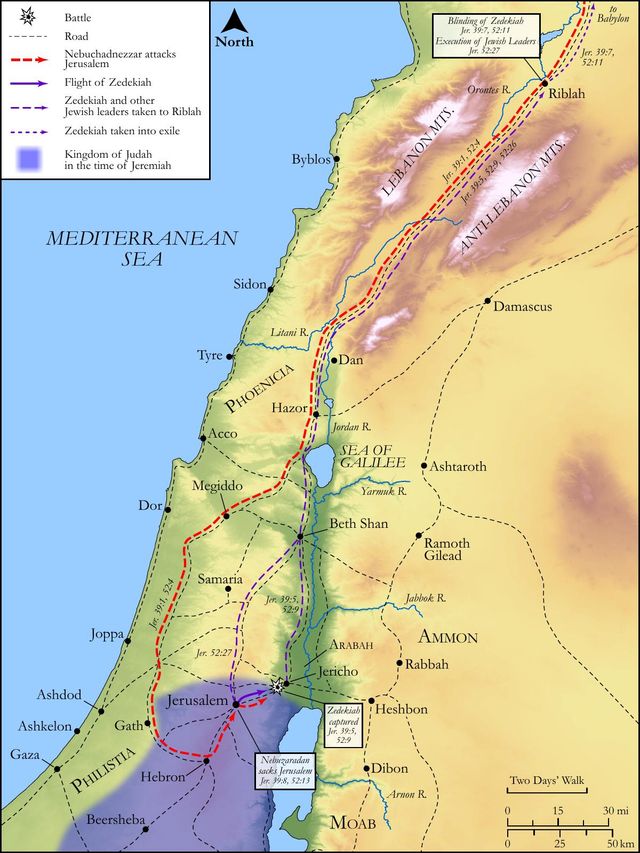
The events of Jeremiah 52:8 transpired in 586 BC, marking the final, cataclysmic moments of the Kingdom of Judah. For over two years, Jerusalem had endured a brutal siege by the Neo-Babylonian Empire, commanded by King Nebuchadnezzar. King Zedekiah, originally made king by the king of Babylon, had foolishly broken his solemn oath of allegiance and sought military assistance from Egypt, an act of rebellion that provoked Babylon's decisive and wrathful response. The "Chaldeans" were the dominant ethnic group of the Neo-Babylonian Empire, renowned among the nations for their military might, strategic prowess, and ruthlessness. The "plains of Jericho" (the Jordan Valley) represented a historically significant and geographically logical escape route from Jerusalem, potentially leading eastward across the Jordan River towards the Transjordanian territories of Moab or Ammon, where Zedekiah might have sought refuge. Ironically, this very location, which served as the entry point for Israel into the Promised Land under Joshua (Joshua 3), now became the scene of Judah's last king's ignominious capture, symbolizing the tragic end of their national sovereignty and freedom.
Key Themes
ShowHideThis verse profoundly contributes to several overarching theological and narrative themes prevalent in the book of Jeremiah and the broader Old Testament. It powerfully underscores the Inevitability of Divine Judgment, demonstrating that God's warnings, consistently delivered through Jeremiah, were not mere threats but certain realities for a nation steeped in idolatry, injustice, and persistent rebellion. Zedekiah's capture is a direct, undeniable consequence of Judah's unwavering Disobedience and Rebellion against God's covenant and their stubborn refusal to heed the prophet's counsel to surrender to Babylon (Jeremiah 38:17-18). The "scattering" of his army vividly illustrates the Collapse of Human Power and the Sovereignty of God, showing how even a king's last vestiges of military strength are utterly futile against God's determined purposes and the instruments of His judgment. Furthermore, this event serves as a potent Foreshadowing of the Exile and Dispersion of Judah, a central theme that explains the subsequent seventy years of captivity in Babylon and the eventual, promised return, highlighting God's faithfulness even in judgment, as seen in later prophecies of restoration and hope (Jeremiah 29:10-14).
Exposition and Analysis
ShowHideKey Word Analysis
ShowHideThis word (H2428) is derived from a root meaning "to be strong" and denotes a force, whether of men, means, or other resources. It encompasses concepts such as strength, valor, wealth, and military might. In Jeremiah 52:8, chayil is used for both the Chaldean military force and Zedekiah's army. The stark contrast in their fates highlights the overwhelming power and effectiveness of the Chaldean chayil in pursuit, versus the ultimate impotence and disintegration of Zedekiah's chayil, emphasizing the futility of Judah's resistance against God's ordained judgment.
The verb (H7291) signifies "to run after," often with hostile intent, to chase, or to hunt. It conveys a sense of relentless, determined, and successful pursuit. This term underscores the intensity and methodical nature of the Chaldean military operation, leaving no avenue for Zedekiah's escape. It suggests a thorough and unwavering hunt, ensuring the king's capture and the complete dismantling of Judah's last organized leadership.
This primitive root (H6327) means "to dash in pieces," "to disperse," or "to break apart." It vividly describes the complete disarray, disintegration, and rout of Zedekiah's remaining forces. The act of scattering implies not merely a retreat but a total loss of cohesion, discipline, and fighting capability, leaving the king utterly exposed and vulnerable. This word carries strong connotations of decisive defeat and dissolution, not only for Zedekiah's personal guard but also foreshadowing the impending dispersion of the entire nation into exile.
Verse Breakdown
ShowHide"But the army of the Chaldeans pursued after the king"
This opening clause immediately establishes the dramatic pursuit. Following King Zedekiah's desperate and clandestine escape from Jerusalem, the formidable Babylonian (Chaldean) military force, known for its efficiency, discipline, and ruthlessness, was swiftly and relentlessly in pursuit. The verb "pursued" (râdaph) implies a determined and unyielding chase, indicating that the Babylonians were committed to preventing the king's escape and ensuring his capture, thereby solidifying their conquest.
"and overtook Zedekiah in the plains of Jericho;"
This phrase marks the critical turning point of the narrative – the successful apprehension of the fleeing monarch. The "plains of Jericho" (ʻărâbâh Yᵉrîychôw) refer to the arid and relatively flat Jordan Valley, a strategic and historically significant area. Zedekiah's choice of this route suggests an attempt to cross the Jordan River and escape into the Transjordanian territories, perhaps seeking refuge or a means to regroup. However, the Chaldean forces, likely anticipating such a move and perhaps familiar with the terrain, successfully intercepted him, demonstrating their strategic acumen and the thoroughness of their military operation.
"and all his army was scattered from him."
This final clause describes the complete collapse of Zedekiah's military support and his utter isolation. The term "scattered" (pûwts) vividly portrays the disintegration of his remaining forces, indicating that they were broken, dispersed, and no longer capable of offering any resistance or protection to their king. This scattering left Zedekiah isolated, defenseless, and utterly at the mercy of his captors, signifying the total defeat of Judah's last king and the effective end of its organized military power, paving the way for his capture and the subsequent destruction of Jerusalem.
Literary Devices
ShowHideJeremiah 52:8 employs several potent literary devices to convey its message of divine judgment and national defeat. Irony is strikingly evident in Zedekiah's flight to the "plains of Jericho." This location, historically hallowed as the entry point for Israel into the Promised Land under Joshua, symbolizing new beginnings and divine faithfulness, now becomes the site of their final king's capture and the symbolic end of their national freedom and sovereignty. What was once a gateway to promise becomes a trap of doom. The phrase "all his army was scattered from him" serves as powerful Foreshadowing, not only of Zedekiah's personal downfall and isolation but also of the broader Dispersion (diaspora) of the entire Jewish nation into exile, a central theme prophesied throughout Jeremiah. The verse also utilizes Contrast between the relentless, successful pursuit of the mighty Chaldean "army" and the complete disintegration and helplessness of Zedekiah's "army," vividly highlighting the overwhelming power of divine judgment executed through Babylon versus the utter futility and weakness of rebellious Judah.
Theological and Thematic Connections
ShowHideJeremiah 52:8 stands as a stark theological declaration of God's sovereign control over human history and the inevitable, devastating consequences of persistent disobedience. Zedekiah's capture is not merely a historical event but a direct and dramatic fulfillment of prophecies concerning Judah's judgment, demonstrating unequivocally that God's word, though often resisted and ridiculed, will ultimately prevail. It powerfully underscores the biblical principle that rebellion against God's revealed will, whether through covenant breaking, idolatry, or rejecting prophetic warnings, inevitably leads to catastrophic outcomes. The scattering of the army symbolizes the dismantling of human efforts and the futility of relying on earthly strength, strategic plans, or military might when divine judgment is at hand, emphasizing God's ultimate authority and sovereignty over all nations and their kings.
Reflection and Application
ShowHideJeremiah 52:8 offers profound and enduring lessons for contemporary believers. It serves as a powerful reminder that choices have consequences, particularly when we choose to defy God's clear commands or ignore His warnings, whether delivered through the inspired Scriptures, wise counsel from godly mentors, or the gentle promptings of the Holy Spirit. Zedekiah's desperate flight and subsequent capture vividly illustrate the futility of attempting to escape the natural and divine consequences of our actions when we are out of alignment with God's will. This verse also highlights the inherent fragility of human power, security, and strategic planning, urging us to place our ultimate trust not in our own strength, resources, or clever schemes, but in the sovereign God who orchestrates all events according to His perfect purposes. It calls us to a posture of humility, immediate obedience, and radical dependence, reminding us that true security, peace, and flourishing are found only in walking faithfully with Him, even when His path seems difficult or counter-intuitive to our worldly wisdom.
Questions for Reflection
ShowHideFAQ
ShowHideWhy did Zedekiah try to escape, and why did he choose the plains of Jericho as his route?
ShowHideKing Zedekiah attempted to escape Jerusalem because the city was under a devastating and prolonged siege by the Babylonians, and its fall was not just imminent but inevitable. His primary motivation was likely self-preservation, hoping to save his life and perhaps even to continue the monarchy from a place of safety, or at least avoid the harsh fate that awaited him if captured. He chose the plains of Jericho, which are part of the Jordan Valley, as an escape route because it offered a path away from the besieged city, potentially towards the Jordan River. From there, he might have intended to cross into the Transjordanian regions (such as Moab or Ammon), which could have offered temporary refuge or a means to regroup. This route was historically significant as an entry point into the land for Israel, and perhaps he hoped it would serve as an exit to freedom. However, the Babylonians were thorough and strategic in their pursuit, anticipating such an attempt and effectively cutting off his escape. His capture there tragically fulfilled specific prophecies about his fate, such as those found in Jeremiah 39:4-5 and Ezekiel 12:12-13.
Christ-Centered Fulfillment
ShowHideJeremiah 52:8, with its somber depiction of a king's failed escape and the ignominious scattering of his army, finds profound Christ-centered fulfillment not in a parallel defeat, but in a victorious contrast that illuminates the perfect kingship and redemptive work of Jesus Christ. Zedekiah, the last earthly king of Judah, represents the ultimate failure of human leadership and the devastating consequences of rebellion, leading to the scattering and exile of his people. In stark contrast, Jesus, the true King of Israel and the eternal Son of David, did not flee from His enemies or from the consequences of humanity's sin. Instead, He willingly laid down His life, allowing Himself to be "overtaken" by death on the cross, not as a sign of defeat but as the ultimate act of obedience and sacrificial love (Philippians 2:8). His "scattering" was not of His army in defeat, but rather His disciples momentarily scattered at His arrest (Matthew 26:31), only to be miraculously regathered, empowered by His resurrection and the Holy Spirit, and commissioned to become His victorious army of witnesses to the ends of the earth (Acts 1:8). Where Zedekiah's capture led to the scattering of a nation into physical exile, Christ's voluntary death and glorious resurrection lead to the gathering of all nations into His eternal kingdom, bringing spiritual freedom, reconciliation, and eternal life to all who believe (John 12:32). He is the King who conquers not by escaping pursuit, but by embracing it, ultimately scattering the forces of sin, death, and the grave, and eternally securing His people in an unbreakable covenant.