


Amos 2:15
Bible text: King James Version (1769 Blayney text) · Public domain
Bible text: King James Version with Strong's numbers · Public domain
Bible text: Berean Standard Bible · Public domain
Bible text: American Standard Version (1901) · Public domain
Bible text: World English Bible, Messianic edition · Public domain
Bible text: Geneva Bible (1599) · Public domain
Bible text: Young's Literal Translation · Public domain
- וְתֹפֵשׂve·to·Fesand [the] handler ofH8610Conj-w ¦ V-Qal-Prtcpl-msVerb Qal Participle Singular Masculine Constructוְandתֹפֵשׂ[the] handler of
- הַקֶּשֶׁתha·Ke·shetthe bowH7198Art ¦ N-fsNoun Singular Feminine Absoluteהַtheקֶּשֶׁתbow
- לֹאlo'notH3808NegParticle Negative
- יַעֲמֹדya·'a·Modhe will standH5975V-Qal-Imperf-3msVerb Qal Imperfect 3rd Singular Masculine
- וְקַלve·Kaland a [person] swiftH7031Conj-w ¦ Adj-msAdjective Singular Masculine Absoluteוְandקַלa [person] swift
- בְּרַגְלָיוbe·rag·Lavon his feetH7272Prep-b ¦ N-fdc ¦ 3msNoun Dual Feminine Constructבְּonרַגְלָיfeetוhis
- לֹאlo'notH3808NegParticle Negative
- יְמַלֵּטye·ma·Lethe will saveH4422V-Piel-Imperf-3msVerb Piel Imperfect 3rd Singular Masculine
- וְרֹכֵבve·ro·Khevand [the] rider ofH7392Conj-w ¦ V-Qal-Prtcpl-msVerb Qal Participle Singular Masculine Constructוְandרֹכֵב[the] rider of
- הַסּוּסha·Susthe horseH5483Art ¦ N-msNoun Singular Masculine Absoluteהַtheסּוּסhorse
- לֹאlo'notH3808NegParticle Negative
- יְמַלֵּטye·ma·Lethe will saveH4422V-Piel-Imperf-3msVerb Piel Imperfect 3rd Singular Masculine
- נַפְשׁוֹnaf·Shohis lifeH5315N-fsc ¦ 3msNoun Singular Feminine Constructנַפְשׁlifeוֹhis
English is a literal word-by-word gloss of the Hebrew, not the KJV's wording. Why?
This is the original text the KJV's translators worked from — each Hebrew word with its own literal English meaning in this verse, prepared by scholars at Tyndale House, Cambridge. The KJV translates whole sentences, not word by word, so its wording differs: one Hebrew word can become several English words, and the KJV may choose “the LORD” where the gloss reads “Yahweh”. Both are faithful — they answer different questions. For the KJV's own rendering, switch to the KJV text.
Details
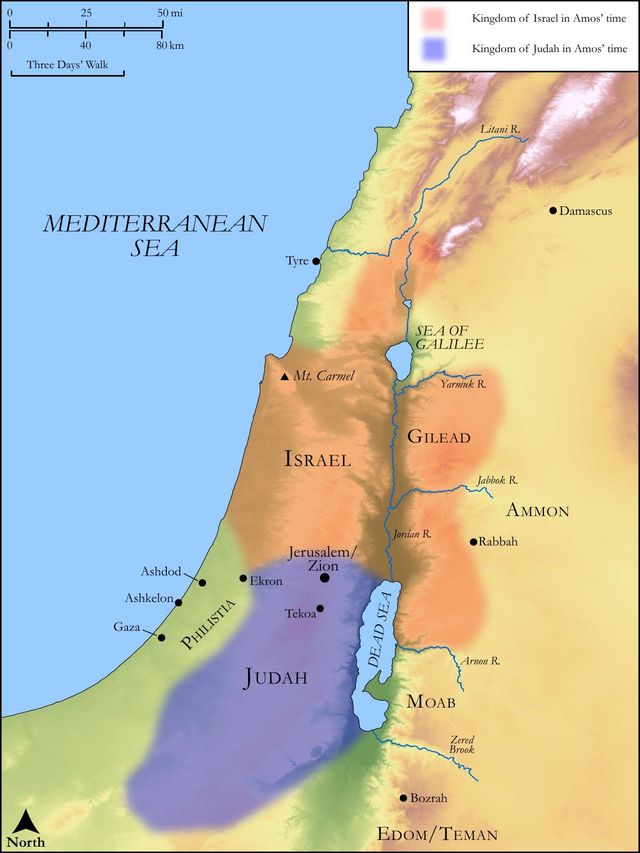
See on the biblical-era map
Study this verse
Public-domain commentary
Matthew Henry
From his Commentary on the Whole Bible. Henry comments on passages, not single verses — this entry covers Amos 2:9–16. His two-level outline is real structure in the source text, so it is rendered as structure.
Here, I. God puts his people Israel in mind of the great things he has done for them, in putting them into possession of the land of Canaan, the greatest part of which these ten tribes now enjoyed, Amo 2:9, Amo 2:10. Note, We need often to be reminded of the mercies we have received, which are the heaviest aggravations of the sins we have committed. God gives liberally, and upbraids us not with our meanness and unworthiness, and the disproportion between his gifts and our merits; but he justly upbraids us with our ingratitude, and ill requital of his favours, and tells us what he has done for us, to shame us for not rendering again according to the benefit done to us. "Son, remember; Israel, remember, 1. That God brought thee out of a house of bondage, rescued thee out of the land of Egypt, where thou wouldst otherwise have perished in slavery." 2. That he led thee forty years through a desert land, and fed thee in a wilderness, where thou wouldst otherwise have perished with hunger. Mercies to our ancestors were mercies to us, for, if they had been cut off, we should not have been. 3. That he made room for them in Canaan, by extirpating the natives by a series of wonders little inferior to those by which they were redeemed out of Egypt: I destroyed the Amorite before them, here put for all the devoted nations. Observe the magnificence of the enemies that stood in their way, which is taken notice of, that God may be the more magnified in the subduing of them. They were of great stature (whose height was like the height of the cedars) and the people of Israel were as shrubs to them; and they were also of great strength, not only tall, but well-set: He was strong as the oaks. Their kingdom was eminent among the nations, and over-topped all its neighbours. The supports and defences of it seemed impregnable; it was as fine as the stately cedar; it was as firm as the sturdy oak; yet, when God had a vine to plant there (Psa 80:8, Psa 80:9), this Amorite was not only cut down, but plucked up: I destroyed his fruit from above and his roots from beneath, so that the Amorites were no more a nation, nor ever read of any more. Thus highly did God value Israel. He gave men for them and people for their life, Isa 43:4. How ungrateful then were those who put such contempt upon him! 4. That he made them possess the land of the Amorite, not only put it into their hands, so that they became masters of it jure belli - by right of conquest, but gave them a better title to it, so that it became theirs by promise.
II.He likewise upbraids them with the spiritual privileges and advantages they enjoyed as a holy nation, Amo 2:11.
They had helps for their souls, which taught them how to make good use of their temporal enjoyments and were therefore more valuable. It is true the ten tribes had not God's temple, altar, and priesthood, and it was their own fault that they deserted them, and for that they might justly have been left in utter darkness; but God left not himself without witness, nor them without guides to show them the way.
1.They had prophets that were powerful instructors in piety, divinely inspired, and commissioned to make known the mind of God to them, to show them what is pleasing to God and what displeasing, to reprove them for their faults and warn them of their dangers, to direct them in their difficulties and comfort them in their troubles. God raised them up prophets, animated them for that work and employed them in it. He raised them up of their sons, from among themselves, as Moses and Christ were raised up from among their brethren, Deu 18:15. It was an honour put upon their nation, and upon their families, that they had children of their own to be God's messengers to them, of their own language, not strangers sent from another country, whom they might suspect to be prejudiced against them and their land, but those who, they knew, wished well to them. Note, Faithful ministers are great blessings to any people, and it is God that raises them up to be so, that they may justly be reckoned an honour to the families they are of.
2.They had Nazarites that were bright examples of piety: I raised up of your young men for Nazarites, men that bound themselves by a vow to God and his service, and, in pursuance of that, denied themselves many of the lawful delights of sense, as drinking wine and eating grapes. There were some of their young men that were in their prime for the enjoyment of the pleasures of this life and yet voluntarily abridged themselves of them; these God raised up by the power of his grace, to be monuments of his grace, to his glory, and to be his witnesses against the impieties of that degenerate age. Note, It is as great a blessing to any place to have eminent good Christians in it as to have eminent good ministers in it; for so they have examples to their rules. We must acknowledge that it bodes well to any people when God raises up numbers of hopeful young people among them, when he makes their young men Nazarites, devout, and conscientious, and mortified to the pleasures of sense; and those that are such Nazarites are purer than snow, whiter than milk; they are indeed the polite young men, for their polishing is of sapphires, Lam 4:7. Those that have such men, such young men, among them, have therein such an advantage, both for direction and encouragement, to be religious, as they will be called to an account for another day if they do not improve. Israel is here reckoned with, not only for the prophets, but for the Nazarites, raised up among them. Concerning the truth of this, he appeals to themselves: "Is it not even thus, O you children of Israel? Can you deny it? Have not you yourselves been sensible of the advantage you had by the prophets and Nazarites raised up among you?" Note, Sinners' own consciences will be witnesses for God that he has not been wanting to them in the means of grace, so that, if they perish, it is because they have been wanting to themselves in not improving those means. The men of Judah shall themselves judge between God and his vineyard, whether he could have done more for it, Isa 5:3, Isa 5:4.
III.He charges them with the abuse of the means of grace they enjoyed, and the opposition they gave to God's designs in affording them those means, Amo 2:12. They were so far from walking in the light that they rebelled against it, and did what they could to extinguish it, that it might not shine in their faces, to their conviction.
1.They did what they could to debauch good people, to draw them off from their seriousness in devotion and their strictness in conversation: You gave the Nazarites wine to drink, contrary to their vow, that, having broken it in that instance, they might not pretend to keep it in any other. Some they surprised, or allured into it, and with their much fair speech caused them to yield; others they forced and frightened into it, reproached and threatened them if they were more precise than their neighbours; and, by drawing them in to drink wine, they spoiled them for Nazarites. Note, Satan and his agents are very busy to corrupt the minds of young people that look heavenward; and many that we thought would have been Nazarites they have overcome by giving them wine to drink, by drawing them in to the love of mirth and pleasure, and drinking company. Multitudes of young men that bade fair for eminent professors of religion have erred through wine, and been undone for ever. And how do the factors for hell triumph in the debauching of a Nazarite!
2.They did what they could to silence good ministers, and to stop their mouths: "You commanded the prophets, saying, Prophesy not, and threatened them if they did prophesy (Amo 7:12), as if God's messengers were bound to observe your orders, and might not deliver their errand unless you gave them leave, and so you not only received the grace of God, in raising up those prophets, in vain, but put the highest affront imaginable upon that God in whose name the prophets spoke." Note, Those have a great deal to answer for that cannot bear faithful preaching, and those much more that suppress it.
IV.He complains of the wrong they did him by their sins (Amo 2:13):
"I am pressed under you, I am straitened by you, and can no longer bear it, and therefore I will ease myself of my adversaries, Isa 1:24. I am pressed under you and the load of your sins as a cart is pressed that is full of sheaves, is loaded with corn, in the midst of the joy of harvest, as long as any will lie on." Note, The great God complains of sin, especially the sins of his professing people, as a burden to him. He is grieved with this generation (Psa 95:10), is broken with their whorish heart (Eze 6:9), a consideration which, if it make not the sinner's repentance very deep, will make his ruin very great. The great God that upholds the world, and never complains that his is pressed under the weight of it (he fainteth not, neither is weary), yet complains of the sins of Israel, yea, and of their hypocritical services too, that he is weary of bearing them, Isa 1:14. No wonder the creature groans being burdened (Rom 8:22), when the Creator says, I am pressed under them.
V.He threatens them with unavoidable ruin.
And so some read, Amo 2:13, "Behold I will press, or straiten, your place, as a cart full of sheaves presses; they shall be loaded with judgments till they shall sink under them, and shall make a noise, as a cart overloaded does." Those that will not submit to the convictions of the word, that will neither be won by that nor by the conversation of those about them, shall be made to sink under the weight of God's judgments. If God load us daily with his benefits, and we, notwithstanding that, load him with our sins, how can we expect any other than that he should load us with his judgments? And it is here threatened in the last three verses that, when God comes forth to contend with this provoking people, they shall not be able to stand before him, to flee from him, nor to make their part good with him; for when God judges he will overcome. Though his patience be tired out, his power is not, and so the sinner shall find, to his cost. When the Assyrian army comes to lay the country waste by sword and captivity none shall escape, but every one shall have his share in the common desolation.
1.It will be in vain to think of fleeing from the enemy that comes armed with a commission to make all desolate: The flight shall perish from the swift; those that have been famed for happy escapes and happy retreats shall now find their arts fail them; they shall have no time to flee, or shall find no way to take, or they shall have no strength or spirit to attempt it; they shall be at their wits' end, and then they are soon at their flight's end. Are they, as Asahel, as swift of foot as a wild roe? (Sa2 2:18), yet, like him, they shall run the faster upon their own destruction: He that is swift of foot shall not deliver himself, Amo 2:15. Or do they say (as those, Isa 30:16), We will flee upon horses, and we will ride upon the swift? Yet they shall be overtaken: Neither shall he that rides the horse deliver himself from his pursuers. A horse is a vain thing for safety.
2.It will be in vain to think of fighting it out. God is at war with them; and are they stronger than he? Is there any military force that can pretend to be a match for Omnipotence? No: The strong shall not strengthen his force. He that has a habit of strength shall not be able to exert it when he has occasion for it. And the mighty, whose should protect and deliver others, shall not be able to deliver himself, to deliver his soul (so the word is), shall not save his life. Let not the strong man then glory in his strength, nor trust in it, but strengthen himself in the Lord his God, for in him is everlasting strength. And, as the bodily strength shall fail, so shall the weapons of war. The armour as well as the arm shall become insufficient: Neither shall he stand that handles the bow, though he stand at a distance, but shall betake himself to flight, and not trust to his own bow to save him. Though the arm be ever so strong, and the armour ever so well fixed, neither will avail when the spirit fails (Amo 2:16): He that is courageous among the mighty, that used to look danger in the face, and not be dismayed at it, shall flee away naked in that day, not only disarmed, having thrown away his weapons both offensive and defensive, but plundered of his treasure, which he thought to carry away with him, and he shall think it as much as he could expect that he has his life for a prey. Thus when God pleases he takes away the heart of the chief of the people of the earth, and causes those who used to boast of their courage, and their daring enterprises in the field, to wander and sneak in a wilderness where there is no way, Job 12:24.
Historical interpretation
Historical reception
1 surviving comment on this verse from the historical church.
(Verse 13 onwards) Behold, I will roar underneath you, like a heavily loaded wagon roars with hay, and the fleet warrior shall perish, and the strong shall not retain his strength, and the mighty shall not save his soul, and the archer shall not stand, and the swift-footed one shall not be saved, and the rider of the horse shall not save his soul, and the strong of heart among the strong ones, shall flee naked on that day, says the Lord. LXX: Therefore, behold, I will roll under you like a wagon full of straw is rolled, and the swift one shall perish in flight, and the strong one shall not retain his strength, and the warrior shall not save his soul, and the archer shall not endure, and the swift-footed one shall not be able to be saved, and the horseman shall not save his soul, and his heart shall be found among the mighty, and the naked one shall flee on that day, says the Lord. With me granting benefits to you, and leading you out of the land of Egypt, and destroying the Amorite before your face, so that you could possess his land, and raising up prophets from your sons, and Nazarites from your young men, you made my Nazarites drink wine, and said to the prophets: Do not prophesy. Therefore, just as a cart is burdened with a load of straw or hay, and it screeches and makes a loud noise from afar, so I, unable to bear your sins any longer, and handing you over to the fire like straw, will cry out and say: The quick will perish in flight, whom the Hebrews understand to be Jeroboam the son of Nabath, who had previously fled to Egypt (1 Kings 11). But here we will not take the princes themselves, but their houses and offspring. And the strong will not retain his strength: strong is interpreted as Basan, who was very ready for war (3 Kings 15). And the mighty will not save his soul: they understand this as referring to Amri (or Omri) here. And the one holding a bow will not stand or sustain: they think this refers to Jehu son of Namsi (or Nemsi), who struck King Joram of Israel with an arrow (4 Kings 9). And he who is swift on his feet will not be saved: Manahen they understand, who vainly hastening directed gifts to the king of the Assyrians (2 Kings 15): And the rider of the horse will not save his life: this Phacee, the son of Romelia, they interpret, who united with Aram, that is, Syria, devastated many things under the reign of Achaz, king of Judah. And with a strong heart, he will flee naked among the strong on that day, says the Lord (Ibid.). Only Osee, who was the last king of the ten tribes, and who attempted to bring back the errant people to the worship of God (2 Kings 18), will go out as if naked from the fire. Moreover, he calls them naked because under him the ten tribes were captured. This is what the Hebrews assert, and as it has been handed down to us, we have faithfully explained it to our people. But now let us return to our own matter. God threatens to roll a cart over them, burdened with hay or straw, so that because they do not have grain to store in granaries, their hay and straw will be consumed by fire. This is the hay of which the prophet says: Let it become like the hay of buildings, which withers before it is uprooted (Ps. 128:6). And: All flesh is grass (Isaiah 40:6). But that straw is what the prophet mourns lamentably for when it catches fire, saying: Woe is me! for I have become like one who gathers straw in the harvest, and like grape clusters in the vintage, when there is no bunch to eat the firstfruit. Woe is me! my soul (added in some versions), for the kind-hearted person has perished from the earth, and there is no one who does what is right among humanity: all are judged by blood (Micah 7:1), and so on. This is hay and straw, of which the Apostle speaks: Each one's work will become manifest, for the Day will disclose it, because it will be revealed by fire. And the rolling cart, that is what we read about in Isaiah: Moab shall be trampled down as straw is trampled in the dung-pit. And in another place: I will make you like a new threshing sledge with sharp teeth; you shall thresh the mountains and crush them, and you shall make the hills like chaff. And after you have broken the mountains and hills, the swift flight shall cease, as Paul says: Do you not know that in a race all the runners compete, but only one receives the prize? So run that you may obtain it. And in another place: You were running well; who hindered you from obeying the truth (Gal. 5:7) ? And about himself, fearing, he said: Not that I have now received, or am already perfected; but I pursue, if I may apprehend, in which also I am apprehended by Christ Jesus (Phil. 3:12) . He did all these things, lest the flight from the swift be in vain: wherefore when he had now reached the end, and had received the reward of victory, he said securely: I have fought a good fight, I have finished my course, I have kept the faith; as to the rest, there is laid up for me a crown of justice, which the Lord, the just judge, will render to me in that day; and not only to me, but to them also that love his coming (2 Tim. 4:7, 8) . If we flee with quickness, sin will not be able to apprehend us; but if malice binds our feet, we will speak with the prophet to God: Where shall I go from your spirit, and where shall I flee from your face (Ps. 138:7)? The Apostle speaks about wicked runners: It is not of the one who wills, nor of the one who runs, but of the one who has mercy of God (Rom. 9:16) . It follows: And the strong will not obtain his strength: not because he is strong, but because he boasts of being strong. Whether one trusts in their own strength and not in God's mercy, according to what is written: 'I will destroy the wisdom of the wise, and the discernment of the discerning I will thwart' (1 Corinthians 2:19): not that true wisdom can perish, and the understanding of truth be rejected; but that the wisdom of those who consider themselves wise and trust in their own erudition may perish. Likewise, the strong or warrior who does not save his own soul is the one who does not possess the full armor of the Apostle: having a shield, but not faith; girded with a belt, but not in truth; clad in armor, but not in righteousness; wielding a sword, but not for salvation (Ephesians 6). A warrior of this sort does not sanctify battle, nor can he wage war in the name of the Lord, fighting against truth for the sake of lies. Such a warrior cannot say: Blessed be the Lord my God, who teaches my hands to fight and my fingers to war. My mercy and my refuge (Ps. CXLIII, 1). The heretics also have archers who, in vain, try to draw the bow, they cannot withstand the arrow of the Lord, as spoken by Isaiah: But I said, 'I have labored in vain, I have spent my strength for nothing and vanity' (Isa. XLIX, 2). These are the archers, of whom David also sings: Look, the sinners have bent their bow, they have prepared their arrows in the quiver, to shoot at the upright in heart in the darkness (Ps. X, 2). And the swift (he says) will not be saved by his feet, who runs through the testimonies of the Scriptures because of the sharpness of his wit, and tries to oppress the truth with the eloquence of speakers or with the sophisms of the dialecticians, and is hindered in it and falls, because he trusts not in God but in his own feet. The horse also will not save his own soul, who disregards the saying through the prophet: The horse is a deceitful hope for salvation (Ps. 32:17). And he does not know that it is written: All who mounted horses have slumbered (Ps. 75:7). This one will not save his own soul; but perishing, he will hear: Some trust in chariots, and some in horses: but we will call upon the name of the Lord our God. They are impeded and have fallen; but we have risen and have been raised up (Ps. 19:8-9). A strong man, even with a courageous heart, will flee when naked among the brave. This place can be interpreted in two ways: either he is able to escape because he has stripped himself of the old man and the garments of sins, and he is burdened by no weight, or on the contrary, he is naked and has lost the clothing of Christ, of which it is said in the Apostle: Put on Christ Jesus (Rom. XIII, 14) . And in another place: For if we are clothed, we shall not be found naked (II Cor. V, 3); his strength will be of no use to him; but on the day of battle and struggle, he will flee from those who pursue him, and not being able to resist the enemies without armor, he will show them his back.
Continue studying Amos 2:15 across the web’s major study libraries — every link below opens this exact verse, chapter, or book on the destination site.
Read & Compare
 BibleGatewayThis verse in more than 200 translations and 70 languages.
 Bible.comThe YouVersion reader — hundreds of translations, reading plans, and highlights.
 ESV.orgCrossway's official English Standard Version reader.
 NET BibleThe NET translation with 60,000+ translators' notes on every rendering decision.
 STEP BibleTyndale House's free study tool — original text, vocabulary, and scholarly resources.
 BibliaLogos Bible Software's free web reader.
 USCCBThe New American Bible (Revised Edition) with the U.S. bishops' study notes.
Commentaries
 BibleHub CommentariesDozens of classic commentaries on this verse, gathered on one page.
 StudyLightMore than 100 commentary sets — the largest collection on the web.
 BibleRefPlain-English commentary on what this verse means, verse by verse.
 Enduring WordDavid Guzik's free commentary on this chapter, widely used by Bible teachers.
 Bible Study ToolsVerse commentary alongside Greek and Hebrew study aids.
Original Language & Research
- BibleHub InterlinearThe verse word by word — original language, transliteration, and English.
- BibleHub LexiconEvery word's original-language definition and Strong's entry.
 Blue Letter BibleDeep-study tools — Strong's numbers, concordance, and word studies.
 SefariaThe Hebrew text with Rashi and centuries of Jewish commentary.
Sermons, Hymns & Audio


TrulyRandomVerse is not affiliated with these sites and doesn’t control their content. They’re linked because they’re genuinely useful.
Summary
Amos 2:15, part of Amos's oracles against Israel, vividly portrays the utter futility of human strength and military prowess in the face of God's determined judgment. It declares that no warrior, no matter how skilled with a bow, how swift of foot, or how powerful on horseback, will be able to escape or deliver themselves from the impending divine reckoning. This verse serves as a stark testament to God's absolute sovereignty and the inescapable consequences of persistent covenant unfaithfulness.
Context
ShowHideLiterary Context
Amos 2:15 is situated within the latter part of Amos's prophetic pronouncements against Israel, specifically following a detailed indictment of their oppression, moral corruption, and idolatry (Amos 2:6-12). The preceding verses (Amos 2:13-14) initiate the theme of inescapable judgment, describing how the land will groan under the weight of Israel's sin, and even the strongest and swiftest will find no refuge. Verse 15 continues this powerful crescendo of judgment, using a series of rhetorical negations to emphasize the comprehensive failure of human might. It is part of a larger unit (Amos 2:13-16) that collectively illustrates the complete breakdown of Israel's defenses—military, physical, and psychological—when confronted by God's wrath. This immediate context sets the stage for the detailed description of various types of warriors who will be rendered helpless.
Historical & Cultural Context
The prophecies of Amos were delivered during the reigns of Uzziah in Judah and Jeroboam II in Israel (Amos 1:1), a period of relative peace and economic prosperity for both kingdoms. However, beneath this veneer of success, Israel (the Northern Kingdom) was rife with disparity between rich and poor, oppression of the poor, and religious syncretism, despite the covenant relationship with Yahweh. Military strength was a source of national pride and security in that day. Archers, swift runners, and cavalry were elite units, representing the pinnacle of military power and defensive capability. Amos's pronouncements directly challenged this human reliance on military might, asserting that even the most formidable aspects of their defense would prove useless. The imagery of the bowman, the swift runner, and the horseman would have immediately resonated with the audience as symbols of ultimate human strength and capability in warfare, making the declaration of their helplessness all the more shocking and impactful.
Key Themes
ShowHideThis verse powerfully contributes to several overarching themes in the book of Amos. Foremost is the Futility of Human Strength and Self-Reliance, asserting that no human contrivance or physical prowess can withstand God's judgment. This theme is echoed throughout the Old Testament, such as in Psalm 33:16-17, which states that a king is not saved by the multitude of an army, nor is a mighty man delivered by great strength. Secondly, the verse underscores the Inevitability and Universality of God's Judgment against unrepentant sin. Once God's decree is issued, it is absolute and inescapable, affecting all segments of society, even its strongest members. This aligns with the broader prophetic message that God holds nations accountable for their actions. Finally, it highlights Divine Sovereignty, demonstrating that God is the ultimate arbiter of human destiny and military outcomes, capable of rendering the mightiest warriors powerless and revealing that true power resides with Him alone, as seen in Isaiah 45:7.
Exposition and Analysis
ShowHideKey Word Analysis
ShowHideMeaning "to stand, in various relations (literal and figurative, intransitive and transitive); abide, appoint, arise, cease, confirm, continue, dwell, be employed, endure, establish, leave, make, ordain, be (over), place, (be) present (self), raise up, remain, repair, serve, set, stand, stay, tarry." In this context, it signifies the inability to maintain one's position, to hold one's ground, or to resist the overwhelming force of God's judgment. The skilled archer will not be able to stand firm in battle.
Meaning "a bow, forshooting (hence, figuratively, strength) or the iris; archer, arrow, bowman, bowshot." The bow represents a primary offensive weapon in ancient warfare, requiring skill and strength to wield effectively. Its mention highlights the failure of even the most potent offensive capabilities.
Meaning "to be smooth, i.e. (by implication) to escape (as if by slipperiness); causatively, to release or rescue; specifically, to bring forth young, emit sparks; deliver (self), escape, lay, leap out, let alone, let go, preserve, save, speedily, surely." This word is repeated for both the swift runner and the horseman, emphasizing the absolute impossibility of escape or self-preservation from the impending judgment, regardless of speed or mobility.
Verse Breakdown
ShowHide"Neither shall he stand that handleth the bow"
This clause speaks to the futility of offensive military strength. The "handler of the bow" refers to a skilled archer, a vital component of ancient armies, capable of inflicting damage from a distance and holding a defensive line. The declaration that he "shall not stand" means he will be unable to hold his ground, maintain his position, or effectively resist the divine onslaught. His expertise and weapon will be rendered useless.
"and [he that is] swift of foot shall not deliver [himself]:"
Here, the focus shifts to the futility of speed and evasion. The "swift of foot" refers to a fast runner, perhaps a scout, messenger, or light infantry known for their agility and ability to escape or outmaneuver. The phrase "shall not deliver himself" underscores that even the greatest physical speed will be insufficient to escape the inevitable judgment. There will be no refuge in flight.
"neither shall he that rideth the horse deliver himself."
This final clause addresses the futility of mounted power and mobility. "He that rideth the horse" signifies cavalry, which represented the pinnacle of ancient military might, combining speed, shock, and maneuverability. The repetition of "shall not deliver himself" emphatically concludes the series, demonstrating that even the most formidable and mobile elements of Israel's military—symbols of their national strength and pride—will be utterly helpless and unable to escape God's decreed judgment.
Literary Devices
ShowHideAmos 2:15 employs several powerful literary devices to convey its message of inescapable judgment. The most prominent is Parallelism, specifically synonymous parallelism with a climactic effect. Each clause reiterates the central idea that human strength cannot deliver from divine judgment, but it does so by introducing a new, increasingly potent symbol of military power (archer, runner, horseman). This builds a sense of comprehensive and universal futility. The use of Anaphora with the repeated "Neither shall he..." or "shall not deliver himself" creates a rhythmic, emphatic declaration that reinforces the absolute and inescapable nature of the impending doom. Furthermore, the verse utilizes Synecdoche, where specific parts (the bowman, the swift foot, the horseman) represent the whole of Israel's military might and human capability. This allows Amos to vividly illustrate the complete breakdown of all human defenses. The overall tone is one of Irony, as the very things Israel trusted in for security (military prowess) are precisely what will fail them in their hour of greatest need.
Theological and Thematic Connections
ShowHideAmos 2:15 profoundly articulates the theological truth that human strength, ingenuity, and military might are utterly insufficient when confronted with the sovereign will and righteous judgment of God. It dismantles any illusion of self-sufficiency, reminding us that true security and deliverance come not from human capabilities but from divine intervention and mercy. This principle is foundational to biblical theology, emphasizing God's ultimate authority over all creation and human affairs. When humanity rebels against God's covenant, no earthly power can avert the consequences. The verse serves as a stark warning against placing trust in anything other than the Almighty, highlighting the seriousness of sin and the inevitability of divine justice for unrepentant disobedience.
Reflection and Application
ShowHideAmos 2:15 serves as a timeless and convicting mirror for believers today, prompting us to critically examine the foundations of our security and confidence. In a world that often prizes self-reliance, personal achievement, and material strength, this verse powerfully reorients our perspective. Do we, like ancient Israel, subtly place our trust in our financial stability, our intellectual prowess, our social networks, or even our physical health, believing these will "deliver" us from life's challenges or ultimate judgment? This passage challenges us to humble ourselves, recognizing that true and lasting deliverance comes only from God. It calls us to repent of any misplaced trust and to re-center our lives on Him, understanding that our greatest "strengths" are utterly useless if they are not submitted to His sovereign will. Furthermore, it reminds us of the serious consequences of unrepentant sin, urging us to live lives of obedience and righteousness, knowing that God's justice is unyielding, yet His grace is abundant for those who turn to Him.
Questions for Reflection
ShowHideFAQ
ShowHideWhat specific "sins" was Israel being judged for in Amos's prophecy?
ShowHideAmos's prophecy details a comprehensive indictment of Israel's sins, moving beyond mere ritualistic failures to deep-seated oppression and moral corruption. Key transgressions included oppressing the poor and needy, selling the righteous for silver, trampling the head of the poor into the dust, and perverting justice (Amos 2:6-7). They engaged in sexual immorality, defiling God's holy name (Amos 2:7), and practiced idolatry, drinking wine in the house of their gods (Amos 2:8). Despite God's past faithfulness in delivering them from Egypt and raising up prophets and Nazirites (Amos 2:9-12), Israel had continually rebelled against His covenant, leading to the severe judgment described in Amos 2:13-16.
Christ-Centered Fulfillment
ShowHideAmos 2:15, with its stark declaration of the futility of human strength in the face of divine judgment, finds its ultimate Christ-centered fulfillment in the person and work of Jesus Christ. While the Old Testament highlights humanity's inability to save itself from the consequences of sin through any earthly means, the New Testament reveals God's perfect provision for deliverance through His Son. No human "bowman," "swift runner," or "horseman" could deliver Israel from their deserved judgment, foreshadowing humanity's universal inability to earn salvation or escape the spiritual consequences of sin through self-effort, good works, or religious rituals. As Ephesians 2:8-9 declares, "For by grace you have been saved through faith. And this is not your own doing; it is the gift of God, not a result of works, so that no one may boast." Jesus Christ is the one who truly "delivers" us, not from an earthly army, but from the power of sin and death (Colossians 1:13-14). His perfect life, atoning death on the cross, and resurrection represent God's sovereign act of salvation, accomplishing what no human strength could ever achieve. He is the ultimate "deliverer," the "Lamb of God who takes away the sin of the world" (John 1:29), offering an escape from eternal judgment that is freely given to all who put their faith in Him. Thus, the futility of self-salvation in Amos points directly to the necessity and sufficiency of Christ's redemptive work.