


Jeremiah 52:10
Bible text: King James Version (1769 Blayney text) · Public domain
Bible text: Berean Standard Bible · Public domain
Bible text: American Standard Version (1901) · Public domain
Bible text: World English Bible, Messianic edition · Public domain
Bible text: Geneva Bible (1599) · Public domain
Bible text: Young's Literal Translation · Public domain
- וַיִּשְׁחַטvai·yish·Chatand he slaughteredH7819Conj-w ¦ V-Qal-ConsecImperf-3msVerb Qal Consecutive Imperfect 3rd Singular Masculineוַandיִּשְׁחַטhe slaughtered
- מֶלֶךְMe·lekh[the] king ofH4428N-mscNoun Singular Masculine Construct
- בָּבֶלba·VelBabylonH894N-properNoun Proper Location
- אֶת'et<obj.>H853DirObjMParticle Object Indicator
- בְּנֵיbe·Nei[the] sons ofH1121N-mpcNoun Plural Masculine Construct
- צִדְקִיָּהוּtzid·ki·Ya·huZedekiahH6667N-proper-mNoun Proper Masculine
- לְעֵינָיוle·'ei·Navto his eyesH5869Prep-l ¦ N-fdc ¦ 3msNoun Dual Feminine Constructלְtoעֵינָיeyesוhis
- וְגַםve·Gamand alsoH1571Conj-w ¦ AdvAdverbוְandגַםalso
- אֶת'et<obj.>H853DirObjMParticle Object Indicator
- כָּלkolallH3605N-mscNoun Singular Masculine Construct
- שָׂרֵיsa·Rei[the] officials ofH8269N-mpcNoun Plural Masculine Construct
- יְהוּדָהye·hu·DahJudahH3063N-properNoun Proper Location
- שָׁחַטsha·Chathe slaughteredH7819V-Qal-Perf-3msVerb Qal Perfect 3rd Singular Masculine
- בְּרִבְלָתָהbe·riv·La·tahat Riblah <towards>H7247Prep-b ¦ N-proper ¦ SfxNoun Proper LocationבְּatרִבְלָתָRiblahה<towards>
English is a literal word-by-word gloss of the Hebrew, not the KJV's wording. Why?
This is the original text the KJV's translators worked from — each Hebrew word with its own literal English meaning in this verse, prepared by scholars at Tyndale House, Cambridge. The KJV translates whole sentences, not word by word, so its wording differs: one Hebrew word can become several English words, and the KJV may choose “the LORD” where the gloss reads “Yahweh”. Both are faithful — they answer different questions. For the KJV's own rendering, switch to the KJV text.
Details
See on the biblical-era map
Study this verse
Public-domain commentary
Matthew Henry
From his Commentary on the Whole Bible. Henry comments on passages, not single verses — this entry covers Jeremiah 52:1–11.
This narrative begins no higher than the beginning of the reign of Zedekiah, though there were two captivities before, one in the fourth year of Jehoiakim, the other in the first of Jeconiah; but probably it was drawn up by some of those that were carried away with Zedekiah, as a reproach to themselves for imagining that they should not go into captivity after their brethren, with which hopes they had long flattered themselves. We have here, 1. God's just displeasure against Judah and Jerusalem for their sin, Jer 52:3. His anger was against them to such a degree that he determined to cast them out from his presence, his favourable gracious presence, as a father, when he is extremely angry with an undutiful son, bids him get out of his presence, he expelled them from that good land that had such tokens of his presence in providential bounty and that holy city and temple that had such tokens of his presence in covenant-grace and love. Note, Those that are banished from God's ordinances have reason to complain that they are in some degree cast out of his presence; yet none are cast out from God's gracious presence but those that by sin have first thrown themselves out of it. This fruit of sin we should therefore deprecate above any thing, as David (Psa 51:11), Cast me not away from thy presence. 2. Zedekiah's bad conduct and management, to which God left him, in displeasure against the people, and for which God punished him, in displeasure against him. Zedekiah had arrived at years of discretion when he came to the throne; he was twenty-one years old (Jer 52:1); he was none of the worst of the kings (we never read of his idolatries), yet his character is that he did evil in the eyes of the Lord, for he did not do the good he should have done. But that evil deed of his which did in a special manner hasten this destruction was his rebelling against the king of Babylon, which was both his sin and his folly, and brought ruin upon his people, not only meritoriously, but efficiently. God was greatly displeased with him for his perfidious dealing with the king of Babylon (as we find, Eze 17:15, etc.); and, because he was angry at Judah and Jerusalem, he put him into the hand of his own counsels, to do that foolish thing which proved fatal to him and his kingdom. 3. The possession which the Chaldeans at length gained of Jerusalem, after eighteen months' siege. They sat down before it, and blocked it up, in the ninth year of Zedekiah's reign, in the tenth month (Jer 52:4), and made themselves masters of it in the eleventh year in the fourth month, Jer 52:6. In remembrance of these two steps towards their ruin, while they were in captivity, they kept a fast in the fourth month, and a fast in the tenth (Zac 8:19): that in the fifth month was in remembrance of the burning of the temple, and that in the seventh of the murder of Gedaliah. We may easily imagine, or rather cannot imagine, what a sad time it was with Jerusalem, during this year and half that it was besieged, when all provisions were cut off from coming to them and they were ever and anon alarmed by the attacks of the enemy, and, being obstinately resolved to hold out to the last extremity, nothing remained but a certain fearful looking for of judgment. That which disabled them to hold out, and yet could not prevail with them to capitulate, was the famine in the city (Jer 52:6); there was no bread for the people of the land, so that the soldiers could not make good their posts, but were rendered wholly unserviceable; and then no wonder that the city was broken up, Jer 52:7. Walls, in such a case, will not hold out long without men, any more than men without walls; nor will both together stand people in any stead without God and his protection. 4. The inglorious retreat of the king and his mighty men. They got out of the city by night (Jer 52:7) and made the best of their way, I know not whither, nor perhaps they themselves; but the king was overtaken by the pursuers in the plains of Jericho, his guards were dispersed, and all his army was scattered from him, Jer 52:8. His fright was not causeless, for there is no escaping the judgments of God; they will come upon the sinner, and will overtake him, let him flee where he will (Deu 28:15), and these judgments particularly that are here executed were there threatened, Jer 51:52, Jer 51:53, etc. 5. The sad doom passed upon Zedekiah by the king of Babylon, and immediately put in execution. he treated him as a rebel, gave judgment upon him, Jer 51:9. One cannot think of it without the utmost vexation and regret that a king, a king of Judah, a king of the house of David, should be arraigned as a criminal at the bar of this heathen king. But he humbled not himself before Jeremiah the prophet; therefore God thus humbled him. Pursuant to the sentence passed upon him by the haughty conqueror, his sons were slain before his eyes, and all the princes of Judah (Jer 52:10); then his eyes were put out, and he was bound in chains, carried in triumph to Babylon; perhaps they made sport with him, as they did with Samson when his eyes were put out; however, he was condemned to perpetual imprisonment, wearing out the remainder of his life (I cannot say his days, for he saw day no more) in darkness and misery. He was kept in prison till the day of his death, but had some honour done him at his funeral, Jer 34:5. Jeremiah had often told him what it would come to, but he would not take warning when he might have prevented it.
Continue studying Jeremiah 52:10 across the web’s major study libraries — every link below opens this exact verse, chapter, or book on the destination site.
Read & Compare
 BibleGatewayThis verse in more than 200 translations and 70 languages.
 Bible.comThe YouVersion reader — hundreds of translations, reading plans, and highlights.
 ESV.orgCrossway's official English Standard Version reader.
 NET BibleThe NET translation with 60,000+ translators' notes on every rendering decision.
 STEP BibleTyndale House's free study tool — original text, vocabulary, and scholarly resources.
 BibliaLogos Bible Software's free web reader.
 USCCBThe New American Bible (Revised Edition) with the U.S. bishops' study notes.
Commentaries
 BibleHub CommentariesDozens of classic commentaries on this verse, gathered on one page.
 StudyLightMore than 100 commentary sets — the largest collection on the web.
 BibleRefPlain-English commentary on what this verse means, verse by verse.
 Enduring WordDavid Guzik's free commentary on this chapter, widely used by Bible teachers.
 Bible Study ToolsVerse commentary alongside Greek and Hebrew study aids.
Original Language & Research
- BibleHub InterlinearThe verse word by word — original language, transliteration, and English.
- BibleHub LexiconEvery word's original-language definition and Strong's entry.
 Blue Letter BibleDeep-study tools — Strong's numbers, concordance, and word studies.
 SefariaThe Hebrew text with Rashi and centuries of Jewish commentary.
Sermons, Hymns & Audio


TrulyRandomVerse is not affiliated with these sites and doesn’t control their content. They’re linked because they’re genuinely useful.
Summary
Jeremiah 52:10 vividly recounts the brutal execution of King Zedekiah's sons and the princes of Judah by Nebuchadnezzar, the king of Babylon, at Riblah. This devastating event marked the tragic and definitive culmination of Judah's persistent rebellion against God and Babylon, serving as a visceral demonstration of divine judgment and the complete collapse of the Davidic monarchy in Jerusalem. It underscores the profound and far-reaching consequences of disobedience and the precise fulfillment of prophetic warnings concerning Judah's final downfall and the end of its independent sovereignty.
Context
ShowHideLiterary Context
Jeremiah 52 functions as a crucial historical appendix to the prophetic book, providing a detailed and somber account of Jerusalem's final destruction and the subsequent exile, largely paralleling the narrative found in 2 Kings 25 and Jeremiah 39. This chapter meticulously documents the precise fulfillment of Jeremiah's dire prophecies, emphasizing the unwavering nature of God's word. The preceding verses (Jeremiah 52:1-9) describe the prolonged and devastating siege of Jerusalem, King Zedekiah's desperate yet failed escape attempt, and his subsequent capture in the plains of Jericho, setting the grim stage for the brutal judgment described in verse 10. The chapter then continues to detail the plundering of the temple, the deportation of the remaining population, and concludes with a summary of the exiles and the eventual, albeit limited, release of Jehoiachin, providing a comprehensive historical closure to the prophetic messages of judgment and exile.
Historical & Cultural Context
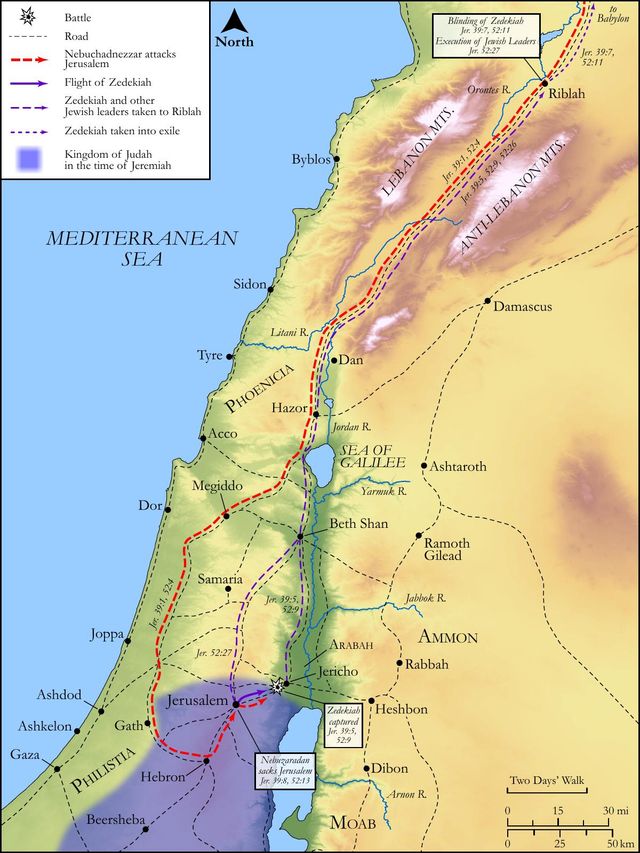
The horrific events of Jeremiah 52:10 transpired in 586 BC, following the final, catastrophic siege and fall of Jerusalem to the Neo-Babylonian Empire under the formidable King Nebuchadnezzar II. King Zedekiah, made king by Nebuchadnezzar after the first deportation, had repeatedly and foolishly rebelled against his Babylonian overlord, despite the prophet Jeremiah's persistent and divinely-inspired warnings to submit to Babylonian rule as God's ordained instrument of judgment. Riblah, located in the land of Hamath (modern-day Syria), served as a crucial Babylonian military and administrative headquarters. Its strategic position controlled vital access routes between Mesopotamia and Egypt, making it an ideal location for Nebuchadnezzar to oversee his western campaigns and administer justice to those who rebelled against him. Among the kings of that day, it was a common, albeit barbaric, practice for conquering kings to inflict maximum psychological torment on defeated rulers, often by executing their family members, especially male heirs, directly before their eyes. This act was designed not only to punish rebellion in the most agonizing way but also to utterly extinguish any hope of future dynastic succession, thereby demonstrating absolute dominance and preventing any future claims to the throne.
Key Themes
ShowHideThis verse powerfully contributes to several overarching themes within the Book of Jeremiah and the broader biblical narrative. Firstly, it stands as a stark testament to Divine Judgment and Consequences, illustrating the severe repercussions of Judah's persistent idolatry, covenant unfaithfulness, and King Zedekiah's direct rebellion against God's revealed will. The cruelty inflicted upon Zedekiah and his family serves as a visceral reminder that God holds nations and their leaders accountable for their actions. Secondly, it vividly demonstrates the Fulfillment of Prophecy, as Jeremiah had relentlessly warned of Jerusalem's destruction and the king's capture and suffering (e.g., Jeremiah 32:4-5). Furthermore, the prophet Ezekiel had specifically prophesied Zedekiah's fate, including being brought to Babylon but not seeing it (Ezekiel 12:13), a prophecy chillingly fulfilled by his blinding after witnessing his sons' deaths. Thirdly, the Severity of Punishment is underscored by the deliberate cruelty of slaying the sons before their father's eyes, symbolizing the complete obliteration of Zedekiah's lineage and the definitive end of Judah's independent sovereignty. This act marked the definitive End of an Era, closing the chapter on the independent Davidic monarchy in Jerusalem and ushering in the painful period of the Babylonian exile.
Exposition and Analysis
ShowHideKey Word Analysis
ShowHideThis verb (H7819) is a primitive root meaning "to slaughter (in sacrifice or massacre)." Its use here is not merely to indicate execution but to emphasize the brutal, violent, and utterly merciless nature of the killings. It conveys the ruthless butchery inflicted upon the royal family and the princes, highlighting the complete lack of compassion and the deliberate act of a conqueror asserting absolute power through bloodshed.
The term (H1121) refers to a "son (as a builder of the family name), in the widest sense." In this context, it specifically denotes Zedekiah's male offspring, who would naturally be his heirs and the continuation of his royal lineage. The deliberate slaying of these "sons" directly before their father's eyes was a calculated act to ensure the termination of his royal line and any future claim to the throne, thereby dismantling the very foundation of the Davidic monarchy in Judah.
This word (H5869) literally means "an eye (literally or figuratively); by analogy, a fountain." Here, it is used idiomatically in the phrase "before his eyes" to emphasize the direct, forced witnessing of the horrific event. This detail is crucial, highlighting the intense psychological torture inflicted upon Zedekiah. He was compelled to experience the full emotional and mental impact of his lineage's destruction, a deliberate act of cruelty designed to maximize his suffering and despair.
Verse Breakdown
ShowHide"And the king of Babylon slew the sons of Zedekiah before his eyes:"
This clause details the primary, most agonizing act of judgment. Nebuchadnezzar, the victorious Babylonian king, either personally or by his direct command, executed King Zedekiah's male offspring. The phrase "before his eyes" is a chilling and critical detail, indicating a deliberate act of psychological cruelty. This was designed to inflict maximum pain and despair upon the defeated King Zedekiah, forcing him to witness the annihilation of his dynastic future and the last vestiges of his hope, before his own eyes were put out, ensuring this image would be his last.
"he slew also all the princes of Judah in Riblah."
This second clause expands the scope of the slaughter, revealing that the judgment extended beyond Zedekiah's immediate heirs to encompass the broader leadership of Judah. "All the princes" (H8269), referring to high-ranking officials, nobles, and military commanders, were also executed. This mass killing at Riblah, the Babylonian military headquarters, served to systematically dismantle Judah's political, military, and social structure, eliminating any potential future resistance or leadership. This ensured complete subjugation and the eradication of Judah's independence, leaving no one to rally a rebellion.
Literary Devices
ShowHideThe verse employs several potent literary devices to convey its stark message and profound impact. Pathos is powerfully evoked, as the reader is confronted with the tragic spectacle of a father forced to witness the brutal murder of his children, a scene designed to elicit profound pity, horror, and despair. This deliberate cruelty also functions as Symbolism, where the slaying of Zedekiah's sons and the princes represents the complete and irreversible end of the Davidic monarchy's earthly reign, the obliteration of Judah's national sovereignty, and the finality of divine judgment. The event is steeped in Irony, as Zedekiah's repeated rebellion, intended to secure his kingdom's independence and preserve his lineage, ultimately led to its utter destruction and the very outcome he sought to avoid. The stark, declarative language, devoid of embellishment, also contributes to the verse's chilling effect, presenting the events as an undeniable and grim historical reality, emphasizing the precision and severity of the judgment.
Theological and Thematic Connections
ShowHideJeremiah 52:10 stands as a stark and unyielding testament to the unwavering nature of God's justice and the severe consequences of covenant infidelity. It powerfully illustrates that divine warnings are not idle threats but expressions of a righteous God who holds nations and their leaders accountable for their actions. The horrific scene underscores the principle that rebellion against God's ordained path, even when that path seems difficult (like submitting to Babylon), inevitably leads to devastating and irreversible outcomes. This event is a climactic fulfillment of the curses pronounced in the Mosaic covenant for disobedience, particularly those related to siege and suffering, and a vivid demonstration of God's absolute sovereignty over history, using even pagan empires as instruments to execute His righteous purposes and bring about His will.
Reflection and Application
ShowHideThe grim reality of Jeremiah 52:10 serves as a profound and sobering reminder for all generations. It compels us to consider the gravity of disobedience, not only to God's explicit commands but also to His providential leading, even when it involves challenging circumstances or requires personal sacrifice. Zedekiah's tragic end, brought about by his stubborn refusal to heed divine counsel through Jeremiah, underscores the critical importance of humility, discernment, and prompt obedience to God's revealed will. We are called to discern and submit to God's purposes in our lives, even when they are difficult, counter-intuitive, or demand a relinquishing of our own cherished plans, trusting in His ultimate sovereignty and wisdom. This passage challenges us to examine areas where we might be resisting God's word or clinging to our own perceived security rather than aligning with His divine will. It also highlights the far-reaching and often devastating consequences of sin, not just for individuals but for families, communities, and nations, urging us to pursue righteousness and justice collectively and to seek true peace and security only in alignment with God.
Questions for Reflection
ShowHideFAQ
ShowHideWhy was Zedekiah's punishment so severe, specifically the slaying of his sons before his eyes?
ShowHideZedekiah's punishment was exceptionally severe for several interconnected reasons, rooted in both the practices of conquering kings of that day and divine judgment. Firstly, it was a direct consequence of his repeated rebellion against Nebuchadnezzar, whom God had explicitly designated as His instrument of judgment against Judah. Zedekiah had sworn an oath of allegiance to Babylon in the name of God, which he then broke, a grave offense in both human and divine eyes (Ezekiel 17:15-19). Secondly, the act of slaying his sons before his eyes was a deliberate and culturally significant form of psychological torture, designed to inflict maximum suffering on the defeated king by destroying his lineage and any hope of dynastic continuity. This was a common, albeit horrific, practice among conquering kings of that day to utterly crush the spirit of a rebellious king and ensure no future challenges to the conqueror's authority. Finally, it was a chilling fulfillment of specific prophecies, particularly Ezekiel 12:13, which foretold Zedekiah's capture, being brought to Babylon, and his blinding, emphasizing the precision and certainty of divine judgment.
What is the significance of Riblah in this account?
ShowHideRiblah (H7247) was a strategically important location in the land of Hamath, situated on the Orontes River in modern-day Syria. It served as a key military and administrative headquarters for the Babylonian army during their campaigns in the Levant. Its significance in this account lies in its role as the staging ground for Babylonian operations and as the place where crucial decisions regarding the fate of conquered territories and their leaders were made. For Zedekiah, being brought to Riblah meant he was firmly within Babylonian control, far from Jerusalem, and subject to Nebuchadnezzar's direct and absolute judgment. It symbolized the complete shift of power and the finality of Judah's defeat, as the last king of Judah faced his ultimate reckoning at the heart of the enemy's regional command center, away from the sacred capital that had once been the seat of his power.
Christ-Centered Fulfillment
ShowHideJeremiah 52:10, in its stark depiction of judgment and the tragic failure of earthly kingship, powerfully points to the necessity and glory of Christ as the true and eternal King. The devastating end of Zedekiah and his lineage underscores the brokenness of the Davidic covenant line under human sin and rebellion, revealing the urgent need for a perfect King who would not fail. While Zedekiah's sons were brutally slain and his eyes put out, symbolizing the end of his earthly kingdom, Jesus, the true Son of David, willingly suffered a far greater judgment—the wrath of God for the sins of humanity—yet emerged victorious through resurrection. He is the King whose lineage cannot be extinguished, for His kingdom is eternal and without end (Luke 1:32-33). Unlike Zedekiah, who faced judgment for his own rebellion and the sins of his people, Christ bore the judgment due to us, becoming the Lamb of God who takes away the sin of the world. The suffering of Zedekiah's family, though horrific, foreshadows the ultimate suffering of the Messiah, who would be pierced for our transgressions and whose eyes would witness the depths of human sin and divine wrath on the cross, all to secure our salvation. Through His death and resurrection, Jesus inaugurated a new and everlasting covenant, establishing a spiritual kingdom that will never be destroyed, a kingdom ruled by the King of kings and Lord of lords. He is the faithful King who perfectly fulfills all the promises of God, offering true hope, eternal life, and an unshakable reign where human kingship utterly failed.