


Jeremiah 52:11
Bible text: King James Version (1769 Blayney text) · Public domain
Bible text: King James Version with Strong's numbers · Public domain
Bible text: Berean Standard Bible · Public domain
Bible text: American Standard Version (1901) · Public domain
Bible text: World English Bible, Messianic edition · Public domain
Bible text: Geneva Bible (1599) · Public domain
Bible text: Young's Literal Translation · Public domain
- וְאֶתve·'Etand <obj.>H853Conj-w ¦ DirObjMParticle Object Indicatorוְandאֶת<obj.>
- עֵינֵי'ei·Nei[the] eyes ofH5869N-fdcNoun Dual Feminine Construct
- צִדְקִיָּהוּtzid·ki·Ya·huZedekiahH6667N-proper-mNoun Proper Masculine
- עִוֵּר'i·Verhe made blindH5786V-Piel-Perf-3msVerb Piel Perfect 3rd Singular Masculine
- וַיַּאַסְרֵהוּvai·ya·'as·Re·huand he bound himH631Conj-w ¦ V-Qal-ConsecImperf-3ms ¦ 3msVerb Qal Consecutive Imperfect 3rd Singular Masculineוַandיַּאַסְרֵhe boundהוּhim
- בַנְחֻשְׁתַּיִםvan·chush·Ta·yimwith <the> bronze fettersH5178Prep-b ¦ N-fdNoun Dual Feminine Absoluteבַwith <the>נְחֻשְׁתַּיִםbronze fetters
- וַיְבִאֵהוּvay·vi·'E·huand he brought himH935Conj-w ¦ V-Hiphil-ConsecImperf-3ms ¦ 3msVerb Hiphil Consecutive Imperfect 3rd Singular Masculineוַandיְבִאֵhe broughtהוּhim
- מֶלֶךְMe·lekh[the] king ofH4428N-mscNoun Singular Masculine Construct
- בָּבֶלba·VelBabylonH894N-properNoun Proper Location
- בָּבֶלָהba·Ve·lahBabylon towardsH894N-proper ¦ SfxNoun Proper LocationבָּבֶלָBabylonהtowards
- וַיִּתְּנֵהוּvai·yi·te·Ne·huand he put himH5414Conj-w ¦ V-Qal-ConsecImperf-3ms ¦ 3msVerb Qal Consecutive Imperfect 3rd Singular Masculineוַandיִּתְּנֵhe putהוּhim
- בֵיתveit[the] house ofH1004N-mscNoun Singular Masculine Construct
- הַפְּקֻדֹּתha·pe·ku·Dot<the> punishment<s>H6486Art ¦ N-fpNoun Plural Feminine Absoluteהַ<the>פְּקֻדֹּתpunishment<s>
- עַד'aduntilH5704PrepPreposition
- יוֹםYom[the] day ofH3117N-mscNoun Singular Masculine Construct
- מוֹתוֹmo·Tohis deathH4194N-msc ¦ 3msNoun Singular Masculine Constructמוֹתdeathוֹhis
English is a literal word-by-word gloss of the Hebrew, not the KJV's wording. Why?
This is the original text the KJV's translators worked from — each Hebrew word with its own literal English meaning in this verse, prepared by scholars at Tyndale House, Cambridge. The KJV translates whole sentences, not word by word, so its wording differs: one Hebrew word can become several English words, and the KJV may choose “the LORD” where the gloss reads “Yahweh”. Both are faithful — they answer different questions. For the KJV's own rendering, switch to the KJV text.
Details
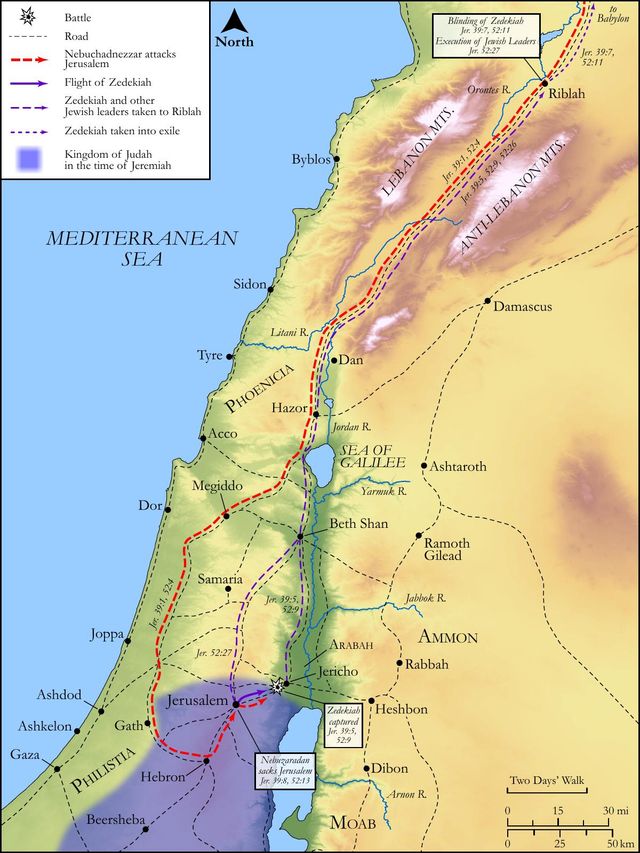
See on the biblical-era map
Study this verse
Public-domain commentary
Matthew Henry
From his Commentary on the Whole Bible. Henry comments on passages, not single verses — this entry covers Jeremiah 52:1–11.
This narrative begins no higher than the beginning of the reign of Zedekiah, though there were two captivities before, one in the fourth year of Jehoiakim, the other in the first of Jeconiah; but probably it was drawn up by some of those that were carried away with Zedekiah, as a reproach to themselves for imagining that they should not go into captivity after their brethren, with which hopes they had long flattered themselves. We have here, 1. God's just displeasure against Judah and Jerusalem for their sin, Jer 52:3. His anger was against them to such a degree that he determined to cast them out from his presence, his favourable gracious presence, as a father, when he is extremely angry with an undutiful son, bids him get out of his presence, he expelled them from that good land that had such tokens of his presence in providential bounty and that holy city and temple that had such tokens of his presence in covenant-grace and love. Note, Those that are banished from God's ordinances have reason to complain that they are in some degree cast out of his presence; yet none are cast out from God's gracious presence but those that by sin have first thrown themselves out of it. This fruit of sin we should therefore deprecate above any thing, as David (Psa 51:11), Cast me not away from thy presence. 2. Zedekiah's bad conduct and management, to which God left him, in displeasure against the people, and for which God punished him, in displeasure against him. Zedekiah had arrived at years of discretion when he came to the throne; he was twenty-one years old (Jer 52:1); he was none of the worst of the kings (we never read of his idolatries), yet his character is that he did evil in the eyes of the Lord, for he did not do the good he should have done. But that evil deed of his which did in a special manner hasten this destruction was his rebelling against the king of Babylon, which was both his sin and his folly, and brought ruin upon his people, not only meritoriously, but efficiently. God was greatly displeased with him for his perfidious dealing with the king of Babylon (as we find, Eze 17:15, etc.); and, because he was angry at Judah and Jerusalem, he put him into the hand of his own counsels, to do that foolish thing which proved fatal to him and his kingdom. 3. The possession which the Chaldeans at length gained of Jerusalem, after eighteen months' siege. They sat down before it, and blocked it up, in the ninth year of Zedekiah's reign, in the tenth month (Jer 52:4), and made themselves masters of it in the eleventh year in the fourth month, Jer 52:6. In remembrance of these two steps towards their ruin, while they were in captivity, they kept a fast in the fourth month, and a fast in the tenth (Zac 8:19): that in the fifth month was in remembrance of the burning of the temple, and that in the seventh of the murder of Gedaliah. We may easily imagine, or rather cannot imagine, what a sad time it was with Jerusalem, during this year and half that it was besieged, when all provisions were cut off from coming to them and they were ever and anon alarmed by the attacks of the enemy, and, being obstinately resolved to hold out to the last extremity, nothing remained but a certain fearful looking for of judgment. That which disabled them to hold out, and yet could not prevail with them to capitulate, was the famine in the city (Jer 52:6); there was no bread for the people of the land, so that the soldiers could not make good their posts, but were rendered wholly unserviceable; and then no wonder that the city was broken up, Jer 52:7. Walls, in such a case, will not hold out long without men, any more than men without walls; nor will both together stand people in any stead without God and his protection. 4. The inglorious retreat of the king and his mighty men. They got out of the city by night (Jer 52:7) and made the best of their way, I know not whither, nor perhaps they themselves; but the king was overtaken by the pursuers in the plains of Jericho, his guards were dispersed, and all his army was scattered from him, Jer 52:8. His fright was not causeless, for there is no escaping the judgments of God; they will come upon the sinner, and will overtake him, let him flee where he will (Deu 28:15), and these judgments particularly that are here executed were there threatened, Jer 51:52, Jer 51:53, etc. 5. The sad doom passed upon Zedekiah by the king of Babylon, and immediately put in execution. he treated him as a rebel, gave judgment upon him, Jer 51:9. One cannot think of it without the utmost vexation and regret that a king, a king of Judah, a king of the house of David, should be arraigned as a criminal at the bar of this heathen king. But he humbled not himself before Jeremiah the prophet; therefore God thus humbled him. Pursuant to the sentence passed upon him by the haughty conqueror, his sons were slain before his eyes, and all the princes of Judah (Jer 52:10); then his eyes were put out, and he was bound in chains, carried in triumph to Babylon; perhaps they made sport with him, as they did with Samson when his eyes were put out; however, he was condemned to perpetual imprisonment, wearing out the remainder of his life (I cannot say his days, for he saw day no more) in darkness and misery. He was kept in prison till the day of his death, but had some honour done him at his funeral, Jer 34:5. Jeremiah had often told him what it would come to, but he would not take warning when he might have prevented it.
Continue studying Jeremiah 52:11 across the web’s major study libraries — every link below opens this exact verse, chapter, or book on the destination site.
Read & Compare
 BibleGatewayThis verse in more than 200 translations and 70 languages.
 Bible.comThe YouVersion reader — hundreds of translations, reading plans, and highlights.
 ESV.orgCrossway's official English Standard Version reader.
 NET BibleThe NET translation with 60,000+ translators' notes on every rendering decision.
 STEP BibleTyndale House's free study tool — original text, vocabulary, and scholarly resources.
 BibliaLogos Bible Software's free web reader.
 USCCBThe New American Bible (Revised Edition) with the U.S. bishops' study notes.
Commentaries
 BibleHub CommentariesDozens of classic commentaries on this verse, gathered on one page.
 StudyLightMore than 100 commentary sets — the largest collection on the web.
 BibleRefPlain-English commentary on what this verse means, verse by verse.
 Enduring WordDavid Guzik's free commentary on this chapter, widely used by Bible teachers.
 Bible Study ToolsVerse commentary alongside Greek and Hebrew study aids.
Original Language & Research
- BibleHub InterlinearThe verse word by word — original language, transliteration, and English.
- BibleHub LexiconEvery word's original-language definition and Strong's entry.
 Blue Letter BibleDeep-study tools — Strong's numbers, concordance, and word studies.
 SefariaThe Hebrew text with Rashi and centuries of Jewish commentary.
Sermons, Hymns & Audio


TrulyRandomVerse is not affiliated with these sites and doesn’t control their content. They’re linked because they’re genuinely useful.
Summary
Jeremiah 52:11 delivers a stark and definitive account of the brutal fate of King Zedekiah, the last king of Judah, at the hands of Nebuchadnezzar, king of Babylon. It details his blinding, his binding in bronze chains, and his subsequent forced deportation to Babylon, where he remained imprisoned until his death. This verse serves as a chilling testament to the precise fulfillment of divine judgment and prophetic warnings, marking the tragic and humiliating end of the independent Davidic monarchy in Jerusalem and ushering in the long period of the Babylonian exile for the people of Judah.
Context
ShowHideLiterary Context
Jeremiah 52 functions as a historical appendix to the prophetic book of Jeremiah, largely recapitulating and confirming the events described in 2 Kings 24-25. This concluding chapter provides a factual, almost clinical, summary of Jerusalem's final siege, its devastating fall, and the subsequent deportations, serving to underscore the absolute reliability and fulfillment of Jeremiah's long and often rejected prophecies of judgment against Judah. Verses 1-3 set the stage by recounting Zedekiah's rebellion against Babylon, which was, in essence, a rebellion against God's ordained judgment. Verses 4-10 vividly depict the intensity of the siege, Zedekiah's desperate and ultimately futile attempt to flee, his capture in the plains of Jericho, and the horrific execution of his sons and Judah's nobles before his very eyes at Riblah. Jeremiah 52:11, therefore, presents the immediate, devastating personal consequence for Zedekiah, serving as the climactic act of his punishment and the ultimate humiliation for the Davidic dynasty in Jerusalem. The subsequent verses detail the systematic destruction of the Temple and the city, emphasizing the comprehensive nature of God's judgment.
Historical & Cultural Context
The events described in Jeremiah 52:11 took place in 586 BC, following the third and final siege of Jerusalem by Nebuchadnezzar's formidable Babylonian forces. Zedekiah, initially installed as a puppet king by Babylon after the first deportation, repeatedly violated his oath of allegiance to Nebuchadnezzar by seeking alliances with Egypt, thereby defying God's explicit command, delivered through Jeremiah, to submit to the yoke of the king of Babylon. The act of blinding a defeated king was a common, albeit brutal, practice among conquering kings of that day. It served multiple strategic and symbolic purposes: to utterly incapacitate the deposed ruler, preventing any future challenge or attempt to reclaim power; to inflict profound humiliation, stripping them of all dignity and authority; and to serve as a stark warning to other potential rebels. Imprisonment until death further solidified this absolute control, ensuring Zedekiah remained a living, sightless testament to Babylon's dominance and Judah's complete subjugation.
Key Themes
ShowHideThis verse powerfully encapsulates several major theological and narrative themes prevalent throughout the book of Jeremiah and the broader Old Testament. Foremost among these is the theme of Divine Judgment and the Fulfillment of Prophecy. Zedekiah's tragic fate precisely aligns with the specific warnings delivered by Jeremiah (e.g., Jeremiah 32:4-5) and Ezekiel (e.g., Ezekiel 12:13), demonstrating God's unwavering faithfulness to His word, whether of blessing or curse. The verse also highlights the severe Consequences of Disobedience and Rebellion against God's revealed will, showing how Zedekiah's persistent defiance and spiritual blindness directly led to the catastrophic destruction of Jerusalem and the definitive end of the Davidic monarchy's rule from the city. Furthermore, it marks the End of an Era, signaling the collapse of the independent Kingdom of Judah and the beginning of the long and painful Babylonian Exile, a pivotal period that profoundly reshaped Israelite identity, theology, and their understanding of covenant (as seen in later prophetic and historical books like Daniel and Ezra).
Exposition and Analysis
ShowHideKey Word Analysis
ShowHideThe phrase "put out the eyes" (H5786, H5869) refers to the brutal and irreversible act of blinding. ʻâvar (H5786) signifies to blind or to put out, often implying a violent removal or destruction of the eye. ʻayin (H5869) literally means "eye" but can also figuratively denote sight, appearance, or a fountain. In this context, it describes the deliberate and permanent mutilation of Zedekiah's vision, a common punishment among conquering kings of that day designed to incapacitate a defeated king and ensure he could never again lead or even perceive his former kingdom. It was a profound act of humiliation and a symbol of utter defeat, ensuring his last sight was the execution of his sons and nobles.
This term (H5178) refers to copper or bronze, and by extension, something made of that metal, specifically fetters or chains. The use of bronze chains emphasizes the harshness, weight, and permanence of Zedekiah's captivity. Unlike lighter materials, bronze chains signify a heavy, inescapable bondage, stripping him of all freedom and dignity, reducing him from a sovereign king to a mere captive. This material choice highlights the severity and inescapability of his new reality.
The phrase "put him in prison" (H5414, H1004, H6486) uses nâthan (H5414, to put/give), bayith (H1004, house), and pᵉquddâh (H6486, visitation, custody, charge, or prison). Bayith (H1004) generally means "house," but in this context, when combined with pᵉquddâh (H6486), it specifically denotes a "house of custody" or "house of prisoners"—a dungeon or jail. This signifies a complete loss of status and freedom, as the former king was confined to a common place of detention, stripped of all royal privilege until his death, underscoring the finality of his punishment and degradation.
Verse Breakdown
ShowHide"Then he put out the eyes of Zedekiah;"
This clause describes the first and most immediate act of Nebuchadnezzar's personal vengeance and punishment upon the captured King Zedekiah. Having already forced Zedekiah to witness the execution of his sons and Judah's nobles, Nebuchadnezzar then inflicted this irreversible physical mutilation. This ensured that the last images Zedekiah ever saw were the destruction of his lineage and kingdom, a profound and lasting psychological torment. This act was a common, brutal tactic in ancient warfare to incapacitate and humiliate a defeated ruler, preventing any future attempts at rebellion.
"and the king of Babylon bound him in chains,"
Following the blinding, Zedekiah was physically restrained with chains, specifically bronze fetters as indicated by the Hebrew word for "chains" (nᵉchôsheth). This action further emphasized his complete loss of freedom, power, and royal dignity. From a sovereign king, he was reduced to a bound prisoner, a public spectacle of Babylon's absolute dominance and his own utter defeat. The heavy chains symbolize the inescapable nature of his captivity and the weight of his consequences.
"and carried him to Babylon, and put him in prison till the day of his death."
The final part of the verse details Zedekiah's ultimate fate: forced deportation to Babylon, the very empire he had defied, and perpetual imprisonment. This was not a temporary detention but a lifelong sentence, ensuring he would never return to Judah or pose a threat again. His confinement "till the day of his death" underscores the finality and severity of his punishment, marking the definitive end of his life as a king and a free man, a tragic and humiliating conclusion to the independent Judean monarchy.
Literary Devices
ShowHideJeremiah 52:11 employs several powerful literary devices to convey its grim message and profound theological implications. The most prominent is Symbolism: the blinding of Zedekiah is not merely a physical act but profoundly symbolizes his spiritual blindness and failure to "see" or heed God's warnings delivered through Jeremiah. His physical inability to see mirrors his spiritual inability to discern God's will and the impending judgment. The Chains and Prison further symbolize his complete loss of freedom, power, and dignity, representing the total subjugation of Judah under Babylon and the inescapable consequences of rebellion. There is also a strong element of Irony in Zedekiah's fate; he sought to escape the Babylonians, but his flight led directly to a more severe and humiliating captivity than if he had submitted. The verse also functions as a powerful Fulfillment of Prophecy, serving as the definitive historical record of Jeremiah's and Ezekiel's earlier warnings coming to pass, thereby validating the divine origin of their messages and the certainty of God's word. The concise, almost clinical tone of the verse, despite the horrific events it describes, creates a sense of Understatement, allowing the gravity of the events to speak for themselves.
Theological and Thematic Connections
ShowHideJeremiah 52:11 stands as a stark testament to the unwavering justice and sovereignty of God, demonstrating that His warnings are not empty threats but certain pronouncements that will be fulfilled. Zedekiah's tragic end, marked by blinding, chains, and lifelong imprisonment, is the direct consequence of his persistent rebellion against God's revealed will, delivered through Jeremiah. It underscores the profound theological truth that disobedience, particularly by those in leadership, carries severe consequences, not only for the individual but for the entire nation. Even through the actions of pagan rulers like Nebuchadnezzar, God's sovereign hand was at work, using the Babylonian empire as an instrument of His judgment against a disobedient people. This verse is a powerful reminder that God holds all, including kings and nations, accountable for their actions, and His word, whether of blessing or judgment, will ultimately prevail, bringing about His divine purposes despite human defiance.
Reflection and Application
ShowHideThe grim account of Zedekiah's fate in Jeremiah 52:11 serves as a profound and enduring lesson for all believers, challenging us to consider the seriousness of our own obedience to God's revealed will. It reminds us that persistent rebellion, even when cloaked in self-preservation, political expediency, or a perceived lack of immediate consequence, ultimately leads to devastating and inescapable outcomes. Just as Zedekiah's physical blindness symbolized his spiritual inability to "see" God's truth, we are called to cultivate spiritual discernment, actively seeking and heeding God's voice in our lives, rather than relying on our own limited understanding or worldly wisdom. This passage also powerfully affirms God's unwavering sovereignty; even in the midst of profound human suffering, national catastrophe, and the apparent triumph of evil, God's purposes are being meticulously fulfilled. We are therefore encouraged to trust in His overarching plan, even when circumstances are dark and confusing, knowing that He is working all things for His glory and the ultimate good of those who love Him.
Questions for Reflection
ShowHideFAQ
ShowHideWhy was Zedekiah blinded, and was this a common punishment?
ShowHideZedekiah was blinded as a severe and humiliating punishment inflicted by Nebuchadnezzar, the king of Babylon. This act followed the horrific execution of his sons and Judah's nobles before his eyes, ensuring that his last sight was the destruction of his lineage and kingdom. Blinding defeated kings or rebels was indeed a common and brutal practice among conquering kings of that day. It served multiple strategic and symbolic purposes: to utterly incapacitate the individual, preventing them from leading any future rebellions; to publicly humiliate them, symbolizing their complete loss of power and dignity; and to serve as a stark warning to others against defying the conquering empire. For Zedekiah, it was the ultimate act of vengeance for his repeated defiance of Babylonian authority, which the prophets, particularly Jeremiah, had warned was defiance of God's own decreed judgment (see Jeremiah 32:4-5).
Christ-Centered Fulfillment
ShowHideWhile Jeremiah 52:11 depicts the tragic end of an earthly king, it profoundly foreshadows the ultimate King, Jesus Christ, and the nature of His eternal kingdom. Zedekiah, a descendant of David, suffered the consequences of his own and his people's sin, experiencing a humiliating end in chains and prison. This stands in stark contrast to Jesus, the true Son of David, who willingly submitted to suffering, chains (figuratively, in His arrest and crucifixion), and a "prison" of death, not for His own sin, but as the sinless Lamb of God who takes away the sin of the world (John 1:29). The physical blindness inflicted upon Zedekiah, a consequence of his spiritual blindness and refusal to see God's truth, finds its redemptive counterpart in Christ's ministry, where He opened the eyes of the physically blind (e.g., John 9:1-7) and, more importantly, offers spiritual sight to those blinded by sin and unbelief (2 Corinthians 4:4-6). Zedekiah's lifelong imprisonment until death underscores the finality of human judgment and the consequences of rebellion, but Christ's death and glorious resurrection broke the chains of sin and death (Colossians 2:13-15), offering eternal freedom and life to all who believe. Thus, Zedekiah's tragic end, a testament to the consequences of rebellion, ultimately points to the victorious King who endured suffering to secure an everlasting kingdom where there will be no more sorrow, no more chains, and no more spiritual blindness, for God Himself will wipe away every tear (Revelation 21:4).