


Jeremiah 34:3
Bible text: King James Version (1769 Blayney text) · Public domain
Bible text: King James Version with Strong's numbers · Public domain
Bible text: Berean Standard Bible · Public domain
Bible text: American Standard Version (1901) · Public domain
Bible text: World English Bible, Messianic edition · Public domain
Bible text: Geneva Bible (1599) · Public domain
Bible text: Young's Literal Translation · Public domain
- וְאַתָּהve·'a·Tahand youH859Conj-w ¦ Pro-2msPronoun Personal 2nd Singular Masculineוְandאַתָּהyou
- לֹאlo'notH3808NegParticle Negative
- תִמָּלֵטti·ma·Letyou will escapeH4422V-Niphal-Imperf-2msVerb Niphal Imperfect 2nd Singular Masculine
- מִיָּדוֹmi·ya·Dofrom his handH3027Prep-m ¦ N-csc ¦ 3msNoun Singular common gender Constructמִfromיָּדhandוֹhis
- כִּיkiforH3588PrtParticle Conditional
- תָּפֹשׂta·Foscertainly <to capture>H8610V-Qal-InfAbsVerb Qal Infinitive Absolute
- תִּתָּפֵשׂti·ta·Fesyou will be capturedH8610V-Niphal-Imperf-2msVerb Niphal Imperfect 2nd Singular Masculine
- וּבְיָדוֹu·ve·ya·Doand in his handH3027Conj-w ¦ Prep-b ¦ N-csc ¦ 3msNoun Singular common gender Constructוּandבְinיָדhandוֹhis
- תִּנָּתֵןti·na·Tenyou will be givenH5414V-Niphal-Imperf-2msVerb Niphal Imperfect 2nd Singular Masculine
- וְעֵינֶיךָVe·'ei·nei·khaand your eyesH5869Conj-w ¦ N-fdc ¦ 2msNoun Dual Feminine Constructוְandעֵינֶיeyesךָyour
- אֶת'et<obj.>H853DirObjMParticle Object Indicator
- עֵינֵי'ei·Nei[the] eyes ofH5869N-fdcNoun Dual Feminine Construct
- מֶלֶךְMe·lekh[the] king ofH4428N-mscNoun Singular Masculine Construct
- בָּבֶלba·VelBabylonH894N-properNoun Proper Location
- תִּרְאֶינָהtir·'Ei·nahthey will seeH7200V-Qal-Imperf-3fpVerb Qal Imperfect 3rd Plural Feminine
- וּפִיהוּu·Fi·huand his mouthH6310Conj-w ¦ N-msc ¦ 3msNoun Singular Masculine Constructוּandפִיmouthהוּhis
- אֶת'etwithH854PrepPreposition
- פִּיךָPi·khayour mouthH6310N-msc ¦ 2msNoun Singular Masculine Constructפִּיmouthךָyour
- יְדַבֵּרye·da·Berit will speakH1696V-Piel-Imperf-3msVerb Piel Imperfect 3rd Singular Masculine
- וּבָבֶלu·va·Veland BabylonH894Conj-w ¦ N-properNoun Proper LocationוּandבָבֶלBabylon
- תָּבוֹאta·Vo'you will goH935V-Qal-Imperf-2msVerb Qal Imperfect 2nd Singular Masculine
English is a literal word-by-word gloss of the Hebrew, not the KJV's wording. Why?
This is the original text the KJV's translators worked from — each Hebrew word with its own literal English meaning in this verse, prepared by scholars at Tyndale House, Cambridge. The KJV translates whole sentences, not word by word, so its wording differs: one Hebrew word can become several English words, and the KJV may choose “the LORD” where the gloss reads “Yahweh”. Both are faithful — they answer different questions. For the KJV's own rendering, switch to the KJV text.
Details
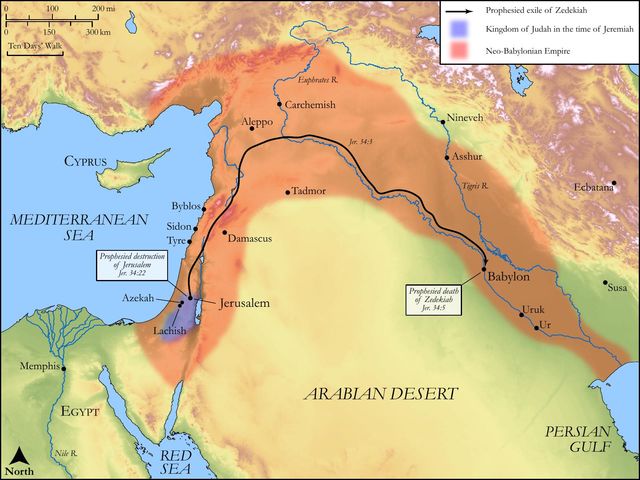
See on the biblical-era map
Study this verse
Public-domain commentary
Matthew Henry
From his Commentary on the Whole Bible. Henry comments on passages, not single verses — this entry covers Jeremiah 34:1–7. His two-level outline is real structure in the source text, so it is rendered as structure.
This prophecy concerning Zedekiah was delivered to Jeremiah, and by him to the parties concerned, before he was shut up in the prison, for we find this prediction here made the ground of his commitment, as appears by the recital of some passages out of it, Jer 32:4. Observe,
I.The time when this message was sent to Zedekiah; it was when the king of Babylon, with all his forces, some out of all the kingdoms of the earth that were within his jurisdiction, fought against Jerusalem and the cities thereof (Jer 34:1), designing to destroy them, having often plundered them. The cities that now remained, and yet held out, are named (Jer 34:7), Lachish and Azekah. This intimates that things were now brought to the last extremity, and yet Zedekiah obstinately stood it out, his heart being hardened to his destruction.
II.The message itself that was sent to him.
1.Here is a threatening of wrath. He is told that again which he had been often told before, that the city shall be taken by the Chaldeans and burnt with fire (Jer 34:2), that he shall himself fall into the enemy's hands, shall be made a prisoner, shall be brought before that furious prince Nebuchadnezzar, and be carried away captive into Babylon (Jer 34:3); yet Ezekiel prophesied that he should not see Babylon; nor did he, for his eyes were put out, Eze 12:13. This Zedekiah brought upon himself from God by his other sins and from Nebuchadnezzar by breaking his faith with him.
2.Here is a mixture of mercy. He shall die a captive, but he shall not die by the sword he shall die a natural death (Jer 34:4); he shall end his days with some comfort, shall die in peace, Jer 34:5. He never had been one of the worst of the kings, but we are willing to hope that what evil he had done in the sight of the Lord he repented of in his captivity, as Manasseh had done, and it was forgiven to him; and, God being reconciled to him, he might truly be said to die in peace, Note, A man may die in a prison and yet die in peace. Nay, he shall end his days with some reputation, more than one would expect, all things considered. He shall be buried with the burnings of his fathers, that is, with the respect usually shown to their kings, especially those that had done good in Israel. It seems, in his captivity he had conducted himself so well towards his own people that they were willing to do him this honour, and towards Nebuchadnezzar that he suffered it to be done. If Zedekiah had continued in his prosperity, perhaps he would have grown worse and would have departed at last without being desired; but his afflictions wrought such a change in him that his death was looked upon as a great loss. It is better to live and die penitent in a prison than to live and die impenitent in a palace. They will lament thee, saying, Ah lord! an honour which his brother Jehoiakim had not, Jer 22:18. The Jews say that they lamented thus over him, Alas! Zedekiah is dead, who drank the dregs of all the ages that went before him, that is, who suffered for the sins of his ancestors, the measure of iniquity being filled up in his days. They shall thus lament him, saith the Lord, for I have pronounced the word; and what God hath spoken shall without fail be made good.
III.Jeremiah's faithfulness in delivering this message.
Though he knew it would be ungrateful to the king, and might prove, as indeed it did, dangerous to himself (for he was imprisoned for it), yet he spoke all these words to Zedekiah, Jer 34:6. It is a mercy to great men to have those about them that will deal faithfully with them, and tell them the evil consequences of their evil courses, that they may reform and live.
Historical interpretation
Historical reception
1 surviving comment on this verse from the historical church.
[Daniel 7:1] "In the first year of Belshazzar, King of Babylon, Daniel beheld a dream. And a vision of his head upon his bed. And when he wrote the dream down, he comprehended it in a few words and gave a brief summary of it, saying..." This section which we now undertake to explain, and also the subsequent section which we are going to discuss, is historically prior to the two previous sections. For this present section and that which follows it are recorded to have taken place in the first and third years of the reign of King Belshazzar (Jeremiah 39) [Jerome's citation of Jeremiah 39 seems quite pointless in this connection]. But the section which we read previously to the one just preceding this, is recorded to have taken place in the last year, indeed on the final day, of Belshaz-zar's reign. And we meet this phenomenon not only in Daniel but also in Jeremiah [cf. Jeremiah 35 and Jeremiah 34] and Ezekiel (Ezekiel 17), as we shall be able to show, if life spares us that long. But in the earlier portion of the book, the historical order has been followed, namely the events which occurred in the time of Nebuchadnezzar, and Belshazzar, and Darius or Cyrus. But in the passages now before us an account is given of various visions which were beheld on particular occasions and of which only the prophet himself was aware, and which therefore lacked any importance as signs or revelations so far as the barbarian nations were concerned. But they were written down only that a record of the things beheld might be preserved for posterity.
Continue studying Jeremiah 34:3 across the web’s major study libraries — every link below opens this exact verse, chapter, or book on the destination site.
Read & Compare
 BibleGatewayThis verse in more than 200 translations and 70 languages.
 Bible.comThe YouVersion reader — hundreds of translations, reading plans, and highlights.
 ESV.orgCrossway's official English Standard Version reader.
 NET BibleThe NET translation with 60,000+ translators' notes on every rendering decision.
 STEP BibleTyndale House's free study tool — original text, vocabulary, and scholarly resources.
 BibliaLogos Bible Software's free web reader.
 USCCBThe New American Bible (Revised Edition) with the U.S. bishops' study notes.
Commentaries
 BibleHub CommentariesDozens of classic commentaries on this verse, gathered on one page.
 StudyLightMore than 100 commentary sets — the largest collection on the web.
 BibleRefPlain-English commentary on what this verse means, verse by verse.
 Enduring WordDavid Guzik's free commentary on this chapter, widely used by Bible teachers.
 Bible Study ToolsVerse commentary alongside Greek and Hebrew study aids.
Original Language & Research
- BibleHub InterlinearThe verse word by word — original language, transliteration, and English.
- BibleHub LexiconEvery word's original-language definition and Strong's entry.
 Blue Letter BibleDeep-study tools — Strong's numbers, concordance, and word studies.
 SefariaThe Hebrew text with Rashi and centuries of Jewish commentary.
Sermons, Hymns & Audio


TrulyRandomVerse is not affiliated with these sites and doesn’t control their content. They’re linked because they’re genuinely useful.
Summary
Jeremiah 34:3 conveys a direct and unyielding divine prophecy to King Zedekiah of Judah, delivered through the prophet Jeremiah. It unequivocally declares that Zedekiah will not escape the impending Babylonian conquest but will be certainly captured, personally confronted by King Nebuchadnezzar, and subsequently led into exile in Babylon. This verse serves as a stark testament to the absolute certainty of God's judgment against Judah's rebellion and the personal humiliation awaiting its disobedient monarch.
Context
ShowHideLiterary Context
This verse is an integral part of a specific oracle found within Jeremiah 34, delivered during the climactic final siege of Jerusalem by Nebuchadnezzar's forces. The preceding verse, Jeremiah 34:2, sets the stage by explicitly stating Jerusalem's impending destruction by fire and Zedekiah's inability to escape. Jeremiah 34:3 then intensifies this pronouncement by detailing the king's personal, inescapable fate, underscoring the directness of divine judgment. Within the broader narrative of Jeremiah, this prophecy functions as a definitive statement of the consequences of Judah's persistent idolatry and covenant unfaithfulness, culminating in the Babylonian exile. It directly refutes any lingering hope Zedekiah might have harbored regarding evasion or military success.
Historical & Cultural Context
The historical backdrop for this prophecy is the intense period between 588 and 586 BC, when Jerusalem was under a relentless siege by the Neo-Babylonian Empire, led by King Nebuchadnezzar II. King Zedekiah had been placed on the throne by Nebuchadnezzar following the first deportation of Judah's elite in 597 BC, as detailed in 2 Kings 24:10-17. Despite solemn oaths of loyalty to Babylon, Zedekiah foolishly rebelled, placing his trust in a fragile alliance with Egypt—a common but ultimately disastrous strategy for smaller nations caught between regional superpowers. Culturally, the fate of a defeated king among the nations of that day often involved public humiliation, execution, or forced exile, serving as a powerful deterrent to other rebellious territories. The concept of a "mouth to mouth" encounter between a victorious emperor and a vanquished monarch was a profound symbol of absolute subjugation, stripping the defeated ruler of all remaining dignity, autonomy, and power.
Key Themes
ShowHideJeremiah 34:3 powerfully articulates several foundational themes central to the book of Jeremiah and the wider Old Testament. Foremost is the theme of Divine Sovereignty and Inevitable Judgment, demonstrating that God's spoken word, conveyed through His prophet, will be perfectly and infallibly fulfilled, regardless of human resistance or strategic maneuvering. Zedekiah's ultimate fate is presented not merely as a consequence of military defeat but as a direct execution of God's righteous judgment against Judah's deep-seated rebellion and unfaithfulness to His covenant, echoing the warnings found in passages like Deuteronomy 28. The verse also highlights the Consequences of Disobedience, vividly illustrating that Zedekiah's consistent refusal to heed Jeremiah's persistent and clear warnings (e.g., Jeremiah 27:12-15) leads directly to his personal downfall and profound humiliation. Lastly, it underscores the Personal Nature of Judgment and Exile, as the king, who embodied Judah's independence and identity, is subjected to a direct, humiliating encounter and forced deportation, thereby foreshadowing the collective fate of the entire nation.
Exposition and Analysis
ShowHideKey Word Analysis
ShowHideThis primitive root (H4422) fundamentally means "to be smooth," which by implication leads to the idea of "to escape (as if by slipperiness)." In a causative sense, it means "to release or rescue." The emphatic negative "shalt not escape" in this verse underscores the absolute certainty of Zedekiah's capture, eliminating any possibility of him slipping away from Babylon's grip or being rescued by any external force. It highlights the divine decree that renders his evasion utterly impossible.
This primitive word (H3027) refers to the open hand, symbolizing power, means, or direction. Its dual appearance in the verse—"out of his hand" and "into his hand"—powerfully depicts the complete and irreversible transfer of control and authority from Zedekiah to Nebuchadnezzar. It signifies the inescapable grip of the conquering king, representing the overwhelming military and political might wielded by Babylon, which is ultimately orchestrated by God's sovereign plan.
Derived from a root meaning "to blow," this word (H6310) primarily refers to the mouth, especially as the organ of speech. The repetition "mouth to mouth" signifies a direct, personal, and unmediated confrontation. This emphasis on direct encounter highlights the profound humiliation of Zedekiah, who, as a sovereign king, would typically interact through official intermediaries. This direct communication underscores his complete subjugation and the stripping away of his royal dignity, as he is compelled to face his conqueror without pretense or protection.
Verse Breakdown
ShowHide"And thou shalt not escape out of his hand"
This opening clause delivers an unequivocal and absolute pronouncement regarding Zedekiah's fate. The "hand" of Nebuchadnezzar here represents his formidable power and inescapable control, from which Zedekiah will find no means of evasion or rescue. This statement directly contradicts any hopes, plans, or military strategies Zedekiah might have entertained for escaping the siege.
"but shalt surely be taken, and delivered into his hand"
This phrase serves to reinforce the absolute certainty of Zedekiah's capture and explicitly highlights the divine agency behind it. The repetition of "into his hand" further emphasizes the inescapable and complete grip of the Babylonian king. Zedekiah will not merely be caught by chance; he will be "delivered," implying a divine handing over, a surrender to the inevitable judgment ordained by God.
"and thine eyes shall behold the eyes of the king of Babylon"
This vivid and poignant imagery paints a picture of a deeply personal and profoundly humiliating confrontation. Zedekiah, the reigning king of Judah, will be compelled to look directly into the eyes of his conqueror, Nebuchadnezzar. This direct gaze symbolizes the complete reversal of power, the utter subjugation of Judah's monarchy, and a moment of profound personal defeat and loss of dignity for the once-proud ruler.
"and he shall speak with thee mouth to mouth"
This phrase further intensifies the personal and unmediated nature of the confrontation. It signifies a direct, unmediated conversation, not conducted through messengers or diplomatic intermediaries. This direct communication, likely a pronouncement of judgment, terms of surrender, or a rebuke, would have been an intensely shaming experience for a defeated king, underscoring his absolute powerlessness before the conquering emperor.
"and thou shalt go to Babylon"
The concluding clause states the ultimate and inescapable outcome: exile. Zedekiah will neither die in Jerusalem nor remain in Judah, but will be forcibly taken to Babylon, the very heart of the empire that has crushed his kingdom. This signifies the definitive end of his reign, the complete loss of his freedom, and the undeniable fulfillment of the long-prophesied judgment of exile for Judah's persistent sin and rebellion.
Literary Devices
ShowHideJeremiah 34:3 is rich in literary devices that amplify its prophetic power and emotional impact. The most prominent is Direct Address, as the prophecy is spoken directly to "thou" (King Zedekiah), making the judgment intensely personal, unavoidable, and deeply impactful. Repetition is strategically employed with phrases such as "his hand" (referring to Nebuchadnezzar's power) and "mouth to mouth" (emphasizing the direct and intimate nature of the confrontation), which serve to underscore the absolute certainty and the profound humiliation of Zedekiah's capture. The use of Metonymy is evident in "hand," which represents not merely a physical limb but the comprehensive power, authority, and control of the Babylonian king. The vivid imagery of "thine eyes shall behold the eyes of the king of Babylon" creates powerful Visual Symbolism, conveying the profound personal humiliation and the complete subjugation of one monarch to another. Finally, the entire verse functions as a potent Foreshadowing of the historical events later detailed in 2 Kings 25 and Jeremiah 39, where Zedekiah's escape attempt fails, and he is indeed brought before Nebuchadnezzar and exiled.
Theological and Thematic Connections
ShowHideJeremiah 34:3 stands as a profound testament to God's unwavering sovereignty and the absolute certainty of His prophetic word. It powerfully illustrates that even earthly kings, who may perceive themselves as autonomous and unchallengeable, are ultimately subject to the divine will and the inescapable consequences of their choices. The prophecy underscores that God, in His righteous judgment, uses earthly powers—even pagan empires like Babylon—as instruments to execute His divine decrees against the sin and rebellion of His own people. Zedekiah's personal humiliation and forced exile serve as a poignant microcosm of Judah's national fate, demonstrating that persistent disobedience to God's covenant inevitably results in severe, divinely ordained consequences. This divine judgment, though undeniably harsh, is ultimately a demonstration of God's perfect justice and His unwavering commitment to His covenant, even if it necessitates purging His people through exile to lead them to repentance and eventual restoration.
Reflection and Application
ShowHideJeremiah 34:3 serves as a deeply sobering reminder that defiance against God's revealed will inevitably leads to severe and inescapable consequences. For King Zedekiah, it was certain capture, personal humiliation, and forced exile; for us, it is a profound call to humility, repentance, and unwavering obedience. This verse challenges us to honestly examine our own lives, asking whether we are truly listening to God's warnings and aligning our decisions and actions with His divine purposes, or if we are, like Zedekiah, clinging to false hopes, human strategies, or personal desires that contradict divine wisdom. It powerfully reinforces the truth that God's word is utterly reliable and will always be fulfilled, providing a firm and unshakeable foundation for our faith even amidst the most difficult or uncertain circumstances. Furthermore, Zedekiah's profound personal humiliation reminds us that true dignity, lasting security, and genuine authority come not from earthly power, position, or human alliances, but from a right and submissive relationship with God, characterized by trust, obedience, and humble surrender to His sovereign will.
Questions for Reflection
ShowHideFAQ
ShowHideWhat was King Zedekiah's primary sin that led to this prophecy?
ShowHideKing Zedekiah's primary sin was his egregious rebellion against King Nebuchadnezzar of Babylon, despite having sworn a solemn oath of allegiance to him in the name of God, as recorded in 2 Chronicles 36:13. This act of defiance was compounded by his persistent and stubborn refusal to heed the prophet Jeremiah, who consistently urged him to surrender to Babylon, clarifying that this was God's explicit will for Judah (Jeremiah 27:12-15). His rebellion was therefore not merely a political miscalculation but a direct act of disobedience to God's explicit command and a profound rejection of divine counsel.
What is the significance of the phrase "mouth to mouth" in this context?
ShowHideThe phrase "mouth to mouth" (Hebrew: peh el peh) signifies a direct, personal, and unmediated confrontation or conversation. In the context of Jeremiah 34:3, it emphasizes the profound humiliation and complete subjugation of King Zedekiah. Instead of communicating through official intermediaries or envoys, as was customary for kings, Zedekiah would be forced to stand directly before Nebuchadnezzar, the conquering emperor. This direct encounter stripped him of all royal dignity and underscored his absolute powerlessness, highlighting the deeply personal and inescapable nature of God's judgment against him.
How was this prophecy in Jeremiah 34:3 ultimately fulfilled?
ShowHideThis chilling prophecy was fulfilled with precise detail shortly after it was given. As vividly recorded in 2 Kings 25:4-7 and Jeremiah 39:4-7, Zedekiah attempted to escape Jerusalem during the final breach of the city walls. However, his escape was thwarted, and he was captured in the plains of Jericho by the Chaldean army. He was then brought to Riblah, where he stood directly before King Nebuchadnezzar, thereby fulfilling the "mouth to mouth" encounter. There, Nebuchadnezzar executed Zedekiah's sons before his very eyes, and then blinded Zedekiah, after which he was bound in bronze chains and taken to Babylon, thus fulfilling every detail of Jeremiah's prophetic word.
Christ-Centered Fulfillment
ShowHideWhile Jeremiah 34:3 vividly details the judgment and profound humiliation of a rebellious earthly king, it ultimately points to a glorious reversal and deeper fulfillment in the person and redemptive work of Jesus Christ, the true and eternal King. Zedekiah's inescapable capture and exile underscore the dire consequences of rebellion against divine authority, a rebellion that is inherent in the fallen nature of all humanity. Yet, in Christ, we behold a King who willingly embraced capture, humiliation, and a profound "exile" (separation from God on the cross) not for His own sin, but as a substitutionary sacrifice for ours. Just as Zedekiah was "delivered into his hand," Jesus was "delivered over by God's deliberate plan and foreknowledge" (Acts 2:23) into the hands of sinful men. The "mouth to mouth" confrontation Zedekiah faced, a moment of utter defeat and subjugation, finds its profound antithesis in Christ's direct and authoritative pronouncements, even before His accusers, as He spoke eternal truth to temporal power (John 18:33-37). Ultimately, Zedekiah went to Babylon in chains, a symbol of his irreversible defeat; Christ, however, willingly went to the cross, which appeared to be the ultimate defeat, but through it, He triumphed decisively over sin, death, and the powers of darkness, leading "captivity captive" (Ephesians 4:8). His "exile" to the grave was temporary, culminating in His glorious resurrection and triumphant ascension, where He now reigns eternally at the right hand of God, inviting all who believe to escape the hand of divine judgment and enter His eternal kingdom, not through coercion, but through grace and faith (Colossians 1:13-14).