


Jeremiah 32:24
- הִנֵּהhi·Nehthere!H2009PrtParticle Interjection
- הַסֹּלְלוֹתha·so·le·Lotthe moundsH5550Art ¦ N-fpNoun Plural Feminine Absoluteהַtheסֹּלְלוֹתmounds
- בָּאוּBa·'uthey have comeH935V-Qal-Perf-3cpVerb Qal Perfect 3rd Plural common gender
- הָעִירha·'Irthe cityH5892Art ¦ N-fsNoun Singular Feminine Absoluteהָtheעִירcity
- לְלָכְדָהּle·la·khe·Dahto capture itH3920Prep-l ¦ V-Qal-Inf ¦ 3fsVerb Qal Infinitive Constructלְtoלָכְדָcaptureהּit
- וְהָעִירve·ha·'Irand the cityH5892Conj-w ¦ Art ¦ N-fsNoun Singular Feminine Absoluteוְandהָtheעִירcity
- נִתְּנָהni·te·Nahit has been givenH5414V-Niphal-Perf-3fsVerb Niphal Perfect 3rd Singular Feminine
- בְּיַדbe·Yadin [the] hand ofH3027Prep-b ¦ N-cscNoun Singular common gender Constructבְּinיַד[the] hand of
- הַכַּשְׂדִּיםha·kas·Dimthe ChaldeansH3778Art ¦ N-mpNoun Gentilic Plural Masculine AbsoluteהַtheכַּשְׂדִּיםChaldeans
- הַנִּלְחָמִיםha·nil·cha·Mimwho are fightingH3898Art ¦ V-Niphal-Prtcpl-mpVerb Niphal Participle Plural Masculine Absoluteהַwhoנִּלְחָמִיםare fighting
- עָלֶיהָ'a·Lei·haon itH5921Prep ¦ 3fsPreposition Definiteעָלֶיonהָit
- מִפְּנֵיmi·pe·Nei<from> because ofH6440Prep-m ¦ N-mpcNoun Plural Masculine Constructמִ<from>פְּנֵיbecause of
- הַחֶרֶבha·Che·revthe swordH2719Art ¦ N-fsNoun Singular Feminine Absoluteהַtheחֶרֶבsword
- וְהָרָעָבve·ha·ra·'Avand the famineH7458Conj-w ¦ Art ¦ N-msNoun Singular Masculine Absoluteוְandהָtheרָעָבfamine
- וְהַדָּבֶרve·ha·Da·verand the pestilenceH1698Conj-w ¦ Art ¦ N-msNoun Singular Masculine Absoluteוְandהַtheדָּבֶרpestilence
- וַאֲשֶׁרva·'a·Sherand [that] whichH834Conj-w ¦ RelParticle Relativeוַandאֲשֶׁר[that] which
- דִּבַּרְתָּdi·Bar·tayou spokeH1696V-Piel-Perf-2msVerb Piel Perfect 2nd Singular Masculine
- הָיָהha·Yahit has happenedH1961V-Qal-Perf-3msVerb Qal Perfect 3rd Singular Masculine
- וְהִנְּךָve·hi·ne·Khaand there youH2005Conj-w ¦ Prt ¦ 2msParticle Interjectionוְandהִנְּthereךָyou
- רֹאֶהro·'Eh[are] seeing [it]H7200V-Qal-Prtcpl-msVerb Qal Participle Singular Masculine Absolute
English is a literal word-by-word gloss of the Hebrew, not the KJV's wording. Why?
This is the original text the KJV's translators worked from — each Hebrew word with its own literal English meaning in this verse, prepared by scholars at Tyndale House, Cambridge. The KJV translates whole sentences, not word by word, so its wording differs: one Hebrew word can become several English words, and the KJV may choose “the LORD” where the gloss reads “Yahweh”. Both are faithful — they answer different questions. For the KJV's own rendering, switch to the KJV text.
Details
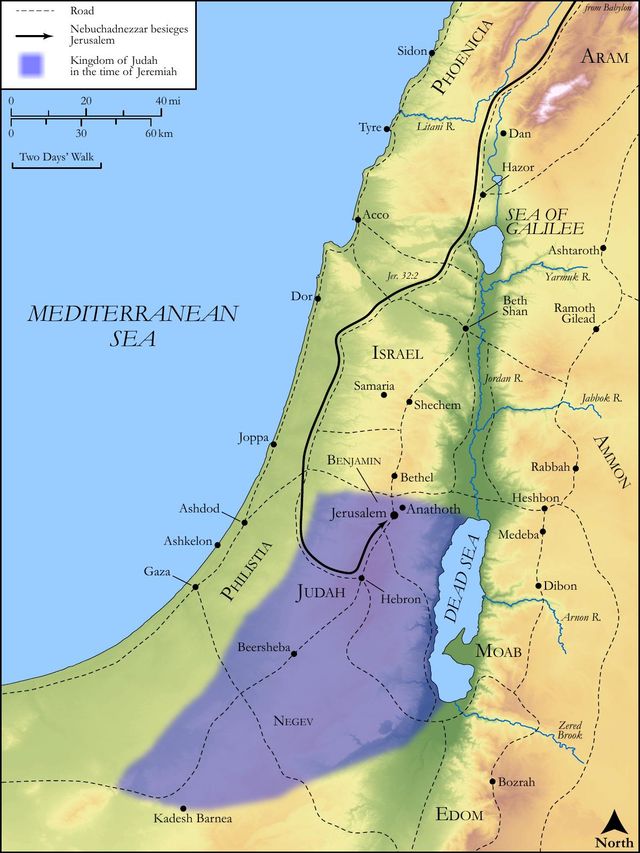
See on the biblical-era map
Study this verse
Public-domain commentary
Matthew Henry
From his Commentary on the Whole Bible. Henry comments on passages, not single verses — this entry covers Jeremiah 32:16–25. His two-level outline is real structure in the source text, so it is rendered as structure.
We have here Jeremiah's prayer to God upon occasion of the discoveries God had made to him of his purposes concerning this nation, to pull it down, and in process of time to build it up again, which puzzled the prophet himself, who, though he delivered his messages faithfully, yet, in reflecting upon them, was greatly at a loss within himself how to reconcile them; in that perplexity he poured out his soul before God in prayer, and so gave himself ease. That which disturbed him was not the bad bargain he seemed to have made for himself in purchasing a field that he was likely to have no good of, but the case of his people, for whom he was still a kind and faithful intercessor, and he was willing to hope that, if God had so much mercy in store for them hereafter as he had promised, he would not proceed with so much severity against them now as he had threatened. Before Jeremiah went to prayer he delivered the deeds that concerned his new purchase to Baruch, which may intimate to us that when we are going to worship God we should get our minds as clear as may be from the cares and incumbrances of this world. Jeremiah was in prison, in distress, in the dark about the meaning of God's providences, and then he prays. Note, Prayer is a salve for every sore. Whatever is a burden to us, we may by prayer cast it upon the Lord and then be easy.
In this prayer, or meditation,
I.Jeremiah adores God and his infinite perfections, and gives him the glory due to his name as the Creator, upholder, and benefactor, of the whole creation, thereby owning his irresistible power, that he can do what he will, and his incontestable sovereignty, that he may do what he will, Jer 32:17-19. Note, When at any time we are perplexed about the particular methods and dispensations of Providence it is good for us to have recourse to our first principles, and to satisfy ourselves with the general doctrines of God's wisdom, power, and goodness. Let us consider, as Jeremiah does here,
1.That God is the fountain of all being, power, life, motion, and perfection: He made the heaven and the earth with his outstretched arm; and therefore who can control him? Who dares contend with him?
2.That with him nothing is impossible, no difficulty insuperable: Nothing is too hard for thee. When human skill and power are quite nonplussed, with God are strength and wisdom sufficient to master all the opposition.
3.That he is a God of boundless bottomless mercy; mercy is his darling attribute; it is his goodness that is his glory: "Thou not only art kind, but thou showest lovingkindness, not to a few, to here and there one, but to thousands, thousands of persons, thousands of generations." 4. That he is a God of impartial and inflexible justice. His reprieves are not pardons, but if in mercy he spares the parents, that they may be led to repentance, yet such a hatred has he to sin, and such a displeasure against sinners, that he recompenses their iniquity into the bosom of their children, and yet does them no wrong; so hateful is the unrighteousness of man, and so jealous of its own honour is the righteousness of God. 5. That he is a God of universal dominion and command: He is the great God, for he is the mighty God, and might among men makes them great. He is the Lord of hosts, of all hosts, that is his name, and he answers to his name, for all the hosts of heaven and earth, of men and angels, are at his beck. 6. That he contrives every thing for the best, and effects every thing as he contrived it: He is great in counsel, so vast are the reaches and so deep are the designs of his wisdom; and he is mighty in doing, according to the counsel of his will. Now such a God as this is not to be quarrelled with. His service is to be constantly adhered to and all his disposals cheerfully acquiesced in.
II.He acknowledges the universal cognizance God takes of all the actions of the children of men and the unerring judgment he passes upon them (Jer 32:19): Thy eyes are open upon all the sons of men, wherever they are, beholding the evil and the good, and upon all their ways, both the course they take and every step they take, not as an unconcerned spectator, but as an observing judge, to give every one according to his ways and according to his deserts, which are the fruit of his doings; for men shall find God as they are found of him.
III.He recounts the great things God had done for his people Israel formerly.
1.He brought them out of Egypt, that house of bondage, with signs and wonders, which remain, if not in the marks of them, yet in the memorials of them, even unto this day; for it would never be forgotten, not only in Israel, who were reminded of it every year by the ordinance of the passover, but among other men: all the neighbouring nations spoke of it, as that which redounded exceedingly to the glory of the God of Israel, and made him a name as at this day. This is repeated (Jer 32:21), that God brought them forth, not only with comforts and joys to them, but with glory to himself, with signs and wonders (witness the ten plagues), with a strong hand, too strong for the Egyptians themselves, and with a stretched-out arm, that reached Pharaoh, proud as he was, and with great terror to them and all about them. This seems to refer to Deu 4:34.
2.He brought them into Canaan, that good land, that land flowing with milk and honey. He swore to their fathers to give it them, and, because he would perform his oath, he did give it to the children (Jer 32:22) and they came in and possessed it. Jeremiah mentions this both as an aggravation of their sin and disobedience and also as a plea with God to work deliverance for them. Note, It is good for us often to reflect upon the great things that God did for his church formerly, especially in the first erecting of it, that work of wonder.
IV.He bewails the rebellions they had been guilty of against God, and the judgments God had brought upon them for these rebellions.
It is a sad account he here gives of the ungrateful conduct of that people towards God. He had done every thing that he had promised to do (they had acknowledged it, Kg1 8:56), but they had done nothing of all that he commanded them to do (Jer 32:23); they made no conscience of any of his laws; they walked not in them, paid no respect to any of his calls by his prophets, for they obeyed not his voice. And therefore he owns that God was righteous in causing all this evil to come upon them. The city is besieged, is attacked by the sword without, is weakened and wasted by the famine and pestilence within, so that it is ready to fall into the hands of the Chaldeans that fight against it (Jer 32:24); it is given into their hands, Jer 32:25. Now,
1.He compares the present state of Jerusalem with the divine predictions, and finds that what God has spoken has come to pass. God had given them fair warning of it before; and, if they had regarded this, the ruin would have been prevented; but, if they will not do what God has commanded, they can expect no other than that he should do what he had threatened.
2.He commits the present state of Jerusalem to the divine consideration and compassion (Jer 32:24): Behold the mounts, or ramparts, or the engines which they make use of to batter the city and beat down the wall of it. And again, "Behold thou seest it, and takest cognizance of it. Is this the city that thou has chosen to put thy name there? And shall it be thus abandoned?" He neither complains of God for what he had done nor prescribes to God what he should do, but desires he would behold their case, and is pleased to think that he does behold it. Whatever trouble we are in, upon a personal or public account, we may comfort ourselves with this, that God sees it and sees how to remedy it.
V.He seems desirous to be let further into the meaning of the order God had now given him to purchase his kinsman's field (Jer 32:25):
"Though the city is given into the hand of the Chaldeans, and no man is likely to enjoy what he has, yet thou hast said unto me, Buy thou the field." As soon as he understood that it was the mind of God he did it, and made no objections, was not disobedient to the heavenly vision; but, when he had done it, he desired better to understand why God had ordered him to do it, because the thing looked strange and unaccountable. Note, Though we are bound to follow God with an implicit obedience, yet we should endeavour that it may be more and more an intelligent obedience. We must never dispute God's statutes and judgments, but we may and must enquire, What mean these statutes and judgments? Deu 6:20.
Historical interpretation
Two Centuries of Reception
2 surviving comments on this verse. Each one is dated, so this reads as a timeline rather than a list.
Select a marker to jump to its quote. Markers stagger vertically where authors wrote within a few decades of each other.
Of course nothing is “too hard for the Lord.” But if we choose to apply this principle so extravagantly and harshly in our capricious imaginations, we may then make out God to have done anything we please, on the ground that it was not impossible for him to do it. We must not suppose, however, because he is able to do all things, that he has done what he has not done. But we must inquire whether he has really done it. God could, if he had liked, have furnished humankind with wings to fly with, just as he gave wings to kites. We must not, however, run to the conclusion that he did this because he was able to do it. He might also have extinguished Praxeas and all other heretics at once; it does not follow, however, that he did, simply because he was able. For it was necessary that there should be both kites and heretics; it was necessary also that the Father should be crucified. In one sense there will be something difficult even for God—namely, that which he has not done—not because he could not but because he would not do it. For with God, to be willing is to be able and to be unwilling is to be unable; all that he has willed, however, he has both been able to accomplish and has displayed his ability.
(Verse 24, 25.) Behold, fortifications have been built against the city, in order to take it; and the city has been given into the hands of the Chaldeans, who fight against it with the sword, famine, and pestilence. And whatever you have spoken has happened, as you yourself see; and you say to me, Lord God, buy the field with silver, and have witnesses, when the city has been given into the hands of the Chaldeans? It was the tenth year of King Zedekiah, for thus it is written: The word that came to Jeremiah from the Lord in the tenth year of Zedekiah king of Judah: at that time the army of the king of Babylon was besieging Jerusalem, and Jeremiah the prophet was confined in the court of the prison. And rightly now it is said: Behold, the fortifications are built against the city, so that it may be captured; and the city has been delivered into the hands of the Chaldeans; they have neither whom to conquer nor whom to capture. For now they have been consumed by sword, famine, and pestilence; and we see that whatever you have said has been fulfilled; therefore why do you say to me, Lord: Buy a field for silver, and call witnesses; when the city has been delivered into the hands of the Chaldeans? Therefore, he does not reprimand, but he asks; and he wants to learn not so much for himself as for others, who were sitting in the courtyard of the prison; and perhaps they silently reprimanded, how the same prophet, whom they believed to proclaim the truth, could say that the city is to be captured and buy a field as if he were going to possess it.
Continue studying Jeremiah 32:24 across the web’s major study libraries — every link below opens this exact verse, chapter, or book on the destination site.
Read & Compare
 BibleGatewayThis verse in more than 200 translations and 70 languages.
 Bible.comThe YouVersion reader — hundreds of translations, reading plans, and highlights.
 ESV.orgCrossway's official English Standard Version reader.
 NET BibleThe NET translation with 60,000+ translators' notes on every rendering decision.
 STEP BibleTyndale House's free study tool — original text, vocabulary, and scholarly resources.
 BibliaLogos Bible Software's free web reader.
 USCCBThe New American Bible (Revised Edition) with the U.S. bishops' study notes.
Commentaries
 BibleHub CommentariesDozens of classic commentaries on this verse, gathered on one page.
 StudyLightMore than 100 commentary sets — the largest collection on the web.
 BibleRefPlain-English commentary on what this verse means, verse by verse.
 Enduring WordDavid Guzik's free commentary on this chapter, widely used by Bible teachers.
 Bible Study ToolsVerse commentary alongside Greek and Hebrew study aids.
Original Language & Research
- BibleHub InterlinearThe verse word by word — original language, transliteration, and English.
- BibleHub LexiconEvery word's original-language definition and Strong's entry.
 Blue Letter BibleDeep-study tools — Strong's numbers, concordance, and word studies.
 SefariaThe Hebrew text with Rashi and centuries of Jewish commentary.
Sermons, Hymns & Audio


TrulyRandomVerse is not affiliated with these sites and doesn’t control their content. They’re linked because they’re genuinely useful.
Summary
Jeremiah 32:24 captures the prophet's prayerful and stark acknowledgment of Jerusalem's devastating siege by the Babylonians. Despite being imprisoned and having just performed a symbolic act of future hope, Jeremiah articulates the overwhelming present despair, confirming that the visible siege mounds, the city's imminent surrender, and the dire consequences of sword, famine, and pestilence are all direct and undeniable fulfillments of God's previously declared word.
Context
ShowHideLiterary Context
Jeremiah 32 unfolds during the climactic and desperate final days of Jerusalem's siege by Nebuchadnezzar's forces, a period of immense national crisis and suffering. Prophet Jeremiah, confined to the court of the guard due to his unpopular prophecies of doom, is given a seemingly paradoxical divine command: to purchase a field in Anathoth from his cousin Hanamel (Jeremiah 32:6-15). This act, utterly illogical in the face of impending destruction and exile, serves as a powerful symbolic gesture of future restoration and the eventual return of God's people to their land, as explicitly stated in Jeremiah 32:15. Verse 24 is embedded within Jeremiah's subsequent prayer to God (Jeremiah 32:16-25), where he wrestles with the tension between God's command for future hope and the overwhelming reality of present judgment. He meticulously details the visible, tangible evidence of the city's fall, confirming that God's word of judgment is being fulfilled before his very eyes.
Historical & Cultural Context
The historical setting for Jeremiah 32 is the intense Babylonian siege of Jerusalem, which commenced around 588 BC and culminated in the city's catastrophic destruction in 586 BC. The "Chaldeans" (H3778) refer to the Neo-Babylonian Empire, led by King Nebuchadnezzar, who served as God's chosen instrument of judgment against the kingdom of Judah for its persistent idolatry, covenant unfaithfulness, and moral corruption (2 Kings 24:1-4). The "mounts" (H5550) are massive siege ramps or mounds, engineering marvels constructed by the attacking army from earth, timber, and debris. Their purpose was to elevate battering rams and troops to the height of the city walls, enabling a direct breach. The triad of "sword, famine, and pestilence" was a common and devastating consequence of ancient sieges. The sword represented direct military conflict, slaughter, and execution; famine resulted from the cutting off of all food supplies to the besieged city; and pestilence (disease) inevitably spread rapidly through overcrowded, unsanitary, and starving populations. These calamities were universally recognized as divine judgments, frequently foretold in covenant curses for disobedience, as seen in Deuteronomy 28:15-68.
Key Themes
ShowHideJeremiah 32:24 powerfully contributes to several foundational themes prevalent throughout the book of Jeremiah and the broader biblical narrative. Firstly, it emphatically highlights the Fulfillment of Prophecy. Jeremiah, who had faithfully proclaimed God's warnings of impending judgment for decades, now witnesses their literal, undeniable manifestation. This underscores God's unwavering faithfulness to His pronouncements, whether of blessing or judgment, demonstrating that His word does not return to Him empty but accomplishes its intended purpose (Isaiah 55:11). Secondly, the verse starkly illustrates Divine Judgment and Consequences. The "sword, famine, and pestilence" are not random calamities but the direct, predicted, and just consequences of Judah's persistent covenant unfaithfulness and deep-seated idolatry. God allowed the Chaldeans to be His instrument of righteous judgment against a rebellious people (Jeremiah 14:12). Finally, the phrase "the city is given into the hand of the Chaldeans" powerfully emphasizes God's Sovereignty. Even amidst overwhelming military might and immense human suffering, Jeremiah recognizes that the city's fate is not merely the outcome of human conflict but is ultimately orchestrated by divine decree. This highlights God's ultimate control over nations and their destinies, even when His people face severe trials and apparent defeat.
Exposition and Analysis
ShowHideKey Word Analysis
ShowHideThis term specifically refers to a military mound or rampart constructed by besieging armies. In the context of ancient warfare, these were massive earthenworks, often reinforced with timber, built by an attacking force to gain elevation. Their purpose was to bring siege engines (like battering rams) or troops to the level of the city's walls, facilitating a breach. Jeremiah's observation of these "mounts" (or siege ramps) signifies the advanced stage and overwhelming nature of the Babylonian siege, indicating that the city's defenses were on the verge of being overcome.
This primitive root means "to give," but its application is remarkably broad, encompassing meanings like "to put," "to make," "to deliver (up)," or "to permit." In the phrase "the city is given into the hand of the Chaldeans," its usage is profoundly significant. It conveys divine agency, indicating that Jerusalem's fall is not merely a military defeat but a divinely ordained surrender. God is actively allowing, orchestrating, or delivering the city into the control of its enemies as a direct act of judgment, underscoring His sovereignty over the unfolding events.
This triad constitutes a recurring and potent prophetic motif throughout the Old Testament, signifying comprehensive and devastating divine judgment. "Sword" denotes violent death, whether through direct military conflict, execution, or general slaughter. "Famine" refers to severe hunger and starvation, typically resulting from the cutting off of food supplies during a prolonged siege or widespread crop failure. "Pestilence" indicates widespread disease, plague, or epidemic, which inevitably spreads rapidly in conditions of overcrowding, poor sanitation, and weakened populations. These three are presented as the direct, visible, and divinely ordained consequences of Judah's persistent unfaithfulness, confirming the severity and totality of the impending destruction.
Verse Breakdown
ShowHide"Behold the mounts, they are come unto the city to take it;"
Jeremiah begins his prayer by drawing attention, both his own and God's, to the undeniable physical evidence of the siege. The "mounts" (siege ramps) are not merely present but have "come unto the city," signifying their completion and readiness for the final assault. This clause establishes the immediate, tangible, and overwhelming military threat that has reached Jerusalem's very walls, indicating the imminent breach and capture.
"and the city is given into the hand of the Chaldeans, that fight against it,"
This is a pivotal theological statement. Jeremiah acknowledges that Jerusalem's impending fall is not just a military outcome but a divine decree. The city is "given" (H5414) over, implying God's active permission, orchestration, and delivery of His people into the hands of their enemies. The Chaldeans, though formidable fighters, are recognized as mere instruments in God's sovereign plan, fulfilling His predetermined purposes of judgment against Judah.
"because of the sword, and of the famine, and of the pestilence:"
This clause explicitly identifies the specific, dire consequences that have already begun to plague the city and are the direct result of the siege. These three instruments of judgment—military violence, starvation, and widespread disease—are presented as the inevitable and divinely ordained outcomes of Judah's unfaithfulness. They bring the long-prophesied judgment to its bitter and devastating fulfillment, leaving no doubt about the cause of the city's suffering.
"and what thou hast spoken is come to pass; and, behold, thou seest [it]."
This concluding clause serves as Jeremiah's profound and direct affirmation of God's unwavering faithfulness to His word, even in judgment. The prophet, who had spent decades faithfully proclaiming these very prophecies, now sees their literal and undeniable manifestation. He directly addresses God, stating that God's spoken word has been fulfilled, and God Himself is witnessing its realization. This underscores the undeniable truth, power, and ultimate authority of divine prophecy, even when its fulfillment brings immense pain.
Literary Devices
ShowHideJeremiah 32:24 employs several potent literary devices to convey its message with striking impact. The opening word, "Behold," functions as an Exclamation and an imperative, immediately arresting the reader's attention and drawing focus to the stark, undeniable reality unfolding before Jeremiah's eyes. This creates a sense of urgency and undeniable truth. The detailed description of the "mounts" and the "Chaldeans, that fight against it" provides vivid Imagery, allowing the listener or reader to visualize the dire military situation and the overwhelming nature of the siege. The recurring triad of "sword, famine, and pestilence" is a powerful instance of Merism, where a comprehensive reality (total destruction and judgment) is conveyed by listing its most prominent, devastating components. This triad also functions as a motif throughout prophetic literature, consistently signifying divine judgment. Finally, the concluding statement, "what thou hast spoken is come to pass; and, behold, thou seest [it]," is a profound declaration of Fulfillment of Prophecy, serving as a narrative device that directly connects Jeremiah's long-standing prophetic ministry to the present, undeniable events. It powerfully highlights the Veracity of God's Word and His ultimate Sovereignty over history.
Theological and Thematic Connections
ShowHideJeremiah 32:24 stands as a powerful testament to the unwavering truthfulness of God's word and His sovereign control over human history. It reveals that divine judgment is not arbitrary but a just and inevitable consequence for persistent disobedience, often enacted through human instruments. Even in the midst of profound suffering and apparent defeat, the prophet's prayer acknowledges God's active hand, demonstrating that God's purposes, whether for judgment or eventual restoration, will always prevail. This verse underscores the critical importance of heeding God's warnings and recognizing His ultimate authority over all circumstances, even when they appear bleak and hopeless.
Reflection and Application
ShowHideJeremiah 32:24 offers profound and enduring lessons for contemporary believers, reminding us that God's word is eternally reliable, whether it speaks of blessing or judgment. In a world often marked by chaos, uncertainty, and apparent randomness, this verse calls us to a deeper trust in God's ultimate sovereignty and His active involvement in human affairs. Just as Jeremiah saw the physical manifestation of prophecy unfolding before his eyes, we are called to discern God's hand at work in our own lives and in the broader world, even when circumstances are difficult, painful, or seemingly contradictory to our hopes. It serves as a stark reminder that actions have consequences and that persistent disobedience to God's revealed will can indeed lead to severe and undesirable outcomes. However, the context of Jeremiah 32 also implicitly points to the hope that God's judgment is often a prelude to a greater redemptive purpose, as evidenced by Jeremiah's simultaneous act of purchasing the field. We are encouraged to pray honestly to God in our despair, acknowledging His power and truth, and to hold onto the certainty that His purposes, both immediate and ultimate, will ultimately be fulfilled.
Questions for Reflection
ShowHideFAQ
ShowHideWhat are the "mounts" mentioned in Jeremiah 32:24?
ShowHideThe "mounts" (Hebrew, çôlᵉlâh', H5550) refer to massive siege ramps or mounds constructed by ancient armies, in this case, the Babylonians, to breach city walls. These were significant engineering feats, built from earth, timber, and debris, designed to elevate troops and battering rams to the height of Jerusalem's formidable defenses. Their presence indicated that the siege was far advanced and the city's fall was imminent, as they allowed direct assault on the fortifications.
Why does Jeremiah emphasize "sword, famine, and pestilence" as the reasons for the city's fall?
ShowHideThe triad of "sword, famine, and pestilence" (Hebrew, chereb' H2719, râʻâb' H7458, deber' H1698) is a recurring and powerful motif in biblical prophecy, particularly throughout the book of Jeremiah, signifying a comprehensive and devastating divine judgment. These were not random calamities but the direct, predicted consequences of Judah's persistent idolatry and covenant unfaithfulness. The sword represents military violence and slaughter, famine results from the cutting off of food supplies during a siege, and pestilence denotes widespread disease that inevitably spreads in such dire conditions. Jeremiah highlights them to underscore that the city's suffering is a direct fulfillment of God's warnings and a just punishment for Judah's rebellion against His covenant.
How does Jeremiah's act of buying a field (Jeremiah 32:6-15) relate to his prayer in Jeremiah 32:24?
ShowHideThese two actions, though seemingly contradictory, are deeply interconnected and reveal the profound tension and paradox inherent in Jeremiah's prophetic ministry. God commanded Jeremiah to buy a field in Anathoth (Jeremiah 32:6-15) as a symbolic act of future hope, signifying that "houses and fields and vineyards shall be possessed again in this land" (Jeremiah 32:15). Immediately following this act of faith in future restoration, Jeremiah prays the prayer that includes verse 24, articulating the overwhelming, visible reality of the present judgment and the city's imminent fall. The juxtaposition demonstrates Jeremiah's honest wrestling with God's paradoxical plan: profound judgment in the present, but an unwavering promise of future hope and restoration. It powerfully illustrates that God is sovereign over both judgment and redemption, and His ultimate purposes will prevail.
Christ-Centered Fulfillment
ShowHideJeremiah 32:24, with its stark depiction of divine judgment and the undeniable fulfillment of prophecy, finds its ultimate Christ-centered fulfillment in several profound ways. The judgment upon Jerusalem, brought by the "sword, famine, and pestilence," foreshadows a greater, spiritual judgment upon sin that only Christ can avert. Just as Jerusalem was "given into the hand of the Chaldeans" by divine decree, so too was Jesus "delivered up according to the definite plan and foreknowledge of God" (Acts 2:23) to suffer for the sins of humanity. He became the ultimate Lamb of God, who takes away the sin of the world (John 1:29), thereby delivering us from the spiritual "sword" of God's wrath, the "famine" of spiritual nourishment, and the "pestilence" of eternal death. Furthermore, Jesus Himself lamented over Jerusalem, prophesying its future destruction (Luke 19:41-44), a fulfillment of Old Testament warnings that culminated in the Roman destruction of 70 AD. Yet, in Christ, God's promise to write His law on hearts and forgive sins (Jeremiah 31:31-34) is perfectly fulfilled through the New Covenant, establishing a spiritual kingdom that no earthly siege or calamity can ever overcome (Hebrews 8:8-12). Thus, the visible fulfillment of judgment in Jeremiah points to the ultimate spiritual deliverance, eternal hope, and restoration found exclusively in Jesus Christ.