


Jeremiah 32:23
Bible text: King James Version (1769 Blayney text) · Public domain
Bible text: King James Version with Strong's numbers · Public domain
Bible text: Berean Standard Bible · Public domain
Bible text: American Standard Version (1901) · Public domain
Bible text: World English Bible, Messianic edition · Public domain
Bible text: Geneva Bible (1599) · Public domain
Bible text: Young's Literal Translation · Public domain
- וַיָּבֹאוּvai·ya·Vo·'uand they cameH935Conj-w ¦ V-Qal-ConsecImperf-3mpVerb Qal Consecutive Imperfect 3rd Plural Masculineוַandיָּבֹאוּthey came
- וַיִּרְשׁוּvai·yir·Shuand they took possession ofH3423Conj-w ¦ V-Qal-ConsecImperf-3mpVerb Qal Consecutive Imperfect 3rd Plural Masculineוַandיִּרְשׁוּthey took possession of
- אֹתָהּ'o·Tah<obj.> itH853DirObjM ¦ 3fsParticle Object Indicatorאֹתָ<obj.>הּit
- וְלֹאve·lo'and notH3808Conj-w ¦ NegParticle Negativeוְandלֹאnot
- שָׁמְעוּsha·me·'Uthey listenedH8085V-Qal-Perf-3cpVerb Qal Perfect 3rd Plural common gender
- בְקוֹלֶךָve·ko·Le·chato your voiceH6963Prep-b ¦ N-msc ¦ 2msNoun Singular Masculine Constructבְtoקוֹלֶvoiceךָyour
- וּבְתוֹרָתְךָu·ve·to·ro·te·khaand in your lawH8451Conj-w ¦ Prep-b ¦ N-fsc ¦ 2msNoun Singular Feminine Constructוּandבְinתוֹרָתְlawךָyour
- לֹאlo'notH3808NegParticle Negative
- הָלָכוּha·La·khuthey walkedH1980V-Qal-Perf-3cpVerb Qal Perfect 3rd Plural common gender
- אֵת'et<obj.>H853DirObjMParticle Object Indicator
- כָּלkolallH3605N-msNoun Singular Masculine Absolute
- אֲשֶׁר'a·SherthatH834RelParticle Relative
- צִוִּיתָהtzi·Vi·tahyou had commandedH6680V-Piel-Perf-2msVerb Piel Perfect 2nd Singular Masculine
- לָהֶםla·Hemto <the> themPrep-l ¦ 3mpSuffix Personal 3rd Plural Masculineלָto <the>הֶםthem
- לַעֲשׂוֹתla·'a·Sotto doH6213Prep-l ¦ V-Qal-InfVerb Qal Infinitive Constructלַtoעֲשׂוֹתdo
- לֹאlo'notH3808NegParticle Negative
- עָשׂוּ'a·Suthey didH6213V-Qal-Perf-3cpVerb Qal Perfect 3rd Plural common gender
- וַתַּקְרֵאva·tak·Re'and you have caused to happen toH7122Conj-w ¦ V-Hiphil-ConsecImperf-2msVerb Hiphil Consecutive Imperfect 2nd Singular Masculineוַandתַּקְרֵאyou have caused to happen to
- אֹתָם'o·Tam<obj.> themH853DirObjM ¦ 3mpParticle Object Indicatorאֹתָ<obj.>םthem
- אֵת'et<obj.>H853DirObjMParticle Object Indicator
- כָּלkolallH3605N-mscNoun Singular Masculine Construct
- הָרָעָהha·ra·'Ahthe calamityH7451Art ¦ N-fsNoun Singular Feminine Absoluteהָtheרָעָהcalamity
- הַזֹּאתha·Zot<the> thisH2063Art ¦ PrtParticle Demonstrativeהַ<the>זֹּאתthis
English is a literal word-by-word gloss of the Hebrew, not the KJV's wording. Why?
This is the original text the KJV's translators worked from — each Hebrew word with its own literal English meaning in this verse, prepared by scholars at Tyndale House, Cambridge. The KJV translates whole sentences, not word by word, so its wording differs: one Hebrew word can become several English words, and the KJV may choose “the LORD” where the gloss reads “Yahweh”. Both are faithful — they answer different questions. For the KJV's own rendering, switch to the KJV text.
Details
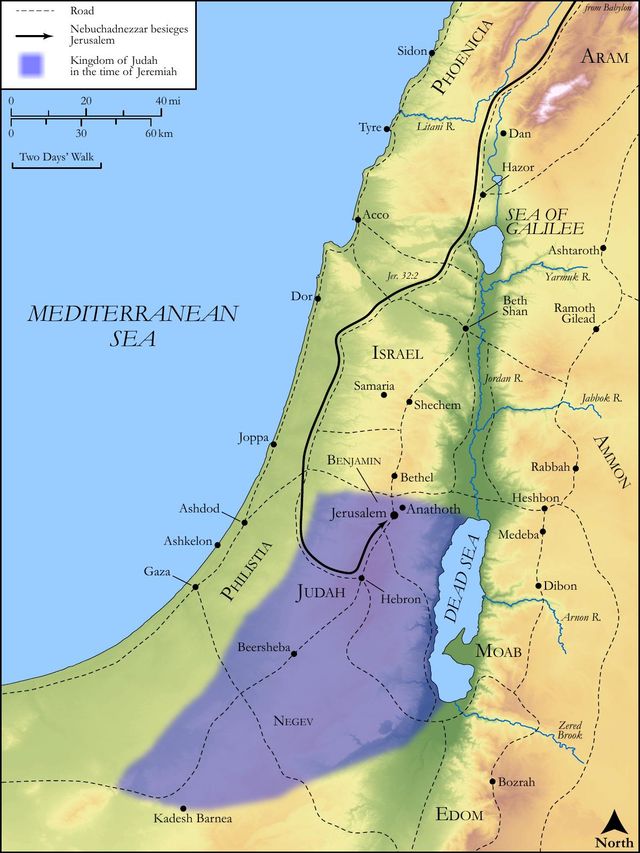
See on the biblical-era map
Study this verse
Public-domain commentary
Matthew Henry
From his Commentary on the Whole Bible. Henry comments on passages, not single verses — this entry covers Jeremiah 32:16–25. His two-level outline is real structure in the source text, so it is rendered as structure.
We have here Jeremiah's prayer to God upon occasion of the discoveries God had made to him of his purposes concerning this nation, to pull it down, and in process of time to build it up again, which puzzled the prophet himself, who, though he delivered his messages faithfully, yet, in reflecting upon them, was greatly at a loss within himself how to reconcile them; in that perplexity he poured out his soul before God in prayer, and so gave himself ease. That which disturbed him was not the bad bargain he seemed to have made for himself in purchasing a field that he was likely to have no good of, but the case of his people, for whom he was still a kind and faithful intercessor, and he was willing to hope that, if God had so much mercy in store for them hereafter as he had promised, he would not proceed with so much severity against them now as he had threatened. Before Jeremiah went to prayer he delivered the deeds that concerned his new purchase to Baruch, which may intimate to us that when we are going to worship God we should get our minds as clear as may be from the cares and incumbrances of this world. Jeremiah was in prison, in distress, in the dark about the meaning of God's providences, and then he prays. Note, Prayer is a salve for every sore. Whatever is a burden to us, we may by prayer cast it upon the Lord and then be easy.
In this prayer, or meditation,
I.Jeremiah adores God and his infinite perfections, and gives him the glory due to his name as the Creator, upholder, and benefactor, of the whole creation, thereby owning his irresistible power, that he can do what he will, and his incontestable sovereignty, that he may do what he will, Jer 32:17-19. Note, When at any time we are perplexed about the particular methods and dispensations of Providence it is good for us to have recourse to our first principles, and to satisfy ourselves with the general doctrines of God's wisdom, power, and goodness. Let us consider, as Jeremiah does here,
1.That God is the fountain of all being, power, life, motion, and perfection: He made the heaven and the earth with his outstretched arm; and therefore who can control him? Who dares contend with him?
2.That with him nothing is impossible, no difficulty insuperable: Nothing is too hard for thee. When human skill and power are quite nonplussed, with God are strength and wisdom sufficient to master all the opposition.
3.That he is a God of boundless bottomless mercy; mercy is his darling attribute; it is his goodness that is his glory: "Thou not only art kind, but thou showest lovingkindness, not to a few, to here and there one, but to thousands, thousands of persons, thousands of generations." 4. That he is a God of impartial and inflexible justice. His reprieves are not pardons, but if in mercy he spares the parents, that they may be led to repentance, yet such a hatred has he to sin, and such a displeasure against sinners, that he recompenses their iniquity into the bosom of their children, and yet does them no wrong; so hateful is the unrighteousness of man, and so jealous of its own honour is the righteousness of God. 5. That he is a God of universal dominion and command: He is the great God, for he is the mighty God, and might among men makes them great. He is the Lord of hosts, of all hosts, that is his name, and he answers to his name, for all the hosts of heaven and earth, of men and angels, are at his beck. 6. That he contrives every thing for the best, and effects every thing as he contrived it: He is great in counsel, so vast are the reaches and so deep are the designs of his wisdom; and he is mighty in doing, according to the counsel of his will. Now such a God as this is not to be quarrelled with. His service is to be constantly adhered to and all his disposals cheerfully acquiesced in.
II.He acknowledges the universal cognizance God takes of all the actions of the children of men and the unerring judgment he passes upon them (Jer 32:19): Thy eyes are open upon all the sons of men, wherever they are, beholding the evil and the good, and upon all their ways, both the course they take and every step they take, not as an unconcerned spectator, but as an observing judge, to give every one according to his ways and according to his deserts, which are the fruit of his doings; for men shall find God as they are found of him.
III.He recounts the great things God had done for his people Israel formerly.
1.He brought them out of Egypt, that house of bondage, with signs and wonders, which remain, if not in the marks of them, yet in the memorials of them, even unto this day; for it would never be forgotten, not only in Israel, who were reminded of it every year by the ordinance of the passover, but among other men: all the neighbouring nations spoke of it, as that which redounded exceedingly to the glory of the God of Israel, and made him a name as at this day. This is repeated (Jer 32:21), that God brought them forth, not only with comforts and joys to them, but with glory to himself, with signs and wonders (witness the ten plagues), with a strong hand, too strong for the Egyptians themselves, and with a stretched-out arm, that reached Pharaoh, proud as he was, and with great terror to them and all about them. This seems to refer to Deu 4:34.
2.He brought them into Canaan, that good land, that land flowing with milk and honey. He swore to their fathers to give it them, and, because he would perform his oath, he did give it to the children (Jer 32:22) and they came in and possessed it. Jeremiah mentions this both as an aggravation of their sin and disobedience and also as a plea with God to work deliverance for them. Note, It is good for us often to reflect upon the great things that God did for his church formerly, especially in the first erecting of it, that work of wonder.
IV.He bewails the rebellions they had been guilty of against God, and the judgments God had brought upon them for these rebellions.
It is a sad account he here gives of the ungrateful conduct of that people towards God. He had done every thing that he had promised to do (they had acknowledged it, Kg1 8:56), but they had done nothing of all that he commanded them to do (Jer 32:23); they made no conscience of any of his laws; they walked not in them, paid no respect to any of his calls by his prophets, for they obeyed not his voice. And therefore he owns that God was righteous in causing all this evil to come upon them. The city is besieged, is attacked by the sword without, is weakened and wasted by the famine and pestilence within, so that it is ready to fall into the hands of the Chaldeans that fight against it (Jer 32:24); it is given into their hands, Jer 32:25. Now,
1.He compares the present state of Jerusalem with the divine predictions, and finds that what God has spoken has come to pass. God had given them fair warning of it before; and, if they had regarded this, the ruin would have been prevented; but, if they will not do what God has commanded, they can expect no other than that he should do what he had threatened.
2.He commits the present state of Jerusalem to the divine consideration and compassion (Jer 32:24): Behold the mounts, or ramparts, or the engines which they make use of to batter the city and beat down the wall of it. And again, "Behold thou seest it, and takest cognizance of it. Is this the city that thou has chosen to put thy name there? And shall it be thus abandoned?" He neither complains of God for what he had done nor prescribes to God what he should do, but desires he would behold their case, and is pleased to think that he does behold it. Whatever trouble we are in, upon a personal or public account, we may comfort ourselves with this, that God sees it and sees how to remedy it.
V.He seems desirous to be let further into the meaning of the order God had now given him to purchase his kinsman's field (Jer 32:25):
"Though the city is given into the hand of the Chaldeans, and no man is likely to enjoy what he has, yet thou hast said unto me, Buy thou the field." As soon as he understood that it was the mind of God he did it, and made no objections, was not disobedient to the heavenly vision; but, when he had done it, he desired better to understand why God had ordered him to do it, because the thing looked strange and unaccountable. Note, Though we are bound to follow God with an implicit obedience, yet we should endeavour that it may be more and more an intelligent obedience. We must never dispute God's statutes and judgments, but we may and must enquire, What mean these statutes and judgments? Deu 6:20.
Historical interpretation
Two Centuries of Reception
2 surviving comments on this verse. Each one is dated, so this reads as a timeline rather than a list.
Select a marker to jump to its quote. Markers stagger vertically where authors wrote within a few decades of each other.
Of course nothing is “too hard for the Lord.” But if we choose to apply this principle so extravagantly and harshly in our capricious imaginations, we may then make out God to have done anything we please, on the ground that it was not impossible for him to do it. We must not suppose, however, because he is able to do all things, that he has done what he has not done. But we must inquire whether he has really done it. God could, if he had liked, have furnished humankind with wings to fly with, just as he gave wings to kites. We must not, however, run to the conclusion that he did this because he was able to do it. He might also have extinguished Praxeas and all other heretics at once; it does not follow, however, that he did, simply because he was able. For it was necessary that there should be both kites and heretics; it was necessary also that the Father should be crucified. In one sense there will be something difficult even for God—namely, that which he has not done—not because he could not but because he would not do it. For with God, to be willing is to be able and to be unwilling is to be unable; all that he has willed, however, he has both been able to accomplish and has displayed his ability.
(Vers. 20 seqq.) You have set signs and wonders in the land of Egypt until this day, both in Israel and among mankind (or among earthlings), and have made a name for yourself, as it is this day. You brought your people Israel out of the land of Egypt with signs and wonders, with a strong hand and an outstretched arm, and with great terror. And you gave them this land, which you swore to their fathers to give them, a land flowing with milk and honey. And they entered and took possession of it, but they did not obey your voice and did not walk in your law. Everything that you commanded them to do, they did not do, and all these disasters happened to them. From a general overview, it then focuses on what specifically Israel has accomplished. It says, 'You have set signs and wonders in the land of Egypt, which have afflicted Egypt until this day, and in Israel and among mankind, whether native-born or foreign.' This that is said, up to this day, must be connected to what follows, so that we may read and understand that your signs are fulfilled both in Israel and in all mortals daily. Alternatively, you not only performed signs and wonders in Egypt, but your power of mercy has also saved your people even until today, and you assist the whole human race as the Creator with your power. And it should be noted that Israel is separated from men and earthborn beings, as it is written: 'My firstborn son is Israel.' And you have made for yourself a name as it is to this day (Exodus IV, 22). Your praises, he says, are celebrated in the language of the whole world. And you have brought your people Israel out of the land of Egypt. It is well said, your people, for at that time when they were brought out, they served under the Lord's command. And you brought them out with signs and wonders, by which Egypt was struck, and with a strong hand, and with an outstretched arm, and with great terror: when the Red Sea provided a way for the people of Israel to cross over, and it obliterated the Egyptian army: And you have given them this land, which you swore to their fathers to give to them: namely, Abraham, Isaac, and Jacob. Therefore, not by their own merit, but by the virtues of their fathers, they received the land flowing with milk and honey. For they were not yet able to consume solid food, but were nourished with milk and honey in their infancy. Indeed, with the abundance and plenty of all things, milk and honey. And they entered and possessed it. And immediately there was no middle ground between possession and disobedience. For abundance produces security, security produces negligence, negligence produces contempt. And they did not obey, he says, your voice, and they did not walk in your law. Therefore, they promised in vain in the wilderness, saying: We will do everything that the Lord has commanded (Exodus 19:8). For the reward is not in the promise, but in the action: to refute the impudence of those who think that a man can fulfill everything that he has promised. They did not do everything that you commanded them to do, and they certainly promised to do so. And all these evils happened to them. Evils for those who are patient, but according to the judgement of the Lord, good things that give to each person according to their ways.
Continue studying Jeremiah 32:23 across the web’s major study libraries — every link below opens this exact verse, chapter, or book on the destination site.
Read & Compare
 BibleGatewayThis verse in more than 200 translations and 70 languages.
 Bible.comThe YouVersion reader — hundreds of translations, reading plans, and highlights.
 ESV.orgCrossway's official English Standard Version reader.
 NET BibleThe NET translation with 60,000+ translators' notes on every rendering decision.
 STEP BibleTyndale House's free study tool — original text, vocabulary, and scholarly resources.
 BibliaLogos Bible Software's free web reader.
 USCCBThe New American Bible (Revised Edition) with the U.S. bishops' study notes.
Commentaries
 BibleHub CommentariesDozens of classic commentaries on this verse, gathered on one page.
 StudyLightMore than 100 commentary sets — the largest collection on the web.
 BibleRefPlain-English commentary on what this verse means, verse by verse.
 Enduring WordDavid Guzik's free commentary on this chapter, widely used by Bible teachers.
 Bible Study ToolsVerse commentary alongside Greek and Hebrew study aids.
Original Language & Research
- BibleHub InterlinearThe verse word by word — original language, transliteration, and English.
- BibleHub LexiconEvery word's original-language definition and Strong's entry.
 Blue Letter BibleDeep-study tools — Strong's numbers, concordance, and word studies.
 SefariaThe Hebrew text with Rashi and centuries of Jewish commentary.
Sermons, Hymns & Audio


TrulyRandomVerse is not affiliated with these sites and doesn’t control their content. They’re linked because they’re genuinely useful.
Summary
Jeremiah 32:23 serves as a poignant lament within the prophet's prayer, articulating the tragic history of Israel's covenant infidelity and its dire consequences. It powerfully recounts how, despite God's faithful act of bringing His people into and granting them possession of the Promised Land, they persistently and comprehensively refused to obey His voice or walk in His law, failing to perform any of His commands. This profound and sustained disobedience is then explicitly identified as the direct cause for the severe calamity and judgment that God, as a righteous and just covenant Lord, has brought upon them.
Context
ShowHideLiterary Context
This verse is a pivotal moment within Jeremiah's profound prayer to God, recorded in Jeremiah 32:17-25. This prayer is offered while Jeremiah is imprisoned during the final, devastating Babylonian siege of Jerusalem, a period of immense national crisis. Immediately preceding the prayer, God commands Jeremiah to purchase a field in Anathoth (Jeremiah 32:6-15), an act that serves as a powerful prophetic sign of future restoration and return, even amidst the present destruction. Jeremiah's prayer begins with an awe-filled affirmation of God's omnipotence and faithfulness in creation and in bringing Israel into the land, as detailed in Jeremiah 32:17-22. Verse 23 then marks a dramatic shift, pivoting from God's faithfulness to Israel's consistent failure to uphold their covenant obligations. This lament serves as a theological justification for the impending judgment, affirming God's justice even in His severe discipline, and setting the stage for God's subsequent response in Jeremiah 32:26-44.
Historical & Cultural Context
The historical backdrop for Jeremiah 32:23 is the grim twilight of the Kingdom of Judah, facing imminent destruction by the Babylonian Empire (circa 588-586 BC). For centuries, the nation of Israel had resided in the Promised Land, a divine gift contingent upon their unwavering obedience to the Mosaic Covenant. This covenant, established at Mount Sinai and meticulously reiterated in the book of Deuteronomy, outlined clear stipulations: blessings for obedience and severe curses for disobedience. The phrase "possessed it" vividly recalls the initial conquest under Joshua, where God faithfully delivered the land to Israel, as affirmed in Joshua 21:43. However, from the period of the Judges through the monarchy, Israel repeatedly turned away from God, engaging in widespread idolatry, pervasive oppression, and a fundamental disregard for God's holy laws. The long line of prophets, including Jeremiah, consistently warned them of the escalating consequences of this covenant unfaithfulness. The "evil" referred to in the verse is the direct and inevitable culmination of this prolonged history of rebellion, manifesting as the devastating Babylonian invasion, siege, and impending exile.
Key Themes
ShowHideJeremiah 32:23 powerfully articulates several core biblical themes that resonate throughout Scripture. Firstly, it highlights the theme of Covenant Faithfulness and Infidelity. God faithfully fulfilled His promise to give Israel the land, demonstrating His unwavering commitment. In stark contrast, Israel consistently failed to be faithful to their part of the covenant, particularly in obeying His voice and walking in His law. This dynamic echoes the intricate stipulations found throughout Deuteronomy, especially chapter 28. Secondly, the verse underscores the undeniable Consequences of Disobedience. The "evil" (calamity and judgment) that has come upon them is presented as a direct, divinely ordained consequence of their actions, illustrating the biblical principle that sin inevitably carries repercussions. This is a recurring motif from Leviticus 26 to the prophetic books. Thirdly, it profoundly affirms Divine Justice. God is not arbitrary or capricious in His judgment; He is perfectly righteous in responding to sustained rebellion, even from His chosen people. Finally, the verse implicitly touches on Human Responsibility, emphasizing that Israel's choices were their own, freely made, and directly led to their tragic plight.
Exposition and Analysis
ShowHideKey Word Analysis
ShowHideThis word (H3423) signifies more than mere occupation; it denotes taking possession, often by driving out previous tenants, inheriting, or seizing. In this context, it emphasizes God's gracious act of giving Israel the land as an inheritance, a direct fulfillment of His ancient promise to Abraham. It highlights the divine gift that Israel then squandered through their subsequent disobedience.
This root (H8085) means "to hear intelligently," often carrying the strong implication of attention, understanding, and, crucially, obedience. It is not merely passive hearing but an active heeding and responsive action. The negation "obeyed not" underscores a deliberate, active refusal to listen to and respond to God's commands, indicating a deep-seated spiritual rebellion rather than simple ignorance or oversight.
While this word (H7451) can refer to moral wickedness, in this specific context, especially when God is stated to "cause" it, it primarily denotes calamity, disaster, affliction, or punishment. It signifies the negative consequences and just judgment that God, as a righteous judge, brings upon His people due to their sustained disobedience, rather than implying God is the author of moral evil. It refers to the destructive outcome of their actions.
Verse Breakdown
ShowHide"And they came in, and possessed it;"
This initial clause refers to the historical entry of the Israelites into the land of Canaan, a monumental event that represented the fulfillment of God's ancient promise to Abraham, Isaac, and Jacob. It underscores God's unwavering faithfulness in granting them the promised inheritance, establishing them in a land described as flowing with milk and honey. This sets the stage by highlighting God's gracious provision.
"but they obeyed not thy voice, neither walked in thy law;"
This marks the dramatic and tragic pivot of the verse. Despite receiving God's gracious gift of the land, Israel consistently failed to live up to the terms of the covenant. "Obeyed not thy voice" indicates a willful refusal to listen to God's direct commands, His prophetic warnings, and His revealed will. "Neither walked in thy law" signifies a comprehensive failure to live according to the principles and statutes of the Mosaic Law, which was divinely given to guide their lives, maintain their covenant relationship with God, and distinguish them among the nations. This points to a pervasive and persistent spiritual rebellion that characterized their history.
"they have done nothing of all that thou commandedst them to do:"
This is a powerful, emphatic declaration of Israel's utter and complete failure in their covenant obligations. It is not merely partial disobedience or occasional lapses, but a profound and sweeping disregard for God's entire body of commands. This highlights the depth of their covenant breaking and their fundamental rejection of God's authority, wisdom, and loving guidance. It underscores the totality of their spiritual rebellion.
"therefore thou hast caused all this evil to come upon them:"
This final clause establishes the direct and undeniable cause-and-effect relationship. The "evil" (referring to the calamity, disaster, and judgment) that Jerusalem is currently experiencing, specifically the Babylonian siege and impending destruction, is not arbitrary or accidental. Instead, it is presented as a just and direct consequence of their prolonged and profound disobedience. God, as the righteous covenant Lord, is executing the curses and penalties explicitly stipulated in the covenant for unfaithfulness, demonstrating His holiness and justice.
Literary Devices
ShowHideJeremiah 32:23 employs several potent literary devices to convey its powerful message. Cause and Effect is central to the verse, explicitly linking Israel's comprehensive disobedience ("obeyed not thy voice, neither walked in thy law; they have done nothing") to the resulting divine judgment ("therefore thou hast caused all this evil to come upon them"). This highlights the theological principle of divine retribution and the inevitable consequences of covenant breaking. There is also a strong Contrast presented: God's faithful act of bringing them into and giving them possession of the land is starkly contrasted with Israel's unfaithful response of persistent and pervasive disobedience. The Repetition of negative actions and their comprehensive nature ("obeyed not," "neither walked," "done nothing of all") emphasizes the totality and depth of their rebellion. Furthermore, the use of Covenant Language ("thy voice," "thy law," "commandedst") grounds the entire statement in the established covenant relationship between God and Israel, underscoring the profound violation of sacred trust and the solemn obligations that were disregarded.
Theological and Thematic Connections
ShowHideJeremiah 32:23 stands as a stark reminder of the conditional nature of God's covenant blessings under the Old Covenant and the unwavering principle of divine justice. It underscores that while God is faithful to His promises, human responsibility for obedience remains paramount. Israel's failure to "obey God's voice" and "walk in His law" was not a minor oversight but a fundamental rejection of the very relationship God sought to establish with them. This verse teaches that God's judgment is not capricious or arbitrary but a righteous and necessary response to sustained rebellion and covenant infidelity, demonstrating His holiness and commitment to upholding justice. It also highlights a recurring pattern in biblical history: God's gracious provision and patient forbearance are often met with human ingratitude and disobedience, leading to inevitable and just consequences.
Reflection and Application
ShowHideJeremiah 32:23 offers timeless and profound lessons for believers today. Just as ancient Israel was called to obey God's voice and walk in His law, so too are New Covenant believers called to live in active, Spirit-empowered obedience to Christ. This verse prompts us to engage in honest self-examination: are we truly listening to God's voice as revealed in His inspired Word, or are we selectively hearing only what aligns with our desires? Do we actively "walk" in His commands, allowing His truth to profoundly shape our daily decisions, priorities, and character, or do we neglect His precepts, assuming grace covers all apathy? The "evil" that came upon Israel serves as a sober reminder that while we live under the glorious umbrella of grace, there are still spiritual consequences for persistent disobedience, apathy, and a casual disregard for God's revealed will. Our choices have profound ramifications, and a life of genuine faith is characterized by a deep desire to honor God through obedience, not primarily out of fear of punishment, but out of profound love, gratitude, and reverence for His saving grace. This verse calls us to a deeper, more intentional commitment to Christ-like living, recognizing that true spiritual flourishing and intimacy with God come from aligning our lives wholeheartedly with His perfect and good will.
Questions for Reflection
ShowHideFAQ
ShowHideWhat does "evil" (H7451, raʻ) specifically mean in Jeremiah 32:23, and does it imply God is the author of moral evil?
ShowHideIn Jeremiah 32:23, the Hebrew word for "evil" (רָע, raʻ) primarily refers to calamity, disaster, or punishment, rather than moral wickedness. When the text states, "therefore thou hast caused all this evil to come upon them," it means God, as a righteous and holy judge, is bringing about the just consequences or judgment for Israel's sustained disobedience and covenant breaking. It does not imply that God is the perpetrator of moral evil or that He is morally corrupt. Instead, it signifies His sovereign act of executing justice in response to human sin, fulfilling the curses outlined in the covenant for disobedience, as seen in passages like Deuteronomy 28:15. This crucial distinction is vital for understanding God's character and His actions in judgment throughout the entirety of Scripture.
How does this verse, which speaks of God bringing "evil" upon His people, reconcile with God's loving and gracious nature?
ShowHideThis verse highlights a profound tension between God's boundless love and His perfect justice. While God is indeed infinitely loving, merciful, and gracious, He is also perfectly righteous, holy, and just. His covenant with Israel included clear stipulations, blessings for obedience, and severe consequences for disobedience. The "evil" (calamity and judgment) brought upon them was not an act of arbitrary malice or a lack of love, but a just and necessary discipline for their persistent rebellion against His commands and their repeated rejection of His grace. It was a severe, yet ultimately redemptive, act intended to call His people back to Himself and to uphold His own holy character. This divine discipline, though painful and devastating in its immediate impact, underscores God's unwavering commitment to His own holiness and His fervent desire for His people to live in a right and obedient relationship with Him, even if it requires severe measures to address their deep-seated sin. This concept of disciplinary judgment is consistently seen throughout the biblical narrative, for example, in the New Testament, where the author of Hebrews 12:5-11 explains that the Lord disciplines those He loves.
Christ-Centered Fulfillment
ShowHideJeremiah 32:23, with its stark portrayal of Israel's profound failure to obey God's voice and walk in His law, finds its ultimate fulfillment and resolution in the person and work of Jesus Christ. Where Israel, the corporate Son of God, repeatedly failed to uphold the covenant and consequently incurred divine judgment, Jesus, the perfect and obedient Son of God, lived a life of absolute and unwavering obedience to the Father's voice and law. He perfectly "walked in His law" and declared that He came not to abolish the Law but to fulfill it Matthew 5:17. Unlike Israel, who "done nothing of all that thou commandedst them to do," Jesus consistently affirmed, "I always do what pleases him" John 8:29. The "evil" or calamity that justly came upon Israel for their sin was ultimately borne by Christ on the cross. He became the curse for us, taking upon Himself the righteous judgment that humanity deserved for its universal disobedience, thereby redeeming us from the curse of the law Galatians 3:13. Through His perfect obedience and atoning sacrifice, Jesus inaugurated a New Covenant, not based on human performance of an external law, but on God's grace, radical forgiveness, and the internal transformation of the heart by the Holy Spirit Hebrews 8:10-12. Thus, in Christ, believers are freed from the condemnation of the law and are empowered to truly obey God's voice, walking in newness of life through His indwelling Spirit Romans 8:3-4.