


Hosea 3:2
Bible text: King James Version (1769 Blayney text) · Public domain
Bible text: Berean Standard Bible · Public domain
Bible text: American Standard Version (1901) · Public domain
Bible text: World English Bible, Messianic edition · Public domain
Bible text: Geneva Bible (1599) · Public domain
Bible text: Young's Literal Translation · Public domain
- וָאֶכְּרֶהָva·'e·ke·Re·haand I bought herH3739Conj-w ¦ V-Qal-ConsecImperf-1cs ¦ 3fsVerb Qal Consecutive Imperfect 1st Singular common genderוָandאֶכְּרֶI boughtהָher
- לִּיLifor myselfPrep-l ¦ 1csSuffix Personal 1st Singular common genderלִּforיmyself
- בַּחֲמִשָּׁהba·cha·mi·Shahfor fif-H2568Prep-b ¦ Adj-csAdjective Numerical Singular common gender Absoluteבַּforחֲמִשָּׁהfif-
- עָשָׂר'a·SarteenH6240Adj-csAdjective Numerical Singular common gender Absolute
- כָּסֶףKa·sefsilverH3701N-msNoun Singular Masculine Absolute
- וְחֹמֶרve·Cho·merand a homer ofH2563Conj-w ¦ N-mscNoun Singular Masculine Constructוְandחֹמֶרa homer of
- שְׂעֹרִיםse·'o·Rimbarley<s>H8184N-mpNoun Plural Masculine Absolute
- וְלֵתֶךְve·Le·tekhand a lethech ofH3963Conj-w ¦ N-mscNoun Singular Masculine Constructוְandלֵתֶךְa lethech of
- שְׂעֹרִיםse·'o·Rimbarley<s>H8184N-mpNoun Plural Masculine Absolute
English is a literal word-by-word gloss of the Hebrew, not the KJV's wording. Why?
This is the original text the KJV's translators worked from — each Hebrew word with its own literal English meaning in this verse, prepared by scholars at Tyndale House, Cambridge. The KJV translates whole sentences, not word by word, so its wording differs: one Hebrew word can become several English words, and the KJV may choose “the LORD” where the gloss reads “Yahweh”. Both are faithful — they answer different questions. For the KJV's own rendering, switch to the KJV text.
Details
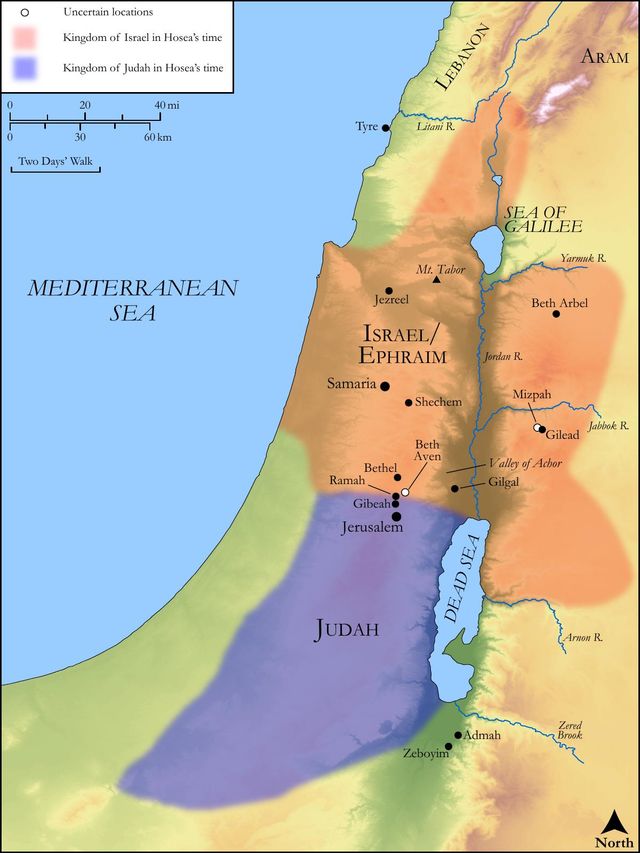
See on the biblical-era map
Study this verse
Public-domain commentary
Matthew Henry
From his Commentary on the Whole Bible. Henry comments on passages, not single verses — this entry covers Hosea 3:1–5. His four-level outline is real structure in the source text, so it is rendered as structure.
Some think that this chapter refers to Judah, the two tribes, as the adulteress the prophet married (Hos 1:3) represented the ten tribes; for this was not to be divorced, as the ten tribes were, but to be left desolate for a long time, and then to return, as the two tribes did. But these are called the children of Israel, which was the ten tribes, and therefore it is more probable that of them this parable, as well as that before, is to be understood. Go, and repeat it, says God to the prophet; Go yet again. Note, For the conviction and reduction of sinners it is necessary that precept be upon precept, and line upon line. If they will not believe one sign, try another, Exo 4:8, Exo 4:9. Now,
I.In this parable we may observe,
1.God's goodness and Israel's badness strangely serving for a foil to each other, Hos 3:1. Israel is as a woman beloved of her friend, either of him that has married her or of him that only courts her, and yet an adulteress; such is the case between God and Israel. We say of those whose affection is mutual that there is no love lost between them; but here we find a great deal of the love even of God himself lost and thrown away upon an unworthy ungrateful people. The God of Israel retains a very great love for the children of Israel, and yet they are an evil and adulterous generation. Be astonished, O heavens! at this, and wonder, O earth!
(1.)That God's goodness has not put an end to their badness; the Lord loves them, has a kindness for them, and is continually showing kindness to them; they know it, they cannot but own it, that he has been as a friend and Father to them; and yet they look to other gods, gods that they can see, and to the love of which they are drawn by the eye; they look to them with an eye of adoration (they offer up all their services to them) and with an eye of dependence (they expect all their comforts from them); if they were restrained from bowing the knee to idols, yet they gave them an amorous glance, and had eyes full of that spiritual adultery. And they loved flagons of wine; they joined with idolaters because they lived merrily and drank hard; they had a kindness for other gods for the sake of the plenty of good wine with which they had been sometimes treated in their temples. Idolatry and sensuality commonly go together; those that make a god of their belly, as drunkards do, will easily be brought to make a god of any thing else. God's priests were to drink no wine when they went in to minister, and his Nazarites none at all. But the worshippers of other gods drank wine in bowls; nay, no less than flagons of wine would content them.
(2.)That their badness had not stopped the current of his favours to them. This is a wonder of mercy indeed, that she is thus beloved of her friend, though an adulteress; such is the love of the Lord towards the children of Israel. "Go," says God, "love such a woman; see if thou canst find in thy heart to do it. No, thou canst not, the breast of no man would admit such a love; yet such is my love to the children of Israel; it is love to the loveless, to the unlovely, to those that have a thousand times forfeited it." Note, In God's goodwill to poor sinners his thoughts and ways are infinitely above ours, and his love is more condescending and compassionate than ours is, or can be; in this, as much as any thing, he is God, and not man, Hos 11:9.
2.The method found for the bringing of a God so very good and a people so very bad together again; this is the thing aimed at, and what God aims at he will accomplish. To our great surprise, we find a breach thus wide as the sea effectually healed; miracles cease not so long as divine mercy does not cease. Observe here,
(1.)The course God takes to humble them and make them know themselves (Hos 3:2): I bought her to me for fifteen pieces of silver, and a homer and a half of barley, that is, I courted her to be reconciled, to leave her ill courses, and return to her first husband, as Hos 2:14. I allured her, and spoke comfortably to her; as the Levite who went after his concubine that had played the harlot from him, and had run away with another man, spoke friendly to her, Jdg 19:3. But here the present which the prophet brought her for the purchasing of her favour is observed to be a very small one; but it was all that was intended for her separate maintenance, and in it she is reduced to a short allowance, and, to punish her for her pride, is made to look very mean. When Samson went to be reconciled to his wife that had disobliged him he visited her with a kid (Jdg 15:1), which was a genteel entertainment. But the prophet here visited his wife with fifteen pieces of silver, a small sum, which yet she must be content to live upon a great while, so long as till her husband thought fit to restore her to her first estate. She shall also have a homer and a half of barley, for bread-corn, and that is all she must expect till she be sufficiently humbled, and, by a competent time of trial, satisfactory proof given that she is indeed reformed. Let her be made sensible that it is not for her own merit that her husband makes court to her; it is but a lame price that he values her at. The price of a servant was thirty shekels, Exo 21:32. This was but half so much; yet let her know that it is more than she is worth. God had given Egypt for Israel's ransom once, so precious were they then in his sight, and so honourable, Isa 43:3, Isa 43:4. But now that they have gone a whoring from him he will give but fifteen pieces of silver for them, so much have they lost in their value by their iniquity. Note, Those whom God designs honour and comfort for he first makes sensible of their own worthlessness, and brings them to acknowledge, with the prodigal, I am no more worthy to be called thy son. Time was when Israel was fed with the finest of the wheat, but they grew wanton, and loved flagons of wine, and therefore, in order to the humbling and reducing of them, they must be brought in the land of their captivity to eat barley-bread, and be thankful they can get it, and to eat that too by weight and measure, whereas they did not use to be stinted. Note, Poverty and disgrace sometimes prove a happy means of making great sinners true penitents.
(2.)The new terms upon which God is willing to come with them (Hos 3:3): Thou shalt abide for me many days, and shalt not be for another, so will I be for thee. He might justly have given them a bill of divorce, and have resolved to have no more to do with them; but he is willing to show them kindness, and that the matter should be compromised; he deals not with them in strict justice, according to the rigour of the law, but according to the multitude of his mercies; and it represents God's gracious dealings with the apostate race of mankind, that had gone a whoring from him; he bought them indeed with an inestimable price, not for their honour, but for the honour of his own justice; and now this is the proposal he makes to them, the covenant of grace he is willing to enter into with them - they must be to him a people, and he will be to them a God, the same with the proposal here made to Israel.
[1.]They must take to themselves the shame of their apostasy from him, must submit to, and accept of, the punishment of their iniquity: Thou shalt abide for me many days in solitude and silence, as a widow that is desolate and in sorrow; they must lay aside their ornaments, and wait with patience and submission to know what God will do with them, and whether he will please to admit such unworthy wretches into his favour again, as they did Exo 33:4, Exo 33:5. Their father, their husband, has spit in their face (as God said concerning Miriam), has put them under the marks of his displeasure, and therefore, like her, they must be ashamed seven days, and be shut out of the camp (Num 12:14), till their uncircumcised hearts be humbled, Lev 26:41. Let them sit alone and keep silence, waiting for the salvation of the Lord, and in the mean time let them bear the yoke, Lam 3:26-28. Let them not expect that God should speedily return in mercy to them,; no, let them want it, let them wait for it many days, during all the days of their captivity, and reckon it a miracle of mercy, and well worth waiting for, it if come at last. Note, Those whom God designs mercy for he will first bring to abase themselves and to put a high value upon his favours.
[2.]They must never return to folly again; that is the condition upon which God will speak peace to his people and to his saints (Psa 85:8), and no other. "Thou shalt not play the harlot, shalt not worship idols in the land of thy captivity, while thou art there set apart for the uncleanness." Note, It is not enough to take shame to ourselves for the sins we have committed, and to justify God in correcting us for them, but we must resolve, in the strength of God's grace, that we will not offend any more, that we will not again go a whoring from God, after the world and the flesh. Blessed be God, though it is the law of the covenant, it is not the condition of it that we shall never in any thing do amiss: "But thou shalt not play the harlot; thou shalt not serve other gods, shalt not be for another man." In the land of their captivity they would be courted to worship the idols of the country; that would be a trial for them, a long trial, many days: "But if thou keep thy ground, and hold fast thy integrity, if, when all this comes upon thee, thou dost not stretch out thy hand to a strange god, thou wilt be qualified for the returns of God's favour." Note, It is a certain sign that our afflictions are means of much good to us, and earnests of more, when we are kept by the grace of God from being overcome by the temptations of an afflicted state.
[3.]Upon these terms their Maker will again be their husband: So will I also be for thee. This is the covenant between God and returning sinners, that, if they will be for him to serve him, he will be for them to save them. Let them renounce and abjure all rivals with God for the throne in the heart, and devote themselves entirely to him and him only, and he will be to them a God all-sufficient. If we be faithful and constant to God in a way of duty, and will never leave nor forsake him, he will be so to us in a way of mercy, and will never leave nor forsake us. And a fairer proposal could not be made.
II.In the last two verses we have the interpretation of the parable and the application of it to Israel.
1.They must long sit like a widow, stripped of all their joys and honours, Lam 4:1, Lam 4:2. They shall abide many days without a king, and without a prince; and a nation in this condition may well be called a widow. They want the blessing,
(1.)Of civil government: They shall abide without a king, and without a prince, of their own. There were kings and princes over them to oppress them and rule them with rigour, but they had no king nor prince to protect them, to fight their battles for them, to administer justice to them, and to take care of their common safety and welfare. Note, Magistracy is a very great blessing to a people, and it is a sad and sore judgment to want it.
(2.)Of public worship: They shall abide without a sacrifice, and without an image (or a statue, or pillar; the word is used concerning the pillars Jacob erected, Gen 28:18; Gen 31:45; Gen 35:20), and without an ephod and teraphim. The teraphim being here closely joined to the ephod, some thing the urim and thummim were meant by it in the breast-plate of the high priest. The meaning is that in their captivity they should not only have no face of a nation upon them, but no face of a church; they should not have (as a learned expositor speaks) liberty of any public profession or exercise of religion, either true or false, according to their choice. They shall have no sacrifice or altar (so the Septuagint), and therefore no sacrifice because no altar. They shall have no ephod, nor teraphim, no legal priesthood, no means of knowing God's mind, no oracle to consult in doubtful cases, but shall be all in the dark. Note, The case of those is very melancholy that are deprived of all opportunities to worship God in public. This was the case of the Jews in their captivity; and it is so far the case of the scattered Jews at this day that, though they have their synagogues, they have no temple-service. Desolate indeed is their condition that are shut out from communion with God, that have no opportunity of directing their addresses to God by sacrifice and altar, and of receiving instruction from him by ephod and teraphim.
2.They shall at length be received again as a wife (Hos 3:5): Afterwards, in process of time, when they have gone through this discipline, they shall return, that is, they shall repent of their idolatries and forsake them, they shall apply themselves to God and adhere to him, and herein they shall be accepted of him. Two things are here promised as instances of their return, and steps towards their acceptance with God in their return: - (1.) The enquiries they shall make after God: They shall seek the Lord their God, and David their king. Note, Those that would find God, and find favour with him, must seek him, must ask after him, covet acquaintance with him, desire to be reconciled to him, set their love on him, and labour in this that they may be accepted of him. Their seeking him implies that they had lost him, that they were lamenting their loss, and that they were solicitous to retrieve what they had lost. They shall seek him as their God; for should not a people seek unto their God? And they shall seek David their King, who can be no other than the Messiah, our Lord Jesus Christ, the Son of David, the root and offspring of David, whom David himself called Lord (Psa 110:1), and to whom God gave the throne of his father David, Luk 1:32. The Chaldee reads it, They shall seek the service of the Lord their God, and shall obey Messiah, the Son of David their king. Compare this with Jer 30:9; Eze 34:23; Eze 37:25. Note, Those that would seek the Lord so as to find him must apply to Jesus Christ, and must seek to him as their King, and become his willing people, and take an oath of fealty and allegiance to him. (2.) The reverence they shall have of God: They shall fear the Lord and his goodness. Some by his goodness here understand the temple, towards which they shall look, in worshipping God. The Jews say, There were three things which Israel cast off in the days of Rehoboam - the kingdom of heaven, the family of David, and the house of the sanctuary; and it will never be well with them till they return, and seek them all three, which is here promised. They shall seek the kingdom of heaven in the Lord their God, the royal family in David their King, and the temple in the goodness of the Lord. Others by his goodness understand Christ, the same with David their King. But it is rather to be taken for that attribute of God which he showed as his glory, and by which he proclaimed his name. Note, It is not only the Lord and his greatness that we are to fear, but the Lord and his goodness, not only his majesty, but his mercy. They shall flee for fear to the Lord and his goodness (so some take it), shall flee to it as their city of refuge. We must fear God's goodness, that is, we must admire it, and stand amazed at it, must adore it, and worship as Moses did at the proclaiming of this name, Exo 34:6. We must be afraid of offending his goodness, of making any ungrateful returns for it, and so forfeiting it. There is forgiveness with God, that he may be feared, Psa 130:4. We must rejoice with trembling in the goodness of God, must not be high-minded, but fear. Now this promise had its accomplishment when by the gospel of Christ great multitudes both of Jews and Gentiles were brought home to God, and incorporated in the New Testament church, served God in Christ, with a filial fear of divine grace, and were accepted of God as his Israel. And some think it is to be yet further accomplished in the conversion of those Jews to the faith of Christ who shall remain in unbelief, when they shall seek their Messiah as David their King, and by him all Israel shall be saved, when the fulness of the Gentiles is brought in. Time was when they sought him to put him to death, saying, We have no king but Caesar; but the day is coming when they shall seek him to appoint him their head, and to lay their necks under his yoke. He that has here promised that they shall do it will enable them to do it, and bring about this great work in his own way and time, in the latter days of the last times, the times of the Messiah: but, alas! who shall live when God does this? How far we are to expect a general conversion of that nation I cannot say; but I am sure we ought to pray that the Jews may be converted.
Historical interpretation
Historical reception
3 surviving comments on this verse. Each one is dated, so this reads as a timeline rather than a list.
Select a marker to jump to its quote. Markers stagger vertically where authors wrote within a few decades of each other.
These then are that seven and eight whereof Hosea says that by that number he purchased to himself, and acquired the fulness of faith, for thus it is written, So I bought her to me for fifteen pieces of silver, and for an homer of barley, and an half homer of barley, and a measure of wine. But in the former verses God had commanded him to hire to himself an harlot, and it is manifest that he did so, in that he has mentioned the price of her hiring. Now the fifteen pieces of silver are made up of the numbers seven and eight, wherefore they represent these numbers.
And how shall I speak of the whore married by the prophet? She is the figure either of the church as gathered in from the Gentiles, or—an interpretation that better suits the passage—of the synagogue. She, Israel, was first adopted from among the idolaters by Abraham and Moses. She has now denied the Savior and proved unfaithful to him. Therefore she has long been deprived of her altar, priests and prophets and has to abide many days to return to her first husband. For when the faithfulness of the Gentiles shall be fulfilled, all Israel shall be saved.
"And I dug it for myself for fifteen pieces of silver, and a cor of barley, and half a cor of barley, and I said to her." The LXX reads, "And I brought her to me for fifteen pieces of silver, and a gomor of barley, and a vessel of wine, and I said to her." Gomor in Hebrew is written Omer, which all interpreters, except the LXX, have translated as "cor". In Greek, especially in the dialect of Palestine, it represents thirty modii. And for nebel vini, in Hebrew it is written Lethech Seorim, which other interpreters have translated as "half a cor of barley," which constitutes fifteen modii. That which is joined in the Vulgate edition: "Neither will you be the husband of another: (you will be) the other" is not present in Hebrew, but simply, "You will not be the husband." For if "another" is inserted, it implies that she belongs to her own husband. However, when it is said absolutely, "You will not be the husband" we understand that she is not connected to anyone at all, and remains without marital union. We read the measurement of the heart in Ezekiel (Ezek. XLV) and in the Gospel (Luke XXVI). Therefore he, that is the adulterer, dug it himself, or hired it for fifteen pieces of silver. When he says 'dig,' he is showing the vineyard, which is planted by the Lord, and is put in many places in Scripture, signifying the Jewish people. But if we read 'I hired,' it is the price of an adulteress, not that he should sleep with a prophet, but that, content with her wages, she should stop committing adultery and not be joined with others indiscriminately. The heart of barley is also dug or hired, and with half a measure of barley, that is, forty-five bushels, accepted as payment, he heard from the Lord:
Continue studying Hosea 3:2 across the web’s major study libraries — every link below opens this exact verse, chapter, or book on the destination site.
Read & Compare
 BibleGatewayThis verse in more than 200 translations and 70 languages.
 Bible.comThe YouVersion reader — hundreds of translations, reading plans, and highlights.
 ESV.orgCrossway's official English Standard Version reader.
 NET BibleThe NET translation with 60,000+ translators' notes on every rendering decision.
 STEP BibleTyndale House's free study tool — original text, vocabulary, and scholarly resources.
 BibliaLogos Bible Software's free web reader.
 USCCBThe New American Bible (Revised Edition) with the U.S. bishops' study notes.
Commentaries
 BibleHub CommentariesDozens of classic commentaries on this verse, gathered on one page.
 StudyLightMore than 100 commentary sets — the largest collection on the web.
 BibleRefPlain-English commentary on what this verse means, verse by verse.
 Enduring WordDavid Guzik's free commentary on this chapter, widely used by Bible teachers.
 Bible Study ToolsVerse commentary alongside Greek and Hebrew study aids.
Original Language & Research
- BibleHub InterlinearThe verse word by word — original language, transliteration, and English.
- BibleHub LexiconEvery word's original-language definition and Strong's entry.
 Blue Letter BibleDeep-study tools — Strong's numbers, concordance, and word studies.
 SefariaThe Hebrew text with Rashi and centuries of Jewish commentary.
Sermons, Hymns & Audio


TrulyRandomVerse is not affiliated with these sites and doesn’t control their content. They’re linked because they’re genuinely useful.
Summary
Hosea 3:2 details the prophet Hosea's act of buying back his unfaithful wife, Gomer, for a specific price of fifteen pieces of silver and a homer and a half of barley. This transaction is a powerful, divinely ordained allegory, vividly portraying Yahweh's steadfast love, relentless pursuit, and costly redemption of unfaithful Israel, who, despite their spiritual idolatry and covenant breaking, remained the object of His enduring grace and desire for restoration.
Context
ShowHideLiterary Context
Hosea 3:2 is a pivotal moment in the book of Hosea, serving as a direct continuation and intensification of the prophetic allegory established in Hosea 1. The preceding verse, Hosea 3:1, explicitly commands Hosea to "go again, love a woman who is loved by another man and is an adulteress, just as the LORD loves the children of Israel, though they turn to other gods." This command sets the stage for Hosea's redemptive act, which mirrors God's own unwavering commitment to His covenant people despite their spiritual harlotry. The narrative shifts from the initial marriage and birth of children (chapters 1-2) to a direct act of re-acquiring Gomer, symbolizing a renewed, albeit disciplined, phase in God's relationship with Israel after a period of separation and judgment. The specific price paid in Hosea 3:2 underscores the degraded state of Gomer (and by extension, Israel) and the humbling nature of the redemption.
Historical & Cultural Context
Hosea ministered in the Northern Kingdom of Israel during the 8th century BCE, a period marked by political instability, oppression, and rampant religious syncretism, particularly the worship of Baal. The people of Israel had repeatedly broken their covenant with Yahweh, adopting the fertility cults of their Canaanite neighbors. In this cultural milieu, the concept of "buying back" or redemption was well-understood, often relating to slaves, forfeited property, or individuals sold into debt. The price for a slave was typically thirty shekels of silver (Exodus 21:32). Gomer's situation, where she is bought back for a combination of silver and barley, suggests a degraded status, possibly as a slave or concubine, highlighting the depths to which Israel had fallen through their spiritual adultery. The use of barley, a common grain often used for animal feed or by the poor, further emphasizes her low standing and the humbling nature of the transaction.
Key Themes
ShowHideThe central theme illuminated by Hosea 3:2 is Redemption and Restoration. Hosea's act of purchasing Gomer back from her degraded state powerfully symbolizes God's initiative to redeem and restore Israel from their spiritual bondage and idolatry, bringing them back into a right relationship with Him. This highlights the divine agency in reconciliation, not based on Israel's merit but on God's sovereign will and covenant faithfulness. Closely related is the theme of God's Unconditional Love and Forgiveness. Despite Israel's persistent unfaithfulness—analogous to Gomer's adultery—God's steadfast love (Hebrew: hesed) endures. Hosea's willingness to re-acquire Gomer, despite her betrayal, illustrates the boundless nature of divine forgiveness and a love that transcends human merit or performance. Finally, the specific price paid underscores The Cost of Redemption. While the price in Hosea is earthly and symbolic, it foreshadows the ultimate, infinite cost of redemption paid by God Himself for humanity's sin, a theme that finds its ultimate fulfillment in the New Testament through the sacrifice of Jesus Christ.
Exposition and Analysis
ShowHideKey Word Analysis
ShowHideThis verb, though often translated simply as "bought" or "purchased," carries the nuance of planning or arranging a bargain. In the context of Hosea, it signifies a deliberate, intentional act of acquisition, not merely a casual transaction. It implies a conscious decision to reclaim something that was lost or forfeited, highlighting the purposeful nature of God's redemptive plan for Israel.
Derived from a root meaning "to be pale," this word refers to silver, often used as currency or a medium of exchange. In ancient Israel, silver was a primary form of wealth and was used in various transactions, including the purchase of slaves or payment for damages. Its presence in the price indicates a monetary value placed on Gomer, reflecting her status as something that needed to be acquired or redeemed, albeit at a specific, symbolic cost.
This term denotes a dry measure, equivalent to about 5-6 bushels or roughly 10 ephahs. It was a significant quantity, often used for grains. The inclusion of "a homer of barley, and an half homer of barley" (1.5 homers total) alongside the silver emphasizes the material aspect of the transaction and, given barley's lower value compared to wheat, subtly reinforces the humbling circumstances of Gomer's (and Israel's) redemption.
Verse Breakdown
ShowHide"So I bought her to me for fifteen [pieces] of silver"
This clause describes the monetary portion of the price Hosea paid for Gomer. Fifteen pieces of silver constituted half the standard price of a slave (30 shekels, as per Exodus 21:32). This partial payment is highly symbolic, suggesting Gomer's degraded state—perhaps she was only partially owned, or her value was diminished due to her lifestyle. It powerfully illustrates Israel's spiritual degradation and low standing before God due to their idolatry and unfaithfulness.
"and [for] an homer of barley, and an half homer of barley"
This specifies the additional, non-monetary portion of the price. A "homer and a half" of barley (approximately 1.5 homers) was a substantial quantity of grain. Barley was a staple food but was generally considered less valuable than wheat, often used for animal feed or consumed by the very poor. The inclusion of barley further emphasizes Gomer's reduced circumstances and the humbling, yet merciful, nature of her redemption. For Israel, it signifies that their restoration would come not through their own merit or valuable offerings, but through God's gracious intervention, meeting them in their impoverished spiritual state.
Literary Devices
ShowHideHosea 3:2 is rich in Symbolism and functions as a key component of the book's overarching Allegory. The entire narrative of Hosea's marriage to Gomer serves as an allegory for God's covenant relationship with Israel. In this verse, the act of "buying back" Gomer symbolizes God's redemptive work for His people, who had prostituted themselves to other gods. The specific price paid—fifteen pieces of silver and a homer and a half of barley—is highly symbolic. The silver, being half the price of a slave, symbolizes Israel's diminished spiritual value and degraded status due to their sin. The barley, a less valuable grain, further emphasizes the humbling nature of their redemption and God's willingness to meet them in their low estate. This combination creates a powerful Metaphor for the cost of redemption and the depth of God's love, which is willing to pay a price for the unworthy.
Theological and Thematic Connections
ShowHideHosea 3:2 profoundly illustrates the core biblical theme of redemption, revealing God's unwavering commitment to His covenant people despite their profound unfaithfulness. The act of "buying back" Gomer, who had fallen into a state of degradation, mirrors God's persistent pursuit and costly redemption of Israel from their spiritual prostitution and idolatry. This passage underscores that God's love is not contingent upon human merit or faithfulness but flows from His own steadfast character and covenant promises. It highlights the divine initiative in reconciliation, demonstrating that restoration from sin and brokenness always originates with God, who is willing to pay a price to reclaim what is His. This foreshadows the ultimate redemptive act in salvation history, where God Himself provides the means for humanity's restoration.
Reflection and Application
ShowHideHosea 3:2 offers profound hope and a powerful challenge for believers today. It serves as a vivid reminder of God's limitless grace and His unwavering commitment to forgive and restore those who have strayed, regardless of the depths of their unfaithfulness. For individuals, this passage speaks volumes about the possibility of returning to God, even after repeated failures or significant spiritual wandering. It assures us that God is eager to redeem, to reclaim us from whatever degraded state our sin has led us to, not based on our worthiness, but on His boundless love and the price He has already paid. For the church, it challenges us to embody this same redemptive love and forgiveness in our communities and relationships. Just as God pursued and bought back Gomer, we are called to extend grace, compassion, and opportunities for restoration to those who are broken, overlooked, or have fallen short, reflecting the very heart of God in our interactions. Ultimately, it compels us to contemplate the immense value of our own redemption, freely given by God through Christ, yet purchased at an infinite cost.
Questions for Reflection
ShowHideFAQ
ShowHideWhat is the significance of the price Hosea paid for Gomer?
ShowHideThe price Hosea paid—fifteen pieces of silver and a homer and a half of barley—is highly symbolic. Fifteen pieces of silver is exactly half the standard price for a slave (which was 30 shekels of silver, as seen in Exodus 21:32). This suggests Gomer's degraded status, possibly indicating she was partially owned, or her value was diminished due to her prostitution. The addition of barley, a less valuable grain often used for animal feed or by the poor, further emphasizes her low standing. The combined price underscores the humbling circumstances of Gomer's redemption, symbolizing Israel's spiritual degradation and the gracious, yet costly, act of divine rescue by God, who meets His people in their lowest state.
How does Hosea's act of buying Gomer back relate to God's love for Israel?
ShowHideHosea's act of buying back Gomer is a direct, divinely commanded allegory for God's steadfast love (Hebrew: hesed) for unfaithful Israel. Just as Gomer repeatedly betrayed Hosea through adultery, Israel continually turned away from Yahweh to worship other gods. Despite this profound unfaithfulness, God's love remained constant. Hosea's willingness to reclaim his wife, paying a price for her, powerfully illustrates God's relentless pursuit of His covenant people, His boundless forgiveness, and His desire to restore them to a right relationship with Him, even when they are undeserving. It highlights that God's love is not based on Israel's merit but on His own faithful character and covenant promises, as seen throughout the book of Hosea.
Does this passage condone buying and selling people?
ShowHideNo, this passage does not condone the practice of buying and selling people. The primary purpose of Hosea 3:2 is not to establish or endorse ancient Near Eastern customs of slavery or human commerce. Instead, it uses a culturally understood practice of the time—the redemption or purchase of a person—as a powerful symbolic act to convey a profound theological truth. Hosea's action is an allegorical demonstration commanded by God to illustrate His redemptive love for Israel. The focus is on the symbolism of the transaction as a picture of God's costly grace and His initiative to reclaim His people from their spiritual bondage, not on the ethical approval of the practice itself.
Christ-Centered Fulfillment
ShowHideHosea 3:2, with its vivid portrayal of Hosea buying back his unfaithful wife, finds its ultimate and most profound fulfillment in the person and work of Jesus Christ. Hosea's act, costly and humbling, serves as a powerful Old Testament shadow of the infinitely greater redemption accomplished by God Himself. Just as Gomer was in a degraded state, sold or enslaved due to her unfaithfulness, humanity was enslaved to sin and separated from God (Romans 6:17). The "price" Hosea paid, though symbolic, foreshadows the immeasurable cost of our redemption. Christ, the Lamb of God, did not pay with "perishable things like silver or gold, but with His precious blood" (1 Peter 1:18-19). He "redeemed us from the curse of the law by becoming a curse for us" (Galatians 3:13), purchasing us out of the slave market of sin and death. Through His sacrifice, we have "redemption through His blood, the forgiveness of our trespasses, according to the riches of His grace" (Ephesians 1:7). Thus, Hosea 3:2 beautifully prefigures the divine initiative and the ultimate, perfect price paid by Christ to reclaim His people, bringing them into an eternal covenant of grace and love (Revelation 5:9).