


Genesis 34:12
- הַרְבּוּhar·BuincreaseH7235V-Hiphil-Imp-2mpVerb Hiphil Imperative 2nd Plural Masculine
- עָלַי'a·Laion meH5921Prep ¦ 1csPreposition Definiteעָלַonיme
- מְאֹדme·'OdexceedinglyH3966Adj-msAdjective Numerical Singular Masculine Absolute
- מֹהַרMo·hara bride priceH4119N-msNoun Singular Masculine Absolute
- וּמַתָּןu·ma·Tanand a giftH4976Conj-w ¦ N-msNoun Singular Masculine Absoluteוּandמַתָּןa gift
- וְאֶתְּנָהve·'E·te·Nahso let me give [it]H5414Conj-w ¦ V-Qal-Imperf-1csVerb Qal Imperfect 1st Singular common genderוְsoאֶתְּנָהlet me give [it]
- כַּאֲשֶׁרka·'a·Sherjust asH834Prep-k ¦ RelParticle Relativeכַּjustאֲשֶׁרas
- תֹּאמְרוּto·me·Ruyou will sayH559V-Qal-Imperf-2mpVerb Qal Imperfect 2nd Plural Masculine
- אֵלָי'e·Laito meH413Prep ¦ 1csPreposition Definiteאֵלָtoיme
- וּתְנוּu·te·nuand giveH5414Conj-w ¦ V-Qal-Imp-2mpVerb Qal Imperative 2nd Plural Masculineוּandתְנוּgive
- לִיlito <the> mePrep-l ¦ 1csSuffix Personal 1st Singular common genderלִto <the>יme
- אֶת'et<obj.>H853DirObjMParticle Object Indicator
- הַנַּעֲרָha·na·'a·Rathe girlH5291Art ¦ N-fsNoun Singular Feminine Absoluteהַtheנַּעֲרָgirl
- לְאִשָּׁהle·'i·Shahto a wifeH802Prep-l ¦ N-fsNoun Singular Feminine Absoluteלְtoאִשָּׁהa wife
English is a literal word-by-word gloss of the Hebrew, not the KJV's wording. Why?
This is the original text the KJV's translators worked from — each Hebrew word with its own literal English meaning in this verse, prepared by scholars at Tyndale House, Cambridge. The KJV translates whole sentences, not word by word, so its wording differs: one Hebrew word can become several English words, and the KJV may choose “the LORD” where the gloss reads “Yahweh”. Both are faithful — they answer different questions. For the KJV's own rendering, switch to the KJV text.
Details
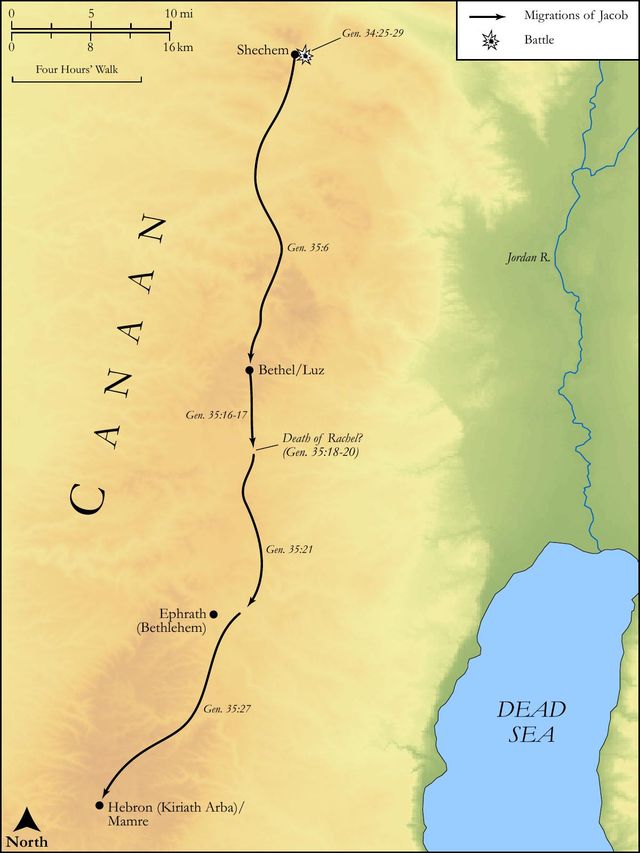
See on the biblical-era maps


Study this verse
Public-domain commentary
Matthew Henry
From his Commentary on the Whole Bible. Henry comments on passages, not single verses — this entry covers Genesis 34:6–17. His two-level outline is real structure in the source text, so it is rendered as structure.
Jacob's sons, when they heard of the injury done to Dinah, showed a very great resentment of it, influenced perhaps rather by jealousy for the honour of their family than by a sense of virtue. Many are concerned at the shamefulness of sin that never lay to heart the sinfulness of it. It is here called folly in Israel (Gen 34:7), according to the language of after-times; for Israel was not yet a people, but a family only. Note, 1. Uncleanness is folly; for it sacrifices the favour of God, peace of conscience, and all the soul can pretend to that is sacred and honourable, to a base and brutish lust. 2. This folly is most shameful in Israel, in a family of Israel, where God is known and worshipped, as he was in Jacob's tents, by the name of the God of Israel. Folly in Israel is scandalous indeed. 3. It is a good thing to have sin stamped with a bad name: uncleanness is here proverbially called folly in Israel, Sa2 13:12. Dinah is here called Jacob's daughter, for warning to all the daughters of Israel, that they betray not themselves to this folly.
Hamor came to treat with Jacob himself, but he turns him over to his sons; and here we have a particular account of the treaty, in which, it is a shame to say, the Canaanites were more honest than the Israelites.
I.Hamor and Shechem fairly propose this match, in order to a coalition in trade.
Shechem is deeply in love with Dinah; he will have her upon any terms, Gen 34:11, Gen 34:12. His father not only consents, but solicits for him, and gravely insists upon the advantages that would follow from the union of the families, Gen 34:9, Gen 34:10. He shows no jealousy of Jacob, though he was a stranger, but rather an earnest desire to settle a correspondence with him and his family, making him that generous offer, The land shall be before you, trade you therein.
II.Jacob's sons basely pretend to insist upon a coalition in religion, when really they designed nothing less.
If Jacob had taken the management of this affair into his own hands, it is probable that he and Hamor would soon have concluded it; but Jacob's sons meditate only revenge, and a strange project they have for the compassing of it - the Shechemites must be circumcised; not to make them holy (they never intended that), but to make them sore, that they might become an easier prey to their sword.
1.The pretence was specious. "It is the honour of Jacob's family that they carry about with them the token of God's covenant with them; and it will be a reproach to those that are thus dignified and distinguished to enter into such a strict alliance with those that are uncircumcised (Gen 34:14); and therefore, if you will be circumcised, then we will become one people with you," Gen 34:15, Gen 34:16. Had they been sincere herein their proposal of these terms would have had in it something commendable; for Israelites should not intermarry with Canaanites, professors with profane; it is a great sin, or at least the cause and inlet of a great deal, and has often been of pernicious consequence. The interest we have in any persons, and the hold we have of them, should be wisely improved by us, to bring them to the love and practice of religion (He that winneth souls is wise); but then we must not, like Jacob's sons, think it enough to persuade them to submit to the external rites of religion, but must endeavour to convince them of its reasonableness, and to bring them acquainted with the power of it.
2.The intention was malicious, as appears by the sequel of the story; all they aimed at was to prepare them for the day of slaughter. Note, Bloody designs have often been covered, and carried on, with a pretence of religion; thus they have been accomplished most plausibly and most securely: but this dissembled piety is, doubtless, double iniquity. Religion is never more injured, nor are God's sacraments more profaned, than when they are thus used for a cloak of maliciousness. Nay, if Jacob's sons had not had this bloody design, I do not see how they could justify their offering the sacred sign of circumcision, the seal of God's covenant, to these devoted Canaanites, who had no part nor lot in the matter. Those had no right to the seal that had no right to the promise. It is not meet to take the children's bread, and cast it to dogs: but Jacob's sons valued not this, while they could make it serve their turn.
Continue studying Genesis 34:12 across the web’s major study libraries — every link below opens this exact verse, chapter, or book on the destination site.
Read & Compare
 BibleGatewayThis verse in more than 200 translations and 70 languages.
 Bible.comThe YouVersion reader — hundreds of translations, reading plans, and highlights.
 ESV.orgCrossway's official English Standard Version reader.
 NET BibleThe NET translation with 60,000+ translators' notes on every rendering decision.
 STEP BibleTyndale House's free study tool — original text, vocabulary, and scholarly resources.
 BibliaLogos Bible Software's free web reader.
 USCCBThe New American Bible (Revised Edition) with the U.S. bishops' study notes.
Commentaries
 BibleHub CommentariesDozens of classic commentaries on this verse, gathered on one page.
 StudyLightMore than 100 commentary sets — the largest collection on the web.
 BibleRefPlain-English commentary on what this verse means, verse by verse.
 Enduring WordDavid Guzik's free commentary on this chapter, widely used by Bible teachers.
 Bible Study ToolsVerse commentary alongside Greek and Hebrew study aids.
Original Language & Research
- BibleHub InterlinearThe verse word by word — original language, transliteration, and English.
- BibleHub LexiconEvery word's original-language definition and Strong's entry.
 Blue Letter BibleDeep-study tools — Strong's numbers, concordance, and word studies.
 SefariaThe Hebrew text with Rashi and centuries of Jewish commentary.
Sermons, Hymns & Audio


TrulyRandomVerse is not affiliated with these sites and doesn’t control their content. They’re linked because they’re genuinely useful.
Summary
Genesis 34:12 presents Shechem's fervent and extravagant offer to Jacob's sons, proposing an unprecedented dowry and gifts in exchange for marrying Dinah, whom he had previously violated. This verse encapsulates his desperate attempt to rectify a grave social and moral transgression, appease the deeply offended family, and secure a marital union that would integrate him with Jacob's powerful household, revealing a keen desire for reconciliation, albeit one rooted in his initial dishonorable act and motivated by self-interest.
Context
ShowHideLiterary Context
This verse is a pivotal moment within the deeply disturbing narrative of Dinah's defilement and its aftermath. Immediately preceding this, Shechem, the Hivite prince, had "taken" Dinah, Jacob's daughter, and "humbled her" (Genesis 34:2), a euphemism for sexual violation. Following this act, his soul "clave unto Dinah" (Genesis 34:3), and he genuinely desired to marry her. His father, Hamor, then approaches Jacob and his sons with a proposal for intermarriage and economic integration between their peoples (Genesis 34:8-10). Shechem's personal plea in verse 12 is a direct follow-up to his father's diplomatic overture, demonstrating his intense personal desire to legitimize the union and presenting a seemingly generous offer to overcome the immense offense. The brothers' response, detailed in Genesis 34:13, reveals their hidden agenda of vengeance, making Shechem's lavish proposal a tragic setup for their brutal retaliation.
Historical & Cultural Context
In the ancient Near East, marriage was a foundational social and economic institution, often involving a complex system of negotiations and payments. The "dowry" (Hebrew: mohar) was a customary bride-price paid by the groom or his family to the bride's father or guardians, compensating them for the loss of their daughter's labor and ensuring her financial security within the marriage. Sexual defilement, especially of an unmarried woman, was a profound affront to a family's honor and a severe social transgression, often punishable by death or requiring substantial restitution and forced marriage. Shechem's offer, therefore, is not merely a personal plea but a strategic move within the intricate framework of tribal relations and honor codes. His willingness to offer an exorbitant dowry and gifts underscores the gravity of his offense and his desperate attempt to avert inter-tribal conflict and restore his standing, even as it highlights the immense value placed on a woman's honor and family reputation in that society.
Key Themes
ShowHideGenesis 34:12 contributes significantly to several major themes present in the chapter and the broader Book of Genesis. Firstly, it highlights the consequences of sin and dishonor, demonstrating how one act of sexual transgression (Shechem's defilement of Dinah) sets in motion a chain of events marked by deceit, violence, and profound familial suffering. Secondly, it explores the tension between justice and vengeance, as Shechem attempts to resolve the situation through material compensation, while Dinah's brothers ultimately opt for a brutal, deceptive retribution. This contrasts sharply with the divine justice often portrayed in biblical narratives, such as the judgment against Sodom and Gomorrah in Genesis 19. Thirdly, the passage underscores the immense importance of family honor and reputation in ancient Israelite culture, where an individual's actions directly impacted the collective standing of their kin. Finally, it subtly touches upon the fragility of human covenants when not rooted in integrity and respect, contrasting with the unwavering faithfulness of God's covenant with Abraham's descendants, as seen in passages like Genesis 15:18.
Exposition and Analysis
ShowHideKey Word Analysis
ShowHideThis word, often translated as "very" or "exceedingly," functions as an intensive or superlative. When used with "ask me" (H7235, râbâh, to increase/multiply), it conveys the idea of multiplying the request greatly, or asking for an exceedingly large amount. Shechem is not just willing to pay, but to pay an amount that is "very much" or "exceedingly" large, far beyond the customary. This emphasizes the extreme nature of his offer and his desperate eagerness.
This term specifically refers to the bride-price, the payment made by the groom or his family to the bride's father or guardians. It was a legal and customary part of marriage arrangements in the ancient Near East, signifying the transfer of rights and the establishment of the marital covenant. Shechem's mention of mohar indicates his desire to legitimize the union according to established social norms, despite the illegitimate circumstances of the initial defilement.
Derived from the verb "to give," mattân refers to a present or offering. In this context, it signifies additional gifts beyond the formal mohar, which might be given to the bride herself or to her family members. The inclusion of "gift" alongside "dowry" further underscores the lavishness and extraordinary nature of Shechem's proposal, indicating his willingness to spare no expense to secure Dinah and appease her family.
Verse Breakdown
ShowHide"Ask me never so much dowry and gift"
Shechem's opening statement is an open-ended invitation to Jacob's sons to name their price, no matter how exorbitant. The phrase "never so much" (literally, "multiply greatly") indicates his willingness to exceed any customary or expected amount for the mohar (bride-price) and mattân (additional gifts). This reveals his desperate urgency and his perception that material compensation is the primary means to rectify the profound offense he committed against Dinah and her family.
"and I will give according as ye shall say unto me"
This clause reinforces Shechem's absolute commitment to their terms. He places the power of negotiation entirely in their hands, promising to fulfill whatever financial demands they might make. This demonstrates his singular focus on securing Dinah as his wife and resolving the conflict, even if it means significant personal cost. It also highlights his somewhat naive belief that all wrongs can be rectified through material payment and social appeasement.
"but give me the damsel to wife"
This is the core demand and motivation behind Shechem's lavish offer. Despite his willingness to pay any price, his ultimate goal is singular: to marry Dinah. The term "damsel" (Hebrew, naʻărâh) refers to a young woman, emphasizing her vulnerable status. His plea reveals a desire for a legitimate marital union, albeit one necessitated by his prior illegitimate act, and underscores the societal importance of marriage as a means of social integration and stability.
Literary Devices
ShowHideThe verse employs several significant literary devices. Hyperbole is evident in Shechem's phrase "Ask me never so much dowry and gift," which literally means "multiply the dowry and gift greatly." This exaggerated language underscores the extraordinary nature of his offer and his desperate desire to secure Dinah as his wife, demonstrating his willingness to pay any price. There is also a strong element of Irony present; Shechem's seemingly sincere and generous offer, intended to bring reconciliation and legitimize a union, is tragically met with deceit and a vengeful plot by Jacob's sons. His genuine desire for marriage, however flawed in its origin, becomes the very lever for his family's destruction. Furthermore, the verse functions as a form of Foreshadowing, setting the stage for the tragic events that follow. Shechem's desperate plea, born of his initial sin, inadvertently provides the brothers with the opportunity to enact their brutal revenge, making his offer a catalyst for the ensuing violence rather than a path to peace.
Theological and Thematic Connections
ShowHideShechem's lavish offer, while seemingly generous, profoundly illustrates the theological principle that material compensation, however great, is utterly insufficient to atone for profound moral and spiritual wrong. His attempt to buy his way out of a crisis of honor and sin highlights humanity's persistent but flawed inclination to offer external remedies for internal brokenness. True reconciliation and forgiveness require more than financial restitution; they demand genuine repentance, a transformation of heart, and a restoration of trust that was entirely absent in this tragic narrative. This story serves as a stark reminder that the consequences of sin are far-reaching, and human attempts to circumvent divine justice or righteous resolution through worldly means often lead to deeper brokenness and further sin.
Reflection and Application
ShowHideThis disturbing passage from Genesis offers profound insights into the complexities of justice, reconciliation, and the dire consequences of sin. It serves as a powerful reminder that material wealth, however great, cannot always atone for deep personal and familial wounds, especially those involving honor, dignity, and moral transgression. The tragic outcome of this story also highlights the dangers of seeking revenge outside of just and righteous means, as the brothers' subsequent actions lead to further violence, deceit, and disrepute for Jacob's family. The narrative underscores the lasting impact of choices on individuals, families, and communities, a theme echoed throughout biblical narratives concerning the importance of righteousness and its impact on a nation. It challenges us to consider how we respond to injustice: do we seek true reconciliation and justice rooted in genuine repentance and forgiveness, or are we tempted by superficial solutions, deceit, and personal vengeance that ultimately perpetuate cycles of harm?
Questions for Reflection
ShowHideFAQ
ShowHideWhy was a dowry so important in ancient societies?
ShowHideIn ancient Near Eastern societies, a dowry (like the mohar mentioned here) was crucial for several reasons, reflecting both economic and social realities. It served as a form of compensation to the bride's family for the loss of her labor and her contribution to the household. More importantly, it provided financial security for the woman within her new marriage, acting as a form of insurance or a trust fund she could access if widowed or divorced. It also legitimized the marriage in the eyes of the community and demonstrated the groom's ability to provide for his wife, thereby reflecting the honor and status of both families involved. The practice is seen in various forms throughout the Old Testament, such as Jacob's service for Laban to marry Rachel in Genesis 29:18.
Does "never so much" imply Shechem's genuine remorse?
ShowHideWhile Shechem's willingness to pay "never so much" (an extraordinary amount) certainly indicates his desperate desire to marry Dinah and appease her family, it doesn't necessarily confirm genuine remorse for his initial act of defilement. His primary motivation appears to be securing the marriage and avoiding conflict with Jacob's powerful family, as well as his personal attachment to Dinah. The offer is a strategic move to rectify the social and political fallout of his actions, rather than a clear indication of a contrite heart over the moral wrong. The text focuses more on his desire for Dinah and his fear of the consequences than on any profound sorrow for his sin.
How does this passage relate to the concept of "honor killings" or family vengeance?
ShowHideThis passage provides a biblical example of the extreme measures taken to defend family honor in ancient cultures. While Shechem attempts to resolve the dishonor through a marriage proposal and lavish payment, Dinah's brothers ultimately choose a path of violent vengeance. While not an "honor killing" in the modern sense (as Dinah was not killed by her family), their actions are undeniably driven by the perceived necessity to restore their family's honor through retribution for the defilement of their sister. The narrative highlights the dangers and tragic consequences of such actions, as the brothers' deceit and violence bring further disrepute and danger upon Jacob's household, demonstrating the destructive cycle that can result when personal vengeance overrides a pursuit of true justice and reconciliation.
Christ-Centered Fulfillment
ShowHideThe tragic narrative of Genesis 34 and Shechem's desperate, self-serving offer underscores humanity's profound brokenness and the utter inadequacy of material wealth or human schemes to truly atone for sin and bring about genuine reconciliation. In stark contrast to Shechem's corrupted pursuit of marriage through payment for a defiled woman, Christ offers a perfect and pure covenant. He is the ultimate "bride-price" given not to appease human anger or to cover over a sin with money, but to satisfy divine justice and purchase His Bride, the Church, not with perishable things like silver or gold, but with His own precious and sinless blood, as 1 Peter 1:18-19 beautifully declares. Where Shechem's offer led to deceit, violence, and further defilement, Christ's sacrifice brings true forgiveness, reconciliation with God, and the restoration of honor, transforming defilement into purity and brokenness into new life. He cleanses and sanctifies His Church, presenting her to Himself "without spot or wrinkle or any such thing, but holy and blameless," as described in Ephesians 5:25-27. This divine act of redemption establishes a covenant of grace that is eternal, unblemished, and founded on perfect love and sacrifice, not on human bargaining or vengeance.