


Ruth 4:1
- וּבֹעַזu·Vo·'azand BoazH1162Conj-w ¦ N-proper-mNoun Proper MasculineוּandבֹעַזBoaz
- עָלָה'a·Lahhe went upH5927V-Qal-Perf-3msVerb Qal Perfect 3rd Singular Masculine
- הַשַּׁעַרha·sha·'Arthe gateH8179Art ¦ N-msNoun Singular Masculine Absoluteהַtheשַּׁעַרgate
- וַיֵּשֶׁבvai·Ye·shevand he sat downH3427Conj-w ¦ V-Qal-ConsecImperf-3msVerb Qal Consecutive Imperfect 3rd Singular Masculineוַandיֵּשֶׁבhe sat down
- שָׁםshamthereH8033AdvAdverb
- וְהִנֵּהve·hi·Nehand there!H2009Conj-w ¦ PrtParticle Interjectionוְandהִנֵּהthere!
- הַגֹּאֵלha·go·'Elthe kinsman-redeemerH1350Art ¦ V-Qal-Prtcpl-msVerb Qal Participle Singular Masculine Absoluteהַtheגֹּאֵלkinsman-redeemer
- עֹבֵר'o·Ver[was] passing byH5674V-Qal-Prtcpl-msVerb Qal Participle Singular Masculine Absolute
- אֲשֶׁר'a·SherwhomH834RelParticle Relative
- דִּבֶּרdi·berhe had spokenH1696V-Piel-Perf-3msVerb Piel Perfect 3rd Singular Masculine
- בֹּעַזBo·'azBoazH1162N-proper-mNoun Proper Masculine
- וַיֹּאמֶרvai·Yo·merand he saidH559Conj-w ¦ V-Qal-ConsecImperf-3msVerb Qal Consecutive Imperfect 3rd Singular Masculineוַandיֹּאמֶרhe said
- סוּרָהSu·rahturn aside !H5493V-Qal-Imp-2ms ¦ SfxVerb Qal Imperative 2nd Singular Masculineסוּרָturn asideה!
- שְׁבָהshe·vahsit !H3427V-Qal-Imp-2ms ¦ SfxVerb Qal Imperative 2nd Singular Masculineשְׁבָsitה!
- פֹּהpohhereH6311AdvAdverb
- פְּלֹנִיpe·lo·Nia certain oneH6423N-mscNoun Singular Masculine Construct
- אַלְמֹנִי'al·mo·Nia certain oneH492N-msNoun Singular Masculine Absolute
- וַיָּסַרvai·Ya·sarand he turned asideH5493Conj-w ¦ V-Qal-ConsecImperf-3msVerb Qal Consecutive Imperfect 3rd Singular Masculineוַandיָּסַרhe turned aside
- וַיֵּשֵׁבvai·ye·Shevand he sat downH3427Conj-w ¦ V-Qal-ConsecImperf-3msVerb Qal Consecutive Imperfect 3rd Singular Masculineוַandיֵּשֵׁבhe sat down
English is a literal word-by-word gloss of the Hebrew, not the KJV's wording. Why?
This is the original text the KJV's translators worked from — each Hebrew word with its own literal English meaning in this verse, prepared by scholars at Tyndale House, Cambridge. The KJV translates whole sentences, not word by word, so its wording differs: one Hebrew word can become several English words, and the KJV may choose “the LORD” where the gloss reads “Yahweh”. Both are faithful — they answer different questions. For the KJV's own rendering, switch to the KJV text.
Details
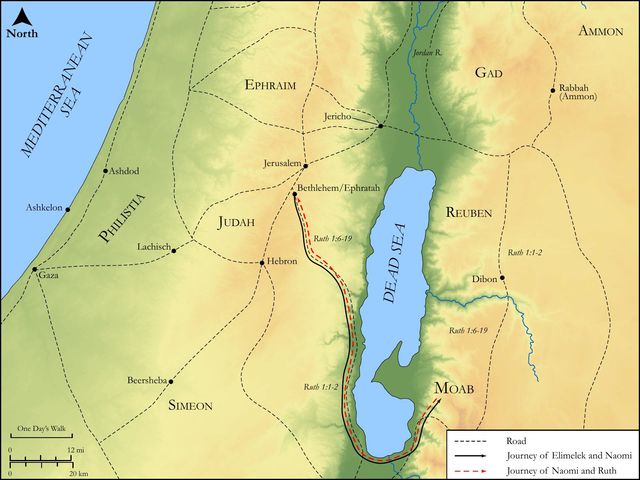
See on the biblical-era map
Study this verse
Public-domain commentary
Matthew Henry
From his Commentary on the Whole Bible. Henry comments on passages, not single verses — this entry covers Ruth 4:1–8.
Here, 1. Boaz calls a court immediately. It is probable he was himself one of the elders (or aldermen) of the city; for he was a mighty man of wealth. Perhaps he was father of the city, and sat chief; for he seems here to have gone up to the gate as one having authority, and not as a common person; like Job, Job 29:7, etc. We cannot suppose him less than a magistrate in his city who was grandson to Nahshon, prince of Judah; and his lying at the end of a heap of corn in the threshing-floor the night before was not at all inconsistent, in those days of plainness, with the honour of his sitting judge in the gate. But why was Boaz so hasty, why so fond of the match? Ruth was not rich, but lived upon alms; not honourable, but a poor stranger. She was never said to be beautiful; if ever she had been so, we may suppose that weeping, and travelling, and gleaning, had withered her lilies and roses. But that which made Boaz in love with her, and solicitous to expedite the affair, was that all her neighbours agreed she was a virtuous woman. This set her price with him far above rubies (Pro 31:10); and therefore he thinks, if by marrying her he might do her a real kindness, he should also do himself a very great kindness. He will therefore bring it to a conclusion immediately. It was not court-day, but he got ten men of the elders of the city to meet him in the town-hall over the gate, where public business used to be transacted, Rut 4:2. So many, it is probable, by the custom of the city, made a full court. Boaz, though a judge, would not be judge in his own cause, but desired the concurrence of other elders. Honest intentions dread not a public cognizance. 2. He summons his rival to come and hear the matter that was to be proposed to him (Rut 4:1): "Ho, such a one, sit down here." He called him by his name, no doubt, but the divine historian thought not fit to record it, for, because he refused to raise up the name of the dead, he deserved not to have his name preserved to future ages in this history. Providence favoured Boaz in ordering it so that this kinsman should come by thus opportunely, just when the matter was ready to be proposed to him. Great affairs are sometimes much furthered by small circumstances, which facilitate and expedite them. 3. He proposes to the other kinsman the redemption of Naomi's land, which, it is probable, had been mortgaged for money to buy bread with when the famine was in the land (Rut 4:3): "Naomi has a parcel of land to sell, namely, the equity of the redemption of it out of the hands of the mortgagee, which she is willing to part with;" or, as some think, it was her jointure for her life, and, wanting money, for a small matter she would sell her interest to the heir at law, who was fittest to be the purchaser. This he gives the kinsman legal notice of (Rut 4:4), that he might have the refusal of it. Whoever had it must pay for it, and Boaz might have said, "My money is as good as my kinsman's; if I have a mind to it, why may not I buy it privately, since I had the first proffer of it, and say nothing to my kinsman?" No, Boaz, though fond enough of the purchase, would not do so mean a thing as to take a bargain over another man's head that was nearer a-kin to it; and we are taught by his example to be not only just and honest, but fair and honourable, in all our dealings, and to do nothing which we are unwilling should see the light, but be above-board. 4. The kinsman seemed forward to redeem the land till he was told that, if he did that, he must marry the widow, and then he flew off. He liked the land well enough, and probably caught at that the more greedily because he hoped that the poor widow being under a necessity of selling he have so much the better bargain: "I will redeem it" (said he) "with all my heart," thinking it would be a fine addition to his estate, Rut 4:4. But Boaz told him there was a young widow in the case, and, if he have the land, he must take her with it, Terra transit cum onere - The estate passes with this incumbrance; either the divine law or the usage of the country would oblige him to it, or Naomi insisted upon it that she would not sell the land but upon this condition, Rut 4:5. Some think this does not relate to the law of marrying the brother's widow (for that seems to oblige only the children of the same father, Deu 25:5, unless by custom it was afterwards made to extend to the next of kin), but to the law of redemption of inheritances (Lev 25:24, Lev 25:25), for it is a Goel, a redeemer, that is here enquired for; and if so it was not by the law, but by Naomi's own resolution, that the purchaser was to marry the widow. However it was, this kinsman, when he heard the conditions of the bargain, refused it (Rut 4:6): "I cannot redeem it for myself. I will not meddle with it upon these terms, lest I mar my own inheritance." The land, he thought, would be an improvement of his inheritance, but not the land with the woman; that would mar it. Perhaps he thought it would be a disparagement to him to marry such a poor widow that had come from a strange country, and almost lived upon alms. He fancied it would be a blemish to his family, it would mar his blood, and disgrace his posterity. Her eminent virtues were not sufficient in his eye to counterbalance this. The Chaldee paraphrase makes his reason for this refusal to be that he had another wife, and, if he should take Ruth, it might occasion strife and contention in his family, which would mar the comfort of his inheritance. Or he thought she might bring him a great many children, and they would all expect shares out of his estate, which would scatter it into too many hands, so that the family would make the less figure. This makes many shy of the great redemption: they are not willing to espouse religion. They have heard well of it, and have nothing to say against it; they will give it their good word, but at the same time they will give their good word with it; they are willing to part with it, and cannot be bound to it, for fear of marring their own inheritance in this world. Heaven they could be glad of, but holiness they can dispense with; it will not agree with the lusts they have already espoused, and therefore, let who will purchase heaven at that rate, they cannot. 5. The right of redemption is fairly resigned to Boaz. If this nameless kinsman lost a good bargain, a good estate, and a good wife too, he may thank himself for not considering it better, and Boaz will thank him for making his way clear to that which he valued and desired above any thing. In those ancient times it was not the usage to pass estates by writings, as afterwards (Jer 32:10, etc.), but by some sign or ceremony, as with us by livery and seisin, as we commonly call it, that is, the delivery of seisin, seisin of a house by giving the key, of land by giving turf and a twig. The ceremony here used was, he that surrendered plucked off his shoe (the Chaldee says it was the glove of his right hand) and gave it to him to whom he made the surrender, intimating thereby that, whatever right he had to tread or go upon the land, he conveyed and transferred it, upon a valuable consideration, to the purchaser: this was a testimony in Israel, Rut 4:7. And it was done in this case, Rut 4:8. If this kinsman had been bound by the law to marry Ruth, and his refusal had been a contempt of that law, Ruth must have plucked off his shoe and spit in his face, Deu 25:9. But, though his relation should in some measure oblige him to the duty, yet the distance of his relation might serve to excuse him from the penalty, or Ruth might very well dispense with it, since his refusal was all she desired from him. But bishop Patrick, and the best interpreters, think this had no relation to that law, and that the drawing off of the shoe was not any disgrace as there, but a confirmation of the surrender, and an evidence that it was not fraudulently nor surreptitiously obtained. Note, Fair and open dealing in all matters of contract and commerce is what all those must make conscience of that would approve themselves Israelites indeed, without guile. How much more honourably and honestly does Boaz come by this purchase than if he had secretly undermined his kinsman, and privately struck up a bargain with Naomi, unknown to him. Honesty will be found the best policy.
Historical interpretation
Two Centuries of Reception
2 surviving comments on this verse. Each one is dated, so this reads as a timeline rather than a list.
Select a marker to jump to its quote. Markers stagger vertically where authors wrote within a few decades of each other.
The man was so virtuous that he did not rush into a marriage outside the law, but he spoke with his neighbors about the marriage. However, his words are also worthy of admiration. For his first words were not about the marriage but about the possession of fields, etc. Moreover, when, on account of the prospective marriage he [the relative] in fact refused the contract for the land and indeed took off his sandal and gave it to Boaz, in accordance with the law, Boaz then took Ruth to be his wife. Furthermore, because he was not serving lust, he took her in the spirit that one should take a wife, and his words also showed themselves worthy of praise, You are witnesses today, etc. “I do not,” he said, “transgress the law in marrying a Moabite woman; rather, I diligently fulfill divine law, so that the memory of the dead is not extinguished.”
When Ruth entered the land of Israel with her mother-in-law, it was provided (on account of the merits of her prayers) that she be married to a man of the lineage of Abraham and whom, indeed, she at first believed to be her closest kinsman. He [the nearest kinsman] said that he could not marry her and, when he had withdrawn, Boaz was married to her, with the witness of ten elders. He [Boaz] who previously confessed himself unable to marry that same woman was united with her and was blessed by those ten elders.It is thought that this passage prefigures John the Baptist who, when he himself was thought by the people of Israel to be Christ and was asked who he was, did not deny who he was but confessed it, saying that he was not Christ. And those who were sent persisted in these inquiries about who he was. He answered, “I am the voice crying in the desert.” He confessed the good news about the Lord, saying, “He who has the bride is the bridegroom.” He showed that he himself was the friend of the groom [the best man], since he added, “Truly, the friend of the groom is he who stands and hears him and rejoices on account of the groom’s voice.” And so they thought he was Christ, because they did not understand that Christ had come on the day of the visitation and that he who was earlier promised by the prophets’ voices was the church’s bridegroom. But just as he told her he was not her kinsman but then afterwards Ruth was united with Boaz, so Christ, who is the true bridegroom of the church, whom the sayings of all the prophets proclaim, was deemed worthy, from all Gentile nations, to claim the church, to present to God the Father unnumbered people throughout the whole orb of the world, because his kinsman took off the sandals.
Continue studying Ruth 4:1 across the web’s major study libraries — every link below opens this exact verse, chapter, or book on the destination site.
Read & Compare
 BibleGatewayThis verse in more than 200 translations and 70 languages.
 Bible.comThe YouVersion reader — hundreds of translations, reading plans, and highlights.
 ESV.orgCrossway's official English Standard Version reader.
 NET BibleThe NET translation with 60,000+ translators' notes on every rendering decision.
 STEP BibleTyndale House's free study tool — original text, vocabulary, and scholarly resources.
 BibliaLogos Bible Software's free web reader.
 USCCBThe New American Bible (Revised Edition) with the U.S. bishops' study notes.
Commentaries
 BibleHub CommentariesDozens of classic commentaries on this verse, gathered on one page.
 StudyLightMore than 100 commentary sets — the largest collection on the web.
 BibleRefPlain-English commentary on what this verse means, verse by verse.
 Enduring WordDavid Guzik's free commentary on this chapter, widely used by Bible teachers.
 Bible Study ToolsVerse commentary alongside Greek and Hebrew study aids.
Original Language & Research
- BibleHub InterlinearThe verse word by word — original language, transliteration, and English.
- BibleHub LexiconEvery word's original-language definition and Strong's entry.
 Blue Letter BibleDeep-study tools — Strong's numbers, concordance, and word studies.
 SefariaThe Hebrew text with Rashi and centuries of Jewish commentary.
Sermons, Hymns & Audio


TrulyRandomVerse is not affiliated with these sites and doesn’t control their content. They’re linked because they’re genuinely useful.
Summary
Ruth 4:1 marks the dramatic shift in the narrative from private encounters to public legal resolution, as Boaz decisively ascends to the city gate, the ancient Israelite hub of commerce and justice. Here, he strategically positions himself to confront the unnamed kinsman-redeemer, initiating the formal process to secure the land of Naomi and the future of Ruth, thereby fulfilling his promise and setting the stage for the climactic redemption of the family line.
Context
ShowHideLiterary Context
This verse immediately follows Boaz's solemn promise to Ruth at the threshing floor in Ruth 3:18, where he assures her, "Sit still, my daughter, until thou know how the matter will fall: for the man will not be in rest, until he have finished the thing this day." Ruth 4:1 demonstrates Boaz's immediate and diligent fulfillment of this pledge. The transition from the clandestine, vulnerable setting of the threshing floor to the public, authoritative space of the city gate underscores the shift from personal assurance to legal execution. It sets the stage for the formal resolution of the levirate marriage and land redemption issues, building narrative tension as the audience anticipates the outcome of this crucial legal encounter.
Historical & Cultural Context
In ancient Israel, the city gate (sha'ar) was far more than a mere entrance; it was the vibrant epicenter of civic life. This highly public space served as the primary venue for commercial transactions, legal proceedings, judicial rulings, and community gatherings. Elders, judges, and prominent citizens would convene there to arbitrate disputes, witness contracts, and ensure the lawful execution of all public affairs. By going "up to the gate" and sitting down, Boaz was not merely waiting; he was strategically positioning himself in the established forum where legal matters were conducted openly and with the necessary public witnesses. This adherence to proper protocol highlights the Israelite emphasis on transparent justice and the validity conferred by public witness, ensuring the legitimacy of the upcoming transaction involving land and family lineage.
Key Themes
ShowHideRuth 4:1 powerfully contributes to several key themes within the book. Firstly, it emphasizes Public Justice and Legal Process, showcasing the meticulous adherence to Israelite law regarding land redemption and levirate marriage, ensuring that all actions are transparent and above reproach. Secondly, it highlights Boaz's Integrity and Proactive Wisdom. Boaz does not delay; he acts immediately and publicly, demonstrating his upright character, commitment to his word, and strategic foresight in navigating complex legal customs. His respectful address to the kinsman, despite the potential for rivalry, underscores his wisdom. Thirdly, the verse introduces the critical concept of the Kinsman-Redeemer (goel). While the specific term goel is not explicitly used in this verse, the "kinsman of whom Boaz spake" is the individual with the prior right of redemption, a concept foundational to the narrative's resolution, as seen in Ruth 2:20 where Boaz is first identified as a goel. This legal obligation involved protecting family property, perpetuating the family name, and rescuing relatives from destitution, setting up the central conflict and resolution of the story. The broader narrative of Ruth, especially in Ruth 4, exemplifies the importance of this role.
Exposition and Analysis
ShowHideKey Word Analysis
ShowHideThis word refers to an opening, i.e., a door or gate. In ancient Near Eastern cities, the shaʻar was the designated public square, serving as the administrative and judicial center where elders sat, judgments were rendered, and commercial transactions were sealed. Boaz's ascent to the "gate" signifies his intent to engage in a formal, public, and legally binding proceeding, moving the narrative from private arrangements to a fully witnessed, communal event.
This primitive root means to redeem according to the Oriental law of kinship, specifically to be the next of kin. This individual had the right and obligation to buy back a relative's property, marry his widow, and act as an avenger or deliverer. The "kinsman of whom Boaz spake" is the goel with the primary right of redemption, whose decision is crucial for the fate of Naomi and Ruth.
This primitive root means to sit down, specifically as a judge or in quiet. By implication, it can also mean to dwell or to remain. Boaz's act of "sitting down" at the gate is not casual; it signifies his readiness to preside, observe, or participate in a formal deliberation, marking him as a man of standing and authority within the community, prepared to conduct serious legal business.
Verse Breakdown
ShowHide"Then went Boaz up to the gate, and sat him down there:"
This opening clause immediately establishes Boaz's initiative and purposeful action. His going "up to the gate" signifies his intention to engage in a public, legal proceeding. His act of "sitting down" indicates his readiness to preside, observe, or participate in a formal deliberation, marking him as a man of standing and authority within the community. This is not a casual encounter but a deliberate, strategic move to initiate the legal process.
"and, behold, the kinsman of whom Boaz spake came by;"
The interjection "behold" (וְהִנֵּה, v'hinneh) draws immediate attention to the providential timing of the kinsman's appearance, suggesting divine orchestration. This kinsman is the individual Boaz referred to in Ruth 3:12-13, who had a prior right to redeem Naomi's land and marry Ruth. His passing by the gate confirms Boaz's foresight and the strategic choice of location for this encounter.
"unto whom he said, Ho, such a one! turn aside, sit down here."
Boaz's address is direct yet respectful. "Ho, such a one!" (פְּלֹנִי אַלְמוֹנִי, peloni 'almoni) is an ancient idiom for "so-and-so," indicating a formal, perhaps even slightly detached, summons to an unnamed individual whose identity is known but not explicitly stated for the record, or simply to keep the narrative focused. The command "turn aside, sit down here" is an invitation to join him in the public forum, setting the stage for the legal discussion that will follow.
"And he turned aside, and sat down."
This final clause confirms the kinsman's compliance, signifying his willingness to engage in the public discourse. His immediate obedience to Boaz's summons underscores Boaz's respected standing in the community and the kinsman's readiness to participate in the traditional legal proceedings at the gate.
Literary Devices
ShowHideRuth 4:1 is rich with literary devices that heighten its significance. The Setting as Character is prominent, as the city gate is not merely a backdrop but an active participant, representing the communal, legal, and public sphere essential for the story's resolution. The verse employs Anticipation, building tension as the audience, aware of Boaz's promise and the kinsman's prior right, eagerly awaits the outcome of this crucial encounter. There is a subtle Dramatic Irony at play; while Boaz and the reader understand the full implications of the summons, the unnamed kinsman appears to be unaware of the specific, weighty proposition awaiting him. The providential timing of the kinsman's arrival, signaled by "behold," hints at Divine Providence orchestrating human actions, even in seemingly mundane legal affairs.
Theological and Thematic Connections
ShowHideRuth 4:1 underscores profound theological truths about God's work through human agency and established systems. Boaz's diligent and public pursuit of justice reflects a commitment to righteousness that aligns with God's character and the principles of the Mosaic Law. It illustrates that divine providence often works not through miraculous interventions alone, but through the integrity, wisdom, and proactive obedience of individuals operating within the social and legal structures of their time. The scene at the gate is a testament to the importance of transparency, accountability, and the communal witness in upholding justice and ensuring the well-being of the vulnerable, echoing God's concern for the lowly (widows, sojourners). This verse sets the stage for a redemption story that is both deeply personal and publicly validated, demonstrating that God's redemptive plan often unfolds through human faithfulness to covenantal obligations.
Reflection and Application
ShowHideRuth 4:1 offers powerful lessons for contemporary believers. Boaz's immediate and public action at the city gate serves as a model of integrity, proactive responsibility, and commitment to fulfilling one's word. In a world often characterized by hidden agendas and reluctance to engage with difficult situations, Boaz's example challenges us to pursue justice and righteousness openly and diligently. It reminds us that our faith is not merely private but should manifest in transparent, ethical conduct in all our dealings—whether personal, professional, or communal. Like Boaz, we are called to be people of our word, to seek resolution through appropriate channels, and to act with wisdom and respect, even when dealing with potential obstacles or rivals. This verse encourages us to trust that God can work through established systems and the faithful actions of His people to bring about His purposes, even in complex or challenging circumstances.
Questions for Reflection
ShowHideFAQ
ShowHideWhy was the city gate the chosen location for this transaction?
ShowHideThe city gate was the central hub of ancient Israelite life, serving as the primary location for legal proceedings, commercial transactions, and public assemblies. It was where the city elders and judges convened, ensuring that all important matters, especially those involving land, property, and family lineage, were conducted openly and with official witnesses. Boaz chose this location specifically because it was the proper, legal forum to address the matter of Naomi's land and Ruth's future, guaranteeing the legitimacy and public validation of the transaction. This ensured that the agreement would be legally binding and beyond dispute, reflecting the importance of transparent justice in Israelite society, as also seen in passages like Deuteronomy 21:19.
Who is the unnamed kinsman referred to as "such a one"?
ShowHideThe "kinsman of whom Boaz spake" is the closest male relative to Naomi's deceased husband, Elimelech, who had the first right and obligation to act as a kinsman-redeemer (goel). According to Israelite law (e.g., Leviticus 25:25 and Deuteronomy 25:5-10), this kinsman had the responsibility to redeem family land that had been sold and, in the case of a childless widow, to marry her to perpetuate the deceased husband's name. The Hebrew phrase "such a one" (peloni 'almoni) is an idiomatic expression for an unnamed person, akin to "so-and-so." The narrator likely leaves him unnamed to emphasize his functional role as the "first in line" rather than his personal identity, highlighting the legal principle at stake and focusing the reader's attention on Boaz as the true hero and redeemer.
Christ-Centered Fulfillment
ShowHideThe meticulous legal process initiated by Boaz at the city gate profoundly foreshadows the ultimate redemption wrought by Jesus Christ. Boaz, as the diligent and righteous kinsman-redeemer, voluntarily steps forward to secure the future of Ruth and Naomi, sacrificing his own resources and reputation to fulfill a legal and moral obligation. This act points to Christ, our greater Kinsman-Redeemer, who, being fully God, humbled Himself to become fully human, taking on our flesh and kinship (as seen in Hebrews 2:14-15). Just as Boaz had to publicly engage with the law and pay a price, Christ entered the public arena of human history, fulfilling every requirement of the law, and offering Himself as the perfect sacrifice on the cross to redeem humanity from the bondage of sin and death (Ephesians 1:7). His redemption is not a private transaction but a public, cosmic act, witnessed by heaven and earth, securing our inheritance and adopting us into God's family (Galatians 4:4-5). Boaz's proactive love and legal precision prefigure the Lamb of God who takes away the sin of the world (John 1:29), demonstrating that our salvation is rooted in a divinely orchestrated, perfectly executed, and publicly validated act of redemption.