


Ruth 3:18
- וַתֹּאמֶרva·To·merand she saidH559Conj-w ¦ V-Qal-ConsecImperf-3fsVerb Qal Consecutive Imperfect 3rd Singular Feminineוַandתֹּאמֶרshe said
- שְׁבִיshe·Visit downH3427V-Qal-Imp-2fsVerb Qal Imperative 2nd Singular Feminine
- בִתִּיvi·Timy O daughterH1323N-fsc ¦ 1csNoun Singular Feminine ConstructבִתִּO daughterיmy
- עַד'aduntilH5704PrepPreposition
- אֲשֶׁר'a·SherthatH834RelParticle Relative
- תֵּדְעִיןte·de·'Inyou will know !H3045V-Qal-Imperf-2fs ¦ SfxVerb Qal Imperfect 2nd Singular Feminineתֵּדְעִיyou will knowן!
- אֵיךְ'eikhhow?H349InterrogParticle Interrogative
- יִפֹּלyi·Polwill it fall outH5307V-Qal-Imperf-3msVerb Qal Imperfect 3rd Singular Masculine
- דָּבָרda·Vara matterH1697N-msNoun Singular Masculine Absolute
- כִּיkiforH3588PrtParticle Conditional
- לֹאlo'notH3808NegParticle Negative
- יִשְׁקֹטyish·Kothe will be at peaceH8252V-Qal-Imperf-3msVerb Qal Imperfect 3rd Singular Masculine
- הָאִישׁha·'Ishthe manH376Art ¦ N-msNoun Singular Masculine Absoluteהָtheאִישׁman
- כִּיkithatH3588PrtParticle Conditional
- אִם'imexceptH518PrtParticle Conditional
- כִּלָּהki·Lahhe has finishedH3615V-Piel-Perf-3msVerb Piel Perfect 3rd Singular Masculine
- הַדָּבָרha·da·Varthe matterH1697Art ¦ N-msNoun Singular Masculine Absoluteהַtheדָּבָרmatter
- הַיּוֹםhai·Yomthis dayH3117Art ¦ N-msNoun Singular Masculine Absoluteהַthisיּוֹםday
English is a literal word-by-word gloss of the Hebrew, not the KJV's wording. Why?
This is the original text the KJV's translators worked from — each Hebrew word with its own literal English meaning in this verse, prepared by scholars at Tyndale House, Cambridge. The KJV translates whole sentences, not word by word, so its wording differs: one Hebrew word can become several English words, and the KJV may choose “the LORD” where the gloss reads “Yahweh”. Both are faithful — they answer different questions. For the KJV's own rendering, switch to the KJV text.
Details
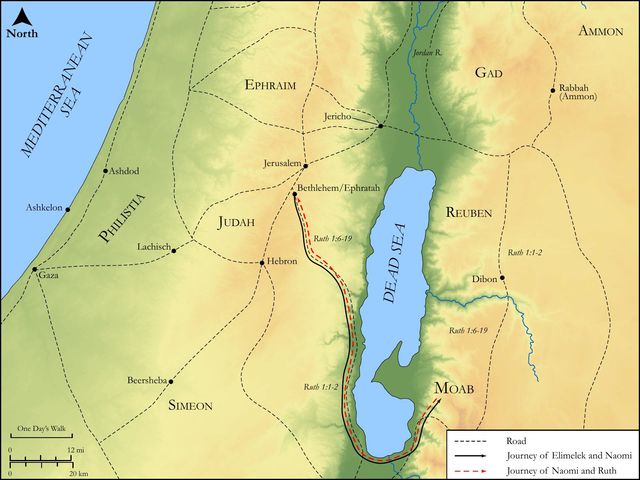
See on the biblical-era map
Study this verse
Public-domain commentary
Matthew Henry
From his Commentary on the Whole Bible. Henry comments on passages, not single verses — this entry covers Ruth 3:14–18.
We are here told, I. How Ruth was dismissed by Boaz. It would not have been safe for her to go home in the dead of the night; therefore she lay at his feet (not by his side) until morning. But as soon as ever the day broke, that she had light to go home by, she got away, before one could know another, that, if she were seen, yet she might not be known to be abroad so unseasonably. She was not shy of being known to be a gleaner in the field, nor ashamed of that mark of her poverty. But she would not willingly be known to be a night-walker, for her virtue was her greatest honour, and that which she most valued. Boaz dismissed her, 1. With a charge to keep counsel (Rut 3:14): Let it not be known that a woman came into the floor, and lay all night so near to Boaz; for, though they needed not to care much what people said of them while they were both conscious to themselves of an unspotted purity, yet, because few could have come so near the fire as they did and not have been scorched, had it been known it would have occasioned suspicions in some and reflections from others. Good people would have been troubled, and bad people would have triumphed, and therefore let it not be known. Note, We must always take care, not only to keep a good conscience, but to keep a good name: either we must not do that which, though innocent, is liable to be misinterpreted, or, if we do, we must not let it be known. We must avoid not only sin, but scandal. There was likewise a particular reason for concealment here. If this matter should take wind, it might prejudice the freedom of the other kinsman's choice, and he would make this his reason for refusing Ruth, that Boaz and she had been together. 2. He dismissed her with a good present of corn, which would be very acceptable to her poor mother at home, and an evidence for her that he had not sent her away in dislike, which Naomi might have suspected if he had sent her away empty. He gave it to her in her veil, or apron, or mantle, gave it to her by measure. Like a prudent corn-master, he kept an account of all he delivered out. It was six measures, that is six omers as is supposed, ten of which made an ephah; whatever the measure was, it is probable he gave her as much as she could well carry, Rut 3:15. And the Chaldee says, Strength was given her from the Lord to carry it; and adds that now it was told her by the spirit of prophecy that from her should descend six of the most righteous men of their age, namely, David, Daniel, his three companions, and the king Messiah.
II.How she was welcomed by her mother-in-law.
She asked her, "Who art thou, my daughter? Art thou a bride or no? Must I give thee joy?" So Ruth told her how the matter stood (Rut 3:17), whereupon her mother, 1. Advised her to be satisfied in what was done: Sit still, my daughter, till thou know how the matter will fall (Rut 3:18) - how it is decreed in heaven, so the Chaldee reads it, for marriages are made there. She had done all that was fit for her to do, and now she must patiently wait the issue and not be perplexed about it. Let us learn hence to cast our care upon providence, to follow that and attend the motions of it, composing ourselves into an expectation of the event, with a resolution to acquiesce in it, whatever it be. Sometimes that proves best done for us that is least our own doing. "Sit still, therefore, and see how the matter will fall, and say, Let it fall how it will, I am ready for it." 2. She assured her that Boaz, having undertaken this matter, would approve himself a faithful careful friend: He will not be at rest till he have finished the matter. Though it was a busy time with him in his fields and his floor, yet, having undertaken to serve his friend, he would not neglect the business. Naomi believes that Ruth has won his heart, and that therefore he will not be easy till he knows whether she be his or no. This she gives as a reason why Ruth should sit still and not perplex herself about it, that Boaz had undertaken it, and he would be sure to manage it well. Much more reason have good Christians to be careful for nothing, but cast their care on God, because he has promised to care for them: and what need have we to care if he do? Sit still, and see how the matter will fall, for the Lord will perfect that which concerns thee, and will make it to work for good to thee, Psa 37:4, Psa 37:5; Psa 138:8. Your strength is to sit still, Isa 30:7.
Continue studying Ruth 3:18 across the web’s major study libraries — every link below opens this exact verse, chapter, or book on the destination site.
Read & Compare
 BibleGatewayThis verse in more than 200 translations and 70 languages.
 Bible.comThe YouVersion reader — hundreds of translations, reading plans, and highlights.
 ESV.orgCrossway's official English Standard Version reader.
 NET BibleThe NET translation with 60,000+ translators' notes on every rendering decision.
 STEP BibleTyndale House's free study tool — original text, vocabulary, and scholarly resources.
 BibliaLogos Bible Software's free web reader.
 USCCBThe New American Bible (Revised Edition) with the U.S. bishops' study notes.
Commentaries
 BibleHub CommentariesDozens of classic commentaries on this verse, gathered on one page.
 StudyLightMore than 100 commentary sets — the largest collection on the web.
 BibleRefPlain-English commentary on what this verse means, verse by verse.
 Enduring WordDavid Guzik's free commentary on this chapter, widely used by Bible teachers.
 Bible Study ToolsVerse commentary alongside Greek and Hebrew study aids.
Original Language & Research
- BibleHub InterlinearThe verse word by word — original language, transliteration, and English.
- BibleHub LexiconEvery word's original-language definition and Strong's entry.
 Blue Letter BibleDeep-study tools — Strong's numbers, concordance, and word studies.
 SefariaThe Hebrew text with Rashi and centuries of Jewish commentary.
Sermons, Hymns & Audio


TrulyRandomVerse is not affiliated with these sites and doesn’t control their content. They’re linked because they’re genuinely useful.
Summary
Ruth 3:18 encapsulates Naomi's profound wisdom and confident reassurance to Ruth following her pivotal encounter with Boaz at the threshing floor. Drawing upon her deep understanding of Boaz's character and the intricate legal customs of their society, Naomi counsels Ruth to wait patiently and trust that Boaz, a man of integrity and unwavering resolve, will swiftly and decisively bring the matter of her redemption and marriage to a complete and satisfactory conclusion before the day ends. This verse marks a crucial transition from uncertainty to hopeful expectation, grounded in the trustworthiness of Boaz and, implicitly, the sovereign providence of God.
Context
ShowHideLiterary Context
This verse serves as the immediate narrative climax following Ruth's daring and obedient actions at the threshing floor, as meticulously instructed by Naomi in Ruth 3:4. Ruth has returned from her nocturnal encounter with Boaz, who, recognizing her virtuous character and profound loyalty, has promised to act as her kinsman-redeemer (Hebrew: goel). The preceding verses detail Boaz's surprise at Ruth's presence, his commendation of her character as superior to younger women, and his firm commitment to fulfill the redemptive duty, even acknowledging the existence of a closer kinsman. Naomi's counsel in Ruth 3:18 is a direct, sagacious response to Ruth's account, providing the final, crucial instruction for Ruth to remain calm and trust the process. It masterfully sets the stage for Boaz's immediate and decisive action in Ruth 4:1, demonstrating the swift and certain fulfillment of Naomi's prophetic confidence.
Historical & Cultural Context
The passage is deeply interwoven with the legal and social customs of ancient Israel. The concept of the goel (kinsman-redeemer) was a foundational institution, obligating the nearest male relative to redeem family land, protect the family name, and, in cases like Ruth's, marry the widow to perpetuate the deceased husband's lineage, as outlined in laws such as Deuteronomy 25:5-10. This was not merely a personal favor but a sacred, communal duty. The "matter" (Hebrew: dabar) refers to the complex legal proceedings that Boaz must undertake at the city gate, which served as the public forum for all legal transactions, disputes, and judicial rulings. Naomi's emphasis on "this day" underscores the urgency and Boaz's commitment to swift action, reflecting a society where legal matters were often resolved promptly to avoid prolonged uncertainty and maintain social order. Her advice to "sit still" also subtly reflects the limited agency women often had in such public legal proceedings, relying instead on the integrity and action of the male kinsman.
Key Themes
ShowHideRuth 3:18 powerfully contributes to several overarching themes in the book of Ruth. Patience and Trust are paramount, as Naomi's instruction to "Sit still, my daughter" encourages Ruth to transition from active pursuit to confident waiting, trusting in Boaz's integrity and, implicitly, God's overarching plan. This echoes broader biblical calls to wait patiently for the Lord and find rest in His timing. Boaz's Integrity and Resolve are highlighted; his character is portrayed as one of unwavering commitment, a man who will not rest until his word is fulfilled, setting him apart as a model of righteousness and dependability. Naomi's Wise Counsel is profoundly evident, showcasing the invaluable role of seasoned wisdom and discernment in guiding younger generations through complex and uncertain situations. Finally, underlying Naomi's remarkable confidence is an implicit faith in Divine Providence, suggesting that God is sovereignly orchestrating these human interactions and legal customs to bring about redemption and restoration for her family, ultimately leading to the lineage of David and, ultimately, Christ, as seen in the broader narrative of the book of Ruth.
Exposition and Analysis
ShowHideKey Word Analysis
ShowHideThis word primarily means "to sit down," but carries a broader implication of "to dwell," "to remain," or "to settle." In this context, it signifies more than mere physical inactivity; it is a call for Ruth to cease her anxious striving and to rest in a posture of calm, confident expectation. It implies remaining in a settled state, trusting that the situation is now in capable hands and that further action on her part is unnecessary.
This word means "to repose," "to be at quiet," or "to settle." The negative construction, "will not be in rest," powerfully emphasizes Boaz's strong sense of duty and his unyielding determination. It portrays him as a man driven by his word and commitment, unable to find inner peace or tranquility until he has completed the task he promised. This highlights his proactive and responsible character, underscoring his integrity and resolve.
This word is highly versatile, meaning "a word," "a matter," or "a thing." Here, it refers to the entire legal and social obligation of kinsman-redemption that Boaz has undertaken. Naomi's use of this term encompasses the complex process of securing Ruth's future, including the negotiations at the city gate and the ultimate marriage. It signifies that Boaz will not merely begin the process but will see it through to its absolute finality, ensuring all legal and social requirements are met.
Verse Breakdown
ShowHide"Then said she, Sit still, my daughter,"
Naomi, with her characteristic wisdom and profound maternal care, advises Ruth to cease her anxious waiting or potential interference. The phrase "sit still" (Hebrew: yashab) implies a posture of calm, patient, and confident waiting, rather than passive resignation. It's an instruction to trust in the unfolding process and the integrity of Boaz, acknowledging that Ruth has done her part and now must allow events to proceed according to a divinely guided plan.
"until thou know how the matter will fall:"
This clause sets the duration and purpose of Ruth's waiting. She is to remain in a state of confident expectation until the outcome of the legal and social situation becomes clear. "The matter" (Hebrew: dabar) refers to Boaz's commitment to act as kinsman-redeemer, which involves navigating the legal complexities with the closer kinsman. Naomi's counsel here suggests that the resolution is assured, and Ruth will soon witness its successful conclusion, emphasizing the certainty of the outcome.
"for the man will not be in rest,"
This explains the profound basis of Naomi's unwavering confidence: Boaz's unimpeachable character. The phrase "will not be in rest" (Hebrew: shaqat) powerfully conveys Boaz's driven nature and unwavering commitment. He is depicted as a man of integrity who, having given his word, will feel an internal compulsion to fulfill it without delay. His peace and tranquility are contingent upon the complete and satisfactory fulfillment of his duty, highlighting his strong moral compass and deep sense of responsibility.
"until he have finished the thing this day."
This final clause specifies the absolute certainty and immediacy of Boaz's action. "Finished the thing" (Hebrew: kalah ha'dabar) emphasizes a complete and decisive resolution, not just a partial attempt or a prolonged process. The crucial addition "this day" underscores Boaz's swiftness and determination; he will not procrastinate but will act promptly and conclusively within the very same day, fulfilling Naomi's confident prophecy and demonstrating his unwavering commitment and reliability.
Literary Devices
ShowHideThe verse employs several effective literary devices to convey its profound message. Characterization is prominently featured, primarily through Naomi's insightful description of Boaz. He is indirectly portrayed as a man of unwavering integrity, diligence, and resolute commitment, whose word is his bond. This indirect characterization reinforces and builds upon the highly positive portrayal of Boaz established throughout the preceding chapters of the book. There is also a strong element of Foreshadowing at play; Naomi's confident prediction that "the man will not be in rest, until he have finished the thing this day" directly anticipates Boaz's immediate and decisive action at the city gate, which is meticulously detailed in the very next chapter, Ruth 4. The subtle yet effective use of Antithesis is observed in the contrast between Ruth's instructed posture to "sit still" and Boaz's active state of "will not be in rest," highlighting the complementary roles of patient waiting and diligent action in the divine plan. Finally, the phrase "the man" acts as a form of Metonymy, where "the man" stands for Boaz's entire character, reputation, and the honorable action that is expected of him as a kinsman-redeemer.
Theological and Thematic Connections
ShowHideRuth 3:18 beautifully illustrates the intricate interplay between human responsibility and divine providence. Naomi's counsel to "sit still" is not a call to passive fatalism but to active trust, recognizing that while human agents (like Boaz) are diligent and honorable, the ultimate outcome rests securely in God's sovereign hand. It powerfully underscores the biblical principle of waiting on the Lord, not in idleness, but in confident expectation that He works through His chosen instruments to bring about His perfect purposes. Boaz's integrity and immediate action serve as a compelling model of righteous human agency, demonstrating how a person committed to God's ways acts decisively and honorably, fulfilling their obligations with diligence. The verse also highlights the invaluable role of wise, godly counsel in navigating life's uncertainties, providing comfort, clear direction, and renewed hope when one has done all they can and must now trust for the resolution. It reminds us that God often works through faithful individuals to accomplish His redemptive plans, bringing order and restoration out of complex and seemingly impossible situations.
Reflection and Application
ShowHideRuth 3:18 offers profound and enduring lessons for believers navigating periods of uncertainty, anxiety, or waiting in their own lives. Just as Naomi instructed Ruth to "sit still," we are often called to adopt a posture of patient trust after we have diligently done our part in a given situation. This "sitting still" is not an invitation to idleness or apathy, but rather an active and confident assurance that God, who is utterly faithful, is at work, often through the integrity and diligence of others He has appointed. It challenges us to release our anxieties and relinquish control, trusting implicitly in His perfect timing and His sovereign methods, knowing that He is orchestrating events for our ultimate good and His greater glory. Furthermore, Boaz's character serves as a powerful and inspiring example for us: a man of his word, driven by an unwavering sense of duty and integrity, who finds no rest until he has completed what is right and honorable. This encourages us to be individuals of similar resolve, fulfilling our commitments and responsibilities with diligence, honor, and a deep sense of purpose, thereby reflecting God's own perfect faithfulness. The wisdom of Naomi also serves as a poignant reminder of the invaluable role of godly mentors and seasoned counselors in our lives, whose discerning wisdom and spiritual insight can provide immense comfort, clear direction, and renewed hope when we feel lost, anxious, or overwhelmed.
Questions for Reflection
ShowHideFAQ
ShowHideWhy was Naomi so confident that Boaz would act immediately and decisively?
ShowHideNaomi's profound confidence stemmed from several deeply rooted factors, primarily her intimate understanding of both Boaz's sterling character and the established societal customs of their time. First, Boaz had already consistently demonstrated his integrity, generosity, and uprightness throughout the narrative, particularly in his compassionate treatment of Ruth in Ruth 2. Second, and crucially, he had explicitly given his solemn word to Ruth at the threshing floor, promising to act as her kinsman-redeemer if the closer kinsman declined (Ruth 3:13). In ancient Israel, a man's word, especially regarding such a significant legal and social obligation, was paramount to his honor, reputation, and standing in the community. Third, Naomi knew that a man of Boaz's standing, righteousness, and commitment would not delay in fulfilling such a sacred duty, particularly to avoid any potential scandal, prolonged uncertainty, or dishonor for Ruth. The phrase "will not be in rest" powerfully highlights his internal compulsion to act swiftly and decisively. Finally, the legal proceedings for redemption were typically conducted publicly at the city gate, and prompt resolution was often desired to maintain social order and prevent lingering disputes or anxieties within the community. Naomi's seasoned wisdom and deep discernment allowed her to accurately predict Boaz's immediate and decisive action.
Christ-Centered Fulfillment
ShowHideRuth 3:18, with its profound emphasis on Boaz's unwavering resolve to complete the intricate work of redemption, beautifully and powerfully foreshadows the ultimate and decisive work of Jesus Christ, our divine Kinsman-Redeemer. Just as Boaz "would not be in rest until he had finished the thing," so too was Christ utterly committed to accomplishing the salvation of His people. His journey to the cross was not one of hesitation or reluctance, but of resolute determination, for He "set His face to go to Jerusalem" (Luke 9:51), knowing full well the suffering that awaited Him. The "thing" that Christ came to finish was the complete, perfect, and eternal redemption of humanity from the bondage of sin and the dominion of death. On the cross, His triumphant cry, "It is finished!" (John 19:30), echoes Boaz's commitment to "finish the thing this day," signifying the complete and final accomplishment of His atoning work, leaving nothing undone. We, like Ruth, are called to "sit still" in confident rest, not in our own futile efforts, but in the glorious finished work of Christ. Our peace, our righteousness, and our eternal salvation are not contingent on our striving but on His perfect integrity and His decisive, once-for-all action. He has gone to the "gate" of heaven, having secured our redemption through His own blood, and now sits at the right hand of God, interceding on our behalf (Romans 8:34). We can rest assured, for our Redeemer will not be in rest until He has brought all things to their glorious and consummated conclusion, just as He promised (Hebrews 12:2).