


Ruth 4:6
- וַיֹּאמֶרvai·Yo·merand he saidH559Conj-w ¦ V-Qal-ConsecImperf-3msVerb Qal Consecutive Imperfect 3rd Singular Masculineוַandיֹּאמֶרhe said
- הַגֹּאֵלha·go·'Elthe kinsman-redeemerH1350Art ¦ V-Qal-Prtcpl-msVerb Qal Participle Singular Masculine Absoluteהַtheגֹּאֵלkinsman-redeemer
- לֹאlo'notH3808NegParticle Negative
- אוּכַל'u·KhalI am ableH3201V-Qal-Imperf-1csVerb Qal Imperfect 1st Singular common gender
- לִגְאָלlig·'olto redeem [it]H1350Prep-l ¦ V-Qal-InfVerb Qal Infinitive Constructלִtoגְאָלredeem [it]
- לִיlifor <the> myselfPrep-l ¦ 1csSuffix Personal 1st Singular common genderלִfor <the>יmyself
- פֶּןpenlestH6435PrtParticle Conditional
- אַשְׁחִית'ash·ChitI should ruinH7843V-Hiphil-Imperf-1csVerb Hiphil Imperfect 1st Singular common gender
- אֶת'et<obj.>H853DirObjMParticle Object Indicator
- נַחֲלָתִיna·cha·la·Timy own inheritanceH5159N-fsc ¦ 1csNoun Singular Feminine Constructנַחֲלָתִown inheritanceיmy
- גְּאַלge·'alredeemH1350V-Qal-Imp-2msVerb Qal Imperative 2nd Singular Masculine
- לְךָle·Khafor <the> yourselfPrep-l ¦ 2msSuffix Personal 2nd Singular Masculineלְfor <the>ךָyourself
- אַתָּה'a·TahyouH859Pro-2msPronoun Personal 2nd Singular Masculine
- אֶת'et<obj.>H853DirObjMParticle Object Indicator
- גְּאֻלָּתִיge·'u·la·Timy right of redemptionH1353N-fsc ¦ 1csNoun Singular Feminine Constructגְּאֻלָּתִright of redemptionיmy
- כִּיkiforH3588PrtParticle Conditional
- לֹאlo'notH3808NegParticle Negative
- אוּכַל'u·KhalI am ableH3201V-Qal-Imperf-1csVerb Qal Imperfect 1st Singular common gender
- לִגְאֹלlig·'Olto redeem [it]H1350Prep-l ¦ V-Qal-InfVerb Qal Infinitive Constructלִtoגְאֹלredeem [it]
English is a literal word-by-word gloss of the Hebrew, not the KJV's wording. Why?
This is the original text the KJV's translators worked from — each Hebrew word with its own literal English meaning in this verse, prepared by scholars at Tyndale House, Cambridge. The KJV translates whole sentences, not word by word, so its wording differs: one Hebrew word can become several English words, and the KJV may choose “the LORD” where the gloss reads “Yahweh”. Both are faithful — they answer different questions. For the KJV's own rendering, switch to the KJV text.
Details
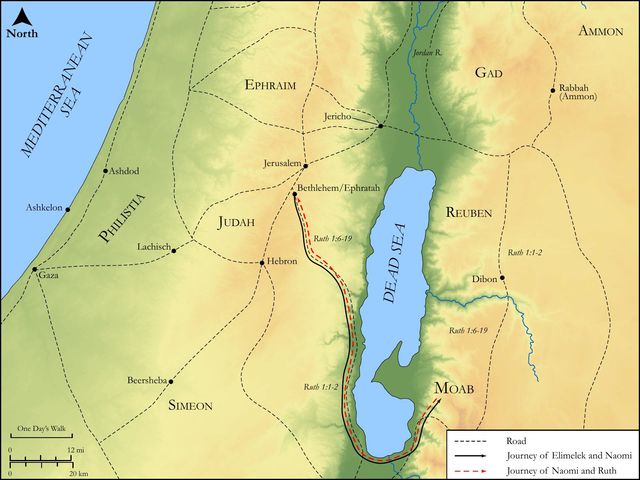
See on the biblical-era map
Study this verse
Public-domain commentary
Matthew Henry
From his Commentary on the Whole Bible. Henry comments on passages, not single verses — this entry covers Ruth 4:1–8.
Here, 1. Boaz calls a court immediately. It is probable he was himself one of the elders (or aldermen) of the city; for he was a mighty man of wealth. Perhaps he was father of the city, and sat chief; for he seems here to have gone up to the gate as one having authority, and not as a common person; like Job, Job 29:7, etc. We cannot suppose him less than a magistrate in his city who was grandson to Nahshon, prince of Judah; and his lying at the end of a heap of corn in the threshing-floor the night before was not at all inconsistent, in those days of plainness, with the honour of his sitting judge in the gate. But why was Boaz so hasty, why so fond of the match? Ruth was not rich, but lived upon alms; not honourable, but a poor stranger. She was never said to be beautiful; if ever she had been so, we may suppose that weeping, and travelling, and gleaning, had withered her lilies and roses. But that which made Boaz in love with her, and solicitous to expedite the affair, was that all her neighbours agreed she was a virtuous woman. This set her price with him far above rubies (Pro 31:10); and therefore he thinks, if by marrying her he might do her a real kindness, he should also do himself a very great kindness. He will therefore bring it to a conclusion immediately. It was not court-day, but he got ten men of the elders of the city to meet him in the town-hall over the gate, where public business used to be transacted, Rut 4:2. So many, it is probable, by the custom of the city, made a full court. Boaz, though a judge, would not be judge in his own cause, but desired the concurrence of other elders. Honest intentions dread not a public cognizance. 2. He summons his rival to come and hear the matter that was to be proposed to him (Rut 4:1): "Ho, such a one, sit down here." He called him by his name, no doubt, but the divine historian thought not fit to record it, for, because he refused to raise up the name of the dead, he deserved not to have his name preserved to future ages in this history. Providence favoured Boaz in ordering it so that this kinsman should come by thus opportunely, just when the matter was ready to be proposed to him. Great affairs are sometimes much furthered by small circumstances, which facilitate and expedite them. 3. He proposes to the other kinsman the redemption of Naomi's land, which, it is probable, had been mortgaged for money to buy bread with when the famine was in the land (Rut 4:3): "Naomi has a parcel of land to sell, namely, the equity of the redemption of it out of the hands of the mortgagee, which she is willing to part with;" or, as some think, it was her jointure for her life, and, wanting money, for a small matter she would sell her interest to the heir at law, who was fittest to be the purchaser. This he gives the kinsman legal notice of (Rut 4:4), that he might have the refusal of it. Whoever had it must pay for it, and Boaz might have said, "My money is as good as my kinsman's; if I have a mind to it, why may not I buy it privately, since I had the first proffer of it, and say nothing to my kinsman?" No, Boaz, though fond enough of the purchase, would not do so mean a thing as to take a bargain over another man's head that was nearer a-kin to it; and we are taught by his example to be not only just and honest, but fair and honourable, in all our dealings, and to do nothing which we are unwilling should see the light, but be above-board. 4. The kinsman seemed forward to redeem the land till he was told that, if he did that, he must marry the widow, and then he flew off. He liked the land well enough, and probably caught at that the more greedily because he hoped that the poor widow being under a necessity of selling he have so much the better bargain: "I will redeem it" (said he) "with all my heart," thinking it would be a fine addition to his estate, Rut 4:4. But Boaz told him there was a young widow in the case, and, if he have the land, he must take her with it, Terra transit cum onere - The estate passes with this incumbrance; either the divine law or the usage of the country would oblige him to it, or Naomi insisted upon it that she would not sell the land but upon this condition, Rut 4:5. Some think this does not relate to the law of marrying the brother's widow (for that seems to oblige only the children of the same father, Deu 25:5, unless by custom it was afterwards made to extend to the next of kin), but to the law of redemption of inheritances (Lev 25:24, Lev 25:25), for it is a Goel, a redeemer, that is here enquired for; and if so it was not by the law, but by Naomi's own resolution, that the purchaser was to marry the widow. However it was, this kinsman, when he heard the conditions of the bargain, refused it (Rut 4:6): "I cannot redeem it for myself. I will not meddle with it upon these terms, lest I mar my own inheritance." The land, he thought, would be an improvement of his inheritance, but not the land with the woman; that would mar it. Perhaps he thought it would be a disparagement to him to marry such a poor widow that had come from a strange country, and almost lived upon alms. He fancied it would be a blemish to his family, it would mar his blood, and disgrace his posterity. Her eminent virtues were not sufficient in his eye to counterbalance this. The Chaldee paraphrase makes his reason for this refusal to be that he had another wife, and, if he should take Ruth, it might occasion strife and contention in his family, which would mar the comfort of his inheritance. Or he thought she might bring him a great many children, and they would all expect shares out of his estate, which would scatter it into too many hands, so that the family would make the less figure. This makes many shy of the great redemption: they are not willing to espouse religion. They have heard well of it, and have nothing to say against it; they will give it their good word, but at the same time they will give their good word with it; they are willing to part with it, and cannot be bound to it, for fear of marring their own inheritance in this world. Heaven they could be glad of, but holiness they can dispense with; it will not agree with the lusts they have already espoused, and therefore, let who will purchase heaven at that rate, they cannot. 5. The right of redemption is fairly resigned to Boaz. If this nameless kinsman lost a good bargain, a good estate, and a good wife too, he may thank himself for not considering it better, and Boaz will thank him for making his way clear to that which he valued and desired above any thing. In those ancient times it was not the usage to pass estates by writings, as afterwards (Jer 32:10, etc.), but by some sign or ceremony, as with us by livery and seisin, as we commonly call it, that is, the delivery of seisin, seisin of a house by giving the key, of land by giving turf and a twig. The ceremony here used was, he that surrendered plucked off his shoe (the Chaldee says it was the glove of his right hand) and gave it to him to whom he made the surrender, intimating thereby that, whatever right he had to tread or go upon the land, he conveyed and transferred it, upon a valuable consideration, to the purchaser: this was a testimony in Israel, Rut 4:7. And it was done in this case, Rut 4:8. If this kinsman had been bound by the law to marry Ruth, and his refusal had been a contempt of that law, Ruth must have plucked off his shoe and spit in his face, Deu 25:9. But, though his relation should in some measure oblige him to the duty, yet the distance of his relation might serve to excuse him from the penalty, or Ruth might very well dispense with it, since his refusal was all she desired from him. But bishop Patrick, and the best interpreters, think this had no relation to that law, and that the drawing off of the shoe was not any disgrace as there, but a confirmation of the surrender, and an evidence that it was not fraudulently nor surreptitiously obtained. Note, Fair and open dealing in all matters of contract and commerce is what all those must make conscience of that would approve themselves Israelites indeed, without guile. How much more honourably and honestly does Boaz come by this purchase than if he had secretly undermined his kinsman, and privately struck up a bargain with Naomi, unknown to him. Honesty will be found the best policy.
Historical interpretation
Two Centuries of Reception
2 surviving comments on this verse. Each one is dated, so this reads as a timeline rather than a list.
Select a marker to jump to its quote. Markers stagger vertically where authors wrote within a few decades of each other.
The man was so virtuous that he did not rush into a marriage outside the law, but he spoke with his neighbors about the marriage. However, his words are also worthy of admiration. For his first words were not about the marriage but about the possession of fields, etc. Moreover, when, on account of the prospective marriage he [the relative] in fact refused the contract for the land and indeed took off his sandal and gave it to Boaz, in accordance with the law, Boaz then took Ruth to be his wife. Furthermore, because he was not serving lust, he took her in the spirit that one should take a wife, and his words also showed themselves worthy of praise, You are witnesses today, etc. “I do not,” he said, “transgress the law in marrying a Moabite woman; rather, I diligently fulfill divine law, so that the memory of the dead is not extinguished.”
When Ruth entered the land of Israel with her mother-in-law, it was provided (on account of the merits of her prayers) that she be married to a man of the lineage of Abraham and whom, indeed, she at first believed to be her closest kinsman. He [the nearest kinsman] said that he could not marry her and, when he had withdrawn, Boaz was married to her, with the witness of ten elders. He [Boaz] who previously confessed himself unable to marry that same woman was united with her and was blessed by those ten elders.It is thought that this passage prefigures John the Baptist who, when he himself was thought by the people of Israel to be Christ and was asked who he was, did not deny who he was but confessed it, saying that he was not Christ. And those who were sent persisted in these inquiries about who he was. He answered, “I am the voice crying in the desert.” He confessed the good news about the Lord, saying, “He who has the bride is the bridegroom.” He showed that he himself was the friend of the groom [the best man], since he added, “Truly, the friend of the groom is he who stands and hears him and rejoices on account of the groom’s voice.” And so they thought he was Christ, because they did not understand that Christ had come on the day of the visitation and that he who was earlier promised by the prophets’ voices was the church’s bridegroom. But just as he told her he was not her kinsman but then afterwards Ruth was united with Boaz, so Christ, who is the true bridegroom of the church, whom the sayings of all the prophets proclaim, was deemed worthy, from all Gentile nations, to claim the church, to present to God the Father unnumbered people throughout the whole orb of the world, because his kinsman took off the sandals.
Continue studying Ruth 4:6 across the web’s major study libraries — every link below opens this exact verse, chapter, or book on the destination site.
Read & Compare
 BibleGatewayThis verse in more than 200 translations and 70 languages.
 Bible.comThe YouVersion reader — hundreds of translations, reading plans, and highlights.
 ESV.orgCrossway's official English Standard Version reader.
 NET BibleThe NET translation with 60,000+ translators' notes on every rendering decision.
 STEP BibleTyndale House's free study tool — original text, vocabulary, and scholarly resources.
 BibliaLogos Bible Software's free web reader.
 USCCBThe New American Bible (Revised Edition) with the U.S. bishops' study notes.
Commentaries
 BibleHub CommentariesDozens of classic commentaries on this verse, gathered on one page.
 StudyLightMore than 100 commentary sets — the largest collection on the web.
 BibleRefPlain-English commentary on what this verse means, verse by verse.
 Enduring WordDavid Guzik's free commentary on this chapter, widely used by Bible teachers.
 Bible Study ToolsVerse commentary alongside Greek and Hebrew study aids.
Original Language & Research
- BibleHub InterlinearThe verse word by word — original language, transliteration, and English.
- BibleHub LexiconEvery word's original-language definition and Strong's entry.
 Blue Letter BibleDeep-study tools — Strong's numbers, concordance, and word studies.
 SefariaThe Hebrew text with Rashi and centuries of Jewish commentary.
Sermons, Hymns & Audio


TrulyRandomVerse is not affiliated with these sites and doesn’t control their content. They’re linked because they’re genuinely useful.
Summary
The pivotal moment where the unnamed kinsman, who held the primary right of redemption, publicly relinquishes his duty to Naomi and Ruth. His refusal is explicitly driven by a pragmatic concern for his own financial well-being and the integrity of his personal inheritance, stating his inability to undertake the redemption lest it compromise his estate. This decision, while seemingly a setback for Naomi and Ruth, providentially clears the legal path for Boaz to step forward, fulfilling the role of kinsman-redeemer and securing the lineage of Elimelech's family, ultimately contributing to the messianic line.
Context
ShowHideLiterary Context
This verse is strategically placed at the climax of the legal proceedings at the city gate, immediately following Boaz's public presentation of the kinsman-redeemer's full obligation to the closer relative in Ruth 4:1-5. Boaz, acting with both wisdom and integrity, has meticulously laid out the dual responsibility: not only the purchase of Naomi's land but also the levirate marriage to Ruth "to perpetuate the name of the dead on his inheritance" (Ruth 4:5). The kinsman's swift and unequivocal refusal in Ruth 4:6 serves as the narrative's crucial turning point, legally removing the obstacle that prevented Boaz from acting. This moment highlights the meticulous, step-by-step unfolding of God's providential plan, where human decisions, even those driven by self-interest, are woven into a larger divine tapestry leading to the establishment of David's lineage.
Historical & Cultural Context
The passage is deeply embedded in ancient Israelite social and legal customs, particularly the institutions of the go'el (kinsman-redeemer) and levirate marriage. The go'el was typically the nearest male relative responsible for protecting the family's interests, which included repurchasing ancestral land lost due to poverty (Leviticus 25:25), avenging spilled blood, or ensuring the continuation of a deceased relative's name. Levirate marriage (from Hebrew yibbum), as prescribed in Deuteronomy 25:5-6, obligated a brother (or, in broader application, the nearest male relative) to marry his deceased brother's childless widow to produce an heir who would carry on the deceased's name and inherit his property. The kinsman's concern about "marring his own inheritance" reflects the complex financial implications: acquiring Naomi's potentially depleted land and the obligation to Ruth meant that any son born to Ruth would inherit the deceased Mahlon's name and property, not the kinsman's own, thus diluting his personal estate. The public setting at the city gate underscored the legal gravity and communal witness of the transaction, ensuring its legitimacy.
Key Themes
ShowHideRuth 4:6 powerfully contributes to several overarching themes in the book of Ruth. Firstly, it underscores The Law of Redemption, demonstrating its practical, often costly, application within Israelite society. The kinsman's refusal highlights the legal intricacies and personal sacrifice sometimes required to fulfill such a duty, setting a crucial contrast. Secondly, it vividly portrays the theme of Self-Interest vs. Sacrificial Love. The unnamed kinsman prioritizes the preservation of his "own inheritance" over the needs of Naomi and Ruth and the perpetuation of his relative's name, revealing a concern for personal gain that stands in stark opposition to the selfless love and generosity later demonstrated by Boaz (Ruth 4:9-10). Finally, this seemingly negative decision by the kinsman is, in fact, a pivotal moment of Divine Providence. His refusal is not a hindrance but a divinely orchestrated step that clears the way for Boaz, who would ultimately become the ancestor of King David (Ruth 4:17) and, ultimately, Jesus Christ, showcasing God's sovereign hand guiding seemingly ordinary human choices towards His grand redemptive plan.
Exposition and Analysis
ShowHideKey Word Analysis
ShowHideA primitive root, this verb is central to the book of Ruth and carries profound theological weight throughout the Old Testament. It signifies not merely buying back or repurchasing, but also delivering, protecting, and restoring, according to the Oriental law of kinship. A go'el was one who acted on behalf of a relative to restore what was lost, whether freedom, property, or honor. In this context, the kinsman's declaration "I cannot redeem" (לא אוכל לגאל, lo' 'ukhál lig'ol) is a statement of legal inability or unwillingness, indicating a failure to embody the spirit of restoration inherent in the role. This sets up the greater redemption by Boaz, and ultimately, by God Himself.
This primitive root means to decay, or causatively, to ruin (literally or figuratively), to corrupt, spoil, or lay waste. The kinsman's fear that redeeming the inheritance would "mar" (אשחית, 'ashchít) his own reveals a deep-seated concern for the integrity and profitability of his existing assets. He perceives the added responsibility of Naomi's land (which may have been unproductive or burdened) and the obligation to raise an heir for Mahlon as a potential financial detriment or complication that would diminish his personal estate. This word highlights his self-preservation and material focus, contrasting sharply with the selfless nature of true redemption.
From a root meaning to inherit, this term properly refers to something inherited, an allotted possession, typically land, which was passed down through generations within a family. It was not just property but represented family identity, lineage, and a stake in the promised land. The kinsman's concern for "mine own inheritance" (נחלתי, nachalatí) underscores his focus on his personal, established legacy and material security. His unwillingness to risk this for the sake of a deceased relative's name and a vulnerable widow reveals a limited understanding of the communal and familial obligations tied to this concept, especially in comparison to the broader, spiritual inheritance offered through Christ.
Verse Breakdown
ShowHide"And the kinsman said,"
This phrase introduces the direct speech of the unnamed closer relative, setting the stage for his pivotal declaration. His anonymity, in contrast to Boaz's named generosity and faithfulness, subtly highlights his self-serving decision and his ultimate irrelevance to the perpetuation of the messianic line.
"I cannot redeem [it] for myself,"
This is the kinsman's explicit and definitive refusal. The phrase "for myself" emphasizes that he views the redemption through a lens of personal benefit or detriment, rather than as a selfless act of familial duty. He is unwilling to take on financial and social obligations that would not directly benefit his own lineage or increase his personal wealth.
"lest I mar mine own inheritance:"
This clause provides the kinsman's primary justification for his refusal. He fears that undertaking the redemption, which includes acquiring Naomi's potentially unproductive land and marrying Ruth to raise an heir for Mahlon, would somehow diminish, complicate, or corrupt his existing family estate. Any son born to Ruth would carry Mahlon's name and inherit Mahlon's portion, not the kinsman's, thus potentially reducing the kinsman's family's share or creating a complex legal situation that he deemed financially undesirable.
"redeem thou my right to thyself;"
This is the kinsman's formal and public relinquishment of his legal right to redeem. By instructing Boaz to "redeem thou my right," he legally transfers his priority and obligation to Boaz, making it permissible for Boaz to act. This public declaration at the city gate ensures the legality and transparency of the transfer, satisfying all legal requirements.
"for I cannot redeem [it]."
This reiterates his initial refusal, serving as a definitive and final statement. The repetition reinforces his firm decision and provides a clear, unambiguous legal transfer of the right of redemption to Boaz, leaving no room for doubt or future claim.
Literary Devices
ShowHideThe passage employs several significant Literary Devices. Foremost is Irony, as the closer kinsman, who by law should have been the primary redeemer, declares his inability or unwillingness to fulfill the role, while Boaz, a more distant relative, willingly steps forward to embrace the costly duty. This highlights the kinsman's self-interest versus Boaz's selfless devotion. There is also a strong element of Contrast between the unnamed kinsman's pragmatic, self-preserving stance and Boaz's later demonstration of hesed (covenant loyalty/kindness) and sacrificial love. The kinsman's fear of "marring" his inheritance stands in stark opposition to Boaz's willingness to embrace the full, potentially costly, responsibility. Furthermore, the kinsman's refusal serves as crucial Foreshadowing, setting the stage for Boaz's noble act of redemption, which in turn prefigures the ultimate redemption offered by Christ. The legal formality and public nature of the exchange at the city gate also provide a sense of Dramatic Tension and Legal Precision, emphasizing the gravity of the decision and the divine orchestration of events.
Theological and Thematic Connections
ShowHideRuth 4:6 serves as a powerful theological pivot, illustrating the limitations of human self-interest in fulfilling divine purposes and setting the stage for a greater, more profound redemption. The kinsman's refusal, driven by a desire to protect his earthly inheritance, underscores humanity's inherent inability to fully redeem itself or others from the consequences of brokenness and loss. This highlights the need for a redeemer who is not constrained by personal gain or fear of loss, but is willing to pay any price. The passage thus points to God's sovereign hand, using even human reluctance to advance His perfect plan, ensuring that the path is cleared for the one who will act with true hesed (covenant loyalty and kindness), foreshadowing the ultimate divine Kinsman-Redeemer.
Reflection and Application
ShowHideThe kinsman's refusal in Ruth 4:6 offers a profound mirror for contemporary believers, challenging us to examine our own priorities when faced with opportunities for costly obedience or self-sacrificial love. Like the kinsman, we are often tempted to prioritize the preservation of our "own inheritance"—whether it be financial security, personal comfort, reputation, or convenience—over the call to serve others, uphold justice, or follow Christ wholeheartedly. This verse reminds us that true discipleship often involves a willingness to "mar" our perceived personal gain for the sake of a greater, Kingdom purpose. However, it also offers immense encouragement: even when individuals act out of self-interest or limitations, God remains sovereign, orchestrating circumstances to fulfill His perfect plan. His divine providence can turn human reluctance into a stepping stone for His redemptive work, reminding us to trust His overarching design even when immediate circumstances seem to present obstacles or when others fail to act righteously.
Questions for Reflection
ShowHideFAQ
ShowHideWhy was the kinsman so concerned about "marring his inheritance"?
ShowHideThe kinsman's concern stemmed from the complex legal and financial implications of fulfilling the kinsman-redeemer (go'el) duty in this specific case. It wasn't just about buying Naomi's land; it also involved marrying Ruth, the widow of Mahlon, to raise up an heir for the deceased. According to the law of levirate marriage as prescribed in Deuteronomy 25:5-6, the first son born to Ruth would be legally considered Mahlon's heir. This son would then inherit Mahlon's portion of the land, not the kinsman's own. This meant that the kinsman would invest his resources (buying the land, supporting Ruth and any children) without the benefit of the land or the children ultimately adding to his personal family lineage or inheritance. Essentially, he would be diminishing his own estate for the benefit of a deceased relative's name, which he saw as a financial "loss" or "corruption" of his own established inheritance. The land itself, having been sold due to poverty, might also have been depleted or difficult to restore to productivity, adding to the perceived financial burden.
Who was this unnamed kinsman?
ShowHideThe Bible deliberately leaves this closer kinsman unnamed, referring to him simply as "the kinsman" or "such a one" (Ruth 4:1). This anonymity serves several literary and theological purposes. Firstly, it highlights his self-serving decision in stark contrast to the named and celebrated generosity of Boaz. His lack of a name might symbolize his failure to perpetuate the name of the deceased (Mahlon) and his own diminished legacy due to his self-interest. Secondly, his anonymity ensures that the focus remains on the role he plays in the divine plan—his refusal is a necessary step that clears the way for Boaz, the true hero of the story and an ancestor of King David (Ruth 4:17) and Jesus Christ. His identity is less important than the pivotal function his refusal serves in God's overarching redemptive narrative.
Christ-Centered Fulfillment
ShowHideThe kinsman's refusal in Ruth 4:6 serves as a profound Old Testament shadow, illuminating the glorious reality of Christ as our ultimate Kinsman-Redeemer. The unnamed kinsman, bound by the limitations of his own earthly inheritance and self-interest, declared, "I cannot redeem [it] for myself, lest I mar mine own inheritance." This human inability to perfectly redeem foreshadows humanity's utter helplessness to redeem itself from the bondage of sin and death. We, like the lost inheritance, were in desperate need of a Redeemer. Unlike the kinsman who feared marring his own estate, Jesus Christ, "though he was in the form of God, did not count equality with God a thing to be grasped, but emptied himself, by taking the form of a servant, being born in the likeness of men" (Philippians 2:6-7). He willingly "marred" His divine glory, not through sin, but through humble incarnation and sacrificial death, to secure our redemption. He did not fear to take on the "inheritance" of our broken humanity, but rather "became poor, so that you by his poverty might become rich" (2 Corinthians 8:9). Through His precious blood, He has fully redeemed us from the domain of darkness and transferred us to the kingdom of His beloved Son (Colossians 1:13-14), granting us an eternal, incorruptible inheritance that no earthly fear or self-interest could ever diminish (1 Peter 1:3-4). He is the one who could and would redeem, paying the ultimate price so that we might be brought back into relationship with God and have our names established forever in His eternal family.