


Mark 6:46
- καὶkaiAndG2532CONJConjunction
- ἀποταξάμενοςapotaxamenoshaving taken leaveG657V-AMP-NSMVerb Aorist Middle Participle Nominative Singular Masculine
- αὐτοῖςautoisof themG846P-DPMPersonal pronoun Dative Plural Masculine
- ἀπῆλθενapēlthenHe departedG565V-2AAI-3SVerb 2nd Aorist Active Indicative 3rd Singular
- εἰςeisintoG1519PREPPreposition
- τὸtotheG3588T-ASNDefinite article Accusative Singular Neuter
- ὄροςorosmountainG3735N-ASNNoun Accusative Singular Neuter
- προσεύξασθαιproseuxasthaito prayG4336V-ADNVerb Aorist Middle Deponent Infinitive
English is a literal word-by-word gloss of the Greek, not the KJV's wording. Why?
This is the original text the KJV's translators worked from — each Greek word with its own literal English meaning in this verse, prepared by scholars at Tyndale House, Cambridge. The KJV translates whole sentences, not word by word, so its wording differs: one Greek word can become several English words, and the KJV may choose “charity” where the gloss reads “love”. Both are faithful — they answer different questions. For the KJV's own rendering, switch to the KJV text.
Details
See on the biblical-era map
Study this verse
Public-domain commentary
Matthew Henry
From his Commentary on the Whole Bible. Henry comments on passages, not single verses — this entry covers Mark 6:45–56. His two-level outline is real structure in the source text, so it is rendered as structure.
This passage of story we had Mat 14:22, etc., only what was there related concerning Peter, is omitted here. Here we have,
I.The dispersing of the assembly; Christ constrained his disciples to go before by ship to Bethsaida, intending to follow them, as they supposed, by land. The people were loth to scatter, so that it cost him some time and pains to send them away. For now that they had got a good supper, they were in no haste to leave him. But as long as we are here in this world, we have no continuing city, no not in communion with Christ. The everlasting feast is reserved for the future state.
II.Christ departed into a mountain, to pray. Observe,
1.He prayed; though he had so much preaching-work upon his hands, yet he was much in prayer; he prayed often, and prayed long, which is an encouragement to us to depend upon the intercession he is making for us at the right hand of the Father, that continual intercession.
2.He went alone, to pray; though he needed not to retire for the avoiding either of distraction or of ostentation, yet, to set us an example, and to encourage us in our secret addresses to God, he prayed alone, and, for want of a closet, went up into a mountain, to pray. A good man is never less alone than when alone with God.
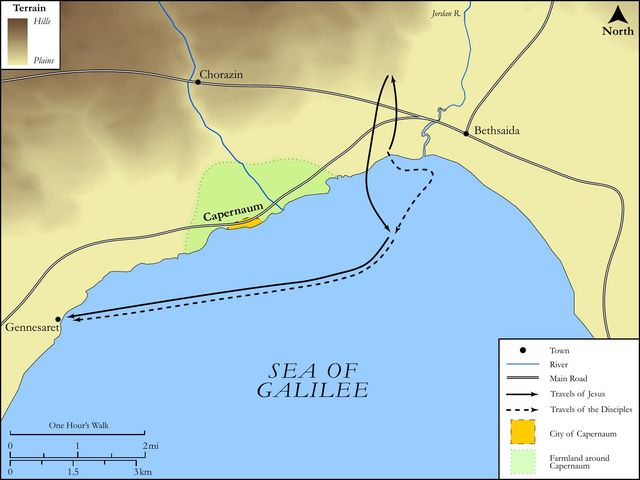
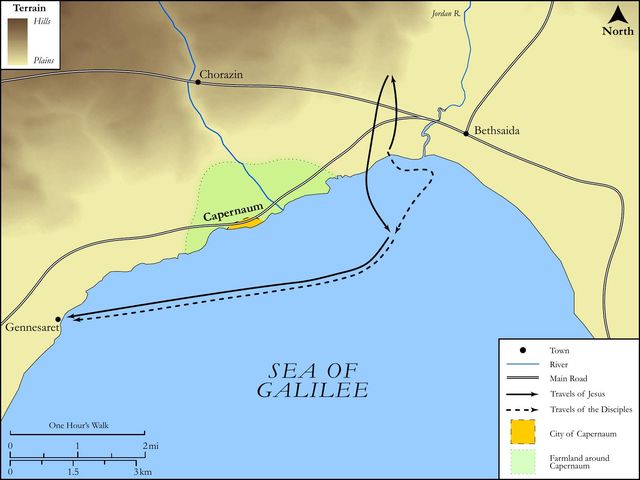
III.The disciples were in distress at sea; The wind was contrary (Mar 6:48), so that they toiled in rowing, and could not get forward.
This was a specimen of the hardships they were to expect, when hereafter he should send them abroad to preach the gospel; it would be like sending them to sea at this time with the wind in their teeth: they must expect to toil in rowing, they must work hard to strive against so strong a stream; they must likewise expect to be tossed with waves, to be persecuted by their enemies; and by exposing them now he intended to train them up for such difficulties, that they might learn to endure hardness. The church is often like a ship at sea, tossed with tempests, and not comforted we may have Christ for us, and yet wind and tide against us; but it is a comfort to Christ's disciples in a storm, that their Master is in the heavenly mount, interceding for them.
IV.Christ made them a kind visit upon the water.
He could have checked the winds, where he was, or have sent an angel to their relief; but he chose to help them in the most endearing manner possible, and therefore came to them himself.
1.He did not come till the fourth watch of the night, not till after three o'clock in the morning; but then he came. Note, If Christ's visits to his people be deferred long, yet at length he will come; and their extremity is his opportunity to appear for them so much the more seasonably. Though the salvation tarry, yet we must wait for it; at the end it shall speak, in the fourth watch of the night, and not lie.
2.He came, walking upon the waters. The sea was now tossed with waves, and yet Christ came, walking upon it; for though the floods lift up their voice, the Lord on high is mightier, Psa 93:3, Psa 93:4. No difficulties can obstruct Christ's gracious appearances for his people, when the set time is come. He will either find, or force, a way through the most tempestuous sea, for their deliverance, Psa 42:7, Psa 42:8,
3.He would have passed by them, that is, he set his face and steered his course, as if he would have gone further, and took no notice of them; this he did, to awaken them to call to him. Note, Providence, when it is acting designedly and directly for the succour of God's people, yet sometimes seems as if it were giving them the go-by, and regarded not their case. They thought that he would, but we may be sure that he would not, have passed by them.
4.They were frightened at the sight of him, supposing him to have been an apparition; They all saw him, and were troubled (Mar 6:50), thinking it had been some daemon, or evil genius, that haunted them, and raised this storm. We often perplex and frighten ourselves with phantasms, the creatures of our own fancy and imagination.
5.He encouraged them, and silenced their fears, by making himself known to them; he talked familiarly with them, saying, Be of good cheer, it is I; be not afraid. Note, (1.) We know not Christ till he is pleased to reveal himself to us. "It is I; I your Master, I your friend, I your Redeemer and Saviour. It is I, that came to a troublesome earth, and now to a tempestuous sea, to look after you." (2.) The knowledge of Christ, as he is in himself, and near to us, is enough to make the disciples of Christ cheerful even in a storm, and no longer fearful. If it be so, why am I thus? If it is Christ that is with thee, be of good cheer, be not afraid. Our fears are soon satisfied, if our mistakes be but rectified, especially our mistakes concerning Christ. See Gen 21:19; Kg2 6:15-17. Christ's presence with us in a stormy day, is enough to make us of good cheer, though clouds and darkness be round about us. He said, It is I. He doth not tell them who he was (there was no occasion), they knew his voice, as the sheep know the voice of their own shepherd, Joh 10:4. How readily doth the spouse say, once and again, It is the voice of my beloved! Sol 2:8; Sol 5:2. He said, egō eimi - I am he; or I am; it is God's name, when he comes to deliver Israel, Exo 3:14. So it is Christ's, now that he comes to deliver his disciples. When Christ said to those that came to apprehend him by force, I am he, they were struck down by it, Joh 18:6. When he saith to those that come to apprehend him by faith, I am he, they are raised up by it, and comforted.
6.He went up to them into the ship, embarked in the same bottom with them, and so made them perfectly easy. Let them but have their Master with them, and all is well. And as soon as he was come into the ship, the wind ceased. In the former storm that they were in, it is said, He arose, and rebuked the winds, and said to the sea, Peace, be still (Mar 4:39); but here we read of no such formal command given, only the wind ceased all of a sudden. note, Our Lord Jesus will be sure to do his own work always effectually, though not always alike solemnly, and with observation. Though we hear not the command given, yet, if thus the wind cease, and we have the comfort of a calm, say, It is because Christ is in the ship, and his decree is gone forth or ever we are aware, Sol 6:12. When we come with Christ to heaven, the wind ceaseth presently; there are no storms in the upper region.
7.They were more surprised and astonished at this miracle than did become them, and there was that at the bottom of their astonishment, which was really culpable; They were sore amazed in themselves, were in a perfect ecstasy; as if it were a new and unaccountable thing, as if Christ had never done the like before, and they had no reason to expect he should do it now; they ought to admire the power of Christ, and to be confirmed hereby in their belief of his being the Son of God: but why all this confusion about it? It was because they considered not the miracle of the loaves; had they given that its due weight, they would not have been so much surprised at this; for his multiplying the bread was as great an instance of his power as his walking on the water. They were strangely stupid and unthinking, and their heart was hardened, or else they would not have thought it a thing incredible that Christ should command a calm. It is for want of a right understanding of Christ's former works, that we are transported at the thought of his present works, as if there never were the like before.
V.When they came to the land of Gennesaret, which lay between Bethsaida and Capernaum, the people bid them very welcome; The men of that place presently knew Jesus (Mar 6:54), and knew what mighty works he did wherever he came, what a universal Healer he was; they knew likewise that he used to stay but a little while at a place, and therefore they were concerned to improve the opportunity of this kind visit which he made them; They ran through that whole region round about, with all possible expedition, and began to carry about in beds those that were sick, and not able to go themselves; there was no danger of their getting cold when they hoped to get a cure, Mar 6:55. Let him go where he would, he was crowded with patients - in towns, in the cities, in the villages about the cities; they laid the sick in the streets, to be in his way, and begged leave for them to touch if it were but the border of his garment, as the woman with the bloody issue did, by whom, it should seem, this method of application was first brought in; and as many as touched, were made whole. We do not find that they were desirous to be taught by him, only to be healed. If ministers could not cure people's bodily diseases, what multitudes would attend them! But it is sad to think how much more concerned the most of men are about their bodies than about their souls.
Historical interpretation
Eight Centuries of Reception
6 surviving comments on this verse. Each one is dated, so this reads as a timeline rather than a list.
Select a marker to jump to its quote. Markers stagger vertically where authors wrote within a few decades of each other.
Or, in the gathering of the twelve baskets full of fragments, is signified the time, when they shall sit on thrones, judging all who are left of Abraham, Isaac, and Jacob, the twelve tribes of Israel, when the remnant of Israel shall be saved.
And He says to them, Be of good cheer, it is I, because we shall see Him as He is. But the wind and the storm ceased when Jesus sat down, that is, reigned in the ship, which is the Catholic Church.
(Vict. Ant. e Cat. in Marc.) He dismisses indeed the people with His blessing and with some cures. But He constrained His disciples, because they could not without pain separate themselves from Him, and that, not only on account of the very great affection which they had for Him, but also because they were at a loss how He would join them.
(Vict. Ant. e Cat. in Marc.) This we must understand of Christ, in that He is man; He does it also to teach us to be constant in prayer.
(Vict. Ant. e Cat. in Marc.) Holy Scripture reckons four watches in the night, making each division three hours; wherefore by the fourth watch it means that which is after the ninth hour, that is, in the tenth or some following hour. There follows, And would have passed them.
(Vict. Ant. e Cat. in Marc.) Or else, the first watch means the time up to the deluge; the second, up to Moses; the third, up to the coming of the Lord; in the fourth the Lord came and spoke to His disciples.
And when he dismissed them, he went into the mountain to pray. Not everyone who prays ascends into the mountain; for there is prayer that commits sin. But he who prays well, who seeks God by praying, this one, progressing from earthly things to higher things, ascends the summit of higher care. However, he who prays concerned about riches, or worldly honor, or certainly the death of an enemy, lying in the lowest parts himself, sends vile prayers to God. The Lord, however, prays not to petition for himself, but to intercede for me. For although he has placed all things in the power of his Son; nevertheless, the Son, to fulfill the form of a man, thinks it proper to petition the Father for us, because he is our advocate. For the Apostle says, “We have an advocate with the Father, Jesus Christ” (1 John 2). If he is an advocate, he ought to intervene for my sins. Therefore, he prays not as weak, but as pious. Do you want to know that he can do all things he wills? He is both advocate and judge. In one is the duty of piety, in the other is the insignia of power.
(in Marc. 2, 27) But it is with reason that we wonder how Mark says, that after the miracle of the loaves the disciples crossed the sea of Bethsaida, when Luke relates that the miracle was done in the parts of Bethsaida, unless we understand that Luke means by the desert which is Bethsaida not the country immediately around the town, but the desert places belonging to it. (Luke 9:10.) But when Mark says that they should go before unto Bethsaida, the town itself is meant. It goes on: And when he had sent them away, he departed into a mountain to pray.
(in Marc. 2, 28) Not every man, however, who prays goes up into a mountain, but he alone prays well, who seeks God in prayer. But he who prays for riches or worldly labour, or for the death of his enemy, sends up from the lowest depths his vile prayers to God. John says, When Jesus therefore perceived that they would come and take him by force and make him a king, he departed again into a mountain himself alone. (John 6:15) It goes on: And when even was come, the ship was in the midst of the sea, and he alone on the land.
(ubi sup.) Buty Theodorus, who was Bishop of Phanara, wrote that the Lord had no bodily weight in His flesh, and walked on the sea without weight; but the Catholic faith declares that He had weight according to the flesh. For Dionysius says, We know not how without plunging in His feet, which had bodily weight and the gravity of matter, He could walk on the wet and unstable subtance.
(ubi sup.) The disciples indeed, who were still carnal, were amazed at the greatness of His virtue, they could not yet however recognise in Him the truth of the Divine Majesty. Wherefore it goes on, For their hearts were hardened. But mystically, the toil of the disciples in rowing, and the contrary wind, mark out the labours of the Holy Church, who amidst the beating waves of the world, and the blasts of unclean spirits, strives to reach the repose of her celestial country. And well is it said that the ship was in the midst of the sea, and He alone on land, for sometimes the Church is afflicted by a pressure from the Gentiles so overwhelming, that her Redeemer seems to have entirely deserted her. But the Lord sees His own, toiling on the sea, for, lest they faint in tribulations, He strengthens them by the look of His love, and sometimes frees them by a visible assistance. Further, in the fourth watch He came to them as daylight approached, for when man lifts up his mind to the light of guidance from on high, the Lord will be with him, and the dangers of temptations will be laid asleep.
(ubi sup.) Often then does the love of heaven seem to have deserted the faithful in tribulation, so that it may be thought that Jesus wishes to pass by His disciples, as it were, toiling in the sea. And still do heretics suppose that the Lord was a phantom, and did not take upon Him real flesh from the Virgin1.
(ubi sup.) In whatsoever heart, also, He is present by the grace of His love, there soon all the strivings of vices, and of the adverse world, or of evil spirits, are kept under and put to rest.
But when He had dismissed the crowd, He goes up to pray, for prayer requires rest and silence.
Now the Lord permitted His disciples to be in danger, that they might learn patience; wherefore He did not immediately come to their aid, but allowed them to remain in danger all night, that He might teach them to wait patiently, and not to hope at once for help in tribulations. For there follows, And he saw them toiling in rowing, for the wind was contrary unto them: and about the fourth watch of the night, he cometh unto them walking upon the sea.
See again how Christ, though He was about to put an end to their dangers, puts them in greater fear. But He immediately reassured them by His voice, for it continues, And immediately he talked with them, and said unto them, It is I, be not afraid.
Then by entering into the ship, the Lord restrained the tempest. For it continues, And he went up unto them into the ship, and the wind ceased. Great indeed is the miracle of our Lord's walking on the sea, but the tempest and the contrary wind were there as well, to make the miracle greater. For the Apostles, not understanding from the miracle of the five loaves the power of Christ, now more fully knew it from the miracle of the sea. Wherefore it goes on, And they were sore amazed in themselves. For they understood not concerning the loaves.
(non occ.) The Lord indeed by the miracle of the loaves showed that He is the Creator of the world: but now by walking on the waves He proved that He had a body free from the weight of all sin, and by appeasing the winds and by calming the rage of the waves, He declared Himself to be the Master of the elements. Wherefore it is said, And straightway he constrained his disciples to get into the ship, and to go to the other side before unto Bethsaida, while he sent away the people.
Continue studying Mark 6:46 across the web’s major study libraries — every link below opens this exact verse, chapter, or book on the destination site.
Read & Compare
 BibleGatewayThis verse in more than 200 translations and 70 languages.
 Bible.comThe YouVersion reader — hundreds of translations, reading plans, and highlights.
 ESV.orgCrossway's official English Standard Version reader.
 NET BibleThe NET translation with 60,000+ translators' notes on every rendering decision.
 STEP BibleTyndale House's free study tool — original text, vocabulary, and scholarly resources.
 BibliaLogos Bible Software's free web reader.
 USCCBThe New American Bible (Revised Edition) with the U.S. bishops' study notes.
Commentaries
 BibleHub CommentariesDozens of classic commentaries on this verse, gathered on one page.
 StudyLightMore than 100 commentary sets — the largest collection on the web.
 BibleRefPlain-English commentary on what this verse means, verse by verse.
 Enduring WordDavid Guzik's free commentary on this chapter, widely used by Bible teachers.
 Bible Study ToolsVerse commentary alongside Greek and Hebrew study aids.
Original Language & Research
- BibleHub InterlinearThe verse word by word — original language, transliteration, and English.
- BibleHub LexiconEvery word's original-language definition and Strong's entry.
 Blue Letter BibleDeep-study tools — Strong's numbers, concordance, and word studies.
 CNTR CollationThe earliest Greek manuscripts of this verse, collated letter by letter.
Sermons, Hymns & Audio


TrulyRandomVerse is not affiliated with these sites and doesn’t control their content. They’re linked because they’re genuinely useful.
Summary
Mark 6:46 presents a profound glimpse into the spiritual discipline of Jesus Christ, immediately following the miraculous feeding of the five thousand. After dismissing the crowds and sending His disciples ahead, Jesus intentionally withdraws to a solitary mountain to engage in private prayer, underscoring His deep reliance on the Father and His commitment to spiritual replenishment amidst intense public ministry.
Context
ShowHideLiterary Context
This verse is strategically placed within Mark's narrative, directly following the feeding of the five thousand Mark 6:30-44, one of Jesus's most dramatic public miracles. The disciples had just returned from their mission trip, reporting their activities Mark 6:30, and Jesus had sought to provide them a place of rest, which was interrupted by the massive crowd. The day was one of immense physical and spiritual exertion, culminating in Jesus's compassionate provision for thousands. His subsequent action of sending away the crowds and dispatching His disciples by boat, before withdrawing Himself, highlights a deliberate choice for solitude and spiritual renewal after significant public engagement. This act sets the stage for the subsequent narrative of Jesus walking on water Mark 6:47-52, where He again demonstrates His divine authority.
Historical & Cultural Context
In ancient Israel, mountains often served as significant locations for divine encounters, revelation, and prayer. Moses received the Law on Mount Sinai Exodus 19, Elijah encountered God on Mount Horeb 1 Kings 19:8-18, and Jesus Himself would later deliver the Sermon on the Mount Matthew 5-7 and be transfigured on a high mountain Mark 9:2-8. This cultural understanding would have imbued Jesus's choice of a mountain with symbolic weight, signifying a place set apart for intimate communion with God. His practice of retreating to solitary places for prayer was a consistent pattern throughout His ministry, reflecting a deep-seated Jewish tradition of seeking God in quietude.
Key Themes
ShowHideMark 6:46 powerfully contributes to several overarching themes in Mark's Gospel and the broader biblical narrative. Firstly, it underscores The Priority of Prayer in Jesus's life, demonstrating that even the Son of God, in His humanity, was utterly dependent on communion with the Father for strength and guidance. This act serves as a model for all believers, emphasizing that effective ministry and spiritual vitality flow from a vibrant prayer life. Secondly, it highlights the theme of Solitude for Spiritual Strength, illustrating the necessity of withdrawing from the demands and distractions of the world to find replenishment in God's presence. Jesus's regular retreats to deserted places or mountains, as seen elsewhere (e.g., Luke 5:16), establish this as a vital spiritual discipline. Lastly, it exemplifies Leadership by Example, as Jesus consistently models the very spiritual practices He encourages in His followers, demonstrating that true spiritual authority is rooted in intimate fellowship with God.
Exposition and Analysis
ShowHideKey Word Analysis
ShowHideThis verb, derived from apó (from) and tássō (to arrange, assign), literally means "to say adieu (by departing or dismissing)" or figuratively "to renounce." Here, it signifies Jesus's deliberate act of dismissing the crowds and His disciples, creating the necessary space for His private communion with God. It implies a purposeful detachment from immediate responsibilities and relationships to pursue a higher spiritual priority.
Formed from apó (from) and érchomai (to come, go), this word means "to go off (i.e. depart), aside (i.e. apart) or behind (i.e. follow)." It emphasizes Jesus's physical movement away from the scene of public ministry, signifying His withdrawal to a secluded location. This departure is not merely a change of place but a purposeful separation for the sake of prayer.
Probably from an obsolete root meaning "to rise or 'rear'," this noun refers to "a mountain (as lifting itself above the plain)" or a hill. In this context, the "mountain" is not just a geographical feature but a symbolic space. Its elevation and isolation make it an ideal location for undisturbed prayer and intimate communion with God, echoing other biblical narratives where mountains are sites of divine encounter.
Derived from prós (towards) and eúchomai (to wish, pray), this verb means "to pray to God, i.e. supplicate, worship." It highlights the specific purpose of Jesus's withdrawal. This was not a mere rest or escape, but a dedicated time of communication, supplication, and worship directed towards His Heavenly Father, revealing the essential nature of His relationship with God.
Verse Breakdown
ShowHide"And when he had sent them away"
This clause describes Jesus's decisive action of dismissing both the large crowd, who had just been miraculously fed, and His disciples. This act of "sending away" is crucial, as it creates the necessary solitude for what follows. It demonstrates Jesus's authority and His intentionality in seeking private time with the Father, prioritizing spiritual replenishment over continued public engagement or immediate interaction with His closest followers.
"he departed into a mountain"
Following the dismissal, Jesus physically withdraws to an elevated, isolated location. The "mountain" serves as a place of separation from the clamor of the multitudes and the demands of ministry. This choice of setting is deliberate, providing an environment conducive to deep, uninterrupted communion with God, a consistent pattern in Jesus's life where mountains often signify places of divine encounter and spiritual retreat.
"to pray"
This final phrase reveals the ultimate purpose of Jesus's withdrawal. His departure to the mountain was not for rest or escape, but specifically for prayer. This highlights the absolute priority of prayer in Jesus's life, even after performing a great miracle and enduring a demanding day. It underscores His dependence on the Father, His need for spiritual sustenance, and His commitment to maintaining an intimate relationship with God through fervent supplication and worship.
Literary Devices
ShowHideMark 6:46 employs several significant literary devices. The most prominent is Modeling, where Jesus's actions serve as a direct example for His disciples and all believers. His deliberate withdrawal to pray after intense ministry models the essential spiritual discipline of seeking solitude and communion with God for replenishment. This act also carries strong Symbolism, as the "mountain" frequently represents a place of divine encounter and revelation in biblical narratives. By ascending a mountain to pray, Jesus evokes the imagery of Moses on Sinai or Elijah on Horeb, underscoring the sacred nature of His communion with the Father. Furthermore, this verse presents a form of Contrast – the contrast between the public, demanding ministry of feeding thousands and the private, quiet intimacy of prayer. This juxtaposition emphasizes the cyclical nature of ministry and spiritual replenishment. Finally, there is an element of Foreshadowing, as Jesus's consistent practice of solitary prayer anticipates other crucial moments of prayer in His ministry, such as His all-night prayer before choosing the twelve Luke 6:12 or His agonizing prayer in Gethsemane before His crucifixion Mark 14:32-42.
Theological and Thematic Connections
ShowHideMark 6:46 offers profound theological insights into the nature of Jesus and the essence of spiritual life. It reveals Jesus's perfect blend of divine power and human dependence. Though He had just demonstrated miraculous power by feeding thousands, He did not rely solely on His inherent divinity but embraced His humanity's need for spiritual sustenance through prayer. This act underscores the vital truth that even the Son of God, in His incarnate state, found it essential to commune with the Father, setting a timeless example for all who seek to live a life of spiritual vitality and effective service. It speaks to the necessity of intentional spiritual discipline, recognizing that even after significant accomplishments or periods of intense outward activity, inner replenishment through God's presence is paramount. This verse also implicitly highlights the relational aspect of the Trinity, showcasing the intimate and continuous fellowship between the Father and the Son.
Reflection and Application
ShowHideIn a world characterized by constant noise, relentless demands, and the pervasive pull of digital distractions, Mark 6:46 stands as a powerful and counter-cultural invitation to intentional solitude and communion with God. Jesus's example teaches us that true spiritual strength and sustainable ministry are not found in perpetual activity but in deliberate withdrawal for the purpose of prayer. It challenges us to recognize our own deep need for spiritual replenishment, especially after periods of intense service or significant achievement. If Jesus, the Son of God, required such intimate time with the Father, how much more do we, His followers, need to cultivate a consistent and fervent prayer life? This verse encourages us to carve out sacred spaces and times in our busy lives, away from the clamor, to simply be present with God, listen to His voice, and draw strength from His inexhaustible well. It reminds us that our doing must always flow from our being – being rooted and nourished in Christ.
Questions for Reflection
ShowHideFAQ
ShowHideWhy did Jesus need to pray if He was God?
ShowHideJesus's prayer life, as exemplified in Mark 6:46, reveals the profound mystery of His dual nature: fully God and fully man. While Jesus is indeed God, in His incarnation, He voluntarily took on the limitations and experiences of humanity, including dependence on the Father. His prayers were not born out of a lack of divine power but out of His perfect human obedience and His desire to maintain a continuous, intimate relationship with the Father. His prayer life demonstrates His perfect reliance on God, models true humanity's relationship with its Creator, and underscores His solidarity with us in our need for spiritual sustenance. It was a vital expression of His filial relationship with the Father and an essential component of His earthly mission.
What is the significance of Jesus going to a "mountain" to pray?
ShowHideThe choice of a "mountain" for prayer in Mark 6:46 carries significant biblical and symbolic weight. Throughout Scripture, mountains are often depicted as places of divine encounter, revelation, and intimate communion with God. Moses received the Law on Mount Sinai Exodus 19, Elijah encountered God on Mount Horeb 1 Kings 19:8-18, and Jesus Himself would later be transfigured on a high mountain Mark 9:2-8. By ascending a mountain, Jesus sought not just physical solitude but a symbolic elevation, a place set apart from the world's clamor, conducive to a deeper, more focused spiritual connection with His Heavenly Father. It represents a deliberate ascent from the earthly demands to heavenly communion.
Christ-Centered Fulfillment
ShowHideMark 6:46, though depicting Jesus's human need for prayer, profoundly points to His ultimate Christ-centered fulfillment. Jesus's consistent practice of withdrawing to pray, as seen here, reveals His perfect communion with the Father, a relationship that is the very foundation of His redemptive work. His prayers were not merely personal piety but an integral part of His mission to accomplish the Father's will, culminating in His ultimate sacrifice on the cross. This verse foreshadows His later intercessory work, as the resurrected Christ now sits at the right hand of God, continually interceding for His people Romans 8:34; Hebrews 7:25. The solitude He sought on the mountain anticipates the ultimate solitude of His suffering on Calvary, where He bore the sins of the world, and the profound communion He enjoyed with the Father is the source from which He drew strength to endure the separation from God on the cross for our sake Matthew 27:46. Thus, Jesus's prayer on the mountain is not just an example to follow, but a revelation of the Son's perfect dependence on the Father, a dependence that empowered Him to fulfill His role as the Lamb of God who takes away the sin of the world John 1:29, and now serves as our great High Priest who ever lives to make intercession for us.