


Matthew 14:23
Bible text: King James Version (1769 Blayney text) · Public domain
Bible text: King James Version with Strong's numbers · Public domain
Bible text: Berean Standard Bible · Public domain
Bible text: American Standard Version (1901) · Public domain
Bible text: World English Bible, Messianic edition · Public domain
Bible text: Geneva Bible (1599) · Public domain
Bible text: Young's Literal Translation · Public domain
- ΚαὶKaiAndG2532CONJConjunction
- ἀπολύσαςapolusashaving dismissedG630V-AAP-NSMVerb Aorist Active Participle Nominative Singular Masculine
- τοὺςtoustheG3588T-APMDefinite article Accusative Plural Masculine
- ὄχλουςochlouscrowdsG3793N-APMNoun Accusative Plural Masculine
- ἀνέβηanebēHe went upG305V-2AAI-3SVerb 2nd Aorist Active Indicative 3rd Singular
- εἰςeisonG1519PREPPreposition
- τὸtotheG3588T-ASNDefinite article Accusative Singular Neuter
- ὄροςorosmountainG3735N-ASNNoun Accusative Singular Neuter
- κατ᾽kat᾽onG2596PREPPreposition
- ἰδίανidian[his] ownG2398A-ASFAdjective Accusative Singular Feminine
- προσεύξασθαιproseuxasthaito prayG4336V-ADNVerb Aorist Middle Deponent Infinitive
- ὈψίαςOpsiasEveningG3798A-GSFAdjective Genitive Singular Feminine
- δὲdenowG1161CONJConjunction
- γενομένηςgenomenēshaving arrivedG1096V-2ADP-GSFVerb 2nd Aorist Middle Deponent Participle Genitive Singular Feminine
- μόνοςmonosaloneG3441A-NSMAdjective Nominative Singular Masculine
- ἦνēnHe wasG1510V-IAI-3SVerb Imperfect Active Indicative 3rd Singular
- ἐκεῖekeithereG1563ADVAdverb
English is a literal word-by-word gloss of the Greek, not the KJV's wording. Why?
This is the original text the KJV's translators worked from — each Greek word with its own literal English meaning in this verse, prepared by scholars at Tyndale House, Cambridge. The KJV translates whole sentences, not word by word, so its wording differs: one Greek word can become several English words, and the KJV may choose “charity” where the gloss reads “love”. Both are faithful — they answer different questions. For the KJV's own rendering, switch to the KJV text.
Details
See on the biblical-era maps
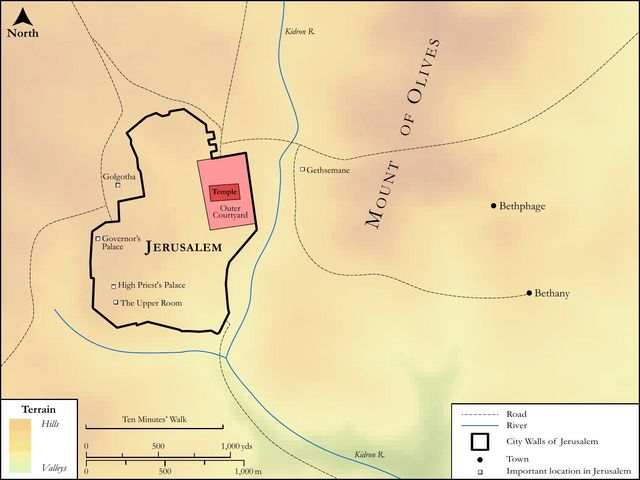
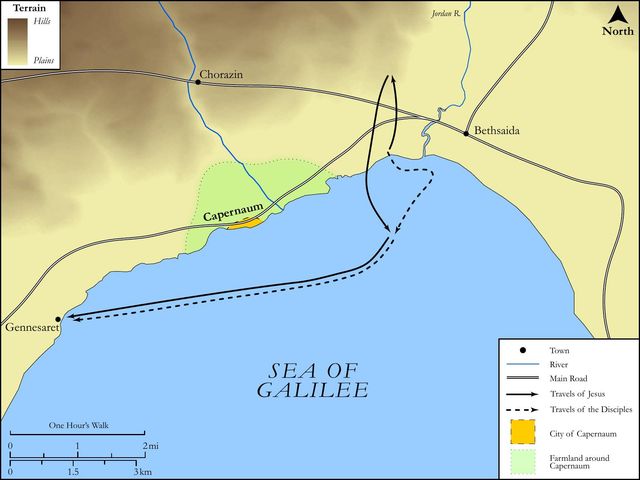
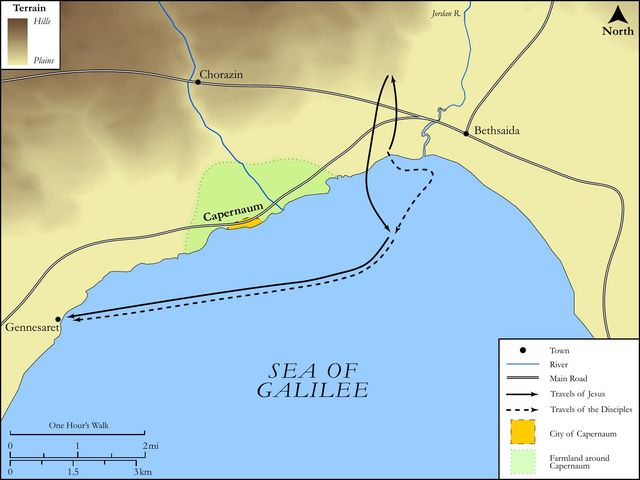
Study this verse
Public-domain commentary
Matthew Henry
From his Commentary on the Whole Bible. Henry comments on passages, not single verses — this entry covers Matthew 14:22–33. His four-level outline is real structure in the source text, so it is rendered as structure.
We have here the story of another miracle which Christ wrought for the relief of his friends and followers, his walking upon the water to his disciples. In the foregoing miracle he acted as the Lord of nature, improving its powers for the supply of those who were in want; in this, he acted as the Lord of nature, correcting and controlling its powers for the succour of those who were in danger and distress. Observe,
I.Christ's dismissing of his disciples and the multitude, after he had fed them miraculously.
He constrained his disciples to get into a ship, and to go before him unto the other side, Mat 14:22. St John gives a particular reason for the hasty breaking up of this assembly, because the people were so affected with the miracle of the loaves, that they were about to take him by force, and make him a king (Joh 6:15); to avoid which, he immediately scattered the people, sent away the disciples, lest they should join with them, and he himself withdrew, Joh 6:15.
When they had sat down to eat and drink, they did not rise up to play, but each went to his business.
1.Christ sent the people away. It intimates somewhat of solemnity in the dismissing of them; he sent them away with a blessing, with some parting words of caution, counsel, and comfort, which might abide with them.
2.He constrained the disciples to go into a ship first, for till they were gone the people would not stir. The disciples were loth to go, and would not have gone, if he had not constrained them. They were loth to go to sea without him. If thy presence go not with us, carry us not up hence. Exo 33:15. They were loth to leave him alone, without any attendance, or any ship to wait for him; but they did it in pure obedience.
II.Christ's retirement hereupon (Mat 14:23); He went up into a mountain apart to pray. Observe here,
1.That he was alone; he went apart into a solitary place, and was there all alone. Though he had so much work to do with others, yet he chose sometimes to be alone, to set us an example. Those are not Christ's followers that do not care for being alone; that cannot enjoy themselves in solitude, when they have none else to converse with, none else to enjoy, but God and their own hearts.
2.That he was alone at prayer; that was his business in this solitude, to pray. Though Christ, as God, was Lord of all, and was prayed to, yet Christ, as Man, had the form of a servant, of a beggar, and prayed. Christ has herein set before us an example of secret prayer, and the performance of it secretly, according to the rule he gave, Mat 6:6. Perhaps in this mountain there was some private oratory or convenience, provided for such an occasion; it was usual among the Jews to have such. Observe, When the disciples went to sea, their Master went to prayer; when Peter was to be sifted as wheat, Christ prayed for him.
3.That he was long alone; there he was when the evening was come, and, for aught that appears, there he was till towards morning, the fourth watch of the night. The night came on, and it was a stormy, tempestuous night, yet he continued instant in prayer. Note, It is good, at least sometimes, upon special occasions, and when we find our hearts enlarged, to continue long in secret prayer, and to take full scope in pouring out our hearts before the Lord. We must not restrain prayer, Job 15:4.
III.The condition that the poor disciples were in at this time:
Their ship was now in the midst of the sea, tossed with waves, Mat 14:24. We may observe here,
1.That they were got into the midst of the sea when the storm rose. We may have fair weather at the beginning of our voyage, and yet meet with storms before we arrive at the port we are bound for. Therefore, let not him that girdeth on the harness boast as he that puts it off, but after a long calm expect some storm or other.
2.The disciples were now where Christ sent them, and yet met with this storm. Had they been flying from their Master, and their work, as Jonah was, when he was arrested by the storm, it had been a dreadful one indeed; but they had a special command from their Master to go to sea at this time, and were going about their work. Note, It is no new thing for Christ's disciples to meet with storms in the way of their duty, and to be sent to sea then when their Master foresees a storm; but let them not take it unkindly; what he does they know not now, but they shall know hereafter, that Christ designs hereby to manifest himself with the more wonderful grace to them and for them.
3.It was a great discouragement to them now that they had not Christ with them, as they had formerly when they were in a storm; though he was then asleep indeed, yet he was soon awaked (Mat 8:24), but now he was not with them at all. Thus Christ used his disciples first to less difficulties, and then to greater, and so trains them up by degrees to live by faith, and not by sense.
4.Though the wind was contrary, and they were tossed with waves, yet being ordered by their Master to the other side, they did not tack about and come back again, but made the best of their way forward. Note, Though troubles and difficulties may disturb us in our duty, they must not drive us from it; but through the midst of them we must press forwards.
IV.Christ's approach to them in this condition (Mat 14:25); and in this we have an instance,
1.Of his goodness, that he went unto them, as one that took cognizance of their case, and was under a concern about them, as a father about his children. Note, The extremity of the church and people of God is Christ's opportunity to visit them and appear for them: but he came not till the fourth watch, toward three o'clock in the morning, for then the fourth watch began. It was in the morning-watch that the Lord appeared for Israel in the Red sea (Exo 14:24), so was this. He that keepeth Israel neither slumbers nor sleeps, but, when there is occasion, walks in darkness for their succour; helps, and that right early.
2.Of his power, that he went unto them, walking on the sea. This is a great instance of Christ's sovereign dominion over all the creatures; they are all under his feet, and at his command; they forget their natures, and change the qualities that we call essential. We need not enquire how this was done, whether by condensing the surface of the water (when God pleases, the depths are congealed in the heart of the sea, Exo 15:8), or by suspending the gravitation of his body, which was transfigured as he pleased; it is sufficient that it proves his divine power, for it is God's prerogative to tread upon the waves of the sea (Job 9:8), as it is to ride upon the wings of the wind. He that made the waters of the sea a wall for the redeemed of the Lord (Isa 51:10), here makes them a walk for the Redeemer himself, who, as Lord of all, appears with one foot on the sea and the other on dry land, Rev 10:2. The same power that made iron to swim (Kg2 6:6), did this. What ailed thee, O thou sea? Psa 114:5. It was at the presence of the Lord. Thy way, O God, is in the sea, (Psa 77:19). Note, Christ can take what way he pleases to save his people.
V.Here is an account of what passed between Christ and his distressed friends upon his approach.
1.Between him and all the disciples. We are here told,
(1.)How their fears were raised (Mat 14:26); When they saw him walking on the sea, they were troubled, saying, It is a spirit; phantasma esti - It is an apparition; so it might much better be rendered. it seems, the existence and appearance of spirits were generally believed in by all except the Sadducees, whose doctrine Christ had warned his disciples against; yet, doubtless, many supposed apparitions have been merely the creatures of men's own fear and fancy. These disciples said, It is the Lord; it can be no other. Note,
[1.]Even the appearances and approaches of deliverance are sometimes the occasions of trouble and perplexity to God's people, who are sometimes most frightened when they are least hurt; nay, when they are most favoured, as the Virgin Mary, Luk 1:29; Exo 3:6, Exo 3:7. The comforts of the Spirit of adoption are introduced by the terrors of the spirit of bondage, Rom 8:15.
[2.]The appearance of a spirit, or the fancy of it, cannot but be frightful, and strike a terror upon us, because of the distance of the world of spirits from us, the just quarrel good spirits have with us, and the inveterate enmity evil spirits have against us: see Job 4:14, Job 4:15. The more acquaintance we have with God, the Father of spirits, and the more careful we are to keep ourselves in his love, the better able we shall be to deal with those fears.
[3.]The perplexing, disquieting fears of good people, arise from their mistakes and misapprehensions concerning Christ, his person, offices, and undertaking; the more clearly and fully we know his name, with the more assurance we shall trust in him, Psa 9:10.
[4.]A little thing frightens us in a storm. When without are fightings, no marvel that within are fears. Perhaps the disciples fancied it was some evil spirit that raised the storm. Note, Most of our danger from outward troubles arises from the occasion they give for inward trouble.
(2.)How these fears were silenced, Mat 14:27. He straightway relieved them, by showing them their mistake; when they were wrestling with the waves, he delayed his succour for some time; but he hastened his succour against their fright, as much the more dangerous; he straightway laid that storm with his word, Be of good cheer; it is I; be not afraid.
[1.]He rectified their mistake, by making himself known to them, as Joseph to his brethren; It is I. He does not name himself, as he did to Paul, I am Jesus; for Paul as yet knew him not: but to these disciples it was enough to say, It is I; they knew his voice, as his sheep (Joh 10:4), as Mary Magdalene, Joh 20:16. They need not ask, Who art thou, Lord? Art thou for us or for our adversaries? They could say with the spouse, It is the voice of my beloved, Sol 2:8; Sol 5:2. True believers know it by a good token. It was enough to make them easy, to understand who it was they saw. Note, A right knowledge opens the door to true comfort, especially the knowledge of Christ.
[2.]He encouraged them against their fright; It is I, and therefore, First, Be of good cheer; tharseite - "Be courageous; pluck up your spirits, and be courageous." If Christ's disciples be not cheerful in a storm, it is their own fault, he would have them so. Secondly, Be not afraid; 1. "Be not afraid of me, now that you know it is I; surely you will not fear, for you know I mean you no hurt." Note, Christ will not be a terror to those to whom he manifests himself; when they come to understand him aright, the terror will be over. 2. "Be not afraid of the tempest, of the winds and waves, though noisy and very threatening; fear them not, while I am so near you. I am he that concerns himself for you, and will not stand by and see you perish." Note, Nothing needs be a terror to those that have Christ near them, and know he is theirs; no, not death itself.
2.Between him and Peter, Mat 14:28-31, where observe,
(1.)Peter's courage, and Christ's countenancing that.
[1.]It was very bold in Peter, that he would venture to come to Christ upon the water (Mat 14:28); Lord, if it be thou, bid me come unto thee. Courage was Peter's master grace; and that made him so forward above the rest to express his love to Christ, though others perhaps loved him as well.
First, It is an instance of Peter's affection to Christ, that he desired to come to him. When he sees Christ, whom, doubtless, during the storm, he had many a time wished for, he is impatient to be with him. He does not say, Bid me walk on the waters, as desiring it for the miracle sake; but, Bid me come to thee, as desiring it for Christ's sake; "Let me come to thee, no matter how." Note, True love will break through fire and water, if duly called to it, to come to Christ. Christ was coming to them, to succour and deliver them. Lord, said Peter, bid me come to thee. Note, When Christ is coming towards us in a way of mercy, we must go forth to meet him in a way of duty; and herein we must be willing and bold to venture with him and venture for him. Those that would have benefit by Christ as a Saviour, must thus by faith come to him. Christ had been now, for some time, absent, and hereby it appears why he absented himself; it was to endear himself so much the more to his disciples at his return, to make it highly seasonable and doubly acceptable. Note, When, for a small amount, Christ has forsaken his people, his returns are welcome, and most affectionately embraced; when gracious souls, after long seeking, find their Beloved at last, they hold him, and will not let him go, Sol 3:4.
Secondly, It is an instance of Peter's caution and due observance of the will of Christ, that he would not come without a warrant. Not, "If it be thou, I will come;" but If it be thou, bid me come. Note, The boldest spirits must wait for a call to hazardous enterprizes, and we must not rashly and presumptuously thrust ourselves upon them. Our will to services and sufferings is interpreted, not willingness, but wilfulness, if it have not a regard to the will of Christ, and be not regulated by his call and command. Such extraordinary warrants as this to Peter we are not now to expect, but must have recourse to the general rules of the word, in the application of which to particular cases, with the help of providential hints, wisdom is profitable to direct.
Thirdly, It is an instance of Peter's faith and resolution, that he ventured upon the water when Christ bid him. To quit the safety of the ship, and throw himself into the jaws of death, to despise the threatening waves he so lately dreaded, argued a very strong dependence upon the power and word of Christ. What difficulty or danger could stand before such a faith and such a zeal?
[2.]It was very kind and condescending in Christ, that he was pleased to own him in it, Mat 14:29. He might have condemned the proposal as foolish and rash; nay, and as proud and assuming; "Shall Peter pretend to do as his Master does?" But Christ knew that it came from a sincere and zealous affection to him, and graciously accepted of it. Note, Christ is well pleased with the expressions of his people's love, though mixed with manifold infirmities, and makes the best of them.
First, He bid him come. When the Pharisees asked a sign, they had not only a repulse, but a reproof, for it, because they did it with a design to tempt Christ; when Peter asked a sign, he had it, because he did it with a resolution to trust Christ. The gospel call is, "Come, come, to Christ; venture all in his hand, and commit the keeping of your souls to him; venture through a stormy sea, a troublesome world, to Jesus Christ."
Secondly, He bore him out when he did come; Peter walked upon the water. The communion of true believers with Christ is represented by their being quickened with him, raised up with him, made to sit with him, (Eph 2:5, Eph 2:6), and being crucified with him, Gal 2:20. Now, methinks, it is represented in this story by their walking with him on the water. Through the strength of Christ we are borne up above the world, enabled to trample upon it, kept from sinking into it, from being overwhelmed by it, obtain a victory over it (1 John v. 4), by faith in Christ's victory (Joh 16:33), and with him are crucified to it, Gal 6:14. See blessed Paul walking upon the water with Jesus, and more than a conqueror through him, and treading upon all the threatening waves, as not able to separate him from the love of Christ, Rom 8:35, etc. Thus the sea of the world is become like a sea of glass, congealed so as to bear; and they that have gotten the victory, stand upon it and sing, Rev 15:2, Rev 15:3.
He walked upon the water, not for diversion or ostentation, but to go to Jesus; and in that he was thus wonderfully borne up. Note, When our souls are following hard after God, then it is that his right hand upholds us; it was David's experience, Psa 63:8. Special supports are promised, and are to be expected, only in spiritual pursuits. When God bears his Israel upon eagles' wings, it is to bring them to himself (Exo 19:4); nor can we ever come to Jesus, unless we be upheld by his power; it is in his own strength that we wrestle with him, that we reach after him, that we press forward toward the mark, being kept by the power of God, which power we must depend upon, as Peter when he walked upon the water: and there is no danger of sinking while underneath are the everlasting arms.
(2.)Here is Peter's cowardice, and Christ's reproving him and succouring him. Christ bid him come, not only that he might walk upon the water, and so know Christ's power, but that he might sink, and so know his own weakness; for as he would encourage his faith, so he would check his confidence, and make him ashamed of it. Observe then,
[1.]Peter's great fear (Mat 14:30); He was afraid. The strongest faith and the greatest courage have a mixture of fear. Those that can say, Lord, I believe; must say, Lord, help my unbelief. Nothing but perfect love will quite cast out fear. Good men often fail in those graces which they are most eminent for, and which they have then in exercise; to show that they have not yet attained. Peter was very stout at first, but afterwards his heart failed him. The lengthening out of a trial discovers the weakness of faith.
Here is, First, The cause of this fear; He saw the wind boisterous. While Peter kept his eye fixed upon Christ, and upon his word and power, he walked upon the water well enough; but when he took notice withal of the danger he was in, and observed how the floods lift up their waves, then he feared. Note, Looking at difficulties with an eye of sense more than at precepts and promises with an eye of faith is at the bottom of all our inordinate fears, both as to public and personal concerns. Abraham was strong in faith, because he considered not his own body (Rom 4:19); he minded not the discouraging improbabilities which the promise lay under, but kept his eye on God's power; and so, against hope, believed in hope, Mat 14:18. Peter, when he saw the wind boisterous, should have remembered what he had seen (Mat 8:27), when the winds and the sea obeyed Christ; but therefore we fear continually every day, because we forget the Lord our Maker, Isa 51:12, Isa 51:13.
Secondly, The effect of this fear; He began to sink. While faith kept up, he kept up above water: but when faith staggered, he began to sink. Note, The sinking of our spirits is owing to the weakness of our faith; we are upheld (but it is as we are saved) through faith (Pe1 1:5); and therefore, when our souls are cast down and disquieted, the sovereign remedy is, to hope in God, Psa 43:5. It is probable that Peter, being bred a fisherman, could swim very well (Joh 21:7); and perhaps he trusted in part to that, when he cast himself into the sea; if he could not walk, he could swim; but Christ let him begin to sink, to show him that it was Christ's right hand and his holy arm, not any skill of his own, that was his security. It was Christ's great mercy to him, that, upon the failing of his faith, he did not leave him to sink outright, to sink to the bottom as a stone (Exo 15:5), but gave him time to cry, Lord, save me. Such is the care of Christ concerning true believers; though weak, they do but begin to sink! A man is never sunk, never undone, till he is in hell. Peter walked as he believed; to him, as to others, the rule held good, According to your faith be it unto you.
Thirdly, The remedy he had recourse to in this distress, the old, tried, approved remedy, and that was prayer: he cried, Lord, save me. Observe, 1. The manner of his praying; it is fervent and importunate; He cried. Note, When faith is weak, prayer should be strong. Our Lord Jesus has taught us in the day of our fear to offer up strong cries, Heb 5:7. Sense of danger will make us cry, sense of duty and dependence on God should make us cry to him. 2. The matter of his prayer was pertinent and to the purpose; He cried, Lord, save me. Christ is the great Saviour, he came to save; those that would be saved, must not only come to him, but cry to him for salvation; but we are never brought to this, till we find ourselves sinking; sense of need will drive us to him.
[2.]Christ's great favour to Peter, in this fright. Though there was a mixture of presumption with Peter's faith in his first adventure, and of unbelief with his faith in his after-fainting, yet Christ did not cast him off; for,
First, He saved him; he answered him with the saving strength of his right hand (Psa 20:6), for immediately he stretched forth his hand, and caught him. Note, Christ's time to save is, when we sink (Psa 18:4-7): he helps at a dead lift. Christ's hand is still stretched out to all believers, to keep them from sinking. Those whom he hath once apprehended as his own, and hath snatched as brands out of the burning, he will catch out of the water too. Though he may seem to have left his hold, he doth but seem to do so, for they shall never perish, neither shall any man pluck them out of his hand, Joh 10:28. Never fear, he will hold his own. Our deliverance from our own fears, which else would overwhelm us, is owing to the hand of his power and grace, Psa 34:4.
Secondly, He rebuked him; for as many as he loves and saves, he reproves and chides; O thou of little faith, wherefore didst thou doubt? Note, 1. Faith may be true, and yet weak; at first, like a grain of mustard-seed. Peter had faith enough to bring him upon the water, yet, because not enough to carry him through, Christ tells him he had but little. 2. Our discouraging doubts and fears are all owing to the weakness of our faith: therefore we doubt, because we are but of little faith. It is the business of faith to resolve doubts, the doubts of sense, in a stormy day, so as even then to keep the head above water. Could we but believe more, we should doubt less. 3. The weakness of our faith, and the prevalence of our doubts, are very displeasing to our Lord Jesus. It is true, he doth not cast off weak believers, but it is as true, that he is not pleased with weak faith, no, not in those that are nearest to him. Wherefore didst thou doubt? What reason was there for it? Note, Our doubts and fears would soon vanish before a strict enquiry into the cause of them; for, all things considered, there is no good reason why Christ's disciples should be of a doubtful mind, no, not in a stormy day, because he is ready to them a very present Help.
VI.The ceasing of the storm, Mat 14:32.
When Christ was come into the ship, they were presently at the shore. Christ walked upon the water till he came to the ship, and then went into that, when he could easily have walked to the shore; but when ordinary means are to be had, miracles are not to be expected. Though Christ needs not instruments for the doing of his work, he is pleased to use them. Observe, when Christ came into the ship, Peter came in with him. Companions with Christ in his patience, shall be companions in his kingdoms, Rev 1:9. Those that walk with him shall reign with him; those that are exposed, and that suffer with him, shall triumph with him.
When they were come into the ship, immediately the storm ceased, for it had done its work, its trying work. He that has gathered the winds into his fists, and bound the waters in a garment, is the same that ascended and descended; and his word even stormy winds fulfil, Psa 148:8. When Christ comes into a soul, he makes winds and storms to cease there, and commands peace. Welcome Christ, and the noise of her waves will soon be quelled. The way to be still is, to know that he is God, that he is the Lord with us.
VII.The adoration paid to Christ hereupon (Mat 14:33); They that were in the ship came and worshipped him, and said, Of a truth, thou art the Son of God. Two good uses they made of this distress, and this deliverance.
1.It was a confirmation of their faith in Christ, and abundantly convinced them that the fulness of the Godhead dwelt in him; for none but the world's Creator could multiply the loaves, none but its Governor could tread upon the waters of the sea; they therefore yield to the evidence, and make confession of their faith; Thou truly art the Son of God. They knew before that he was the Son of God, but now they know it better. Faith, after a conflict with unbelief, is sometimes the more active, and gets to greater degrees of strength by being exercised. Now they know it of a truth. Note, It is good for us to know more and more of the certainty of those things wherein we have been instructed, Luk 1:4. Faith then grows, when it arrives at a full assurance, when it sees clearly, and saith, Of a truth.
2.They took occasion from it to give him the glory due unto his name. They not only owned that great truth, but were suitable affected by it; they worshiped Christ. Note, When Christ manifests his glory for us, we ought to return it to him (Psa 50:15); I will deliver thee, and thou shalt glorify me. Their worship and adoration of Christ were thus expressed, Of a truth thou art the Son of God. Note, The matter of our creed may and must be made the matter of our praise. Faith is the proper principle of worship, and worship the genuine product of faith. He that comes to God must believe; and he that believes in God, will come, Heb 9:6.
Historical interpretation
Seven Centuries of Reception
12 surviving comments on this verse. Each one is dated, so this reads as a timeline rather than a list.
Select a marker to jump to its quote. Markers stagger vertically where authors wrote within a few decades of each other.
(App. Serm. 72. 1.) Mystically; The mountain is loftiness. But what is higher than the heavens in the world? And Who it was that ascended into heaven, that our faith knows. Why did He ascend alone into heaven? Because no man has ascended into heaven, but He that came down from heaven. For even when He shall come in the end, and shall have exalted us into heaven, He will yet ascend alone, inasmuch as the head with its body is One Christ, and now the head only is ascended. He went up to pray, because He is ascended to make intercession to His Father for us.
Or, that He is alone in the evening, signifies His sorrow at the time of His passion, when the rest were scattered from Him in fear.
That He commands His disciples to enter the ship and to go across the sea, while He sends the multitudes away, and after that He goes up into the mountain to pray; He therein bids us to be within the Church, and to be in peril until such time as returning in His splendour He shall give salvation to all the people that shall be remaining of Israel, and shall for give their sins; and having dismissed them into His Father's kingdom, returning thanks to His Father, He shall sit down in His glory and majesty. Meanwhile the disciples are tossed by the wind and the waves; struggling against all the storms of this world, raised by the opposition of the unclean spirit.
The first watch Was therefore of the Law, the second of the Prophets, the third His coming in the flesh, the fourth His return in glory.
But Christ coming in the end shall find His Church wearied, and tossed by the spirit of Anti-Christ, and by the troubles of the world. And because by their long experience of Anti-Christ they will be troubled at every novelty of trial, they shall have fear even at the approach of the Lord, suspecting deceitful appearances. But the good Lord banishes their fear, saying, It is I; and by proof of His presence takes away their dread of impending shipwreck.
Or; That Peter alone out of all the number of those that were in the vessel has courage to answer, and to pray that the Lord would bid him come to Him upon the waters, figures the frowardness of his will in the Lord's passion, when following after the Lord's steps he endeavoured to attain to despise death. But his fearfulness shows his weakness in his after trial, when through fear of death, he was driven to the necessity of denial. His crying out here is the groaning of his repentance there.
That when Peter was seized with fear, the Lord gave him not power of coming to Him, but held him by the hand and sustained him, this is the signification thereof; that He who alone was to suffer for all alone forgave the sins of all; and no partner is admitted into that which was bestowed upon mankind by one.
Also by this entrance of Christ into the boat, and the calm of the wind and sea thereupon, is pointed out the eternal peace of the Church, and that rest which shall be after His return in glory. And forasmuch as He shall then appear manifestly, rightly do they all cry out now in wonder, Truly thou art the Son of God. For there shall then be a free and public confession of all men that the son of God is come no longer in lowliness of body, but that He has given peace to the Church in heavenly glory.
And, having wrought the miracle, "straightway He constrained His disciples to get into a ship, and to go before Him unto the other side, while He sent the multitudes away."
For even if He had seemed, when in sight, to be presenting an illusion, and not to have wrought a truth; yet surely not in His absence also. For this cause then, submitting His proceedings to an exact test, He commanded those that had got the memorials, and the proof of the miracles, to depart from Him.
And besides this, when He is doing great works, He disposes elsewhere of the multitudes and the disciples, instructing us in nothing to follow after the glory that comes from the people, nor to collect a crowd about us.
Now by saying, "He constrained them," He indicates the very close attendance of the disciples.
And His pretext indeed for dismissing them was the multitude, but He was Himself minded to go up into the mountain; and He did this, instructing us neither to be always in intercourse with multitudes, nor always to fly from the crowd, but each of the two as may be expedient, and giving each duly his turn.
For what purpose doth He go up into the mountain? To teach us, that loneliness and retirement is good, when we are to pray to God. With this view, you see, He is continually withdrawing into the wilderness, and there often spends the whole night in prayer, teaching us earnestly to seek such quietness in our prayers, as the time and place may confer. For the wilderness is the mother of quiet; it is a calm and a harbor, delivering us from all turmoils.
He Himself then went up thither with this object, but the disciples are tossed with the waves again, and undergo a storm, equal even to the former. But whereas before they had Him in the ship when this befell them, now they were alone by themselves. Thus gently and by degrees He excites and urges them on for the better, even to the bearing all nobly. Accordingly we see, that when they were first near that danger, He was present, though asleep, so as readily to give them relief; but now leading them to a greater degree of endurance, He doth not even this, but departs, and in mid sea permits the storm to arise, so that they might not so much as look for a hope of preservation from any quarter; and He lets them be tempest-tost all the night, thoroughly to awaken, as I suppose, their hardened heart.
For such is the nature of the fear, which the time concurs with the rough weather in producing. And together with the compunction, He cast them also into a greater longing for Himself, and a continual remembrance of Him.
Desiring to occasion a diligent examination of the things that had been done, He commanded those who had beheld the foregoing sign to be separated from Him; for even if He had continued present it would have been said that He had wrought the miracle fantastically, and not in verity; but it would never be urged against Him that He had done it in His absence; and therefore it is said, And straightway Jesus compelled his disciples to get into a ship, and to go before him to the other side, while he sent the multitudes away.
It should be observed, that when the Lord works a great miracle, He sends the multitudes away, teaching us thereby never to pursue the praise of the multitude, nor to attract them to us. Further, He teaches us that we should not be ever mixed with crowds, nor yet always shunning them; but that both may be done with profit; whence it follows, And when he had sent the multitude away, he went up into a mountain apart to pray; showing us that solitude is good, when we have need to pray to God. For this also He goes into the desert, and there spends the night in prayer, to teach us that for prayer we should seek stillness both in time and place.
Again, the disciples suffer shipwreck, as they had done before; but then they had Him in the boat, but now they are alone. Thus gradually He leads them to higher things, and instructs them to endure all manfully.
But He suffers them to be tossed the whole night, exciting their hearts by fear, and inspiring them with greater desire and more lasting recollection of Him; for this reason He did not stand by them immediately, but as it follows, in the fourth watch of the night he came to them walking upon the sea.
Teaching them not to seek a speedy riddance of coming evil, but to bear manfully such things as befal them. But when they thought that they were delivered, then was their fear increased, whence it follows, And seeing him walking upon the sea, they were troubled, saying, It is a vision, and through fear they cried out. For this the Lord ever does; when He is to rescue from any evil, He brings in things terrible and difficult. For since it is impossible that our temptation should continue a long time, when the warfare of the righteous is to be finished, then He increases their conflicts, desiring to make greater gain of them; which He did also in Abraham, making his hot conflict his trial of the loss of his son.
Christ then did not reveal Himself to His disciples until they cried out; for the more intense their fear, the more did they rejoice in His presence; whence it follows, And immediately Jesus spoke to them, saying, Be of good cheer, it is J, be not afraid. This speech took away their fear, and prepared their confidence.
See how great his warmth, how great his faith. He said not, Pray and entreat for me; but Bid me; he believes not only that Christ can Himself walk on the sea, but that He can lead others also thereon; also he wishes to come to Him speedily, and this, so great a thing, he asks not from ostentation, but from love. For he said not, Bid me walk upon the waters, but, Bid me come unto thee. And it seems that having shown in the first miracle that He has power over the sea, He now leads them to a more powerful sign; He saith unto him, Come. And Peter, going forth of the boat, walked on the sea, that he might go to Jesus.
Peter overcame that which was greater, the waves, namely, of the sea, but is troubled by the lesser, the blowing wind, for it follows, But seeing the wind boisterous, he was afraid. Such is human nature, in great trials ofttimes holding itself aright, and in lesser falling into fault. This fear of Peter showed the difference between Master and disciple, and thereby appeased the other disciples. For if they had indignation when the two brothers prayed to sit on the right and left hand, much more had they now. For they were not yet made spiritual; afterwards when they had been made spiritual, they every where yield the first place to Peter, and appoint him to lead in harangues to the people.
He bade not the winds to cease, but stretched forth His hand and caught him, because his faith was required. For when our own means fail, then those which are of God stand. Then to show that not the strength of the tempest, but the smallness of his faith worked the danger, He saith unto him, O thou of little faith, why didst thou doubt? which shows that not even the wind would have been able to hurt him, if his faith had been firm. But as the mother bears on her wings and brings back to the nest her chick which has left the nest before its time and has fallen, so did Christ. And when they were come into the boat, the wind ceased. Then they that were in the boat came and worshipped him, saying, Truly thou art the Son of God.
Observe how He leads all gradually to that which is above them; He had before rebuked the sea, now He shows forth His power yet more by walking upon the sea, by bidding another to do the same, and by saving him in his peril; therefore they said unto Him, Truly thou art the Son of God, which they had not said above.
These words show that they left the Lord unwillingly, not desiring through their love for their teacher to be separated from Him even for a moment.
That He withdraws to pray alone, you should refer not to Him who fed five thousand on five loaves, but to Him who on hearing of the death of John withdrew into the desert; not that we would separate the Lord's person into two parts, but that His actions are divided between the God and the man.
Rightly had the Apostles departed from the Lord as unwilling, and slow to leave Him, lest they should suffer shipwreck whilst He was not with them. For it follows, Now when it was evening he was there alone; that is, in the mountain; but the boat was in the middle of the sea tossed with the waves; for the wind was contrary.
While the Lord tarries in the top of the mountain, straightway a wind arises contrary to them, and stirs up the sea, and the disciples are in imminent peril of shipwreck, which continues till Jesus comes.
The military guards and watches are divided into portions of three hours each. When then he says that the Lord came to them in the fourth watch, this shows that they had been in danger the whole night.
A confused noise and uncertain sound is the mark of great fear. But if, according to Marcion and Manichæus, our Lord was not born of a virgin, but was seen in a phantasm, how is it that the Apostles now fear that they have seen a phantasm (or vision)?
Whereas He says, It is I, without saying who, either they might be able to understand Him speaking through the darkness of night; or they might know that it was He who had spoken to Moses, Say unto the children of Israel, He that is has sent me unto you. (Exod. 3:14.) On every occasion Peter is found to be the one of the most ardent faith. And with the same zeal as ever, so now, while the others are silent, he believes that by the will of his Master he will be able to do that which by nature he cannot do; whence it follows, Peter answered and said unto him, Lord, if it be thou, bid me come unto thee upon the water. As much as to say, Do thou command, and straightway it will become solid; and that body which is in itself heavy will become light.
Let those who think that the Lord's body was not real, because He walked upon the yielding waters as a light æthereal substance, answer here how Peter walked, whom they by no means deny to be man.
Moreover he is left to temptation for a short season, that his faith may be increased, and that he may understand that he is saved not by his ability to ask, but by the power of the Lord. For faith burned at his heart, but human frailty drew him into the deep.
If then upon this single miracle of stilling the sea, a thing which often happens by accident after even great tempests, the sailors and pilots confessed them to be truly the Son of God, how does Arrius preach in the Church itself that He is a creature?
Also He ascends into the mountain alone because the multitude cannot follow Him aloft, until He has instructed it by the shore of the sea.
(Verse 23) And when the crowd was dismissed, he went up the mountain alone to pray. But when evening came, he was there alone. If Peter, James, and John, who had seen the glory of his transfiguration, had been with him, perhaps they would have gone up the mountain with him. But the crowd cannot follow to the heights, unless he teaches them by the sea on the shore and feeds them in the desert. But as for him going up alone to pray, do not attribute it to the one who satisfied five thousand men with five loaves, excluding women and children; but to the one who, upon hearing of John's death, withdrew into solitude. Not that we should separate the person of the Lord, but that his works are divided between God and man.
(ubi sup.) But while Christ prays on high, the boat is tossed with great waves in the deep; and forasmuch as the waves rise, that boat can be tossed; but because Christ prays, it cannot be sunk. Think of that boat as the Church, and the stormy sea as this world.
(De Cons. Ev. ii. 47.) This may seem contrary to that Matthew says, that having sent the multitudes away, He went up into a mountain that He might pray alone; and John again says, that it was on a mountain that He fed this same multitude. But since John himself says further, that after that miracle He retired to a mountain that He might not be held by the multitude, who sought to make Him a king, it is clear that He had come down from the mountain when He fed them. Nor do Matthew's words, He went up into a mountain alone to pray, disagree with this, though John says, When he knew that they would come to make him a king, he withdrew into a mountain himself alone. (John 6:15.) For the cause of His praying is not contrary to the cause of His retiring, for herein the Lord teaches us that we have great cause for prayer when we have cause for flight. Nor, again, is it contrary to this that Matthew says first, that He bade His disciples go into the boat, and then that He sent the multitudes away, and went into a mountain alone to pray; while John relates that He first withdrew to the mountain, and then, when it was late, his disciples went down to the sea, and when they had entered into a boat, &c. for who does not see that John is relating as afterwards done by His disciples what Jesus had commanded before He retired into the mountain?
And the Lord will be with thee to help thee, when lulling to rest the perils of thy trials, He restores the confidence of His protection, and this towards the break of day; for when human frailty beset with difficulties considers the weakness of its own powers, it looks upon itself as in darkness; when it raises its view to the protection of heaven, it straightway beholds the rise of the morning star, which gives its light through the whole of the morning watch.
The multitude being hungry, He creates no new viands, but having taken what the disciples had, He gave thanks. In like manner when He came in the flesh, He preached no other things than what had been foretold, but showed that the writings of the Law and the Prophets were big with mysteries. That which, the multitude leave is taken up by the disciples, because the more secret mysteries which cannot be comprehended by the uninstructed, are not to be treated with neglect, but are to be diligently sought out by the twelve Apostles (who are represented by the twelve baskets) and their successors. For by baskets servile offices are performed, and God has chosen the weak things of the world to confound the strong. The five thousand for the five senses of the body are they who in a secular condition know how to use rightly things without.
Lastly, Theodorus wrote that the Lord had not bodily weight in respect of His flesh, but without weight walked on the sea. But the catholic faith preaches the contrary; for Dionysius says that He walked on the wave, without the feet, being immersed, having bodily weight, and the burden of matter.
(Non occ.) This may be understood either of the sailors, or of the Apostles.
Whence it is well said here, that the ship was in the middle of the sea, and He alone on the land, because the Church is sometimes oppressed with such persecution that her Lord may seem to have forsaken her for a season.
The Lord looked back upon him, and brought him to repentance; He stretched forth His hand, and forgave him, and thus the disciple found salvation, which is not of him that willeth or of him that runneth, but of God that showeth mercy. (Rom. 9:16.)
Nor should we wonder that the wind ceased when the Lord had entered into the boat; for in whatsoever heart the Lord is present by grace, there all wars cease.
He went up on the mountain to show that we should pray in an undistracted manner; everything He did was for our sake as He Himself had no need of prayer. He prayed on into the evening, teaching us not to cease praying after a short time, and also to pray especially at night, for it is very quiet then. He permits the disciples to be caught in a storm, so that they might learn to endure trials bravely and know His power. The boat was out in the very middle of the sea so that their fear would be greater.
Continue studying Matthew 14:23 across the web’s major study libraries — every link below opens this exact verse, chapter, or book on the destination site.
Read & Compare
 BibleGatewayThis verse in more than 200 translations and 70 languages.
 Bible.comThe YouVersion reader — hundreds of translations, reading plans, and highlights.
 ESV.orgCrossway's official English Standard Version reader.
 NET BibleThe NET translation with 60,000+ translators' notes on every rendering decision.
 STEP BibleTyndale House's free study tool — original text, vocabulary, and scholarly resources.
 BibliaLogos Bible Software's free web reader.
 USCCBThe New American Bible (Revised Edition) with the U.S. bishops' study notes.
Commentaries
 BibleHub CommentariesDozens of classic commentaries on this verse, gathered on one page.
 StudyLightMore than 100 commentary sets — the largest collection on the web.
 BibleRefPlain-English commentary on what this verse means, verse by verse.
 Enduring WordDavid Guzik's free commentary on this chapter, widely used by Bible teachers.
 Bible Study ToolsVerse commentary alongside Greek and Hebrew study aids.
Original Language & Research
- BibleHub InterlinearThe verse word by word — original language, transliteration, and English.
- BibleHub LexiconEvery word's original-language definition and Strong's entry.
 Blue Letter BibleDeep-study tools — Strong's numbers, concordance, and word studies.
 CNTR CollationThe earliest Greek manuscripts of this verse, collated letter by letter.
Sermons, Hymns & Audio


TrulyRandomVerse is not affiliated with these sites and doesn’t control their content. They’re linked because they’re genuinely useful.
Summary
After miraculously feeding thousands, Jesus deliberately withdrew from the clamoring crowds and even His disciples, ascending a mountain to engage in solitary prayer as evening fell. This intentional act highlights His profound reliance on the Father, His need for spiritual replenishment, and His consistent prioritization of communion with God amidst intense public ministry.
Context
ShowHideLiterary Context
This verse immediately follows the miraculous feeding of the five thousand, one of Jesus' most public and impressive displays of divine power. The sheer scale of the miracle, involving thousands of people fed from a meager supply, would have generated immense excitement and perhaps even political fervor, as evidenced by the crowd's desire to make Jesus king (John 6:15). In response to this overwhelming attention and the physical demands of ministry, Jesus takes proactive steps to disperse the crowds and send His disciples ahead by boat. This strategic withdrawal sets the stage for a period of personal communion with God, demonstrating a pattern of retreating for spiritual refreshment before significant events, such as the subsequent dramatic walking on water.
Historical & Cultural Context
Mountains in the biblical narrative often serve as places of divine encounter, revelation, and prayer. From Moses receiving the Law on Mount Sinai (Exodus 19) to Elijah's encounter with God on Mount Horeb (1 Kings 19), these elevated spaces symbolized proximity to God and separation from the mundane. For Jesus, withdrawing to a mountain would have resonated with this established spiritual tradition, signifying a deliberate ascent not just geographically, but spiritually. Furthermore, the constant demands of a public ministry in ancient Israel, where crowds would follow a revered teacher relentlessly, made intentional solitude a vital, though often challenging, practice for maintaining spiritual focus and avoiding the pitfalls of popular acclaim.
Key Themes
ShowHideMatthew 14:23 powerfully contributes to several overarching themes in the Gospel. Firstly, it underscores the priority of prayer in Jesus' life, revealing that even the Son of God, despite His divine nature and recent triumph, relied completely on His Father. This consistent practice of prayer is seen throughout His ministry, as highlighted in passages like Luke 5:16. Secondly, the verse emphasizes the necessity of solitude for spiritual renewal and clarity, modeling a counter-cultural discipline in a world filled with distractions and demands. Thirdly, it illustrates Jesus' profound humility and dependence on God, choosing communion with the Father over the adulation of the masses or the immediate needs of His disciples. This act of withdrawal serves as a quiet preparation for the powerful demonstration of His authority over creation that immediately follows.
Exposition and Analysis
ShowHideKey Word Analysis
ShowHideThis verb means "to free fully, i.e. (literally) relieve, release, dismiss (reflexively, depart), or (figuratively) let die, pardon or (specially) divorce." In this context, it signifies Jesus' deliberate act of dismissing the large crowds, not merely a casual departure. It implies a purposeful separation, creating space for His own spiritual need and preventing the crowds from imposing their agenda (e.g., making Him king, as in John 6:15).
Derived from a word meaning "pertaining to self," this term conveys "one's own; by implication, private or separate." When combined with the preposition katá (G2596, "down" or "according to"), as in the phrase kat' idian, it strongly emphasizes Jesus' intentional seeking of privacy and isolation. It was not a coincidental aloneness but a deliberate, personal withdrawal for a specific purpose.
Meaning "remaining, i.e. sole or single; by implication, mere," this word reinforces the complete isolation Jesus sought. It highlights His singular focus on communion with God, free from the presence of even His closest disciples. This state of being "alone" underscores the depth and intimacy of the prayer He was about to engage in.
Verse Breakdown
ShowHide"And when he had sent the multitudes away"
This clause describes Jesus' active and intentional dismissal of the large crowds that had just witnessed the miracle of the feeding. It signifies His control over the situation and His prioritization of spiritual discipline over continued public engagement or the potential for political uprising.
"he went up into a mountain apart to pray"
This phrase reveals Jesus' destination and His explicit purpose. Ascending a mountain suggests a deliberate move away from the populated areas, seeking an elevated, secluded place. The phrase "apart" (Greek kat' idian) emphasizes the privacy and solitude of this withdrawal, which was specifically "to pray"—highlighting the central motivation for His isolation.
"and when the evening was come"
This temporal marker indicates the passage of time, suggesting that Jesus spent a significant portion of the afternoon or early evening in this solitary ascent and initial period of prayer. It sets the scene for the subsequent events that would unfold under the cover of darkness.
"he was there alone"
This final clause reiterates and emphasizes the complete solitude of Jesus. It confirms that His intentional dismissal of the crowds and disciples resulted in a state of utter aloneness, allowing for unhindered and intimate communion with His Heavenly Father.
Literary Devices
ShowHideMatthew 14:23 employs several literary devices to convey its profound message. The Contrast between the preceding scene of thousands of people and Jesus' subsequent state of utter solitude ("alone") powerfully highlights His intentional withdrawal and the counter-cultural nature of His spiritual discipline. The Symbolism of the "mountain" is significant; throughout Scripture, mountains are places of divine encounter, revelation, and prayer, suggesting a spiritual ascent and a direct communion with God. This setting foreshadows the divine power Jesus will display shortly thereafter by walking on water. The repeated emphasis on Jesus being "apart" and "alone" serves as Emphasis, underscoring the deliberate and profound nature of His need for isolated prayer, not merely a casual retreat. This deliberate action also serves as Foreshadowing for the subsequent dramatic event of Jesus walking on water, implying that periods of deep communion with God often precede powerful demonstrations of His presence and authority.
Theological and Thematic Connections
ShowHideThis verse is a profound theological statement about the nature of Jesus' humanity and His divine relationship with the Father. It reveals that even the Son of God, fully divine, lived a life of complete dependence on the Father, modeling for humanity the absolute necessity of prayer and solitude for spiritual vitality. His withdrawal after a major miracle, rather than basking in acclaim or continuing ministry, demonstrates His unwavering focus on the Father's will above all else. This practice of retreating to pray was a consistent pattern for Jesus, underscoring that spiritual power and effectiveness flow from intimate communion with God, not from human effort or public success.
Reflection and Application
ShowHideIn an age characterized by constant connectivity, relentless demands, and the pervasive noise of digital distractions, Matthew 14:23 offers a compelling and counter-cultural model for spiritual health. Jesus, despite His divine power and the pressing needs of the multitudes, intentionally sought solitude for prayer. This teaches us that true spiritual strength and clarity are cultivated not in the clamor of activity, but in the quiet space of communion with God. It challenges us to re-evaluate our priorities, asking whether we genuinely carve out dedicated, undistracted time to be "apart" and "alone" with our Heavenly Father. This practice is not a luxury but a necessity for spiritual growth, discernment, and resilience in the face of life's challenges, preparing us for whatever "storm" may come next, just as Jesus' prayer preceded His walking on water.
Questions for Reflection
ShowHideFAQ
ShowHideWhy did Jesus need to pray if He was God?
ShowHideJesus' need for prayer, as demonstrated in Matthew 14:23, highlights His perfect humanity and His complete reliance on the Father as part of the Trinity. While fully God, Jesus also fully embraced His human nature, which included dependence on God for strength, guidance, and communion. His prayer life was not a sign of weakness or a lack of divine power, but rather an example for us. It showed His submission to the Father's will, His deep intimacy within the Godhead, and His consistent practice of seeking spiritual replenishment to fulfill His mission. It underscores that even the Son of God lived a life of perfect obedience and dependence, modeling the very relationship with God that He came to restore for humanity.
What is the significance of Jesus going "into a mountain apart" to pray?
ShowHideThe choice of a "mountain apart" for prayer carries significant biblical and theological weight. Throughout Scripture, mountains are often depicted as places of divine encounter and revelation, such as Mount Sinai where Moses received the Law (Exodus 19) or Mount Carmel where Elijah confronted the prophets of Baal (1 Kings 18). By ascending a mountain, Jesus was not merely seeking physical solitude but also engaging in a spiritual ascent, separating Himself from the clamor of the world to draw closer to the Father. The phrase "apart" (Greek kat' idian) emphasizes this intentional privacy, signifying a deliberate withdrawal from public ministry and even His disciples to engage in unhindered, intimate communion with God. This setting underscores the sacredness and intensity of His prayer.
Christ-Centered Fulfillment
ShowHideMatthew 14:23, depicting Jesus' solitary prayer on the mountain, profoundly illuminates His identity and mission as the Christ. This act of withdrawal and dependence on the Father is not merely an admirable spiritual discipline but a vital aspect of His redemptive work. As the perfect human, Jesus models the absolute dependence on God that humanity lost in the Fall, demonstrating what it means to live a life fully surrendered to the Father's will. His prayer life, particularly in moments of intense pressure or before significant events, reveals His constant communion with the Father, which was essential for His messianic task. This intimate relationship empowered Him to perfectly fulfill His role as the Lamb of God who takes away the sin of the world, and as the Great High Priest who intercedes for us. His solitary prayer on the mountain foreshadows His ultimate agonizing prayer in Gethsemane, where He again sought the Father's will before His ultimate sacrifice. Thus, His solitude and prayer here are not only an example but a demonstration of the perfect Son's complete reliance on the Father, a reliance that secured our salvation and opened the way for us to enter into that same communion through Him (John 14:6).