


Matthew 26:36
- ΤότεToteThenG5119ADVAdverb
- ἔρχεταιerchetaicomesG2064V-PNI-3SVerb Present Middle Or Passive Deponent Indicative 3rd Singular
- μετ᾽met᾽withG3326PREPPreposition
- αὐτῶνautōnthemG846P-GPMPersonal pronoun Genitive Plural Masculine
- ὁho<the>G3588T-NSMDefinite article Nominative Singular Masculine
- ἸησοῦςIēsousJesusG2424N-NSM-PNoun Nominative Singular Masculine Individual
- εἰςeistoG1519PREPPreposition
- χωρίονchōriona placeG5564N-ASNNoun Accusative Singular Neuter
- λεγόμενονlegomenonbeing namedG3004V-PPP-ASNVerb Present Passive Participle Accusative Singular Neuter
- ΓεθσημανὶGethsēmaniGethsemaneG1068N-ASN-LNoun Accusative Singular Neuter Location
- καὶkaiandG2532CONJConjunction
- λέγειlegeiHe saysG3004V-PAI-3SVerb Present Active Indicative 3rd Singular
- τοῖςtoisto theG3588T-DPMDefinite article Dative Plural Masculine
- μαθηταῖς·mathētaisdisciplesG3101N-DPMNoun Dative Plural Masculine
- καθίσατεkathisatedo sitG2523V-AAM-2PVerb Aorist Active Imperative 2nd Plural
- αὐτοῦautouhereG847ADVAdverb
- ἕωςhe'ōsuntilG2193PREPPreposition
- οὗhouthatG3739R-GSMRelative pronoun Genitive Singular Masculine
- ἀπελθὼνapelthōnhaving gone awayG565V-2AAP-NSMVerb 2nd Aorist Active Participle Nominative Singular Masculine
- ἐκεῖekeiover thereG1563ADVAdverb
- προσεύξωμαιproseuxōmaiI may prayG4336V-ADS-1SVerb Aorist Middle Deponent Subjunctive 1st Singular
English is a literal word-by-word gloss of the Greek, not the KJV's wording. Why?
This is the original text the KJV's translators worked from — each Greek word with its own literal English meaning in this verse, prepared by scholars at Tyndale House, Cambridge. The KJV translates whole sentences, not word by word, so its wording differs: one Greek word can become several English words, and the KJV may choose “charity” where the gloss reads “love”. Both are faithful — they answer different questions. For the KJV's own rendering, switch to the KJV text.
Details
See on the biblical-era map
Study this verse
Historical interpretation
Nine Centuries of Reception
13 surviving comments on this verse. Each one is dated, so this reads as a timeline rather than a list.
Select a marker to jump to its quote. Markers stagger vertically where authors wrote within a few decades of each other.
Jesus brought his disciples from the upper room to a garden which was called Gethsemane because, after he was betrayed, he did not want to be arrested in the same place where he and his disciples had eaten the Passover. Even before he was betrayed, however, he thought it fitting to choose to pray in places devoted purely to prayer, for he knew that some locations are holier than others, as it is written: “The place where you are standing is holy ground.”
For it was not fitting that He should be seized in the place where He had sate and eaten the Passover with His disciples. Also He must first pray, and choose a place pure for prayer.
These words, He began to be sorrowful and very heavy, are interpreted by heretics that fear of death assailed the Son of God, being (as they allege) neither begotten from eternity, nor existing in the Father's infinite substance, but produced out of nothing by Him who created all things; and that hence He was liable to anguish of grief, and fear of death. And He who can fear death can also die; and He who can die, though He shall exist after death, yet is not eternal through Him who begot Him in past time. Had these faith to receive the Gospels, they would know that the Word was in the beginning God, and from the beginning with God, and that the eternity of Him who begets and Him who is begotten is one and the same. But if the assumption of flesh infected with its natural infirmity the virtue of that incorruptible substance, so that it became subject to pain, and shrinking from death, it would also become thereby liable to corruption, and thus its immortality being changed into fear, that which is in it is capable of at some time ceasing to be. But God ever is without measure of time, and such as He is, He continues to be eternally. Nothing then in God can die, nor can God have any fear springing out of Himself.
(de Trin. x. 10.) I suppose that there are some who offer here no other cause of His fear than His passion and death. I ask those who think thus, whether it stands with reason that He should have feared to die, who banished from the Apostles all fear of death, and exhorted them to the glory of martyrdom? How can we suppose Him to have felt pain and grief in the sacrament of death, who rewards with life those who die for Him? And what pangs of death could He fear, who came to death of the free choice of His own power? And if His Passion was to do Him honour, how could the fear of His Passion make Him sorrowful?
(in loc.) Since then we read that the Lord was sorrowful, let us discover the causes of His agony. He had forewarned them all that they would be offended, and Peter that he would thrice deny his Lord; and taking him and James and John, He began to be sorrowful. Therefore He was not sorrowful till He took them, but all His fear began after He had taken them; so that His agony was not for Himself, but for them whom He had taken.
(ill. Luc. 22:43.) He is sorrowful, yet not Himself, but His soul; not His Wisdom, not His divine Substance, but His soul, for He took upon Him my soul, and my body.
Because they clung to Him inseparably, therefore He saith, "Tarry ye here, while I go away and pray." For it was usual with Him to pray apart from them. And this He did teaching us in our prayers, to prepare silence for ourselves and great retirement.
And He takes with Him the three, and saith unto them, "my soul is exceeding sorrowful, even unto death." Wherefore doth He not take all with Him? That they might not be cast down; but these He taketh that had been spectators of His glory.
[I suppose also that Peter fell into these words through ambition and boastfulness. And they had disputed at supper which of them should be greatest, whence we see that the love of empty glory disturbed them much. And so to deliver him from such passions, Christ withdrew His aid from him. Moreover observe how after the resurrection, taught by his fall he speaks to Christ more humbly, and does not any more resist His words. All this his fall wrought for him; for before he had attributed all to himself, when he ought rather to have said, I will not deny Thee if Thou succour me with Thy aid. But afterwards he shows that every thing is to be ascribed to God; Why look ye so earnestly upon us, as though by our own power and holiness we had made this man to walk?]q (Act 3:12.) Hence then we learn the great doctrine, that man's wish is not enough, unless he enjoys Divine support.
(Hom. Ixxxiii.) He says, Sit ye here, while I go and pray yonder, because the disciples adhered inseparably to Christ; but it was His practice to pray apart from them, therein teaching us to study quiet and retirement for our prayers.
Gethsemane is interpreted, 'The rich valley;' and there He bade His disciples sit a little while, and wait His return whilst He prayed alone for all.
(non. occ.) But we say that passible man was so taken by God the Son, that His Deity remained impassible. Indeed the Son of God suffered, not by imputation but actually, all that Scripture testifies, in respect of that part of Him which could suffer, viz. in respect of the substance that He had taken on Him.
The Lord therefore sorrowed not from fear of suffering, for for this cause He had come that He should suffer, and had rebuked Peter for his fearfulness; (Matt. 14:31.) but for the wretched Judas, for the offence of the rest of the Apostles, for the rejection and reprobation of the Jewish nation, and the overthrow of unhappy Jerusalem.
Our Lord therefore sorrowed to prove the reality of the Man which He had taken upon Him; but that passion might bear no sway in His mind, He began to be sorrowful by pro-passion;s for it is one thing to be sorrowful, and another to be very sorrowful.
He is sorrowful not because of death, but unto death, until He has set the Apostles free by His Passion. Let those who imagine Jesus to have taken an irrational soul, say how it is that He is thus sorrowful, and knows the season of His sorrow, for though the brute animals have sorrow, yet they know neither the causes of it, nor the time for which it must endure.
Or the sleep which He would have them forego is not bodily rest, for which at this critical time there was no room, but mental torpor, the sleep of unbelief.
Gethsemane is interpreted as the “very fertile valley” where the Lord ordered his disciples to sit down and wait for him to return while he prayed alone for everyone.
(Verse 36.) Then Jesus came with them to a village called Gethsemane and said to his disciples, 'Sit here while I go over there and pray.' Gethsemane means 'very fertile valley,' in which he ordered the disciples to sit for a little while and wait for the Lord to return, while he prayed for everyone alone.
The Evangelist had said a little above, that when they had sung an hymn they went out to the mount of Olives; to point out the part of the mount to which they took their way, he now adds, Then came Jesus with them to a garden called Gethsemane.
He had accepted the disciples' faith and the devotedness of their will, but He foresaw that they would be troubled and scattered abroad, and therefore bade them sit still in their places; for to sit belongs to one at ease, but they would be grievously troubled that they should have denied Him. In what fashion He went forward it describes, And taking with him Peter and the two sons of Zebedee, he began to be sorrowful and very heavy; the same to whom He had shown His glory in the mount.
By this place are overthrown the Manichæans, who said that He took an unreal body; and those also who said that He had not a real soul, but His Divinity in place of a soul1
(de. Fid. Orth. iii. 24.) But seeing that prayer is the sending up the understanding to God, or the asking of God things fitting, how did the Lord pray? For His understanding needed not to be lifted up to God, having been once united hypostatically to God the Word. Neither could He need to ask of God things fitting, for the One Christ is both God and Man. But giving in Himself a pattern to us, He taught us to ask of God, and to lift up our minds to Him. As He took on Him our passions, that by triumphing over them Himself, He might give us also the victory over them, so now He prays to open to us the way to that lifting up to God, to fulfil for us all righteousness, to reconcile His Father to us, to pay honour to Him as the First Cause, and to show that He is not against God.
(Fid. Orth. iii. 23.) Or otherwise; All things which have not yet been brought into existence by their Maker have a natural desire of existence, and naturally shun non-existence. God the Word then, having been made Man, had this desire, through which He desired food, drink, and sleep, by which life is supported, and naturally used them, and contrariwise shunned the things that are destructive of life. Hence in the season of His Passion which He endured voluntarily, He had the natural fear and sorrow for death. For there is a natural fear wherewith the soul shrinks from separation from the body, by reason of that close sympathy implanted from the first by the Maker of all things.
(Fid. Orth. iii. 20.) Wherefore the passions of our nature were in Christ both by nature and beyond nature. By nature, because He left His flesh to suffer the things incidental to it; beyond nature, because these natural emotions did not in Him precede the will. For in Christ nothing befel of compulsion, but all was voluntary; with His will He hungered, with His will He feared, or was sorrowful. Here His sorrow is declared, Then saith he unto them, My soul is sorrowful even unto death.
Luke says, To the mount of Olives, (Luke 22:39.) and John, Went forth over the brook Cedron, where was a garden, (John 18:1.) which is the same as this Gethsemane, and is a place where He prayed at the foot of mount Olivet, where is a garden, and a Church now builtr
When the Lord prayed in the mountain, He taught us to make supplication for heavenly things; when He prays in the garden, He teaches us to study humility in our prayer. And beautifully, as He draws near His Passion, does He pray in the 'valley of fatness,' showing that through the valley of humility, and the richness of charity, He took upon Him death for our sakes. The practical instruction which we may also learn from this is, that we should not suffer our heart to dry up from the richness of charity.
Wanting to show that he had genuine love, Peter contradicted the Saviour. He had earlier been freed of the fear that he himself might be the betrayer, and now Peter, with great love but also out of a desire for honor, began to rise up against the others and even to oppose Christ. But equally the other disciples, before they had experienced the trials, in ignorance made promises that they would not be able to keep. Jesus went away to pray in private, for prayer requires quiet and solitude.
Continue studying Matthew 26:36 across the web’s major study libraries — every link below opens this exact verse, chapter, or book on the destination site.
Read & Compare
 BibleGatewayThis verse in more than 200 translations and 70 languages.
 Bible.comThe YouVersion reader — hundreds of translations, reading plans, and highlights.
 ESV.orgCrossway's official English Standard Version reader.
 NET BibleThe NET translation with 60,000+ translators' notes on every rendering decision.
 STEP BibleTyndale House's free study tool — original text, vocabulary, and scholarly resources.
 BibliaLogos Bible Software's free web reader.
 USCCBThe New American Bible (Revised Edition) with the U.S. bishops' study notes.
Commentaries
 BibleHub CommentariesDozens of classic commentaries on this verse, gathered on one page.
 StudyLightMore than 100 commentary sets — the largest collection on the web.
 BibleRefPlain-English commentary on what this verse means, verse by verse.
 Enduring WordDavid Guzik's free commentary on this chapter, widely used by Bible teachers.
 Bible Study ToolsVerse commentary alongside Greek and Hebrew study aids.
Original Language & Research
- BibleHub InterlinearThe verse word by word — original language, transliteration, and English.
- BibleHub LexiconEvery word's original-language definition and Strong's entry.
 Blue Letter BibleDeep-study tools — Strong's numbers, concordance, and word studies.
 CNTR CollationThe earliest Greek manuscripts of this verse, collated letter by letter.
Sermons, Hymns & Audio


TrulyRandomVerse is not affiliated with these sites and doesn’t control their content. They’re linked because they’re genuinely useful.
Summary
Matthew 26:36 initiates the profoundly poignant scene in the Garden of Gethsemane, where Jesus, on the eve of His crucifixion, confronts the immense weight of His impending suffering and death. This verse sets the stage for His agonizing prayer, revealing His full humanity and perfect submission to the Father's redemptive plan, a pivotal moment of spiritual struggle and resolve before His arrest.
Context
ShowHideLiterary Context
This verse immediately follows the institution of the Lord's Supper, where Jesus revealed the new covenant in His blood and foreshadowed His sacrificial death. Directly after this, Jesus led His disciples in singing a hymn, likely a part of the Hallel psalms (Psalm 113-118), traditionally sung during Passover. As they left the Upper Room, Jesus prophesied the disciples' scattering and Peter's threefold denial (Matthew 26:31-35). Thus, Matthew 26:36 marks a transition from communal fellowship and prophetic declaration to a deeply personal and solitary spiritual battle, setting the narrative trajectory toward His betrayal, arrest, and ultimate crucifixion. It is the calm before the storm, a moment of intense internal conflict for the Savior.
Historical & Cultural Context
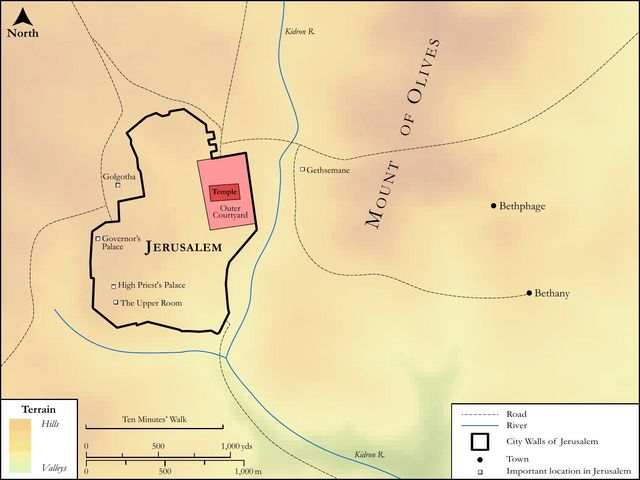
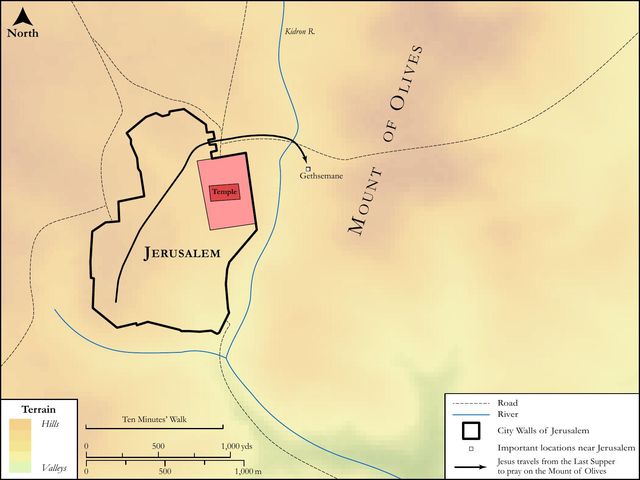
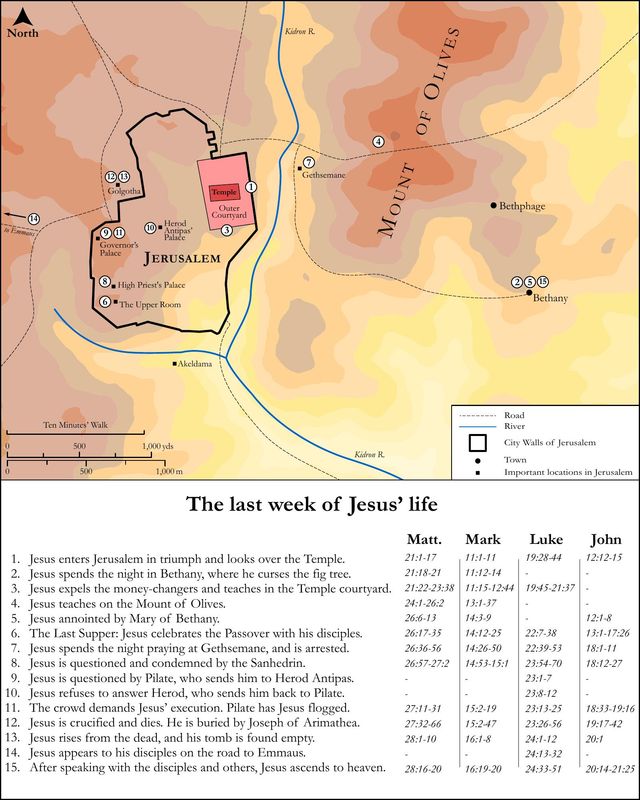
The setting, Gethsemane, was a garden or olive grove located at the foot of the Mount of Olives, across the Kidron Valley from Jerusalem. This area was a familiar retreat for Jesus and His disciples (Luke 22:39). The timing was late at night, likely after midnight, during the Passover Feast, a time of heightened religious fervor and pilgrimage in Jerusalem. The city would have been bustling, but Gethsemane offered a measure of quiet and seclusion. Gardens were often places of prayer and contemplation in ancient Jewish culture. The act of Jesus withdrawing to pray, even asking His disciples to wait, highlights the cultural understanding of private devotion, yet within the context of a shared spiritual journey. The journey across the Kidron Valley itself, a valley often associated with judgment and death in prophetic literature, adds a somber undertone to their path.
Key Themes
ShowHideMatthew 26:36 contributes significantly to several overarching themes in Matthew's Gospel and the broader biblical narrative. Firstly, it powerfully underscores the Humanity of Christ, demonstrating Jesus' very real human emotions of sorrow, anguish, and the need for divine strength in the face of suffering, even as He remains fully divine. Secondly, it highlights the Necessity and Power of Prayer, portraying Jesus, the Son of God, modeling profound reliance on the Father through fervent prayer in His greatest trial. This sets the stage for His subsequent plea in Matthew 26:39, "My Father, if it be possible, let this cup pass from me: nevertheless not as I will, but as thou wilt." Thirdly, it introduces the theme of Submission to Divine Will, as Gethsemane becomes the crucible where Jesus fully embraces the Father's redemptive plan, despite the immense personal cost. Finally, it subtly introduces the theme of Discipleship and Failure, as the disciples are asked to "sit ye here," indicating their limited capacity to fully comprehend or participate in the depth of Jesus' agony, foreshadowing their eventual desertion.
Exposition and Analysis
ShowHideKey Word Analysis
ShowHideThis name, derived from Aramaic, literally means "oil press." The symbolism is profound: just as olives were crushed under immense pressure to extract their oil, Jesus was about to be "pressed" by the overwhelming weight of humanity's sin, the wrath of God, and the agony of the cross. This location, therefore, becomes a prophetic stage for His spiritual and emotional crushing, leading to the ultimate outpouring of His life for salvation.
This verb signifies "to come or go," often with a sense of purpose or destiny. Here, it emphasizes Jesus' deliberate movement towards Gethsemane, not as a passive victim, but as one purposefully advancing towards the culmination of His earthly mission. It implies a conscious, determined step into the crucible of His suffering, underscoring His active role in fulfilling the Father's will.
This term specifically denotes prayer directed toward God, often with an implication of supplicating or worshipping. It highlights the intimate, dependent relationship Jesus had with the Father, even in His divine nature. His intention to "pray yonder" signals a deep, personal, and intense communion, distinct from the disciples' more passive waiting, indicating the profound spiritual battle He was about to engage in.
Verse Breakdown
ShowHide"Then cometh Jesus with them unto a place called Gethsemane,"
This clause establishes the setting and the company. "Then" (G5119, tóte) marks a chronological progression from the Last Supper and the journey from Jerusalem. Jesus' active "cometh" (G2064, érchomai) signifies His intentional movement towards this specific location. The phrase "with them" indicates that His disciples are still accompanying Him, though their role is about to shift. The destination, "Gethsemane" (G1068), is introduced as a known "place" (G5564, chōríon), setting the stage for the intense spiritual struggle to unfold.
"and saith unto the disciples,"
This simple conjunction "and" (G2532, kaí) introduces Jesus' direct address to His followers. The act of "saith" (G3004, légō) indicates a formal instruction or command, distinguishing His subsequent actions from theirs. It underscores His leadership and the specific instructions He gives them for this critical moment.
"Sit ye here, while I go and pray yonder."
This is Jesus' direct command, separating Himself from the main group of disciples. "Sit ye here" (G2523, kathízō G847, autoû) instructs them to remain at a designated spot, implying a boundary to their participation in His immediate struggle. The phrase "while I go" (G565, apérchomai) indicates His intention to proceed further into the garden alone, or with a select few. The purpose of His withdrawal is clear: "and pray" (G4336, proseúchomai), emphasizing the central activity. "Yonder" (G1563, ekeî) further stresses His desire for a more private, intense communion, underscoring the solitary nature of the spiritual battle He was about to face.
Literary Devices
ShowHideMatthew 26:36 is rich with Symbolism and Foreshadowing. The very name Gethsemane, meaning "oil press," serves as a powerful symbol of the intense spiritual and physical "pressing" Jesus is about to endure. Just as olives are crushed to yield their oil, Jesus will be crushed by the weight of sin and divine wrath to bring forth salvation. This location, therefore, is not arbitrary but deeply meaningful. The act of Jesus separating Himself from the disciples and going "yonder" to pray foreshadows the solitary nature of His ultimate suffering and atonement on the cross—a burden He alone could bear. There is also an element of Contrast established between Jesus' active, purposeful movement towards prayer and the disciples' passive instruction to "sit ye here," hinting at their inability to fully grasp or participate in the depth of His agony, which will later manifest in their falling asleep. This sets up the Dramatic Irony of the disciples' failure to watch and pray, despite Jesus' clear instruction and their earlier fervent promises.
Theological and Thematic Connections
ShowHideMatthew 26:36 serves as a profound theological statement on the nature of Christ and the necessity of His atoning work. It reveals Jesus as both fully divine and fully human, experiencing genuine anguish and dependence on the Father, even as He steadfastly walks the path of obedience. This moment underscores the reality of the Incarnation, where the Son of God voluntarily embraces the human condition, including its vulnerability to suffering and the need for divine sustenance through prayer. His withdrawal to pray in Gethsemane is not a sign of weakness, but of perfect reliance and submission to the Father's will, a necessary step in the unfolding of God's redemptive plan for humanity. It is here that the battle for the soul of humanity is spiritually engaged before its physical manifestation on the cross.
Reflection and Application
ShowHideMatthew 26:36 offers a timeless model for every believer facing moments of profound difficulty, fear, or decision. Jesus, in His deepest anguish, did not retreat into despair or self-pity, but intentionally sought out a place of solitude to commune with His Father. This highlights the indispensable role of prayer as our primary resource for strength, clarity, and submission to God's will, especially when our own "Gethsemanes" arise—those seasons of intense spiritual, emotional, or physical trial. We are called to follow His example, drawing near to God in honest, fervent prayer, even when the path ahead seems overwhelming or terrifying. Furthermore, this verse reminds us of Jesus' perfect humanity; He truly understands our weaknesses and struggles, making Him a compassionate High Priest who can empathize with our every infirmity. Our faith is not in a distant, unfeeling deity, but in a Savior who has walked our path of suffering and conquered it through perfect obedience and reliance on God.
Questions for Reflection
ShowHideFAQ
ShowHideWhy did Jesus choose Gethsemane for this pivotal prayer?
ShowHideJesus chose Gethsemane, meaning "oil press," for this pivotal prayer not only because it was a familiar and secluded place for Him and His disciples on the Mount of Olives, but also for its profound symbolic significance. The name itself foreshadows the immense spiritual and emotional "pressing" or crushing that Jesus would endure there, akin to olives being crushed to extract oil. This location served as the crucible where He wrestled with the Father's will and the full weight of humanity's sin before His ultimate sacrifice on the cross. It was a place of deep agony, but also of resolute submission to the divine plan, setting the stage for the redemptive work that would culminate at Calvary.
What is the significance of Jesus telling His disciples, "Sit ye here, while I go and pray yonder"?
ShowHideJesus' instruction to His disciples to "Sit ye here, while I go and pray yonder" is highly significant. It indicates His need for a deeper, more solitary communion with the Father in this moment of intense spiritual struggle. While He desired their presence and support, the battle He was about to face was uniquely His own, a burden no one else could share or fully comprehend. This separation underscores the unparalleled nature of His atoning work and His unique relationship with the Father. It also highlights the disciples' limited capacity to truly "watch" or participate in the depth of His agony, foreshadowing their later failure to stay awake and their eventual desertion of Him (as seen in Matthew 26:40-41).
Christ-Centered Fulfillment
ShowHideMatthew 26:36, the gateway to Gethsemane, is a profound Christ-centered moment, revealing the very heart of the Messiah's mission. Here, Jesus, the Son of God, fully embraces His role as the Suffering Servant, perfectly fulfilling the prophecies of Isaiah (e.g., Isaiah 53:3-7). His agonizing prayer, initiated by His withdrawal to "pray yonder," is not a sign of reluctance but of His perfect humanity grappling with the immense cost of divine obedience, ultimately leading to His resolute "not my will, but yours be done" (Matthew 26:39). Gethsemane is where the Lamb of God willingly submits to being "pressed" for the sins of the world, foreshadowing His ultimate sacrifice on the cross, which brings about the new covenant in His blood (Luke 22:20). His obedience in this moment of intense spiritual warfare secured victory over sin and death, paving the way for our reconciliation with God and His triumphant resurrection (Romans 5:19). Thus, Matthew 26:36 is not merely a historical account but a vital theological pivot, showcasing Christ's active and willing participation in His redemptive work for all humanity.