


Mark 14:34
- καὶkaiAndG2532CONJConjunction
- λέγειlegeiHe saysG3004V-PAI-3SVerb Present Active Indicative 3rd Singular
- αὐτοῖς·autoisto themG846P-DPMPersonal pronoun Dative Plural Masculine
- περίλυπόςperiluposVery sorrowfulG4036A-NSFAdjective Nominative Singular Feminine
- ἐστινestinisG1510V-PAI-3SVerb Present Active Indicative 3rd Singular
- ἡhētheG3588T-NSFDefinite article Nominative Singular Feminine
- ψυχήpsuchēsoulG5590N-NSFNoun Nominative Singular Feminine
- μουmouof MineG3165P-1GSPersonal pronoun Genitive 1st Singular
- ἕωςhe'ōsuntilG2193PREPPreposition
- θανάτουthanatoudeathG2288N-GSMNoun Genitive Singular Masculine
- μείνατεmeinatedo remainG3306V-AAM-2PVerb Aorist Active Imperative 2nd Plural
- ὧδεhōdehereG5602ADVAdverb
- καὶkaiandG2532CONJConjunction
- γρηγορεῖτεgrēgoreitedo watchG1127V-PAM-2PVerb Present Active Imperative 2nd Plural
English is a literal word-by-word gloss of the Greek, not the KJV's wording. Why?
This is the original text the KJV's translators worked from — each Greek word with its own literal English meaning in this verse, prepared by scholars at Tyndale House, Cambridge. The KJV translates whole sentences, not word by word, so its wording differs: one Greek word can become several English words, and the KJV may choose “charity” where the gloss reads “love”. Both are faithful — they answer different questions. For the KJV's own rendering, switch to the KJV text.
Details
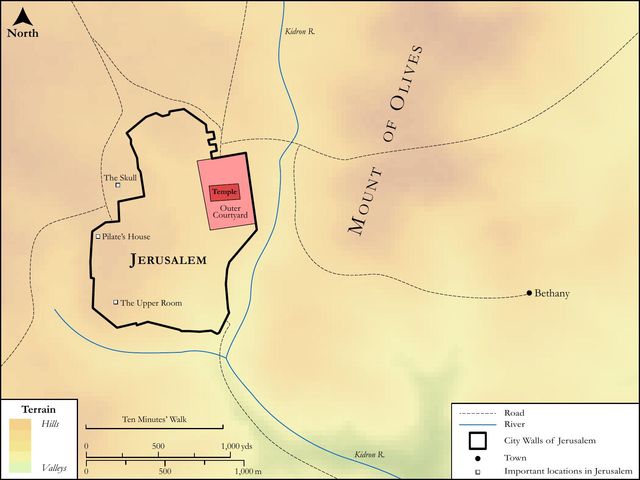
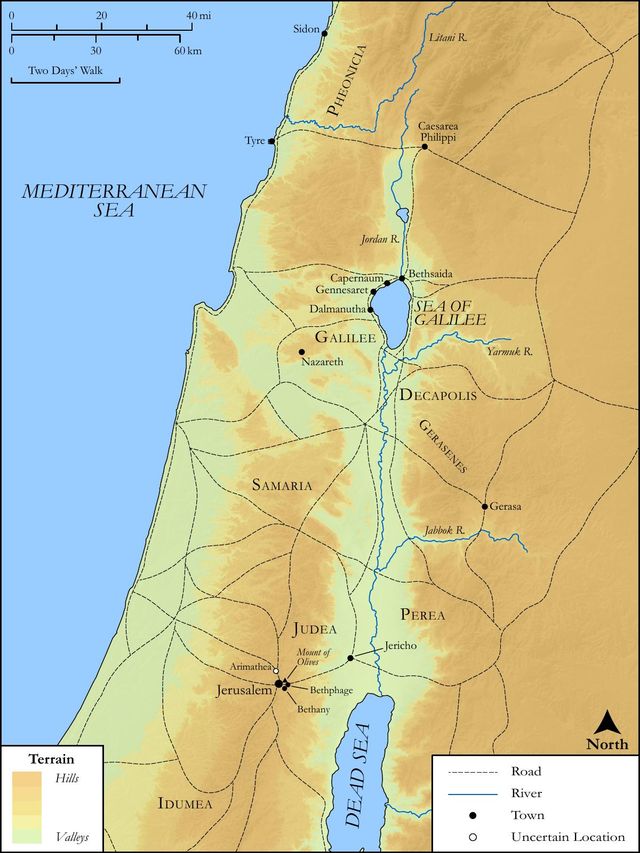
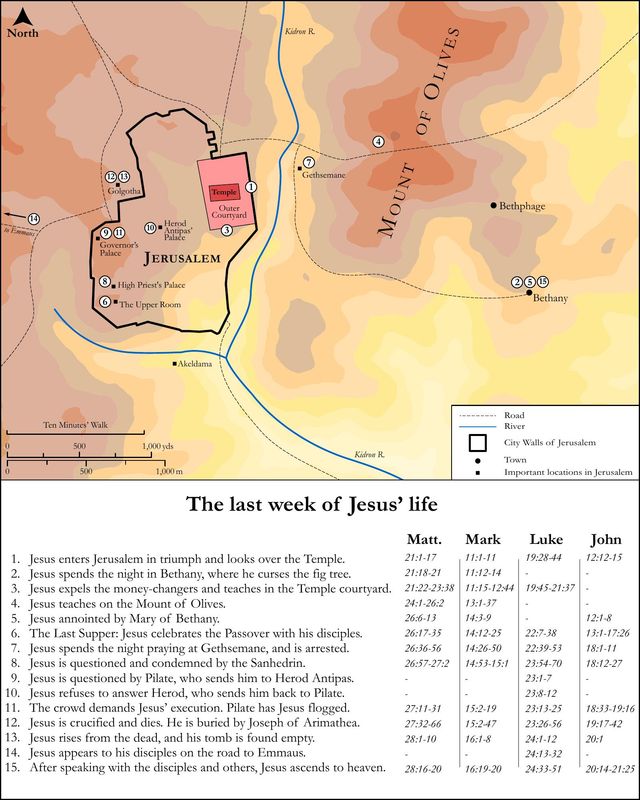
See on the biblical-era map
Study this verse
Public-domain commentary
Matthew Henry
From his Commentary on the Whole Bible. Henry comments on passages, not single verses — this entry covers Mark 14:32–42. His three-level outline is real structure in the source text, so it is rendered as structure.
Christ is here entering upon his sufferings, and begins with those which were the sorest of all his sufferings, those in his soul. Here we have him in his agony; this melancholy story we had in Matthew; this agony in soul was the wormwood and the gall in the affliction and misery; and thereby it appeared that no sorrow was forced upon him, but that it was what he freely admitted.
I.He retired for prayer; Sit ye here (saith he to his disciples), while I go a little further, and pray.
He had lately prayed with them (Jn. 17); and now he appoints them to withdraw while he goes to his Father upon an errand peculiar to himself. Note, Our praying with our families will not excuse our neglect of secret worship. When Jacob entered into his agony, he first sent over all that he had, and was left alone, and then there wrestled a man with him (Gen 32:23, Gen 32:24), though he had been at prayer before (Mar 14:9), it is likely, with his family.
II.Even into that retirement he took with him Peter, and James, and John (Mar 14:33), three competent witnesses of this part of his humiliation; and though great spirits care not how few know any thing of their agonies, he was not ashamed that they should see. These three had boasted most of their ability and willingness to suffer with him; Peter here, in this chapter, and James and John (Mar 10:39); and therefore Christ takes them to stand by, and see what a struggle he had with the bloody baptism and the bitter cup, to convince them that they knew not what they said. It is fit that they who are most confident, should be first tried, that they may be made sensible of their folly and weakness.
III.There he was in a tremendous agitation (Mar 14:33); He began to be sore amazed - ekthambeisthai, a word not used in Matthew, but very significant; it bespeaks something like that horror of great darkness, which fell upon Abraham (Gen 15:12), or, rather, something much worse, and more frightful. The terrors of God set themselves in array against him, and he allowed himself the actual and intense contemplation of them. Never was sorrow like unto his at that time; never any had such experience as he had from eternity of divine favours, and therefore never any had, or could have, such a sense as he had of divine favours. Yet there was not the least disorder or irregularity in this commotion of his spirits; his affections rose not tumultuously, but under direction, and as they were called up, for he had no corrupt nature to mix with them, as we have. If water have a sediment at the bottom, though it may be clear while it stands still, yet, when shaken, it grows muddy; so it is with our affections: but pure water in a clean glass, though ever so much stirred, continues clear; and so it was with Christ. Dr. Lightfoot thinks it very probable that the devil did now appear to our Saviour in a visible shape, in his own shape and proper colour, to terrify and affright him, and to drive him from his hope in God (which he aimed at in persecuting Job, a type of Christ, to make him curse God, and die), and to deter him from the further prosecution of his undertaking; whatever hindered him from that, he looked upon as coming from Satan, Mat 16:23. When the devil had tempted him in the wilderness, it is said, He departed from him for a season (Luk 4:13), intending another grapple with him, and in another way; finding that he could not by his flatteries allure him into sin, he would try by his terrors to affright him into it, and so make void his design.
IV.He made a sad complaint of this agitation. He said, My soul is exceeding sorrowful.
1.He was made sin for us, and therefore was thus sorrowful; he fully knew the malignity of the sins he was to suffer for; and having the highest degree of love to God, who was offended by them, and of love to man, who was damaged and endangered by them, now that those were set in order before him, no marvel that his soul was exceeding sorrowful. Now was he made to serve with our sins, and was thus wearied with our iniquities.
2.He was made a curse for us; the curses of the law were transferred to him as our surety and representative, not as originally bound with us, but a bail to the action. And when his soul was thus exceeding sorrowful, he did, as it were, yield to them, and lie down under the load, until by his death he had satisfied for sin, and so for ever abolished the curse. He now tasted death (as he is said to do, Heb 2:9), which is not an extenuating expression, as if he did but taste it; no, he drank up even the dregs of the cup; but it is rather aggravating; it did not go down by wholesale, but he tasted all the bitterness of it. This was that fear which the apostle speaks of (Heb 5:7), a natural fear of pain and death, which it is natural to human nature to startle at.
Now the consideration of Christ's sufferings in his soul, and his sorrows for us, should be of use to us,
(1.)To embitter our sins. Can we ever entertain a favourable or so much as a slight thought of sin, when we see what impression sin (though but imputed) made upon the Lord Jesus? Shall that sit light upon our souls, which sat so heavy upon his? Was Christ in such an agony for our sins, and shall we never be in an agony about them? How should we look upon him whom we have pressed, whom we have pierced, and mourn, and be in bitterness! It becomes us to be exceeding sorrowful for sin, because Christ was so, and never to make a mock at it. If Christ thus suffered for sin, let us arm ourselves with the same mind.
(2.)To sweeten our sorrows; if our souls be at any time exceeding sorrowful, through the afflictions of this present time, let us remember that our Master was so before us, and the disciple is not greater than his Lord. Why should we affect to drive away sorrow, when Christ for our sakes courted it, and submitted to it, and thereby not only took out the sting of it, and made it tolerable, but put virtue into it, and made it profitable (for by the sadness of the countenance the heart is made better), nay, and put sweetness into it, and made it comfortable. Blessed Paul was sorrowful, and yet always rejoicing. If we be exceeding sorrowful, it is but unto death; that will be the period of all our sorrows, if Christ be ours; when the eyes are closed, all tears are wiped away from them.
V.He ordered his disciples to keep with him, not because he needed their help, but because he would have them to look upon him and receive instruction; he said to them, Tarry ye here and watch. He had said to the other disciples nothing but, Sit ye here (Mar 14:32); but these three he bids to tarry and watch, as expecting more from them than from the rest.
VI.He addressed himself to God by prayer (Mar 14:35); He fell on the ground, and prayed.
It was but a little before this, that in prayer he lifted up his eyes (Joh 17:1); but here, being in an agony, he fell upon his face, accommodating himself to his present humiliation, and teaching us thus to abase ourselves before God; it becomes us to be low, when we come into the presence of the Most High.
1.As Man, he deprecated his sufferings, that, if it were possible, the hour might pass from him (Mar 14:35); "This short, but sharp affliction, that which I am now this hour to enter upon, let man's salvation be, if possible, accomplished without it." We have his very words (Mar 14:36), Abba, Father. The Syriac word is here retained, which Christ used, and which signifies Father, to intimate what an emphasis our Lord Jesus, in his sorrows, laid upon it, and would have us to lay. It is with an eye to this, that St. Paul retains this word, putting it into the mouths of all that have the Spirit of adoption; they are taught to cry, Abba, Father, Rom 8:15; Gal 4:6. Father, all things are possible to thee. Note, Even that which we cannot expect to be done for us, we ought yet to believe that God is able to do: and when we submit to his will, and refer ourselves to his wisdom and mercy, it must be with a believing acknowledgment of his power, that all things are possible to him.
2.As Mediator, he acquiesced in the will of God concerning them; "Nevertheless, not what I will, but what thou wilt. I know the matter is settled, and cannot be altered, I must suffer and die, and I bid it welcome."
VII.He roused his disciples, who were dropped asleep while he was at prayer, Mar 14:37, Mar 14:38.
He comes to look after them, since they did not look after him; and he finds them asleep, so little affected were they with his sorrows, his complaints, and prayers. This carelessness of theirs was a presage of their further offence in deserting him; and it was an aggravation of it, that he had so lately commended them for continuing with him in his temptations, though they had not been without their faults. Was he so willing to make the best of them, and were they so indifferent in approving themselves to him? They had lately promised not to be offended in him; what! and yet mind him so little? He particularly upbraided Peter with his drowsiness; Simon, sleepest thou? Kai su teknon; - "What thou, my son? Thou that didst so positively promise thou wouldest not deny me, dost thou slight me thus? From thee I expected better things. Couldest thou not watch one hour?" He did not require him to watch all night with him, only for one hour. It aggravates our faintness and short continuance in Christ's service, that he doth not over-task us, nor weary us with it, Isa 43:23. He puts upon us no other burthen than to hold fast till he comes (Rev 2:24, Rev 2:25); and behold, he comes quickly, Rev 3:11.
As those whom Christ loves he rebukes when they do amiss, so those whom he rebukes he counsels and comforts. 1. It was a very wise and faithful word of advice which Christ here gave to his disciples; Watch and pray, lest ye enter into temptation, v. 38. It was bad to sleep when Christ was in his agony, but they were entering into further temptation, and if they did not stir up themselves, and fetch in grace and strength from God by prayer, they would do worse; and so they did, when they all forsook him, and fled. 2. It was a very kind and tender excuse that Christ made for them; "The spirit truly is willing; I know it is, it is ready, it is forward; you would willingly keep awake, but you cannot." This may be taken as a reason for that exhortation, "Watch and pray; because, though the spirit is willing, I grant it is (you have sincerely resolved never to be offended in me), yet the flesh is weak, and if you do not watch and pray, and use the means of perseverance, you may be overcome, notwithstanding." The consideration of the weakness and infirmity of our flesh should engage and quicken us to prayer and watchfulness, when we are entering into temptation.
VIII.He repeated his address to his Father (Mar 14:39); He went again, and prayed, saying, ton auton logon - the same word, or matter, or business; he spoke to the same purport, and again the third time. This teaches us, that men ought to pray, and not to faint, Luk 18:1. Though the answers to our prayers do not come quickly, yet we must renew our requests, and continue instant in prayer; for the vision is for an appointed time, and at the end it shall speak, and not lie, Hab 2:3. Paul, when he was buffeted by a messenger of Satan, besought the Lord thrice, as Christ did here, before he obtained an answer of peace, Co2 12:7, Co2 12:8. A little before this, when Christ, in the trouble of his soul, prayed, Father, glorify thy name, he had an immediate answer by a voice from heaven, I have both glorified it, and I will glorify it yet again; but now he must come a second and third time, for the visits of God's grace, in answer to prayer, come sooner or later, according to the pleasure of his will, that we may be kept depending.
IX.He repeated his visits to his disciples.
Thus he gave a specimen of his continued care for his church on earth, even when it is half asleep, and not duly concerned for itself, while he ever lives making intercession with his Father in heaven. See how, as became a Mediator, he passes and repasses between both. He came the second time to his disciples, and found them asleep again, Mar 14:40. See how the infirmities of Christ's disciples return upon them, notwithstanding their resolutions, and overpower them, notwithstanding their resistance; and what clogs those bodies of ours are to our souls, which should make us long for that blessed state in which they shall be no more our encumbrance. This second time he spoke to them as before, but they wist not what to answer him; they were ashamed of their drowsiness, and had nothing to say in excuse for it. Or, They were so overpowered with it, that, like men between sleeping and waking, they knew not where they were, or what they said. But, the third time, they were bid to sleep if they would (Mar 14:41); "Sleep on now, and take your rest. I have now no more occasion for your watching, you may sleep, if you will, for me." It is enough; we had not that word in Matthew. "You have had warning enough to keep awake, and would not take it; and now you shall see what little reason you have to be secure." Apekei, I discharge you from any further attendance; so some understand it; "Now the hour is come, in which I knew you would all forsake me, even take your course;" as he said to Judas, What thou doest, do quickly. The Son of man is now betrayed into the hands of sinners, the chief priests and elders; those worst of sinners, because they made a profession of sanctity. "Come, rise up, do not lie dozing there. Let us go and meet the enemy, for lo, he that betrayeth me is at hand, and I must not now think of making an escape." When we see trouble at the door, we are concerned to stir up ourselves to get ready for it.
Historical interpretation
Ten Centuries of Reception
7 surviving comments on this verse. Each one is dated, so this reads as a timeline rather than a list.
Select a marker to jump to its quote. Markers stagger vertically where authors wrote within a few decades of each other.
In the valley of fatness also, the fat bulls beset Him. There follows, And he saith to his disciples, Sit ye here, while I shall pray; they are separated from Him in prayer, who are separated in His Passion; for He prays, they sleep, overcome by the sloth of their heart.
By this also we are taught to fear and to be sorrowful before the judgment of death, for not by ourselves, but by Him only, can we say, The prince of this world cometh, and hath nothing in Me. (John 14:30) There follows: Tarry ye here, and watch.
By which also He ceases not up to the end to teach us to obey our fathers, and to prefer their will to ours. There follows: And he cometh, and findeth them sleeping. For as they are asleep in mind, so also in body. 1But after His prayer, the Lord coming, and seeing His disciples sleeping, rebukes Peter alone. Wherefore it goes on: And saith unto Peter, Simon, steepest thou? couldest not thou watch with me one hour? As if He had said, If thou couldest not watch one hour with me, how wilt thou be able to despise death, thou who promisest to die with me? It goes on: Watch and pray, that ye enter not into temptation, that is, the temptation of denying me.
But he is said to enter into temptation, who neglects to pray. There follows: The spirit indeed is willing, but the flesh is weak.
The threefold sleep of the disciples points out the three dead, whom our Lord raised up; the first, in a house; the second, at the tomb; the third, from the tomb. And the threefold watch of the Lord teaches us in our prayers, to beg for the pardon of past, future, and present sins.
He was troubled, as we are told, in the hour of death, as he himself confesses when he says, “My soul is sorrowful even unto death.” He was finally led to that death which is considered the most shameful of all. On the third day he rose again. When, therefore, we see in him some things so human that they appear in no way to differ from the common frailty of mortals, and some things so divine that they are appropriate to nothing else but the primal and ineffable nature of deity, the human understanding with its own narrow limits is baffled, and struck with amazement at so mighty a wonder. It does not know which way to turn, what to hold to, or how to establish itself.
What is meant by “sorrowful even unto death?” It cannot mean the same as “to be sorrowful because of death”; for where there is sorrow because of death, it is the death that is the cause of the sadness. But a sadness even unto death implies that death is the completion, not the cause, of the sadness.
(ubi sup.) The place Gethsemane, in which the Lord prayed, is shown up to this day at the foot of the Mount of Olives. The meaning of Gethsemane is, the valley of the fat, or of fatness. Now when our Lord prays on a mountain, He teaches us that we should when we pray ask for lofty things; but by praying in the valley of fatness, He implies that in our prayer humility and the fatness of interior love must be kept. He also by the valley of humility and the fatness of charity underwent death for us.
(ubi sup.) As being God, dwelling in the body, He shows the frailty of flesh, that the blasphemy of those who deny the mystery of His Incarnation might find no place; for having taken up a body, He must needs also take up all that belongs to the body, hunger, thirst, pain, grief; for the Godhead cannot suffer the changes of these affections.
He does not mean natural sleep by the sleep which He forbids, for the time of approaching danger did not allow of it, but the sleep of unfaithfulness, and the torpor of the mind. But going forward a little, He falls on His face, and shows his lowliness of mind, by the posture of His body. Wherefore there follows: And he went forward a little, and fell on the ground, and prayed that, if it were possible, the hour might pass from him.
(ubi sup.) But He prays, that the cup may pass away, to show that He is very man, wherefore He adds: Take away this cup from me. But remembering why He was sent, He accomplishes the dispensation for which He was sent, and cries out, But not what I will, but what thou wilt. As if He had said, If death can die, without my dying according to the flesh, let this cup pass away; but since this cannot be otherwise, not what I will, but what thou wilt. Many still are sad at the prospect of death, but let them keep their heart right, and avoid death as much as they can; but if they cannot, then let them say what the Lord said for us.
(ubi sup.) He does not say, Pray that ye may not be tempted, because it is impossible for the human mind not to be tempted, but that ye enter not into temptation, that is, that temptation may not vanquish you.
(ubi sup.) He here represses the rash, who think that they can compass whatever they are confident about. But in proportion as we are confident from the ardour of our mind, so let us fear from the weakness of our flesh. 2For this place makes against those, who say that there was but one operation in the Lord and one will. For He shows two wills, one human, which from the weakness of the flesh shrinks from suffering; one divine, which is most ready. It goes on: And again he went away and prayed, and spake the same words.
Endure here, and keep watch. And when he had gone on a little further, he fell to the ground. What he commands, endure here, and keep watch, does not forbid sleep, whose time had not come with impending danger, but the sleep of infidelity and the numbness of the mind. And after giving them the command to endure and keep watch with him, proceeding a little further, he fell on his face and showed the humility of the mind through the habit of the flesh.
It was also His custom always to pray by Himself, in order to give us an example, to seek for silence and solitude in our prayers. There follows: And he taketh with him Peter, and James, and John. He takes only those who had been witnesses of His glory on Mount Tabor, that they who had seen His glory might also see His sufferings, and learn that He is really man, in that He is sorrowful. Wherefore there follows: And began to be sore amazed, and very heavy. For since He had taken on Himself the whole of human nature, He took also those natural things which belong to man, amazement, heaviness, and sorrow; for men are naturally unwilling to die. Wherefore it goes on: And he saith unto them, My soul is exceeding sorrowful unto death.
But some have understood this, as if He had said, I am sorrowful, not because I am to die, but because the Jews, my countrymen, are about to crucify me, and by these means to be shut out from the kingdom of God.
As if He had said, Your spirit indeed is ready not to deny me, and for this reason ye promise; but your flesh is weak, in that unless God give power to your flesh through prayer, ye shall enter into temptation.
That by His second prayer He might show Himself to be very man. It goes on: And when he returned, he found them asleep again; He however did not rebuke them severely. For their eyes were heavy, (that is, with sleep,) neither wist they what to answer him. By this learn the weakness of men, and let us not, whom even sleep can overcome, promise things which are impossible to us. Therefore He goes away the third time to pray the prayer mentioned above. Wherefore it goes on: And he cometh the third time, and saith unto them, Sleep on now, and take your rest. He is not vehement against them, though after His rebuke they had done worse, but He tells them ironically, Sleep on now, and take your rest, because He knew that the betrayer was now close at hand. And that He spoke ironically is evident, by what is added: It is enough, the hour is come; behold, the Son of man is betrayed into the hands of sinners. He speaks this, as deriding their sleep, as if He had said; Now indeed is a time for sleep, when the traitor is approaching. Then He says; Arise, let us go; lo, he that betrayeth me is at hand; he did not say this to bid them fly, but that they might meet their enemies.
(non occ.) After that the Lord had foretold the offence of His disciples, the Evangelist gives an account of His prayer, in which He is supposed to have prayed for His disciples; and first describing the place of prayer, he says, And they came to a place which was named Gethsemane.
Continue studying Mark 14:34 across the web’s major study libraries — every link below opens this exact verse, chapter, or book on the destination site.
Read & Compare
 BibleGatewayThis verse in more than 200 translations and 70 languages.
 Bible.comThe YouVersion reader — hundreds of translations, reading plans, and highlights.
 ESV.orgCrossway's official English Standard Version reader.
 NET BibleThe NET translation with 60,000+ translators' notes on every rendering decision.
 STEP BibleTyndale House's free study tool — original text, vocabulary, and scholarly resources.
 BibliaLogos Bible Software's free web reader.
 USCCBThe New American Bible (Revised Edition) with the U.S. bishops' study notes.
Commentaries
 BibleHub CommentariesDozens of classic commentaries on this verse, gathered on one page.
 StudyLightMore than 100 commentary sets — the largest collection on the web.
 BibleRefPlain-English commentary on what this verse means, verse by verse.
 Enduring WordDavid Guzik's free commentary on this chapter, widely used by Bible teachers.
 Bible Study ToolsVerse commentary alongside Greek and Hebrew study aids.
Original Language & Research
- BibleHub InterlinearThe verse word by word — original language, transliteration, and English.
- BibleHub LexiconEvery word's original-language definition and Strong's entry.
 Blue Letter BibleDeep-study tools — Strong's numbers, concordance, and word studies.
 CNTR CollationThe earliest Greek manuscripts of this verse, collated letter by letter.
Sermons, Hymns & Audio


TrulyRandomVerse is not affiliated with these sites and doesn’t control their content. They’re linked because they’re genuinely useful.
Summary
Mark 14:34 captures the profound spiritual and emotional anguish of Jesus in the Garden of Gethsemane, revealing His deep humanity as He confronts the immense suffering and separation from God that awaited Him on the cross. In this pivotal moment, Jesus expresses the overwhelming sorrow that threatened His very life, while also issuing a crucial command to His closest disciples to remain vigilant and supportive during His ultimate trial.
Context
ShowHideLiterary Context
This verse is situated within the intensely dramatic Gethsemane narrative in Mark 14:32-42. Immediately preceding this, Jesus has shared the Last Supper with His disciples, instituted the new covenant, and foretold Peter's denial and the disciples' desertion. He then withdraws to Gethsemane, taking Peter, James, and John with Him, setting the stage for this deeply intimate and vulnerable confession of His inner turmoil. The subsequent verses detail His fervent prayers to the Father, His repeated discovery of the disciples sleeping, and His ultimate acceptance of God's will, leading directly to His betrayal and arrest.
Historical & Cultural Context
The Garden of Gethsemane, located at the foot of the Mount of Olives, was a familiar place for Jesus and His disciples, often used for prayer and quiet reflection. The time was late evening, likely after midnight, following the Passover meal. Jewish tradition and prophecy frequently spoke of the suffering of the Messiah, and Jesus was now entering the final, most agonizing phase of His earthly ministry. The concept of "sorrow unto death" (a Hebrew idiom) would have been understood as a grief so profound it could literally be fatal, reflecting the immense spiritual and physical burden Jesus was preparing to bear. The disciples' inability to "watch" highlights a common human failing in the face of spiritual challenge, a theme often contrasted with Jesus' unwavering resolve.
Key Themes
ShowHideMark 14:34 contributes significantly to several major themes within the Gospel of Mark and broader biblical theology. It powerfully illustrates Jesus' Full Humanity, showcasing His capacity for deep emotional and spiritual suffering, which underscores His identification with humanity in its weakness and pain (Hebrews 4:15). The verse also highlights the Cost of Atonement, revealing the immense personal anguish Jesus endured in anticipation of bearing the world's sin and facing divine wrath. Furthermore, Jesus' command to "watch" introduces the theme of Spiritual Vigilance, a recurring motif in Mark's Gospel, emphasizing the need for disciples to remain alert and prayerful, especially in times of spiritual testing and the anticipation of the Lord's return (e.g., Mark 13:33-37).
Exposition and Analysis
ShowHideKey Word Analysis
ShowHideThis word is a compound of perí (around) and lýpē (grief). It means "grieved all around" or "intensely sad," conveying a state of being completely overwhelmed by sorrow, to the point of being surrounded by it. This is not mere sadness but a profound, suffocating anguish that permeates one's entire being.
This term refers to physical death. In the phrase "unto death" (Greek, héōs thánatou' from G2193 and G2288), it denotes an intensity of suffering so severe that it is life-threatening. It suggests that Jesus' emotional and spiritual agony was so profound it could literally cause Him to die, even before the crucifixion, highlighting the ultimate stakes of His impending sacrifice.
Meaning "to keep awake" or "be vigilant." This command is twofold. It implies physical wakefulness to provide company and support, but more significantly, spiritual alertness. Jesus calls His disciples to be watchful against temptation and to remain spiritually prepared for the impending spiritual battle and His suffering, a call He reiterates in Mark 14:38.
Verse Breakdown
ShowHide"And saith unto them,"
This introductory phrase, using the verb "saith" (Greek, légō' from G3004), indicates Jesus is speaking directly and intimately to His inner circle of disciples—Peter, James, and John—whom He had taken further into the garden (Mark 14:33). It sets the stage for a deeply personal and vulnerable revelation.
"My soul is exceeding sorrowful unto death:"
This is Jesus' raw, vulnerable confession of His inner state. "My soul" (Greek, psychḗ' from G5590) refers to His innermost being, His emotional, spiritual, and volitional core. The intensity of "exceeding sorrowful unto death" reveals an agony so profound it threatens His very life, a spiritual and emotional suffering that goes beyond mere human grief, encompassing the weight of the world's sin and the impending separation from the Father.
"tarry ye here, and watch."
This is Jesus' direct instruction and plea to His disciples. "Tarry ye here" (Greek, ménō' from G3306, and hōde' from G5602) implies staying put and providing a measure of support through their presence. The command to "watch" (Greek, grēgoreúō' from G1127) is crucial, calling them to spiritual vigilance and alertness, both for Him in His hour of need and for themselves in the face of temptation, as the spiritual battle intensifies around them.
Literary Devices
ShowHideMark 14:34 masterfully employs several literary devices to convey the gravity of Jesus' experience. The phrase "My soul is exceeding sorrowful unto death" utilizes Hyperbole to emphasize the extreme, life-threatening intensity of Jesus' emotional and spiritual anguish. While not literally suggesting His immediate demise from sorrow alone, it vividly communicates a grief so profound it felt fatal. This expression also serves as a powerful instance of Anthropomorphism, where Jesus, in His divine nature, fully embraces and expresses human emotions and vulnerabilities, demonstrating His complete identification with humanity. Furthermore, Jesus' command to "watch" and the subsequent narrative of the disciples repeatedly falling asleep (Mark 14:37-41) creates poignant Foreshadowing, hinting at the disciples' spiritual unpreparedness and their eventual failure to stand with Jesus during His arrest and trial. The contrast between Jesus' agonizing vigilance and their slumber highlights a thematic tension between divine resolve and human weakness.
Theological and Thematic Connections
ShowHideThis verse offers a profound glimpse into the theological reality of Jesus' suffering, not just physically on the cross, but deeply within His soul. It underscores the true cost of atonement, revealing that the "Lamb of God" (as described in John 1:29) bore the full weight of human sin and divine wrath in His very being. This spiritual agony in Gethsemane was an essential part of His redemptive work, demonstrating that He fully experienced the consequences of sin—separation from God—even before the physical crucifixion. It solidifies His role as the compassionate High Priest, one who can truly sympathize with our weaknesses because He was tempted in every respect as we are, yet without sin (Hebrews 4:15).
Reflection and Application
ShowHideMark 14:34 invites us to contemplate the immeasurable depth of Jesus' love and sacrifice. His "exceeding sorrowful unto death" reveals a Savior who did not merely endure physical pain, but who plumbed the depths of spiritual and emotional agony for our sake. This should evoke profound gratitude and humble us, reminding us that our salvation was purchased at an incalculable cost to our Lord. In our own moments of deep sorrow, anxiety, or spiritual struggle, we can find solace in knowing that Jesus fully understands our pain, having experienced it to an unimaginable degree. His example in Gethsemane teaches us the vital importance of turning to God in prayer during our darkest hours, even when our souls are overwhelmed. Furthermore, His command to "watch" serves as a timeless call to spiritual vigilance for all believers. We are to be alert to the temptations of the enemy, prepared for spiritual battles, and ready for the Lord's return, maintaining a posture of prayer and dependence on God's strength rather than our own.
Questions for Reflection
ShowHideFAQ
ShowHideWhy was Jesus' soul "exceeding sorrowful unto death"?
ShowHideJesus' profound sorrow in Gethsemane was multifaceted, encompassing the immense spiritual and emotional burden of His impending sacrifice. It was not merely fear of physical pain, but the horror of bearing the sins of humanity, the weight of divine wrath, and the anticipated temporary separation from His Father. This was the ultimate spiritual battle, where He wrestled with the full implications of becoming sin for us (2 Corinthians 5:21). The phrase "unto death" (Greek, _héōs thánatou'_) signifies an agony so intense it could have been fatal, highlighting the unparalleled depth of His suffering for our redemption.
Christ-Centered Fulfillment
ShowHideMark 14:34 powerfully anticipates and fulfills the prophetic suffering of the Messiah, revealing Jesus as the ultimate Suffering Servant foretold in Isaiah 53. His "exceeding sorrowful unto death" is not merely human grief but the divine Son taking upon Himself the full weight of humanity's sin and the curse of the Law, becoming a curse for us (Galatians 3:13). This Gethsemane agony, where His soul was pressed to the point of death, foreshadows His ultimate victory over death itself on the cross and resurrection. He is the one who, "for the joy that was set before him endured the cross, despising the shame" (Hebrews 12:2), demonstrating His perfect obedience even unto the most excruciating spiritual and physical suffering. His Gethsemane ordeal is the prelude to His atoning death, where He, as the perfect Lamb of God, willingly offered Himself as a sacrifice to reconcile humanity to God, securing eternal life for all who believe (John 3:16).