


Matthew 26:46
- ἐγείρεσθεegeiresthedo rise upG1453V-PEM-2PVerb Present Middle Or Passive Imperative 2nd Plural
- ἄγωμεν·agōmenlet us goG71V-PAS-1PVerb Present Active Subjunctive 1st Plural
- ἰδοὺidouBeholdG2400INJInterjection
- ἤγγικενēngikenhe has drawn nearG1448V-RAI-3SVerb Perfect Active Indicative 3rd Singular
- ὁhowhoG3588T-NSMDefinite article Nominative Singular Masculine
- παραδιδούςparadidousis betrayingG3860V-PAP-NSMVerb Present Active Participle Nominative Singular Masculine
- μεmeMe!G3165P-1ASPersonal pronoun Accusative 1st Singular
English is a literal word-by-word gloss of the Greek, not the KJV's wording. Why?
This is the original text the KJV's translators worked from — each Greek word with its own literal English meaning in this verse, prepared by scholars at Tyndale House, Cambridge. The KJV translates whole sentences, not word by word, so its wording differs: one Greek word can become several English words, and the KJV may choose “charity” where the gloss reads “love”. Both are faithful — they answer different questions. For the KJV's own rendering, switch to the KJV text.
Details
See on the biblical-era map

Study this verse
Historical interpretation
Nine Centuries of Reception
11 surviving comments on this verse. Each one is dated, so this reads as a timeline rather than a list.
Select a marker to jump to its quote. Markers stagger vertically where authors wrote within a few decades of each other.
"Look! The hour is approaching, and the Son of man will be delivered up into the hands of sinners." It is also in view of this hour, I believe, that he said to his mother, "My hour has not yet come." And now he declares that with the hour approaching, "the Son of man will be delivered up into the hands of sinners." Would that only into the hands of those sinners had Jesus been delivered up! But now I believe that he is delivered up always "into the hands of sinners" when they who seem to believe in Jesus have him in their hands since they are sinners. Indeed, as often as a righteous person indwelt by Jesus has fallen under the sway of sinners, Jesus is delivered up "into the hands of sinners.""Rise, let us be going; see, my betrayer is approaching." After he has awakened them from that sleep we spoke about, he says to his disciples, "Rise, let us be going." And seeing Judas in his mind, who was approaching him to deliver him up and who was not yet seen by his disciples, he says, "See, the one who will deliver me up is approaching." I believe, however, that "see, he is approaching" and "see, the one who will deliver me up is approaching" are not equivalent. Furthermore, the traitor, who had separated himself from Jesus by his sins and his betrayal was not simply "approaching" Jesus, but "he is approaching" to deliver up the Son of God, whom he already betrayed. Plainly, all wrongdoers first betray Jesus; then they deliver him up.
When He had roused them from sleep, seeing in the Spirit Judas drawing near to betray Him, though the disciples could not yet see him, He says, Behold, the hour is at hand, and the Son of man is betrayed into the hands of sinners.
And even now Jesus is betrayed into the hands of sinners, when those who seem to believe in Jesus, continue to sin while they have Him in their hands. Also whenever a righteous man, who has Jesus in Him, is put into the power of sinners, Jesus is delivered into the hands of sinners.
He says not, Draws near to thee, for indeed the traitor was not near Him, but had removed himself far off through his sins.
After His persevering prayer, after His departures and several returns, He takes away their fear, restores their confidence, and exhorts them to sleep on, and take their rest.
Or, He bids them sleep on, and take their rest, because He now confidently awaited His Father's will concerning the disciples, concerning which He had said, Thy will be done, and in obedience to which He drunk the cup that was to pass from Him to us, diverting upon Himself the weakness of our body, the terrors of dismay, and even the pains of death itself.
And whereas, when He returned and found them sleeping, He rebukes them the first time, the second time says nothing, the third time bids them take their rest; the interpretation of this is, that at the first after His resurrection, when He finds them dispersed, distrustful, and timorous, He rebukes them; the second time, when their eyes were heavy to look upon the liberty of the Gospel, He visited them, sending them the Spirit, the Paraclete; for, held back by attachment to the Law, they slumbered in respect of faith; but the third time, when He shall come in His glory, He shall restore them to quietness and confidence.
Or, He bids them “sleep on, and take their rest,” because He now confidently awaited His Father’s will concerning the disciples, concerning which He had said, “Thy will be done,” and in obedience to which He drunk the cup that wasto pass from Him to us, diverting upon Himself the weakness of our body, the terrors of dismay, and even the pains of death itself.
And whereas, when He returned and found them sleeping, He rebukes them the first time, the second time says nothing, the third time bids them take their rest; the interpretation of this is, that at the first after His resurrection, when He finds them dispersed, distrustful, and timorous, He rebukes them; the second time, when their eyes were heavy to look upon the liberty of the Gospel, He visited them, sending them the Spirit, the Paraclete; for, held back by attachment to the Law, they slumbered in respect of faith; but the third time, when He shall come in His glory, He shall restore them to quietness and confidence.
"And He came and found them asleep." For besides that it was late at night, their eyes also were weighed down by their despondency. And the third time He went and spake the same thing, establishing the fact, that He was become man. For the second and third time is in the Scriptures especially indicative of truth; like as Joseph also said to Pharaoh, "Did the dream appear to thee the second time? For truth was this done, and that thou mightest be assured that this shall surely be." Therefore He too once, and twice, and three times spake the same thing, for the sake of proving the incarnation.
And wherefore came He the second time? In order to reprove them, for that they were so drowned in despondency, as not to have any sense even of His presence. He did not however reprove them, but stood apart from them a little, showing their unspeakable weakness, that not even when they had been rebuked, were they able to endure. But He doth not awake and rebuke them again, lest He should smite them that were already smitten, but He went away and prayed, and when He is come back again, He saith, "Sleep on now, and take your rest." And yet then there was need to be wakeful, but to show that they will not bear so much as the sight of the dangers, but will be put to flight and desert Him from their terror, and that He hath no need of their succor, and that He must by all means be delivered up, "Sleep on now," He saith, "and take your rest; behold the hour is at hand, and the Son of Man is betrayed into the hands of sinners."
He shows again that what is done belongs to a divine dispensation.
But He doth not this only, but also, by saying, "into the hands of sinners," He cheers up their minds, showing it was the effect of their wickedness, not of His being liable to any charge.
"Rise, let us be going; behold, he is at hand that doth betray me." For by all means He taught them, that the matter was not of necessity, nor of weakness, but of some secret dispensation. For, as we see, He foreknew that Judas would come, and so far from flying, He even went to meet him.
Indeed it behoved them then to watch, but He said this to show that the prospect of coming evils was more than they would bear, that He had no need of their aid, and that it must needs be that He should be delivered up.
The words, the hour is at hand, point out that all that has been done was by Divine interference; and that, into the hands of sinners, show that this was the work of their wickedness, not that He was guilty of any crime.
Having concluded His third prayer, and having obtained that the Apostles' terror should be corrected by subsequent penitence, He goes forth undaunted by the prospect of His own Passion to meet His pursuers, and offers Himself voluntarily to be sacrificed. Arise, let us be going; as much as to say, Let them not find you trembling, let us go forth willingly to death, that they may see us confident and rejoicing in suffering; Lo, he that shall betray me draweth near.
(Verse 46, 47) Get up, let's go, behold the one who will betray me is approaching. While He was still speaking, behold Judas, one of the twelve, came, and with him a great crowd with swords and clubs, sent by the chief priests and elders of the people. Let us not be found as if fearing and retreating, let us willingly go towards death, so that they may see the confidence and joy we will endure.
(de Cons. Ev. iii. 4.) This speech as Matthew has it seems self-contradictory. For how could He say, Sleep on, and take your rest, and immediately continue, Rise, let us be going. This contradiction some have endeavoured to reconcile by supposing the words, Sleep on, and take your rest, to be an ironical rebuke, and not a permission; it might be rightly so taken if need were. But as Mark records it, when He had said, Sleep on, and take your rest, He added, it is enough, and then continued, The hour is come, behold, the Son of man is betrayed into the hands of sinners; (Mark 14:41.) we clearly understand the Lord to have been silent some time after He had said, Sleep on, to allow of their doing so, and then after some interval to have roused them with, Behold, the hour is at hand. And as Mark fills up the sense with, it is enough, that is, ye have had rest enough.
Or, He prays thrice for the Apostles, and for Peter in particular, who was to deny Him thrice.
Showing that He has no need of their help, even when He is about to be betrayed, He says to them, "Sleep on now." Or, He is speaking with irony, as if to say, "Behold, the betrayer is at hand — sleep, if you so desire and time allows." Then He rouses them from that place where He was praying and approaches those who are about to arrest Him, and goes forward to meet them as if they were about to present Him with some delightful gift. Thus we see that Christ God prayed as a man in Gethsemane to confirm the divine economy, the plan of salvation. His prayer in Gethsemane also showed His desire to avoid His suffering, knowing that as a consequence of the Crucifixion the Jews would be destroyed for their sin against Him.
Continue studying Matthew 26:46 across the web’s major study libraries — every link below opens this exact verse, chapter, or book on the destination site.
Read & Compare
 BibleGatewayThis verse in more than 200 translations and 70 languages.
 Bible.comThe YouVersion reader — hundreds of translations, reading plans, and highlights.
 ESV.orgCrossway's official English Standard Version reader.
 NET BibleThe NET translation with 60,000+ translators' notes on every rendering decision.
 STEP BibleTyndale House's free study tool — original text, vocabulary, and scholarly resources.
 BibliaLogos Bible Software's free web reader.
 USCCBThe New American Bible (Revised Edition) with the U.S. bishops' study notes.
Commentaries
 BibleHub CommentariesDozens of classic commentaries on this verse, gathered on one page.
 StudyLightMore than 100 commentary sets — the largest collection on the web.
 BibleRefPlain-English commentary on what this verse means, verse by verse.
 Enduring WordDavid Guzik's free commentary on this chapter, widely used by Bible teachers.
 Bible Study ToolsVerse commentary alongside Greek and Hebrew study aids.
Original Language & Research
- BibleHub InterlinearThe verse word by word — original language, transliteration, and English.
- BibleHub LexiconEvery word's original-language definition and Strong's entry.
 Blue Letter BibleDeep-study tools — Strong's numbers, concordance, and word studies.
 CNTR CollationThe earliest Greek manuscripts of this verse, collated letter by letter.
Sermons, Hymns & Audio


TrulyRandomVerse is not affiliated with these sites and doesn’t control their content. They’re linked because they’re genuinely useful.
Summary
Matthew 26:46 marks a profound turning point in the Gethsemane narrative, transitioning from Jesus' agonizing prayer to His resolute acceptance of His imminent betrayal and arrest. These words, spoken to His sleeping disciples, underscore Christ's perfect submission to the Father's will and His active readiness to face the cross, even as the instrument of His betrayal draws near. It is a moment of divine resolve amidst human weakness, signaling the commencement of the passion events.
Context
ShowHideLiterary Context
This verse immediately follows Jesus' third return to His disciples in the Garden of Gethsemane, finding them asleep despite His earnest request to "watch and pray" (Matthew 26:41). His prior prayers revealed His human struggle and ultimate submission to the Father's will, saying, "Nevertheless not as I will, but as thou wilt" (Matthew 26:39). The shift from prayerful agony to decisive action in verse 46 signals the end of the internal struggle and the beginning of the external confrontation, setting the stage for Judas's arrival and Jesus' arrest in Matthew 26:47-56).
Historical & Cultural Context
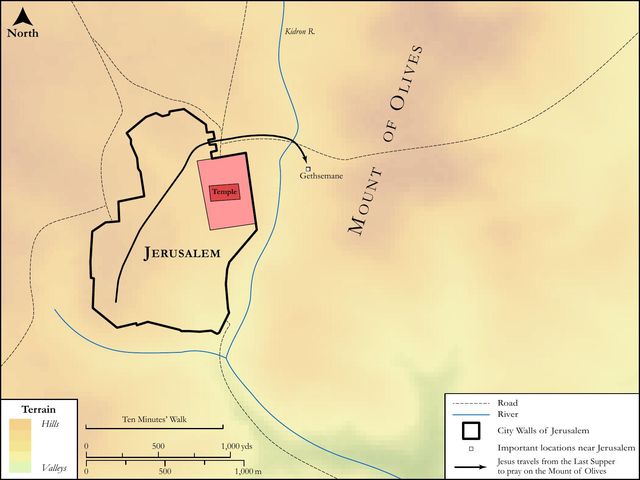
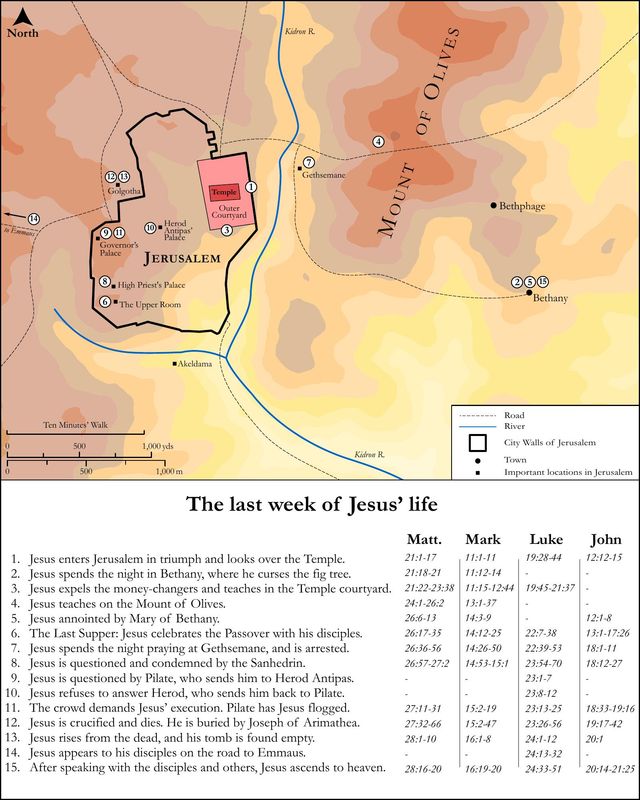
The setting is the Garden of Gethsemane, at the foot of the Mount of Olives, a place Jesus and His disciples frequented. This was likely late at night, after the Passover meal. Betrayal by a trusted associate was a particularly heinous act in ancient cultures, often viewed as a deep violation of loyalty and hospitality. The arrival of a large crowd with "swords and staves" (Matthew 26:47) indicates an official, albeit clandestine, arrest operation, likely involving temple guards and Roman soldiers, orchestrated by the chief priests and elders who sought to apprehend Jesus without causing a public disturbance during the festival.
Key Themes
ShowHideMatthew 26:46 powerfully contributes to several overarching themes within the Gospel of Matthew and the broader biblical narrative. It highlights Jesus' divine sovereignty and control over His destiny, even in the face of human treachery, demonstrating that His suffering was not a tragic accident but a predetermined part of God's redemptive plan (Matthew 26:24). It also emphasizes Christ's perfect obedience to the Father, as He willingly embraces the path of suffering that leads to the cross. Furthermore, the stark contrast between Jesus' vigilance and the disciples' repeated failure to stay awake underscores the theme of human spiritual weakness and the constant need for watchfulness and prayer, a lesson Jesus had just imparted to them.
Exposition and Analysis
ShowHideKey Word Analysis
ShowHideThis verb means "to waken (transitively or intransitively), i.e. rouse (literally, from sleep, from sitting or lying, from disease, from death; or figuratively, from obscurity, inactivity, ruins, nonexistence)." Here, it is an imperative, a direct command to the disciples to "wake up" or "get up" from their sleep. It carries a sense of urgency and a call to action, moving from a state of rest or inaction to readiness.
This is an interjection used as an imperative, meaning "lo!" or "see!" It functions as a deictic particle, drawing immediate attention to what is about to be stated or to something that is suddenly present. In this context, it signals the imminent and visible arrival of Judas and the arresting party, emphasizing the immediacy and undeniable reality of the unfolding events.
This verb means "to surrender, i.e. yield up, intrust, transmit." While it can have neutral meanings like "deliver" or "hand over," in the context of Judas's actions concerning Jesus, it takes on the sinister meaning of "betray." It describes the act of handing Jesus over to His enemies, an act of treachery that initiates the passion narrative.
Verse Breakdown
ShowHide"Rise, let us be going"
This is a command from Jesus to His disciples, urging them to awaken and prepare for action. It is not a call to flee, but rather to meet the approaching confrontation. The "us" indicates that Jesus includes Himself in this movement, signifying His active participation and willingness to step forward into His predetermined destiny, rather than passively awaiting it.
"behold"
This interjection serves as an urgent announcement, drawing the disciples' attention to the immediate reality. It underscores the suddenness and inevitability of the impending event, demanding their immediate awareness and comprehension of the gravity of the situation.
"he is at hand that doth betray me"
This clause reveals the specific and immediate threat: Judas, the betrayer, is already very close. The phrase "is at hand" (Greek, engízō' - G1448) emphasizes the proximity and the precise, divinely orchestrated timing of the betrayal. Jesus' knowledge of Judas's identity and his purpose highlights His omniscience and His control, even as He is "delivered over" by human treachery.
Literary Devices
ShowHideThe verse employs several significant literary devices. The use of the Imperative Mood ("Rise," "behold") conveys Jesus' authority and the urgency of the moment, shifting the narrative from contemplative prayer to decisive action. There is profound Irony in the fact that one of Jesus' own chosen disciples, Judas, is the one who "doth betray me," highlighting the depth of human sin and the unexpected source of opposition. The entire statement functions as a form of Foreshadowing and Prophecy Fulfillment, as Jesus had repeatedly predicted His betrayal and suffering (e.g., Matthew 17:22-23). The stark Contrast between Jesus' resolute readiness and the disciples' repeated failure to stay awake underscores the theme of spiritual vigilance versus human frailty.
Theological and Thematic Connections
ShowHideMatthew 26:46 is a powerful testament to Christ's divine sovereignty and His unwavering commitment to the Father's redemptive plan. Despite the horrific nature of betrayal by one of His own, Jesus does not recoil or attempt to escape. Instead, He actively steps into the moment, demonstrating His perfect obedience even unto death. This verse highlights that the events of the passion were not accidental or forced upon Jesus, but were willingly embraced by Him as the means to accomplish salvation. It underscores the profound truth that God's purposes are sovereign, even over the darkest acts of human sin and treachery, weaving them into His ultimate plan for good.
Reflection and Application
ShowHideMatthew 26:46 calls believers to a profound reflection on the nature of discipleship, vigilance, and divine purpose. Jesus' command to "Rise, let us be going" is not a call to flee from difficulty, but to courageously meet the challenges that God permits in our lives, knowing that He is sovereign over all circumstances. His example of moving from agonizing prayer to resolute action teaches us the importance of submitting our will to God's, even when His path leads through suffering or betrayal. We are reminded that spiritual preparedness is crucial, especially in times of trial, and that our trust in God's overarching plan can provide peace and strength when facing the unexpected or the painful. This verse encourages us to remain spiritually awake, to pray without ceasing, and to embrace God's will with courageous obedience, just as Christ did.
Questions for Reflection
ShowHideFAQ
ShowHideWhy did Jesus tell the disciples to "Rise" and "let us be going" if He knew Judas was coming to betray Him? Was He trying to escape?
ShowHideJesus was not attempting to escape. His words "Rise, let us be going" signify His active and willing movement towards His destiny, not away from it. Having fully submitted His will to the Father's in prayer (Matthew 26:39), Jesus was now ready to embrace the cross. His command was a call to His disciples to awaken from their spiritual slumber and face the reality of the moment with Him, even if they could not fully comprehend it. It underscores His divine control over the situation, even in the face of betrayal, demonstrating that He was not a victim but a willing participant in God's redemptive plan.
Christ-Centered Fulfillment
ShowHideMatthew 26:46 is a pivotal moment that profoundly illuminates the Christ-centered narrative of salvation. Jesus' resolute command, "Rise, let us be going: behold, he is at hand that doth betray me," is not merely a statement of impending doom, but an active step towards His ultimate triumph. In this moment, Jesus fully embodies the obedient Son, who, having wrestled in prayer and perfectly aligned His will with the Father's (Hebrews 5:7-8), now willingly offers Himself as the Lamb of God. His "going" is not a retreat, but an advance towards the cross, where He would become the perfect sacrifice for the sins of the world (John 1:29). The betrayal by Judas, though an act of human evil, was paradoxically woven into God's predetermined plan (Acts 2:23), fulfilling ancient prophecies concerning the suffering Messiah (Isaiah 53:7). Thus, Jesus' words in Gethsemane reveal His active participation in His own "delivery" into the hands of sinners, a voluntary act of love that ultimately secured our redemption and victory over sin and death (Philippians 2:8).