


1 Samuel 17:48
Bible text: King James Version (1769 Blayney text) · Public domain
Bible text: King James Version with Strong's numbers · Public domain
Bible text: Berean Standard Bible · Public domain
Bible text: American Standard Version (1901) · Public domain
Bible text: World English Bible, Messianic edition · Public domain
Bible text: Geneva Bible (1599) · Public domain
Bible text: Young's Literal Translation · Public domain
- וְהָיָהve·ha·Yahand it wasH1961Conj-w ¦ V-Qal-ConsecPerf-3msVerb Qal Consecutive Perfect 3rd Singular Masculineוְandהָיָהit was
- כִּיkithatH3588PrtParticle Conditional
- קָםkamhe aroseH6965V-Qal-Perf-3msVerb Qal Perfect 3rd Singular Masculine
- הַפְּלִשְׁתִּיha·pe·lish·Tithe PhilistineH6430Art ¦ N-msNoun Gentilic Singular Masculine AbsoluteהַtheפְּלִשְׁתִּיPhilistine
- וַיֵּלֶךְvai·Ye·lekhand he cameH1980Conj-w ¦ V-Qal-ConsecImperf-3msVerb Qal Consecutive Imperfect 3rd Singular Masculineוַandיֵּלֶךְhe came
- וַיִּקְרַבvai·yik·Ravand he drew nearH7126Conj-w ¦ V-Qal-ConsecImperf-3msVerb Qal Consecutive Imperfect 3rd Singular Masculineוַandיִּקְרַבhe drew near
- לִקְרַאתlik·Ratto meetH7122Prep-l ¦ V-Qal-InfVerb Qal Infinitive Constructלִtoקְרַאתmeet
- דָּוִדda·VidDavidH1732N-proper-mNoun Proper Masculine
- וַיְמַהֵרvay·ma·Herand he hurriedH4116Conj-w ¦ V-Piel-ConsecImperf-3msVerb Piel Consecutive Imperfect 3rd Singular Masculineוַandיְמַהֵרhe hurried
- דָּוִדda·VidDavidH1732N-proper-mNoun Proper Masculine
- וַיָּרָץvai·Ya·rotzand he ranH7323Conj-w ¦ V-Qal-ConsecImperf-3msVerb Qal Consecutive Imperfect 3rd Singular Masculineוַandיָּרָץhe ran
- הַמַּעֲרָכָהha·ma·'a·ra·Khahthe battle lineH4634Art ¦ N-fsNoun Singular Feminine Absoluteהַtheמַּעֲרָכָהbattle line
- לִקְרַאתlik·Ratto meetH7122Prep-l ¦ V-Qal-InfVerb Qal Infinitive Constructלִtoקְרַאתmeet
- הַפְּלִשְׁתִּיha·pe·lish·Tithe PhilistineH6430Art ¦ N-msNoun Gentilic Singular Masculine AbsoluteהַtheפְּלִשְׁתִּיPhilistine
English is a literal word-by-word gloss of the Hebrew, not the KJV's wording. Why?
This is the original text the KJV's translators worked from — each Hebrew word with its own literal English meaning in this verse, prepared by scholars at Tyndale House, Cambridge. The KJV translates whole sentences, not word by word, so its wording differs: one Hebrew word can become several English words, and the KJV may choose “the LORD” where the gloss reads “Yahweh”. Both are faithful — they answer different questions. For the KJV's own rendering, switch to the KJV text.
Details
See on the biblical-era map
Study this verse
Public-domain commentary
Matthew Henry
From his Commentary on the Whole Bible. Henry comments on passages, not single verses — this entry covers 1 Samuel 17:48–58.
Here is 1. The engagement between the two champions, Sa1 17:48. To this engagement the Philistine advanced with a great deal of state and gravity; if he must encounter a pigmy, yet it shall be with the magnificence of a giant and a grandee. This is intimated in the manner of expression: He arose, and came, and drew nigh, like a stalking mountain, overlaid with brass and iron, to meet David. David advanced with no less activity and cheerfulness, as one that aimed more to do execution than to make a figure: He hasted, and ran, being lightly clad, to meet the Philistine. We may imagine with what tenderness and compassion the Israelites saw such a pleasing youth as this throwing himself into the mouth of destruction, but he knew whom he had believed and for whom he acted. 2. The fall of Goliath in this engagement. He was in no haste, because in no fear, but confident that he should soon at one stroke cleave his adversary's head; but, while he was preparing to do it solemnly, David did his business effectually, without any parade: he slang a stone which hit him in the forehead, and, in the twinkling of an eye, fetched him to the ground, Sa1 17:49. Goliath knew there were famous slingers in Israel (Jdg 20:16), yet was either so forgetful or presumptuous as to go with the beaver of his helmet open, and thither, to the only part left exposed, not so much David's art as God's providence directed the stone, and brought it with such force that it sunk into his head, notwithstanding the impudence with which his forehead was brazened. See how frail and uncertain life is, even when it thinks itself best fortified, and how quickly, how easily, and with how small a matter, the passage may be opened for life to go out and death to enter. Goliath himself has not power over the spirit to retain the spirit, Ecc 8:8. Let not the strong man glory in his strength, nor the armed man in his armour. See how God resists the proud and pours contempt upon those that bid defiance to him and his people. None ever hardened his heart against God and prospered. One of the Rabbin thinks that when Goliath said to David, Come, and I will give thy flesh to the fowls of the air, he threw up his head so hastily that his helmet fell off, and so left his broad forehead a fair mark for David. To complete the execution, David drew Goliath's own sword, a two-handed weapon for David, and with it cut off his head, Sa1 17:51. What need had David to take a sword of his own? his enemy's sword shall serve his purpose, when he has occasion for one. God is greatly glorified when his proud enemies are cut off with their own sword and he makes their own tongues to fall upon them, Psa 64:8. David's victory over Goliath was typical of the triumphs of the son of David over Satan and all the powers of darkness, whom he spoiled, and made a show of them openly (Col 2:15), and we through him are more than conquerors. 3. The defeat of the Philistines' army hereupon. They relied wholly upon the strength of their champion, and therefore, when they saw him slain, they did not, as Goliath had offered, throw down their arms and surrender themselves servants to Israel (Sa1 17:9), but took to their heels, being wholly dispirited, and thinking it to no purpose to oppose one before whom such a mighty man had fallen: They fled (Sa1 17:51), and this put life into the Israelites, who shouted and pursued them (David, it is probable, leading them on in the pursuit) even to the gates of their own cities, Sa1 17:52. In their return from the chase they seized all the baggage, plundered the tents (Sa1 17:53), and enriched themselves with the spoil. 4. David's disposal of his trophies, Sa1 17:54. He brought the head of the Philistine to Jerusalem, to be a terror to the Jebusites, who held the strong-hold of Sion: it is probable that he carried it in triumph to other cities. His armour he laid up in his tent; only the sword was preserved behind the ephod in the tabernacle, as consecrated to God, and a memorial of the victory to his honour, Sa1 21:9. 5. The notice that was taken of David. Though he had been at court formerly, yet, having been for some time absent (Sa1 17:15), Saul had forgotten him, being melancholy and mindless, and little thinking that his musician would have spirit enough to be his champion; and therefore, as if he had never seen him before, he asked whose son he was. Abner was a stranger to him, but brought him to Saul (Sa1 17:57), and he gave a modest account of himself, Sa1 17:58. And now he was introduced to the court with much greater advantages than before, in which he owned God's hand performing all things for him.
Continue studying 1 Samuel 17:48 across the web’s major study libraries — every link below opens this exact verse, chapter, or book on the destination site.
Read & Compare
 BibleGatewayThis verse in more than 200 translations and 70 languages.
 Bible.comThe YouVersion reader — hundreds of translations, reading plans, and highlights.
 ESV.orgCrossway's official English Standard Version reader.
 NET BibleThe NET translation with 60,000+ translators' notes on every rendering decision.
 STEP BibleTyndale House's free study tool — original text, vocabulary, and scholarly resources.
 BibliaLogos Bible Software's free web reader.
 USCCBThe New American Bible (Revised Edition) with the U.S. bishops' study notes.
Commentaries
 BibleHub CommentariesDozens of classic commentaries on this verse, gathered on one page.
 StudyLightMore than 100 commentary sets — the largest collection on the web.
 BibleRefPlain-English commentary on what this verse means, verse by verse.
 Enduring WordDavid Guzik's free commentary on this chapter, widely used by Bible teachers.
 Bible Study ToolsVerse commentary alongside Greek and Hebrew study aids.
Original Language & Research
- BibleHub InterlinearThe verse word by word — original language, transliteration, and English.
- BibleHub LexiconEvery word's original-language definition and Strong's entry.
 Blue Letter BibleDeep-study tools — Strong's numbers, concordance, and word studies.
 SefariaThe Hebrew text with Rashi and centuries of Jewish commentary.
Sermons, Hymns & Audio


TrulyRandomVerse is not affiliated with these sites and doesn’t control their content. They’re linked because they’re genuinely useful.
Summary
1 Samuel 17:48 dramatically captures the pivotal moment in the confrontation between David and Goliath, showcasing David's extraordinary and proactive faith. As the Philistine giant began his advance, David, rather than retreating or waiting, swiftly and eagerly ran forward to meet his formidable foe, demonstrating an unwavering conviction in God's power to deliver victory through him. This verse powerfully underscores the dramatic reversal of expectations and the profound courage born of absolute trust in divine intervention.
Context
ShowHideLiterary Context
This verse serves as the intense climax of the narrative in 1 Samuel 17. For forty agonizing days, Goliath, the Philistine champion, had taunted the armies of Israel, instilling paralyzing fear in King Saul and all his soldiers, none of whom dared to answer the giant's challenge. Into this scene of national paralysis steps young David, a humble shepherd boy, who arrives at the battlefield to bring provisions to his brothers. Appalled by Goliath's blasphemous defiance of the living God, David, fueled by righteous indignation and an unshakeable faith, volunteers to fight the giant. He famously rejects King Saul's cumbersome armor, choosing instead his simple shepherd's tools—a staff, five smooth stones, and a sling. David boldly declares that the battle belongs to the Lord, not to human strength or weaponry, as articulated in 1 Samuel 17:47. Verse 48 describes the precise instant of direct, head-on confrontation, where the colossal Philistine champion and the seemingly insignificant Israelite youth finally engage in a clash that would determine the fate of nations.
Historical & Cultural Context
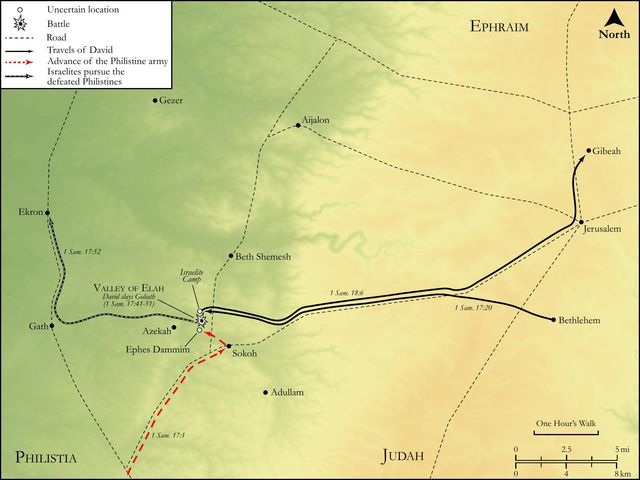
The setting for this iconic confrontation is the Valley of Elah, a strategically vital border region situated between the territories of Philistia and Israel, frequently a flashpoint for military engagements. The Philistines were a dominant military power among the nations of that day, renowned for their superior iron weaponry, advanced military organization, and formidable warriors, which stood in stark contrast to Israel's less developed military technology and often fearful leadership under King Saul. The practice of single combat, where champions from opposing armies would fight to decide the outcome of a larger battle, was a recognized custom of the nations, primarily intended to minimize widespread casualties. Goliath's immense stature, estimated at over nine feet tall, coupled with his heavy bronze armor and weaponry, would have presented an overwhelmingly intimidating presence, fully explaining the terror that gripped the Israelite army. David, a shepherd from Bethlehem, a relatively small town, chose simple, unconventional weapons over traditional military gear, a choice that would have appeared utterly foolish to contemporary observers, thereby highlighting the unconventional nature of God's chosen instruments and methods.
Key Themes
ShowHide1 Samuel 17:48 powerfully encapsulates several core themes prevalent throughout the book of Samuel and the broader biblical narrative. Firstly, it vividly showcases the theme of divine sovereignty and intervention, demonstrating unequivocally that God's power is not constrained by human weakness or overwhelming odds. David's profound courage is not derived from self-confidence or physical prowess, but from an absolute and unwavering trust in God's ability to deliver. Secondly, the verse highlights the stark contrast between human fear and divine faith, sharply juxtaposing the paralyzed and terrified Israelite army with David's proactive and fearless advance. This emphasizes that true victory and deliverance come through reliance on God, not on human might, military prowess, or numerical superiority, echoing the principle found in Zechariah 4:6. Thirdly, the narrative powerfully underscores the theme of God using the weak and foolish to confound the strong and wise, a recurring motif throughout Scripture, as seen in 1 Corinthians 1:27. David, the youngest, least experienced, and most unlikely candidate, becomes the chosen vessel for God's glory, demonstrating that God's ways are often contrary to human wisdom and expectation. Finally, David's zealous concern for God's name and his willingness to risk everything for the honor of the Lord foreshadows his future role as a king after God's own heart and ultimately points to the supreme champion who would come from his royal lineage.
Exposition and Analysis
ShowHideKey Word Analysis
ShowHideThis verb signifies a prompt, eager, and deliberate speed, indicating that David's movement was not hesitant or reluctant, but an immediate and purposeful response. According to the Strong's data, it means "to hurry (in a good or a bad sense); often used (with another verb) adverbially, promptly." In this context, it highlights David's readiness and conviction, driven by faith rather than fear, embodying a swift and decisive action.
This verb means "to run (for whatever reason, especially to rush)." When combined with "hasted," it intensifies the description of David's swift and determined advance. It paints a vivid picture of a young man charging forward with full commitment, directly engaging the threat rather than passively waiting for it to fully materialize. This active, forward motion is a powerful visual of proactive and unhesitating faith.
Derived from a root meaning "to call," this noun signifies "an encountering," whether "accidental, friendly or hostile." In this context, it denotes a purposeful and direct confrontation. David's action was not to avoid, but to actively "meet" the Philistine, indicating his intentionality in engaging the enemy head-on and seizing the initiative in the battle.
Verse Breakdown
ShowHide"And it came to pass, when the Philistine arose, and came and drew nigh to meet David"
This opening clause meticulously sets the stage, detailing Goliath's movement. He "arose," indicating a shift from a stationary or perhaps resting position, now preparing for his final, menacing approach. He then "came and drew nigh," signifying a slow, deliberate, and intimidating advance, characteristic of a giant supremely confident in his overwhelming size and power. The natural expectation of any observer would be that David would recoil, prepare for defense, or attempt to evade.
"that David hasted, and ran toward the army to meet the Philistine"
This is the pivotal counter-action, dramatically reversing all expectations. Instead of waiting for Goliath to reach him, David "hasted, and ran." The repetition and combination of these verbs emphatically underscore his extraordinary eagerness, swiftness, and resolute determination. Crucially, he ran "toward the army," not merely toward Goliath. This specific detail signifies David's complete lack of fear, not just of Goliath personally, but of the entire formidable Philistine military force. It highlights his intention to engage not just the champion, but to confront the entire Philistine threat head-on, demonstrating absolute and audacious confidence in God's imminent victory over Israel's enemies. He actively "met" the Philistine, seizing the initiative and demonstrating that the battle was already won in his heart by faith.
Literary Devices
ShowHideThe verse is exceptionally rich in Juxtaposition and Antithesis, creating a powerful visual and thematic contrast that defines the narrative. Goliath's slow, deliberate, and menacing advance is sharply juxtaposed with David's swift, eager, and proactive charge. This highlights the profound antithesis between Goliath's reliance on brute physical might and overwhelming size, and David's reliance on humble faith and divine power. The colossal giant, representing human strength, worldly intimidation, and the apparent impossibility of the challenge, is met by the seemingly insignificant youth, symbolizing humble faith and God's chosen, unconventional instrument. There is also a strong element of Dramatic Irony for the reader, who, possessing foreknowledge of David's eventual miraculous victory, perceives his bold rush as even more significant and courageous when contrasted with the paralyzing fear of the entire Israelite army. Furthermore, David's act of running towards the enemy, rather than away, serves as a powerful Symbolism of proactive faith, unwavering courage, and divine empowerment in the face of overwhelming odds, offering a timeless model for spiritual warfare and trusting God in the impossible.
Theological and Thematic Connections
ShowHide1 Samuel 17:48 is a profound theological statement on the nature of faith and the manifestation of divine power. It unequivocally declares that God's strength is made perfect in weakness, and that true victory comes not through human might, strategic advantage, or superior weaponry, but through unwavering trust in the Lord. David's proactive charge embodies a faith that steps out boldly, refusing to be paralyzed by fear, and instead actively engages with the challenges, confident that God will fight on behalf of His people. This moment serves as a powerful reminder that when God is on our side, no foe is too great, and no obstacle insurmountable. It calls believers to move beyond passive hope to active, courageous engagement, knowing that the battle ultimately belongs to the Lord and that He is faithful to deliver.
Reflection and Application
ShowHideDavid's audacious sprint towards Goliath in 1 Samuel 17:48 offers a timeless and potent lesson for believers navigating the "giants" of their own lives. Whether these giants manifest as overwhelming financial burdens, debilitating illnesses, spiritual attacks, relational conflicts, daunting career challenges, or any seemingly insurmountable obstacle, David's example calls us to a proactive, courageous faith. Instead of shrinking back in fear, paralyzed by the enormity of the challenge, we are invited to "run toward" our difficulties, not in reckless self-reliance, but in absolute dependence on God's power and provision. This means actively engaging in fervent prayer, diligently seeking God's wisdom through His Word, and taking Spirit-led steps of obedience, even when the odds seem stacked against us and human logic suggests retreat. It encourages us to remember God's past faithfulness, to boldly declare His sovereignty over every seemingly impossible situation, and to move forward with the conviction that the victory ultimately belongs to Him.
Questions for Reflection
ShowHideFAQ
ShowHideWhy did David run toward the army and not just Goliath?
ShowHideThe text specifies that David "ran toward the army to meet the Philistine." This detail is profoundly significant, signifying David's complete and utter lack of fear, not only of Goliath personally but of the entire formidable Philistine military force. It underscores his unwavering conviction that God was actively fighting for Israel, and that the victory would not merely be over Goliath, but a comprehensive triumph over the entire enemy army. His audacious charge was a direct challenge to the collective Philistine might and a profound public statement of faith in the God of Israel, who would deliver His people from their oppressors. It also suggests that David understood that defeating Goliath was merely the catalyst for the larger battle, which would then ensue between the two armies, as indeed it did, leading to the Philistine rout described in 1 Samuel 17:52.
What does David's speed and eagerness signify in this context?
ShowHideDavid's "hasted, and ran" signifies several crucial spiritual and practical truths. Firstly, it demonstrates his unwavering faith and zealous commitment to God's honor. He was not hesitant or reluctant, but rather eager and determined to defend the name of the Lord, which Goliath had so flagrantly blasphemed. Secondly, it highlights his proactive and decisive nature. Unlike the Israelite army, which was paralyzed by fear and inaction for forty days, David immediately took bold action. This proactive faith is a powerful example of trusting God's enablement and moving forward in obedience, rather than passively waiting for circumstances to change or for the enemy to dictate the terms. Thirdly, it underscores the divine empowerment at work within him. David's extraordinary courage and speed were not merely human attributes, but a clear manifestation of God's Spirit working powerfully through him, enabling him to defy all human logic and confront an impossible foe with supernatural confidence.
Christ-Centered Fulfillment
ShowHideDavid's audacious sprint toward Goliath in 1 Samuel 17:48 serves as a powerful and poignant foreshadowing of Jesus Christ, the ultimate Champion and Deliverer for humanity. Just as David, the humble shepherd, willingly and proactively ran towards an overwhelming foe to secure the salvation and honor of Israel, so too did Jesus, the Good Shepherd, willingly and purposefully "run" towards the cross to secure the eternal salvation of humanity. He did not shrink from the ultimate "giant" of sin, death, and the powers of darkness, but "for the joy that was set before him endured the cross, despising the shame" (Hebrews 12:2). Christ's entire earthly ministry was a deliberate, purposeful advance towards Calvary, where He would confront and utterly defeat the spiritual forces of evil, principalities, and powers (Colossians 2:15). He came into the world specifically to destroy the works of the devil (1 John 3:8), accomplishing this not by human might or earthly weaponry, but by divine love, perfect obedience, and sacrificial atonement. While David's victory over Goliath was a physical triumph that brought temporary deliverance, Christ's victory on the cross was an eternal triumph for all creation, securing definitive and everlasting deliverance for all who believe, demonstrating that the battle truly belongs to the Lord, and He has won it decisively and completely through His Son.