


1 Samuel 17:10
Bible text: King James Version (1769 Blayney text) · Public domain
Bible text: Berean Standard Bible · Public domain
Bible text: American Standard Version (1901) · Public domain
Bible text: World English Bible, Messianic edition · Public domain
Bible text: Geneva Bible (1599) · Public domain
Bible text: Young's Literal Translation · Public domain
- וַיֹּאמֶרvai·Yo·merand he saidH559Conj-w ¦ V-Qal-ConsecImperf-3msVerb Qal Consecutive Imperfect 3rd Singular Masculineוַandיֹּאמֶרhe said
- הַפְּלִשְׁתִּיha·pe·lish·Tithe PhilistineH6430Art ¦ N-msNoun Gentilic Singular Masculine AbsoluteהַtheפְּלִשְׁתִּיPhilistine
- אֲנִי'a·NiIH589Pro-1csPronoun Personal 1st Singular common gender
- חֵרַפְתִּיche·Raf·tiI defyH2778V-Piel-Perf-1csVerb Piel Perfect 1st Singular common gender
- אֶת'et<obj.>H853DirObjMParticle Object Indicator
- מַעַרְכוֹתma·'ar·Khot[the] battle lines ofH4634N-fpcNoun Plural Feminine Construct
- יִשְׂרָאֵלYis·ra·'ElIsraelH3478N-properNoun Proper Location
- הַיּוֹםhai·Yomthe dayH3117Art ¦ N-msNoun Singular Masculine Absoluteהַtheיּוֹםday
- הַזֶּהha·Zeh<the> thisH2088Art ¦ PrtParticle Demonstrativeהַ<the>זֶּהthis
- תְּנוּte·nugiveH5414V-Qal-Imp-2mpVerb Qal Imperative 2nd Plural Masculine
- לִיlito <the> mePrep-l ¦ 1csSuffix Personal 1st Singular common genderלִto <the>יme
- אִישׁ'Isha manH376N-msNoun Singular Masculine Absolute
- וְנִלָּחֲמָהve·ni·la·cha·Mahso let us fightH3898Conj-w ¦ V-Niphal-Imperf-1cpVerb Niphal Imperfect 1st Plural common genderוְsoנִלָּחֲמָהlet us fight
- יָחַדYa·chadtogetherH3162N-msNoun Singular Masculine Absolute
English is a literal word-by-word gloss of the Hebrew, not the KJV's wording. Why?
This is the original text the KJV's translators worked from — each Hebrew word with its own literal English meaning in this verse, prepared by scholars at Tyndale House, Cambridge. The KJV translates whole sentences, not word by word, so its wording differs: one Hebrew word can become several English words, and the KJV may choose “the LORD” where the gloss reads “Yahweh”. Both are faithful — they answer different questions. For the KJV's own rendering, switch to the KJV text.
Details
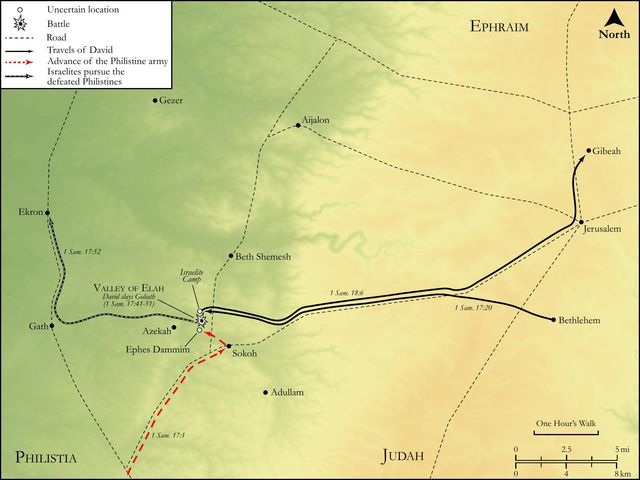
See on the biblical-era map
Study this verse
Public-domain commentary
Matthew Henry
From his Commentary on the Whole Bible. Henry comments on passages, not single verses — this entry covers 1 Samuel 17:1–11. His two-level outline is real structure in the source text, so it is rendered as structure.
It was not long ago that the Philistines were soundly beaten, and put to the worse, before Israel, and they would have been totally routed if Saul's rashness had not prevented; but here we have them making head again. Observe,
I.How they defied Israel with their armies, Sa1 17:1.
They made a descent upon the Israelites' country, and possessed themselves, as it should seem, of some part of it, for they encamped in a place which belonged to Judah. Israel's ground would never have been footing for Philistine-armies if Israel had been faithful to their God. The Philistines (it is probable) had heard that Samuel had fallen out with Saul and forsaken him, and no longer assisted and advised him, and that Saul had grown melancholy and unfit for business, and this news encouraged them to make this attempt for the retrieving of the credit they had lately lost. The enemies of the church are watchful to take all advantages, and they never have greater advantages than when her protectors have provoked God's Spirit and prophets to leave them. Saul mustered his forces, and faced them, Sa1 17:2, Sa1 17:3. And here we must take notice,
1.That the evil spirit, for the present, had left Saul, Sa1 16:23. David's harp having given him some relief, perhaps the alarms and affairs of the war prevented the return of the distemper. Business is a good antidote against melancholy. Let the mind have something without to fasten on and employ itself about, and it will be the less in danger of preying upon itself. God, in mercy to Israel, suspended the judgment for a while; for how distracted must the affairs of the public have been if at this juncture the prince had been distracted!
2.That David for the present had returned to Bethlehem, and had left the court, Sa1 17:15. When Saul had no further occasion to use him for the relief of his distemper, though, being anointed, he had a very good private reason, and, having a grant of the place of Saul's armour-bearer, he had a very plausible pretence to have continued his attendance, as a retainer to the court, yet he went home to Bethlehem, and returned to keep his father's sheep; this was a rare instance, in a young man that stood so fair for preferment, of humility and affection to his parents. He knew better than most do how to come down again after he had begun to rise, and strangely preferred the retirements of the pastoral life before all the pleasures and gaieties of the court. None more fit for honour than he, nor that deserved it better, and yet none more dead to it.
II.How they defied Israel with their champion Goliath, whom they were almost as proud of as he was of himself, hoping by him to recover their reputation and dominion. Perhaps the army of the Israelites was superior in number and strength to that of the Philistines, which made the Philistines decline a battle, and stand at bay with them, desiring rather to put the issue upon a single combat, in which, having such a champion, they hoped to gain the victory. Now concerning this champion observe,
1.His prodigious size. He was of the sons of Anak, who at Gath kept their ground in Joshua's time (Jos 11:22), and kept up a race of giants there, of which Goliath was one, and, it is probable, one of the largest. He was in height six cubits and a span, v. 4. They learned bishop Cumberland has made it out that the scripture-cubit was above twenty-one inches (above three inches more than our half-yard) and a span was half a cubit, by which computation Goliath wanted but eight inches of four yard in height, eleven feet and four inches, a monstrous stature, and which made him very formidable, especially if he had strength and spirit proportionable.
2.His armour. Art, as well as nature, made him terrible. He was well furnished with defensive armour (Sa1 17:5, Sa1 17:6): A helmet of brass on his head, a coat of mail, made of brass plates laid over one another, like the scales of a fish; and, because his legs would lie most within the reach of an ordinary man, he wore brass boots, and had a large corselet of brass about his neck. The coat is said to weigh 5000 shekels, and a shekel was half an ounce avoirdupois, a vast weight for a man to carry, all the other parts of his armour being proportionable. But some think it should be translated, not the weight of the coat, but the value of it, was 5000 shekels; so much it cost. His offensive weapons were extraordinary, of which his spear only is here described, Sa1 17:7. It was like a weaver's beam. His arm could manage that which an ordinary man could scarcely heave. His shield only, which was the lightest of all his accoutrements, was carried before him by his esquire, probably for state; for he that was clad in brass little needed a shield.
3.His challenge. The Philistines having chosen him for their champion, to save themselves from the hazard of battle, he here throws down the gauntlet, and bids defiance to the armies of Israel, Sa1 17:8-10. He came into the valley that lay between the camps, and, his voice probably being as much stronger than other people's as his arm was, he cried so as to make them all hear him, Give me a man, that we may fight together. He looked upon himself with admiration, because he was so much taller and stronger than all about him; his heart (says bishop Hall) nothing but a lump of proud flesh. He looked upon Israel with disdain, because they had none among them of such a monstrous bulk, and defies them to find a man among them bold enough to enter the list with him. (1.) He upbraids them with their folly in drawing an army together: "Why have you come to set the battle in array? How dare you oppose the mighty Philistines?" Or, "Why should the two armies engage, when the controversy may be sooner decided, with only the expense of one life and the hazard of another?" (2.) He offers to put the war entirely upon the issue of the duel he proposes: "If your champion kill me, we will be your servants; if I kill him, you shall be ours." This, says bishop Patrick, was only a bravado, for no nation would be willing thus to venture its all upon the success of one man, nor is it justifiable; notwithstanding Goliath's stipulation here, when he was killed the Philistines did not stand to his word, nor submit themselves as servants to Israel. When he boasts, I am a Philistine, and you are servants to Saul, he would have it thought a great piece of condescension in him, who was a chief ruler, to enter the lists with an Israelite; for he looked on them as no better than slaves. The Chaldee paraphrase brings him in boasting that he was the man that had killed Hophni and Phinehas and taken the ark prisoner, but that the Philistines had never given him so much as the command of a regiment in recompence of his services, whereas Saul had been made king for his services: "Let him therefore take up the challenge."
4.The terror this struck upon Israel: Saul and his army were greatly afraid, Sa1 17:11. The people would not have been dismayed but that they observed Saul's courage failed him; and it is not to be expected that, if the leader be a coward, the followers should be bold. We found before, when the Spirit of the Lord came upon Saul (Sa1 11:6), none could be more daring nor forward to answer the challenge of Nahash the Ammonite, but now that the Spirit of the Lord had departed from him even the big looks and big words of a single Philistine make him change colour. But where was Jonathan all this while? Why did not he accept the challenge, who, in the last war, had so bravely engaged a whole army of Philistines? Doubtless he did not feel himself stirred up of God to it, as he did in the former case. As the best, so the bravest men, are no more than what God makes them. Jonathan must now sit still, because the honour of engaging Goliath is reserved for David. In great and good actions, the wind of the Spirit blows when and where he listeth. Now the pious Israelites lament their king's breach with Samuel.
Historical interpretation
Historical reception
1 surviving comment on this verse from the historical church.
And he stood and cried out against the ranks of Israel, etc. Pride is the enemy of old, so that until the incarnation and passion of the Lord Savior, he assumed he could not be overcome by any mortal. For it is not without reason that it was said to blessed Job: "There is no power upon the earth that can be compared to him, who was made to fear no one" (Job 41); and even up to the end of this present age, he troubles the Church through the Jews, gentiles, and heretics, as if with a wicked armor-bearer preceding him, standing against the ranks of Israel and crying out. Nor is it surprising if all the Israelites, fearing this one, flee. For how, without the Lord's presence, can flesh fight against an archangel? But for the flesh to prevail against a spirit lacking flesh, first God must triumph against the same in the guise of the flesh. Concerning which it is typically added:
Continue studying 1 Samuel 17:10 across the web’s major study libraries — every link below opens this exact verse, chapter, or book on the destination site.
Read & Compare
 BibleGatewayThis verse in more than 200 translations and 70 languages.
 Bible.comThe YouVersion reader — hundreds of translations, reading plans, and highlights.
 ESV.orgCrossway's official English Standard Version reader.
 NET BibleThe NET translation with 60,000+ translators' notes on every rendering decision.
 STEP BibleTyndale House's free study tool — original text, vocabulary, and scholarly resources.
 BibliaLogos Bible Software's free web reader.
 USCCBThe New American Bible (Revised Edition) with the U.S. bishops' study notes.
Commentaries
 BibleHub CommentariesDozens of classic commentaries on this verse, gathered on one page.
 StudyLightMore than 100 commentary sets — the largest collection on the web.
 BibleRefPlain-English commentary on what this verse means, verse by verse.
 Enduring WordDavid Guzik's free commentary on this chapter, widely used by Bible teachers.
 Bible Study ToolsVerse commentary alongside Greek and Hebrew study aids.
Original Language & Research
- BibleHub InterlinearThe verse word by word — original language, transliteration, and English.
- BibleHub LexiconEvery word's original-language definition and Strong's entry.
 Blue Letter BibleDeep-study tools — Strong's numbers, concordance, and word studies.
 SefariaThe Hebrew text with Rashi and centuries of Jewish commentary.
Sermons, Hymns & Audio


TrulyRandomVerse is not affiliated with these sites and doesn’t control their content. They’re linked because they’re genuinely useful.
Summary
Goliath's audacious declaration in 1 Samuel 17:10 serves as the pivotal moment, crystallizing the spiritual and military crisis confronting Israel. By publicly "defying the armies of Israel" and demanding a champion for single combat, the Philistine giant not only sought to resolve the conflict through a proxy battle but, more profoundly, issued a direct challenge to the living God whom Israel claimed as their sovereign protector. This bold taunt exposed the pervasive fear within God's people and set the dramatic stage for divine intervention through an unexpected, humble deliverer, fundamentally testing the nation's faith and trust in Yahweh.
Context
ShowHideLiterary Context
This verse is strategically positioned as the climax of Goliath's initial appearance and challenge within the broader narrative of 1 Samuel chapter 17. It immediately follows the detailed, intimidating description of Goliath's physical stature and weaponry (1 Samuel 17:4-7), and his initial, less explicit challenge to the Israelite forces (1 Samuel 17:8-9). Goliath's explicit defiance in verse 10 intensifies the dramatic tension, articulating the terms of the proposed single combat. This declaration is then reinforced by his repeated taunts over forty days (1 Samuel 17:16), highlighting the complete paralysis and abject fear that had gripped King Saul and his entire army. The verse thus functions as the formal, public challenge that underscores Israel's desperate need for a champion, a role that none of their seasoned warriors, including Saul himself, were willing or able to fill.
Historical & Cultural Context
The practice of single combat, as proposed by Goliath, was a culturally accepted method of resolving conflicts among the nations of that day. This approach aimed to minimize large-scale casualties by having a designated champion represent each army, with the outcome often interpreted as a divine judgment reflecting the superiority of one nation's deity over another. The Philistines, a powerful "Sea Peoples" confederation, were a dominant military force during this period, known for their superior iron technology, which Israel largely lacked (1 Samuel 13:19-22). The setting in the Valley of Elah was a crucial strategic pass, controlling access between the Philistine coastal plain and the Judean highlands. Goliath's challenge was therefore deeply embedded in the military, political, and religious customs of the time, placing immense pressure on Israel to respond in a manner that would either affirm or deny the power and honor of their God.
Key Themes
ShowHideGoliath's defiant challenge in 1 Samuel 17:10 powerfully introduces and develops several key theological and narrative themes prevalent throughout the book of 1 Samuel. Firstly, it starkly illustrates the theme of human inadequacy versus divine power. King Saul, chosen for his impressive physical stature and initial military success (1 Samuel 9:2; 10:23-24), proves utterly incapable of confronting this formidable giant, symbolizing the inherent limitations of human strength and leadership when detached from divine empowerment. Secondly, the verse profoundly highlights the theme of God's honor and reputation. Goliath's "defiance" is not merely a military taunt but an implicit blasphemy against the God of Israel, challenging His very existence and power to protect His people. This sets the stage for God to vindicate His name and demonstrate His sovereignty through an unexpected means, as later articulated by David (1 Samuel 17:45-47). Finally, the verse vividly portrays the crisis of faith within Israel, where fear and reliance on human might have supplanted their covenantal trust in Yahweh, thereby paving the way for a new kind of leadership exemplified by David, who understood that "the battle is the LORD's."
Exposition and Analysis
ShowHideKey Word Analysis
ShowHideThis verb carries a potent semantic range, encompassing reproach, taunt, insult, and challenge. It signifies more than a simple dare to fight; it implies a public shaming, a direct affront to honor, and a profound act of contempt. In this context, Goliath's use of châraph extends beyond mere military bravado; it is a spiritual provocation, a direct scorn for the God of Israel, whose honor was inextricably linked to His people's strength. This word underscores the audacious and blasphemous nature of Goliath's challenge, designed to demoralize and humiliate Israel by questioning the very power of their divine protector.
Derived from a root meaning "to arrange" or "to set in order," this noun refers to organized battle lines, military formations, or armies arrayed for conflict. Goliath's defiance is directed not at a single individual or a small contingent, but at the entire, assembled military force of Israel. This emphasizes the sheer scale of his challenge, as he mocks the collective strength, defensive capabilities, and national pride of an entire nation. By targeting the "armies," Goliath aims to shatter the morale of the entire host, suggesting that their organized might is utterly futile against his individual prowess and the power of his gods.
This term refers to an individual or male person, often used to denote a champion or a worthy opponent. Goliath's demand, "give me a man," is a direct call for a single champion to represent Israel in a duel. This highlights the ancient practice of single combat as a means of resolving larger conflicts. The word here emphasizes the specific nature of the challenge: a one-on-one confrontation to determine the fate of the armies. It also subtly underscores the immediate problem for Israel – the absence of an ʼîysh (man) courageous enough to step forward, revealing the widespread fear and lack of faith among their ranks.
Verse Breakdown
ShowHide"And the Philistine said,"
This opening clause immediately identifies Goliath, the formidable Philistine champion, as the speaker. It establishes his authority and centrality to the unfolding drama, signaling that his subsequent words are not mere boasts but a formal, weighty challenge from the opposing side's most imposing figure.
"I defy the armies of Israel this day;"
This is the core of Goliath's audacious and blasphemous challenge. The verb "defy" (חָרַף, châraph) signifies a public act of scorn, insult, and direct challenge, aimed not just at the soldiers but implicitly at the God of Israel, whose presence and power were believed to be with His covenant people's army. "This day" adds an immediate, non-negotiable urgency to his demand, intensifying the psychological pressure and forcing an immediate response from the paralyzed Israelite forces.
"give me a man, that we may fight together."
This final clause articulates the precise terms of Goliath's challenge: a demand for single combat. He calls for a specific champion from Israel to face him, proposing to resolve the entire military confrontation through a proxy battle. This strategy, common in ancient warfare to avert widespread bloodshed, places immense pressure on the challenged party to produce a worthy and courageous representative, starkly highlighting Israel's current lack of a leader willing to step forward.
Literary Devices
ShowHideThe verse masterfully employs several literary devices to amplify its dramatic impact and underscore the profound stakes. Hyperbole is evident in Goliath's sweeping declaration, "I defy the armies of Israel," implying an almost boundless confidence and an exaggerated sense of his own invincibility against an entire nation's military might. This overstatement serves to intimidate and demoralize the Israelite forces. An implicit Antithesis is established, contrasting Goliath's overwhelming physical presence and boastful challenge with the perceived weakness, fear, and paralysis of the Israelite army and their king. This contrast is further emphasized by his demand for "a man," highlighting the conspicuous absence of a willing champion. Furthermore, Goliath functions as a powerful Foil to the yet-to-be-introduced David. His reliance on physical might, intimidation, and verbal taunts stands in stark opposition to David's humble, faith-filled approach, setting the stage for a dramatic reversal of expectations and a demonstration of divine power through unexpected means.
Theological and Thematic Connections
ShowHideGoliath's defiance transcends a mere military challenge; it is a profound theological assault, directly impugning the honor and power of the God of Israel. His words expose the spiritual vulnerability and fear-driven paralysis of the Israelite army, who, despite being God's covenant people, are relying on human strength and perceived inadequacy rather than divine intervention. This pivotal moment underscores a recurring biblical theme: true strength and ultimate victory do not originate from human might, impressive stature, or military prowess, but from humble, unwavering reliance on the Lord. It sets the stage for God to demonstrate His sovereignty by raising up an unlikely deliverer, thereby proving that the battle belongs to Him alone and that His reputation is supremely at stake in the affairs of His people.
Reflection and Application
ShowHideGoliath's challenge in 1 Samuel 17:10 serves as a timeless and potent metaphor for the "giants" we inevitably encounter in our personal and communal lives—overwhelming obstacles, intimidating adversaries, or deeply entrenched spiritual strongholds that seem to mock our every effort. Just as Goliath sought to demoralize Israel with his words, many of life's most significant challenges are accompanied by a profound sense of fear, inadequacy, or hopelessness, whispering doubts and attempting to paralyze us into inaction. This verse compels us to critically examine the true object of our trust. Are we, like the Israelite army, fixated on our own limited strength, resources, or perceived weaknesses, leading to fear and paralysis? Or are we prepared to courageously recognize that the battle is not ours alone, but the Lord's, and that His power is most perfectly displayed in our weakness? Our response to these "Goliaths" reveals the depth of our faith and our practical understanding of God's sovereign power. It invites us to step forward, not in our own might or self-confidence, but in the unwavering assurance that God is infinitely greater than any challenge, and He calls us to engage with faith, knowing He actively fights on our behalf.
Questions for Reflection
ShowHideFAQ
ShowHideWhy did Goliath specifically "defy the armies of Israel" and not just their king or a specific general?
ShowHideGoliath's defiance was strategically directed at the entire "armies of Israel" to maximize the psychological impact and to challenge the collective strength, honor, and faith of the entire nation, implicitly including their God. In ancient warfare, the outcome of a champion's duel was often interpreted as a divine judgment, with the gods of the victorious champion's nation being deemed superior. By defying the entire host, Goliath was not merely challenging their military prowess but also directly assaulting the very deity they claimed protected them, Yahweh. This broad challenge aimed to demoralize every single soldier and to publicly shame the entire nation, creating a profound sense of hopelessness that would ideally lead to surrender without a full-scale battle. It underscored that no individual within their ranks was perceived as mighty enough to stand against him, thereby diminishing Israel's national pride and their faith in their covenant-keeping God. The phrase "armies of Israel" also highlights the covenantal relationship between God and His people, making Goliath's taunt a direct affront to Yahweh Himself, who was supposed to lead their armies, as seen in passages like Deuteronomy 20:4.
Christ-Centered Fulfillment
ShowHideGoliath's audacious defiance in 1 Samuel 17:10 serves as a profound Old Testament type, powerfully foreshadowing the ultimate spiritual battle and the decisive triumph of Jesus Christ. Goliath, the seemingly invincible giant who taunts and enslaves through fear and intimidation, represents the formidable, seemingly insurmountable enemies of humanity: sin, death, and Satan. Just as Goliath stood as an unassailable champion demanding a man to fight, so too did these spiritual forces hold humanity captive, with no one capable of standing against their dominion. Israel's paralysis and abject fear in the face of Goliath mirror humanity's utter helplessness in the face of spiritual bondage and the power of death. However, the true "man" who would fight and conquer did not come from the ranks of human might or earthly kingship, but was the Son of Man, Jesus Christ. He alone, through His perfect life of obedience, His atoning death on the cross, and His glorious resurrection, entered the arena of ultimate spiritual combat. Christ's victory on the cross, where He "disarmed the powers and authorities" and "made a public spectacle of them, triumphing over them by the cross" (Colossians 2:15), powerfully echoes David's defeat of Goliath. He conquered the "giant" of sin, breaking its power and dominion over believers (Romans 6:6), and triumphed over death itself, offering eternal life and resurrection hope to all who believe (1 Corinthians 15:54-57). Thus, Goliath's challenge, which seemed insurmountable to Israel, ultimately points to the decisive and complete victory won by the true champion, Jesus Christ, who defeated the ultimate enemies of God's people, securing eternal freedom and life.