


1 Samuel 17:9
Bible text: King James Version (1769 Blayney text) · Public domain
Bible text: King James Version with Strong's numbers · Public domain
Bible text: Berean Standard Bible · Public domain
Bible text: American Standard Version (1901) · Public domain
Bible text: World English Bible, Messianic edition · Public domain
Bible text: Geneva Bible (1599) · Public domain
Bible text: Young's Literal Translation · Public domain
- אִם'imifH518PrtParticle Conditional
- יוּכַלyu·Khalhe will be ableH3201V-Qal-Imperf-3msVerb Qal Imperfect 3rd Singular Masculine
- לְהִלָּחֵםle·hi·la·Chemto fightH3898Prep-l ¦ V-Niphal-InfVerb Niphal Infinitive Constructלְtoהִלָּחֵםfight
- אִתִּי'i·Tiwith meH854Prep ¦ 1csPreposition Definiteאִתִּwithיme
- וְהִכָּנִיve·hi·Ka·niand he will strike down meH5221Conj-w ¦ V-Hiphil-ConsecPerf-3ms ¦ 1csVerb Hiphil Consecutive Perfect 3rd Singular Masculineוְandהִכָּhe will strike downנִיme
- וְהָיִינוּve·ha·Yi·nuand we will becomeH1961Conj-w ¦ V-Qal-ConsecPerf-1cpVerb Qal Consecutive Perfect 1st Plural common genderוְandהָיִינוּwe will become
- לָכֶםla·Khemof youPrep-l ¦ 2mpSuffix Personal 2nd Plural Masculineלָofכֶםyou
- לַעֲבָדִיםla·'a·va·Dim<into> slavesH5650Prep-l ¦ N-mpNoun Plural Masculine Absoluteלַ<into>עֲבָדִיםslaves
- וְאִםve·'imand ifH518Conj-w ¦ PrtParticle Conditionalוְandאִםif
- אֲנִי'a·NiIH589Pro-1csPronoun Personal 1st Singular common gender
- אוּכַל'u·khalI will prevailH3201V-Qal-Imperf-1csVerb Qal Imperfect 1st Singular common gender
- לוֹloto <the> himPrep-l ¦ 3msSuffix Personal 3rd Singular Masculineלto <the>וֹhim
- וְהִכִּיתִיוve·hi·ki·Tivand I will strike down himH5221Conj-w ¦ V-Hiphil-ConsecPerf-1cs ¦ 3msVerb Hiphil Consecutive Perfect 1st Singular common genderוְandהִכִּיתִיI will strike downוhim
- וִהְיִיתֶםvih·Yi·temand you will becomeH1961Conj-w ¦ V-Qal-ConsecPerf-2mpVerb Qal Consecutive Perfect 2nd Plural Masculineוִandהְיִיתֶםyou will become
- לָנוּla·nuof usPrep-l ¦ 1cpSuffix Personal 1st Plural common genderלָofנוּus
- לַעֲבָדִיםla·'a·va·Dim<into> slavesH5650Prep-l ¦ N-mpNoun Plural Masculine Absoluteלַ<into>עֲבָדִיםslaves
- וַעֲבַדְתֶּםva·'a·vad·Temand you will serveH5647Conj-w ¦ V-Qal-ConsecPerf-2mpVerb Qal Consecutive Perfect 2nd Plural Masculineוַandעֲבַדְתֶּםyou will serve
- אֹתָנוּ'o·Ta·nu<obj.> usH853DirObjM ¦ 1cpParticle Object Indicatorאֹתָ<obj.>נוּus
English is a literal word-by-word gloss of the Hebrew, not the KJV's wording. Why?
This is the original text the KJV's translators worked from — each Hebrew word with its own literal English meaning in this verse, prepared by scholars at Tyndale House, Cambridge. The KJV translates whole sentences, not word by word, so its wording differs: one Hebrew word can become several English words, and the KJV may choose “the LORD” where the gloss reads “Yahweh”. Both are faithful — they answer different questions. For the KJV's own rendering, switch to the KJV text.
Details
See on the biblical-era map
Study this verse
Public-domain commentary
Matthew Henry
From his Commentary on the Whole Bible. Henry comments on passages, not single verses — this entry covers 1 Samuel 17:1–11. His two-level outline is real structure in the source text, so it is rendered as structure.
It was not long ago that the Philistines were soundly beaten, and put to the worse, before Israel, and they would have been totally routed if Saul's rashness had not prevented; but here we have them making head again. Observe,
I.How they defied Israel with their armies, Sa1 17:1.
They made a descent upon the Israelites' country, and possessed themselves, as it should seem, of some part of it, for they encamped in a place which belonged to Judah. Israel's ground would never have been footing for Philistine-armies if Israel had been faithful to their God. The Philistines (it is probable) had heard that Samuel had fallen out with Saul and forsaken him, and no longer assisted and advised him, and that Saul had grown melancholy and unfit for business, and this news encouraged them to make this attempt for the retrieving of the credit they had lately lost. The enemies of the church are watchful to take all advantages, and they never have greater advantages than when her protectors have provoked God's Spirit and prophets to leave them. Saul mustered his forces, and faced them, Sa1 17:2, Sa1 17:3. And here we must take notice,
1.That the evil spirit, for the present, had left Saul, Sa1 16:23. David's harp having given him some relief, perhaps the alarms and affairs of the war prevented the return of the distemper. Business is a good antidote against melancholy. Let the mind have something without to fasten on and employ itself about, and it will be the less in danger of preying upon itself. God, in mercy to Israel, suspended the judgment for a while; for how distracted must the affairs of the public have been if at this juncture the prince had been distracted!
2.That David for the present had returned to Bethlehem, and had left the court, Sa1 17:15. When Saul had no further occasion to use him for the relief of his distemper, though, being anointed, he had a very good private reason, and, having a grant of the place of Saul's armour-bearer, he had a very plausible pretence to have continued his attendance, as a retainer to the court, yet he went home to Bethlehem, and returned to keep his father's sheep; this was a rare instance, in a young man that stood so fair for preferment, of humility and affection to his parents. He knew better than most do how to come down again after he had begun to rise, and strangely preferred the retirements of the pastoral life before all the pleasures and gaieties of the court. None more fit for honour than he, nor that deserved it better, and yet none more dead to it.
II.How they defied Israel with their champion Goliath, whom they were almost as proud of as he was of himself, hoping by him to recover their reputation and dominion. Perhaps the army of the Israelites was superior in number and strength to that of the Philistines, which made the Philistines decline a battle, and stand at bay with them, desiring rather to put the issue upon a single combat, in which, having such a champion, they hoped to gain the victory. Now concerning this champion observe,
1.His prodigious size. He was of the sons of Anak, who at Gath kept their ground in Joshua's time (Jos 11:22), and kept up a race of giants there, of which Goliath was one, and, it is probable, one of the largest. He was in height six cubits and a span, v. 4. They learned bishop Cumberland has made it out that the scripture-cubit was above twenty-one inches (above three inches more than our half-yard) and a span was half a cubit, by which computation Goliath wanted but eight inches of four yard in height, eleven feet and four inches, a monstrous stature, and which made him very formidable, especially if he had strength and spirit proportionable.
2.His armour. Art, as well as nature, made him terrible. He was well furnished with defensive armour (Sa1 17:5, Sa1 17:6): A helmet of brass on his head, a coat of mail, made of brass plates laid over one another, like the scales of a fish; and, because his legs would lie most within the reach of an ordinary man, he wore brass boots, and had a large corselet of brass about his neck. The coat is said to weigh 5000 shekels, and a shekel was half an ounce avoirdupois, a vast weight for a man to carry, all the other parts of his armour being proportionable. But some think it should be translated, not the weight of the coat, but the value of it, was 5000 shekels; so much it cost. His offensive weapons were extraordinary, of which his spear only is here described, Sa1 17:7. It was like a weaver's beam. His arm could manage that which an ordinary man could scarcely heave. His shield only, which was the lightest of all his accoutrements, was carried before him by his esquire, probably for state; for he that was clad in brass little needed a shield.
3.His challenge. The Philistines having chosen him for their champion, to save themselves from the hazard of battle, he here throws down the gauntlet, and bids defiance to the armies of Israel, Sa1 17:8-10. He came into the valley that lay between the camps, and, his voice probably being as much stronger than other people's as his arm was, he cried so as to make them all hear him, Give me a man, that we may fight together. He looked upon himself with admiration, because he was so much taller and stronger than all about him; his heart (says bishop Hall) nothing but a lump of proud flesh. He looked upon Israel with disdain, because they had none among them of such a monstrous bulk, and defies them to find a man among them bold enough to enter the list with him. (1.) He upbraids them with their folly in drawing an army together: "Why have you come to set the battle in array? How dare you oppose the mighty Philistines?" Or, "Why should the two armies engage, when the controversy may be sooner decided, with only the expense of one life and the hazard of another?" (2.) He offers to put the war entirely upon the issue of the duel he proposes: "If your champion kill me, we will be your servants; if I kill him, you shall be ours." This, says bishop Patrick, was only a bravado, for no nation would be willing thus to venture its all upon the success of one man, nor is it justifiable; notwithstanding Goliath's stipulation here, when he was killed the Philistines did not stand to his word, nor submit themselves as servants to Israel. When he boasts, I am a Philistine, and you are servants to Saul, he would have it thought a great piece of condescension in him, who was a chief ruler, to enter the lists with an Israelite; for he looked on them as no better than slaves. The Chaldee paraphrase brings him in boasting that he was the man that had killed Hophni and Phinehas and taken the ark prisoner, but that the Philistines had never given him so much as the command of a regiment in recompence of his services, whereas Saul had been made king for his services: "Let him therefore take up the challenge."
4.The terror this struck upon Israel: Saul and his army were greatly afraid, Sa1 17:11. The people would not have been dismayed but that they observed Saul's courage failed him; and it is not to be expected that, if the leader be a coward, the followers should be bold. We found before, when the Spirit of the Lord came upon Saul (Sa1 11:6), none could be more daring nor forward to answer the challenge of Nahash the Ammonite, but now that the Spirit of the Lord had departed from him even the big looks and big words of a single Philistine make him change colour. But where was Jonathan all this while? Why did not he accept the challenge, who, in the last war, had so bravely engaged a whole army of Philistines? Doubtless he did not feel himself stirred up of God to it, as he did in the former case. As the best, so the bravest men, are no more than what God makes them. Jonathan must now sit still, because the honour of engaging Goliath is reserved for David. In great and good actions, the wind of the Spirit blows when and where he listeth. Now the pious Israelites lament their king's breach with Samuel.
Continue studying 1 Samuel 17:9 across the web’s major study libraries — every link below opens this exact verse, chapter, or book on the destination site.
Read & Compare
 BibleGatewayThis verse in more than 200 translations and 70 languages.
 Bible.comThe YouVersion reader — hundreds of translations, reading plans, and highlights.
 ESV.orgCrossway's official English Standard Version reader.
 NET BibleThe NET translation with 60,000+ translators' notes on every rendering decision.
 STEP BibleTyndale House's free study tool — original text, vocabulary, and scholarly resources.
 BibliaLogos Bible Software's free web reader.
 USCCBThe New American Bible (Revised Edition) with the U.S. bishops' study notes.
Commentaries
 BibleHub CommentariesDozens of classic commentaries on this verse, gathered on one page.
 StudyLightMore than 100 commentary sets — the largest collection on the web.
 BibleRefPlain-English commentary on what this verse means, verse by verse.
 Enduring WordDavid Guzik's free commentary on this chapter, widely used by Bible teachers.
 Bible Study ToolsVerse commentary alongside Greek and Hebrew study aids.
Original Language & Research
- BibleHub InterlinearThe verse word by word — original language, transliteration, and English.
- BibleHub LexiconEvery word's original-language definition and Strong's entry.
 Blue Letter BibleDeep-study tools — Strong's numbers, concordance, and word studies.
 SefariaThe Hebrew text with Rashi and centuries of Jewish commentary.
Sermons, Hymns & Audio


TrulyRandomVerse is not affiliated with these sites and doesn’t control their content. They’re linked because they’re genuinely useful.
Summary
1 Samuel 17:9 presents the audacious and terrifying challenge issued by Goliath, the Philistine champion, to the assembled armies of Israel. This verse starkly articulates the high stakes of the impending conflict, proposing a single combat between champions whose outcome would unequivocally determine the national servitude or freedom of the respective peoples. Goliath's words were meticulously designed to instill profound fear, demoralization, and a sense of utter hopelessness among the Israelites, thereby setting the stage for the dramatic and divinely orchestrated intervention of David, which would ultimately demonstrate God's supreme power over all human might and arrogance.
Context
ShowHideLiterary Context
This pivotal verse is deeply embedded within the broader narrative of 1 Samuel 17, which meticulously details the protracted standoff between the Philistine and Israelite armies in the strategically significant Valley of Elah. Goliath's initial appearance and his daily, taunting declarations (as described in 1 Samuel 17:4-8) immediately precede this specific challenge, firmly establishing his formidable presence and the psychological warfare he relentlessly waged. Following Goliath's explicit proposal in 1 Samuel 17:9, the narrative immediately shifts to describe the profound and paralyzing fear that gripped King Saul and all Israel, as they were "dismayed and greatly afraid" (1 Samuel 17:11). The verse thus serves as the critical moment that crystallizes the precise terms of engagement, highlighting the seemingly insurmountable obstacle facing Israel and thereby paving the way for David's providential arrival and his subsequent, divinely empowered confrontation with the giant.
Historical & Cultural Context
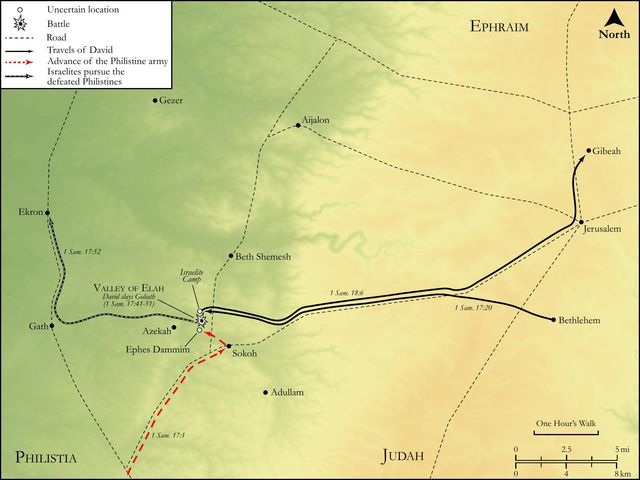
The setting for this dramatic encounter is the Valley of Elah, a crucial border region situated between the territories controlled by the Philistines and the Israelites. This area was frequently a flashpoint for military conflict due to its strategic importance. The practice of "champion warfare" or "single combat," as proposed by Goliath, was a recognized, though not universally common, military strategy among the nations of that day. This method allowed opposing armies to potentially avoid a full-scale, costly, and bloody battle by delegating the outcome to a duel between their strongest and most representative warriors. The stakes, as explicitly articulated by Goliath, were immense: the losing nation would be reduced to "servants" of the victor. For Israel, a people whose national identity was inextricably forged in their miraculous deliverance from centuries of slavery in Egypt, the threat of renewed servitude was particularly potent, humiliating, and deeply resonant, representing a profound loss of their God-given liberty and cherished sovereignty. Goliath, a towering "giant" from Gath, epitomized the pinnacle of Philistine military might and pagan defiance against the living God of Israel.
Key Themes
ShowHideGoliath's audacious challenge in 1 Samuel 17:9 powerfully underscores several core themes prevalent in this chapter and throughout the broader book of 1 Samuel. Firstly, it vividly highlights the theme of intimidation and psychological warfare, as Goliath's imposing stature, formidable weaponry, and audacious proposal were meticulously calculated to demoralize and paralyze the Israelites before any physical battle could even commence. Secondly, it emphasizes the high stakes of single combat, where the very fate of entire nations, their freedom, and their future existence hung precariously on the outcome of a single, decisive duel. Thirdly, the stark contrast between servitude and freedom is absolutely central, powerfully echoing Israel's foundational history and their covenantal identity as a free people under the direct sovereignty of God. Most significantly, this verse masterfully sets the stage for the overarching and profound theme of human might versus divine power. Goliath's absolute and unyielding confidence in his own physical strength and military prowess stands in stark and dramatic opposition to David's later, faith-filled declaration that he came against Goliath "in the name of the LORD of hosts" (1 Samuel 17:45), thereby demonstrating with undeniable clarity that true and lasting victory belongs not to the strong or the mighty, but exclusively to those who place their unwavering trust in God.
Exposition and Analysis
ShowHideKey Word Analysis
ShowHideThis primitive root (H3201) signifies the capacity "to be able," whether literally (can, could) or morally (may, might). In Goliath's challenge, it underscores the condition of the duel: "If he be able to fight with me." It speaks to the perceived capability of the Israelite champion to match Goliath's formidable strength and skill. Goliath uses this word to frame the contest, implying that such ability is highly unlikely, thereby amplifying the psychological pressure on Israel.
A primitive root (H3898) meaning "to feed on; figuratively, to consume; by implication, to battle (as destruction)." When Goliath says, "If he be able to fight with me," he is not merely proposing a skirmish but a decisive, destructive combat. This word emphasizes the intensity and finality of the proposed duel, a struggle intended to consume and utterly defeat the opponent, determining the fate of nations through violent confrontation.
Derived from the root ʻâbad (H5650), this noun refers to "a servant" or "bondman." In the context of Goliath's challenge, the plural form "servants" signifies a state of complete subjugation, bondage, or forced labor for an entire nation. It implies not merely a political alliance or tribute, but a comprehensive loss of autonomy, dignity, and national identity. For Israel, a people whose history was defined by their miraculous liberation from Egyptian servitude, this word carried immense weight, evoking the painful memory of oppression and representing the antithesis of their covenantal freedom.
Verse Breakdown
ShowHide"If he be able to fight with me, and to kill me, then will we be your servants:"
This opening clause presents the Philistine champion's conditional offer of surrender. Goliath, with a theatrical flourish and calculated arrogance, proposes that if any Israelite champion could somehow overcome his immense strength and unparalleled skill, and successfully kill him, then the mighty Philistine army would, astonishingly, submit to Israelite rule. This seemingly magnanimous offer is deeply ironic and designed to be profoundly demoralizing, as Goliath's formidable reputation and colossal physical stature made such an outcome appear utterly impossible to the terrified Israelites, thereby amplifying their despair and fear.
"but if I prevail against him, and kill him, then shall ye be our servants, and serve us."
This second, starkly contrasting clause outlines Goliath's anticipated and confidently predicted outcome, along with the dire and humiliating consequences for Israel. Here, Goliath's unshakeable confidence in his own invincibility is palpable. He asserts his own inevitable victory ("if I prevail against him, and kill him"), predicting the complete and total subjugation of Israel. The powerful repetition of "servants, and serve us" is a potent rhetorical device emphasizing the totality, permanence, and deeply humiliating nature of the impending servitude, leaving absolutely no ambiguity about the profound loss of national sovereignty, freedom, and dignity that would befall the Israelites.
Literary Devices
ShowHideThe language of 1 Samuel 17:9 is remarkably rich with literary techniques that amplify the dramatic tension and underscore the high stakes of the encounter. The most prominent device is Antithesis, clearly structured by the "If...then...but if...then" construction. This creates a stark, binary opposition between the two possible outcomes, highlighting the absolute nature of the stakes: total victory or total defeat, freedom or complete subjugation. Goliath's speech also employs powerful Defiance and Challenge, as he directly addresses the opposing army with an audacious, provocative proposition, designed to both intimidate and enrage. His words carry an implicit Hyperbole, as his confidence in his own invincibility is exaggerated to instill overwhelming fear, making his defeat seem utterly unimaginable to his opponents. Furthermore, the verse functions as a powerful piece of Foreshadowing, setting up the dramatic and unexpected reversal that will occur when David, relying solely on divine power rather than human might, defies Goliath's terms and brings about the unforeseen outcome. The repetition of the term "servants" and the phrase "serve us" in the latter clause serves as a form of Emphasis, underscoring the severity and totality of the proposed servitude for the nation of Israel.
Theological and Thematic Connections
ShowHideGoliath's challenge in 1 Samuel 17:9 is far more than a mere military proposal; it is, at its core, a profound theological confrontation. It represents the world's pervasive reliance on visible might, overwhelming intimidation, and human power, standing in direct and defiant opposition to God's absolute sovereignty and His miraculous ability to deliver His people through unexpected and seemingly impossible means. The Philistine champion's words encapsulate the very essence of the "giant" problem: an overwhelming, seemingly insurmountable obstacle that appears to demand immediate surrender and promises inevitable servitude. Theologically, this verse sets the grand stage for God to demonstrate unequivocally that His power is not limited by human logic, physical prowess, or military might. It powerfully foreshadows the timeless truth that ultimate victory belongs to the Lord, and He frequently chooses the weak, the unassuming, and the overlooked to accomplish His mighty purposes, thereby ensuring that all glory redounds solely to Him. This narrative serves as a timeless and potent reminder that when faced with seemingly insurmountable challenges, unwavering faith in God's infinite ability to deliver is paramount, rather than succumbing to fear or the enemy's intimidating tactics.
Reflection and Application
ShowHideThe chilling proposition articulated in 1 Samuel 17:9 resonates deeply with the universal human experience of facing overwhelming challenges. Just as Israel stood paralyzed and demoralized before Goliath's intimidating words and imposing presence, we too often encounter "giants" in our lives – whether they manifest as daunting circumstances, persistent and enslaving sins, overwhelming anxieties and fears, or pervasive cultural pressures that threaten to compromise our faith and enslave our spirits. These "giants" frequently present us with an ultimatum, much like Goliath's: surrender to their perceived power and become their "servants," or face what appears to be inevitable and crushing defeat. This verse powerfully reminds us of the profound psychological and spiritual impact of such threats, which can lead to paralysis, despair, and a sense of utter helplessness if we focus solely on the sheer size of the challenge rather than on the infinite power and faithfulness of our God. It challenges us to critically examine where our confidence truly lies when confronted with seemingly insurmountable obstacles. Do we, like the terrified Israelites, shrink back in fear and succumb to despair, or do we, like the young David, recall the proven faithfulness of God in our past and step forward in courageous faith, firmly knowing that the battle ultimately belongs to the Lord? This passage unequivocally calls us to resist the powerful temptation to succumb to the enemy's intimidation tactics and instead to stand firm in the unwavering conviction that God is infinitely greater than any "giant" we may face, fully capable of transforming our threatened servitude into a glorious testimony of His liberating power and victorious presence.
Questions for Reflection
ShowHideFAQ
ShowHideWas single combat common in ancient warfare?
ShowHideWhile not the sole or most frequent method of engagement, single combat, often referred to as champion warfare, was indeed a recognized and occasionally employed practice, as when twelve of Benjamin and twelve of David's servants met before Abner and Joab at the pool of Gibeon. It was a high-stakes strategy intended to avert the immense human and material cost of a full-scale battle. The underlying idea was that two chosen champions would fight, and the outcome of their duel would definitively determine the victor of the larger conflict, with the losing side submitting to the winner. This practice, known in Israel's own history, makes Goliath's challenge in 1 Samuel 17:9 historically plausible and a significant element of ancient military strategy.
What was the significance of "servitude" for Israel?
ShowHideFor Israel, the threat of "servitude" carried profound historical, theological, and psychological weight. Their national identity was intrinsically linked to their miraculous deliverance from centuries of brutal slavery in Egypt, as vividly recounted in the books of Exodus and Deuteronomy. God had called them out of bondage to be His free people, a "kingdom of priests and a holy nation" (Exodus 19:6). The prospect of returning to servitude, especially under the pagan Philistines, was not merely a political or military defeat but a theological catastrophe, a direct affront to God's redemptive work and their covenantal status. It represented a devastating loss of their God-given liberty and a humiliating return to the very condition from which God had so powerfully rescued them.
Why didn't Saul or any other Israelite champion accept the challenge?
ShowHideThe biblical text explicitly indicates that Saul and all Israel were "dismayed and greatly afraid" (1 Samuel 17:11) of Goliath. King Saul himself, though initially chosen for his imposing physical stature and kingly appearance (1 Samuel 9:2), had by this point experienced a spiritual decline, and his courage had significantly waned, as he was operating outside of God's full favor and empowering Spirit. Goliath's immense size, formidable armor, terrifying weaponry, and incessant daily taunts for forty days had completely demoralized and paralyzed the entire Israelite army. The challenge was not just physical but profoundly psychological and spiritual. No one dared to face Goliath because they saw only his overwhelming human might and failed to consider the omnipotent power of the Lord of Hosts, leading to a debilitating paralysis born of fear and a profound lack of faith.
Christ-Centered Fulfillment
ShowHideThe dramatic confrontation in 1 Samuel 17:9-51, initiated by Goliath's audacious challenge, finds its ultimate and most profound Christ-centered fulfillment in the person and redemptive work of Jesus Christ. Goliath, the seemingly invincible champion, represents the formidable forces of sin, death, and the devil that held all humanity in spiritual servitude. Just as Goliath issued an ultimatum that promised either fleeting freedom or perpetual bondage, so too did these spiritual adversaries hold humanity captive, demanding our allegiance and condemning us to a life of futility and ultimate eternal death (Romans 6:17). Humanity, much like the terrified Israelites cowering before Goliath, was utterly powerless to meet this challenge or to break free from this pervasive spiritual bondage. However, Jesus Christ, the true and greater David, stepped forward as humanity's perfect champion. He did not come with human might or impressive physical armor, but with divine authority, perfect obedience, and the power of the Holy Spirit. Through His sinless life, sacrificial death on the cross, and glorious resurrection, Christ confronted and utterly defeated the "giant" of sin and death, disarming the principalities and powers that held us captive and triumphing over them decisively (Colossians 2:15). He destroyed "him who has the power of death, that is, the devil" (Hebrews 2:14-15), liberating us from our former servitude to sin and making us "servants of righteousness" (Romans 6:18). The victory won by Christ is not merely a symbolic one; it is a decisive, historical, and eternal triumph that secures true freedom for all who place their trust in Him, enabling us to overcome the world because He has already overcome it (John 16:33).