


2 Samuel 21:21
Bible text: King James Version (1769 Blayney text) · Public domain
Bible text: Berean Standard Bible · Public domain
Bible text: American Standard Version (1901) · Public domain
Bible text: World English Bible, Messianic edition · Public domain
Bible text: Geneva Bible (1599) · Public domain
Bible text: Young's Literal Translation · Public domain
- וַיְחָרֵףvay·cha·Refand he tauntedH2778Conj-w ¦ V-Piel-ConsecImperf-3msVerb Piel Consecutive Imperfect 3rd Singular Masculineוַandיְחָרֵףhe taunted
- אֶת'et<obj.>H853DirObjMParticle Object Indicator
- יִשְׂרָאֵלYis·ra·'ElIsraelH3478N-properNoun Proper Location
- וַיַּכֵּהוּvai·ya·Ke·huand he struck down himH5221Conj-w ¦ V-Hiphil-ConsecImperf-3ms ¦ 3msVerb Hiphil Consecutive Imperfect 3rd Singular Masculineוַandיַּכֵּhe struck downהוּhim
- יְהוֹנָתָןye·Ho·na·TanJonathanH3083N-proper-mNoun Proper Masculine
- בֶּןben[the] son ofH1121N-mscNoun Singular Masculine Construct
- שִׁמְעָהshim·'iShimeahH8093N-proper-mNoun Proper Masculine
- אֲחִי'a·Chi[the] brother ofH251N-mscNoun Singular Masculine Construct
- דָוִדda·VidDavidH1732N-proper-mNoun Proper Masculine
English is a literal word-by-word gloss of the Hebrew, not the KJV's wording. Why?
This is the original text the KJV's translators worked from — each Hebrew word with its own literal English meaning in this verse, prepared by scholars at Tyndale House, Cambridge. The KJV translates whole sentences, not word by word, so its wording differs: one Hebrew word can become several English words, and the KJV may choose “the LORD” where the gloss reads “Yahweh”. Both are faithful — they answer different questions. For the KJV's own rendering, switch to the KJV text.
Details
See on the biblical-era maps
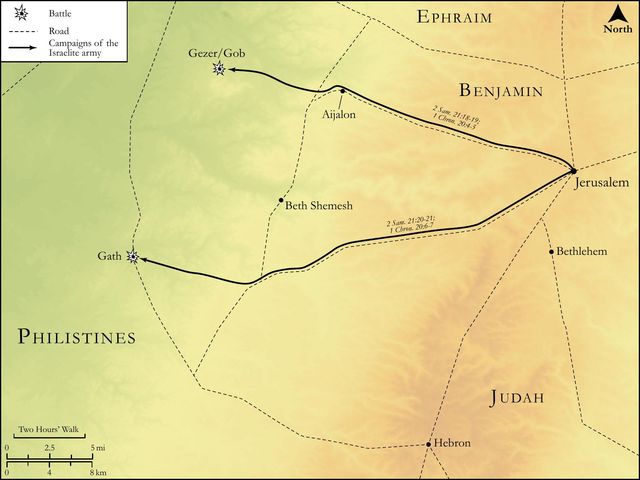
Study this verse
Public-domain commentary
Matthew Henry
From his Commentary on the Whole Bible. Henry comments on passages, not single verses — this entry covers 2 Samuel 21:15–22. His three-level outline is real structure in the source text, so it is rendered as structure.
We have here the story of some conflicts with the Philistines, which happened, as it should seem, in the latter end of David's reign. Though he had so subdued them that they could not bring any great numbers into the field, yet as long as they had any giants among them to be their champions, they would never be quiet, but took all occasions to disturb the peace of Israel, to challenge them, or make incursions upon them.
I.David himself was engaged with one of the giants.
The Philistines began the war yet again, Sa2 21:15. The enemies of God's Israel are restless in their attempts against them. David, though old, desired not a writ of ease from the public service, but he went down in person to fight against the Philistines (Senescit, non segnescit - He grows old, but not indolent), a sign that he fought not for his own glory (at this age he was loaded with glory, and needed no more), but for the good of his kingdom. But in this engagement we find him,
1.In distress and danger. He thought he could bear the fatigues of war as well as he had done formerly; his will was good, and he hoped he could do as at other times. But he found himself deceived; age had cut his hair, and, after a little toil, he waxed faint. His body could not keep pace with his mind. The champion of the Philistines was soon aware of his advantage, perceived that David's strength failed him, and, being himself strong and well-armed, he thought to slay David; but God was not in his thoughts, and therefore in that very day they all perished. The enemies of God's people are often very strong, very subtle, and very sure of success, like Isbi-benob, but there is no strength, nor counsel, nor confidence against the Lord.
2.Wonderfully rescued by Abishai, who came seasonably in to his relief, Sa2 21:17. Herein we must own Abishai's courage and fidelity to his prince (to save whose life he bravely ventured his own), but much more the good providence of God, which brought him in to David's succour in the moment of his extremity. Such a cause and such a champion, though distressed, shall not be deserted. When Abishai succoured him, gave him a cordial, it may be, to relieve his fainting spirits, or appeared as his second, he (namely, David, so I understand it) smote the Philistine and killed him; for it is said (Sa2 21:22) that David had himself a hand in slaying the giants. David fainted, but he did not flee; though his strength failed him, he bravely kept his ground, and then God sent him this help in the time of need, which, though brought him by his junior and inferior, he thankfully accepted, and, with a little recruiting, gained his point, and came off a conqueror. Christ, in his agonies, was strengthened by an angel. In spiritual conflicts, even strong saints sometimes wax faint; then Satan attacks them furiously; but those that stand their ground and resist him shall be relieved, and made more than conquerors.
3.David's servants hereupon resolved that he should never expose himself thus any more. They had easily persuaded him not to fight against Absalom (Sa2 18:3), but against the Philistines he would go, till, having had this narrow escape, it was resolved in council, and confirmed with an oath, that the light of Israel (its guide and glory, so David was) should never be put again into such hazard of being blown out. The lives of those who are as valuable to their country as David was ought to be preserved with a double care, both by themselves and others.
II.The rest of the giants fell by the hand of David's servants.
1.Saph was slain by Sibbechai, one of David's worthies, Sa2 21:18; Ch1 11:29.
2.Another, who was brother to Goliath, was slain by Elhanan, who is mentioned Sa2 23:24.
3.Another, who was of very unusual bulk, who had more fingers and toes than other people (Sa2 21:20), and such an unparalleled insolence that, though he had seen the fall of other giants, yet he defied Israel, was slain by Jonathan the son of Shimea. Shimea had one son named Jonadab (Sa2 13:3), whom I should have taken for the same with this Jonathan, but that the former was noted for subtlety, the latter for bravery. These giants were probably the remains of the sons of Anak, who, though long feared, fell at last. Now observe,
(1.)It is folly for the strong man to glory in his strength. David's servants were no bigger nor stronger than other men; yet thus, by divine assistance, they mastered one giant after another. God chooses by the weak things to confound the mighty.
(2.)It is common for those to go down slain to the pit who have been the terror of the mighty in the land of the living, Eze 32:27.
(3.)The most powerful enemies are often reserved for the last conflict. David began his glory with the conquest of one giant, and here concludes it with the conquest of four. Death is a Christian's last enemy, and a son of Anak; but, through him that triumphed for us, we hope to be more than conquerors at last, even over that enemy.
Continue studying 2 Samuel 21:21 across the web’s major study libraries — every link below opens this exact verse, chapter, or book on the destination site.
Read & Compare
 BibleGatewayThis verse in more than 200 translations and 70 languages.
 Bible.comThe YouVersion reader — hundreds of translations, reading plans, and highlights.
 ESV.orgCrossway's official English Standard Version reader.
 NET BibleThe NET translation with 60,000+ translators' notes on every rendering decision.
 STEP BibleTyndale House's free study tool — original text, vocabulary, and scholarly resources.
 BibliaLogos Bible Software's free web reader.
 USCCBThe New American Bible (Revised Edition) with the U.S. bishops' study notes.
Commentaries
 BibleHub CommentariesDozens of classic commentaries on this verse, gathered on one page.
 StudyLightMore than 100 commentary sets — the largest collection on the web.
 BibleRefPlain-English commentary on what this verse means, verse by verse.
 Enduring WordDavid Guzik's free commentary on this chapter, widely used by Bible teachers.
 Bible Study ToolsVerse commentary alongside Greek and Hebrew study aids.
Original Language & Research
- BibleHub InterlinearThe verse word by word — original language, transliteration, and English.
- BibleHub LexiconEvery word's original-language definition and Strong's entry.
 Blue Letter BibleDeep-study tools — Strong's numbers, concordance, and word studies.
 SefariaThe Hebrew text with Rashi and centuries of Jewish commentary.
Sermons, Hymns & Audio


TrulyRandomVerse is not affiliated with these sites and doesn’t control their content. They’re linked because they’re genuinely useful.
Summary
2 Samuel 21:21 recounts a pivotal act of valor during the latter part of King David's reign, where Jonathan, a nephew of David, courageously confronted and decisively defeated a formidable Philistine giant. This specific encounter, part of a series detailing Israel's ongoing conflict with the Philistines, underscores God's steadfast providence and protection over His people, demonstrating that His power and ability to grant victory extend not only through the king himself but also through the faithfulness and bravery of his family members and mighty men who rise to overcome seemingly insurmountable adversaries.
Context
ShowHideLiterary Context
This verse is situated within a crucial appendix to the book of 2 Samuel (chapters 21-24), which offers a retrospective look at significant events from David's later years, providing a theological summary rather than a strict chronological account. Specifically, 2 Samuel 21:15-22 details four distinct encounters between David's mighty men and various Philistine giants. These narratives serve to demonstrate that even as David aged and his direct involvement in battle lessened, the Lord continued to grant Israel victory through the valor of his loyal warriors. The account here complements the earlier, more famous narrative of David's triumph over Goliath in 1 Samuel 17, showing that the threat of these colossal figures persisted and required ongoing divine intervention and human courage. The preceding verse, 2 Samuel 21:20, provides the specific, unusual description of the giant Jonathan slew, emphasizing his formidable and unnatural nature.
Historical & Cultural Context
The Philistines were a persistent and formidable enemy of Israel throughout the period of the Judges and the early monarchy. Originating from the Aegean region ("Sea Peoples"), they were technologically superior, possessing iron weaponry, and militarily organized, posing a constant threat to Israel's security and territorial integrity from their base in the coastal plain. The concept of "giants" (Hebrew: rapha or rephaim) recurs in Scripture, where only Og king of Bashan "remained of the remnant of giants" and the sons of Anak made the spies seem as grasshoppers in their own sight. Such figures often symbolized overwhelming, almost supernatural, opposition. The act of "defying Israel" (verse 21) carried immense cultural weight, akin to Goliath's taunts, as it was not merely a military challenge but a direct insult to the God of Israel and His chosen people, demanding a champion to restore honor and demonstrate divine power.
Key Themes
ShowHideThe narrative of Jonathan's victory contributes to several overarching themes within 2 Samuel and the broader Deuteronomistic History. Firstly, it highlights Divine Protection and Providence, demonstrating that God's covenant faithfulness extends beyond a single leader, empowering others to secure His people's safety, even when the king is no longer at the forefront of every battle. Secondly, it powerfully illustrates Valor and Courage, as Jonathan, a member of David's own family, steps forward to confront a terrifying foe, echoing the bravery of his uncle David. This act of individual heroism within a corporate struggle underscores the importance of personal faith and action. Thirdly, the ongoing series of battles against the Philistine giants reinforces the theme of Ongoing Conflict and Triumph, reminding the audience that the path of God's people is often marked by persistent opposition, yet divine assistance consistently leads to victory over seemingly insurmountable adversaries, as seen throughout the book of 2 Samuel.
Exposition and Analysis
ShowHideKey Word Analysis
ShowHideThe Hebrew verb חרף (châraph) signifies "to taunt, reproach, defy, insult, or blaspheme." This word carries a strong connotation of open challenge and public shaming. When the giant "defied Israel," he was not merely issuing a military challenge but was publicly insulting the nation and, by extension, their God. This act of defiance made the confrontation a spiritual battle for honor and vindication, similar to Goliath's taunts against the armies of the living God in 1 Samuel 17:10. Jonathan's action, therefore, was a restoration of Israel's honor and a demonstration of God's power.
The Hebrew noun בן (bên) means "a son" in the widest sense, encompassing literal and figurative relationships, including descendants and members of a family or group. In this verse, "Jonathan the son of Shimea" emphasizes Jonathan's direct lineage from David's brother, connecting him firmly to the royal family and highlighting that courage and divine favor were not exclusive to David but extended to his kin. This familial connection reinforces the idea of a shared heritage of valor and God's blessing within the covenant community.
The Hebrew verb נכה (nâkâh) is a common word for "to strike, smite, kill." In this context, it signifies a decisive and complete defeat. Jonathan did not merely wound or repel the giant; he "slew him," indicating a definitive end to the threat posed by this particular Philistine champion. This emphasizes the finality of the victory and the effectiveness of Jonathan's courage and skill, empowered by God, in eliminating a significant enemy of Israel.
Verse Breakdown
ShowHide"And when he defied Israel,"
This opening clause sets the scene, highlighting the giant's aggressive and provocative challenge against the entire nation of Israel. The act of defiance was a direct affront not only to Israel's military might but also to their God, making the ensuing battle a theological contest as much as a military one. It evokes echoes of Goliath's defiance, establishing a thematic parallel between the two giant-slaying narratives.
"Jonathan the son of Shimea the brother of David"
This phrase precisely identifies the hero and his significant lineage. Jonathan is identified as the son of Shimea (also known as Shammah in 1 Samuel 16:9), one of David's brothers. This familial connection underscores that God's blessing and valor were not confined to David alone but extended to his family and, by extension, to the wider community of Israel. It also subtly reinforces David's legacy through his kin, demonstrating that the spirit of courage and faith continued within his household.
"slew him."
This concluding phrase delivers the decisive outcome. Jonathan's act was one of remarkable courage and effectiveness, resulting in the death of the giant. This victory was crucial for Israel's security and morale, demonstrating God's continued faithfulness to His people through the actions of His chosen servants, even those not as prominent as David himself, solidifying the narrative of divine empowerment.
Literary Devices
ShowHideThe passage employs several significant literary devices. Parallelism is prominent, as Jonathan's feat directly echoes David's earlier, more famous victory over Goliath in 1 Samuel 17. Both narratives involve a giant defying Israel and a seemingly less prominent individual stepping forward to defeat him, thereby vindicating God's people. This parallelism serves to reinforce the theme of divine empowerment and the ongoing nature of God's work through various champions. The description of the giant in the preceding verse (2 Samuel 21:20) with "six fingers on each hand, and six toes on each foot, four and twenty in number" utilizes Hyperbole and Grotesque Imagery to emphasize the monstrous and unnatural nature of the foe, thereby magnifying Jonathan's courage and the divine power at work. The giant functions as a Symbol of overwhelming, seemingly insurmountable opposition, representing not just a physical threat but also spiritual and existential challenges that defy human strength alone.
Theological and Thematic Connections
ShowHideThe account of Jonathan's victory over the Philistine giant profoundly illustrates God's unwavering commitment to His people, even when their primary leader, David, is no longer in his prime. It demonstrates that divine protection is not contingent upon a single individual's strength but is extended corporately through the faithfulness of many. This narrative reminds us that God raises up champions from unexpected places, empowering ordinary individuals to accomplish extraordinary feats for His glory and the good of His people. It underscores that the battle against spiritual and physical "giants" is ongoing, but victory is assured through God's providence and the courage He instills in His servants. The valor displayed by Jonathan is a testament to the fact that God's power is made perfect in weakness, enabling His people to overcome what seems impossible.
Reflection and Application
ShowHideJonathan's courageous act in 2 Samuel 21:21 offers enduring lessons for believers today. Just as ancient Israel faced literal giants who defied their God, we too encounter metaphorical "giants" in our lives—overwhelming challenges, spiritual attacks, pervasive injustices, or seemingly impossible obstacles that mock our faith and threaten our peace. This passage serves as a powerful reminder that God continues to equip and empower His people, often through unexpected individuals, to confront and overcome these formidable adversaries. We are called to cultivate a spirit of courage, trusting that the same God who enabled Jonathan to slay a giant will enable us to face our own "giants" with faith and resolve. Furthermore, Jonathan's role as part of David's family and the broader community of Israel's warriors highlights the vital importance of corporate strength and mutual support in spiritual warfare. We are not meant to face our battles alone; the body of Christ is designed for interdependency, where each member contributes to the collective victory. Every act of faithful service, whether grand or seemingly small, contributes to God's overarching plan and triumph.
Questions for Reflection
ShowHideFAQ
ShowHideWho was Jonathan, and why is his lineage emphasized here?
ShowHideJonathan in 2 Samuel 21:21 is identified as "the son of Shimea the brother of David." Shimea was one of David's older brothers, also known as Shammah (1 Samuel 16:9). His lineage is emphasized to establish his connection to the royal house and to David, highlighting that valor and divine favor were not exclusive to David but extended to his family and, by extension, to the wider community of Israel. This detail underscores the corporate nature of Israel's strength and God's continued work through various individuals within the covenant community, even as David himself aged and was less active in direct combat. It shows that God raises up champions from within His people, demonstrating His faithfulness to the entire nation.
Christ-Centered Fulfillment
ShowHideThe narrative of Jonathan slaying the giant in 2 Samuel 21:21 finds its ultimate Christ-centered fulfillment in the person and work of Jesus Christ. Just as Jonathan, a kinsman of David, confronted a physical giant who defied Israel, so Jesus, the Son of David and the ultimate champion, confronted and decisively defeated the spiritual giants of sin, death, and the devil that had defied humanity and God's righteous rule. His victory on the cross, where He disarmed the powers and authorities (Colossians 2:15), was the ultimate giant-slaying act, securing eternal triumph for all who believe. Furthermore, as Jonathan was part of David's family and mighty men, believers are now united with Christ, the greater David, as members of His body, the Church (Ephesians 4:15-16). Through Christ, we are empowered to participate in His ongoing victory over spiritual adversaries, no longer facing our "giants" alone but through the strength of the resurrected Lord who lives within us (Philippians 4:13). Jonathan's courage foreshadows the perfect courage and decisive victory of the Lamb of God, who takes away the sin of the world (John 1:29).