


Matthew 26:43
Bible text: King James Version (1769 Blayney text) · Public domain
Bible text: Berean Standard Bible · Public domain
Bible text: American Standard Version (1901) · Public domain
Bible text: World English Bible, Messianic edition · Public domain
Bible text: Geneva Bible (1599) · Public domain
Bible text: Young's Literal Translation · Public domain
- καὶkaiAndG2532CONJConjunction
- ἐλθὼνelthōnhaving comeG2064V-2AAP-NSMVerb 2nd Aorist Active Participle Nominative Singular Masculine
- πάλινpalinagainG3825ADVAdverb
- εὗρενheurenHe foundG2147V-2AAI-3SVerb 2nd Aorist Active Indicative 3rd Singular
- αὐτοὺςautousthemG846P-APMPersonal pronoun Accusative Plural Masculine
- καθεύδοντας·katheudontassleepingG2518V-PAP-APMVerb Present Active Participle Accusative Plural Masculine
- ἦσανēsanwereG1510V-IAI-3PVerb Imperfect Active Indicative 3rd Plural
- γὰρgarforG1063CONJConjunction
- αὐτῶνautōnof themG846P-GPMPersonal pronoun Genitive Plural Masculine
- οἱhoitheG3588T-NPMDefinite article Nominative Plural Masculine
- ὀφθαλμοὶophthalmoieyesG3788N-NPMNoun Nominative Plural Masculine
- βεβαρημένοιbebarēmenoiweariedG916V-RPP-NPMVerb Perfect Passive Participle Nominative Plural Masculine
English is a literal word-by-word gloss of the Greek, not the KJV's wording. Why?
This is the original text the KJV's translators worked from — each Greek word with its own literal English meaning in this verse, prepared by scholars at Tyndale House, Cambridge. The KJV translates whole sentences, not word by word, so its wording differs: one Greek word can become several English words, and the KJV may choose “charity” where the gloss reads “love”. Both are faithful — they answer different questions. For the KJV's own rendering, switch to the KJV text.
Details
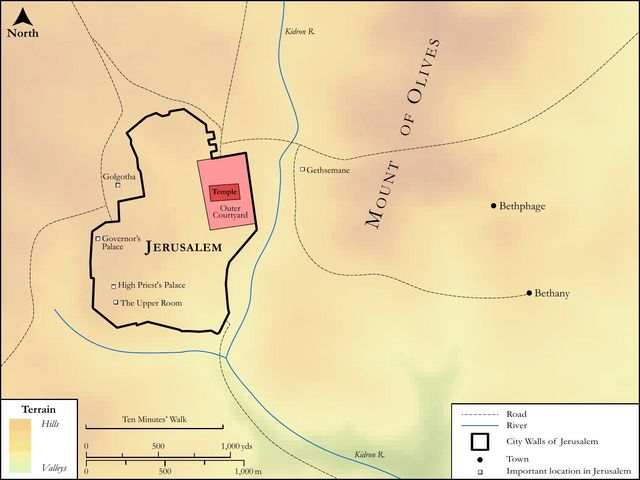
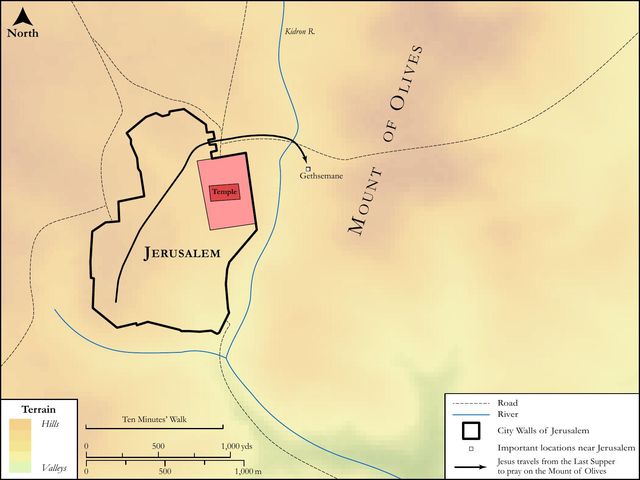
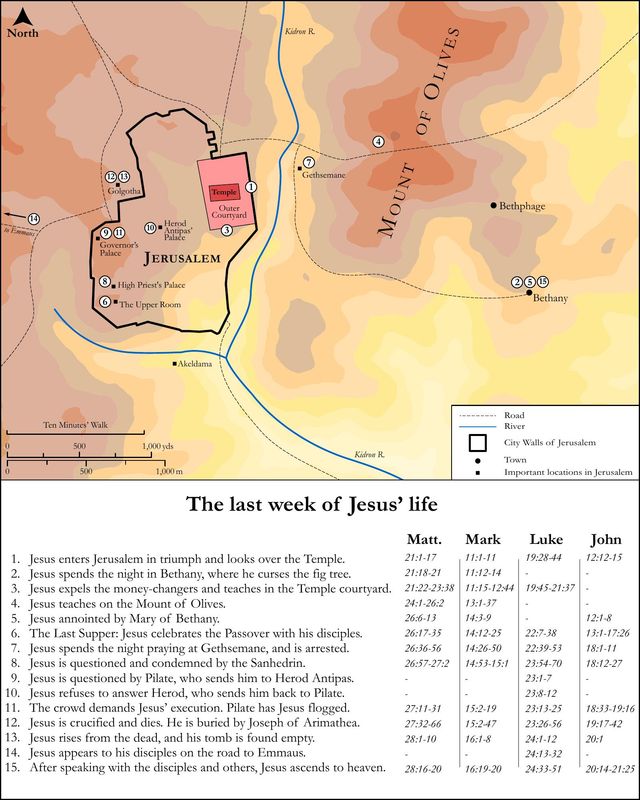
See on the biblical-era maps
Study this verse
Historical interpretation
Nine Centuries of Reception
14 surviving comments on this verse. Each one is dated, so this reads as a timeline rather than a list.
Select a marker to jump to its quote. Markers stagger vertically where authors wrote within a few decades of each other.
But notice that after the first prayer "he came to the disciples and found them sleeping." Likewise after the second prayer "he came and found them sleeping, for their eyes were heavy." On this, I believe they were the eyes not so much of their bodies as of their souls. Besides, he had not yet removed the heaviness from their eyes, "because he was not yet glorified." And just as "the Spirit had not been given, because Jesus was not yet glorified," so too the heaviness had not yet been removed from their eyes "because Jesus was not yet glorified." Therefore he does not rebuke them, but "leaving them again, he went away and prayed for the third time, saying the same words." He also teaches us through those "same words," that we may not grow faint in prayer but persist in the very words of our prayer until we obtain those things we have begun to pray for.
And I suppose that the eyes of their body were not so much affected as the eyes of their mind, because the Spirit was not yet given them.
After that, he returns to the disciples and finds them sleeping. He asks Peter why he could not watch with him one hour—Peter, indeed, was one of the three, for he had boasted in front of the others that he would not fall away. And he indicates the cause of his greater fear, saying, “Pray that you may not enter into temptation.” He wanted then to prevent temptation (so he included in his prayer the words “lead us not into temptation”), lest anything in us cater to the weakness of the flesh. He also makes it clear why he urged them to pray in order to avoid temptation, saying, “The spirit indeed is willing, but the flesh is weak.” These words did not apply to himself but were aimed at them. For that matter, how is it that now his spirit is willing, whereas before his soul was sad even to death? At any rate, he orders them to watch and pray lest they give in to temptation and succumb to the weakness of the body. He therefore prays that, if possible, the cup may pass from himself, for when it comes to drinking from it, all flesh is weak.
Otherwise; He says not, Let this cup pass away from Me, for that would be the speech of one who feared it; but He prays that it may pass not so as that He should be passed over, but that when it has passed from Him, it may go to another. His whole fear then is for those who were to suffer, and therefore He prays for those who were to suffer after Him, saying, Let this cup pass from me, i. e. as it is drunk by Me, so let it be drunk by these, without mistrust, without sense of pain, without fear of death. He says, If it be possible, because flesh and blood shrink from these things, and it is hard for human bodies not to sink beneath their infliction. That He says, Not as I will, but as thou wilt, He would fain indeed that they should not suffer, lest their faith should fail in their sufferings, if indeed we might attain to the glory of our joint inheritance with Him without the hardship of sharing in His Passion. He says, Not as I will, but as thou wilt, because it is the Father's will that strength to drink of the cup should pass from Him to them, that the Devil might be vanquished not so much by Christ as by His disciples also.
When then He returned to His disciples and found them sleeping, He rebukes Peter, Could ye not watch one hour with me? He addresses Peter rather than the rest, because he had most loudly boasted that he would not be offended.
And why He thus encouraged them to pray that they might not enter into temptation, He adds, For the spirit indeed is willing, but the flesh is weak; this He says not of Himself, but addresses them.
Otherwise, He bare in His own body all the infirmities of us His disciples who should suffer, and nailed to His cross all wherein we are distressed; and therefore that cup cannot pass from Him, unless He drink it, because we cannot suffer, except by His passion.
The fact that, after returning and finding them asleep, he first reproves them, secondly is silent and thirdly orders them to rest, can be explained in this way: First, after the resurrection, he scolded them for scattering and for being apprehensive and restless; second, once the Holy Spirit had been sent, he came and found them sleeping, since their eyes were too heavy for them to discern the freedom of the gospel—having been held back by the love of the law for some time, their faith was still sleeping; and third, with the return of his radiance, he restored them to restfulness and peace of mind.
He finds them sleeping, both because it was a late hour of the night, and their eyes were heavy with sorrow.
But as they had all said the same, He charges them all with weakness; they had chosen to die with Christ, and yet could not even watch with Him.
That He prays for this a second and a third time, comes of the feelings belonging to human frailty, through which also He feared death, thus giving assurance that He was truly made man. For in Scripture when any thing is repeated a second and third time, that is the greatest proof of its truth and reality; as, for example, when Joseph says to Pharaoh, And for that thou sawedst it twice, it is proof of the thing being established by God. (Gen. 41:32.)
However, even these He dismisses: "And He went on a little farther, and prayeth, saying, Father, if it be possible, let this cup pass from me; nevertheless not as I will, but as Thou wilt. And He cometh unto them, and findeth them sleeping, and saith unto Peter, What, could ye not watch with me one hour? Watch and pray, that ye enter not into temptation; the spirit indeed is willing, but the flesh is weak."
Not without reason doth He inveigh against Peter most, although the others also had slept; but to make him feel by this also, for the cause which I mentioned before. Then because the others also said the same thing (for when Peter had said (these are the words), "Though I must die with Thee, I will not deny Thee; likewise also," it is added, "said all the disciples"); He addresses Himself to all, convicting their weakness. For they who are desiring to die with Him, were not then able so much as to sorrow with Him wakefully, but sleep overcame them.
And He prays with earnestness, in order that the thing might not seem to be acting. And sweats flow over him for the same cause again, even that the heretics might not say this, that He acts the agony. Therefore there is a sweat like drops of blood, and an angel appeared strengthening Him, and a thousand sure signs of fear, lest any one should affirm the words to be feigned. For this cause also was this prayer. By saying then, "If it be possible, let it pass from me," He showed His humanity; but by saying, "Nevertheless not as I will, but as Thou wilt," He showed His virtue and self-command, teaching us even when nature pulls us back, to follow God. For since it was not enough for the foolish to show His face only, He uses words also. Again, words sufficed not alone, but deeds likewise were needed; these also He joins with the words, that even they who are in a high degree contentious may believe, that He both became man and died. For if, even when these things are so, this be still disbelieved by some, much more, if these had not been. See by how many things He shows the reality of the incarnation: by what He speaks, by what He suffers. After that He cometh and saith to Peter, as it is said, "What, couldest thou not watch one hour with me?" All were sleeping, and He rebukes Peter, hinting at him, in what He spake. And the words, "with me," are not employed without reason; it is as though He had said, Thou couldest not watch with me one hour, and wilt thou lay down thy life for me? and what follows also, intimates this self-same thing. For "Watch," saith He, "and pray not to enter into temptation." See how He is again instructing them not to be self-confident, but contrite in mind, and to be humble, and to refer all to God.
And at one time He addresses Himself to Peter, at another to all in common. And to him He saith, "Simon, Simon, Satan hath desired to have you, that he may sift you as wheat; but I have prayed for thee;" and to all in common, "Pray that ye enter not into temptation;" every way plucking up their self-will, and making them earnest-minded. Then, that He might not seem to make His language altogether condemnatory, He saith, "The spirit indeed is ready, but the flesh is weak." For even although thou dost desire to despise death, yet thou wilt not be able, until God stretch forth His hand, for the carnal mind draws down.
And again He prayed in the same way, saying, "Father, if this cannot pass from me except I drink it, Thy will be done," showing here, that He fully harmonizes with God's will, and that we must always follow this, and seek after it.
“Watch and pray that you may not enter into temptation.” It is impossible for the human soul to avoid temptation. Hence we say in the Lord’s Prayer, “Lead us not into temptation,” which we are unable to withstand. We do not refuse to face temptation entirely but pray for the strength to bear up under it. Therefore he does not say, “Watch and pray that you may not be tempted” but “that you may not enter into temptation,” that is, that temptation may not overwhelm you and hold you in its grip. For example, a martyr who has shed blood by professing faith in the Lord was certainly tempted but was not ensnared in the net of temptation. One who denies the faith, however, has fallen into the snares of temptation.“The spirit indeed is willing, but the flesh is weak.” This is aimed at those rash people who think that whatever they believe, they can obtain. Therefore, as much as we trust in the ardor of our spirit, so too should we fear the weakness of the flesh. And yet, according to the apostle, the works of the flesh are mortified by the Spirit.
Or the sleep which He would have them forego is not bodily rest, for which at this critical time there was no room, but mental torpor, the sleep of unbelief.
Whence He says emphatically, This cup, that is, of this people of the Jews, who, if they shall put Me to death, can have no excuse for their ignorance, seeing they have the Law and the Prophets, who speak of Me.
It is impossible that the human mind should not be tempted, therefore He says not Watch and pray that ye be not tempted, but that ye enter not into temptation, that is, that temptation vanquish you not.
This is against those rash persons who think that whatever they believe they can perform. The more confident we are of our zeal, the more mistrustful should we be of the frailty of the flesh.
Or otherwise; He prays a second time that if Nineveh, or the Gentile world, cannot be saved unless the gourd, i. e. the Jews, be withered, His Father's will may be done, which is not contrary to the Son's will, who Himself speaks by the Prophet, I am content to do thy will, O God. (Ps. 40:8.)
Christ singly prays for all, as He singly suffers for all. Their eyes were heavy, i. e. an oppression and stupefaction came on as their denial drew near.
He prayed the third time, that in the mouth of two or three witnesses every word might be established.
(Verse 43, 44.) And he came again and found them sleeping. For their eyes were heavy. And leaving them, he went away again and prayed for the third time, saying the same thing. He alone prays for all, just as he alone suffers for everyone. But the apostles' eyes grew weak and burdened by imminent denial.
(Serm. 58, 5.) This speech of the Head is the health of the whole body, this saying is instruction to the faithful, animates the confessor, crowns the martyr. For who could vanquish the hatred of the world, or the whirlwind of temptations, or the terrors of the persecutors, if Christ did not in all and for all say to the Father, Thy will be done. Let all the sons of the Church then utter this prayer, that when the pressure of some mighty temptation lies upon them, they may embrace endurance of the suffering, disregarding its terrors.
Otherwise; In these words He shows that He took real flesh of the Virgin, and had a real soul, saying that His spirit is willing to suffer, but His flesh weak in fearing the pain of Passion.
Or, He prays thrice for the Apostles, and for Peter in particular, who was to deny Him thrice.
Or, The Lord prayed thrice, to teach us to pray for pardon of sins past, defence against present evil, and provision against future perils, and that we should address every prayer to Father, Son, and Holy Spirit, and that our spirit, soul, and body should be kept in safety.
. When you hear that the Lord Himself prayed many times, learn, O man, that you ought to pray continuously when beset by temptations. When Jesus found them sleeping again, He did not rebuke them lest He grieve them, but He let them be. And He left them and prayed for the third time, thus confirming His human nature. For the number three signifies both truth and confirmation.
Continue studying Matthew 26:43 across the web’s major study libraries — every link below opens this exact verse, chapter, or book on the destination site.
Read & Compare
 BibleGatewayThis verse in more than 200 translations and 70 languages.
 Bible.comThe YouVersion reader — hundreds of translations, reading plans, and highlights.
 ESV.orgCrossway's official English Standard Version reader.
 NET BibleThe NET translation with 60,000+ translators' notes on every rendering decision.
 STEP BibleTyndale House's free study tool — original text, vocabulary, and scholarly resources.
 BibliaLogos Bible Software's free web reader.
 USCCBThe New American Bible (Revised Edition) with the U.S. bishops' study notes.
Commentaries
 BibleHub CommentariesDozens of classic commentaries on this verse, gathered on one page.
 StudyLightMore than 100 commentary sets — the largest collection on the web.
 BibleRefPlain-English commentary on what this verse means, verse by verse.
 Enduring WordDavid Guzik's free commentary on this chapter, widely used by Bible teachers.
 Bible Study ToolsVerse commentary alongside Greek and Hebrew study aids.
Original Language & Research
- BibleHub InterlinearThe verse word by word — original language, transliteration, and English.
- BibleHub LexiconEvery word's original-language definition and Strong's entry.
 Blue Letter BibleDeep-study tools — Strong's numbers, concordance, and word studies.
 CNTR CollationThe earliest Greek manuscripts of this verse, collated letter by letter.
Sermons, Hymns & Audio


TrulyRandomVerse is not affiliated with these sites and doesn’t control their content. They’re linked because they’re genuinely useful.
Summary
Matthew 26:43 describes Jesus' return to His disciples in the Garden of Gethsemane for the second time, only to find them once again succumbed to sleep. This poignant moment underscores the profound human weakness of even His closest companions in the face of overwhelming exhaustion and spiritual intensity, contrasting sharply with Jesus' own fervent agony and solitary resolve as He prepared for the cross. It highlights the unique burden Jesus bore alone in His redemptive mission.
Context
ShowHideLiterary Context
This verse is situated within the deeply solemn narrative of Jesus' agony in the Garden of Gethsemane, immediately following the Last Supper and the institution of the new covenant. Jesus has withdrawn with Peter, James, and John, asking them to "remain here and watch with me" Matthew 26:38. This is the second of three times Jesus finds them asleep, having previously found them so in Matthew 26:40 and delivering the poignant warning in Matthew 26:41 that "the spirit indeed is willing, but the flesh is weak." The repeated discovery of their slumber emphasizes their inability to comprehend or participate in the profound spiritual battle Jesus was enduring, setting a stark contrast between His solitary suffering and their human frailty. The narrative builds toward Jesus' betrayal and arrest, making the disciples' failure to watch all the more tragic.
Historical & Cultural Context
The setting is the Garden of Gethsemane, likely an olive grove on the Mount of Olives, a place Jesus and His disciples frequented John 18:1-2. It was late at night, after the Passover meal, a time when exhaustion would naturally set in. The disciples had experienced a day of intense emotional and spiritual events, including the Last Supper, Jesus' predictions of betrayal, and His solemn teachings. The act of "watching" (Greek: grēgoreō) in a spiritual sense was a common theme in Jewish eschatological expectation, signifying vigilance for the coming of the Messiah or the Day of the Lord. For the disciples, it also implied a commitment to stand with their master during a time of crisis. Their inability to stay awake, despite the gravity of the situation and Jesus' explicit request, speaks to the overwhelming physical and mental fatigue, perhaps compounded by the emotional stress and the late hour, making their eyes "heavy" (Greek: bebarymenoi, G916).
Key Themes
ShowHideMatthew 26:43 contributes significantly to several overarching themes within the Gospel of Matthew and the broader biblical narrative. Firstly, it powerfully illustrates Human Weakness and Frailty, demonstrating that even the most devoted followers can fail in moments of critical spiritual need due to physical limitations. This contrasts with the theme of Divine Strength and Solitude, as Jesus alone bears the weight of His impending suffering, highlighting His unique role as the Son of God who must tread the winepress alone Isaiah 63:3. The verse also underscores the Intensity of Jesus' Agony, emphasizing the profound spiritual and emotional cost of His obedience to the Father's will, a burden so immense that His closest companions could not even remain awake to witness it. This scene foreshadows the ultimate Sacrifice and Atonement, where Jesus, in His complete humanity and divinity, fully embraces the suffering necessary for humanity's redemption, without human aid or comfort.
Exposition and Analysis
ShowHideKey Word Analysis
ShowHideThis verb, often translated as "to come" or "to go," signifies movement and presence. In this context, it highlights Jesus' deliberate and repeated return to check on His disciples. It implies His continued care and expectation, even as His own agony intensifies. The repeated "coming" emphasizes the disciples' consistent failure to remain vigilant.
Derived from words meaning "down" and "to sleep," this term denotes a state of lying down to rest or falling asleep. Here, it describes the disciples' profound physical slumber, a state of unconsciousness that prevents them from fulfilling Jesus' request to "watch." The repeated use of this word underscores their physical inability to stay awake, despite their spiritual willingness.
This word means "to weigh down" or "to burden." In the passive voice, as used here, it describes their eyes as being "weighed down" or "burdened." This is not merely casual drowsiness but a deep, almost oppressive fatigue that made it physically impossible for them to keep their eyes open. It conveys an inescapable weariness, emphasizing the extreme physical toll of the late hour and the emotional intensity of the situation.
Verse Breakdown
ShowHide"And he came"
This clause signifies Jesus' deliberate return to His inner circle of disciples—Peter, James, and John—after His second period of intense prayer. It highlights His persistent engagement with them, even as He grappled with His profound spiritual agony. His coming implies an expectation that they would be found watching, as He had previously instructed.
"and found them asleep again:"
This phrase reveals the disappointing reality Jesus encountered. For the second time, He finds His chosen companions in a state of slumber, directly contradicting His earnest plea for them to "watch with me." The word "again" emphasizes the repetition of their failure, underscoring their human weakness and inability to remain vigilant, despite the critical nature of the hour and their Master's suffering.
"for their eyes were heavy."
This final clause provides the reason for their repeated slumber. The phrase "their eyes were heavy" indicates an overwhelming physical exhaustion, a profound weariness that made it impossible for them to keep their eyelids open. It's not presented as a lack of desire, but a physical limitation, a deep, almost oppressive fatigue that had taken hold of them, preventing them from fulfilling their spiritual duty to watch and pray.
Literary Devices
ShowHideThe verse employs several significant literary devices. Repetition is evident in Jesus' repeated discovery of the disciples asleep, reinforcing their consistent failure to remain vigilant and highlighting the depth of their physical exhaustion. This repetition creates a sense of tragic irony, as the disciples, despite their commitment, are unable to share in Jesus' most intense hour. Contrast is powerfully utilized between Jesus' fervent, agonizing prayer and the disciples' inability to stay awake. This stark juxtaposition emphasizes Jesus' solitary burden and the unique nature of His suffering. Furthermore, the phrase "their eyes were heavy" functions as a form of Metonymy, where "heavy eyes" stand for the deep, inescapable weariness that has overcome their entire being, preventing them from spiritual watchfulness. The sleep itself can also be seen as Symbolism, representing not just physical exhaustion but also a spiritual dullness or inability to fully grasp the gravity of the spiritual battle unfolding around them.
Theological and Thematic Connections
ShowHideMatthew 26:43 stands as a poignant reminder of the inherent frailty of human nature, even among those closest to Christ. It underscores the reality that while the spirit may be willing, the flesh is often weak, unable to sustain the vigilance required in moments of intense spiritual warfare or profound crisis. This scene deepens our understanding of Jesus' solitary suffering, emphasizing that His ultimate redemptive work was a burden He bore alone, unmatched by any human capacity for empathy or companionship. It highlights the unique divine strength and unwavering resolve of Christ in the face of unimaginable spiritual and emotional pressure, setting Him apart as the perfect Son who fully accomplished the Father's will. The disciples' failure serves as a timeless cautionary tale, urging believers to cultivate spiritual discipline and reliance on God's strength, especially when facing temptation or the demands of the Kingdom.
Reflection and Application
ShowHideMatthew 26:43 serves as a profound mirror for our own spiritual lives. The disciples' heavy eyes and inability to stay awake, despite their proximity to Jesus and the gravity of the moment, powerfully illustrate the constant battle between our spiritual intentions and our human limitations. We, too, often find ourselves spiritually drowsy when vigilance is most needed, whether due to the weariness of daily life, the distractions of the world, or a failure to grasp the true intensity of the spiritual battles around us. This verse calls us to a deeper self-awareness, acknowledging our own inherent weakness, not to condemn us, but to drive us to greater dependence on God's strength. It reminds us that true spiritual watchfulness is not merely a matter of willpower but a continuous reliance on the Holy Spirit to empower us to pray without ceasing and to remain alert in a world that constantly seeks to lull us into spiritual slumber. Our empathy for Christ's solitary suffering in Gethsemane should also deepen, leading us to profound gratitude for His unique and perfect sacrifice, which He accomplished without the aid or comfort of human companionship.
Questions for Reflection
ShowHideFAQ
ShowHideWhy did the disciples keep falling asleep, despite Jesus' clear instructions?
ShowHideThe disciples' repeated slumber was primarily due to extreme physical and emotional exhaustion, rather than a deliberate act of disobedience or a lack of love for Jesus. They had just shared the Last Supper, a deeply significant and emotionally charged event, and it was late at night (likely past midnight, heading into the early morning hours). Jesus Himself acknowledged their physical weakness, stating in Matthew 26:41, "The spirit indeed is willing, but the flesh is weak." While their spirit desired to be with Jesus and support Him, their physical bodies simply gave out under the immense strain and fatigue. This highlights the reality of human limitations, even for those with the best intentions and closest relationship with the Lord.
Christ-Centered Fulfillment
ShowHideMatthew 26:43, with its stark portrayal of human weakness contrasted with divine resolve, finds its profound Christ-centered fulfillment in Jesus' unique and perfect obedience. The disciples' inability to stay awake underscores the singular nature of Jesus' Gethsemane agony; He alone was capable of bearing the full weight of humanity's sin and the Father's wrath. Their "heavy eyes" symbolize the spiritual dullness and frailty of fallen humanity, unable to comprehend or participate in the ultimate spiritual battle. In contrast, Jesus, the Son of God, remained perfectly vigilant and obedient, even to the point of death on the cross Philippians 2:8. Where human flesh failed, Christ's divine-human nature triumphed. His solitary suffering in Gethsemane foreshadows His solitary sacrifice on Calvary, where He became the Lamb of God who takes away the sin of the world John 1:29. Through His perfect obedience and ultimate sacrifice, Jesus provides the strength and spiritual vigilance that we, in our weakness, so desperately need. He is our High Priest who sympathizes with our weaknesses, having been tempted in every way, yet without sin Hebrews 4:15. Thus, His victory in Gethsemane and on the cross is the source of our ability to "watch and pray" and to overcome the weakness of our flesh through His indwelling Spirit Romans 8:26.