


Luke 9:32
Bible text: King James Version (1769 Blayney text) · Public domain
Bible text: King James Version with Strong's numbers · Public domain
Bible text: Berean Standard Bible · Public domain
Bible text: American Standard Version (1901) · Public domain
Bible text: World English Bible, Messianic edition · Public domain
Bible text: Geneva Bible (1599) · Public domain
Bible text: Young's Literal Translation · Public domain
- ὁho<the>G3588T-NSMDefinite article Nominative Singular Masculine
- δὲdeAndG1161CONJConjunction
- ΠέτροςPetrosPeterG4074N-NSM-PNoun Nominative Singular Masculine Individual
- καὶkaiandG2532CONJConjunction
- οἱhoithoseG3588T-NPMDefinite article Nominative Plural Masculine
- σὺνsunwithG4862PREPPreposition
- αὐτῷautōhimG846P-DSMPersonal pronoun Dative Singular Masculine
- ἦσανēsanwereG1510V-IAI-3PVerb Imperfect Active Indicative 3rd Plural
- βεβαρημένοιbebarēmenoiweariedG916V-RPP-NPMVerb Perfect Passive Participle Nominative Plural Masculine
- ὕπνῳhupnōwith sleepG5258N-DSMNoun Dative Singular Masculine
- διαγρηγορήσαντεςdiagrēgorēsanteshaving awoken fullyG1235V-AAP-NPMVerb Aorist Active Participle Nominative Plural Masculine
- δὲdethenG1161CONJConjunction
- εἶδονeidonthey sawG1492V-2AAI-3PVerb 2nd Aorist Active Indicative 3rd Plural
- τὴνtēntheG3588T-ASFDefinite article Accusative Singular Feminine
- δόξανdoxangloryG1391N-ASFNoun Accusative Singular Feminine
- αὐτοῦautouof HimG846P-GSMPersonal pronoun Genitive Singular Masculine
- καὶkaiandG2532CONJConjunction
- τοὺςtoustheG3588T-APMDefinite article Accusative Plural Masculine
- δύοduotwoG1417A-NUIAdjective
- ἄνδραςandrasmenG435N-APMNoun Accusative Plural Masculine
- τοὺςtouswhoG3588T-APMDefinite article Accusative Plural Masculine
- συνεστῶταςsunestōtasalready standing withG4921V-RAP-APMVerb Perfect Active Participle Accusative Plural Masculine
- αὐτῷautōHimG846P-DSMPersonal pronoun Dative Singular Masculine
English is a literal word-by-word gloss of the Greek, not the KJV's wording. Why?
This is the original text the KJV's translators worked from — each Greek word with its own literal English meaning in this verse, prepared by scholars at Tyndale House, Cambridge. The KJV translates whole sentences, not word by word, so its wording differs: one Greek word can become several English words, and the KJV may choose “charity” where the gloss reads “love”. Both are faithful — they answer different questions. For the KJV's own rendering, switch to the KJV text.
Details
See on the biblical-era maps
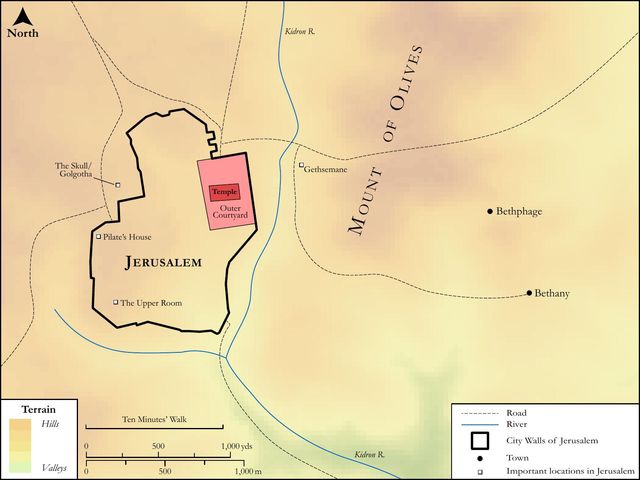
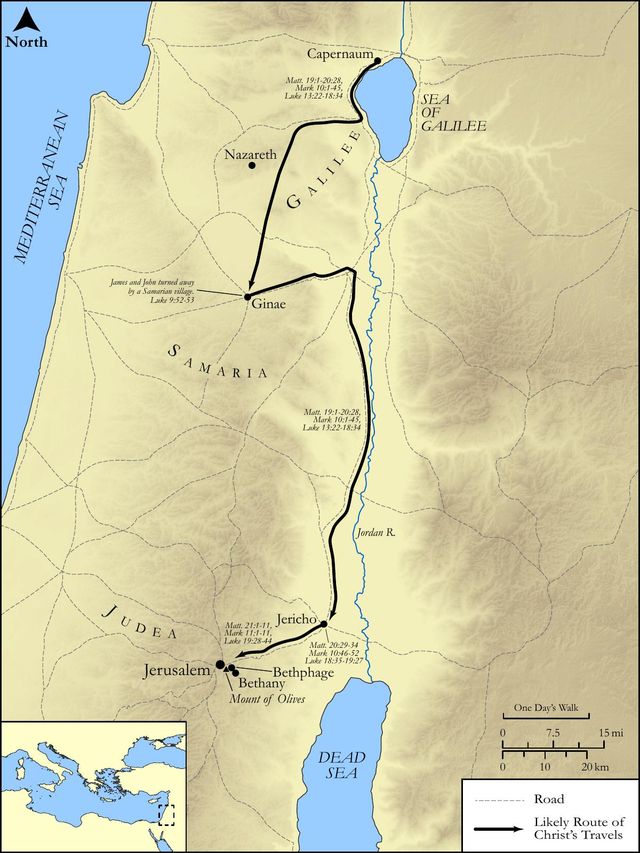
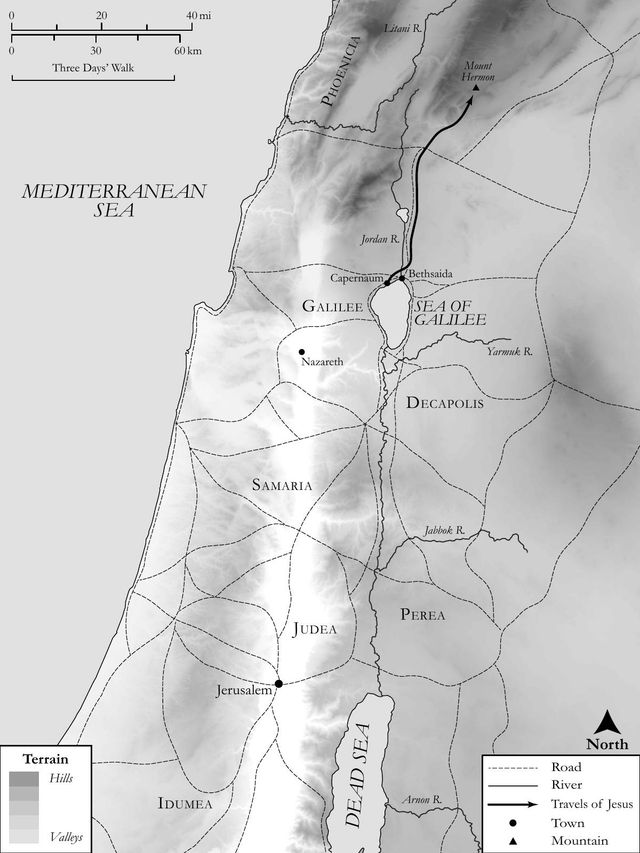
Study this verse
Public-domain commentary
Matthew Henry
From his Commentary on the Whole Bible. Henry comments on passages, not single verses — this entry covers Luke 9:28–36. His three-level outline is real structure in the source text, so it is rendered as structure.
We have here the narrative of Christ's transfiguration, which was designed for a specimen of that glory of his in which he will come to judge the world, of which he had lately been speaking, and, consequently, an encouragement to his disciples to suffer for him, and never to be ashamed of him. We had this account before in Matthew and Mark, and it is well worthy to be repeated to us, and reconsidered by us, for the confirmation of our faith in the Lord Jesus, as the brightness of his Father's glory and the light of the world, for the filling of our minds with high and honourable thoughts of him, notwithstanding his being clothed with a body, and giving us some idea of the glory which he entered into at his ascension, and in which he now appears within the veil, and for the raising and encouraging of our hopes and expectations concerning the glory reserved for all believers in the future state.
I.Here is one circumstance of the narrative that seems to differ from the other two evangelists that related it.
They said that it was six days after the foregoing sayings; Luke says that it was about eight days after, that is, it was that day sevennight, six whole days intervening, and it was the eighth day. Some think that it was in the night that Christ was transfigured, because the disciples were sleepy, as in his agony, and in the night his appearance in splendour would be the more illustrious; if in the night, the computation of the time would be the more doubtful and uncertain; probably, in the night, between the seventh and eighth day, and so about eight days.
II.Here are divers circumstances added and explained, which are very material.
1.We are here told that Christ had this honour put upon him when he was praying: He went up into a mountain to pray, as he frequently did (Luk 9:28), and as he prayed he was transfigured. When Christ humbled himself to pray, he was thus exalted. He knew before that this was designed for him at this time, and therefore seeks it by prayer. Christ himself must sue out the favours that were purposed for him, and promised to him: Ask of me, and I will give thee, Psa 2:8. And thus he intended to put an honour upon the duty of prayer, and to recommend it to us. It is a transfiguring, transforming duty; if our hearts be elevated and enlarged in it, so as in it to behold the glory of the Lord, we shall be changed into the same image from glory to glory, Co2 3:18. By prayer we fetch in the wisdom, grace, and joy, which make the face to shine.
2.Luke does not use the word transfigured - metamorphōthē (which Matthew and Mark used), perhaps because it had been used so much in the Pagan theology, but makes use of a phrase equivalent, to eidos tou prosōpou heteron - the fashion of his countenance was another thing from what it had been: his face shone far beyond what Moses's did when he came down from the mount; and his raiment was white and glistering: it was exastraptōn - bright like lightning (a word used only here), so that he seemed to be arrayed all with light, to cover himself with light as with a garment.
3.It was said in Matthew and Mark that Moses and Elias appeared to them; here it is said that they appeared in glory, to teach us that saints departed are in glory, are in a glorious state; they shine in glory. He being in glory, they appeared with him in glory, as all the saints shall shortly do.
4.We are here told what was the subject of the discourse between Christ and the two great prophets of the Old Testament: They spoke of his decease, which he should accomplish at Jerusalem. Elegon tēn exodon autou - his exodus, his departure; that is, his death.
(1.)The death of Christ is here called his exit, his going out, his leaving the world. Moses and Elias spoke of it to him under that notion, to reconcile him to it, and to make the foresight of it the more easy to his human nature. The death of the saints is their exodus, their departure out of the Egypt of this world, their release out of a house of bondage. Some think that the ascension of Christ is included here in his departure; for the departure of Israel out of Egypt was a departure in triumph, so was his when he went from earth to heaven.
(2.)This departure of his he must accomplish; for thus it was determined, the matter was immutably fixed in the counsel of God, and could not be altered.
(3.)He must accomplish it at Jerusalem, though his residence was mostly in Galilee; for his most spiteful enemies were at Jerusalem, and there the sanhedrim sat, that took upon them to judge of prophets.
(4.)Moses and Elias spoke of this, to intimate that the sufferings of Christ, and his entrance into his glory, were what Moses and the prophets had spoken of; see Luk 24:26, Luk 24:27; Pe1 1:11.
(5.)Our Lord Jesus, even in his transfiguration, was willing to enter into a discourse concerning his death and sufferings, to teach us that meditations on death, as it is our departure out of this world to another, are never unseasonable, but in a special manner seasonable when at any time we are advanced, lest we should be lifted up above measure. In our greatest glories on earth, let us remember that here we have no continuing city.
5.We are here told, which we were not before, that the disciples were heavy with sleep, Luk 9:32. When the vision first began, Peter, and James, and John were drowsy, and inclined to sleep. Either it was late, or they were weary, or had been disturbed in their rest the night before; or perhaps a charming composing air, or some sweet and melodious sounds, which disposed them to soft and gentle slumbers, were a preface to the vision; or perhaps it was owing to a sinful carelessness: when Christ was at prayer with them, they did not regard his prayer as they should have done, and, to punish them for that, they were left to sleep on now, when he began to be transfigured, and so lost an opportunity of seeing how that work of wonder was wrought. These three were now asleep, when Christ was in his glory, as afterwards they were, when he was in his agony; see the weakness and frailty of human nature, even in the best, and what need they have of the grace of God. Nothing could be more affecting to these disciples, one would think, than the glories and the agonies of their Master, and both in the highest degree; and yet neither the one nor the other would serve to keep them awake. What need have we to pray to God for quickening grace, to make us not only alive, but lively! Yet that they might be competent witnesses of this sign from heaven, to those that demanded one, after awhile they recovered themselves, and became perfectly awake; and then they took an exact view of all those glories, so that they were able to give a particular account, as we find one of them does, of all that passed when they were with Christ in the holy mount, Pe2 1:18.
6.It is here observed that it was when Moses and Elias were now about to depart that Peter said, Lord, it is good to be here, let us make three tabernacles. Thus we are often not sensible of the worth of our mercies till we are about to lose them; nor do we covet and court their continuance till they are upon the departure. Peter said this, not knowing what he said. Those know not what they say that talk of making tabernacles on earth for glorified saints in heaven, who have better mansions in the temple there, and long to return to them.
7.It is here added, concerning the cloud that overshadowed them, that they feared as they entered into the cloud. This cloud was a token of God's more peculiar presence. It was in a cloud that God of old took possession of the tabernacle and temple, and, when the cloud covered the tabernacle, Moses was not able to enter (Exo 40:34, Exo 40:35), and, when it filled the temple, the priests could not stand to minister by reason of it, Ch2 5:14. Such a cloud was this, and then no wonder that the disciples were afraid to enter into it. But never let any be afraid to enter into a cloud with Jesus Christ; for he will be sure to bring them safely through it.
8.The voice which came from heaven is here, and in Mark, related not so fully as in Matthew: This is my beloved Son, hear him: though those words, in whom I am well pleased, which we have both in Matthew and Peter, are not expressed, they are implied in that, This is my beloved Son; for whom he loves, and in whom he is well pleased, come all to one; we are accepted in the Beloved.
Lastly, The apostles are here said to have kept this vision private. They told no man in those days, reserving the discovery of it for another opportunity, when the evidences of Christ's being the Son of God were completed in the pouring out of the Spirit, and that doctrine was to be published to all the world. As there is a time to speak, so there is a time to keep silence. Every thing is beautiful and useful in its season.
Historical interpretation
Sixteen Centuries of Reception
14 surviving comments on this verse. Each one is dated, so this reads as a timeline rather than a list.
Select a marker to jump to its quote. Markers stagger vertically where authors wrote within a few decades of each other.
(non occ.) Peter also was ignorant what he said, seeing that it was not proper to make three tabernacles for the three. For the servants are not received with their Lord, the creature is not placed beside the Creator.
(in Esai. c. 4. 5.) For the obscurity of the Law had passed away; for as smoke is caused by the fire, so the cloud by light; but because a cloud is the sign of calmness, the rest of the future state is signified by the covering of a cloud.
He was bright as the lightning on the mountain and became more luminous than the sun, initiating us into the mystery of the future.
Or else, according to your capacity is the word either lessened or increased to you, and unless you ascend the summit of a higher wisdom, you behold not what glory there is in the word of God. Now the garments of the Word, are the discourses of the Scriptures, and certain clothings of the Divine mind; and as His raiment shone white, so in the eyes of your understanding, the sense of the divine words becomes clear. Hence after Moses, Elias; that is, the Law and the Prophets in the Word. For neither can the Law exist without the Word, nor the Prophet, unless he prophesied of the Son of God.
For the incomprehensible brightness of the Divine nature oppresses our bodily senses. For if the sight of the body is unable to contain the sun's ray when opposite to the eyes which behold it, how can the corruption of our fleshly members endure the glory of God? And perhaps they were oppressed with sleep, that after their rest they might behold the sight of the resurrection. Therefore when they were awake they saw His glory. For no one, except he is watching, sees the glory of Christ. Peter was delighted, and as the allurements of this world enticed him not, was carried away by the glory of the resurrection. Hence it follows, And it came to pass as they departed, &c.
But Peter distinguished not only by earnest feeling, but also by devout deeds, wishing like a zealous workman to build three tabernacles, offers the service of their united labour; for it follows, Let us make three tabernacles, one for thee, &c.
Nor does the condition of man in this corruptible body allow of making a tabernacle to God, whether in the soul or in the body, or in any other place; and although he knew not what he said, yet a service was offered which not by any deliberate forwardness, but its premature devotion, receives in abundance the fruits of piety. For his ignorance was part of his condition, his offer of devotion.
For it is the overshadowing of the divine Spirit which does not darken, but reveals secret things to the hearts of men.
Now observe, that the cloud was not black from the darkness of condensed air, and such as to overcast the sky with a horrible gloom, but a shining cloud, from which we were not moistened with rain, but as the voice of Almighty God came forth the dew of faith was shed upon the hearts of men. For it follows, And there came a voice out of the cloud, saying, This is my beloved Son: hear ye him. Elias was not His Son. Moses was not. But this is the Son whom you see alone.
They then departed, when our Lord's manifestation had begun. There are three seen at the beginning, one at the end; for faith being made perfect, they are one. Therefore are they also received into the body of Christ, because we also shall be one in Christ Jesus; or perhaps, because the Law and the Prophets came out from the Word.
Peter saw this grace, and so did those who were with him, although they were heavy with sleep. The incomprehensible magnificence of the Godhead overwhelms the perceptions of our body. If the sharpness of bodily vision cannot bear the ray of the sun directly into watching eyes, how may the corruption of human members endure the glory of God? The garment of the body, purer and finer after the removal of the materiality of vices, is made for the resurrection. Perhaps they were so heavy with sleep that they saw the radiance of the resurrection after their rest. Keeping vigil, they saw his majesty, because no one sees the glory of Christ unless he is vigilant.
It says, “It is good for us to be here.” “My desire is to depart and be with Christ, for that is far better.” The diligent workman is not content to praise. Even more admirable, not only in affection but also in pious deeds, he promises a ministry of common worship for the building of three tabernacles. Although he did not know what he said, he promised an observance that does not heap up the fruits of piety in indiscreet carelessness but in untimely zeal. His ignorance came from his condition, but his promise from his devotion. The human condition is corruptible in this. This mortal body is not capable of making a tabernacle for God.
“While he spoke, there came a cloud, and overshadowed them.” That is the overshadowing of the divine Spirit, who is not dark with the emotions of humankind but unveils secrets. This is also revealed in another place when an angel says, “And the power of the Most High shall overshadow you.” The effect of this is shown when the voice of God is heard, saying, “This is my beloved Son; hear him.” Elijah is not the Son, and Moses is not the Son. This is the Son whom only you see, because they had withdrawn when he began to be described as Lord.… It was a luminous cloud that does not soak us with rainwater or the downpour of storm, but from dew that sprinkles the minds of men with faith sent by the voice of almighty God.
(Hom. 56. in Matt.) Or, by the word sleep, he means that strange maze that fell upon them by reason of the vision. For it was not night time, but the exceeding brightness of the light weighed down their weak eyes.
(ubi sup.) Or else Peter heard that it was necessary Christ must die, and on the third day rise again, but he saw around him a very remote and solitary place; he supposed therefore that the place had some great protection. For this reason he said, It is good for us to be here. (Exod. 24:15, 2 Kings 1:12.) Moses, too was present, who entered into the cloud. Elias, who on the mount brought down fire from heaven. The Evangelist then, to indicate the confusion of mind in which he utters this, added, Not knowing what he said.
And mark, that as when our Lord was baptized in Jordan, so also when He was glorified on the Mount, the mystery of the whole Trinity is declared; for His glory which we confess at baptism, we shall see at the resurrection. Nor in vain does the Holy Spirit appear here in the cloud, there in the form of a dove, seeing that he who now preserves with a simple heart the faith which he receives, shall then in the light of open vision look upon those things which he believed.
The Father’s voice did not forbid them to listen to Moses and Elijah (that is, to the Law and the Prophets). It rather suggested to all of them that listening to his Son was to take precedence since he came to fulfill the Law and the Prophets. It impressed on them that the light of gospel truth was to be put ahead of all the types and obscure signs of the Old Testament. By the benevolent, divinely arranged plan when the moment of the cross was drawing near, he strengthened them so that the disciples’ faith might not falter when the Lord was crucified. He revealed to them how also his humanity was to be lifted up by heavenly light through his resurrection. The heavenly voice of the Father gave assurance that the Son was coeternal to the Father in his divinity so that when the hour of the passion approached, they would be less sorrowful at his dying. They remembered that after his death he would soon be glorified as a human being, although in his divinity he had always been glorified by God his Father.Since the disciples were fleshly and still fragile in substance, they were afraid and fell upon their faces when they heard God’s voice. Since the Lord was a benevolent master in everything, he consoled them at the same time by his word and his touch, and he lifted them up.
Peter, and those who were with him, were heavy with sleep, but when they were fully awake, they saw His majesty and the two men standing with Him. Not by mere chance, but by the reason of the mystery were the disciples heavy with sleep, namely, that they might see a representation of the resurrection after physical rest. Those who are awakened to the glory of the saints will see the majesty of the Lord more truly, the more they will rejoice in the immortality of their own flesh, in which they had conquered death. Then they will behold Moses and Elijah in glory, because they will better understand how not one jot or one tittle got passed from the law, nor the Lord came to dissolve the law or the prophets, but to fulfill them (Matthew V).
(Orat. de Trans. fig.) It were not good for thee, Peter, that Christ should abide there, for if He had remained, the promise made to thee would never receive its accomplishment. For neither wouldest thou have obtained the keys of the kingdom, nor the tyranny of death been abolished. Seek not bliss before its time, as Adam did to be made a God. The time shall come when thou shalt enjoy the sight without ceasing, and dwell together with Him who is light and life.
(ubi sup.) But the Lord ordained thee not the builder of tabernacles, but of the universal Church. Thy words have been brought to pass by thy disciples, by thy sheep, in building a tabernacle, not only for Christ, but also for His servants. But Peter said not this deliberately, but through the inspiration of the Spirit revealing things to come, as it follows, not knowing what he said.
(ubi sup.) It behoved Him also not to confine the fruit of His incarnation to the service of those only who were on the mount, but to extend it to all believers, which was to be accomplished by His cross and passion.
(ubi sup.) This also our Lord commands, since He knew His disciples to be imperfect, seeing that they had not yet received the full measure of the Spirit, lest the hearts of others who had not seen should be prostrated by sorrow, and lest the traitor should be stirred up to a frantic hatred.
While Christ is engaged in prayer, Peter is heavy with sleep, for he was weak, and did what was natural to man; as it is said, But Peter and they that were with him were heavy with sleep. But when they awake, they behold His glory, and the two men with Him; as it follows, And when they were awake, they saw his glory, and the two men, that stood with him.
But while Peter spake, our Lord builds a tabernacle not made with hands, and enters into it with the Prophets. Hence it is added, While he thus spake there came a cloud and overshadowed them, to show that He was not inferior to the Father. For as in the Old Testament it was said, the Lord dwelt in the cloud, so now also a cloud received our Lord, not a dark cloud, but bright and shining.
Lest in truth any one should suppose that these words, This is my beloved Son, were uttered about Moses or Elias.
Now those things which began from the Word, end in the Word. For by this he implies that up to a certain time the Law and the Prophets appear, as here Moses and Elias; but afterwards, at their departure, Jesus is alone. For now abideth the Gospel, legal things having passed away.
The Transfiguration and the walking on the water are glimpses of the beauty and the effortless power over all matter which will belong to men when they are really waked by God.
Continue studying Luke 9:32 across the web’s major study libraries — every link below opens this exact verse, chapter, or book on the destination site.
Read & Compare
 BibleGatewayThis verse in more than 200 translations and 70 languages.
 Bible.comThe YouVersion reader — hundreds of translations, reading plans, and highlights.
 ESV.orgCrossway's official English Standard Version reader.
 NET BibleThe NET translation with 60,000+ translators' notes on every rendering decision.
 STEP BibleTyndale House's free study tool — original text, vocabulary, and scholarly resources.
 BibliaLogos Bible Software's free web reader.
 USCCBThe New American Bible (Revised Edition) with the U.S. bishops' study notes.
Commentaries
 BibleHub CommentariesDozens of classic commentaries on this verse, gathered on one page.
 StudyLightMore than 100 commentary sets — the largest collection on the web.
 BibleRefPlain-English commentary on what this verse means, verse by verse.
 Enduring WordDavid Guzik's free commentary on this chapter, widely used by Bible teachers.
 Bible Study ToolsVerse commentary alongside Greek and Hebrew study aids.
Original Language & Research
- BibleHub InterlinearThe verse word by word — original language, transliteration, and English.
- BibleHub LexiconEvery word's original-language definition and Strong's entry.
 Blue Letter BibleDeep-study tools — Strong's numbers, concordance, and word studies.
 CNTR CollationThe earliest Greek manuscripts of this verse, collated letter by letter.
Sermons, Hymns & Audio


TrulyRandomVerse is not affiliated with these sites and doesn’t control their content. They’re linked because they’re genuinely useful.
Summary
Luke 9:32 captures a pivotal moment during the Transfiguration, revealing both the human frailty of the disciples and the overwhelming divine manifestation of Jesus' glory. Despite their profound drowsiness, Peter, James, and John were granted a glimpse of Christ's radiant, divine nature and witnessed Him conversing with two monumental figures of Old Testament history, Moses and Elijah, a vision intended to strengthen their faith for the trials ahead.
Context
ShowHideLiterary Context
This verse is deeply embedded within the dramatic account of the Transfiguration, which serves as a crucial theological and narrative pivot in Luke's Gospel. Immediately preceding this event, Jesus had given His first clear prediction of His suffering, death, and resurrection in Jerusalem, a concept difficult for the disciples to grasp (Luke 9:22). This was followed by His challenging call for discipleship, emphasizing self-denial and cross-bearing (Luke 9:23-27). The Transfiguration, therefore, acts as a powerful counterpoint and affirmation of Jesus' divine identity and ultimate victory, providing a necessary spiritual anchor for the disciples before they embark on the journey to Jerusalem and witness His crucifixion. The narrative in Luke 9:28-31 details Jesus taking Peter, James, and John up a mountain to pray, where His appearance dramatically changed, and Moses and Elijah appeared, discussing His "departure" (exodus) which He was about to accomplish in Jerusalem.
Historical & Cultural Context
Mountains in biblical tradition often served as places of divine encounter and revelation (e.g., Mount Sinai for Moses). Taking the disciples "up into a mountain to pray" (Luke 9:28) aligns with this pattern. The presence of Moses, who received the Law, and Elijah, the greatest of the prophets, would have been profoundly significant to Jewish listeners. They represented the entirety of the Old Testament revelation, validating Jesus as its fulfillment and climax. The concept of "glory" (Hebrew: kavod, Greek: doxa) was deeply ingrained in Jewish thought, referring to the visible manifestation of God's presence and majesty, often associated with the Shekinah glory in the tabernacle and temple. The disciples' sleepiness, while seemingly mundane, reflects the human inability to fully comprehend or sustain the intensity of divine encounters, a theme seen elsewhere in Scripture (e.g., the Garden of Gethsemane in Luke 22:45).
Key Themes
ShowHideLuke 9:32 contributes to several major themes in Luke's Gospel and the broader biblical narrative. Firstly, it powerfully highlights the revelation of Christ's divine glory, providing a glimpse into His inherent deity that transcends His human form, prefiguring His resurrection and heavenly reign. Secondly, it underscores human weakness and the need for spiritual vigilance, as the disciples' physical weariness causes them to miss part of this profound spiritual event, contrasting sharply with the divine activity unfolding before them. Thirdly, the appearance of Moses and Elijah emphasizes the continuity and fulfillment of God's redemptive plan, demonstrating that Jesus is the culmination of the Law and the Prophets. Finally, this glorious vision serves as preparation for future trials, strengthening the disciples' faith and providing them with an enduring image of Christ's ultimate triumph, which would be crucial for them to recall during the impending suffering and crucifixion of Jesus in Jerusalem (Luke 9:31).
Exposition and Analysis
ShowHideKey Word Analysis
ShowHideThis phrase combines the verb baréō (G916), meaning "to weigh down" or "to burden," and the noun hýpnos (G5258), meaning "sleep" or, figuratively, "spiritual torpor." The combination vividly portrays a profound, oppressive drowsiness that made it exceedingly difficult for Peter and the others to remain awake. It suggests a physical and perhaps spiritual lethargy that hindered their full engagement with the divine revelation unfolding before them.
The verb diagrēgoréō (G1235) is a strong compound verb, formed from dia (through, thoroughly) and grēgoreúō (to be watchful, to wake). It signifies a thorough awakening, an overcoming of the heavy sleep. This implies a sudden and complete transition from deep slumber to full consciousness, allowing them to perceive the extraordinary scene before them.
The term dóxa (G1391) refers to divine splendor, majesty, radiance, or honor. In this context, it describes the visible manifestation of Jesus' inherent divine nature, a brilliant, supernatural light that shone from Him. This is not merely human honor but a revelation of His intrinsic deity, echoing the glory of God revealed in the Old Testament (e.g., the Shekinah glory).
Verse Breakdown
ShowHide"But Peter and they that were with him were heavy with sleep:"
This clause immediately establishes the human element of the scene, highlighting the disciples' physical and spiritual struggle. Despite being chosen to witness a profound divine event, they succumbed to deep drowsiness, a common human frailty that contrasts sharply with the divine activity. The inclusion of "Peter and they that were with him" (James and John) emphasizes that even the inner circle of disciples, privileged to be closest to Jesus, were not immune to this human limitation.
"and when they were awake, they saw his glory,"
This transitional phrase marks the moment of their awakening, suggesting a sudden and perhaps startling realization of the extraordinary event. Upon waking, their perception shifted from mundane sleep to a direct encounter with the divine. The object of their sight is "his glory," a direct, visible manifestation of Jesus' divine majesty and splendor, which momentarily transcended His earthly appearance. This vision was not merely an ordinary sight but a supernatural revelation.
"and the two men that stood with him."
This final phrase completes the description of the vision, identifying the companions of Jesus. These "two men" are explicitly identified in Luke 9:30 as Moses and Elijah, figures of immense significance in Jewish tradition. Their presence validates Jesus' messianic identity and mission, signifying that He is the culmination of the Law and the Prophets, and that His impending "departure" (death) in Jerusalem is part of God's sovereign plan.
Literary Devices
ShowHideLuke 9:32 effectively employs several literary devices to enhance its theological impact. Juxtaposition is prominent, contrasting the disciples' human weakness ("heavy with sleep") with the overwhelming divine power and majesty of Jesus ("his glory"). This contrast underscores the transcendence of the divine and the limitations of the human. Symbolism is also at play, particularly with the "glory" of Jesus, which symbolizes His inherent deity and prefigures His resurrection and ultimate heavenly reign. The presence of Moses and Elijah further reinforces symbolism, representing the Law and the Prophets, thereby signifying that Jesus fulfills the entire Old Testament revelation. Finally, the entire Transfiguration account, including this verse, functions as Foreshadowing, preparing the disciples (and the reader) for the difficult journey to the cross and the subsequent resurrection, providing a glimpse of Christ's ultimate victory and divine authority that would sustain them through the impending trials.
Theological and Thematic Connections
ShowHideLuke 9:32 offers a profound theological statement about the person of Jesus Christ. It is a direct revelation of His divine nature, demonstrating that He is more than just a prophet or a teacher; He is the Son of God, possessing inherent glory. This moment on the mountain serves as a crucial affirmation of Jesus' identity, not only for the disciples but for all believers. It links His earthly ministry to His heavenly glory, providing a glimpse of His ultimate triumph over sin and death. The disciples' sleepiness, while a human failing, also highlights the overwhelming nature of divine revelation and the need for spiritual attentiveness in the presence of God. This vision, given before the journey to the cross, was intended to fortify their faith, reminding them that suffering is not the end, but a path to glory.
Reflection and Application
ShowHideLuke 9:32 invites us to consider our own spiritual attentiveness in the presence of God's revelation. Just as the disciples were "heavy with sleep," we too can become spiritually drowsy, missing out on moments of divine encounter or failing to grasp the full significance of God's truth. This verse serves as a powerful reminder to cultivate spiritual vigilance, to be awake and alert to God's presence and work in our lives, whether through His Word, prayer, or the circumstances He orchestrates. The vision of Jesus' glory, given before His suffering, also teaches us that God often provides glimpses of His power and purpose to strengthen us for the trials and challenges that lie ahead. This divine encouragement is not meant to bypass suffering but to equip us to face it with enduring faith, knowing that ultimate glory follows the path of the cross. Our focus should always be centered on Christ, the supreme revelation of God, who fulfills all of God's promises.
Questions for Reflection
ShowHideFAQ
ShowHideWhy were the disciples "heavy with sleep" during such a significant event?
ShowHideThe text states that Peter and those with him "were heavy with sleep," indicating a profound physical drowsiness. While the exact cause isn't specified, it could have been due to the late hour, the physical exertion of climbing the mountain, or simply the overwhelming nature of the spiritual experience itself. This human frailty serves to highlight the contrast between their limited human capacity and the boundless divine power being manifested. It also underscores a recurring theme in the Gospels where disciples struggle with spiritual vigilance, as seen later in Gethsemane.
What is the significance of "his glory" that the disciples saw?
ShowHideThe "glory" (Greek: dóxa) that the disciples saw was a visible manifestation of Jesus' inherent divine nature. It was not merely a human radiance but a supernatural splendor, akin to the Shekinah glory of God in the Old Testament. This moment revealed Jesus' true identity as the Son of God, momentarily stripping away His earthly appearance to display His heavenly majesty. It served as a powerful confirmation of His deity, prefiguring His resurrection glory and His ultimate exaltation at the right hand of God (Philippians 2:9-11).
Why were Moses and Elijah the two men who appeared with Jesus?
ShowHideMoses and Elijah were highly significant figures in Jewish tradition, representing the Law (Moses) and the Prophets (Elijah). Their appearance with Jesus at the Transfiguration served several crucial purposes. Firstly, it demonstrated that Jesus was the culmination and fulfillment of the entire Old Testament revelation. He was not contradicting the Law and the Prophets but bringing them to their ultimate purpose. Secondly, their discussion with Jesus about His "departure" (Greek: exodos) which He was about to accomplish in Jerusalem (Luke 9:31) underscored the divine necessity and redemptive purpose of His impending suffering, death, and resurrection. This confirmed that Jesus' mission was part of God's eternal plan.
Christ-Centered Fulfillment
ShowHideLuke 9:32, with its vivid portrayal of Jesus' transfigured glory, serves as a powerful Christ-centered fulfillment of Old Testament prophecy and a profound revelation of His divine person. The appearance of Moses, representing the Law, and Elijah, representing the Prophets, signifies that Jesus is the ultimate fulfillment of all that the Old Testament anticipated. He is the one to whom the Law pointed, and the one about whom the Prophets spoke. This moment on the mountain is a prefiguration of Christ's resurrection glory and His ultimate exaltation as King of kings and Lord of lords (Revelation 19:16). The disciples' glimpse of His divine majesty was a necessary strengthening for the trials ahead, particularly the cross, reminding them that suffering is not the end but the path to ultimate glory. In Christ, we see the full radiance of God's glory, for He is "the radiance of God's glory and the exact representation of his being" (Hebrews 1:3). This vision assures us that the Jesus who suffered and died is the same Jesus who possesses all authority in heaven and on earth (Matthew 28:18), and who will one day return in power and great glory (Matthew 24:30).