


Acts 21:13
- τότεtoteThenG5119ADVAdverb
- ἀπεκρίθηapekrithēansweredG611V-ADI-3SVerb Aorist Middle Deponent Indicative 3rd Singular
- ὁho<the>G3588T-NSMDefinite article Nominative Singular Masculine
- Παῦλος·PaulosPaulG3972N-NSM-PNoun Nominative Singular Masculine Individual
- τίtiWhatG5101I-ASNInterrogative pronoun Accusative Singular Neuter
- ποιεῖτεpoieiteare you doingG4160V-PAI-2PVerb Present Active Indicative 2nd Plural
- κλαίοντεςklaiontesweepingG2799V-PAP-NPMVerb Present Active Participle Nominative Plural Masculine
- καὶkaiandG2532CONJConjunction
- συνθρύπτοντέςsunthruptontesbreakingG4919V-PAP-NPMVerb Present Active Participle Nominative Plural Masculine
- μουmoumyG3165P-1GSPersonal pronoun Genitive 1st Singular
- τὴνtēn<the>G3588T-ASFDefinite article Accusative Singular Feminine
- καρδίαν;kardianheart?G2588N-ASFNoun Accusative Singular Feminine
- ἐγὼegōI myselfG1473P-1NSPersonal pronoun Nominative 1st Singular
- γὰρgarforG1063CONJConjunction
- οὐounotG3756PRT-NNegative Particle Negative
- μόνονmonononlyG3441A-ASNAdjective Accusative Singular Neuter
- δεθῆναιdethēnaito be boundG1210V-APNVerb Aorist Passive Infinitive
- ἀλλὰallabutG235CONJConjunction
- καὶkaialsoG2532CONJConjunction
- ἀποθανεῖνapothaneinto dieG599V-2AANVerb 2nd Aorist Active Infinitive
- εἰςeisatG1519PREPPreposition
- ἸερουσαλὴμIerousalēmJerusalemG2419N-ASF-LNoun Accusative Singular Feminine Location
- ἑτοίμωςhetoimōsreadinessG2093ADVAdverb
- ἔχωechōhaveG2192V-PAI-1SVerb Present Active Indicative 1st Singular
- ὑπὲρhuperforG5228PREPPreposition
- τοῦtoutheG3588T-GSNDefinite article Genitive Singular Neuter
- ὀνόματοςonomatosnameG3686N-GSNNoun Genitive Singular Neuter
- τοῦtouof theG3588T-GSMDefinite article Genitive Singular Masculine
- κυρίουkuriouLordG2962N-GSM-TNoun Genitive Singular Masculine Title
- ἸησοῦIēsouJesusG2424N-GSM-PNoun Genitive Singular Masculine Individual
English is a literal word-by-word gloss of the Greek, not the KJV's wording. Why?
This is the original text the KJV's translators worked from — each Greek word with its own literal English meaning in this verse, prepared by scholars at Tyndale House, Cambridge. The KJV translates whole sentences, not word by word, so its wording differs: one Greek word can become several English words, and the KJV may choose “charity” where the gloss reads “love”. Both are faithful — they answer different questions. For the KJV's own rendering, switch to the KJV text.
Details
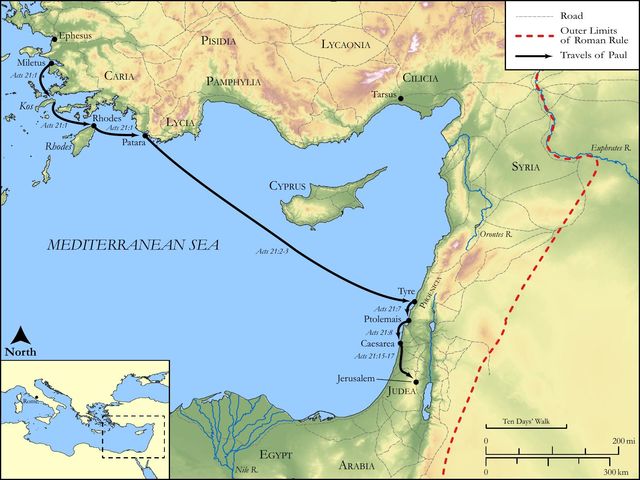
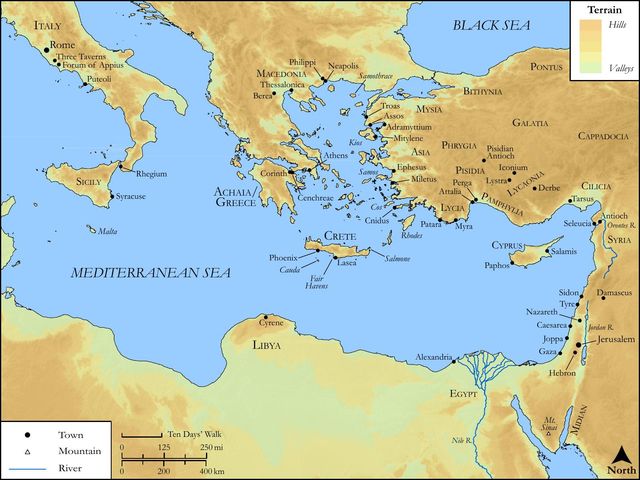
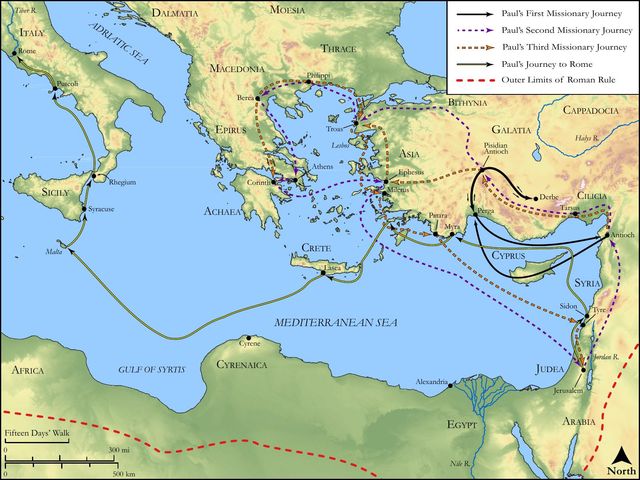
See on the biblical-era map
Study this verse
Public-domain commentary
Matthew Henry
From his Commentary on the Whole Bible. Henry comments on passages, not single verses — this entry covers Acts 21:8–14. His three-level outline is real structure in the source text, so it is rendered as structure.
We have here Paul and his company arrived at length at Caesarea, where he designed to make some stay, it being the place where the gospel was first preached to the Gentiles, and the Holy Ghost fell upon them, Act 10:1, Act 10:44. Now here we are told,
I.Who it was that entertained Paul and his company at Caesarea.
He seldom had occasion to go to a public house, but, wherever he came, some friend or other took him in, and bade him welcome. Observe, those that had sailed together parted when the voyage was accomplished, according as their business was. "Those that were concerned in the cargo staid where the ship was to unlade her burden (Act 21:3); others, when they came to Ptolemais, went as their occasions led them; but we that were of Paul's company went where he went, and came to Caesarea." Those that travel together through this world will separate at death, and then it will appear who are of Paul's company and who are not. Now at Caesarea.
1.They were entertained by Philip the evangelist, whom we left at Caesarea many years ago, after he had baptized the eunuch (Act 8:40), and there we now find him again.
(1.)He was originally a deacon, one of the seven that were chosen to serve tables, Act 6:5.
(2.)He was now and had long been an evangelist, one that went about to plant and water churches, as the apostles did, and gave himself, as they did, to the word and prayer; thus, having used the office of a deacon well, he purchased to himself a good degree; and, having been faithful in a few things, was made ruler over many things.
(3.)He had a house at Caesarea, fit to entertain Paul and all his company, and he bade him and them very welcome to it; We entered into the house of Philip the evangelist, and we abode with him. Thus does it become Christians and ministers, according as their ability is, to use hospitality one to another, without grudging, Pe1 4:9.
2.This Philip had four maiden daughters, who did prophesy, Act 21:9. It intimates that they prophesied of Paul's troubles at Jerusalem, as others had done, and dissuaded him from going; or perhaps they prophesied for his comfort and encouragement, in reference to the difficulties that were before him. Here was a further accomplishment of that prophecy, Joe 2:28, of such a plentiful pouring out of the Spirit upon all flesh that their sons and their daughters should prophesy, that is, foretel things to come.
II.A plain and full prediction of the sufferings of Paul, by a noted prophet, Act 21:10, Act 21:11.
1.Paul and his company tarried many days at Caesarea, perhaps Cornelius was yet living there, and (though Philip lodged them) yet might be many ways kind to them, and induce them to stay there. What cause Paul saw to tarry so long there, and to make so little haste at the latter end of his journey to Jerusalem, when he seemed so much in haste at the beginning of it, we cannot tell; but we are sure he did not stay either there or any where else to be idle; he measured his time by days, and numbered them.
2.Agabus the prophet came to Caesarea from Judea; this was he of whom we read before, who came from Jerusalem to Antioch, to foretel a general famine, Act 11:27, Act 11:28. See how God dispenseth his gifts variously. To Paul was given the word of wisdom and knowledge, as an apostle, by the Spirit, and the gifts of healing; to Agabus, and to Philip's daughters, was given prophecy, by the same Spirit - the foretelling of things to come, which came to pass according to the prediction. See Co1 12:8, Co1 12:10. So that that which was the most eminent gift of the Spirit under the Old Testament, the foretelling of things to come, was under the New Testament quite outshone by other gifts, and was bestowed upon those that were of less note in the church. It should seem as if Agabus came on purpose to Caesarea, to meet Paul with this prophetic intelligence.
3.He foretold Paul's bonds at Jerusalem,
(1.)By a sign, as the prophets of old did, Isaiah (Isa 20:3), Jeremiah (Jer 13:1; Jer 27:2), Ezekiel (Eze 4:1; Eze 12:3), and many others. Agabus took Paul's girdle, when he laid it by, or perhaps took it from about him, and with it bound first his own hands, and then his own feet, or perhaps bound his hands and feet together; this was designed both to confirm the prophecy (it was as sure to be done as if it were done already) and to affect those about him with it, because that which we see usually makes a greater impression upon us than that which we only hear of.
(2.)By an explication of the sign: Thus saith the Holy Ghost, the Spirit of prophecy, So shall the Jews at Jerusalem bind the man that owneth this girdle, and, as they dealt with his Master (Mat 20:18, Mat 20:19), shall deliver him into the hands of the Gentiles, as the Jews in other places had all along endeavoured to do, by accusing him to the Roman governors. Paul had this express warning given him of his troubles, that he might prepare for them, and that when they came they might be no surprise nor terror to him; the general notice given us that through much tribulation we must enter into the kingdom of God should be of the same use to us.
III.The great importunity which his friends used with him to dissuade him from going forward to Jerusalem, Act 21:12.
"Not only those of that place, but we that were of Paul's company, and among the rest Luke himself, who had heard this often before, and seen Paul's resolution notwithstanding, besought him with tears that he would not go up to Jerusalem, but steer his course some other way." Now,
1.Here appeared a commendable affection to Paul, and a value for him, upon account of his great usefulness in the church. Good men that are very active sometimes need to be dissuaded from overworking themselves, and good men that are very bold need to be dissuaded from exposing themselves too far. The Lord is for the body, and so we must be.
2.Yet there was a mixture of infirmity, especially in those of Paul's company, who knew he undertook this journey by divine direction, and had seen with what resolution he had before broken through the like opposition. But we see in them the infirmity incident to us all; when we see trouble at a distance, and have only a general notice of it, we can make light of it; but when it comes near we begin to shrink, and draw back. Now that it toucheth thee thou art troubled, Job 4:5.
IV.The holy bravery and intrepidity with which Paul persisted in his resolution, Act 21:13.
1.He reproves them for dissuading him. Here is a quarrel of love on both sides, and very sincere and strong affections clashing with each other. They love him dearly, and therefore oppose his resolution; he loves them dearly, and therefore chides them for opposing it: What mean you to weep and to break my heart? They were an offence to him, as Peter was to Christ, when, in a like case, he said, Master, spare thyself. Their weeping about him broke his heart. (1.) It. was a temptation to him, it shocked him, it began to weaken and slacken his resolution, and caused him to entertain thoughts of tacking about: "I know I am appointed to suffering, and you ought to animate and encourage me, and to say that which will strengthen my heart; but you, with your tears, break my heart, and discourage me. What do you mean by doing thus? Has not our Master told us to take up our cross? And would you have me to avoid mine?" (2.) It was a trouble to him that they should so earnestly press him to that in which he could not gratify them without wronging his conscience. Paul was of a very tender spirit. As he was much in tears himself, so he had a compassionate regard to the tears of his friends; they made a great impression upon him, and would bring him almost to yield to any thing. But now it breaks his heart, when he is under a necessity of denying the request of his weeping friends. It was an unkind kindness, a cruel pity, thus to torment him with their dissuasions, and to add affliction to his grief. When our friends are called out to sufferings, we shall show our love rather by comforting them than by sorrowing for them. But observe, These Christians at Caesarea, if they could have foreseen the particulars of that event, the general notice of which they received with so much heaviness, would have been better reconciled to it for their own sakes; for, when Paul was made a prisoner at Jerusalem, he was presently sent to Caesarea, the very place where he now was (Act 23:33), and there he continued at least two years (Act 24:27), and he was a prisoner at large, as appears (Act 24:23), orders being given that he should have liberty to go among his friends, and his friends to come to him; so that the church at Caesarea had much more of Paul's company and help when he was imprisoned than they could have had if he had been at liberty. That which we oppose, as thinking it to operate much against us, may be overruled by the providence of God to work for us, which is a reason why we should follow providence, and not fear it.
2.He repeats his resolution to go forward, notwithstanding: "What mean you to weep thus? I am ready to suffer whatever is appointed for me. I am fully determined to go, whatever comes of it, and therefore it is to no purpose for you to oppose it. I am willing to suffer, and therefore why are you unwilling that I should suffer? Am not I nearest myself, and fittest to judge for myself? If the trouble found me unready, it would be a trouble indeed, and you might well weep at the thoughts of it. But, blessed be God, it does not. It is very welcome to me, and therefore should not be such a terror to you. For my part, I am ready," etoimōs echō - I have myself in a readiness, as soldiers for an engagement. "I expect trouble, I count upon it, it will be no surprise to me. I was told at first what great things I must suffer," Act 9:16. "I am prepared for it, by a clear conscience, a firm confidence in God, a holy contempt of the world and the body, a lively faith in Christ, and a joyful hope of eternal life. I can bid it welcome, as we do a friend that we look for, and have made preparation for. I can, through grace, not only bear it, but rejoice in it." Now,
(1.)See how far his resolution extends: You are told that I must be bound at Jerusalem, and you would have me keep away for fear of this. I tell you, "I am ready not only to be bound, but, if the will of God be so, to die at Jerusalem; not only to lose my liberty, but to lose my life." It is our wisdom to think of the worst that may befall us, and to prepare accordingly, that we may stand complete in all the will of God.
(2.)See what it is that carries him out thus, that makes him willing to suffer and die: it is for the name of the Lord Jesus. All that a man has will he give for his life; but life itself will Paul give for the service and honour of the name of Christ.
V.The patient acquiescence of his friends in his resolution, Act 21:14.
1.They submitted to the wisdom of a good man. They had carried the matter as far as they could with decency; but, "when he would not be persuaded, we ceased our importunity. Paul knows best his own mind, and what he has to do, and it becomes us to leave it to himself, and not to censure him for what he does, nor to say he is rash, and wilful, and humoursome, and has a spirit of contradiction, as some people are apt to judge of those that will not do just as they would have them do. No doubt, Paul has a good reason for his resolution, though he sees cause to keep it to himself, and God has gracious ends to serve in confirming him in it." It is good manners not to over-press those in their own affairs that will not be persuaded.
2.They submitted to the will of a good God: We ceased, saying, The will of the Lord be done. They did not resolve his resolution into his stubbornness, but into his willingness to suffer, and God's will that he should. Father in heaven, thy will be done, as it is a rule to our prayers and to our practice, so it is to our patience. This may refer,
(1.)To Paul's present firmness; he is inflexible, and unpersuadable, and in this they see the will of the Lord done. "It is he that has wrought this fixed resolution in him, and therefore we acquiesce in it." Note, In the turning of the hearts of our friends or ministers, this way or that way (and it may be quite another way than we could wish), we should eye the hand of God, and submit to that.
(2.)To his approaching sufferings: "If there be no remedy, but Paul will run himself into bonds, the will of the Lord Jesus be done. We have done all that we could do on our parts to prevent it, and now we leave it to God, we leave it to Christ, to whom the Father has committed all judgment, and therefore we do, not as we will, but as he will." Note, When we see trouble coming, and particularly that of our ministers' being silenced or removed from us, it becomes us to say, The will of the Lord be done. God is wise, and knows how to make all work for good, and therefore "welcome his holy will." Not only, "The will of the Lord must be done, and there is no remedy;" but, "Let the will of the Lord be done, for his will is his wisdom, and he doeth all according to the counsel of it; let him therefore do with us and ours as seemeth good in his eyes." When a trouble is come, this must allay our griefs, that the will of the Lord is done; when we see it coming, this must silence our fears, that the will of the Lord shall be done, to which we must say, Amen, let it be done.
Historical interpretation
Four Centuries of Reception
7 surviving comments on this verse. Each one is dated, so this reads as a timeline rather than a list.
Select a marker to jump to its quote. Markers stagger vertically where authors wrote within a few decades of each other.
Nay, Paul too, who had submitted to deliverance from persecution by being let down from the wall, as to do so was at this time a matter of command, refused in like manner now at the close of his ministry, and after the injunction had come to an end, to give in to the anxieties of the disciples, eagerly entreating him that he would not risk himself at Jerusalem, because of the sufferings in store for him which Agabus had foretold; but doing the very opposite, it is thus he speaks, "What do ye, weeping and disquieting my heart? For I could wish not only to suffer bonds, but also to die at Jerusalem, for the name of my Lord Jesus Christ." And so they all said, "Let the will of the Lord be done.
To this sort of opposition, respond as follows: “Why are you trying to keep me from the way I have set out on by weeping at the mention of the chains and afflictions that await me when I arrive in Jerusalem? Let it be known that I will follow the Spirit that has made known to me what awaits me and that I am setting out on the road to the city. I do not go ignorant of what will happen there, for I have foreseen it, and I am not being checked from going. So do not break my heart with your tears.” Whoever has been nobly prepared to be courageous enough to have no thought for his own life does not succumb to fear even if someone tries to provoke it. Now among them such dread had come to grip their thinking, and so the apostle said that his heart was being broken. He was not saying that he was weak but that he had come to such a state because of their bitter weeping. One could also say that just as little sins, in their actual commission, seem great to a holy person, so do the initial movements toward them, and so here he says the breaking of his heart is great.
Tell me, what do you think about that adamant will of Paul? Could weeping break it? "Yes," he says, "for I can hold out against anything except for love, since it is love that has overcome and rules me." In this he is like God, whom an abyss of waters would not break but teardrops could.
Others were crying, but [Paul] was exhorting them as he grieved for their tears. "What are you doing," he says, "crying and breaking my heart?" Nothing was dearer to him than these people. Because he saw them crying, he grieved, while he cared nothing for his own trials. "Let the Lord's will," he said, "be done." You wrong me by doing this, so stop making me grieve. They stopped when he said, "You're breaking my heart." "I weep for you," he says, "not for my sufferings, on behalf of which I am even willing to die." They said, "Don't go into the theatre," and he did not. Again and again they drew him away and he obeyed. He fled through the window, but now, though myriads, so to speak, exhort him, and those in Tyre and Caesarea weep and foretell countless trials, he does not allow it. And yet they were foretelling terrible things for him, and, what is more, through the Holy Spirit. They were not holding him back through the Spirit, and they were not simply announcing terrible events to come his way. No, they were afraid for him because he had to go up to Jerusalem. Since they could not convince him not to go, they cried, and then they settled down. You see the love of wisdom, you see the affection. "The Lord," he says, "will do what is pleasing in his sight." They realized it was God's will. Otherwise Paul, who was constantly having to snatch himself from dangers, would not have been so eager.
"Then Paul answered, What mean ye to weep and to break mine heart?" Do you mark? Lest, having heard that saying, "I go bound in the Spirit," you should imagine it a matter of necessity, or that he fell into it ignorantly, therefore these things are foretold. But they wept, and he comforted them, grieving at their tears. For, "what mean ye," he says, "to weep and to break my heart?" Nothing could be more affectionate: because he saw them weeping, he grieved, he that felt no pain at his own trials. "For I am ready not to be bound only, but also to die at Jerusalem for the name of the Lord Jesus."
The battering ram of natural affection, which so often shatters faith, must recoil powerless from the wall of the gospel.
"Then Paul answering, said," etc. While they cried, Paul told them not to be distressed by his bitter plight, since he was ready not only to be bound, but even gladly to be killed for the name of Christ. The disciples said to him, since they could not detain him: "The will of the Lord be done. "When they came to Jerusalem, they were received gladly by the brethren. On the next day, Paul went to James, telling him all that the divine power had granted the Gentiles by his ministry. That made them very happy, and, rejoicing with him, they gave thanks to the Lord, but they warned him to be careful about the people of the Jews, as he was clearly much suspected by them on the grounds that he taught, against the law of Moses, that circumcision should be abolished. They advised him to take four men of their company and to enter the synagogue with them after they had shaved their heads: when the Jews realized this, they would believe that he would not say anything against the law of Moses. As for the Gentiles that believed, they said that they had written to them what things it was enough for them to abstain from and had told them to continue in the rules they had been taught.
Continue studying Acts 21:13 across the web’s major study libraries — every link below opens this exact verse, chapter, or book on the destination site.
Read & Compare
 BibleGatewayThis verse in more than 200 translations and 70 languages.
 Bible.comThe YouVersion reader — hundreds of translations, reading plans, and highlights.
 ESV.orgCrossway's official English Standard Version reader.
 NET BibleThe NET translation with 60,000+ translators' notes on every rendering decision.
 STEP BibleTyndale House's free study tool — original text, vocabulary, and scholarly resources.
 BibliaLogos Bible Software's free web reader.
 USCCBThe New American Bible (Revised Edition) with the U.S. bishops' study notes.
Commentaries
 BibleHub CommentariesDozens of classic commentaries on this verse, gathered on one page.
 StudyLightMore than 100 commentary sets — the largest collection on the web.
 BibleRefPlain-English commentary on what this verse means, verse by verse.
 Enduring WordDavid Guzik's free commentary on this chapter, widely used by Bible teachers.
 Bible Study ToolsVerse commentary alongside Greek and Hebrew study aids.
Original Language & Research
- BibleHub InterlinearThe verse word by word — original language, transliteration, and English.
- BibleHub LexiconEvery word's original-language definition and Strong's entry.
 Blue Letter BibleDeep-study tools — Strong's numbers, concordance, and word studies.
 CNTR CollationThe earliest Greek manuscripts of this verse, collated letter by letter.
Sermons, Hymns & Audio


TrulyRandomVerse is not affiliated with these sites and doesn’t control their content. They’re linked because they’re genuinely useful.
Summary
Acts 21:13 captures the Apostle Paul's unwavering resolve and profound commitment to Christ in the face of imminent suffering and death in Jerusalem. Despite the tearful pleas of his companions, who feared for his life and sought to dissuade him, Paul declares his readiness to endure imprisonment and even martyrdom for the sake of the Lord Jesus's name, demonstrating a faith that transcends personal comfort and emotional distress.
Context
ShowHideLiterary Context
This powerful declaration by Paul occurs at a pivotal moment in his final journey to Jerusalem, as detailed in Acts 20 and Acts 21. Throughout this journey, Paul has received repeated prophetic warnings from the Holy Spirit that "bonds and afflictions" await him in Jerusalem (Acts 20:23). Immediately preceding this verse, the prophet Agabus dramatically illustrates Paul's impending arrest by taking Paul's belt, binding his own hands and feet, and declaring, "Thus says the Holy Spirit, 'So shall the Jews at Jerusalem bind the man who owns this belt and deliver him into the hands of the Gentiles'" (Acts 21:11). The emotional response of the local believers and Paul's traveling companions, who weep and plead with him not to go, sets the stage for Paul's resolute and deeply moving reply in Acts 21:13.
Historical & Cultural Context
Paul's journey to Jerusalem was fraught with danger, not only from hostile Jewish factions who sought his life but also from the Roman authorities who viewed his activities with suspicion. Jerusalem, as the religious and political center of Judaism, was a particularly volatile place for a figure like Paul, who was perceived by many as a renegade Jew undermining traditional law and custom. The act of weeping and pleading was a culturally acceptable and common expression of deep concern and sorrow, particularly for a beloved leader facing grave peril. Paul's companions were not merely expressing sentimentality but a genuine fear for his life, understanding the very real threats that awaited him in the city. His willingness to face these dangers, despite the emotional cost to himself and his friends, highlights the profound conviction that characterized early Christian discipleship in a hostile world.
Key Themes
ShowHideActs 21:13 powerfully encapsulates several major theological and narrative themes prevalent in the book of Acts and Paul's epistles. Foremost among these is the theme of unwavering faith and dedication to Christ, even unto death, echoing the call to take up one's cross and follow Jesus. It underscores the cost of discipleship, demonstrating that following Christ often involves significant personal sacrifice, suffering, and potential martyrdom, a reality Paul frequently addressed in his letters (e.g., 2 Timothy 3:12). Furthermore, the passage highlights the sovereignty of God's will over human emotion and desire for safety, as Paul prioritizes his divine mission above the understandable pleas of his friends. Paul's readiness to suffer "for the name of the Lord Jesus" emphasizes the supremacy of Christ's honor and cause, illustrating that the Gospel's advance was worth any personal price.
Exposition and Analysis
ShowHideKey Word Analysis
ShowHideG4919 - From syn (together) and a root meaning "to crumble"; to crush together, i.e. (figuratively) to dispirit. Paul's use of this word indicates that the weeping of his companions was not merely annoying but deeply distressing, causing him emotional pain and a sense of being "crushed" or "shattered" in spirit. It reveals his genuine empathy and the heavy emotional toll of their sorrow on him.
G2093 - Adverb from hetoímos (prepared); in readiness. This adverb emphasizes Paul's immediate and complete preparedness. It's not a reluctant acceptance but an eager and settled determination. He is fully poised and willing to act, indicating a profound internal conviction and alignment with God's purpose.
G599 - From apo (from) and thnéskō (to die); to die off (literally or figuratively). Paul's declaration of readiness "to die" is a stark and ultimate commitment. It signifies a willingness to experience physical death, the complete cessation of earthly life, for the sake of Christ. This is the highest form of sacrifice, demonstrating the absolute value he placed on the "name of the Lord Jesus."
Verse Breakdown
ShowHide"Then Paul answered, What mean ye to weep and to break mine heart?"
Paul's opening response is a rhetorical question, expressing his deep emotional distress at his companions' weeping. He is not being insensitive but rather articulating the profound impact their sorrow has on him. The phrase "to break mine heart" vividly conveys his inner anguish, indicating that their tears are tearing at his emotional core, making his resolve even more costly. He acknowledges their love and concern, but also challenges their attempt to sway him from his divinely appointed path.
"for I am ready not to be bound only, but also to die at Jerusalem for the name of the Lord Jesus."
This clause reveals the core of Paul's unwavering commitment. The conjunction "for" (G1063, gár) introduces the reason for his emotional state and his firm stance: his readiness. He explicitly states his preparedness for two levels of suffering: first, "to be bound," referring to imprisonment and physical restraint, which was a common consequence for early Christian missionaries. Second, and more profoundly, "but also to die," indicating his willingness to face martyrdom. The location, "at Jerusalem," is significant, as it is the very place where the prophecies indicated his suffering would occur. The ultimate motivation for this readiness is "for the name of the Lord Jesus," signifying for His honor, glory, cause, and the advancement of His kingdom. This phrase encapsulates the sum total of Paul's mission and devotion.
Literary Devices
ShowHidePaul's declaration in Acts 21:13 is rich with literary devices that amplify its emotional and theological impact. The verse opens with a Rhetorical Question ("What mean ye to weep and to break mine heart?"), which serves not to elicit an answer but to express Paul's profound emotional distress and to gently rebuke his companions for undermining his resolve. The phrase "to break mine heart" functions as Hyperbole, emphasizing the intense emotional pain their weeping caused him, conveying that he was deeply affected, not unfeeling. This also employs Metaphor, as a heart cannot literally be broken by tears, but the imagery powerfully conveys emotional shattering. The subsequent declaration, "I am ready not to be bound only, but also to die," uses Parallelism and Climax. The "not only...but also" construction builds from a lesser form of suffering (imprisonment) to the ultimate sacrifice (death), creating a climactic statement of absolute dedication. This structure also highlights Paul's Emphasis on his unwavering commitment, demonstrating a resolve that transcends even the most severe physical and emotional challenges.
Theological and Thematic Connections
ShowHidePaul's resolute declaration in Acts 21:13 stands as a powerful testament to the transformative power of the Gospel and the radical demands of Christ-centered discipleship. It illustrates a faith that is not merely intellectual assent but a profound, life-altering commitment to God's will, even when that will leads through suffering and death. Paul's willingness to sacrifice himself "for the name of the Lord Jesus" underscores the supreme value he placed on Christ's honor and the advancement of His kingdom, echoing the New Testament's consistent theme that genuine faith often involves enduring hardship for the sake of the Gospel. This passage serves as a timeless reminder that true devotion to Christ may require prioritizing His call above personal comfort, safety, or the emotional pleas of loved ones, demonstrating a surrender to divine purpose that transcends human understanding.
Reflection and Application
ShowHidePaul's unwavering resolve in Acts 21:13 provides a profound challenge and inspiration for believers today. In a world that often prioritizes comfort, safety, and personal well-being, Paul's example calls us to examine the depth of our own commitment to Christ. Are we willing to embrace God's will even when it leads to discomfort, opposition, or personal sacrifice? This verse encourages a steadfastness in faith, reminding us that true discipleship often requires courage and an unwavering dedication to the "name of the Lord Jesus," regardless of the cost. It calls us to live with a similar Christ-centered purpose, ready to face whatever comes for the sake of the Gospel, knowing that our ultimate allegiance belongs to Him. Paul's emotional transparency also teaches us that deep commitment does not equate to stoicism; it is possible to feel the pain of difficult choices while remaining firm in conviction.
Questions for Reflection
ShowHideFAQ
ShowHideWas Paul insensitive to his companions' feelings when he said, "What mean ye to weep and to break mine heart?"
ShowHideNo, Paul was not insensitive. His rhetorical question, "What mean ye to weep and to break mine heart?" reveals his deep emotional connection to his companions and the genuine pain their sorrow caused him. The Greek word for "break" (synthrýptō) means to crush or shatter, indicating that their tears were profoundly distressing to him. His statement is an expression of his own anguish at their distress, coupled with a gentle plea for them to understand that their emotional outpouring, while loving, was making it harder for him to maintain his resolve. He was acknowledging their feelings while firmly reiterating his commitment to God's higher purpose, showing that true dedication does not mean an absence of emotion, but rather a resolve that transcends it.
What does "for the name of the Lord Jesus" signify in this context?
ShowHideThe phrase "for the name of the Lord Jesus" is a comprehensive expression of Paul's motivation. In biblical thought, a "name" represents the full character, authority, reputation, and essence of a person. Therefore, to suffer or die "for the name of the Lord Jesus" means to do so for His honor, for the advancement of His kingdom, for the sake of His message, and in allegiance to His divine authority. It signifies that Paul's entire mission and willingness to endure suffering were rooted in his devotion to Christ and his desire to see Jesus glorified and His Gospel proclaimed, regardless of the personal cost. It encapsulates the ultimate purpose of his life and ministry.
Christ-Centered Fulfillment
ShowHidePaul's declaration in Acts 21:13 finds its ultimate Christ-centered fulfillment not merely in Paul's personal sacrifice, but in the perfect and ultimate sacrifice of Jesus Christ Himself. Paul's readiness "to be bound...but also to die at Jerusalem for the name of the Lord Jesus" is a direct echo and imitation of Christ's own journey to Jerusalem, where He willingly faced suffering, betrayal, and death for the redemption of humanity. Jesus, "for the joy that was set before Him endured the cross, despising the shame" (Hebrews 12:2), demonstrating the ultimate readiness to suffer for the Father's will and the salvation of His people. Paul's commitment to the "name of the Lord Jesus" reflects the call for all believers to take up their cross and follow Him, participating in Christ's suffering and sharing in His mission (Philippians 3:10). Thus, Paul's unwavering resolve is not an isolated act of heroism, but a profound demonstration of a life transformed by the Gospel, mirroring the self-giving love and sacrificial obedience of the Savior whom he served, ultimately pointing to Jesus as the supreme example of devotion and the source of such radical commitment.