


1 Samuel 7:14
Bible text: King James Version (1769 Blayney text) · Public domain
Bible text: King James Version with Strong's numbers · Public domain
Bible text: Berean Standard Bible · Public domain
Bible text: American Standard Version (1901) · Public domain
Bible text: World English Bible, Messianic edition · Public domain
Bible text: Geneva Bible (1599) · Public domain
Bible text: Young's Literal Translation · Public domain
- וַתָּשֹׁבְנָהva·ta·Shoe·nahand they went backH7725Conj-w ¦ V-Qal-ConsecImperf-3fpVerb Qal Consecutive Imperfect 3rd Plural Feminineוַandתָּשֹׁבְנָהthey went back
- הֶעָרִיםhe·'a·Rimthe citiesH5892Art ¦ N-mpNoun Plural Masculine Absoluteהֶtheעָרִיםcities
- אֲשֶׁר'a·SherwhichH834RelParticle Relative
- לָקְחוּla·ke·chuthey had takenH3947V-Qal-Perf-3cpVerb Qal Perfect 3rd Plural common gender
- פְלִשְׁתִּיםfe·lish·Tim[the] PhilistinesH6430N-mpNoun Gentilic Plural Masculine Absolute
- מֵאֵתme·'Etfrom withH854Prep-m ¦ PrepPrepositionמֵfromאֵתwith
- יִשְׂרָאֵלYis·ra·'ElIsraelH3478N-properNoun Proper Location
- לְיִשְׂרָאֵלle·Yis·ra·'Elto IsraelH3478Prep-l ¦ N-properNoun Proper LocationלְtoיִשְׂרָאֵלIsrael
- מֵעֶקְרוֹןme·'ek·Ronfrom EkronH6138Prep-m ¦ N-properNoun Proper LocationמֵfromעֶקְרוֹןEkron
- וְעַדve·'adand toH5704Conj-w ¦ PrepPrepositionוְandעַדto
- גַּתGatGathH1661N-properNoun Proper Location
- וְאֶתve·'Etand <obj.>H853Conj-w ¦ DirObjMParticle Object Indicatorוְandאֶת<obj.>
- גְּבוּלָןge·vu·Lantheir territoryH1366N-msc ¦ 3fpNoun Singular Masculine Constructגְּבוּלָterritoryןtheir
- הִצִּילhi·Tzilhe deliveredH5337V-Hiphil-Perf-3msVerb Hiphil Perfect 3rd Singular Masculine
- יִשְׂרָאֵלYis·ra·'ElIsraelH3478N-properNoun Proper Location
- מִיַּדmi·Yadfrom [the] hand ofH3027Prep-m ¦ N-cscNoun Singular common gender Constructמִfromיַּד[the] hand of
- פְּלִשְׁתִּיםpe·lish·Tim[the] PhilistinesH6430N-mpNoun Gentilic Plural Masculine Absolute
- וַיְהִיvay·Hiand it wasH1961Conj-w ¦ V-Qal-ConsecImperf-3msVerb Qal Consecutive Imperfect 3rd Singular Masculineוַandיְהִיit was
- שָׁלוֹםsha·LompeaceH7965N-msNoun Singular Masculine Absolute
- בֵּיןbeinbetweenH996Adj-mscAdjective Numerical Singular Masculine Construct
- יִשְׂרָאֵלYis·ra·'ElIsraelH3478N-properNoun Proper Location
- וּבֵיןu·Veinand betweenH996Conj-w ¦ Adj-mscAdjective Numerical Singular Masculine Constructוּandבֵיןbetween
- הָאֱמֹרִיha·'e·mo·Rithe Amorite[s]H567Art ¦ N-msNoun Gentilic Singular Masculine AbsoluteהָtheאֱמֹרִיAmorite[s]
English is a literal word-by-word gloss of the Hebrew, not the KJV's wording. Why?
This is the original text the KJV's translators worked from — each Hebrew word with its own literal English meaning in this verse, prepared by scholars at Tyndale House, Cambridge. The KJV translates whole sentences, not word by word, so its wording differs: one Hebrew word can become several English words, and the KJV may choose “the LORD” where the gloss reads “Yahweh”. Both are faithful — they answer different questions. For the KJV's own rendering, switch to the KJV text.
Details
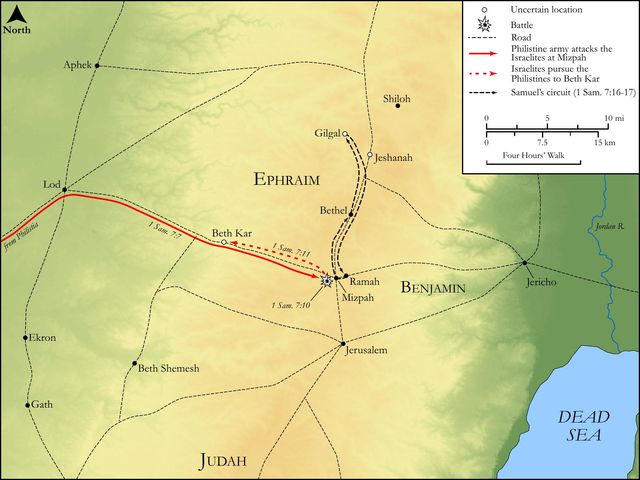
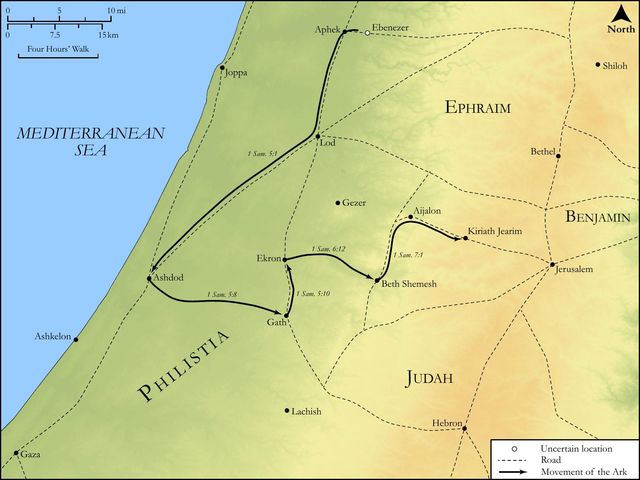
See on the biblical-era maps
Study this verse
Public-domain commentary
Matthew Henry
From his Commentary on the Whole Bible. Henry comments on passages, not single verses — this entry covers 1 Samuel 7:13–17.
We have here a short account of the further good services that Samuel did to Israel. Having parted them from their idols, and brought them home to their God, he had put them into a capacity of receiving further benefits by his ministry. Having prevailed in that, he becomes, in other instances, a great blessing to them; yet, writing it himself, he is brief in the relation. We are not told here, but it appears (Ch2 35:18) that in the days of Samuel the prophet the people of Israel kept the ordinance of the passover with more than ordinary devotion, notwithstanding the distance of the ark and the desolations of Shiloh. Many good offices, no doubt, he did for Israel, but here we are only told how instrumental he was, 1. In securing the public peace (Sa1 7:13): "In his days the Philistines came no more into the coast of Israel, made no inroads or incursions upon them; they perceived that God now fought for Israel and that his hand was against the Philistines, and this kept them in awe, and restrained the remainder of their wrath." Samuel was a protector and deliverer to Israel, not by dint of sword, as Gideon, nor by strength of arm, as Samson, but by the power of prayer to God and carrying on a work of reformation among the people. Religion and piety are the best securities of a nation. 2. In recovering the public rights, Sa1 7:14. By his influence Israel had the courage to demand the cities which the Philistines had unjustly taken from them and had long detained; and the Philistines, not daring to contend with one that had so great an interest in heaven, tamely yielded to the demand, and restored (some think) even Ekron and Gath, two of the capital cities, though afterwards they retook them; others think some small towns that lay between Ekron and Gath, which were forced out of the Philistines' hands. This they got by their reformation and religion, they got ground of their enemies and got forward in their affairs. It is added, There was peace between Israel and the Amorites, that is, the Canaanites, the remains of the natives. Not that Israel made any league with them, but they were quiet, and not so mischievous to Israel as they had sometimes been. Thus when a man's ways please the Lord he maketh even his enemies to be at peace with him and give him no disturbance, Pro 16:7. 3. In administering public justice (Sa1 7:15, Sa1 7:16): He judged Israel; as a prophet he taught them their duty and reproved them for their sins, which is called judging, Eze 20:4; Eze 22:2. Moses judged Israel when he made them know the statutes of God and his laws (Exo 18:16); and thus Samuel judged them to the last, even after Saul was made king; so he promised them then, when Saul was inaugurated (Sa1 12:23), I will not cease to teach you the good and the right way. As a magistrate, he received appeals from the inferior courts and gave judgment upon them, tried causes and determined them, tried prisoners and acquitted or condemned them, according to the law. This he did all his days, till he grew old and past service, and resigned to Saul; and afterwards he exercised authority when application was made to him; nay, he judged even Agag, and Saul himself. But when he was in his prime he rode the circuit, for the convenience of the country, at least of that part of it which lay most under his influence. He kept courts at Beth-el, Gilgal, and Mizpeh, all in the tribe of Benjamin; but his constant residence was at Ramah, his father's city, and there he judged Israel, thither they resorted to him from all parts with their complaints, Sa1 7:17. 4. In keeping up the public exercises of religion; for there, where he lived, he built an altar to the Lord, not in contempt of the altar that was at Nob, or Gibeon, or wherever the tabernacle was; but divine justice having laid Sholoh waste, and no other place being yet chosen for them to bring their offerings to (Deu 12:11), he looked upon the law which confined them to one place to be for the present suspended, and therefore, being a prophet, and under divine direction, he did as the patriarchs did, he built an altar where he lived, both for the use of his own family and for the good of the country that resorted to it. Great men should use their wealth, power, and interest, for the keeping up of religion in the places where they live.
Historical interpretation
Historical reception
1 surviving comment on this verse from the historical church.
There was peace between Israel and the Amorites. After the ascension of the Lord, with the Churches confirmed in faith, there was our peace, which made both one, between those from the Jews and those who believed from the Gentiles. There will also be in you, when you live as a true Israelite, that is, without deceit, peace with the former bitter enemy, which is interpreted as Amorite, when you have taught all vices conquered in you to favor virtues, and the members which were weapons of iniquity for sin, you will have made weapons of righteousness for God. For as long as the grace of the true Samuel lives and reigns in your mind, although you cannot completely be free from sin as a human, whatever filthy thoughts, as if ambushing the spiritual virtues, the hands of the Philistines may take from you, you will recover with his daily help, and you yourself will also free into the boundaries of your good works from the hand of the Philistines, because the patience of the poor will not perish forever. And although you may not be able to be invulnerable in the midst of battle, once the course is completed, you will be granted the crown of life.
Continue studying 1 Samuel 7:14 across the web’s major study libraries — every link below opens this exact verse, chapter, or book on the destination site.
Read & Compare
 BibleGatewayThis verse in more than 200 translations and 70 languages.
 Bible.comThe YouVersion reader — hundreds of translations, reading plans, and highlights.
 ESV.orgCrossway's official English Standard Version reader.
 NET BibleThe NET translation with 60,000+ translators' notes on every rendering decision.
 STEP BibleTyndale House's free study tool — original text, vocabulary, and scholarly resources.
 BibliaLogos Bible Software's free web reader.
 USCCBThe New American Bible (Revised Edition) with the U.S. bishops' study notes.
Commentaries
 BibleHub CommentariesDozens of classic commentaries on this verse, gathered on one page.
 StudyLightMore than 100 commentary sets — the largest collection on the web.
 BibleRefPlain-English commentary on what this verse means, verse by verse.
 Enduring WordDavid Guzik's free commentary on this chapter, widely used by Bible teachers.
 Bible Study ToolsVerse commentary alongside Greek and Hebrew study aids.
Original Language & Research
- BibleHub InterlinearThe verse word by word — original language, transliteration, and English.
- BibleHub LexiconEvery word's original-language definition and Strong's entry.
 Blue Letter BibleDeep-study tools — Strong's numbers, concordance, and word studies.
 SefariaThe Hebrew text with Rashi and centuries of Jewish commentary.
Sermons, Hymns & Audio


TrulyRandomVerse is not affiliated with these sites and doesn’t control their content. They’re linked because they’re genuinely useful.
Summary
1 Samuel 7:14 encapsulates a profound moment of national restoration and comprehensive peace for Israel under Samuel's leadership, marking a decisive turning point after prolonged Philistine oppression. This verse details the tangible outcomes of Israel's corporate repentance and God's miraculous intervention at Mizpah, specifically highlighting the return of strategic cities from Philistine control and the establishment of harmonious relations with the Amorites, thereby ushering in an era of divinely granted security and flourishing that profoundly impacted the nation's well-being.
Context
ShowHideLiterary Context
This verse serves as the triumphant culmination and direct consequence of Israel's dramatic victory over the Philistines at Mizpah, an event divinely orchestrated in response to Israel's national repentance and Samuel's fervent intercession. For two decades, as detailed in 1 Samuel 7:2, Israel had suffered under severe Philistine dominance. Samuel had called the nation to a radical spiritual renewal, urging them to turn back to the Lord wholeheartedly, to cast away their foreign gods and the idolatrous Ashtoreths, and to serve the Lord alone. Their corporate obedience at Mizpah, marked by fasting, confession, and the pouring out of water before the Lord, led to God's dramatic intervention with thunder, which discomfited the Philistines and allowed Israel to rout them. Verse 14, therefore, demonstrates the full scope of the deliverance, detailing the territorial and relational peace that followed, solidifying the narrative of God's faithfulness to a repentant people.
Historical & Cultural Context
The period preceding 1 Samuel 7 was characterized by significant Philistine hegemony over Israel, a direct consequence of Israel's spiritual apostasy and disunity during the turbulent era of the Judges. The Philistines, a formidable "sea people" who had settled on the coastal plain, possessed superior iron technology and military organization, enabling them to oppress Israel, even disarming them by controlling access to smiths (1 Samuel 13:19-22). Cities like Ekron and Gath were not merely towns but key Philistine strongholds, strategically vital and symbolic of their oppressive control over Israelite territory. The restoration of these cities thus signified a major shift in the balance of power and a reassertion of Israelite sovereignty. Furthermore, the mention of "peace between Israel and the Amorites" indicates a broader regional stability. The Amorites were an indigenous people group of Canaan, and their peaceful coexistence with Israel suggests a divinely orchestrated cessation of hostilities on multiple fronts, reflecting God's comprehensive blessing on a repentant nation.
Key Themes
ShowHideThe passage powerfully articulates several core themes. Firstly, Divine Restoration is paramount; the return of the cities from Ekron to Gath underscores God's faithfulness to restore His people's land and sovereignty when they return to Him. This echoes ancient covenant promises regarding the land (e.g., Deuteronomy 30:3-5). Secondly, Peace and Security are presented not merely as an absence of conflict but as a holistic divine gift, extending beyond the Philistines to include the Amorites, signifying a comprehensive national tranquility and flourishing. Thirdly, the entire narrative arc of 1 Samuel 7 emphasizes the Consequence of Repentance; this restoration and peace are a direct result of Israel's corporate turning from idolatry to Yahweh, illustrating the principle that genuine repentance brings God's favor and blessing. Finally, Samuel's Effective Leadership is highlighted as instrumental; his role as a faithful prophet and judge, guiding Israel to genuine repentance and interceding on their behalf (1 Samuel 7:5-9), was crucial in bringing about this period of national renewal and peace.
Exposition and Analysis
ShowHideKey Word Analysis
ShowHideThe verb שׁוּב (shûwb) is a highly significant term in the Hebrew Bible, meaning "to turn back," "to return," or "to bring back." In this context, it emphasizes a reversal of fortune and a return to the rightful state of affairs for Israel. It implies divine agency in reversing the consequences of their sin and oppression, highlighting God's redemptive power to reclaim what was lost. This is not merely a military re-conquest but a divinely granted restitution, signifying a complete turnaround from their previous state of subjugation.
The Hebrew word גְּבוּל (gᵉbûwl) refers to "border," "boundary," or "territory." The KJV translation "coasts" might be misleading to a modern reader, as it does not necessarily imply proximity to the sea, but rather the entire region or territory associated with the mentioned cities. This signifies that Israel recovered not just the urban centers of Ekron and Gath, but also the surrounding lands and jurisdictional areas that had been under Philistine control, indicating a comprehensive territorial recovery that secured their national boundaries.
The word שָׁלוֹם (shâlôwm) is a rich and multifaceted term meaning "completeness," "wholeness," "well-being," "prosperity," and "peace." It denotes not merely the absence of conflict but a state of holistic flourishing and harmonious relationships. Here, it signifies a divinely established tranquility, both externally (with the Philistines and Amorites) and implicitly, a renewed internal stability for the nation, flowing from their restored relationship with God. This shalom encompasses national security, economic prosperity, and spiritual well-being.
Verse Breakdown
ShowHide"And the cities which the Philistines had taken from Israel were restored to Israel, from Ekron even unto Gath;"
This clause details the primary territorial outcome of the victory at Mizpah. It specifies the recovery of key strategic cities, Ekron and Gath, which were significant Philistine strongholds. The phrase "from Ekron even unto Gath" delineates the full geographical extent of the recovered territory, signifying a substantial restoration of Israel's traditional land, reversing decades of Philistine encroachment and control. The passive voice "were restored" subtly points to divine agency, implying God's sovereign hand in this remarkable reversal of fortune.
"and the coasts thereof did Israel deliver out of the hands of the Philistines."
This reinforces the previous statement, clarifying that Israel not only regained the cities themselves but also their surrounding territories and borders. The active verb "did Israel deliver" highlights the human effort in the aftermath of God's miraculous intervention, as Israel pursued and reclaimed the land. This phrase emphasizes the completeness of the territorial recovery, ensuring security and sovereignty over the entire region and preventing future Philistine incursions.
"And there was peace between Israel and the Amorites."
This final clause broadens the scope of the peace beyond the Philistines. It indicates a cessation of hostilities and the establishment of harmonious relations with the Amorites, another significant indigenous group in Canaan. This suggests a comprehensive period of tranquility and stability for Israel, reflecting God's holistic blessing on a nation that had turned back to Him. It implies a divinely granted peace on multiple fronts, securing Israel's borders and allowing for internal flourishing without constant threat from various regional adversaries.
Literary Devices
ShowHide1 Samuel 7:14 employs several literary devices to convey its powerful message. Divine Reversal is central, as the verse depicts a dramatic turnaround from decades of Philistine oppression to a state of territorial restoration and peace, directly attributable to God's intervention. This serves as a powerful testament to God's faithfulness to His covenant promises when His people repent. The use of Merism in "from Ekron even unto Gath" effectively communicates the full geographical scope of the recovered territory, indicating a comprehensive reclaiming of land from the Philistines' sphere of influence, encompassing both the major strongholds and the intervening regions. Furthermore, the verse demonstrates Covenantal Fulfillment, as the peace and secure borders echo the blessings promised in the Mosaic covenant for obedience (e.g., Leviticus 26:6). Finally, there is a subtle Juxtaposition between the active "Israel did deliver" regarding the Philistines and the more passive "there was peace" with the Amorites, suggesting that while Israel played a role in securing the Philistine border through military engagement following divine assistance, the broader peace with other groups was a more direct, encompassing divine gift, perhaps through a cessation of hostilities or diplomatic means.
Theological and Thematic Connections
ShowHide1 Samuel 7:14 stands as a profound testament to the principle that divine restoration and comprehensive peace are direct consequences of national repentance and God's sovereign intervention. It underscores God's unwavering faithfulness to His covenant people, demonstrating His power to reverse long-standing oppression and re-establish their security and prosperity when they humble themselves and seek Him wholeheartedly. This passage reinforces the theological truth that true peace, both territorial and relational, is ultimately a gift from God, not merely a result of human military might or strategic prowess. It highlights the interconnectedness of spiritual obedience, divine favor, and national well-being, serving as a powerful historical example of God's redemptive work in response to a repentant heart and a nation's turning back to its rightful King.
Reflection and Application
ShowHideThe narrative of 1 Samuel 7:14 offers timeless lessons for believers today, underscoring the transformative power of genuine repentance and God's readiness to restore. Just as Israel experienced a dramatic reversal of fortune and the return of what was lost, we too can find hope for restoration in areas of our lives that have been surrendered to spiritual "Philistines"—whether they be patterns of sin, debilitating despair, overwhelming anxiety, or oppressive circumstances. This verse reminds us that true peace, both internal and external, is not merely the absence of conflict but a holistic well-being and flourishing that flows from a right relationship with God. When we turn from our idols and wholeheartedly seek Him, God is faithful to bring healing, reconciliation, and a profound sense of security. It encourages us to actively pursue genuine repentance, trust in God's power to deliver, and anticipate His comprehensive peace that surpasses all understanding, even in the midst of lingering challenges, knowing that His restorative hand is at work.
Questions for Reflection
ShowHideFAQ
ShowHideWhat is the significance of Ekron and Gath being mentioned specifically?
ShowHideEkron and Gath were two of the five principal cities of the Philistine pentapolis (the others being Ashdod, Ashkelon, and Gaza). They were strategically important strongholds located on the border between Philistine and Israelite territory, representing the extent of Philistine control and oppression over Israel. Their restoration to Israel, as described in 1 Samuel 7:14, symbolized a significant reversal of power and a reclaiming of vital land that had been lost. It marked a decisive victory, demonstrating God's hand in re-establishing Israel's sovereignty over a crucial region and pushing back the boundaries of Philistine influence.
How did Israel achieve peace with the Amorites, and why is this mentioned alongside the Philistine defeat?
ShowHideThe text does not provide specific details on how peace with the Amorites was achieved, but it is presented as a direct outcome of God's favor upon a repentant Israel. While the Philistine situation involved direct military confrontation and dramatic divine intervention (the thunder in 1 Samuel 7:10), the peace with the Amorites likely implies a cessation of hostilities and a period of non-aggression, perhaps through diplomatic means or simply a divine calming of regional tensions that led to a cessation of conflict. Its inclusion alongside the Philistine defeat emphasizes the comprehensive nature of the peace God granted Israel. It signifies a broader period of national security and stability, not just from their primary enemy but from other potential adversaries as well, highlighting God's holistic blessing on His obedient people and the far-reaching effects of their repentance.
Christ-Centered Fulfillment
ShowHide1 Samuel 7:14, with its depiction of territorial restoration and comprehensive peace, profoundly foreshadows the ultimate work of Jesus Christ. While Samuel brought a temporary peace and physical restoration to Israel, Christ inaugurates a spiritual and eternal restoration, reclaiming humanity from the dominion of sin and death. He is the true Lamb of God who takes away the sin of the world, whose atoning sacrifice brings about a reconciliation far greater than any territorial recovery. Through His victorious work on the cross, Jesus disarms the spiritual "Philistines" of sin, Satan, and death, delivering us from their oppressive grip and making a public spectacle of them (Colossians 2:15). Furthermore, Christ Himself is our peace, breaking down the dividing walls of hostility not only between God and humanity but also between diverse people groups, creating one new humanity in Himself (Ephesians 2:14-16). The peace with the Amorites in 1 Samuel 7:14 points to the global reconciliation and unity found in Christ, where believers from every nation and tribe are brought into a harmonious relationship with God and one another. Ultimately, the restoration of land and peace in Samuel's day finds its glorious and eternal fulfillment in the new heavens and new earth, where God's people will dwell in perfect and unending shalom with Him, free from all oppression, conflict, and sorrow (Revelation 21:4).