


1 Samuel 7:15
Bible text: King James Version (1769 Blayney text) · Public domain
Bible text: Berean Standard Bible · Public domain
Bible text: American Standard Version (1901) · Public domain
Bible text: World English Bible, Messianic edition · Public domain
Bible text: Geneva Bible (1599) · Public domain
Bible text: Young's Literal Translation · Public domain
- וַיִּשְׁפֹּטvai·yish·Potand he judgedH8199Conj-w ¦ V-Qal-ConsecImperf-3msVerb Qal Consecutive Imperfect 3rd Singular Masculineוַandיִּשְׁפֹּטhe judged
- שְׁמוּאֵלshe·mu·'ElSamuelH8050N-proper-mNoun Proper Masculine
- אֶת'et<obj.>H853DirObjMParticle Object Indicator
- יִשְׂרָאֵלYis·ra·'ElIsraelH3478N-properNoun Proper Location
- כֹּלkolallH3605N-mscNoun Singular Masculine Construct
- יְמֵיye·Mei[the] days ofH3117N-mpcNoun Plural Masculine Construct
- חַיָּיוchai·Yavhis lifeH2416N-mpc ¦ 3msNoun Plural Masculine Constructחַיָּיlifeוhis
English is a literal word-by-word gloss of the Hebrew, not the KJV's wording. Why?
This is the original text the KJV's translators worked from — each Hebrew word with its own literal English meaning in this verse, prepared by scholars at Tyndale House, Cambridge. The KJV translates whole sentences, not word by word, so its wording differs: one Hebrew word can become several English words, and the KJV may choose “the LORD” where the gloss reads “Yahweh”. Both are faithful — they answer different questions. For the KJV's own rendering, switch to the KJV text.
Details
See on the biblical-era maps
Study this verse
Public-domain commentary
Matthew Henry
From his Commentary on the Whole Bible. Henry comments on passages, not single verses — this entry covers 1 Samuel 7:13–17.
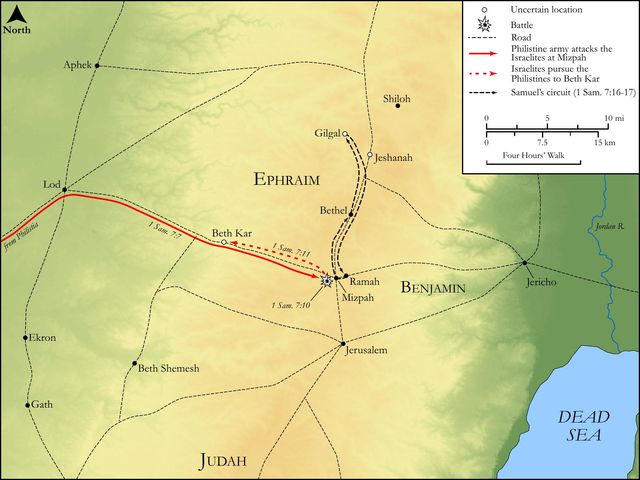
We have here a short account of the further good services that Samuel did to Israel. Having parted them from their idols, and brought them home to their God, he had put them into a capacity of receiving further benefits by his ministry. Having prevailed in that, he becomes, in other instances, a great blessing to them; yet, writing it himself, he is brief in the relation. We are not told here, but it appears (Ch2 35:18) that in the days of Samuel the prophet the people of Israel kept the ordinance of the passover with more than ordinary devotion, notwithstanding the distance of the ark and the desolations of Shiloh. Many good offices, no doubt, he did for Israel, but here we are only told how instrumental he was, 1. In securing the public peace (Sa1 7:13): "In his days the Philistines came no more into the coast of Israel, made no inroads or incursions upon them; they perceived that God now fought for Israel and that his hand was against the Philistines, and this kept them in awe, and restrained the remainder of their wrath." Samuel was a protector and deliverer to Israel, not by dint of sword, as Gideon, nor by strength of arm, as Samson, but by the power of prayer to God and carrying on a work of reformation among the people. Religion and piety are the best securities of a nation. 2. In recovering the public rights, Sa1 7:14. By his influence Israel had the courage to demand the cities which the Philistines had unjustly taken from them and had long detained; and the Philistines, not daring to contend with one that had so great an interest in heaven, tamely yielded to the demand, and restored (some think) even Ekron and Gath, two of the capital cities, though afterwards they retook them; others think some small towns that lay between Ekron and Gath, which were forced out of the Philistines' hands. This they got by their reformation and religion, they got ground of their enemies and got forward in their affairs. It is added, There was peace between Israel and the Amorites, that is, the Canaanites, the remains of the natives. Not that Israel made any league with them, but they were quiet, and not so mischievous to Israel as they had sometimes been. Thus when a man's ways please the Lord he maketh even his enemies to be at peace with him and give him no disturbance, Pro 16:7. 3. In administering public justice (Sa1 7:15, Sa1 7:16): He judged Israel; as a prophet he taught them their duty and reproved them for their sins, which is called judging, Eze 20:4; Eze 22:2. Moses judged Israel when he made them know the statutes of God and his laws (Exo 18:16); and thus Samuel judged them to the last, even after Saul was made king; so he promised them then, when Saul was inaugurated (Sa1 12:23), I will not cease to teach you the good and the right way. As a magistrate, he received appeals from the inferior courts and gave judgment upon them, tried causes and determined them, tried prisoners and acquitted or condemned them, according to the law. This he did all his days, till he grew old and past service, and resigned to Saul; and afterwards he exercised authority when application was made to him; nay, he judged even Agag, and Saul himself. But when he was in his prime he rode the circuit, for the convenience of the country, at least of that part of it which lay most under his influence. He kept courts at Beth-el, Gilgal, and Mizpeh, all in the tribe of Benjamin; but his constant residence was at Ramah, his father's city, and there he judged Israel, thither they resorted to him from all parts with their complaints, Sa1 7:17. 4. In keeping up the public exercises of religion; for there, where he lived, he built an altar to the Lord, not in contempt of the altar that was at Nob, or Gibeon, or wherever the tabernacle was; but divine justice having laid Sholoh waste, and no other place being yet chosen for them to bring their offerings to (Deu 12:11), he looked upon the law which confined them to one place to be for the present suspended, and therefore, being a prophet, and under divine direction, he did as the patriarchs did, he built an altar where he lived, both for the use of his own family and for the good of the country that resorted to it. Great men should use their wealth, power, and interest, for the keeping up of religion in the places where they live.
Historical interpretation
Historical reception
1 surviving comment on this verse from the historical church.
Samuel also judged Israel, etc. The Lord judges the Church at all times, in which, while it wanders on earth, He vivifies it with the light of His divine presence. For the days of Christ are the same as the days of the Church. About which He speaks in the Gospel: "As long as I am in the world, I am the light of the world" (John IX). Elsewhere, specifying this clearly, He says: "And behold, I am with you all days, even to the end of the age" (Matt. XXVIII). He also judges it, either by teaching through adversities, illuminating with gifts, delivering it from an unholy people, or leading it to heavenly kingdoms. Therefore, with hidden presence examining each of the elect, their hope, faith, and love, how much each has advanced in the aforementioned virtues, He examines daily either by Himself, who knows the secrets of the heart, or through spiritual teachers. For that a year denotes a person through figurative speech is also proven by the fact that the four well-known humors, by which the human body is sustained, are harmoniously associated with the four annual seasons: true blood with spring, red bile with summer, black bile with autumn, and phlegm with winter. Furthermore, the memorized cities are rightly compared to the aforementioned virtues, as their very names indicate, of which Bethel is translated into "house of God," Galgal into "wheel," and Masphat into "watchtower." The house of God signifies those who, having recently accepted the mystery of faith, have already become the temple of their Creator. The type of wheel alludes to those who, confirmed by the certainty of hope, have undertaken the swift course of transferring from this world in mind. By the name "watchtower" are expressed those who, perfected by the excellence of love, although still dwelling in the flesh, have learned to transcend the confines of the flesh by contemplating eternity. Indeed, it is narrated above that Samuel gathered Israel in Masphat, and there judged them, and went against the Philistines to fight them, but, while he was offering a burnt offering, they were defeated and fled. Now, however, he is reported to have also circled around two other cities, as if they were associates with Masphat, because the principal virtue that gathers the Church and fortifies it against all enemies is charity. But so that one may worthily attain to this, it is necessary first to care for the gift of faith, which purifies hearts, and hope, which leads to higher things.
Continue studying 1 Samuel 7:15 across the web’s major study libraries — every link below opens this exact verse, chapter, or book on the destination site.
Read & Compare
 BibleGatewayThis verse in more than 200 translations and 70 languages.
 Bible.comThe YouVersion reader — hundreds of translations, reading plans, and highlights.
 ESV.orgCrossway's official English Standard Version reader.
 NET BibleThe NET translation with 60,000+ translators' notes on every rendering decision.
 STEP BibleTyndale House's free study tool — original text, vocabulary, and scholarly resources.
 BibliaLogos Bible Software's free web reader.
 USCCBThe New American Bible (Revised Edition) with the U.S. bishops' study notes.
Commentaries
 BibleHub CommentariesDozens of classic commentaries on this verse, gathered on one page.
 StudyLightMore than 100 commentary sets — the largest collection on the web.
 BibleRefPlain-English commentary on what this verse means, verse by verse.
 Enduring WordDavid Guzik's free commentary on this chapter, widely used by Bible teachers.
 Bible Study ToolsVerse commentary alongside Greek and Hebrew study aids.
Original Language & Research
- BibleHub InterlinearThe verse word by word — original language, transliteration, and English.
- BibleHub LexiconEvery word's original-language definition and Strong's entry.
 Blue Letter BibleDeep-study tools — Strong's numbers, concordance, and word studies.
 SefariaThe Hebrew text with Rashi and centuries of Jewish commentary.
Sermons, Hymns & Audio


TrulyRandomVerse is not affiliated with these sites and doesn’t control their content. They’re linked because they’re genuinely useful.
Summary
1 Samuel 7:15 serves as a concise yet profound summary of Samuel's unparalleled and enduring leadership over Israel. Following a period of spiritual decline and Philistine oppression, Samuel emerged as God's chosen leader, guiding the nation through repentance, securing a decisive victory, and establishing a period of peace and spiritual renewal. This verse highlights that Samuel's role as judge was not a temporary assignment but a lifelong commitment, providing consistent spiritual and civil governance that brought stability to Israel during a crucial transitional era before the establishment of the monarchy.
CONTEXT
ShowHideLiterary Context: This verse opens the closing summary (7:15-17) of a pivotal narrative arc in 1 Samuel. It follows the dramatic events of 1 Samuel 7, where Samuel calls Israel to repentance at Mizpah, as detailed in 1 Samuel 7:5-6, after decades of Philistine oppression and the devastating loss of the Ark of the Covenant, recounted in 1 Samuel 4:11. God responds to Israel's turning by sending thunder against the Philistines, granting Israel a decisive victory, as described in 1 Samuel 7:10-11. The subsequent verses, 1 Samuel 7:13-14, describe the resulting peace and restoration of Israelite territory. Verse 15 then encapsulates Samuel's ongoing, divinely-ordained role as the nation's consistent leader, setting the stage for the later demand for a king in 1 Samuel 8.
Historical & Cultural Context: Samuel's era represents a critical juncture between the chaotic period of the Judges and the establishment of the monarchy. Israel was a loose confederation of tribes, often vulnerable to external enemies like the Philistines, who posed a significant military and cultural threat. Internally, spiritual decline was evident, symbolized by the corruption of Eli's sons, detailed in 1 Samuel 2:12-17. The role of a "judge" (Hebrew: shaphat) in this period was far more comprehensive than a modern legal arbiter; it encompassed military leadership, civil administration, and spiritual guidance. Samuel uniquely combined the roles of prophet, priest, and judge, providing a centralized, righteous authority that Israel desperately needed. His extensive circuit, mentioned in 1 Samuel 7:16-17, highlights his national influence and the stability he brought to the fragmented nation.
Key Themes:
Exposition and Analysis
ShowHideKey Word Analysis
ShowHideThe Hebrew verb שָׁפַט (shâphaṭ) is translated "judged." While it certainly includes the legal function of rendering verdicts and administering justice, its scope in the context of the Book of Judges and Samuel is much broader. According to the ground truth data, it signifies a comprehensive leadership role encompassing governing, delivering (as in military deliverance from enemies), leading the people, arbitrating disputes, and providing spiritual direction. Thus, "Samuel judged Israel" means he was their primary national leader, spiritual guide, and civil authority, ensuring justice and leading them in righteousness and security.
The Hebrew noun יוֹם (yôwm) refers to a "day" in the sense of a warm period, but also figuratively as a "space of time." In the phrase "all the days of his life," it emphasizes the temporal extent and continuous nature of Samuel's service. It highlights that his leadership was not confined to specific events or seasons but was a constant, ongoing reality for the entirety of his active years.
The Hebrew noun חַי (chay) means "alive" or "life." When combined with "days," as in "all the days of his life," it underscores the duration and vitality of Samuel's service. It points to his active, living presence as a judge and leader throughout his entire existence, signifying an unbroken period of governance and spiritual guidance until his old age.
Verse Breakdown
ShowHide"And Samuel judged Israel"
This clause establishes Samuel's primary and ongoing function. It signifies his divinely appointed role as the nation's chief leader, responsible for maintaining justice, guiding the people spiritually, and ensuring their security and well-being. His leadership was foundational to Israel's stability after a period of chaos and oppression, encompassing civil administration, military leadership, and spiritual arbitration.
"all the days of his life"
This phrase emphasizes the enduring and continuous nature of Samuel's commitment and service. Unlike earlier judges whose tenures might have been more localized or episodic, Samuel's influence was continuous and national, providing a consistent spiritual and civil anchor for Israel until his old age, bridging the gap between the tribal confederacy and the eventual monarchy. It highlights the unwavering dedication and longevity of his divinely ordained leadership.
Literary Devices
ShowHideThe verse functions primarily as a Summary Statement, providing a concise encapsulation of Samuel's enduring and impactful leadership following the pivotal national revival and victory described in the preceding verses of chapter 7. It serves to emphasize the stability and peace that characterized Israel under his consistent guidance. Furthermore, the phrase "all the days of his life" employs Emphasis, highlighting the extraordinary and unwavering nature of Samuel's dedication and service. This continuous, lifelong commitment sets him apart as a uniquely consistent figure in Israel's history, especially in contrast to the often intermittent and localized leadership of previous judges. This sustained period of righteous leadership also serves as a subtle Foreshadowing of the need for stable, centralized governance that would eventually lead to the establishment of the monarchy.
Theological and Thematic Connections
ShowHideSamuel's lifelong judicial role underscores God's faithfulness in providing consistent, righteous leadership even when human institutions falter. It highlights the importance of integrity and unwavering commitment in divine service, setting a high standard for future leaders, including kings. This period of stability under Samuel reflects a time when Israel, through national repentance, experienced God's blessing and deliverance, demonstrating the profound link between obedience to God and national well-being. Samuel's unique blend of prophetic, priestly, and judicial functions also prefigures the multifaceted ministry of the coming Messiah.
Reflection and Application
ShowHideSamuel's unwavering commitment to judging Israel "all the days of his life" challenges believers today to consider the longevity and depth of their own faithfulness in their God-given callings. His example reminds us that true influence and lasting impact stem not from fleeting popularity or positions of power, but from consistent integrity, unwavering obedience to God's voice, and selfless service to His people. In a world that often values short-term gains and transient leadership, Samuel's life provides a powerful counter-narrative, emphasizing the enduring spiritual and societal benefits of a life wholly dedicated to God's purposes. It prompts us to reflect on how we might cultivate such steadfastness in our own spheres of influence, bringing stability and spiritual health to those under our care, whether in family, church, or community.
Questions for Reflection
ShowHideFAQ
ShowHideWhat does "judged Israel" truly mean in this context?
ShowHideIn the context of ancient Israel, especially during the period of the Judges, the term "judged" (Hebrew: shaphat) encompassed far more than merely presiding over legal disputes. It referred to a comprehensive leadership role that included military deliverance (e.g., Judges 3:9), civil administration, spiritual guidance, and maintaining justice throughout the land. Samuel acted as a prophet, priest, and the chief civil authority, arbitrating disputes, leading the people in spiritual revival, and ensuring national security against threats like the Philistines, as seen in 1 Samuel 7:10-14. He was the central figure providing consistent governance and spiritual direction.
Why is it significant that Samuel judged "all the days of his life"?
ShowHideThis phrase highlights the unique and enduring nature of Samuel's leadership. Unlike many previous judges whose influence might have been regional or episodic, Samuel provided a consistent, national spiritual and civil anchor for Israel. His lifelong service ensured a period of stability and peace following years of Philistine oppression and spiritual decline. It underscores his unwavering dedication and God's sustained provision of a righteous leader, bridging the gap between the era of the judges and the establishment of the monarchy, which he himself would inaugurate by anointing both Saul and David. His consistent presence provided a much-needed foundation for the nation's future.
Christ-Centered Fulfillment
ShowHideSamuel's lifelong, comprehensive, and righteous leadership, though exemplary and divinely appointed, ultimately points to the perfect and eternal reign of Jesus Christ. While Samuel served as judge, prophet, and priest, foreshadowing the multifaceted roles of the Messiah, his human limitations eventually necessitated a transition to monarchy, and even the kings he anointed proved fallible. Jesus, however, is the ultimate King of kings who reigns eternally, the Great High Priest who offered a perfect, once-for-all sacrifice, and the Prophet who perfectly reveals the Father's will. He is the ultimate "Judge" who not only administers justice but embodies it, bringing true peace and spiritual restoration not just to Israel, but to all who believe. Unlike Samuel, whose life ultimately ended, Christ's reign is without end (Luke 1:33), and His perfect leadership ensures eternal stability and salvation for His people, fulfilling all that Samuel's dedicated service could only hint at.