


1 Timothy 5:21
- ΔιαμαρτύρομαιDiamarturomaiI earnestly testifyG1263V-PNI-1SVerb Present Middle Or Passive Deponent Indicative 1st Singular
- ἐνώπιονenōpionbeforeG1799PREPPreposition
- τοῦtou<the>G3588T-GSMDefinite article Genitive Singular Masculine
- θεοῦtheouGodG2316N-GSM-TNoun Genitive Singular Masculine Title
- καὶkaiandG2532CONJConjunction
- κυρίουkuriouLordG2962N-GSM-TNoun Genitive Singular Masculine Title
- ΧριστοῦChristouChristG5547N-GSM-TNoun Genitive Singular Masculine Title
- ἸησοῦIēsouJesusG2424N-GSM-PNoun Genitive Singular Masculine Individual
- καὶkaiandG2532CONJConjunction
- τῶνtōntheG3588T-GPMDefinite article Genitive Plural Masculine
- ἐκλεκτῶνeklektōnelectG1588A-GPMAdjective Genitive Plural Masculine
- ἀγγέλωνangelōnangelsG32N-GPMNoun Genitive Plural Masculine
- ἵναinathatG2443CONJConjunction
- ταῦταtautathese thingsG3778D-APNDemonstrative pronoun Accusative Plural Neuter
- φυλάξῃςphulaxēsyou may keepG5442V-AAS-2SVerb Aorist Active Subjunctive 2nd Singular
- χωρὶςchōrisapart fromG5565PREPPreposition
- προκρίματοςprokrimatosprejudiceG4299N-GSNNoun Genitive Singular Neuter
- μηδὲνmēdennothingG3367A-ASN-NAdjective Accusative Singular Neuter Negative
- ποιῶνpoiōndoingG4160V-PAP-NSMVerb Present Active Participle Nominative Singular Masculine
- κατὰkataout ofG2596PREPPreposition
- πρόσκλισινprosklisinpartialityG4346N-ASFNoun Accusative Singular Feminine
English is a literal word-by-word gloss of the Greek, not the KJV's wording. Why?
This is the original text the KJV's translators worked from — each Greek word with its own literal English meaning in this verse, prepared by scholars at Tyndale House, Cambridge. The KJV translates whole sentences, not word by word, so its wording differs: one Greek word can become several English words, and the KJV may choose “charity” where the gloss reads “love”. Both are faithful — they answer different questions. For the KJV's own rendering, switch to the KJV text.
Details
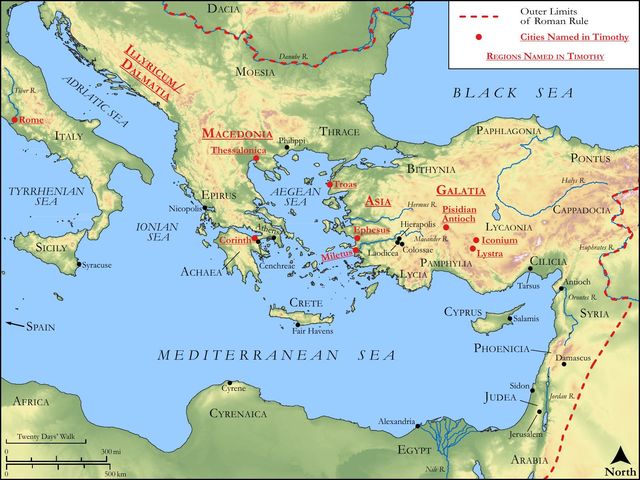
See on the biblical-era map

Study this verse
Public-domain commentary
Matthew Henry
From his Commentary on the Whole Bible. Henry comments on passages, not single verses — this entry covers 1 Timothy 5:17–25. His three-level outline is real structure in the source text, so it is rendered as structure.
Here are directions,
I.Concerning the supporting of ministers.
Care must be taken that they be honourably maintained (Ti1 5:17): Let the elders that rule well be counted worthy of double honour (that is, of double maintenance, double to what they have had, or to what others have), especially those who labour in the word and doctrine, those who are more laborious than others. Observe, The presbytery ruled, and the same that ruled were those who laboured in the word and doctrine: they had not one to preach to them and another to rule them, but the work was done by one and the same person. Some have imagined that by the elders that rule well the apostle means lay-elders, who were employed in ruling but not in teaching, who were concerned in church-government, but did not meddle with the administration of the word and sacraments; and I confess this is the plainest text of scripture that can be found to countenance such an opinion. But it seem a little strange that mere ruling elders should be accounted worthy of double honour, when the apostle preferred preaching to baptizing, and much more would he prefer it to ruling the church; and it is more strange that the apostle should take no notice of them when he treats of church-officers; but, as it is hinted before, they had not, in the primitive church, one to preach to them and another to rule them, but ruling and teaching were performed by the same persons, only some might labour more in the word and doctrine than others. Here we have,
1.The work of ministers; it consists principally in two things: ruling well and labouring in the word and doctrine. This was the main business of elders or presbyters in the days of the apostles.
2.The honour due to those who were not idle, but laborious in this work; they were worthy of double honour, esteem, and maintenance. He quotes a scripture to confirm this command concerning the maintenance of ministers that we might think foreign; but it intimates what a significancy there was in many of the laws of Moses, and particularly in this, Thou shalt not muzzle the ox that treads out the corn, Deu 25:4. The beasts that were employed in treading out the corn (for that way they took instead of threshing it) were allowed to feed while they did the work, so that the more work they did the more food they had; therefore let the elders that labour in the word and doctrine be well provided for; for the labourer is worthy of his reward (Mat 10:10), and there is all the reason in the world that he should have it. We hence learn,
(1.)God, both under the law, and now under the gospel, has taken care that his ministers be well provided for. Does God take care for oxen, and will he not take care of his own servants? The ox only treads out the corn of which they make the bread that perishes; but ministers break the bread of life which endures for ever.
(2.)The comfortable subsistence of ministers, as it is God's appointment that those who preach the gospel should live of the gospel (Co1 9:14), so it is their just due, as much as the reward of the labourer; and those who would have ministers starved, or not comfortably provided for, God will require it of them another day.
II.Concerning the accusation of ministers (Ti1 5:19):
Against an elder receive not an accusation, but before two or three witnesses. Here is the scripture-method of proceeding against an elder, when accused of any crime. Observe,
1.There must be an accusation; it must not be a flying uncertain report, but an accusation, containing a certain charge, must be drawn up. Further, He is not to be proceeded against by way of enquiry; this is according to the modern practice of the inquisition, which draws up articles for men to purge themselves of such crimes, or else to accuse themselves; but, according to the advice of Paul, there must be an accusation brought against an elder.
2.This accusation is not to be received unless supported by two or three credible witnesses; and the accusation must be received before them, that is, the accused must have the accusers face to face, because the reputation of a minister is, in a particular manner, a tender thing; and therefore, before any thing be done in the least to blemish that reputation, great care should be taken that the thing alleged against him be well proved, that he be not reproached upon an uncertain surmise; "but (Ti1 5:20) those that sin rebuke before all; that is, thou needest not be so tender of other people, but rebuke them publicly." Or "those that sin before all rebuke before all, that the plaster may be as wide as the wound, and that those who are in danger of sinning by the example of their fall may take warning by the rebuke given them for it, that others also may fear." Observe,
(1.)Public scandalous sinners must be rebuked publicly: as their sin has been public, and committed before many, or at least come to the hearing of all, so their reproof must be public, and before all.
(2.)Public rebuke is designed for the good of others, that they may fear, as well as for the good of the party rebuked; hence it was ordered under the law that public offenders should receive public punishment, that all Israel might hear, and fear, and do no more wickedly.
III.Concerning the ordination of ministers (Ti1 5:22):
Lay hands suddenly on no man; it seems to be meant of the ordaining of men to the office of the ministry, which ought not to be done rashly and inconsiderately, and before due trial made of their gifts and graces, their abilities and qualifications for it. Some understand it of absolution: "Be not too hasty in laying hands on any; remit not the censure of the church to any, till time be first taken for the proof of their sincerity in their repentance, neither be partakers of other men's sins, implying that those who are too easy in remitting the censures of the church encourage others in the sins which are thus connived at, and make themselves thereby guilty." Observe, We have great need to watch over ourselves at all times, that we do not make ourselves partakers of other men's sins. "Keep thyself pure, not only from doing the like thyself, but from countenancing it, or being any way accessary to it, in others." Here is,
1.A caution against the rash ordination of ministers, or absolution of those who have been under church-censures: Lay hands suddenly on no man.
2.Those who are rash, either in the one case or the other, will make themselves partakers in other men's sins.
3.We must keep ourselves pure, if we will be pure; the grace of God makes and keeps us pure, but it is by our own endeavours.
IV.Concerning absolution, to which Ti1 5:24, Ti1 5:25, seem to refer:
Some men's sins are open beforehand, going before to judgment, and some follow after, etc. Observe, Ministers have need of a great deal of wisdom, to know how to accommodate themselves to the variety of offences and offenders that they have occasion to deal with. Some men's sins are so plain and obvious, and not found by secret search, that there is no dispute concerning the bringing of them under the censures of the church; they go before to judgment, to lead them to censure. - Others they follow after; that is, their wickedness does not presently appear, nor till after a due search has been made concerning it. Or, as some understand it, some men's sins continue after they are censured; they are not reformed by the censure, and in that case there must be no absolution. So, also, as to the evidences of repentance: The good works of some are manifest beforehand. And those that are otherwise, whose good works do not appear, their wickedness cannot be hid, and so it will be easy to discern who are to be absolved, and who are not. Observe,
1.There are secret, and there are open sins; some men's sins are open beforehand, and going unto judgment, and some they follow after.
2.Sinners must be differently dealt with by the church.
3.The effects of church-censures are very different; some are thereby humbled and brought to repentance, so that their good works are manifest beforehand, while it is quite otherwise with others.
4.The incorrigible cannot be hid; for God will bring to light the hidden things of darkness, and make manifest the counsels of all hearts.
V.Concerning Timothy himself.
1.Here is a charge to him to be careful of his office; and a solemn charge it is: I charge thee before God, as thou wilt answer it to God before the holy and elect angels, observe these things without partiality, Ti1 5:21. Observe, It ill becomes ministers to be partial, and to have respect of persons, and to prefer one before another upon any secular account. He charges him, by all that is dear, before God, and the Lord Jesus Christ, and the elect angels, to guard against partiality. Ministers must give an account to God and the Lord Jesus Christ, whether, and how, they have observed all things given them in charge: and woe to them if they have been partial in their ministrations, out of an worldly politic view.
2.He charges him to take care of his health: Drink no longer water, etc. It seems Timothy was a mortified man to the pleasures of sense; he drank water, and he was a man of no strong constitution of body, and for this reason Paul advises him to use wine for the helping of his stomach and the recruiting of his nature. Observe, It is a little wine, for ministers must not be given to much wine; so much as may be for the health of the body, not so as to distemper it, for God has made wine to rejoice man's heart. Note,
(1.)It is the will of God that people should take all due care of their bodies. As we are not to make them our masters, so neither our slaves; but to use them so that they may be most fit and helpful to us in the service of God.
(2.)Wine is most proper for sickly and weak people, whose stomachs are often out of order, and who labour under infirmities. Give strong drink to him that is ready to perish, and wine to those that are of heavy hearts, Pro 31:6.
(3.)Wine should be used as a help, and not a hindrance, to our work and usefulness.
Historical interpretation
Nine Centuries of Reception
4 surviving comments on this verse. Each one is dated, so this reads as a timeline rather than a list.
Select a marker to jump to its quote. Markers stagger vertically where authors wrote within a few decades of each other.
Let us reverence the Lord Jesus Christ, whose blood was given for us; let us esteem those who have the rule over us; let us honour the aged among us; let us train up the young men in the fear of God; let us direct our wives to that which is good. Let them exhibit the lovely habit of purity [in all their conduct]; let them show forth the sincere disposition of meekness; let them make manifest the command which they have of their tongue, by their manner of speaking; let them display their love, not by preferring one to another, but by showing equal affection to all that piously fear God.
Just as they carefully prepared their will and testament, and committed it to a trust, and adjured (the trustees to be faithful to their charge), even so do I hold it.
Having spoken of Bishops and Deacons, of men, and women, of widows and elders, and of all others, and having shown how great was the authority of a Bishop, now he was speaking of judgment, he has added, "I charge thee before God and the Lord Jesus Christ and the elect angels, that thou observe these things without preferring one before another, doing nothing by partiality." Thus fearfully he charges him. For though Timothy was his beloved son, he did not therefore stand in awe of him. For as he was not ashamed to say of himself, "Lest by any means when I have preached to others, I myself should be a cast-away" (1 Cor. ix. 27); much less would he be afraid or ashamed in the case of Timothy. He called the Father and the Son to witness. But wherefore the elect Angels? From great moderation, as Moses said, "I call heaven and earth to witness" (Deut. iv. 26); and again, "Hear ye, O mountains, and strong foundations of the earth." (Mic. vi. 2.) He calls the Father and the Son to witness what he has said, making his appeal to Them against that future Day, that if anything should be done that ought not to be done, he was clear from the guilt of it.
"That thou observe these things without preferring one before another, doing nothing by partiality." That is, that thou deal impartially and equally between those who are upon trial and are to be judged by thee, that no one may pre-occupy thy mind, or gain thee over to his side beforehand.
But who are the elect Angels? It is because there are some not elect. As Jacob calls to witness God and the heap (Gen. xxxi. 45), so we often take at once superior and inferior persons to witness; so great a thing is testimony. As if he had said, I call to witness God and His Son and His servants, that I have charged thee: so before them I charge thee. He impresses Timothy with fear.
I seriously charge you before God and the Lord Jesus Christ and the elect angels to keep these instructions without bias, and to do nothing out of favoritism.
I seriously charge you before God. Paul warns of severity. For Timothy did not simply resign, but protested, securing himself in case anything improper should happen. But why did Paul call the Father and the Son as witnesses, and also angels together? Because they, along with their Lord who is to come in judgment, are present and will bear witness to the discourse. It is also our custom to call both superiors and inferiors as witnesses. And Jacob also took God and the mountain as witnesses. (Gen. 31:46)
and the elect angels. He said "elect angels," because angels and demons alike are cast away.
— [OECUMENIUS] Either he spoke what was truly the case, or he brought them to the brink of ruin. [end of the excerpt by Oecumenius A f. 173v; B f. 209τ; G f. 297r] —
to keep these instructions without bias. This, for example, is what he said: Without haste in judgment, that is, so that you do nothing rashly or recklessly from what has been said, and not without preceding judgment or counsel.
and to do nothing out of favoritism. Indeed, presumptions are often devoid of truth. For favoritism [πρόσκλησις] is an affectation that incites someone to do something without judgment.
without bias. That is, without falling into the judgment and punishment of disobedience for someone who has erred in something. Thus Clement in the seventh book of Hypotyposes. And Basil, in his interpretation of the Proverbs, says, According to inclination, that is, not leaning towards what is wrong, but bringing forth straight judgment. For he says thus: Doing nothing according to inclination, but bringing forth judgments straight and unaltered.
Continue studying 1 Timothy 5:21 across the web’s major study libraries — every link below opens this exact verse, chapter, or book on the destination site.
Read & Compare
 BibleGatewayThis verse in more than 200 translations and 70 languages.
 Bible.comThe YouVersion reader — hundreds of translations, reading plans, and highlights.
 ESV.orgCrossway's official English Standard Version reader.
 NET BibleThe NET translation with 60,000+ translators' notes on every rendering decision.
 STEP BibleTyndale House's free study tool — original text, vocabulary, and scholarly resources.
 BibliaLogos Bible Software's free web reader.
 USCCBThe New American Bible (Revised Edition) with the U.S. bishops' study notes.
Commentaries
 BibleHub CommentariesDozens of classic commentaries on this verse, gathered on one page.
 StudyLightMore than 100 commentary sets — the largest collection on the web.
 BibleRefPlain-English commentary on what this verse means, verse by verse.
 Enduring WordDavid Guzik's free commentary on this chapter, widely used by Bible teachers.
 Bible Study ToolsVerse commentary alongside Greek and Hebrew study aids.
Original Language & Research
- BibleHub InterlinearThe verse word by word — original language, transliteration, and English.
- BibleHub LexiconEvery word's original-language definition and Strong's entry.
 Blue Letter BibleDeep-study tools — Strong's numbers, concordance, and word studies.
 CNTR CollationThe earliest Greek manuscripts of this verse, collated letter by letter.
Sermons, Hymns & Audio


TrulyRandomVerse is not affiliated with these sites and doesn’t control their content. They’re linked because they’re genuinely useful.
Summary
The Apostle Paul delivers a profound and solemn charge to Timothy, his protégé and leader of the Ephesian church, emphasizing the critical importance of impartiality in all aspects of ministry and church governance. This verse serves as a foundational ethical mandate, underscoring that decisions, especially concerning discipline and leadership, must be made without prejudice, favoritism, or any form of bias, as if under the direct scrutiny of God, Christ, and the elect angels.
Context
ShowHideLiterary Context
This weighty injunction in 1 Timothy 5:21 is strategically placed within Paul's instructions regarding the internal administration and conduct of the church in Ephesus. Immediately preceding this verse, Paul provides detailed guidance on how Timothy should handle accusations against elders, stipulating that such charges should only be accepted on the testimony of "two or three witnesses" (1 Timothy 5:19). He also instructs on public rebuke for persistent sin (1 Timothy 5:20). Therefore, 1 Timothy 5:21 acts as a crucial ethical safeguard, ensuring that these sensitive and potentially divisive matters are handled with the utmost integrity, fairness, and transparency, free from personal agendas or external pressures. The broader context of 1 Timothy 5 also includes Paul's directives on caring for widows (1 Timothy 5:3-16) and honoring faithful elders (1 Timothy 5:17-18), all of which necessitate a spirit of discernment and equitable treatment.
Historical & Cultural Context
Timothy was operating in Ephesus, a prominent city in the Roman province of Asia, known for its diverse population, pagan worship (especially of Artemis), and significant Jewish and Christian communities. The early church, still in its formative stages, faced internal challenges related to leadership, false teaching, and the practicalities of community life. In Greco-Roman society, patronage and social status often dictated relationships and legal outcomes. Paul's emphasis on impartiality directly countered these prevailing cultural norms, which often favored the wealthy or influential. The concept of "elect angels" as witnesses might resonate with both Jewish apocalyptic traditions, where angels observe human affairs and divine judgments, and broader ancient Near Eastern legal customs where witnesses were called to validate oaths or proceedings. Paul's charge elevates the standard of church conduct far above that of the surrounding secular world, grounding it in divine accountability.
Key Themes
ShowHideThis verse powerfully contributes to several overarching themes within 1 Timothy and Paul's broader theology. Firstly, it highlights the theme of sound doctrine and godly conduct in the church, emphasizing that right belief must translate into right practice, especially in leadership. Secondly, it reinforces the theme of pastoral integrity and accountability, placing a heavy burden of responsibility on Timothy to lead justly, knowing his actions are observed by divine witnesses. This echoes Paul's consistent call for leaders to be "above reproach" (1 Timothy 3:2). Thirdly, the verse underscores the theme of unity and purity in the church, as partiality inevitably leads to division, injustice, and compromise of the gospel message. Paul consistently champions unity and love as hallmarks of the Christian community, as seen in his emphasis on love as the goal of instruction in 1 Timothy 1:5. Finally, it speaks to the nature of God's justice and impartiality, urging human leaders to mirror the divine character in their judgments, a principle found throughout Scripture, from the Law to the Prophets and the New Testament (Deuteronomy 1:17 and Romans 2:11).
Exposition and Analysis
ShowHideKey Word Analysis
ShowHideThis word (G1263) comes from a compound of "through" (δια) and "to bear witness" (μαρτυρέω). It means "to attest or protest earnestly, or (by implication) hortatively." Paul is not merely advising Timothy; he is solemnly appealing, testifying, and strongly urging him with the weight of divine authority. It conveys a sense of earnest exhortation, often with a warning or an appeal to conscience, indicating the gravity of the instruction.
This term (G4299) is derived from "before" (πρό) and "to judge" (κρίνω), meaning "a prejudgment (prejudice), i.e., prepossession." It refers to forming an opinion or making a decision in advance, without sufficient information or based on bias. It speaks to the internal disposition of the judge or leader – the pre-existing bias that can taint a judgment before the facts are fully considered.
This word (G4346) comes from "towards" (πρός) and "to lean" (κλίνω), signifying "a leaning towards, i.e., (figuratively) proclivity (favoritism)." While prókrima refers to the internal prejudice, prósklisis describes the outward manifestation of that bias – the act of showing favoritism or respect of persons based on external factors like wealth, social status, or personal relationship, rather than on merit or truth.
Verse Breakdown
ShowHide"I charge [thee] before God, and the Lord Jesus Christ, and the elect angels,"
Paul initiates his command with a solemn adjuration, invoking the highest possible witnesses. This is not a casual instruction but a divine mandate, placing Timothy's actions under the direct scrutiny of the triune God (Father and Son) and the heavenly host. The "elect angels" serve as cosmic witnesses, emphasizing the profound spiritual significance and accountability of Timothy's ministry, indicating that the integrity of the church's leadership has cosmic implications.
"that thou observe these things"
"These things" refers to the specific instructions Paul has just given regarding the handling of accusations against elders (vv. 19-20) and, by extension, the broader principles of church administration and discipline outlined in the chapter. Timothy is commanded to "observe" (G5442, phylássō), meaning to watch, guard, preserve, and obey these instructions carefully and diligently.
"without preferring one before another,"
This clause directly addresses the internal disposition of the leader. It warns against prókrima (prejudice or prejudgment). Timothy is to approach every situation with an open mind, free from preconceived notions, personal biases, or pre-existing opinions that might sway his judgment before all facts are considered. Decisions must be based on objective truth, not subjective inclination.
"doing nothing by partiality."
This clause complements the previous one by focusing on the outward action. It forbids prósklisis (favoritism or respect of persons). Timothy is not to allow external factors—such as a person's social standing, wealth, personal friendship, or influence—to dictate his decisions or actions. Every individual, regardless of their status, must be treated equally under the church's standards and divine law.
Literary Devices
ShowHidePaul employs several powerful literary devices to underscore the gravity of his charge. The most prominent is Solemn Adjuration, where he invokes the names of "God, and the Lord Jesus Christ, and the elect angels." This elevates the command from a mere human instruction to a divinely witnessed and sanctioned imperative, impressing upon Timothy the immense spiritual weight of his responsibilities. Furthermore, Paul uses Parallelism and Synonymy through the phrases "without preferring one before another" and "doing nothing by partiality." While distinct in their nuances (internal prejudice vs. external favoritism), these two phrases are closely related and reinforce the same core principle of absolute impartiality, creating a powerful rhetorical emphasis through repetition of a similar idea. Finally, the use of Emphasis through Negation ("without preferring," "doing nothing") clearly delineates what Timothy must not do, leaving no room for ambiguity regarding the absolute prohibition of bias in leadership.
Theological and Thematic Connections
ShowHideThis verse profoundly connects to the biblical theme of God's perfect justice and impartiality, serving as a mandate for human leaders to reflect the divine character. God himself "shows no partiality" (Romans 2:11), judging all according to their deeds, not their outward status or human distinctions. Therefore, those who represent Him in leadership are called to embody this same standard of righteousness. This principle is deeply rooted in the Old Testament Law, which repeatedly warns against perverting justice or showing favoritism to the rich or poor (Deuteronomy 1:17 and Leviticus 19:15). The New Testament reiterates this truth, particularly in the epistle of James, which strongly condemns favoritism within the church, declaring it a sin that violates the "royal law" of love (James 2:1-9). Paul's charge to Timothy thus aligns the ethical conduct of church leadership with the very nature of God and the consistent ethical demands of His covenant.
Reflection and Application
ShowHide1 Timothy 5:21 stands as a timeless and urgent call for integrity in all forms of leadership, particularly within the church. It challenges every believer, especially those in positions of authority, to examine their hearts and actions for any trace of prejudice or favoritism. In a world often driven by social status, wealth, and personal connections, the church is called to be a counter-cultural community that embodies divine justice and treats every individual with equal dignity and respect under God's righteous standards. This requires intentional self-awareness to identify our own biases, humility to seek counsel, and courage to make difficult decisions based on truth rather than popularity or personal gain. Our decisions, whether in church discipline, ministry appointments, or even everyday interactions, are not merely human affairs but are witnessed by God, Christ, and the elect angels, carrying eternal weight. Embracing impartiality fosters trust, promotes unity, and ensures that the church truly reflects the character of its impartial Head, Jesus Christ.
Questions for Reflection
ShowHideFAQ
ShowHideWhy does Paul invoke "elect angels" as witnesses alongside God and Christ?
ShowHideThe inclusion of "elect angels" (G1588, eklektós, meaning chosen or select; G32, ángelos, messenger) alongside God and the Lord Jesus Christ serves to heighten the solemnity and cosmic significance of Paul's charge. In ancient Jewish thought and early Christian understanding, angels are often depicted as observers of human affairs, witnesses to divine judgments, and participants in God's heavenly court. By invoking them, Paul emphasizes that Timothy's conduct in ministry is not merely a human matter but is under divine scrutiny, visible to the heavenly realm. This underscores the profound spiritual accountability of leadership within God's household and the eternal consequences of upholding or compromising justice. It also implies that the integrity of the church's internal life has implications that extend beyond the earthly sphere.
Christ-Centered Fulfillment
ShowHideThe charge for impartiality in 1 Timothy 5:21 finds its ultimate fulfillment and perfect embodiment in the person and work of Jesus Christ. Our Lord consistently demonstrated absolute impartiality throughout His earthly ministry. He did not show favoritism based on social status, wealth, or religious background, but welcomed sinners, tax collectors, and outcasts (Matthew 9:10-13). When challenged by those seeking to trap Him, Jesus's response affirmed His unwavering commitment to truth over human opinion: "Teacher, we know that you are true and teach the way of God truthfully, and you do not care about anyone's opinion, for you are not swayed by appearances" (Matthew 22:16). His sacrifice on the cross was for all humanity, without partiality, offering salvation to "whoever believes in him" (John 3:16). Furthermore, Christ is the righteous judge who will return to judge the living and the dead, and His judgment will be perfectly just and without bias (Acts 17:31). As the Head of the Church, Christ calls His body to reflect His own character of perfect justice and love. Therefore, the church's pursuit of impartiality in its leadership and community life is a direct participation in the ongoing mission of Christ to establish His righteous kingdom, where all are treated with dignity and justice, reflecting the very nature of God Himself.