


1 Timothy 6:13
Bible text: King James Version (1769 Blayney text) · Public domain
Bible text: King James Version with Strong's numbers · Public domain
Bible text: Berean Standard Bible · Public domain
Bible text: American Standard Version (1901) · Public domain
Bible text: World English Bible, Messianic edition · Public domain
Bible text: Geneva Bible (1599) · Public domain
Bible text: Young's Literal Translation · Public domain
- ΠαραγγέλλωParangellōI chargeG3853V-PAI-1SVerb Present Active Indicative 1st Singular
- σοιsoiyouG4771P-2DSPersonal pronoun Dative 2nd Singular
- ἐνώπιονenōpionbeforeG1799PREPPreposition
- τοῦtou<the>G3588T-GSMDefinite article Genitive Singular Masculine
- θεοῦtheouGodG2316N-GSM-TNoun Genitive Singular Masculine Title
- τοῦtouwhoG3588T-GSMDefinite article Genitive Singular Masculine
- ζῳογονοῦντοςzōogonountosis giving lifeG2225V-PAP-GSMVerb Present Active Participle Genitive Singular Masculine
- τὰta<the>G3588T-APNDefinite article Accusative Plural Neuter
- πάνταpantato all thingsG3956A-APNAdjective Accusative Plural Neuter
- καὶkaiandG2532CONJConjunction
- ΧριστοῦChristouChristG5547N-GSM-TNoun Genitive Singular Masculine Title
- ἸησοῦIēsouJesusG2424N-GSM-PNoun Genitive Singular Masculine Individual
- τοῦtouthe [One who]G3588T-GSMDefinite article Genitive Singular Masculine
- μαρτυρήσαντοςmarturēsantoshaving testifiedG3140V-AAP-GSMVerb Aorist Active Participle Genitive Singular Masculine
- ἐπὶepibeforeG1909PREPPreposition
- ΠοντίουPontiouPontiusG4194N-GSM-PNoun Genitive Singular Masculine Individual
- ΠιλάτουPilatouPilateG4091N-GSM-PNoun Genitive Singular Masculine Individual
- τὴνtēntheG3588T-ASFDefinite article Accusative Singular Feminine
- καλὴνkalēngoodG2570A-ASFAdjective Accusative Singular Feminine
- ὁμολογίανhomologianconfessionG3671N-ASFNoun Accusative Singular Feminine
English is a literal word-by-word gloss of the Greek, not the KJV's wording. Why?
This is the original text the KJV's translators worked from — each Greek word with its own literal English meaning in this verse, prepared by scholars at Tyndale House, Cambridge. The KJV translates whole sentences, not word by word, so its wording differs: one Greek word can become several English words, and the KJV may choose “charity” where the gloss reads “love”. Both are faithful — they answer different questions. For the KJV's own rendering, switch to the KJV text.
Details
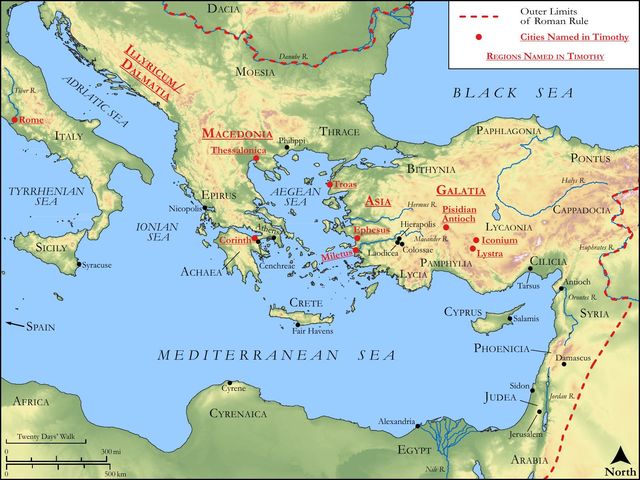
See on the biblical-era maps

Study this verse
Public-domain commentary
Matthew Henry
From his Commentary on the Whole Bible. Henry comments on passages, not single verses — this entry covers 1 Timothy 6:13–21. His three-level outline is real structure in the source text, so it is rendered as structure.
The apostle here charges Timothy to keep this commandment (that is, the whole work of his ministry, all the trust reposed in him, all the service expected from him) without spot, unrebukable; he must conduct himself so in his ministry that he might not lay himself open to any blame nor incur any blemish. What are the motives to move him to this?
I.He gives him a solemn charge:
I give thee charge in the sight of God that thou do this. He charges him as he will answer it at the great day to that God whose eyes are upon us all, who sees what we are and what we do: - God, who quickens all things, who has life in himself and is the fountain of life. This should quicken us to the service of God that we serve a God who quickens all things. He charges him before Christ Jesus, to whom in a peculiar manner he stood related as a minister of his gospel: Who before Pontius Pilate witnessed a good confession. Observe, Christ died not only as a sacrifice, but as a martyr; and he witnessed a good confession when he was arraigned before Pilate, saying (Joh 18:36, Joh 18:37), My kingdom is not of this world: I am come to bear witness unto the truth. That good confession of his before Pilate, My kingdom is not of this world, should be effectual to draw off all his followers, both ministers and people, from the love of this world.
II.He reminds him of the confession that he himself had made:
Thou hast professed a good profession before many witnesses (Ti1 6:12), namely, when he was ordained by the laying on of the hands of the presbytery. The obligation of that was still upon him, and he must live up to that, and be quickened by that, to do the work of his ministry.
III.He reminds him of Christ's second coming:
"Keep this commandment - until the appearing of our Lord Jesus Christ; keep it as long as thou live, till Christ come at death to give thee a discharge. Keep it with an eye to his second coming, when we must all give an account of the talents we have been entrusted with," Luk 16:2. Observe, The Lord Jesus Christ will appear, and it will be a glorious appearing, not like his first appearing in the days of his humiliation. Ministers should have an eye to this appearing of the Lord Jesus Christ in all their ministrations, and, till his appearing, they are to keep this commandment without spot, unrebukable. Mentioning the appearing of Christ, as one that loved it, Paul loves to speak of it, and loves to speak of him who shall then appear. The appearing of Christ is certain (he shall show it), but it is not for us to know the time and season of it, which the Father has kept in his own power: let this suffice us, that in time he will show it, in the time that he thinks fit for it. Observe,
1.Concerning Christ and God the Father the apostle here speaks great things.
(1.)That God is the only Potentate; the powers of earthly princes are all derived from him, and depend upon him. The powers that exist are ordained of God, Rom 13:1. He is the only Potentate that is absolute and sovereign, and perfectly independent.
(2.)He is the blessed and the only Potentate, infinitely happy, and nothing can in the least impair his happiness.
(3.)He is King of kings, and Lord of lords. All the kings of the earth derive their power from him; he gave them their crowns, they hold them under him, and he has a sovereign dominion over them. This is Christ's title (Rev 19:16), upon his vesture and his thigh; for he has a name higher than the kings of the earth.
(4.)He only has immortality. He only is immortal in himself, and has immortality as he is the fountain of it, for the immortality of angels and spirits derived from him.
(5.)He dwells in inaccessible light, light which no man can approach unto: no man can get to heaven but those whom he is pleased to bring thither, and admit into his kingdom.
(6.)He is invisible: Whom no man hath seen, nor can see. It is impossible that mortal eyes should bear the brightness of the divine glory. No man can see God and live.
2.Having mentioned these glorious attributes, he concludes with a doxology: To him be honour and power everlasting. Amen. God having all power and honour to himself, it is our duty to ascribe all power and honour to him.
(1.)What an evil is sin, when committed against such a God, the blessed and only Potentate! The evil of it rises in proportion to the dignity of him against whom it is committed.
(2.)Great is his condescension, to take notice of such mean and vile creatures as we are. What are we then, that the blessed God, the King of kings and Lord of lords, should seek after us?
(3.)Blessed are those who are admitted to dwell with this great and blessed Potentate. Happy are thy men (says the queen of Sheba to king Solomon), happy are these thy servants, who stand continually before thee, Kg1 10:8. Much more happy are those who are allowed to stand before the King of kings.
(4.)Let us love, adore, and praise, the great God; for who shall not fear thee, O Lord, and glorify thy name? For thou only art holy, Rev 15:4.
IV.The apostle adds, by way of postscript, a lesson for rich people, Ti1 6:17-19.
1.Timothy must charge those that are rich to beware of the temptations, and improve the opportunities, of their prosperous estate.
(1.)He must caution them to take heed of pride. This is a sin that easily besets rich people, upon whom the world smiles. Charge them that they be not high-minded, or think of themselves above what is meet, or be puffed up with their wealth.
(2.)He must caution them against vain confidence in their wealth. Charge them that they trust not in uncertain riches. Nothing is more uncertain than the wealth of this world; many have had much of it one day and been stripped of all the next. Riches make themselves wings, and fly away as an eagle, etc., Pro 23:5.
(3.)He must charge them to trust in God, the living God, to make him their hope, who giveth us richly all things to enjoy. Those who are rich must see God giving them their riches, and giving them to enjoy them richly; for many have riches, but enjoy them poorly, not having a heart to use them.
(4.)He must charge them to do good with what they have (for what is the best estate worth, any more than as it gives a man an opportunity of doing so much the more good?): That they be rich in good works. Those are truly rich who are rich in good works. That they be ready to distribute, willing to communicate: not only to do it, but to do it willingly, for God loves a cheerful giver.
(5.)He must charge them to think of another world, and prepare for that which is to come by works of charity: Laying up in store a good foundation against the time to come, that they may take hold on eternal life.
2.Hence we may observe,
(1.)Ministers must not be afraid of the rich; be they ever so rich, they must speak to them, and charge them.
(2.)They must caution them against pride, and vain confidence in their riches: That they be not high-minded, nor trust in uncertain riches. Stir them up to works of piety and charity: That they do good, etc.
(3.)This is the way for the rich to lay up in store for themselves for the time to come, that they may lay hold on eternal life; in the way of well-doing we are to seek for glory, honour, and immortality, and eternal life will be the end of all, Rom 2:7.
(4.)Here is a lesson for ministers in the charge given to Timothy: Keep that which is committed to thy trust. Every minister is a trustee, and it is a treasure committed to his trust, which he has to keep. The truths of God, the ordinances of God, keep these, avoiding profane and vain babblings; not affecting human eloquence, which the apostle calls vain babbling, or human learning, which often opposes the truths of God, but keep close to the written word, for that is committed to our trust. Some who have been very proud of their learning, their science, which is falsely so called, have by that been debauched in their principles and been drawn away from the faith of Christ, which is a good reason why we should keep to the plain word of the gospel, and resolve to live and die by that. Observe, [1.] Ministers cannot be too earnestly exhorted to keep what is committed to their trust, because it is a great trust lodged with them: O Timothy, keep that which is committed to thy trust! as if he had said, "I cannot conclude without charging thee again; whatever thou doest, be sure to keep this trust, for it is too great a trust to be betrayed." [2.] Ministers are to avoid babblings, if they would keep what is committed to them, because they are vain and profane. [3.] That science that opposes the truth of the gospel is falsely so called; it is not true science, for if it were it would approve of the gospel and consent to it. [4.] Those who are so fond of such science are in great danger of erring concerning the faith; those who are for advancing reason above faith are in danger of leaving faith.
V.Our apostle concludes with a solemn prayer and benediction:
Grace be with thee. Amen. Observe, this is a short, yet comprehensive prayer for our friends, for grace comprehends in it all that is good, and grace is an earnest, yea, a beginning, of glory; for, wherever God gives grace, he will give glory, and will not withhold any good thing from him who walketh uprightly. Grace be with you all. Amen.
Historical interpretation
Eight Centuries of Reception
3 surviving comments on this verse. Each one is dated, so this reads as a timeline rather than a list.
Select a marker to jump to its quote. Markers stagger vertically where authors wrote within a few decades of each other.
What is this deposit? Is it so secret as to be supposed to characterize a new doctrine? or is it a part of that charge of which he says, "This charge I commit unto thee, son Timothy? " and also of that precept of which he says, "I charge thee in the sight of God, who quickeneth all things, and before Jesus Christ who witnessed a good confession under Pontius Pilate, that thou keep this commandment? " Now, what is (this) commandment and what is (this) charge? From the preceding and the succeeding contexts, it will be manifest that there is no mysterious hint darkly suggested in this expression about (some) far-fetched doctrine, but that a warning is rather given against receiving any other (doctrine) than that which Timothy had heard from himself, as I take it publicly: "Before many witnesses" is his phrase.
Again he calls God to witness, as he had done a little before, at once to increase his disciple's awe, and to secure his safety, and to show that these were not human commandments, that receiving the commandment as from the Lord Himself, and ever bearing in mind the Witness before Whom he heard it, he may have it more fearfully impressed upon his mind.
"I charge thee," he says, "before God, Who quickeneth all things."
Here is at once consolation in the dangers which awaited him, and a remembrance of the resurrection awakened in him.
"And before Jesus Christ, Who before Pontius Pilate witnessed a good confession."
The exhortation again is derived from the example of his Master, and what he means is this; as He had done, so ought ye to do, for for this cause He "witnessed" (1 Pet. ii. 21), that we might tread in His steps.
"A good confession." What he does in his Epistle to the Hebrews,-"Looking unto Jesus, the Author and Finisher of our faith; Who for the joy that was set before Him endured the cross, despising the shame, and is set down at the right hand of the throne of God. For consider Him that endured such contradiction of sinners against Himself, lest ye be wearied and faint in your minds" (Heb. xii. 2, Heb xii. 3),-that he now does to his disciple Timothy. As if he had said, Fear not death, since thou art the servant of God, Who can give life to all things.
But to what "good confession" does he allude? To that which He made when Pilate asked, "Art thou a King?" "To this end," He said, "was I born." And again, "I came, that I might bear witness to the Truth. Behold, these have heard Me." (John xviii. 37.) He may mean this, or that when asked, "Art thou the Son of God?" He answered, "Thou sayest, that I am (the Son of God)." (Luke xxii. 70.) And many other testimonies and confessions did He make.
I charge you before God, who gives life to all things, and Christ Jesus, who testified before Pontius Pilate the good confession, to keep the commandment without spot, blameless, until the appearing of our Lord Jesus Christ.
Again Paul makes God a witness, both increasing the fear and making the disciple more secure, because he has in mind the one who was witnessed.
who gives life to all things. This is also a comfort against dangers. For if God, Paul says, gives life to all things, why should we fear the struggles for faith? And that He encourages this is clear from what follows, Jesus Christ, who testified before Pontius Pilate. For if the Master testified, why do we delay?
Who testified before Pontius Pilate. For Jesus testified concerning what he was doing, that he himself is the Christ, the Son of God. Therefore, Clement in the seventh book of Hypotyposes.
the good confession. What good confession does it speak of? In a somewhat mysterious way, however, Jesus confessed that he is God. For when Pilate said, "Are you a king?" he said, "For this I was born." (Jn. 18:37)
to keep the commandment without spot. That is, neither tainted by doctrines nor by conduct.
until the appearing. Until, Paul says, your last breath. But he did not say it thus. However, in order to stir him more greatly, he remembered the Lord's appearance, and the dreadful glory.
Continue studying 1 Timothy 6:13 across the web’s major study libraries — every link below opens this exact verse, chapter, or book on the destination site.
Read & Compare
 BibleGatewayThis verse in more than 200 translations and 70 languages.
 Bible.comThe YouVersion reader — hundreds of translations, reading plans, and highlights.
 ESV.orgCrossway's official English Standard Version reader.
 NET BibleThe NET translation with 60,000+ translators' notes on every rendering decision.
 STEP BibleTyndale House's free study tool — original text, vocabulary, and scholarly resources.
 BibliaLogos Bible Software's free web reader.
 USCCBThe New American Bible (Revised Edition) with the U.S. bishops' study notes.
Commentaries
 BibleHub CommentariesDozens of classic commentaries on this verse, gathered on one page.
 StudyLightMore than 100 commentary sets — the largest collection on the web.
 BibleRefPlain-English commentary on what this verse means, verse by verse.
 Enduring WordDavid Guzik's free commentary on this chapter, widely used by Bible teachers.
 Bible Study ToolsVerse commentary alongside Greek and Hebrew study aids.
Original Language & Research
- BibleHub InterlinearThe verse word by word — original language, transliteration, and English.
- BibleHub LexiconEvery word's original-language definition and Strong's entry.
 Blue Letter BibleDeep-study tools — Strong's numbers, concordance, and word studies.
 CNTR CollationThe earliest Greek manuscripts of this verse, collated letter by letter.
Sermons, Hymns & Audio


TrulyRandomVerse is not affiliated with these sites and doesn’t control their content. They’re linked because they’re genuinely useful.
Summary
In 1 Timothy 6:13, the Apostle Paul delivers a solemn and weighty charge to his spiritual son, Timothy, placing him under the direct scrutiny of God, the ultimate Giver of life, and before Christ Jesus, the supreme example of unwavering truth. This verse serves as a profound commission, reminding Timothy of the immense responsibility and divine accountability inherent in his pastoral ministry, particularly as he is called to maintain a steadfast witness in a challenging environment, mirroring the perfect confession made by Christ Himself before Pontius Pilate.
Context
ShowHideLiterary Context
This verse is situated within Paul's concluding exhortations to Timothy in his first letter, a manual for pastoral leadership. Having addressed issues like false teaching, the pursuit of godliness, and the dangers of materialism in 1 Timothy 6:3-10, Paul pivots to a direct and forceful command. The preceding verses (1 Timothy 6:11-12) call Timothy to "flee these things" and "fight the good fight of faith," emphasizing the active pursuit of righteousness. Verse 13 then grounds this call in the ultimate divine witnesses, setting the stage for the specific "commandment" Timothy is to keep "without spot, unrebukeable" (1 Timothy 6:14). It underscores the gravity of the pastoral office and the integrity required of those who serve Christ.
Historical & Cultural Context
Timothy served as Paul's delegate in Ephesus, a prominent city known for its diverse religious practices, including the worship of Artemis, and its bustling commercial activity. This environment presented unique challenges for the nascent Christian community, including the infiltration of false doctrines and the pressure to compromise Christian distinctiveness. Paul's charge to Timothy reflects the demanding nature of early church leadership, which often involved confronting opposition, upholding sound doctrine, and modeling godly conduct in a hostile or indifferent world. The reference to Pontius Pilate evokes the Roman judicial system and the political pressures faced by those who stood for truth, a context familiar to both Paul and Timothy, and indeed, to all early Christians living under Roman rule.
Key Themes
ShowHide1 Timothy 6:13 contributes significantly to several major themes throughout the letter and broader Pauline corpus. Firstly, it highlights Divine Accountability, emphasizing that all ministry and indeed all of life is lived "in the sight of God" (1 Timothy 6:13), who is the ultimate authority and judge. Secondly, the phrase "who quickeneth all things" underscores God's Sovereignty and Life-Giving Power, reminding Timothy that the God who issues the charge is also the One who empowers and sustains. Thirdly, the verse presents Christ as the Ultimate Exemplar of Faithful Witness. Jesus' "good confession" before Pilate (John 18:33-37) serves as the paradigm for Timothy's own steadfastness in proclaiming the truth, even in the face of adversity. This theme of faithful witness is central to Paul's instructions for Christian living and ministry, as seen in his call to "hold fast the form of sound words" (2 Timothy 1:13).
Exposition and Analysis
ShowHideKey Word Analysis
ShowHideThis word signifies a formal, authoritative command or injunction. It implies a serious and binding instruction, often given with a sense of urgency and expectation of obedience. Paul is not merely advising Timothy but issuing a solemn mandate.
Derived from "life" (zōon) and "to make" (poiéō), this verb means "to make alive," "to give life to," or "to impart life." It speaks to God's inherent power as the source and sustainer of all existence, both physical and spiritual. It emphasizes His ability to bring life out of death, and to empower His servants for their tasks.
This term refers to an "acknowledgment" or "public declaration of truth." It is not merely a statement but a solemn affirmation, often made under oath or in a legal context. Jesus' "good confession" was a public, unwavering declaration of His identity and mission, made before a powerful authority figure, despite the dire consequences.
Verse Breakdown
ShowHide"I give thee charge in the sight of God, who quickeneth all things"
Paul begins with a direct, authoritative command to Timothy. The phrase "in the sight of God" elevates the charge to the highest possible level of solemnity and accountability. It implies that Timothy's obedience (or disobedience) is directly observed by the Almighty. The description of God as "who quickeneth all things" underscores His supreme power and sovereignty as the Giver and Sustainer of all life, reinforcing the gravity of the charge and the divine authority behind it.
"and before Christ Jesus"
Paul adds a second, equally weighty witness to his charge: Christ Jesus. This parallelism emphasizes the divine nature of the commission and the dual divine audience before whom Timothy's ministry is performed. It also introduces the exemplary role of Christ, which is immediately elaborated upon.
"who before Pontius Pilate witnessed a good confession"
This clause presents Jesus as the ultimate model for Timothy's faithful witness. The setting of Pontius Pilate, the Roman governor, highlights the public, legal, and potentially perilous nature of Jesus' declaration. His "good confession" (referring to His affirmation of His kingship and mission to bear witness to the truth, as in John 18:37) was not a compromise but a steadfast declaration of truth, even unto death. This serves as the standard for Timothy's own integrity and courage in ministry.
Literary Devices
ShowHidePaul employs several powerful literary devices in this verse. The structure itself demonstrates Parallelism, presenting two supreme witnesses—God and Christ Jesus—before whom Timothy is charged, thereby doubling the solemnity and weight of the command. The phrase "who quickeneth all things" functions as an Appellation or descriptive epithet for God, highlighting His essential attribute as the Giver of life, which serves to underscore His ultimate authority and power. Jesus' action of "witnessed a good confession" serves as a profound Exemplar or Paradigm, providing Timothy with a concrete, historical, and supremely authoritative model for his own conduct and witness. The specific mention of Pontius Pilate acts as a historical Allusion, immediately bringing to mind the dramatic and pivotal trial of Jesus, thereby imbuing Timothy's charge with a sense of profound historical and theological significance, linking his present ministry to the foundational events of Christian faith.
Theological and Thematic Connections
ShowHideThis verse profoundly articulates the concept of divine accountability in Christian service. Paul's charge to Timothy is not merely a human directive but a mandate issued under the direct gaze of the triune God. God, as the One "who quickeneth all things," is not only the source of all life and power but also the ultimate standard of truth and righteousness. Christ's "good confession" before Pilate serves as the supreme theological model for faithful witness, demonstrating that truth must be proclaimed uncompromisingly, even in the face of worldly power and potential suffering. This establishes a high bar for all believers, particularly those in leadership, to live and minister with integrity, courage, and an unwavering commitment to the Gospel, knowing that their lives are lived before a divine audience.
Reflection and Application
ShowHide1 Timothy 6:13 calls every believer to a profound awareness of their life lived "in the sight of God." This is not an oppressive surveillance but an empowering truth: our faithfulness, integrity, and witness are seen and valued by the One who gives and sustains all life. For those in ministry, this verse is a sobering reminder of the divine accountability for their stewardship of the Gospel and the flock. For all Christians, it underscores the call to bear a "good confession" in their daily lives—to live out their faith authentically, speak truth courageously, and stand firm in their convictions, even when it is costly or unpopular. Just as Christ bore witness before Pilate, we are called to embody and articulate the truth of the Gospel in our spheres of influence, trusting that the God who quickens all things will enable us to fulfill our charge. This verse encourages us to pursue a life of unwavering integrity, knowing that our ultimate audience is not human, but divine.
Questions for Reflection
ShowHideFAQ
ShowHideWhat does it mean that God "quickeneth all things" in this context?
ShowHideThe phrase "who quickeneth all things" (from the Greek zōopoiéō) means that God is the ultimate source and sustainer of all life. In this context, it emphasizes His absolute sovereignty and power. It reminds Timothy, and us, that the God who gives the solemn charge is also the God who has the power to bring life out of death, to empower His servants, and to fulfill His purposes, even in seemingly impossible situations. It reinforces that the one giving the command is fully capable of enabling its fulfillment and is the ultimate authority over all existence.
Why is Jesus' "good confession" before Pontius Pilate highlighted as an example for Timothy?
ShowHideJesus' "good confession" before Pontius Pilate (John 18:33-37) is highlighted as the supreme example because it demonstrates unwavering truthfulness and faithfulness in the face of ultimate worldly power and personal peril. Jesus publicly affirmed His identity as King and His mission to bear witness to the truth, even though He knew it would lead to His crucifixion. This act serves as the paradigm for Timothy (and all believers) to maintain integrity, courage, and an uncompromising commitment to the truth of the Gospel, regardless of the consequences. It teaches that true witness is not about popularity or safety, but about fidelity to Christ and His truth.
Christ-Centered Fulfillment
ShowHide1 Timothy 6:13 finds its profound Christ-centered fulfillment in the person and work of Jesus Christ, who is not only the subject of Paul's charge but also its ultimate embodiment and enabler. Jesus Himself is the "faithful witness" (Revelation 1:5), whose "good confession" before Pontius Pilate was the ultimate demonstration of truth spoken in love and power. His declaration, "To this end was I born, and for this cause came I into the world, that I should bear witness unto the truth" (John 18:37), reveals His mission. Furthermore, the God "who quickeneth all things" is the same God who "raised Christ from the dead" (Romans 8:11), demonstrating His supreme life-giving power. Christ's resurrection is the ultimate "quickening," validating His confession and establishing Him as Lord over all (Philippians 2:9-11). Thus, Timothy's charge, and indeed the charge to all believers, is not merely to imitate Christ's confession, but to do so by the power of the resurrected Christ, who indwells them and empowers them to live a new life (2 Corinthians 5:17) in His sight, bearing witness to the very truth He embodied and fulfilled.