


1 Timothy 6:12
Bible text: King James Version (1769 Blayney text) · Public domain
Bible text: King James Version with Strong's numbers · Public domain
Bible text: Berean Standard Bible · Public domain
Bible text: American Standard Version (1901) · Public domain
Bible text: World English Bible, Messianic edition · Public domain
Bible text: Geneva Bible (1599) · Public domain
Bible text: Young's Literal Translation · Public domain
- ἀγωνίζουagōnizoudo fightG75V-PNM-2SVerb Present Middle Or Passive Deponent Imperative 2nd Singular
- τὸνtontheG3588T-ASMDefinite article Accusative Singular Masculine
- καλὸνkalongoodG2570A-ASMAdjective Accusative Singular Masculine
- ἀγῶναagōnafightG73N-ASMNoun Accusative Singular Masculine
- τῆςtēsof theG3588T-GSFDefinite article Genitive Singular Feminine
- πίστεωςpisteōsfaithG4102N-GSFNoun Genitive Singular Feminine
- ἐπιλαβοῦepilaboudo lay holdG1949V-2ADM-2SVerb 2nd Aorist Middle Deponent Imperative 2nd Singular
- τῆςtēsof theG3588T-GSFDefinite article Genitive Singular Feminine
- αἰωνίουaiōnioueternalG166A-GSFAdjective Genitive Singular Feminine
- ζωῆςzōēslifeG2222N-GSFNoun Genitive Singular Feminine
- εἰςeistoG1519PREPPreposition
- ἣνhēnwhichG3739R-ASFRelative pronoun Accusative Singular Feminine
- καὶkaialsoG2532CONJConjunction
- ἐκλήθηςeklēthēsyou were calledG2564V-API-2SVerb Aorist Passive Indicative 2nd Singular
- καὶkaiandG2532CONJConjunction
- ὡμολόγησαςhōmologēsasdid confessG3670V-AAI-2SVerb Aorist Active Indicative 2nd Singular
- τὴνtēntheG3588T-ASFDefinite article Accusative Singular Feminine
- καλὴνkalēngoodG2570A-ASFAdjective Accusative Singular Feminine
- ὁμολογίανhomologianconfessionG3671N-ASFNoun Accusative Singular Feminine
- ἐνώπιονenōpionbeforeG1799PREPPreposition
- πολλῶνpollōnmanyG4183A-GPMAdjective Genitive Plural Masculine
- μαρτύρωνmarturōnwitnessesG3144N-GPMNoun Genitive Plural Masculine
English is a literal word-by-word gloss of the Greek, not the KJV's wording. Why?
This is the original text the KJV's translators worked from — each Greek word with its own literal English meaning in this verse, prepared by scholars at Tyndale House, Cambridge. The KJV translates whole sentences, not word by word, so its wording differs: one Greek word can become several English words, and the KJV may choose “charity” where the gloss reads “love”. Both are faithful — they answer different questions. For the KJV's own rendering, switch to the KJV text.
Details
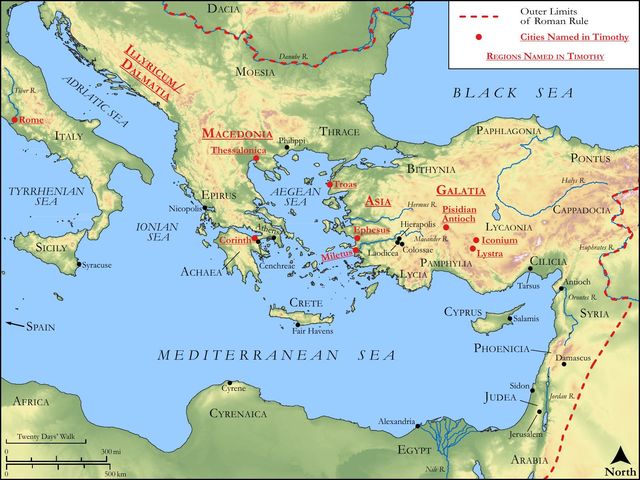
See on the biblical-era maps

Study this verse
Public-domain commentary
Matthew Henry
From his Commentary on the Whole Bible. Henry comments on passages, not single verses — this entry covers 1 Timothy 6:6–12. His four-level outline is real structure in the source text, so it is rendered as structure.
From the mention of the abuse which some put upon religion, making it to serve their secular advantages, the apostle,
I.Takes occasion to show the excellency of contentment and the evil of covetousness.
1.The excellency of contentment, Ti1 6:6-8. Some account Christianity an advantageous profession for this world. In the sense they mean this is false; yet it is undoubtedly true that, though Christianity is the worst trade, it is the best calling in the world. Those that make a trade of it, merely to serve their turn for this world, will be disappointed, and find it a sorry trade; but those that mind it as their calling, and make a business of it, will find it a gainful calling, for it has the promise of the life that now is, as well as of that which is to come.
(1.)The truth he lays down is that godliness with contentment is great gain. Some read it, godliness with a competency; that is, if a man have but a little in this world, yet, if he have but enough to carry him through it, he needs desire no more, his godliness with that will be his great gain. For a little which a righteous man has is better than the riches of many wicked, Psa 37:16. We read it, godliness with contentment; godliness is itself great gain, it is profitable to all things; and, wherever there is true godliness, there will be contentment; but those have arrived at the highest pitch of contentment with their godliness are certainly the easiest happiest people in this world. Godliness with contentment, that is, Christian contentment (content must come from principles of godliness) is great gain; it is all the wealth in the world. He that is godly is sure to be happy in another world; and if withal he do by contentment accommodate himself to his condition in this world he has enough. Here we have,
[1.]A Christian's gain; it is godliness with contentment, this is the true way to gain, yea, it is gain itself.
[2.]A Christian's gain is great: it is not like the little gain of worldlings, who are so fond of a little worldly advantage.
[3.]Godliness is ever accompanied with contentment in a great or less degree; all truly godly people have learned with Paul, in whatever state they are, to be therewith content, Phi 4:11. They are content with what God allots for them, well knowing that this is best for them. Let us all then endeavour after godliness with contentment.
(2.)The reason he gives for it is, For we brought nothing with us into this world, and it is certain we can carry nothing out, Ti1 6:7. This is a reason why we should be content with a little.
[1.]Because we can challenge nothing as a debt that is due to us, for we came naked into the world. Whatever we have had since, we are obliged to the providence of God for it; but he that gave may take what and when he pleases. We had our beings, our bodies, our lives (which are more than meat, and which are more than raiment), when we came into the world, though we came naked, and brought nothing with us; may we not then be content while our beings and lives are continued to us, though we have not every thing we would have? We brought nothing with us into this world, and yet God provided for us, care was taken of us, we have been fed all our lives long unto this day; and therefore, when we are reduced to the greatest straits, we cannot be poorer than when we came into this world, and yet then we were provided for; therefore let us trust in God for the remaining part of our pilgrimage.
[2.]We shall carry nothing with us out of this world. A shroud, a coffin, and a grave, are all that the richest man in the world can have from his thousands. Therefore why should we covet much? Why should we not be content with a little, because, how much soever we have, we must leave it behind us? Ecc 5:15, Ecc 5:16.
(3.)Hence he infers, having food and raiment, let us be therewith content, Ti1 6:8. Food and a covering, including habitation as well as raiment. Observe, If God give us the necessary supports of life, we ought to be content therewith, though we have not the ornaments and delights of it. If nature should be content with a little, grace should be content with less; though we have not dainty food, though we have not costly raiment, if we have but food and raiment convenient for us we ought to be content. This was Agur's prayer: Give me neither poverty nor riches; feed me with food convenient for me, Pro 30:8. Here we see,
[1.]The folly of placing our happiness in these things, when we did not bring any thing into this world with us, and we can carry nothing out. What will worldlings do when death shall strip them of their happiness and portion, and they must take an everlasting farewell of all these things, on which they have so much doted? They may say with poor Micah, You have taken away my gods; and what have I more? Jdg 18:24.
[2.]The necessaries of life are the hounds of a true Christian's desire, and with these he will endeavour to be content; his desires are not insatiable; no, a little, a few comforts of this life, will serve him, and these may hope to enjoy: Having food and raiment.
2.The evil of covetousness. Those that will be rich (that set their hearts upon the wealth of this world, and are resolved right or wrong, they will have it), fall into temptation and a snare, Ti1 6:9. It is not said, those that are rich, but those that will be rich, that is, that place their happiness in worldly wealth, that covet it inordinately, and are eager and violent in the pursuit of it. Those that are such fall into temptation and a snare, unavoidably; for, when the devil sees which way their lusts carry them, he will soon bait his hook accordingly. He knew how fond Achan would be of a wedge of gold, and therefore laid that before him. They fall into many foolish and hurtful lusts. Observe,
(1.)The apostle supposes that,
[1.]Some will be rich; that is, they are resolved upon it, nothing short of a great abundance will satisfy.
[2.]Such will not be safe nor innocent, for they will be in danger of ruining themselves for ever; they fall into temptation, and a snare, etc.
[3.]Worldly lusts are foolish and hurtful, for they drown men in destruction and perdition.
[4.]It is good for us to consider the mischievousness of worldly fleshly lusts. They are foolish, and therefore we should be ashamed of them, hurtful, and therefore we should be afraid of them, especially considering to what degree they are hurtful, for they drown men in destruction and perdition.
(2.)The apostle affirms that the love of money is the root of all evil, Ti1 6:10. What sins will not men be drawn to by the love of money? Particularly this was at the bottom of the apostasy of many from the faith of Christ; while they coveted money, they erred from the faith, they quitted their Christianity, and pierced themselves through with many sorrows. Observe,
[1.]What is the root of all evil; the love of money: people may have money, and yet not love it; but, if they love it inordinately, it will push them on to all evil.
[2.]Covetous persons will quit the faith, if that be the way to get money: Which while some coveted after, they have erred from the faith. Demas hath forsaken me, having loved this present world, Ti2 4:10. For the world was dearer to him than Christianity. Observe, Those that err from the faith pierce themselves with many sorrows; those that depart from God do but treasure up sorrows for themselves.
II.Hence he takes occasion to caution Timothy, and to counsel him to keep in the way of God and his duty, and particularly to fulfil the trust reposed in him as a minister. He addresses himself to him as a man of God. Ministers are men of God, and ought to conduct themselves accordingly in every thing; they are men employed for God, devoted to his honour more immediately. The prophets under the Old Testament were called men of God.
1.He charges Timothy to take heed of the love of money, which had been so pernicious to many: Flee these things. It ill becomes any men, but especially men of God, to set their hearts upon the things of this world; men of God should be taken up with the things of God.
2.To arm him against the love of the world, he directs him to follow that which is good. Follow after righteousness, godliness, faith, love, patience, meekness: righteousness in his conversation towards men, godliness towards God, faith and love as living principles, to support him and carry him on in the practice both of righteousness and godliness. Those that follow after righteousness and godliness, from a principle of faith and love, have need to put on patience and meekness - patience to bear both the rebukes of Providence and the reproaches of men, and meekness wherewith to instruct gainsayers and pass by the affronts and injuries that are done us. Observe, It is not enough that men of God flee these things, but they must follow after what is directly contrary thereto. Further, What excellent persons men of God are who follow after righteousness! They are the excellent of the earth, and, being acceptable to God, they should be approved of men.
3.He exhorts him to do the part of a soldier: Fight the good fight of faith. Note, Those who will get to heaven must fight their way thither. There must be a conflict with corruption and temptations, and the opposition of the powers of darkness. Observe, It is a good fight, it is a good cause, and it will have a good issue. It is the fight of faith; we do not war after the flesh, for the weapons of our warfare are not carnal, Co2 10:3, Co2 10:4. He exhorts him to lay hold on eternal life. Observe,
(1.)Eternal life is the crown proposed to us, for our encouragement to war, and to fight the good fight of faith, the good warfare.
(2.)This we must lay hold on, as those that are afraid of coming short of it and losing it. Lay hold, and take heed of losing your hold. Hold fast that which thou hast, that no man take thy crown, Rev 3:11.
(3.)We are called to the fight, and to lay hold on eternal life.
(4.)The profession Timothy and all faithful ministers make before many witnesses is a good profession; for they profess and engage to fight the good fight of faith, and to lay hold on eternal life; their calling and their own profession oblige them to this.
Historical interpretation
Eight Centuries of Reception
7 surviving comments on this verse. Each one is dated, so this reads as a timeline rather than a list.
Select a marker to jump to its quote. Markers stagger vertically where authors wrote within a few decades of each other.
In like manner, O blessed, consider whatever is hard in your present situation as an exercise of your powers of mind and body. You are about to enter a noble contest in which the living God acts the part of superintendent and the Holy Spirit is your trainer, a contest whose crown is eternity, whose prize is angelic nature, citizenship in heaven for ever and ever.
For the angels, as it were, have charge over our souls, to whom “while we are still children we are committed,” as it were, “to tutors and governors until the time appointed by the father.” And they, therefore, now say about the progress of each of us, “Now I know that you fear God.” Suppose, for example, I intend to be a martyr. An angel could not say to me on this basis, “Now I know that you fear God,” for an intention of the mind is known to God alone. But if I shall undertake the struggles, if I shall utter a “good confession,” if I shall bear calmly all things which are inflicted. Then an angel can say, as if confirming and strengthening me, “Now I know that you fear God.”
In another place the apostle says, “And all those who will live godly lives in Christ Jesus will suffer persecution.” Then, to help prevent people from renouncing godliness when they are persecuted, he urges them to cling to the faith. “You, therefore, continue in the things you have learned and been assured of.” Just as brothers become strongly knit together when one helps another, so faith and godliness, coming from the same family, cohere together. A person who gives his attention to one of the two is strengthened by the other. Consequently, wishing Timothy to live godly to the end and to fight the battle in faith, St. Paul says, “Fight the good fight of faith, and lay hold on eternal life.”
Recall your glorious profession which you made before God, the angels and men. Remember the august company, the holy chorus of virgins, the assembly of the Lord and the church of saints. Call to mind also your grandmother, old in Christ but still young and strong in virtue, and your mother, vying with her in the Lord and striving by new and unusual toils to destroy former habits. Remember also your sister, who is likewise both imitating and aspiring to surpass them, and who by the advantage of her virginity is outstripping the virtuous actions of her elders and is industriously summoning, both by word and by life, you her sister, as she thought, to a contest of like eagerness. Recall these, and also the angelic chorus singing with them to God, the spiritual life in the flesh and the heavenly life on earth.
Let godliness move you to justice, continence, gentleness, that you may avoid childish acts, and that rooted and grounded in grace you may fight the good fight of faith. Do not entangle yourself in the affairs of this life, for you are fighting for God. For he who fights for the emperor is forbidden by human laws to enter upon lawsuits or do any legal business or sell merchandise. How much more ought he who enters upon the warfare of faith to keep away from every kind of business. Let him be satisfied with the produce of his own little bit of land, if he has it. If he has not that, let him be content with the pay he will get for his service.
"Fight the good fight of faith, lay hold on eternal life." Lo, there is thy reward, "whereunto thou art also called, and hast professed a good profession," in hope of eternal life, "before many witnesses."
That is, do not put that confidence to shame. Why dost thou labor to no profit?
"Fight the good fight."
Here he commends his boldness and manliness, that before all he confidently "made profession," and he reminds him of his early instruction.
"Lay hold on eternal life."
There is need not only of profession, but of patience also to persevere in that profession, and of vehement contention, and of numberless toils, that you be not overthrown. For many are the stumbling-blocks, and impediments, therefore the way is "strait and narrow." It is necessary therefore to be self-collected, and well girt on every side. All around appear pleasures attracting the eyes of the soul. Those of beauty, of wealth, of luxury, of indolence, of glory, of revenge, of power, of dominion, and these are all fair and lovely in appearance, and able to captivate those who are unsteady, and who do not love the truth. For truth has but a severe and uninviting countenance. And why? Because the pleasures that she promises are all future, whereas the others hold out present honors and delights, and repose; though all are false and counterfeit. To these therefore adhere gross, effeminate, unmanly minds, indisposed to the toils of virtue. As in the games of the heathens, he who does not earnestly covet the crown, may from the first give himself up to revellings and drunkenness, and so do in fact the cowardly and unmanly combatants, whilst those who look steadfastly to the crown sustain blows without number. For they are supported and roused to action by the hope of future reward.
Fight the good fight of faith; take hold of eternal life, to which you were called, and you made the good confession before many witnesses.
Fight the good fight of faith. The fight of faith, both what has been said, and the courageous one in trials. And immediately the reward of such a fight, eternal life.
to which you were called. For everyone who comes to baptism is called to this.
the good confession. Rather confession, it refers to that in baptism, when we confess to renounce the Devil and to join and believe in Christ.
A command about purity, obedience until the end.
Continue studying 1 Timothy 6:12 across the web’s major study libraries — every link below opens this exact verse, chapter, or book on the destination site.
Read & Compare
 BibleGatewayThis verse in more than 200 translations and 70 languages.
 Bible.comThe YouVersion reader — hundreds of translations, reading plans, and highlights.
 ESV.orgCrossway's official English Standard Version reader.
 NET BibleThe NET translation with 60,000+ translators' notes on every rendering decision.
 STEP BibleTyndale House's free study tool — original text, vocabulary, and scholarly resources.
 BibliaLogos Bible Software's free web reader.
 USCCBThe New American Bible (Revised Edition) with the U.S. bishops' study notes.
Commentaries
 BibleHub CommentariesDozens of classic commentaries on this verse, gathered on one page.
 StudyLightMore than 100 commentary sets — the largest collection on the web.
 BibleRefPlain-English commentary on what this verse means, verse by verse.
 Enduring WordDavid Guzik's free commentary on this chapter, widely used by Bible teachers.
 Bible Study ToolsVerse commentary alongside Greek and Hebrew study aids.
Original Language & Research
- BibleHub InterlinearThe verse word by word — original language, transliteration, and English.
- BibleHub LexiconEvery word's original-language definition and Strong's entry.
 Blue Letter BibleDeep-study tools — Strong's numbers, concordance, and word studies.
 CNTR CollationThe earliest Greek manuscripts of this verse, collated letter by letter.
Sermons, Hymns & Audio


TrulyRandomVerse is not affiliated with these sites and doesn’t control their content. They’re linked because they’re genuinely useful.
Summary
First Timothy 6:12 is a potent apostolic charge from Paul to his spiritual son, Timothy, urging him to engage vigorously in the spiritual struggle of faith, to firmly grasp the reality of eternal life, and to remain steadfast in the public confession of his Christian commitment. This verse encapsulates a call to spiritual warfare, active discipleship, and unwavering integrity, reminding believers of their divine calling and the solemnity of their public declaration of faith in Christ.
Context
ShowHideLiterary Context
This verse stands as a climactic exhortation within Paul's pastoral counsel to Timothy, who is leading the church in Ephesus. Immediately preceding this verse, in 1 Timothy 6:11, Paul commands Timothy to "flee these things" (referring to the love of money, greed, and associated evils discussed in 1 Timothy 6:9-10) and instead to "pursue righteousness, godliness, faith, love, patience, meekness." Verse 12 then builds upon this positive pursuit, shifting from fleeing vice to actively engaging in the spiritual disciplines necessary for a faithful life. It is a direct, forceful imperative that summarizes the essence of Christian perseverance and commitment in the face of various challenges, both internal and external, that Timothy was encountering in his ministry.
Historical & Cultural Context
Timothy was ministering in Ephesus, a prominent city in the Roman province of Asia, known for its significant temple to Artemis (Diana) and a vibrant, yet often challenging, religious and philosophical landscape. The early Christian community there faced pressures from both pagan influences and internal false teachings, particularly those promoting asceticism, legalism, or speculative myths (as referenced in 1 Timothy 1:3-7). Paul's instructions reflect the need for strong, resolute leadership in such an environment. The imagery of "fighting the good fight" would have resonated with the athletic contests (like the Isthmian Games) and military training common among the Greeks and Romans, providing a familiar metaphor for intense, disciplined effort. The public "profession" of faith also held significant weight in a society where religious and civic allegiances were often intertwined, making a Christian confession a potentially costly, yet vital, declaration.
Key Themes
ShowHideFirst Timothy 6:12 contributes significantly to several overarching themes in the letter. Firstly, it underscores the theme of godly living and spiritual discipline, emphasizing that faith is not passive but requires active engagement and perseverance against spiritual adversaries and temptations, a concept echoed in Ephesians 6:10-18. Secondly, it highlights the reality and importance of eternal life, not merely as a future hope but as a present possession to be lived out, informing daily choices and priorities. This aligns with the broader New Testament emphasis on the transformative power of the gospel and the new life in Christ, as seen in John 17:3. Thirdly, the verse reinforces the theme of public confession and accountability, reminding Timothy of the solemn commitment he made before witnesses, a principle that applies to all believers who publicly identify with Christ, as discussed in Romans 10:9-10.
Exposition and Analysis
ShowHideKey Word Analysis
ShowHideThis verb means "to struggle, literally (to compete for a prize), figuratively (to contend with an adversary), or genitive case (to endeavor to accomplish something)." It conveys intense effort, like an athlete competing in a grueling contest or a soldier in battle, implying sustained, disciplined exertion against opposition.
This adjective means "properly, beautiful, but chiefly (figuratively) good (literally or morally), i.e., valuable or virtuous (for appearance or use, and thus distinguished from ἀγαθός, which is properly intrinsic)." When applied to the "fight," it signifies that the struggle is noble, honorable, excellent, and morally upright, not just effective.
This middle voice verb means "to seize (for help, injury, attainment, or any other purpose; literally or figuratively)." It suggests an urgent, firm, and active grasping or appropriation, indicating that eternal life, though a gift, requires active engagement and firm resolve to possess and live out its implications.
This adjective means "perpetual (also used of past time, or past and future as well)." It describes life that is not merely long-lasting but qualitative, belonging to the age to come, characterized by God's own nature and presence, transcending temporal limitations.
This noun refers to "life (literally or figuratively)." In this context, combined with "eternal," it denotes the spiritual, divine life that believers receive through Christ, which is both a present reality and a future consummation.
This verb means "to assent, i.e., covenant, acknowledge; con- (pro-)fess, confession is made, give thanks, promise." It refers to a public declaration or acknowledgment, indicating a verbal and often formal commitment.
This noun means "acknowledgment; con- (pro-)fession, professed." It is the act or content of the public declaration, a formal and binding confession of faith.
This noun means "a witness (literally (judicially) or figuratively (genitive case)); by analogy, a 'martyr'." It refers to those who observe and can testify to an event or declaration, implying accountability.
Verse Breakdown
ShowHide"Fight the good fight of faith"
This is a powerful imperative, calling believers to engage in a strenuous, disciplined, and honorable spiritual struggle. The "fight" is not against flesh and blood but against spiritual forces, temptations, and false teachings that threaten one's fidelity to Christ. It is "of faith" because faith is both the arena in which the fight occurs and the means by which it is waged.
"lay hold on eternal life"
This command urges an active, firm grasping and appropriation of the eternal life that believers already possess in Christ. It's not about earning salvation, but about fully embracing and living out the implications of that divine life now, clinging to its promises and realities amidst the struggles of the present age.
"whereunto thou art also called"
This clause reminds Timothy of his divine calling, emphasizing that his pursuit of eternal life and engagement in the good fight are not self-initiated but are responses to God's sovereign invitation and purpose for his life. This calling encompasses both salvation and ministry.
"and hast professed a good profession before many witnesses"
This refers to Timothy's public declaration of faith, likely at his baptism or ordination. This "good profession" (a noble, honorable confession) was made openly, before a multitude of observers, underscoring the public nature of his commitment and the accountability that comes with such a solemn vow.
Literary Devices
ShowHideThe verse is rich in Metaphor, primarily seen in "Fight the good fight of faith." This phrase employs an athletic or military metaphor (from the Greek agōn), likening the Christian life to a strenuous contest or battle. This conveys the intensity, discipline, and perseverance required in spiritual living. The repetition of the root word (agōnízomai and agṓn) forms a Cognate Accusative ("fight the fight"), which emphasizes the action and its nature, making the command more forceful and vivid. The phrase "lay hold on eternal life" uses Synecdoche, where "eternal life" represents not just a future state but the entire reality of salvation and new life in Christ, which believers are to appropriate and live out in the present. The mention of "many witnesses" functions as a form of Audience Appeal and Accountability, reminding Timothy (and by extension, all believers) that their public confession carries weight and implies a commitment observed by others, both human and divine.
Theological and Thematic Connections
ShowHideFirst Timothy 6:12 deeply connects to the New Testament's understanding of Christian discipleship as an active, Spirit-empowered journey rather than a passive state. It underscores the dual reality of salvation: a free gift received by grace through faith, and a life to be actively lived out in perseverance and obedience. The "good fight" is a spiritual battle against sin, temptation, and spiritual adversaries, requiring vigilance and reliance on God's strength. The command to "lay hold on eternal life" emphasizes the present reality of eternal life, which begins at conversion, and the ongoing need to appropriate and live by its principles. This active pursuit is rooted in God's prior calling, highlighting divine initiative and human responsibility in the Christian walk. The public profession serves as a foundational act of commitment, binding the believer to a life of integrity and faithfulness before God and humanity.
Reflection and Application
ShowHideThis verse serves as a powerful reminder that the Christian life is not a leisurely stroll but a purposeful, demanding journey that requires intentional effort and unwavering commitment. To "fight the good fight of faith" means actively engaging in spiritual disciplines, resisting temptation, contending for truth, and persevering through trials with the strength that God supplies. It calls us to be vigilant against anything that would undermine our faith or distract us from our divine calling. Simultaneously, to "lay hold on eternal life" is to live with an acute awareness of the profound reality of our salvation—not just as a future hope, but as a present possession that transforms our values, priorities, and daily conduct. Our public confession of faith, made before God and others, is a sacred vow that should motivate us to live consistently with the gospel we proclaim, demonstrating integrity and faithfulness in every sphere of life. This verse encourages us to press on, knowing that our struggles are for a noble cause, leading to an eternal reward that is already ours by grace.
Questions for Reflection
ShowHideFAQ
ShowHideWhat does "fight the good fight of faith" truly mean for a modern believer?
ShowHideFor a modern believer, "fighting the good fight of faith" means actively engaging in the spiritual disciplines necessary to maintain and grow one's faith, and contending for biblical truth in a world often hostile to it. It involves a disciplined commitment to prayer, Bible study, fellowship, and obedience to God's Word. It also means resisting the temptations of sin, the allure of worldly values, and the deceptive influence of false teachings. This "fight" is not physical combat but an internal and external struggle for spiritual integrity and faithfulness, requiring perseverance and reliance on God's strength, as highlighted in Ephesians 6:12. It's a noble and worthy struggle because its ultimate aim is to honor God and secure eternal life.
How is "eternal life" something we can "lay hold on" if it's a gift from God?
ShowHideWhile eternal life is indeed a gracious gift from God, received by faith in Jesus Christ (as affirmed in John 3:16), the command to "lay hold on" it signifies an active appropriation and living out of that gift. It implies embracing its full implications for our lives now, not just waiting for a future reward. This means living in conscious awareness of our new identity in Christ, allowing the principles of God's eternal kingdom to govern our daily choices, and actively pursuing godliness. It's about clinging firmly to the promises of God, drawing strength from the Holy Spirit, and rejecting anything that would diminish or compromise the quality of the divine life we've been given. It's a call to live consistently with the hope that is within us, as described in Colossians 3:1-4.
Christ-Centered Fulfillment
ShowHideFirst Timothy 6:12 finds its ultimate fulfillment and deepest meaning in the person and work of Jesus Christ. He is the preeminent example of one who "fought the good fight," not for Himself, but for humanity's redemption. His entire earthly ministry, culminating in His suffering on the cross, was a relentless "fight" against sin, death, and the powers of darkness, a struggle He victoriously completed (as celebrated in Colossians 2:15). Jesus Himself is the embodiment of "eternal life," declaring, "I am the way, the truth, and the life" and promising that those who believe in Him "have eternal life" (John 6:47). Our ability to "lay hold on eternal life" is entirely dependent on our union with Him, for He is "our life" (Colossians 3:4). Furthermore, Jesus made "a good profession before many witnesses" through His faithful obedience to the Father, even unto death (Philippians 2:8), and His public testimony before Pontius Pilate (1 Timothy 6:13). Thus, our fight of faith is a participation in Christ's victory, our grasp of eternal life is a reception of His very being, and our profession of faith is an echo of His own perfect obedience and truth. We fight and live by His power, for His glory, and in His footsteps.