


John 1:32
- καὶkaiAndG2532CONJConjunction
- ἐμαρτύρησενemarturēsenbore witnessG3140V-AAI-3SVerb Aorist Active Indicative 3rd Singular
- ἸωάννηςIōannēsJohnG2491N-NSM-PNoun Nominative Singular Masculine Individual
- λέγωνlegōnsayingG3004V-PAP-NSMVerb Present Active Participle Nominative Singular Masculine
- ὅτιhotithatG3754CONJConjunction
- τεθέαμαιtetheamaiI have beheldG2300V-RNI-1SVerb Perfect Middle Or Passive Deponent Indicative 1st Singular
- τὸtotheG3588T-ASNDefinite article Accusative Singular Neuter
- πνεῦμαpneumaSpiritG4151N-ASNNoun Accusative Singular Neuter
- καταβαῖνονkatabainondescendingG2597V-PAP-ASNVerb Present Active Participle Accusative Singular Neuter
- ὡςhōsasG5613PRTParticle or Disjunctive
- περιστερὰνperisterana doveG4058N-ASFNoun Accusative Singular Feminine
- ἐξexout ofG1537PREPPreposition
- οὐρανοῦouranouheavenG3772N-GSMNoun Genitive Singular Masculine
- καὶkaiandG2532CONJConjunction
- ἔμεινενemeinenit remainedG3306V-AAI-3SVerb Aorist Active Indicative 3rd Singular
- ἐπ᾽ep᾽uponG1909PREPPreposition
- αὐτόνautonHimG846P-ASMPersonal pronoun Accusative Singular Masculine
English is a literal word-by-word gloss of the Greek, not the KJV's wording. Why?
This is the original text the KJV's translators worked from — each Greek word with its own literal English meaning in this verse, prepared by scholars at Tyndale House, Cambridge. The KJV translates whole sentences, not word by word, so its wording differs: one Greek word can become several English words, and the KJV may choose “charity” where the gloss reads “love”. Both are faithful — they answer different questions. For the KJV's own rendering, switch to the KJV text.
Details
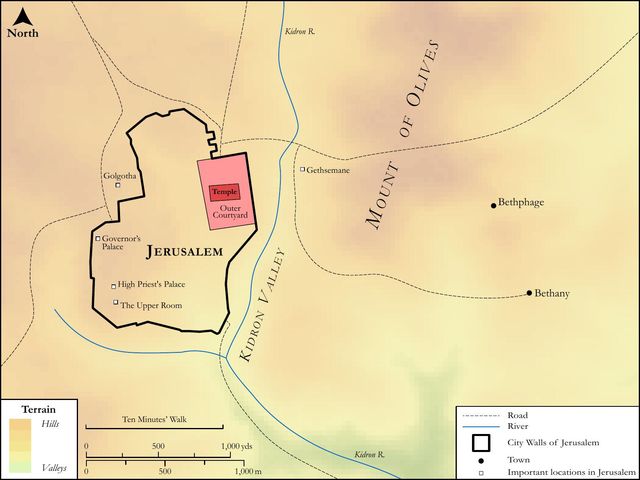
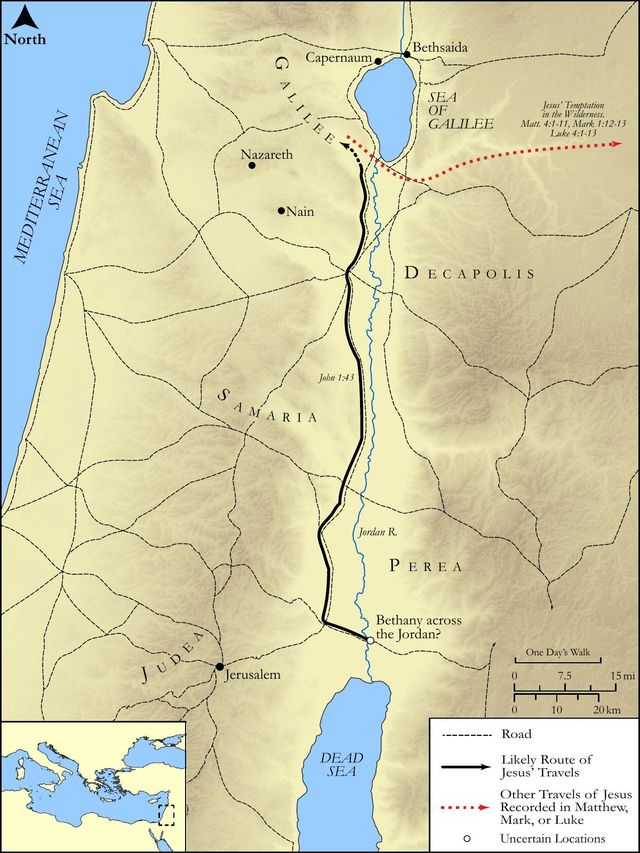
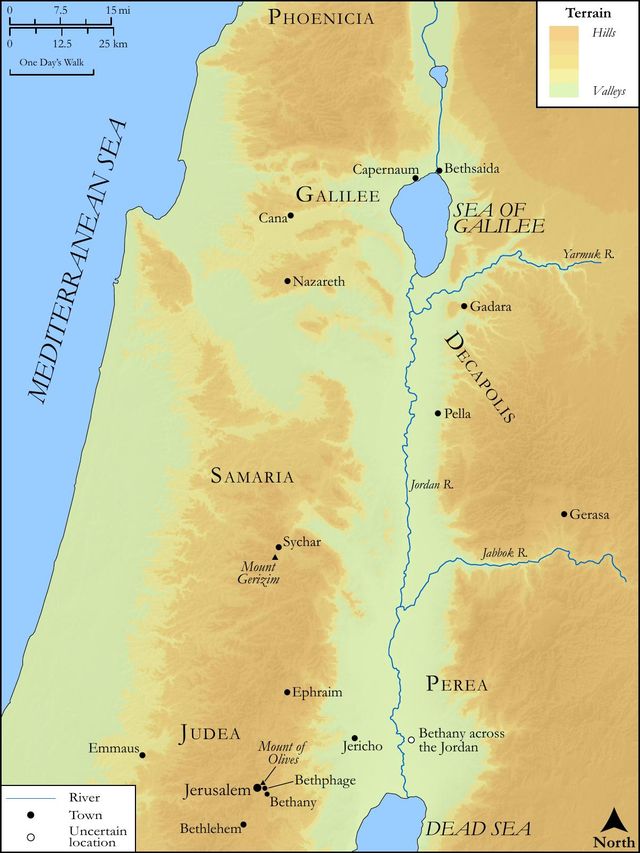
See on the biblical-era map
Study this verse
Public-domain commentary
Matthew Henry
From his Commentary on the Whole Bible. Henry comments on passages, not single verses — this entry covers John 1:29–36. His four-level outline is real structure in the source text, so it is rendered as structure.
We have in these verses an account of John's testimony concerning Jesus Christ, which he witnessed to his own disciples that followed him. As soon as ever Christ was baptized he was immediately hurried into the wilderness, to be tempted; and there he was forty days. During his absence John had continued to bear testimony to him, and to tell the people of him; but now at last he sees Jesus coming to him, returning from the wilderness of temptation. As soon as that conflict was over Christ immediately returned to John, who was preaching and baptizing. Now Christ was tempted for example and encouragement to us; and this teaches us, 1. That the hardships of a tempted state should engage us to keep close to ordinances; to go into the sanctuary of God, Psa 73:17. Our combats with Satan should oblige us to keep close to the communion of saints: two are better than one. 2. That the honours of a victorious state must not set us above ordinances. Christ had triumphed over Satan, and been attended by angels, and yet, after all, he returns to the place where John was preaching and baptizing. As long as we are on this side heaven, whatever extraordinary visits of divine grace we may have here at any time, we must still keep close to the ordinary means of grace and comfort, and walk with God in them. Now here are two testimonies borne by John to Christ, but those two agree in one.
I.Here is his testimony to Christ on the first day that he saw him coming from the wilderness; and here four things are witnessed by him concerning Christ, when he had him before his eyes: -
1.That he is the Lamb of God which taketh away the sin of the world, Joh 1:29. Let us learn here,
(1.)That Jesus Christ is the Lamb of God, which bespeaks him the great sacrifice, by which atonement is made for sin, and man reconciled to God. Of all the legal sacrifices he chooses to allude to the lambs that were offered, not only because a lamb is an emblem of meekness, and Christ must be led as a lamb to the slaughter (Isa 53:7), but with a special reference,
[1.]To the daily sacrifice, which was offered every morning and evening continually, and that was always a lamb (Exo 29:38), which was a type of Christ, as the everlasting propitiation, whose blood continually speaks.
[2.]To the paschal lamb, the blood of which, being sprinkled upon the door-posts, secured the Israelites from the stroke of the destroying angel. Christ is our passover, Co1 5:7. He is the Lamb of God; he is appointed by him (Rom 3:25), he was devoted to him (Joh 17:19), and he was accepted with him; in him he was well pleased. The lot which fell on the goat that was to be offered for a sin-offering was called the Lord's lot (Lev 16:8, Lev 16:9); so Christ, who was to make atonement for sin, is called the Lamb of God.
(2.)That Jesus Christ, as the Lamb of God, takes away the sin of the world. This was his undertaking; he appeared, to put away sin by the sacrifice of himself, Heb 9:26. John Baptist had called people to repent of their sins, in order to the remission of them. Now here he shows how and by whom that remission was to be expected, what ground of hope we have that our sins shall be pardoned upon our repentance, though our repentance makes no satisfaction for them. This ground of hope we have - Jesus Christ is the Lamb of God.
[1.]He takes away sin. He, being Mediator between God and man, takes away that which is, above any thing, offensive to the holiness of God, and destructive to the happiness of man. He came, First, To take away the guilt of sin by the merit of his death, to vacate the judgment, and reverse the attainder, which mankind lay under, by an act of indemnity, of which all penitent obedient believers may claim the benefit. Secondly, To take away the power of sin by the Spirit of his grace, so that it shall not have dominion, Rom 6:14. Christ, as the Lamb of God, washes us from our sins in his own blood; that is, he both justifies and sanctifies us: he takes away sin. He is ho airōn - he is taking away the sin of the world, which denotes it not a single but a continued act; it is his constant work and office to take away sin, which is such a work of time that it will never be completed till time shall be no more. He is always taking away sin, by the continual intercession of his blood in heaven, and the continual influence of his grace on earth.
[2.]He takes away the sin of the world; purchases pardon for all those that repent, and believe the gospel, of what country, nation, or language, soever they be. The legal sacrifices had reference only to the sins of Israel, to make atonement for them; but the Lamb of God was offered to be a propitiation for the sin of the whole world; see Jo1 2:2. This is encouraging to our faith; if Christ takes away the sin of the world, then why not my sin? Christ levelled his force at the main body of sin's army, struck at the root, and aimed at the overthrow, of that wickedness which the whole world lay in. God was in him reconciling the world to himself.
[3.]He does this by taking it upon himself. He is the Lamb of God, that bears the sin of the world; so the margin reads it. He bore sin for us, and so bears it from us; he bore the sin of many, as the scape-goat had the sins of Israel put upon his head, Lev 16:21. God could have taken away the sin by taking away the sinner, as he took away the sin of the old world; but he has found out a way of abolishing the sin, and yet sparing the sinner, by making his Son sin for us.
(3.)That it is our duty, with an eye of faith, to behold the Lamb of God thus taking away the sin of the world. See him taking away sin, and let that increase our hatred of sin, and resolutions against it. Let not us hold that fast which the Lamb of God came to take away: for Christ will either take our sins away or take us away. Let it increase our love to Christ, who loved us, and washed us from our sins in his own blood, Rev 1:5. Whatever God is pleased to take away from us, if withal he take away our sins, we have reason to be thankful, and no reason to complain.
2.That this was he of whom he had spoken before (Joh 1:30, Joh 1:31): This is he, this person whom I now point at, you see where he stands, this is he of whom I said, After me cometh a man. Observe,
(1.)This honour John had above all the prophets, that, whereas they spoke of him as one that should come, he saw him already come. This is he. He sees him now, he sees him nigh, Num 24:17. Such a difference there is between present faith and future vision. Now we love one whom we have not seen; then we shall see him whom our souls love, shall see him, and say, This is he of whom I said, my Christ, and my all, my beloved, and my friend.
(2.)John calls Christ a man; after me comes a man - anēr, a strong man: like the man, the branch, or the man of God's right hand.
(3.)He refers to what he had himself said of him before: This is he of whom I said. Note, Those who have said the most honourable things of Christ will never see cause to unsay them; but the more they know him the more they are confirmed in their esteem of him. John still thinks as meanly of himself, and as highly of Christ, as ever. Though Christ appeared not in any external pomp or grandeur, yet John is not ashamed to own, This is he whom I meant, who is preferred before me. And it was necessary that John should thus show them the person, otherwise they could not have believed that one who made so mean a figure should be he of whom John had spoken such great things.
(4.)He protests against any confederacy or combination with this Jesus: And I knew him not. Though there was some relation between them (Elisabeth was cousin to the virgin Mary), yet there was no acquaintance at all between them; John had no personal knowledge of Jesus till he saw him come to his baptism. Their manner of life had been different: John had spent his time in the wilderness, in solitude; Jesus at Nazareth, in conversation. There was no correspondence, no interview between them, that the matter might appear to be wholly carried on by the direction and disposal of Heaven, and not by any design or concert of the persons themselves. And as he hereby disowns all collusion, so also all partiality and sinister regard in it; he could not be supposed to favour him as a friend, for there was no friendship or familiarity between them. Nay, as he could not be biassed to speak honourably of him because he was a stranger to him, he was not able to say any thing of him but what he received from above, to which he appeals, Joh 3:27. Note, They who are taught believe and confess one whom they have not seen, and blessed are they who yet have believed.
(5.)The great intention of John's ministry and baptism was to introduce Jesus Christ. That he should be made manifest to Israel, therefore am I come baptizing with water. Observe,
[1.]Though John did not know Jesus by face, yet he knew that he should be made manifest. Note, We may know the certainty of that which yet we do not fully know the nature and intention of. We know that the happiness of heaven shall be made manifest to Israel, but cannot describe it.
[2.]The general assurance John had that Christ should be made manifest served to carry him with diligence and resolution through his work, though he was kept in the dark concerning particulars: Therefore am I come. Our assurance of the reality of things, though they are unseen, is enough to quicken us to our duty.
[3.]God reveals himself to his people by degrees. At first, John knew no more concerning Christ but that he should be made manifest; in confidence of that, he came baptizing, and now he is favoured with a sight of him. They who, upon God's word, believe what they do not see, shall shortly see what they now believe.
[4.]The ministry of the word and sacraments is designed for no other end than to lead people to Christ, and to make him more and more manifest.
[5.]Baptism with water made way for the manifesting of Christ, as it supposed our corruption and filthiness, and signified our cleansing by him who is the fountain opened.
3.That this was he upon whom the Spirit descended from heaven like a dove. For the confirming of his testimony concerning Christ, he here vouches the extraordinary appearance at his baptism, in which God himself bore witness to him. This was a considerable proof of Christ's mission. Now, to assure us of the truth of it, we are here told (Joh 1:32-34),
(1.)That John Baptist saw it: He bore record; did not relate it as a story, but solemnly attested it, with all the seriousness and solemnity of witness-bearing. He made affidavit of it: I saw the Spirit descending from heaven. John could not see the Spirit, but he saw the dove which was a sign and representation of the Spirit. The Spirit came now upon Christ, both to make him fir for his work and to make him known to the world. Christ was notified, not by the descent of a crown upon him, or by a transfiguration, but by the descent of the Spirit as a dove upon him, to qualify him for his undertaking. Thus the first testimony given to the apostles was by the descent of the Spirit upon them. God's children are made manifest by their graces; their glories are reserved for their future state. Observe,
[1.]The spirit descended from heaven, for every good and perfect gift is from above.
[2.]He descended like a dove - an emblem of meekness, and mildness, and gentleness, which makes him fit to teach. The dove brought the olive-branch of peace, Gen 8:11.
[3.]The Spirit that descended upon Christ abode upon him, as was foretold, Isa 11:2. The Spirit did not move him at times, as Samson (Jdg 13:25), but at all times. The Spirit was given to him without measure; it was his prerogative to have the Spirit always upon him, so that he could at no time be found either unqualified for his work himself or unfurnished for the supply of those that seek to him for his grace.
(2.)That he was told to expect it, which very much corroborates the proof. It was not John's bare conjecture, that surely he on whom he saw the Spirit descending was the Son of God; but it was an instituted sign given him before, by which he might certainly know it (Joh 1:33): I knew him not. He insists much upon this, that he knew no more of him than other people did, otherwise than by revelation. But he that sent me to baptize gave me this sign, Upon whom thou shalt see the Spirit descending, the same is he.
[1.]See here what sure grounds John went upon in his ministry and baptism, that he might proceed with all imaginable satisfaction. First, He did not run without sending: God sent him to baptize. He had a warrant from heaven for what he did. When a minister's call is clear, his comfort is sure, though his success is not always so. Secondly, He did not run without speeding; for, when he was sent to baptize with water, he was directed to one that should baptize with the Holy Ghost. Under this notion John Baptist was taught to expect Christ, as one who would give that repentance and faith which he called people to, and would carry on and complete that blessed structure of which he was now laying the foundation. Note, It is a great comfort to Christ's ministers, in their administration of the outward signs, that he whose ministers they are can confer the grace signified thereby, and so put life, and soul, and power into their ministrations; can speak to the heart what they speak to the ear, and breathe upon the dry bones to which they prophesy.
[2.]See what sure grounds he went upon in his designation of the person of the Messiah. God had before given him a sign, as he did to Samuel concerning Saul: "On whom thou shalt see the Spirit descend, that same is he." This not only prevented any mistakes, but gave him boldness in his testimony. When he had such assurance as this given him, he could speak with assurance. When John was told this before, his expectations could not but be very much raised; and, when the event exactly answered the prediction, his faith could not but be much confirmed: and these things are written that we may believe.
4.That he is the Son of God. This is the conclusion of John's testimony, that in which all the particulars centre, as the quod erat demonstrandum - the fact to be demonstrated (Joh 1:34): I saw, and bore record, that this is the Son of God.
(1.)The truth asserted is, that this is the Son of God. The voice from heaven proclaimed, and John subscribed to it, not only that he should baptize with the Holy Ghost by a divine authority, but that he has a divine nature. This was the peculiar Christian creed, that Jesus is the Son of God (Mat 16:16), and here is the first framing of it.
(2.)John's testimony to it: "I saw, and bore record. Not only I now bear record of it, but I did so as soon as I had seen it." Observe,
[1.]What he saw he was forward to bear record of, as they, Act 4:20 : We cannot but speak the things which we have seen.
[2.]What he bore record of was what he saw. Christ's witnesses were eye-witnesses, and therefore the more to be credited: they did not speak by hear-say and report, Pe2 1:16.
II.Here is John's testimony to Christ, the next day after, Joh 1:35, Joh 1:36. Where observe,
1.He took every opportunity that offered itself to lead people to Christ: John stood looking upon Jesus as he walked. It should seem, John was now retired from the multitude, and was in close conversation with two of his disciples. Note, Ministers should not only in their public preaching, but in their private converse, witness to Christ, and serve his interests. He saw Jesus walking at some distance, yet did not go to him himself, because he would shun every thing that might give the least colour to suspect a combination. He was looking upon Jesus - emblepsas; he looked stedfastly, and fixed his eyes upon him. Those that would lead others to Christ must be diligent and frequent in the contemplation of him themselves. John had seen Christ before, but now looked upon him, Jo1 1:1.
2.He repeated the same testimony which he had given to Christ the day before, though he could have delivered some other great truth concerning him; but thus he would show that he was uniform and constant in his testimony, and consistent with himself. His doctrine was the same in private that it was in public, as Paul's was, Act 20:20, Act 20:21. It is good to have that repeated which we have heard, Phi 3:1. The doctrine of Christ's sacrifice for the taking away of the sin of the world ought especially to be insisted upon by all good ministers: Christ, the Lamb of God, Christ and him crucified.
3.He intended this especially for his two disciples that stood with him; he was willing to turn them over to Christ, for to this end he bore witness to Christ in their hearing that they might leave all to follow him, even that they might leave him. He did not reckon that he lost those disciples who went over from him to Christ, any more than the schoolmaster reckons that scholar lost whom he sends to the university. John gathered disciples, not for himself, but for Christ to prepare them for the Lord, Luk 1:17. So far was he from being jealous of Christ's growing interest, that there was nothing he was more desirous of. Humble generous souls will give others their due praise without fear of diminishing themselves by it. What we have of reputation, as well as of other things, will not be the less for our giving every body his own.
Historical interpretation
Two Centuries of Reception
15 surviving comments on this verse. Each one is dated, so this reads as a timeline rather than a list.
Select a marker to jump to its quote. Markers stagger vertically where authors wrote within a few decades of each other.
(Hom. xvii. [al. xvi.] 2) John having made a declaration, so astonishing to all his hearers, viz. that He, whom he pointed out, did of Himself take away the sins of the world, confirms it by a reference to the Father and the Holy Spirit. For John might be asked, how did you know Him? Wherefore he replies beforehand, by the descent of the Holy Spirit: And John bare record, saying, I saw the Spirit descending from heaven like a dove, and it abode upon him.
(Hom. xvii [al. xvi.] 2. in Joan.) Should any however think that Christ really wanted the Holy Spirit, in the way that we do, he corrects this notion also, by informing us that the descent of the Holy Ghost took place only for the purpose of manifesting Christ: And I knew Him not: but He that sent me to baptize with water, the same said unto me, Upon whom thou shalt see the Spirit descending, and remaining on Him, the same is He which baptizeth with the Holy Ghost.
(Hom. xvii. [al. xvi.] c. 3. in Joan.) When he saith, I knew Him not, he is speaking of time past, not of the time of his baptism, when he forbad Him, saying, I have need to be baptized of Thee.
(Hom. xvii. [al. xvi.] 3) The Father having sent forth a voice proclaiming the Son, the Holy Spirit came besides, bringing the voice upon the head of Christ, in order that no one present might think that what was said of Christ, was said of John. But it will be asked: How was it that the Jews believed not, if they saw the Spirit? Such sights however require the mental vision, rather than the bodily. If those who saw Christ working miracles were so drunken with malice, that they denied what their own eyes had seen, how could the appearance of the Holy Spirit in the form of a dove overcome their incredulity? Some say however that the sight was not visible to all, but only to John, and the more devotional part. But even if the descent of the Spirit, as a dove, was visible to the outward eye, it does not follow that because all saw it, all understood it. Zacharias himself, Daniel, Ezechiel, and Moses saw many things, appearing to their senses, which no one else saw: and therefore John adds, And I saw and bare record that this is the Son of God. He had called Him the Lamb before, and said that He would baptize with the Spirit; but he had no where called Him the Son before.
"How then didst thou know Him?" "By the descent of the Spirit," he saith. But again, test any one should suppose that he was in need of the Spirit as we are, hear how he removes the suspicion, by showing that the descent of the Spirit was only to declare Christ. For having said, "And I knew Him not," he adds "But He that sent me to baptize with water the Same said unto me, Upon whom thou shalt see the Spirit descending and remaining on Him, the same is He which baptizeth with the Holy Ghost."
Seest thou that this was the work of the Spirit, to point out Christ? The testimony of John was indeed not to be suspected, but wishing to make it yet more credible, he leads it up to God and the Holy Spirit. For when John had testified to a thing so great and wonderful, so fit to astonish all his hearers, that He alone took on Him the sins of all the world, and that the greatness of the gift sufficed for so great a ransom, afterwards he proves this assertion. And the proof is that He is the Son of God, and that He needed not baptism, and that the object of the descent of the Spirit was only to make Him known. For it was not in the power of John to give the Spirit, as those who were baptized by him show when they say, "We have not so much as heard whether there be any Holy Ghost." In truth, Christ needed not baptism, neither his nor any other; but rather baptism needed the power of Christ. For that which was wanting was the crowning blessing of all, that he who was baptized should be deemed worthy of the Spirit; this free gift then of the Spirit He added when He came.
"But," says one, "how then did not the Jews believe? for it was not John only that saw the Spirit in the likeness of a dove." It was, because, even if they did see, such things require not only the eyes of the body, but more than these, the vision of the understanding, to prevent men from supposing the whole to be a vain illusion. For if when they saw Him working wonders, touching with His own hands the sick and the dead, and so bringing them back to life and health, they were so drunk with malice as to declare the contrary of what they saw; how could they shake off their unbelief by the descent of the Spirit only? And some say, that they did not all see it, but only John and those of them who were better disposed. Because even though it were possible with fleshly eyes to see the Spirit descending as in the likeness of a dove, still not for this was it absolutely necessary that the circumstance should be visible to all. For Zacharias saw many things in a sensible form, as did Daniel and Ezekiel, and had none to share in what they saw; Moses also saw many things such as none other hath seen; nor did all the disciples enjoy the view of the Transfiguration on the mount, nor did they all alike behold Him at the time of the Resurrection. And this Luke plainly shows, when he says, that He showed Himself "to witnesses chosen before of God."
"And John bare record, saying, I saw the Spirit descending from the heaven like a dove, and It abode upon Him. And I knew Him not: but He that sent me to baptize with water, the Same said unto me, Upon whom thou shalt see the Spirit descending, and remaining on Him, the same is He which baptizeth with the Holy Ghost. And I saw, and bare record that this is the Son of God."
He puts the "I knew Him not" repeatedly. On what account, and wherefore? He was His kinsman according to the flesh. "Behold," saith the angel, "thy cousin Elisabeth, she also hath received a son." That therefore he might not seem to favor Him because of the relationship, he repeats the "I knew Him not." And this happened with good reason; for he had passed all his time in the wilderness away from his father's house.
How then, if he knew Him not before the descent of the Spirit, and if he then for the first time recognized Him, did he forbid Him before baptism, saying, "I have need to be baptized of Thee, and comest Thou to me?" since this was a proof that he knew Him very well. Yet he knew Him not before or for a long time, and with good cause; for the marvels which took place when He was a child, as the circumstances of the Magi and others the like, had happened long before, while John himself was very young, and since much time had elapsed in the interval, He was naturally unknown to all. For had He been known, John would not have said, "That He should be made manifest to Israel, therefore am I come baptizing."
Hence it remains clear to us, that the miracles which they say belong to Christ's childhood, are false, and the inventions of certain who bring them into notice. For if He had begun from His early age to work wonders, neither could John have been ignorant of Him, nor would the multitude have needed a teacher to make Him known.
Here it is evident that the Spirit descending like a dove on the baptized Lord was not seen by all those present, but by John only in a sort of spiritual vision. Similarly, the prophets amid many people were used to seeing those things that were invisible to all the others. It would have been useless to say that John testified and said, “I saw the Spirit,” if all those present had been participants in that vision as well.
For why, my brethren? Who does not see what they do not? And no wonder; for they who are unwilling to return from that are just like the raven that was sent forth from the ark. For who does not see what they see not? They are unthankful even to the Holy Spirit Himself. See, the dove descended upon the Lord, upon the Lord when baptized: and thereupon was manifested that holy and real Trinity, which to us is one God. For the Lord went up out of the water, as we read in the Gospel: "And, lo, the heavens were opened unto Him, and He saw the Spirit descending like a dove, and it abode upon Him: and immediately a voice followed, Thou art my beloved Son, in whom I am well pleased." The Trinity most manifestly appears: the Father in the voice, the Son in the man, the Spirit in the dove.
When He sent the Holy Spirit He manifested Him visibly in two ways-by a dove and by fire: by a dove upon the Lord when He was baptized, by fire upon the disciples when they were gathered together. For when the Lord had ascended into heaven after His resurrection, having spent forty days with His disciples, and the day of Pentecost being fully come, He sent unto them the Holy Spirit as He had promised. Accordingly the Spirit coming at that time filled the place, and there was first a sound from heaven as of a rushing mighty wind, as we read in the Acts of the Apostles, and "there appeared unto them," it says, "cloven tongues as of fire, and it sat upon each of them; and they began to speak with tongues, as the Spirit gave them utterance." Here we have seen a dove descending upon the Lord; there, cloven tongues upon the assembled disciples: in the former, simplicity is shown; in the latter, fervency. Now there are who are said to be simple, who are only indolent; they are called simple, but they are only slow. Not such was Stephen, full of the Holy Ghost: he was simple, because he injured no one; he was fervent, because he reproved the ungodly. For he held not his peace before the Jews. His are those burning words: "Ye stiff-necked and uncircumcised of heart and ears, ye do always resist the Holy Spirit." Mighty impetuosity; but it is the dove without gall raging. For that you know that he was fierce without gall, see how, upon hearing these words, they who were the ravens immediately took up stones and rushed together upon this dove. They begin to stone Stephen; and he who a little before stormed and glowed with ardor of spirit,-who had, as it were, made an onset on his enemies, and like one full of violence had attacked them in such fiery and burning words as you have heard, "Ye stiff-necked and uncircumcised in heart and ears," that any one who heard those words might fancy that Stephen, if he were allowed, would have them consumed at once,-but when the stones thrown from their hands reached him, with fixed knee he saith, "Lord, lay not this sin to their charge." He held fast to the unity of the dove. For his Master, upon whom the dove descended, had done the same thing before him; who, while hanging on the cross, said, "Father, forgive them, for they know not what they do." Wherefore by the dove it is shown that they who are sanctified by the Spirit should be without guile; and that their simplicity should not continue cold is shown us by the fire. Nor let it trouble you that the tongues were divided; for tongues are diverse, therefore the appearance was that of cloven tongues. "Cloven tongues," it saith, "as of fire, and it sat upon each of them." There is a diversity of tongues, but the diversity of tongues does not imply schisms. Be not afraid of separation in the cloven tongues; in the dove recognize unity.
Christ was certainly not then anointed with the Holy Spirit when the Spirit as a dove descended upon him at his baptism. For here he condescends to prefigure his body, that is, his church, in which preeminently the baptized receive the Holy Spirit.… For it would be most absurd to believe that he received the Holy Spirit when he was near thirty years of age. For that was the age at which he was baptized by John. But although he came to baptism without any sin at all, he did not come without the Holy Spirit. For it was written of his servant and forerunner John himself, “He shall be filled with the Holy Spirit, even from his mother’s womb.” If [John], though generated by his father, still received the Holy Spirit when formed in the womb, what must be understood and believed of the man Christ whose flesh had not a carnal but spiritual conception?
"And John bare record, saying, I saw the Spirit descending from heaven like a dove, and it abode upon Him. And I knew Him not: but He that sent me to baptize with water, the same said unto me, Upon whom thou shalt see the Spirit descending, and abiding upon Him, the same is He who baptizeth with the Holy Ghost. And I saw, and bare record that this is the Son of God." Give heed for a little, beloved. When did John learn Christ? For he was sent to baptize with water. They asked, Wherefore? That He might be made manifest to Israel, he said. Of what profit was the baptism of John? My brethren, if it had profited in any respect, it would have remained now, and men would have been baptized with the baptism of John, and thus have come to the baptism of Christ. But what saith he? "That He might be made manifest to Israel,"--that is, to Israel itself, to the people Israel, so that Christ might be made manifest to it,--therefore he came baptizing with water. John received the ministry of baptism, that by the water of repentance he might prepare the way for the Lord, not being himself the Lord; but where the Lord was known, it was superfluous to prepare for Him the way, for to those who knew Him He became Himself the way; therefore the baptism of John did not last long. But how was the Lord pointed out? Lowly, that John might so receive a baptism in which the Lord Himself should be baptized.
But that you may know, my brethren, that not from a necessity of any chain of sin did the Lord come to this John, as the other evangelists say when the Lord came to him to be baptized, John himself said, "Comest Thou to me? I have need to be baptized of Thee." What did He reply to him? "Suffer it to be so now: let all righteousness be fulfilled?" What meaneth this, "let all righteousness be fulfilled"? I came to die for men, have I not to be baptized for men? What meaneth "let all righteousness be fulfilled"? Let all humility be fulfilled. What then? Was not He to accept baptism from a good servant who accepted suffering at the hands of evil servants? Give heed then. The Lord being baptized, if John for this end baptized, that by means of his baptism the Lord might manifest His humility, should no one else have been baptized with the baptism of John? But many were baptized with the baptism of John. When the Lord was baptized with the baptism of John, the baptism of John ceased. John was forthwith cast into prison. Afterwards we do not find that any one is baptized with that baptism. If, then, John came baptizing for this end that the humility of the Lord might be made manifest to us, in order that we might not disdain to receive from the Lord that which the Lord had received from a servant, should John have baptized the Lord alone? But if John had baptized the Lord alone, some would have thought that the baptism of John was more holy than that of Christ: as if Christ alone had been found worthy to be baptized with the baptism of John, but the human race with that of Christ. Give heed, beloved brethren. With the baptism of Christ we have been baptized, and not only we, but the whole world, and this will continue to the end. Which of us can in any respect be compared with Christ, whose shoe's latchet John declared himself unworthy to unloose? If, then, the Christ, a man of such excellence, a man who is God, had been alone baptized with the baptism of John, what were men likely to say? What a baptism was that of John! His was a great baptism, an ineffable sacrament; behold, Christ alone deserved to be baptized with the baptism of John. And thus the baptism of the servant would appear greater than the baptism of the Lord. Others were also baptized with the baptism of John, that the baptism of John might not appear better than the baptism of Christ; but baptized also was the Lord, that through the Lord receiving the baptism of the servant, other servants might not disdain to receive the baptism of the Lord: for this end, then, was John sent.
But did he know Christ, or did he not know Him? If he did not know Him, wherefore did He say, when Christ came to the river, "I have need to be baptized of Thee"? that is to say, I know who Thou art. If, then, he already knew Him, assuredly he knew Him when he saw the dove descending. It is evident that the dove did not descend upon the Lord until after He went up out of the water of baptism. "The Lord having been baptized, went up out of the water, and the heavens were opened, and he saw a dove descending on Him." If, then, the dove descended after the baptism, and if, before the Lord was baptized, John said to Him, "Comest Thou to me? I have need to be baptized of Thee;" that is to say, before he knew Him to whom he said, "Comest Thou to me? I have need to be baptized of Thee;"--how then said he, "And I knew Him not: but He who sent me to baptize with water, the same said to me, Upon whom thou seest the Spirit descending as a dove, and abiding upon Him, the same is He which baptizeth with the Holy Ghost"? It is not an insignificant question, my brethren. If you have seen the question, you have seen not a little; it remains that the Lord give the solution of it. This, however, I say, if you have seen the question, it is no small matter. Behold, John is placed before your eyes, standing beside the river. Behold John the Baptist. Behold, the Lord comes, as yet to be baptized, not yet baptized. Hear the voice of John, "Comest Thou to me? I have need to be baptized of Thee." Behold, already he knew the Lord, by whom He wishes to be baptized. The Lord, having been baptized, goes up out of the water; the heavens are opened, the Spirit descends; then John knows Him. If then for the first time he knew Him, why did he say before, "I have need to be baptized of Thee"? But if he did not then recognize Him for the first time, because he knew Him already, what is the meaning of what he said, "I knew Him not: but He that sent me to baptize with water, the same said unto me, Upon whom thou shalt see the Spirit descending, and abiding upon Him, as a dove, the same is He which baptizeth with the Holy Ghost"?
We do not attribute only to Christ the possession of a real body and say that the Holy Spirit assumed a false appearance to people's eyes. For the Holy Spirit could no more, in consistency with his nature, deceive people than could the Son of God. The almighty God, who made every creature out of nothing, could as easily form a real body of a dove, without the instrumentality of other doves, as he made a real body in the womb of the Virgin without the seed of the male.
Hence in this manner it behoved the Holy Spirit to be manifested when coming upon the Lord, that every one might understand that if he has the Holy Spirit he ought to be simple as the dove, to have true peace with his brethren, that peace which the kisses of doves signify. Ravens have their kisses too; but in the case of the ravens it is a false peace, in that of the dove a true peace. Not every one, therefore, who says, "Peace be with you," is to be listened to as if he were a dove. How then are the kisses of ravens distinguished from those of doves? Ravens kiss, but they tear; the nature of doves is innocent of tearing. Where consequently there is tearing, there is not true peace in the kisses. They have true peace who have not torn the Church. Ravens feed upon carrion, it is not so with the dove; it lives on the fruits of the earth, its food is innocent. This, brethren, is really worthy of admiration in the dove. Sparrows are very small birds, but yet they kill flies at least. The dove does nothing of this sort, for it does not feed on what is dead. They who have torn the Church feed on the dead. God is mighty; let us pray that they who are devoured by them, and perceive it not, may come to life again. Many acknowledge that they do come to life again, for at their coming we daily express joy with them in the name of Christ. Be ye simple, but only in such wise that ye be fervent, and let your fervor be in your tongues. Hold not your peace, speak with glowing tongues, set those that are cold on fire.
(Tr. iv. c. 12, 13) Now when our Lord became known, it was unnecessary to prepare a way for Him; for to those who knew Him, He became His own way. And therefore John's baptism did not last long, but only so long as to show our Lord's humility. (Tr. v. c. 5.). Our Lord received baptism from a servant, in order to give us such a lesson of humility as might prepare us for receiving the grace of baptism. And that the servant's baptism might not be set before the Lord's, others were baptized with it; who after receiving it, had to receive our Lord's baptism: whereas those who first received our Lord's baptism, did not receive the servant's after.
(de Trin. xv. c. 46. [26.]) This was not however the first occasion of Christ's receiving the unction of the Holy Spirit: viz. Its descent upon Him at His baptism; wherein He condescended to prefigure His body, the Church, wherein those who are baptized receive preeminently the Holy Spirit. For it would be absurd to suppose that at thirty years old, (which was His age, when He was baptized by John,) He received for the first time the Holy Spirit: and that, when He came to that baptism, as He was without sin, so was He without the Holy Spirit. For if even of His servant and forerunner John it is written, He shall be filled with the Holy Ghost, even from His mother's womb; if He, though sprung from His father's seed, yet received the Holy Ghost, when as yet He was only formed in the womb; what ought we to think and believe of Christ, whose very flesh had not a carnal but spiritual conception?
(de Agon. Christiano, c. 24. [22.]) We do not attribute to Christ only the possession of a real body, and say that the Holy Spirit assumed a false appearance to men's eyes: for the Holy Spirit could no more, in consistency with His nature, deceive men, than could the Son of God. The Almighty God, Who made every creature out of nothing, could as easily form a real body of a dove, without the instrumentality of other doves, as He made a real body in the womb of the Virgin, without the seed of the male.
(in Joan. Tr. vi. sparsim) The Holy Ghost was made to appear visibly in two ways: as a dove, upon our Lord at His baptism; and as a flame upon His disciples, when they were met together: the former shape denoting simplicity, the latter fervency. The dove intimates that souls sanctified by the Spirit should have no guile; the fire, that in that simplicity there should not be coldness. Nor let it disturb thee, that the tongues are cloven; fear no division; unity is assured to us in the dove. It was meet then that the Holy Spirit should be thus manifested descending upon our Lord; in order that every one who had the Spirit might know, that he ought to be simple as a dove, and be in sincere peace with the brethren. The kisses of doves represent this peace. Ravens kiss, but they tear also; but the nature of the dove is most alien to tearing. Ravens feed on the dead, but the dove eats nothing but the fruits of the earth. If doves moan in their love, marvel not that He Who appeared in the likeness of a dove, the Holy Spirit, maketh intercession for us with groanings that cannot be uttered. (Rom. 8:26) The Holy Spirit however groaneth not in Himself, but in us: He maketh us to groan. And he who groaneth, as knowing that, so long as He is under the burden of this mortality, he is absent from the Lord, groaneth well: it is the Spirit that hath taught him to groan. But many groan because of earthly calamities; because of losses which disquiet them, or bodily sickness which weigh heavily on them: they groan not, as doth the dove. What then could more fitly represent the Holy Spirit, the Spirit of unity, than the dove? as He saith Himself to His reconciled Church, My dove is one. (Cant. 6:9) What could better express humility, than the simplicity and moaning of a dove? Wherefore on this occasion it was that there appeared the very most Holy Trinity, the Father in the voice which said, Thou art My beloved Son; the Holy Spirit in the likeness of the dove. (Matt. 28:19) In that Trinity the Apostles were sent to baptize, i. e. in the name of the Father, and of the Son, and of the Holy Ghost.
(Aug. Tr. v. c. i) But who sent John? If we say the Father, we say true; if we say the Son, we say true. But it would be truer to say, the Father and the Son. How then knew he not Him, by Whom he was sent? For if he knew not Him, by Whom he wished to be baptized, it was rash in him to say, I have need to be baptized by Thee. So then he knew Him; and why saith he, I knew Him not?
(Aug. Tr. iv.v. and vi. sparsim.) Let us turn to the other Evangelists, who relate the matter more clearly, and we shall find most satisfactorily, that the dove descended when our Lord ascended from the water. If then the dove descended after baptism, but John said before the baptism, I have need to be baptized of Thee, he knew Him before His baptism also. How then said he, I knew him not, but He which sent me to baptize? Was this the first revelation made to John of Christ's person, or was it not rather a fuller disclosure of what had been already revealed? John knew the Lord to be the Son of God, knew that He would baptize with the Holy Ghost: for before Christ came to the river, many having come together to hear John, he said unto them, He that cometh after me is mightier than I: He shall baptize you with the Holy Ghost and with fire. (Matt. 3:11) What then? He did not know that our Lord (lest Paul or Peter might say, my baptism, as we find Paul did say, my Gospel,) would have and retain to Himself the power of baptism, the ministering of it however passing to good and bad indiscriminately. What hindrance is the badness of the minister, when the Lord is good? So then we baptize again after John's baptism; after a homicide's we baptize not: because John gave his own baptism, the homicide gives Christ's; which is so holy a sacrament, that not even a homicide's ministration can pollute it. Our Lord could, had He so willed, have given power to any servant of His to give baptism as it were in His own stead; and to the baptism, thus transferred to the servant, have imparted the same power, that it would have had, when given by Himself. But this He did not choose to do; that the hope of the baptized might be directed to Him, Who had baptized them; He wished not the servant to place hope in the servant. And again, had He given this power to servants, there would have been as many baptisms as servants; as there had been the baptism of John, so should we have had the baptism of Paul and of Peter. It is by this power then, which Christ retains in His own possession exclusively, that the unity of the Church is established; of which it is said, My dove is one. (Cant. 6:9) A man may have a baptism besides the dove; but that any besides the dove should profit, is impossible.
(Tr. vii. in Joan) It was necessary that the Only Son of God should baptize, not an adopted son. Adopted sons are ministers of the Only Son: but though they have the ministration, the Only one alone has the power.
Now if the dove's note is a moaning, as we all know it to be, and doves moan in love, hear what the apostle says, and wonder not that the Holy Ghost willed to be manifested in the form of a dove: "For what we should pray for as we ought," says he, "we know not; but the Spirit Himself intercedes for us with groanings which cannot be uttered." What then, my brethren? shall we say this, that the Spirit groans where He has perfect and eternal blessedness with the Father and the Son? For the Holy Spirit is God, even as the Son of God is God, and the Father God. I have said "God" thrice, but not three Gods; for indeed it is God thrice rather than three Gods; because the Father, and the Son, and the Holy Ghost are one God: this you know full well. It is not then in Himself with Himself in that Trinity, in that blessedness, in that His eternal substance, that the Holy Spirit groans; but in us He groans because He makes us to groan. Nor is it a little matter that the Holy Spirit teaches us to groan, for He gives us to know that we are sojourners in a foreign land, and He teaches us to sigh after our native country; and through that very longing do we groan. He with whom it is well in this world, or rather he who thinks it is well with him, who exults in the joy of carnal things, in the abundance of things temporal, in an empty felicity, has the cry of the raven; for the raven's cry is full of clamor, not of groaning. But he who knows that he is in the pressure of this mortal life, a pilgrim "absent from the Lord," that he does not yet possess that perpetual blessedness which is promised to us, but that he has it in hope, and will have it in reality when the Lord shall come openly in glory who came before in humility concealed; he, I say, who knows this doth groan. And so long as it is for this he groans, he does well to groan; it was the Spirit that taught him to groan, he learnt it from the dove.
CHAPTER I. That the Holy Ghost is in the Son not by participation, not from without, but Essentially and by Nature.
Having said above that he knew Him not, he profitably explains and uncovers the Divine Mystery, both showing that He Who told him was God the Father, and clearly relating the manner of the revelation. By all does he profit the mind of the headers; and whereby he says that the Mystery of Christ to men-ward was taught him of God, he shows that his opposers are fighting against the decree from above, and to their own peril arraying themselves against the mighty purpose of the Father. For this was the part of one skillfully persuading them to desist from their vain counsel, and to receive Him Who by the goodwill of the Father came for the salvation of all. He therefore testifieth, both that he saw the Spirit descending from Heaven upon Him, in the form of a Dove, and that It abode upon Him. Then besides, he says that himself was the ear-witness of Him Who sent him to baptize with water, that He upon Whom the Spirit came and abode upon Him is He which baptizeth with the Holy Ghost. Most worthy of belief then the witness, supernatural the sign, above all the Father Who revealed.
And these things are thus. But perchance the heretic fond of carping will jump up, and with a big laugh, say; What again, sirs, say ye to this too, or what argument will ye bring forth, wresting that which is written? Lo, he saith that the Spirit descendeth upon the Son; lo, He is anointed by God the Father; That Which He hath not, He receives forsooth, the Psalmist co-witnessing with us and saying, as to Him: Wherefore God, Thy God, hath anointed Thee with the oil of gladness above Thy fellows. How then will the Son any more be Consubstantial with the Perfect Father, not being Himself Perfect, and therefore anointed? To this then I think it right to say to those who overturn the holy doctrines of the Church, and pervert the truth of the Scriptures: Awake, ye drunkards, from your wine, that viewing the clear beauty of the truth, ye may be able with us to cry to the Son: Of a truth Thou art the Son of God. For if thou fully believe that He is by Nature God, how will He not have perfection? For time is it that ye now speak impiously against the Father Himself also: for whence must He needs, as thou sayest, have perfection? how will He not be brought down to the abasement of His Offspring, which according to you is imperfect, in that the Divine Essence in the Son has once received the power of not having Perfection, according to your unlearned and uninstructed reasoning? For we will not divide that Great and Untaint Nature into different Words, so that it should be imperfect perchance in one, and again Perfect in the other. Since the definition of human nature too is one in respect of all men, and equal in all of us, what man will be less, qua man? but neither will he be considered more so than another. And I suppose that one angel will differ in nothing from another angel in respect of their being what they are, angels to wit, from sameness of nature, being all linked with one another unto one nature. How then can the Nature Which is Divine and surpassing all, show Itself in a state inferior to things originate in Its own special good, and endure a condition which the creature cannot endure? How will It be at all simple and uncompounded, if Perfection and imperfection appear in It? For It will be compounded of both, since Perfection is not of the same kind as imperfection. For if they be of the same kind, and there be no difference between them, every thing which is perfect will without distinction be also imperfect: and if ought again be imperfect, this too will be perfect. And the charge against the Son will be nought, even though according to your surmisings He appear not Perfect: but neither will the Father Himself, though witnessed to in respect of His Perfection, surpass the Son, and there is an end of our dispute. But if much interval severs imperfection from perfection, and the Divine Nature admits both together, It is compound, and not simple.
But perchance some one will say, that contraries are incompatible, and not co-existent in one subject at the same time, as for instance in a body white and black skin together. Well, my friend, and very bravely hast thou backed up my argument. For if the Divine Nature be One, and there be none other than It, how, tell me, will It admit of contraries? How will things unlike to one another come together into one subject? But since the Father is by Nature God, the Son too is by Nature God. He will therefore in nothing differ, in respect of being Perfect, from the Father, since He is begotten of His Divine and most Perfect Essence. For must not He needs be Perfect Who is of a Perfect Parent, since He is both His exact Likeness, and the express Image of His Person, as it is written? But every one will I suppose consent and agree to this. Or let him come forward and say, how the Son is the exact Image of the Perfect Father, not having Perfection in His Own Nature, according to the uncounsel of some. For since He is the Impress and Image, He is Himself too perfect as He, Whose Image He is.
But, says one, John saw the Spirit descending from Heaven upon the Son, and He has Sanctification from without, for He receives it as not having it. Time then is it to call Him openly a creature, barely honoured with a little excellence, perfected and sanctified in equal rank with the rest, and having His supply of good things an acquired one. Then how does the Evangelist not lie, when he says, Of His fulness have all we received? For how will He be full in His Own Nature, Who Himself receiveth from Another? Or how will God be at all conceived of as Father if the Only-Begotten is a creature, and not rather Son? For if this be so, both Himself will be falsely called Father, and the Son will not be Truth, having upon Him a spurious dignity, and a title of bare words. The whole therefore will come to nothing; the Father being neither truly father, nor the Son this by Nature, which He is said to be. But if God be truly Father, He surely has whereof He is Father, the Son, that is, of Himself.
Then how will the Godhead Holy by Nature beget that of Itself which is void of holiness, and bring forth Its own Fruit destitute of Its own inherent Properties? For if He hath sanctification from without, as they babbling say;----they must needs confess, even against their will, that He Was not always holy, but became so afterwards, when the Spirit descended upon Him, as John saith. How then was the Son holy even before the Incarnation? for so did the Seraphim glorify Him, repeating the Holy, in order, from the first to the third time. If then He was holy, even before the Incarnation, yea rather being ever with the Father, how needed He a sanctifier, and this in the last times, when He became Man? I marvel how this too escapes them, with all their love of research. For must we not needs conceive, that the Son could at any time reject sanctification, if it be not in Him essentially, but came to Him as it does to us, or any other reasonable creature? But that which falls away from sanctification, will it not be altogether under the bonds of sin, and sink to the worse, no longer retaining power to be apart from vice? Therefore neither will the Son be found to be unchangeable, and the Psalmist will lie crying in the Spirit as to Him, But Thou art the Same.
Besides what has been already said, let this too be considered, for it brings in a kindred idea: All reasoning will demonstrate that the partaken is somewhat other by nature than the partaker. For if this be not true, but that shall in no wise differ from this, and is the same; that which partakes of ought partakes of itself, which is incredible even to think of (for how can any one be imagined to partake of himself?). But if the things mentioned lie altogether in natural diversity one to another, and the necessity of reasoning separates them, let them who give the Spirit by participation to the Only-Begotten, see to what a depth of impiety they sink unawares. For if the Son is partaker of the Spirit, and the Spirit is by Nature holy, He Himself will not be by Nature holy, but is shown to be hardly so through combination with another, transelemented by grace to the better, than that wherein He was at first. But let the fighter against God again see, into how great impiety the question casts him down. For first some change and turning, as we said before, will be found to exist respecting the Son. And being according to you changed, and having advanced unto the better, He will be shown to be not only not inferior to the Father, but even somehow to have become superior: and how this is, we will say, taking it from the Divine Scripture. The divine Paul says somewhere of Him: Be each among you so 1 minded, according to what was also in Christ Jesus, Who being in the form of God, thought it not robbery to be equal with God, but emptied Himself, and took upon Him the form of a servant, and was made in the likeness of men, and being found in fashion as a Man, He humbled Himself. Since then even before the Incarnation, He was in the form and equality of the Father, but at the time of the Incarnation receiving the Spirit from Heaven was sanctified, according to them, and became by reason of this better alike and greater than Himself, He surpasses at length it is plain even the measure of His Father. And if on receiving the Spirit He mounted up unto dignity above that of the Father, then is the Spirit superior even to the Father Himself, seeing that He bestows on the Son the superiority over Him. Who then will not shudder at the mere hearing of this? For hard is it in truth even to go through such arguments, but no otherwise can the harm of their stubbornness be driven off. Therefore we will say again to them: If when the Word of God became Man, He is then also sanctified by receiving the Spirit: but before the Incarnation was in the Form and Equality of the Father, not yet according to them sanctified, time is it they should boldly say, that God the Father is not holy, if the Word Who is in all things altogether Con-formal and Equal to Him, was not holy in the beginning, but barely in the last times became so. And again, if He is truly the Word of God, Who receiveth the Spirit, and is sanctified in His Own Nature, let our opponents say, whether in doing this, He became greater or less than Himself, or remained the Same. For if He hath nothing more from the Spirit, but remaineth the same as He was, be not offended at learning that It descended on Him. But if He was injured by receiving It, and became less, you will introduce to us the Word as passible, and will accuse the Essence of the Father as wronging rather than sanctifying. But if He became better by receiving the Spirit, but was in the Form and Equality of the Father, even before, according to you, He became bettered, the Father hath not attained unto the height of glory, but will be in that measure of it, in which the Son Who hath advanced to the better was Con-formal and Equal to Him. Convenient is it then, I deem, to say to the ill-instructed heretics, Behold o foolish people and without understanding, which have eyes, and see not; which have ears and hear not; for the god of this world hath indeed blinded the eyes of them, which believe not, lest the light of the glorious gospel of Christ should shine unto them: worthy of pity are they rather than of anger. For they understand not, what they read.
But that the reasoning is true, will be clear from hence, even if we have not, by our previous attempts, made the demonstration perfectly clear. Again shall this that is spoken by the mouth of Paul be brought forward: Be each among you, saith he, so minded, according to what was also in Christ Jesus, Who being in the Form of God thought it not robbery to be equal with God, but emptied Himself, and took upon Him the Form of a servant, and was made in the likeness of men, and being found in fashion as a Man, He humbled Himself. Lo, he much marvels at the Son, as being Equal and Con-formal with God the Father, not, by reason of His Love to us, seizing this, but descending to lowliness, through the Form of a servant, emptied by reason of His Manhood. But if, sirs, He on receiving the Spirit were sanctified rather, when He became Man, and were, through the sanctification, rendered superior to Himself, into what kind of lowliness shall we see Him to have descended? How is That made low that was exalted, how did That descend that was sanctified, or how did it not rather ascend, and was exalted for the better? What emptiness hath filling through the Spirit? or how will He at all be thought to have been Incarnate for our sakes, Who underwent so great profit in respect of Himself? How did the Rich become poor for our sakes, who was enriched because of us? How was He rich even before His Advent, Who according to them received in it what He had not, to wit the Spirit? Or how will He not rather justly offer to us thank-offering for what by means of us He gained? Be astonished, as it is written, O ye heavens, at this: and be horribly afraid, saith the Lord: for the people of the heretics have in truth committed two evils, understanding neither what they say, nor whereof they affirm, and think it not grievous thus to incur such danger in the weightiest matters. For else would they, shedding bitter tears from their eyes, and lifting up a mighty voice on high, have approached, saying, Set a watch, O Lord, before my mouth, keep the door of my lips. Incline not my heart to words of wickedness. For words of wickedness in truth are their words, travailing with extremest mischief to the hearers. But we, having expelled their babbling from our heart, will walk in the right way of the faith, bearing in mind that which is written: Casting down imaginations, and every high thing that exalteth itself against the knowledge of God, and bringing into captivity every thought to the obedience of Christ. Come then, and bringing into captivity our mind as to the subjects before us, let us subject it to the glory of the Only-Begotten, bringing all things wisely to His obedience, that is, to the mode of the Incarnation. For, being Rich, for our sakes He became poor, that we through His poverty might be rich.
Receive then, if you please, our proof through that also which is now before us, opening a forbearing ear to our words. The Divine Scripture testifies that man was made in the Image and Likeness of God Who is over all. And indeed, he who compiled the first book for us (Moses, who above all men was known to God) says, And God created man, in the Image of God created He him. But that through the Spirit he was sealed unto the Divine Image, himself again taught us, saying, And breathed into his nostrils the breath of life. For the Spirit at once began both to put life into His formation and in a Divine manner to impress His own Image thereon. Thus the most excellent Artificer God, having formed the reasonable living creature upon the earth, gave him the saving commandment. And he was in Paradise, as it is written, still keeping the Gift, and eminent in the Divine Image of Him That made him, through the Holy Ghost That indwelt him. But when perverted by the wiles of the devil, he began to despise his Creator, and by trampling on the law assigned him, to grieve his Benefactor, He recalled the grace given to him, and he that was made unto life then first heard Dust thou art, and unto dust shalt thou return. And now the Likeness to God was through the inroad of sin defaced, and no longer was the Impress bright, but fainter and darkened because of the transgression. But when the race of man had reached to an innumerable multitude, and sin had dominion over them all, manifoldly despoiling each man's soul, his nature was stripped of the ancient grace; the Spirit departed altogether, and the reasonable creature fell into extremest folly, ignorant even of its Creator. But the Artificer of all, having endured a long season, at length pities the corrupted world, and being Good hastened to gather together to those above His runaway flock upon earth; and decreed to trans-element human nature anew to the pristine Image through the Spirit. For no otherwise was it possible that the Divine Impress should again shine forth in him, as it did aforetime.
What then He contrives to this end, how He implanted in us the inviolate grace, or how the Spirit again took root in man, |142 in what manner nature was re-formed to its old condition, it is meet to say. The first man, being earthy, and of the earth, and having, placed in his own power, the choice between good and evil, being master of the inclination to each, was caught of bitter guile, and having inclined to disobedience, falls to the earth, the mother from whence he sprang, and over-mastered now at length by corruption and death, transmits the penalty to his whole race. The evil growing and multiplying in us, and our understanding ever descending to the worse, sin reigned, and thus at length the nature of man was shown bared of the Holy Ghost Which indwelt him. For the Holy Spirit of wisdom will flee deceit, as it is written, nor dwell in the body that is subject unto sin. Since then the first Adam preserved not the grace given him of God, God the Father was minded to send us from Heaven the second Adam. For He sendeth in our likeness His own Son Who is by Nature without variableness or change, and wholly unknowing of sin, that as by the disobedience of the first, we became subject to Divine wrath, so through the obedience of the Second, we might both escape the curse, and its evils might come to nought. But when the Word of God became Man, He received the Spirit from the Father as one of us, (not receiving ought for Himself individually, for He was the Giver of the Spirit); but that He Who knew no sin, might, by receiving It as Man, preserve It to our nature, and might again inroot in us the grace which had left us. For this reason, I deem, it was that the holy Baptist profitably added, I saw the Spirit descending from Heaven, and It abode upon Him. For It had fled from us by reason of sin, but He Who knew no sin, became as one of us, that the Spirit might be accustomed to abide in us, having no occasion of departure or withdrawal in Him.
Therefore through Himself He receives the Spirit for us, and renews to our nature, the ancient good. For thus is He also said for our sakes to become poor. For being rich, as God and lacking no good thing, He became Man lacking all things, to whom it is somewhere said and that very well, What hast thou that thou didst not receive? As then, being by Nature Life, He died in the Flesh for our sakes, that He might overcome death for us, and raise up our whole nature together with Himself (for all we were in Him, in that He was made Man): so does He also receive the Spirit for our sakes, that He may sanctify our whole nature. For He came not to profit Himself, but to be to all us the Door and Beginning and Way of the Heavenly Goods. For if He had not pleased to receive, as Man, or to suffer too, as one of us, how could any one have shown that He humbled Himself? or how would the Form of a servant have been fittingly kept, if nothing befitting a servant were written of Him? Let not then the all-wise account of the dispensation be pulled to pieces, whereof the divine Paul himself rightly cries in admiration: To the intent that now unto the principalities and powers in heavenly places might be known by the Church the manifold wisdom of God, according to the eternal purpose which He purposed in Christ Jesus our Lord. For wisdom indeed and God-befitting, is the great mystery of the Incarnation seen to be.
Such an apprehension of our Saviour do I suppose that we who choose to be pious, and rejoice in orthodox doctrines, ought to have. For we too will not descend to such lack of reason as to suppose that in the Son by Nature was the Spirit by participation and not rather essentially inherent even as in the Father Himself. For as of the Father, so also of the Son, is the Holy Ghost. So did we also read in the Divine Scriptures. For it says: After they were come to Mysia, they assayed to go into Bithynia, and the Spirit of Jesus suffered them not.
But if it seem good to any one, with over contentious zeal, to object to our words hereon, and to assert again, that the Spirit is in the Son by participation, or that, not being in Him before, He then came to be in Him, when He was baptized, in the period of His Incarnation, let him see, into what and how great absurdities he will fall. For first, the Saviour saith: Among them that are born of women there hath not arisen a greater than John the Baptist. And the word is true: but we see him who hath attained to the summit of glory and virtue that belong to us, honouring Christ with incomparable excellencies. For I am not worthy, says he, to stoop down and unloose the latchet of His shoes. How then is it not absurd, yea rather impious, to believe that John was filled with the Holy Ghost, even from his mother's womb, because it is so written of him: and to suppose that his Master, yea rather the Master and Lord of all, then first received the Spirit, when He was baptized, albeit holy Gabriel says to the holy Virgin: The Holy Ghost shall come upon thee, and the Power of the Highest shall overshadow thee; therefore also that holy Thing which shall be born of thee, shall be called the Son of God. And let the lover of learning see, with how great a meaning the word travaileth. For of John, it saith, he shall be filled with the Holy Ghost (for the Holy Ghost was in him as a gift, and not essentially), but of the Saviour, he no longer saith shall be filled, (in rightness of conception,) but that holy Thing which shall be born of thee. Nor did he add shall be, for It was always Holy by Nature, as God.
But since I deem that we ought to seek after what is profitable from all quarters; the voice of the archangel having been once brought forward, come, let us exercise ourselves a little in it. The Holy Ghost, says he, shall come upon thee, and the Power of the Highest shall overshadow thee; therefore also That Holy Thing which shall be born of thee, shall be called the Son of God. Let him then, who from great unlearning, opposeth the right doctrines of the Church, tell us, whether even before the Incarnation the the Word of God the Father was Son, or had the glory in name only, but was a bastard, and falsely called. For if he say that He was not the Son at all, he will deny the Father (for of whom will He be the Father, if He have no Son?): and he will think contrary to all the Divine Scriptures. But if he confess that the Son even before the Incarnation both was and was called Son, how does the Archangel tell us that That which should be born of the holy Virgin shall be called the Son of God, albeit He was this by Nature even long before? As therefore the Son being from eternity with the Father, as having Origin of Being, is at the time of His Incarnation called Son of God, from His appearing in the world with a Body; so, having in Himself Essentially His Own Spirit, He is said to receive It as Man, preserving to the Humanity the order befitting it, and with it appropriating for our sakes the things befitting it. But how can the Word be thought of at all apart from Its Own Spirit? For would it not be absurd to say, that the spirit of man, which is in him, according to the definition of nature, and for the completeness of the living-being, was separated from him? But I suppose that this is most evident to all. How then shall we sever the Spirit from the Son, Which is so inherent and essentially united, and through Him proceeding and being in Him by Nature, that It cannot be thought to be Other than He by reason both of Identity of working, and the very exact likeness of Nature. Hear what the Saviour saith to His own disciples, If ye love Me, keep My Commandments, and I will pray the Father, and He shall give you Another Comforter, the Spirit of Truth, Whom the world cannot receive. Lo, plainly He calls the Holy Ghost Spirit of Truth. But that He and none other than He is the Truth, hear Him again saying, I am the Truth. The Son by Nature then being and being called Truth, see how great Oneness with Him the Spirit hath. For the disciple John saith somewhere of our Saviour, This is He that came by water and blood and the spirit, Jesus Christ; not by water only, but by water and blood: and it is the Spirit That beareth witness, because the Spirit is Truth. Therefore also, the Holy Ghost indwelling in our inner man, Christ Himself is said to dwell therein, and so it is. And indeed the blessed Paul most clearly teaching this, says, But ye are not in the flesh, but in the Spirit, If so be that the Spirit of God dwell in you. Now if any man have not the Spirit of Christ, he is none of His. And if Christ be in you, the body |146 is dead because of sin, but the Spirit is life because of righteousness. Apply, sir, a quick ear to what is said. Having named the Spirit of Christ That dwelleth in us, he straightway added, If Christ be in you, introducing the exact likeness of the Son with the Spirit, Which is His Own and proceeding from Him by Nature. Therefore He is called the Spirit of adoption also, and in Him we cry Abba, Father. And as the blessed John somewhere says, Hereby know we that He dwelleth in us, because He hath given us of His Spirit.
I think then that these things will suffice, to enable the children of the Church to repel the mischief of the heretics. But if any one be soused in the unmixed strong drink of their unlearning, and suppose that the Son then first received the Spirit, when He became Man: let him show that the Word of God was not holy before the Incarnation, and we will hold our peace.
But one may well wonder that the holy Evangelist every where preserves with much observance what befits the Divine Nature. For since he said above, that no man hath seen God at any time, and now says that the blessed Baptist saw the Spirit descend from Heaven upon the Son, he adds of necessity, I saw the Spirit, but in the form of a Dove, not Himself by Nature, as He is, but shadowed in the gentlest animal; that in this again He might be shown to preserve His Natural Affinity and Likeness to the Son, Who saith, Learn of Me, for I am meek and lowly in heart. Therefore the Spirit will not fall away from being God by Nature: for the never having been seen at any time has been preserved to Him, save under the form of a dove, by reason of the need of the disciple. For the blessed Baptist says that the descent of the Spirit was given him by way of a sign and token, adding to his testimonies respecting our Saviour, He that sent me to baptize with water, the Same said unto me, Upon Whom thou shalt see the Spirit descending and remaining on Him, the Same is He Which baptizeth with the Holy Ghost. Therefore I think we may fitly laugh to scorn those senseless heretics who take as matter of fact, that which was set forth by way of sign, even though it took place as part of the oeconomy, as hath been already said, for the need's sake of the human race.
It is written in the Gospel that the one on whom you see the Spirit descending and remaining on, this is the one who baptizes with the Holy Spirit. For the Spirit descends on all the faithful. But he only remains on the mediator—and does so in a special way. For he has never left the Son’s human nature even as he proceeds from his divine nature.… But when the voice of truth tells the disciples that this same Spirit, “will dwell with you and shall be in you,” how is this abiding of the Spirit declared by the voice of God supposed to be a peculiar sign of the mediator?… This will appear if we distinguish between the different gifts of the Spirit. There are some gifts which are necessary for attaining life and there are others through which holiness of life becomes evident for the good of others. Gentleness, humility, faith, hope and charity are all gifts that come from the Spirit and are gifts a person needs in order to attain life.… In the case of these gifts … the Holy Spirit always remains.… But with respect to those which have for their object, not our own salvation, but that of others, he does not always abide.… Instead, sometimes he withdraws and ceases to exhibit them so that people should be more humble in the possession of his gifts.… But the Mediator between God and men, the man Christ Jesus, always had all the gifts of the Spirit without interruption.
Continue studying John 1:32 across the web’s major study libraries — every link below opens this exact verse, chapter, or book on the destination site.
Read & Compare
 BibleGatewayThis verse in more than 200 translations and 70 languages.
 Bible.comThe YouVersion reader — hundreds of translations, reading plans, and highlights.
 ESV.orgCrossway's official English Standard Version reader.
 NET BibleThe NET translation with 60,000+ translators' notes on every rendering decision.
 STEP BibleTyndale House's free study tool — original text, vocabulary, and scholarly resources.
 BibliaLogos Bible Software's free web reader.
 USCCBThe New American Bible (Revised Edition) with the U.S. bishops' study notes.
Commentaries
 BibleHub CommentariesDozens of classic commentaries on this verse, gathered on one page.
 StudyLightMore than 100 commentary sets — the largest collection on the web.
 BibleRefPlain-English commentary on what this verse means, verse by verse.
 Enduring WordDavid Guzik's free commentary on this chapter, widely used by Bible teachers.
 Bible Study ToolsVerse commentary alongside Greek and Hebrew study aids.
Original Language & Research
- BibleHub InterlinearThe verse word by word — original language, transliteration, and English.
- BibleHub LexiconEvery word's original-language definition and Strong's entry.
 Blue Letter BibleDeep-study tools — Strong's numbers, concordance, and word studies.
 CNTR CollationThe earliest Greek manuscripts of this verse, collated letter by letter.
Sermons, Hymns & Audio


TrulyRandomVerse is not affiliated with these sites and doesn’t control their content. They’re linked because they’re genuinely useful.
Summary
John 1:32 presents the pivotal eyewitness testimony of John the Baptist, who declares that he saw the Holy Spirit descending from heaven in the visible form of a dove and abiding permanently upon Jesus. This divine manifestation served as the promised sign to John, confirming Jesus' identity as the Son of God and the Messiah, inaugurating His public ministry with a clear, undeniable anointing from the Father.
Context
ShowHideLiterary Context
This verse is a crucial component of John the Baptist's testimony regarding Jesus, which dominates the opening chapter of John's Gospel. Immediately preceding this, John has publicly denied being the Christ, Elijah, or the Prophet, instead identifying himself as "the voice of one crying in the wilderness" (John 1:23). He then points to Jesus as "the Lamb of God, who takes away the sin of the world!" (John 1:29) and "the Son of God" (John 1:34). While the Synoptic Gospels explicitly recount Jesus' baptism by John, John's Gospel strategically focuses on John the Baptist's witness to the divine sign that identified Jesus. This sign, the descent and abiding of the Spirit, was the specific confirmation John was given by God to recognize the Messiah, as he later explains in John 1:33. Thus, John 1:32 serves as the divine basis for John's authoritative declarations about Jesus' identity and mission.
Historical & Cultural Context
First-century Judaism was steeped in messianic expectation, longing for the promised deliverer who would restore Israel. Prophets in the Old Testament were often anointed by the Spirit for specific tasks, but the expectation for the Messiah was of a permanent, unparalleled anointing. The concept of divine signs was also deeply ingrained, as God frequently used visible manifestations to confirm His chosen ones or to inaugurate new phases of His redemptive plan. The imagery of a dove held various associations in Jewish thought, including purity, peace (as in Noah's dove bringing the olive branch after the flood, Genesis 8:8-12), and even the Spirit of God hovering over creation (Genesis 1:2). This event, therefore, resonated deeply within the Jewish cultural framework as a clear, divine endorsement of Jesus as the long-awaited Messiah, fulfilling prophecies concerning the Spirit's anointing upon the coming King (Isaiah 11:2).
Key Themes
ShowHideThis verse powerfully contributes to several foundational themes in John's Gospel and biblical theology. Firstly, it underscores Divine Identification and Confirmation, as God Himself publicly authenticates Jesus' unique identity and mission through a visible sign and the Spirit's presence. Secondly, it highlights the Role of the Holy Spirit in the life and ministry of Jesus, signifying divine empowerment and anointing for His messianic work. The Spirit's "abiding" presence upon Jesus marks the beginning of His public ministry, demonstrating a sustained, perpetual anointing unlike the temporary empowerments seen in the Old Testament. Thirdly, the verse emphasizes John the Baptist's Witness, establishing his crucial role not merely as a forerunner but as a divinely commissioned witness whose testimony is authoritative and foundational for understanding Jesus' true nature. Finally, it speaks to the Messianic Anointing of Jesus, portraying Him as the one upon whom the Spirit rests fully and permanently, enabling Him to fulfill His role as Prophet, Priest, and King.
Exposition and Analysis
ShowHideKey Word Analysis
ShowHideThis verb signifies "to bear witness," "to testify," or "to give evidence." It carries a strong legal connotation, implying a formal, authoritative, and truthful declaration based on firsthand observation. John's "record" is not merely an opinion but a divinely commissioned and observed fact, establishing the credibility and weight of his subsequent statements about Jesus.
Meaning "to come down" or "to go down," this word emphasizes the divine origin of the Spirit's appearance. The Spirit does not emerge from the earth or from human effort but comes "from heaven," underscoring the supernatural and God-ordained nature of this event. It highlights the Father's active involvement in anointing His Son.
This term means "to stay," "to remain," or "to dwell." Its significance here is profound, indicating a permanent, continuous presence rather than a fleeting visit. Unlike the temporary anointings of the Spirit upon Old Testament prophets or kings, the Spirit's "abiding" upon Jesus signifies His unique, uninterrupted, and perpetual empowerment for His entire messianic ministry, establishing His unparalleled relationship with the Holy Spirit.
Verse Breakdown
ShowHide"And John bare record, saying"
This opening phrase establishes the authority and purpose of John's statement. He is not merely recounting an anecdote but delivering a formal, divinely appointed testimony. His "saying" introduces the content of his eyewitness account, underscoring its importance as a public declaration.
"I saw the Spirit descending from heaven like a dove"
This clause describes the specific divine sign John witnessed. The personal pronoun "I saw" emphasizes John's direct, verifiable observation, lending credibility to his testimony. The Holy Spirit's descent "from heaven" points to its divine origin and supernatural nature. The simile "like a dove" describes the visual manifestation of the Spirit, evoking imagery of peace, purity, and possibly the new creation.
"and it abode upon him"
This final clause is crucial, highlighting the permanence of the Spirit's presence on Jesus. The word "abode" (Greek: ménō) signifies a lasting dwelling, not a temporary visitation. This continuous indwelling of the Spirit distinguishes Jesus' anointing from any previous anointing in salvation history, confirming His unique status as the Messiah, perpetually empowered for His redemptive mission.
Literary Devices
ShowHideJohn 1:32 employs several significant literary devices. Eyewitness Testimony is central, with John the Baptist explicitly stating, "I saw," which lends irrefutable credibility and authority to his declaration. This direct observation serves to authenticate Jesus' identity. The phrase "like a dove" is a powerful Simile, comparing the manner of the Spirit's descent to a dove. This imagery carries rich Symbolism, often associated with peace, purity, gentleness, and even new creation (as in Noah's dove). It contrasts with the fiery or powerful manifestations of God's presence in other biblical accounts, suggesting the nature of Jesus' ministry—one of peace and grace. Furthermore, the entire event functions as a Divine Manifestation, where God visibly intervenes and reveals His Son to humanity, providing an undeniable sign for those who seek to know the Messiah.
Theological and Thematic Connections
ShowHideJohn 1:32 is a cornerstone for understanding the Christology and Pneumatology woven throughout the New Testament. It powerfully illustrates the Trinitarian nature of God, with the Father sending the Spirit, the Spirit descending, and the Son being identified and empowered. This event marks the divine anointing of Jesus, signifying His unique status and equipping Him for His redemptive mission. The abiding presence of the Spirit on Jesus is a theological statement about His continuous divine empowerment, setting Him apart as the ultimate Prophet, Priest, and King. It foreshadows the Spirit's role in the life of believers, who are also empowered by the Spirit to bear witness to Christ.
Reflection and Application
ShowHideJohn 1:32 offers profound insights for the believer's journey. Just as God publicly affirmed Jesus through the Holy Spirit, He also affirms His children and equips them for their unique callings. This verse reminds us that genuine spiritual authority and effective ministry stem from a divine anointing and the abiding presence of the Holy Spirit, not from human effort or charisma alone. It encourages us to seek a deeper, continuous relationship with the Spirit, trusting that He will empower us to live out our faith and bear witness to Christ in a world that desperately needs Him. The quiet, dove-like descent of the Spirit on Jesus also teaches us that God's power often operates not in ostentatious displays, but in gentle, abiding presence, enabling us to embody peace and purity even amidst spiritual warfare.
Questions for Reflection
ShowHideFAQ
ShowHideWhy is John the Baptist's testimony in John 1:32 so important?
ShowHideJohn the Baptist's testimony is supremely important for several reasons. Firstly, he was a divinely appointed forerunner, prophesied in the Old Testament (Isaiah 40:3), whose mission was to prepare the way for the Messiah and identify Him to Israel. His public declaration carried immense weight among the Jewish people. Secondly, his testimony is an eyewitness account of a supernatural event—the descent and abiding of the Holy Spirit on Jesus. This was the specific sign God had given John to recognize the Messiah (John 1:33). Therefore, John's witness provides irrefutable divine confirmation of Jesus' identity as the Son of God and the Christ, serving as a foundational truth for the nascent Christian movement.
What is the significance of the Spirit appearing "like a dove" rather than in a more powerful or fiery form?
ShowHideThe appearance of the Spirit "like a dove" is rich in symbolism and significant for understanding Jesus' ministry. While the Spirit often manifested powerfully in the Old Testament (e.g., wind, fire, earthquake), the dove imagery conveys purity, peace, gentleness, and new creation (recalling Noah's dove bringing the olive branch after the flood, Genesis 8:8-12). This gentle manifestation contrasts with the expected political or military power of a conquering Messiah, foreshadowing Jesus' mission as the Prince of Peace, who brings reconciliation and new life through His sacrifice, not through earthly conquest. It also highlights the quiet, abiding presence of the Spirit that empowers Jesus' ministry of grace and truth, rather than a temporary, overwhelming force.
Christ-Centered Fulfillment
ShowHideJohn 1:32 is a profound declaration of Christ-centered fulfillment, marking the divine inauguration of Jesus' messianic ministry. The descent and abiding of the Holy Spirit upon Jesus signify His unique anointing as the Christ, the "Anointed One," for the specific purpose of accomplishing God's redemptive plan. This event is not merely a symbolic gesture but the very empowerment that enables Jesus to fulfill all righteousness, preach the good news, heal the sick, cast out demons, and ultimately offer Himself as the perfect sacrifice for sin. The permanent indwelling of the Spirit on Jesus means He is always fully equipped to be the Lamb of God who takes away the sin of the world (John 1:29) and the one who baptizes with the Holy Spirit (John 1:33). This divine anointing culminates in His resurrection and ascension, leading to the outpouring of the Spirit on Pentecost (Acts 2:1-4), thereby extending His Spirit-empowered mission to His church. Jesus, empowered by the Spirit, becomes the source of the Spirit for all who believe, fulfilling His promise to send the Helper (John 14:16; John 15:26; John 16:7), enabling His followers to continue His work in the world.