


John 1:33
Bible text: King James Version (1769 Blayney text) · Public domain
Bible text: King James Version with Strong's numbers · Public domain
Bible text: Berean Standard Bible · Public domain
Bible text: American Standard Version (1901) · Public domain
Bible text: World English Bible, Messianic edition · Public domain
Bible text: Geneva Bible (1599) · Public domain
Bible text: Young's Literal Translation · Public domain
- κἀγὼkagōAnd I myselfG2532P-1NS + G2532=CONJ
- οὐκouknotG3756PRT-NNegative Particle Negative
- ᾔδεινēdeinknewG1492V-2LAI-1SVerb Pluperfect Active Indicative 1st Singular
- αὐτόνautonHimG846P-ASMPersonal pronoun Accusative Singular Masculine
- ἀλλ᾽all᾽butG235CONJConjunction
- ὁhothe [One]G3588T-NSMDefinite article Nominative Singular Masculine
- πέμψαςpempsashaving sentG3992V-AAP-NSMVerb Aorist Active Participle Nominative Singular Masculine
- μεmemeG3165P-1ASPersonal pronoun Accusative 1st Singular
- βαπτίζεινbaptizeinto baptizeG907V-PANVerb Present Active Infinitive
- ἐνenwithG1722PREPPreposition
- ὕδατιhudatiwaterG5204N-DSNNoun Dative Singular Neuter
- ἐκεῖνόςekeinosHeG1565D-NSMDemonstrative pronoun Nominative Singular Masculine
- μοιmoito meG3165P-1DSPersonal pronoun Dative 1st Singular
- εἶπεν·eipensaidG2036V-2AAI-3SVerb 2nd Aorist Active Indicative 3rd Singular
- ἐφ᾽eph᾽UponG1909PREPPreposition
- ὃνhonwhomG3739R-ASMRelative pronoun Accusative Singular Masculine
- ἂνanmaybeG302PRTParticle or Disjunctive
- ἴδῃςidēsyou may seeG1492V-2AAS-2SVerb 2nd Aorist Active Subjunctive 2nd Singular
- τὸtotheG3588T-ASNDefinite article Accusative Singular Neuter
- πνεῦμαpneumaSpiritG4151N-ASNNoun Accusative Singular Neuter
- καταβαῖνονkatabainondescendingG2597V-PAP-ASNVerb Present Active Participle Accusative Singular Neuter
- καὶkaiandG2532CONJConjunction
- μένονmenonabidingG3306V-PAP-ASNVerb Present Active Participle Accusative Singular Neuter
- ἐπ᾽ep᾽onG1909PREPPreposition
- αὐτόνautonHimG846P-ASMPersonal pronoun Accusative Singular Masculine
- οὗτόςhoutosHeG3778D-NSMDemonstrative pronoun Nominative Singular Masculine
- ἐστινestinisG1510V-PAI-3SVerb Present Active Indicative 3rd Singular
- ὁhothe [One]G3588T-NSMDefinite article Nominative Singular Masculine
- βαπτίζωνbaptizōnbaptizingG907V-PAP-NSMVerb Present Active Participle Nominative Singular Masculine
- ἐνenwithG1722PREPPreposition
- πνεύματιpneumati[the] SpiritG4151N-DSNNoun Dative Singular Neuter
- ἁγίῳhagiōHolyG40A-DSNAdjective Dative Singular Neuter
English is a literal word-by-word gloss of the Greek, not the KJV's wording. Why?
This is the original text the KJV's translators worked from — each Greek word with its own literal English meaning in this verse, prepared by scholars at Tyndale House, Cambridge. The KJV translates whole sentences, not word by word, so its wording differs: one Greek word can become several English words, and the KJV may choose “charity” where the gloss reads “love”. Both are faithful — they answer different questions. For the KJV's own rendering, switch to the KJV text.
Details
See on the biblical-era maps
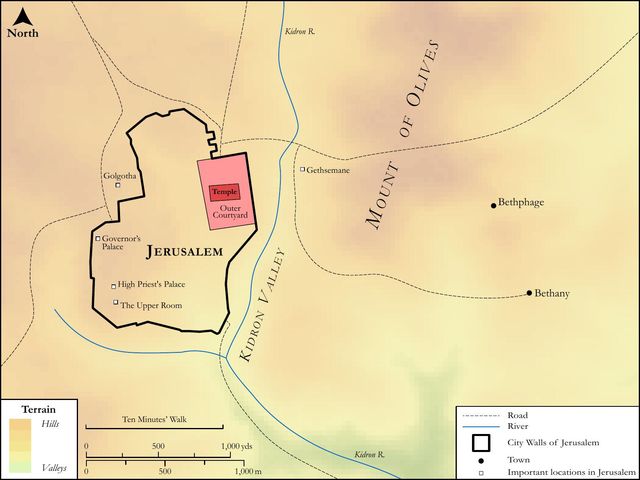
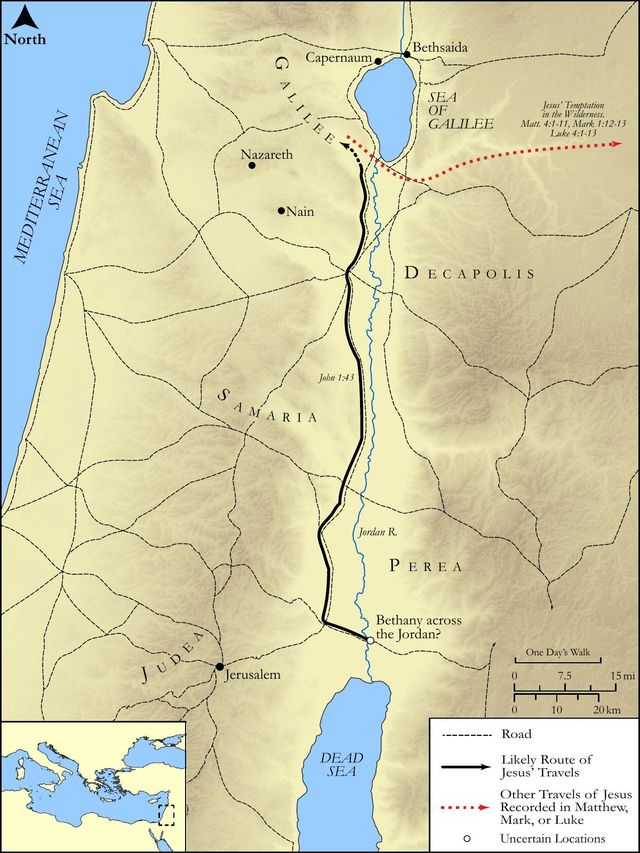
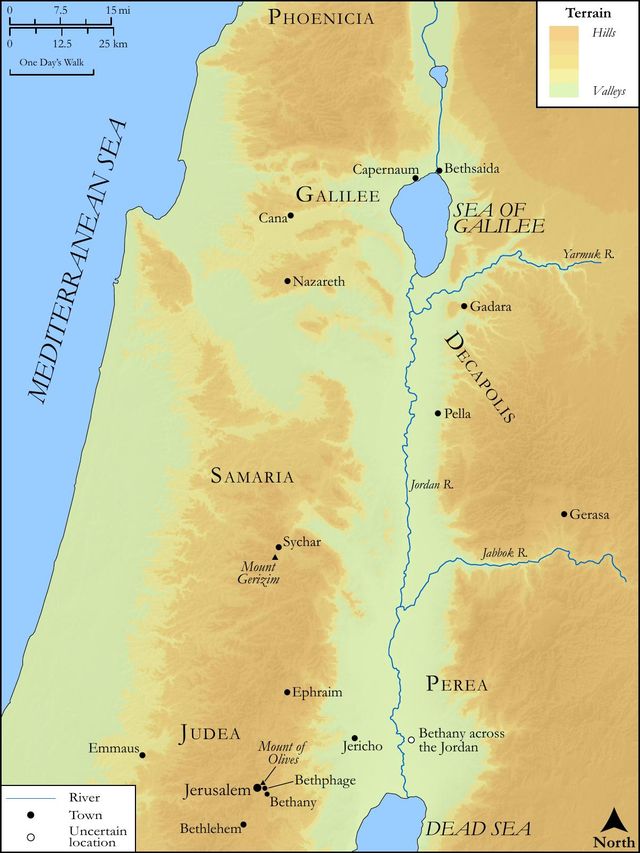
Study this verse
Public-domain commentary
Matthew Henry
From his Commentary on the Whole Bible. Henry comments on passages, not single verses — this entry covers John 1:29–36. His four-level outline is real structure in the source text, so it is rendered as structure.
We have in these verses an account of John's testimony concerning Jesus Christ, which he witnessed to his own disciples that followed him. As soon as ever Christ was baptized he was immediately hurried into the wilderness, to be tempted; and there he was forty days. During his absence John had continued to bear testimony to him, and to tell the people of him; but now at last he sees Jesus coming to him, returning from the wilderness of temptation. As soon as that conflict was over Christ immediately returned to John, who was preaching and baptizing. Now Christ was tempted for example and encouragement to us; and this teaches us, 1. That the hardships of a tempted state should engage us to keep close to ordinances; to go into the sanctuary of God, Psa 73:17. Our combats with Satan should oblige us to keep close to the communion of saints: two are better than one. 2. That the honours of a victorious state must not set us above ordinances. Christ had triumphed over Satan, and been attended by angels, and yet, after all, he returns to the place where John was preaching and baptizing. As long as we are on this side heaven, whatever extraordinary visits of divine grace we may have here at any time, we must still keep close to the ordinary means of grace and comfort, and walk with God in them. Now here are two testimonies borne by John to Christ, but those two agree in one.
I.Here is his testimony to Christ on the first day that he saw him coming from the wilderness; and here four things are witnessed by him concerning Christ, when he had him before his eyes: -
1.That he is the Lamb of God which taketh away the sin of the world, Joh 1:29. Let us learn here,
(1.)That Jesus Christ is the Lamb of God, which bespeaks him the great sacrifice, by which atonement is made for sin, and man reconciled to God. Of all the legal sacrifices he chooses to allude to the lambs that were offered, not only because a lamb is an emblem of meekness, and Christ must be led as a lamb to the slaughter (Isa 53:7), but with a special reference,
[1.]To the daily sacrifice, which was offered every morning and evening continually, and that was always a lamb (Exo 29:38), which was a type of Christ, as the everlasting propitiation, whose blood continually speaks.
[2.]To the paschal lamb, the blood of which, being sprinkled upon the door-posts, secured the Israelites from the stroke of the destroying angel. Christ is our passover, Co1 5:7. He is the Lamb of God; he is appointed by him (Rom 3:25), he was devoted to him (Joh 17:19), and he was accepted with him; in him he was well pleased. The lot which fell on the goat that was to be offered for a sin-offering was called the Lord's lot (Lev 16:8, Lev 16:9); so Christ, who was to make atonement for sin, is called the Lamb of God.
(2.)That Jesus Christ, as the Lamb of God, takes away the sin of the world. This was his undertaking; he appeared, to put away sin by the sacrifice of himself, Heb 9:26. John Baptist had called people to repent of their sins, in order to the remission of them. Now here he shows how and by whom that remission was to be expected, what ground of hope we have that our sins shall be pardoned upon our repentance, though our repentance makes no satisfaction for them. This ground of hope we have - Jesus Christ is the Lamb of God.
[1.]He takes away sin. He, being Mediator between God and man, takes away that which is, above any thing, offensive to the holiness of God, and destructive to the happiness of man. He came, First, To take away the guilt of sin by the merit of his death, to vacate the judgment, and reverse the attainder, which mankind lay under, by an act of indemnity, of which all penitent obedient believers may claim the benefit. Secondly, To take away the power of sin by the Spirit of his grace, so that it shall not have dominion, Rom 6:14. Christ, as the Lamb of God, washes us from our sins in his own blood; that is, he both justifies and sanctifies us: he takes away sin. He is ho airōn - he is taking away the sin of the world, which denotes it not a single but a continued act; it is his constant work and office to take away sin, which is such a work of time that it will never be completed till time shall be no more. He is always taking away sin, by the continual intercession of his blood in heaven, and the continual influence of his grace on earth.
[2.]He takes away the sin of the world; purchases pardon for all those that repent, and believe the gospel, of what country, nation, or language, soever they be. The legal sacrifices had reference only to the sins of Israel, to make atonement for them; but the Lamb of God was offered to be a propitiation for the sin of the whole world; see Jo1 2:2. This is encouraging to our faith; if Christ takes away the sin of the world, then why not my sin? Christ levelled his force at the main body of sin's army, struck at the root, and aimed at the overthrow, of that wickedness which the whole world lay in. God was in him reconciling the world to himself.
[3.]He does this by taking it upon himself. He is the Lamb of God, that bears the sin of the world; so the margin reads it. He bore sin for us, and so bears it from us; he bore the sin of many, as the scape-goat had the sins of Israel put upon his head, Lev 16:21. God could have taken away the sin by taking away the sinner, as he took away the sin of the old world; but he has found out a way of abolishing the sin, and yet sparing the sinner, by making his Son sin for us.
(3.)That it is our duty, with an eye of faith, to behold the Lamb of God thus taking away the sin of the world. See him taking away sin, and let that increase our hatred of sin, and resolutions against it. Let not us hold that fast which the Lamb of God came to take away: for Christ will either take our sins away or take us away. Let it increase our love to Christ, who loved us, and washed us from our sins in his own blood, Rev 1:5. Whatever God is pleased to take away from us, if withal he take away our sins, we have reason to be thankful, and no reason to complain.
2.That this was he of whom he had spoken before (Joh 1:30, Joh 1:31): This is he, this person whom I now point at, you see where he stands, this is he of whom I said, After me cometh a man. Observe,
(1.)This honour John had above all the prophets, that, whereas they spoke of him as one that should come, he saw him already come. This is he. He sees him now, he sees him nigh, Num 24:17. Such a difference there is between present faith and future vision. Now we love one whom we have not seen; then we shall see him whom our souls love, shall see him, and say, This is he of whom I said, my Christ, and my all, my beloved, and my friend.
(2.)John calls Christ a man; after me comes a man - anēr, a strong man: like the man, the branch, or the man of God's right hand.
(3.)He refers to what he had himself said of him before: This is he of whom I said. Note, Those who have said the most honourable things of Christ will never see cause to unsay them; but the more they know him the more they are confirmed in their esteem of him. John still thinks as meanly of himself, and as highly of Christ, as ever. Though Christ appeared not in any external pomp or grandeur, yet John is not ashamed to own, This is he whom I meant, who is preferred before me. And it was necessary that John should thus show them the person, otherwise they could not have believed that one who made so mean a figure should be he of whom John had spoken such great things.
(4.)He protests against any confederacy or combination with this Jesus: And I knew him not. Though there was some relation between them (Elisabeth was cousin to the virgin Mary), yet there was no acquaintance at all between them; John had no personal knowledge of Jesus till he saw him come to his baptism. Their manner of life had been different: John had spent his time in the wilderness, in solitude; Jesus at Nazareth, in conversation. There was no correspondence, no interview between them, that the matter might appear to be wholly carried on by the direction and disposal of Heaven, and not by any design or concert of the persons themselves. And as he hereby disowns all collusion, so also all partiality and sinister regard in it; he could not be supposed to favour him as a friend, for there was no friendship or familiarity between them. Nay, as he could not be biassed to speak honourably of him because he was a stranger to him, he was not able to say any thing of him but what he received from above, to which he appeals, Joh 3:27. Note, They who are taught believe and confess one whom they have not seen, and blessed are they who yet have believed.
(5.)The great intention of John's ministry and baptism was to introduce Jesus Christ. That he should be made manifest to Israel, therefore am I come baptizing with water. Observe,
[1.]Though John did not know Jesus by face, yet he knew that he should be made manifest. Note, We may know the certainty of that which yet we do not fully know the nature and intention of. We know that the happiness of heaven shall be made manifest to Israel, but cannot describe it.
[2.]The general assurance John had that Christ should be made manifest served to carry him with diligence and resolution through his work, though he was kept in the dark concerning particulars: Therefore am I come. Our assurance of the reality of things, though they are unseen, is enough to quicken us to our duty.
[3.]God reveals himself to his people by degrees. At first, John knew no more concerning Christ but that he should be made manifest; in confidence of that, he came baptizing, and now he is favoured with a sight of him. They who, upon God's word, believe what they do not see, shall shortly see what they now believe.
[4.]The ministry of the word and sacraments is designed for no other end than to lead people to Christ, and to make him more and more manifest.
[5.]Baptism with water made way for the manifesting of Christ, as it supposed our corruption and filthiness, and signified our cleansing by him who is the fountain opened.
3.That this was he upon whom the Spirit descended from heaven like a dove. For the confirming of his testimony concerning Christ, he here vouches the extraordinary appearance at his baptism, in which God himself bore witness to him. This was a considerable proof of Christ's mission. Now, to assure us of the truth of it, we are here told (Joh 1:32-34),
(1.)That John Baptist saw it: He bore record; did not relate it as a story, but solemnly attested it, with all the seriousness and solemnity of witness-bearing. He made affidavit of it: I saw the Spirit descending from heaven. John could not see the Spirit, but he saw the dove which was a sign and representation of the Spirit. The Spirit came now upon Christ, both to make him fir for his work and to make him known to the world. Christ was notified, not by the descent of a crown upon him, or by a transfiguration, but by the descent of the Spirit as a dove upon him, to qualify him for his undertaking. Thus the first testimony given to the apostles was by the descent of the Spirit upon them. God's children are made manifest by their graces; their glories are reserved for their future state. Observe,
[1.]The spirit descended from heaven, for every good and perfect gift is from above.
[2.]He descended like a dove - an emblem of meekness, and mildness, and gentleness, which makes him fit to teach. The dove brought the olive-branch of peace, Gen 8:11.
[3.]The Spirit that descended upon Christ abode upon him, as was foretold, Isa 11:2. The Spirit did not move him at times, as Samson (Jdg 13:25), but at all times. The Spirit was given to him without measure; it was his prerogative to have the Spirit always upon him, so that he could at no time be found either unqualified for his work himself or unfurnished for the supply of those that seek to him for his grace.
(2.)That he was told to expect it, which very much corroborates the proof. It was not John's bare conjecture, that surely he on whom he saw the Spirit descending was the Son of God; but it was an instituted sign given him before, by which he might certainly know it (Joh 1:33): I knew him not. He insists much upon this, that he knew no more of him than other people did, otherwise than by revelation. But he that sent me to baptize gave me this sign, Upon whom thou shalt see the Spirit descending, the same is he.
[1.]See here what sure grounds John went upon in his ministry and baptism, that he might proceed with all imaginable satisfaction. First, He did not run without sending: God sent him to baptize. He had a warrant from heaven for what he did. When a minister's call is clear, his comfort is sure, though his success is not always so. Secondly, He did not run without speeding; for, when he was sent to baptize with water, he was directed to one that should baptize with the Holy Ghost. Under this notion John Baptist was taught to expect Christ, as one who would give that repentance and faith which he called people to, and would carry on and complete that blessed structure of which he was now laying the foundation. Note, It is a great comfort to Christ's ministers, in their administration of the outward signs, that he whose ministers they are can confer the grace signified thereby, and so put life, and soul, and power into their ministrations; can speak to the heart what they speak to the ear, and breathe upon the dry bones to which they prophesy.
[2.]See what sure grounds he went upon in his designation of the person of the Messiah. God had before given him a sign, as he did to Samuel concerning Saul: "On whom thou shalt see the Spirit descend, that same is he." This not only prevented any mistakes, but gave him boldness in his testimony. When he had such assurance as this given him, he could speak with assurance. When John was told this before, his expectations could not but be very much raised; and, when the event exactly answered the prediction, his faith could not but be much confirmed: and these things are written that we may believe.
4.That he is the Son of God. This is the conclusion of John's testimony, that in which all the particulars centre, as the quod erat demonstrandum - the fact to be demonstrated (Joh 1:34): I saw, and bore record, that this is the Son of God.
(1.)The truth asserted is, that this is the Son of God. The voice from heaven proclaimed, and John subscribed to it, not only that he should baptize with the Holy Ghost by a divine authority, but that he has a divine nature. This was the peculiar Christian creed, that Jesus is the Son of God (Mat 16:16), and here is the first framing of it.
(2.)John's testimony to it: "I saw, and bore record. Not only I now bear record of it, but I did so as soon as I had seen it." Observe,
[1.]What he saw he was forward to bear record of, as they, Act 4:20 : We cannot but speak the things which we have seen.
[2.]What he bore record of was what he saw. Christ's witnesses were eye-witnesses, and therefore the more to be credited: they did not speak by hear-say and report, Pe2 1:16.
II.Here is John's testimony to Christ, the next day after, Joh 1:35, Joh 1:36. Where observe,
1.He took every opportunity that offered itself to lead people to Christ: John stood looking upon Jesus as he walked. It should seem, John was now retired from the multitude, and was in close conversation with two of his disciples. Note, Ministers should not only in their public preaching, but in their private converse, witness to Christ, and serve his interests. He saw Jesus walking at some distance, yet did not go to him himself, because he would shun every thing that might give the least colour to suspect a combination. He was looking upon Jesus - emblepsas; he looked stedfastly, and fixed his eyes upon him. Those that would lead others to Christ must be diligent and frequent in the contemplation of him themselves. John had seen Christ before, but now looked upon him, Jo1 1:1.
2.He repeated the same testimony which he had given to Christ the day before, though he could have delivered some other great truth concerning him; but thus he would show that he was uniform and constant in his testimony, and consistent with himself. His doctrine was the same in private that it was in public, as Paul's was, Act 20:20, Act 20:21. It is good to have that repeated which we have heard, Phi 3:1. The doctrine of Christ's sacrifice for the taking away of the sin of the world ought especially to be insisted upon by all good ministers: Christ, the Lamb of God, Christ and him crucified.
3.He intended this especially for his two disciples that stood with him; he was willing to turn them over to Christ, for to this end he bore witness to Christ in their hearing that they might leave all to follow him, even that they might leave him. He did not reckon that he lost those disciples who went over from him to Christ, any more than the schoolmaster reckons that scholar lost whom he sends to the university. John gathered disciples, not for himself, but for Christ to prepare them for the Lord, Luk 1:17. So far was he from being jealous of Christ's growing interest, that there was nothing he was more desirous of. Humble generous souls will give others their due praise without fear of diminishing themselves by it. What we have of reputation, as well as of other things, will not be the less for our giving every body his own.
Historical interpretation
Two Centuries of Reception
34 surviving comments on this verse. Each one is dated, so this reads as a timeline rather than a list.
Select a marker to jump to its quote. Markers stagger vertically where authors wrote within a few decades of each other.
But we, with but as poor a measure of understanding as of faith, are able to determine that that baptism was divine indeed, (yet in respect of the command, not in respect of efficacy too, in that we read that John was sent by the lord to perform this duty, ) but human in its nature: for it conveyed nothing celestial, but it fore-ministered to things celestial; being, to wit, appointed over repentance, which is in man's power.
This Holy Spirit came down when the Lord was baptized so that the dignity of him who was baptized might not be hidden.… The heavens too were opened because of the dignity of him who descended. For see, he says, the heavens were opened, and he saw the Spirit of God descending as a dove, and lighting upon him. The Spirit descended voluntarily. For it was appropriate, as some have interpreted, that the primacy and firstfruits of the Holy Spirit promised to the baptized should be conferred upon the humanity of the Savior first since the Spirit is the giver of such grace. But perhaps he came down in the form of a dove, as some say, to exhibit a figure of that dove who is pure and innocent and undefiled—who also helps the prayers of the children she has begotten and who brings forgiveness of sins. It was emblematically foretold that Christ should be made known in this way in the appearance of his eyes. For in the Song of Songs she cries concerning the Bridegroom, and says, “Your eyes are as doves by the rivers of water.”69The dove of Noah, according to some, was in part a figure of this dove. In the time of Noah, salvation came to them by means of wood and water along with the beginning of a whole new generation. And, the dove returned to him towards evening with an olive branch. Just as this happened, they say, so the Holy Spirit also descended upon the true Noah, the author of the second birth, who draws together into one the wills of all nations. The various dispositions of the animals in the ark were in fact a figure of him too—him at whose coming the spiritual wolves feed with the lambs, in whose church the calf, and the lion, and the ox, feed in the same pasture, as we behold to this day the rulers of the world guided and taught by churchmen. The spiritual dove therefore, as some interpret, came down at the season of his baptism so that he might show that it is he who by the wood of the cross saves those who believe, he who when evening comes grants salvation through his death.
(Hom. xvii. [al. xvi.] 2) John having made a declaration, so astonishing to all his hearers, viz. that He, whom he pointed out, did of Himself take away the sins of the world, confirms it by a reference to the Father and the Holy Spirit. For John might be asked, how did you know Him? Wherefore he replies beforehand, by the descent of the Holy Spirit: And John bare record, saying, I saw the Spirit descending from heaven like a dove, and it abode upon him.
(Hom. xvii [al. xvi.] 2. in Joan.) Should any however think that Christ really wanted the Holy Spirit, in the way that we do, he corrects this notion also, by informing us that the descent of the Holy Ghost took place only for the purpose of manifesting Christ: And I knew Him not: but He that sent me to baptize with water, the same said unto me, Upon whom thou shalt see the Spirit descending, and remaining on Him, the same is He which baptizeth with the Holy Ghost.
(Hom. xvii. [al. xvi.] c. 3. in Joan.) When he saith, I knew Him not, he is speaking of time past, not of the time of his baptism, when he forbad Him, saying, I have need to be baptized of Thee.
(Hom. xvii. [al. xvi.] 3) The Father having sent forth a voice proclaiming the Son, the Holy Spirit came besides, bringing the voice upon the head of Christ, in order that no one present might think that what was said of Christ, was said of John. But it will be asked: How was it that the Jews believed not, if they saw the Spirit? Such sights however require the mental vision, rather than the bodily. If those who saw Christ working miracles were so drunken with malice, that they denied what their own eyes had seen, how could the appearance of the Holy Spirit in the form of a dove overcome their incredulity? Some say however that the sight was not visible to all, but only to John, and the more devotional part. But even if the descent of the Spirit, as a dove, was visible to the outward eye, it does not follow that because all saw it, all understood it. Zacharias himself, Daniel, Ezechiel, and Moses saw many things, appearing to their senses, which no one else saw: and therefore John adds, And I saw and bare record that this is the Son of God. He had called Him the Lamb before, and said that He would baptize with the Spirit; but he had no where called Him the Son before.
"How then didst thou know Him?" "By the descent of the Spirit," he saith. But again, test any one should suppose that he was in need of the Spirit as we are, hear how he removes the suspicion, by showing that the descent of the Spirit was only to declare Christ. For having said, "And I knew Him not," he adds "But He that sent me to baptize with water the Same said unto me, Upon whom thou shalt see the Spirit descending and remaining on Him, the same is He which baptizeth with the Holy Ghost."
Seest thou that this was the work of the Spirit, to point out Christ? The testimony of John was indeed not to be suspected, but wishing to make it yet more credible, he leads it up to God and the Holy Spirit. For when John had testified to a thing so great and wonderful, so fit to astonish all his hearers, that He alone took on Him the sins of all the world, and that the greatness of the gift sufficed for so great a ransom, afterwards he proves this assertion. And the proof is that He is the Son of God, and that He needed not baptism, and that the object of the descent of the Spirit was only to make Him known. For it was not in the power of John to give the Spirit, as those who were baptized by him show when they say, "We have not so much as heard whether there be any Holy Ghost." In truth, Christ needed not baptism, neither his nor any other; but rather baptism needed the power of Christ. For that which was wanting was the crowning blessing of all, that he who was baptized should be deemed worthy of the Spirit; this free gift then of the Spirit He added when He came.
"But," says one, "how then did not the Jews believe? for it was not John only that saw the Spirit in the likeness of a dove." It was, because, even if they did see, such things require not only the eyes of the body, but more than these, the vision of the understanding, to prevent men from supposing the whole to be a vain illusion. For if when they saw Him working wonders, touching with His own hands the sick and the dead, and so bringing them back to life and health, they were so drunk with malice as to declare the contrary of what they saw; how could they shake off their unbelief by the descent of the Spirit only? And some say, that they did not all see it, but only John and those of them who were better disposed. Because even though it were possible with fleshly eyes to see the Spirit descending as in the likeness of a dove, still not for this was it absolutely necessary that the circumstance should be visible to all. For Zacharias saw many things in a sensible form, as did Daniel and Ezekiel, and had none to share in what they saw; Moses also saw many things such as none other hath seen; nor did all the disciples enjoy the view of the Transfiguration on the mount, nor did they all alike behold Him at the time of the Resurrection. And this Luke plainly shows, when he says, that He showed Himself "to witnesses chosen before of God."
"And John bare record, saying, I saw the Spirit descending from the heaven like a dove, and It abode upon Him. And I knew Him not: but He that sent me to baptize with water, the Same said unto me, Upon whom thou shalt see the Spirit descending, and remaining on Him, the same is He which baptizeth with the Holy Ghost. And I saw, and bare record that this is the Son of God."
He puts the "I knew Him not" repeatedly. On what account, and wherefore? He was His kinsman according to the flesh. "Behold," saith the angel, "thy cousin Elisabeth, she also hath received a son." That therefore he might not seem to favor Him because of the relationship, he repeats the "I knew Him not." And this happened with good reason; for he had passed all his time in the wilderness away from his father's house.
How then, if he knew Him not before the descent of the Spirit, and if he then for the first time recognized Him, did he forbid Him before baptism, saying, "I have need to be baptized of Thee, and comest Thou to me?" since this was a proof that he knew Him very well. Yet he knew Him not before or for a long time, and with good cause; for the marvels which took place when He was a child, as the circumstances of the Magi and others the like, had happened long before, while John himself was very young, and since much time had elapsed in the interval, He was naturally unknown to all. For had He been known, John would not have said, "That He should be made manifest to Israel, therefore am I come baptizing."
Hence it remains clear to us, that the miracles which they say belong to Christ's childhood, are false, and the inventions of certain who bring them into notice. For if He had begun from His early age to work wonders, neither could John have been ignorant of Him, nor would the multitude have needed a teacher to make Him known.
He revealed why he lived in the wilderness. This certainly happened through a special providence of God, in order that he might not have any relationship with the Messiah. And John certainly would have had such a relationship if he had lived in town, since they were of the same age and they were related. The suspicion would have easily arisen that he had testified those words because of that previous relationship and because of their friendship and the fact that they were related. In order to remove this suspicion, John was segregated from adolescence onward and grew up in the wilderness. Therefore, with good reason he said, “I myself did not know him.” I had no familiarity or friendship with him, but I was sent to baptize with water for him so that I might reveal him whom I did not know. He clearly showed that he baptized so that all the Jews who came because of the baptism might have an occasion to hear his doctrine and to see him to whom he testified.
He who sent me so that I might reveal before everybody that he had come—and therefore he gave me the power to baptize with water—predicted to me that the Spirit would descend on him. These words were said to the Baptist while he was in the wilderness, and immediately he who indeed did [preach and baptize] came. As the Lord then came to John, he immediately received the vision so that he might recognize the Lord. This is why he preached so publicly about his greatness. When he, while administering the baptism, saw in a spiritual vision the Spirit descending, as had been predicted to him, then he was sure that he was seeing the expected result of the prophecy.
Mark, brethren; before our Lord Jesus Christ came to His baptism (for it was after the baptism that the dove descended, whereby John recognized something that was peculiar to Him, since he was told, "Upon whom thou shalt see the Spirit descending like a dove, and remaining on Him, the same is He that baptizeth with the Holy Ghost"), John knew that He it was that baptizeth with the Holy Ghost; but that it should be with this peculiarity, that the authority should not pass from Him to another, notwithstanding He confers it, this is what he learnt there. And whence do we prove that John did already know that the Lord was to baptize with the Holy Ghost; so that what he must be understood to have learned by the dove is, that the Lord was to baptize with the Holy Ghost in such wise that the authority should not pass from Him to any other man? Whence do we prove this? The dove descended after the Lord was baptized; but before the Lord came to be baptized by John in the Jordan, we have said that John knew Him, on the evidence of those words, in which he says, "Comest Thou to me to be baptized? I have need to be baptized of Thee." Well, he did know Him to be the Lord, knew Him to be the Son of God; how do we prove that he knew already that the same was He who should baptize with the Holy Ghost? Before He came to the river, whilst many people were running together to John to be baptized, he says to them, "I indeed baptize you with water; but He that cometh after me is greater than I, the latchet of whose shoes I am not worthy to loose; the same shall baptize you with the Holy Ghost, and with fire." Already he knew this also. What then did he learn from the dove, that he may not afterwards be found a liar (which God forbid we should think), if it be not this, that there was to be a certain peculiarity in Christ, such that, although many ministers, be they righteous or unrighteous, should baptize, the virtue of baptism would be attributed to Him alone on whom the dove descended, and of whom it was said, "This is He that baptizeth with the Holy Ghost"? Peter may baptize, but this is He that baptizeth; Paul may baptize, yet this is He that baptizeth; Judas may baptize, still this is He that baptizeth.
Who then sent John? If we say the Father, we speak truly; if we say the Son, we speak truly; but to speak more plainly, we say the Father and the Son. But whom the Father and the Son sent, one God sent; because the Son said, "I and the Father are one." How, then, did he not know Him by whom he was sent? For he said, "I knew Him not: but He that sent me to baptize with water, the same said unto me." I interrogate John: "Who sent thee to baptize with water? what did He say to thee?" "Upon whom thou shalt see the Spirit descending as a dove, and abiding upon Him, the same is He which baptizeth with the Holy Ghost." Is it this, O John, that He said to thee who sent thee? It is manifest that it was this; who, then, sent thee? Perhaps the Father. True God is the Father, and the Truth is God the Son: if the Father without the Son sent thee, God without the Truth sent thee; but if thou art true, because thou dost speak the truth, and dost speak of the Truth, the Father did not send thee without the Son, but the Father and the Son together sent thee.
I do not reject John, but rather I believe John. In what do I believe John? In that which he learned through the dove? What did he learn through the dove? "This is He which baptizeth with the Holy Ghost." Now therefore, brethren, hold this fast and impress it upon your hearts; for if I would more fully explain to-day, Wherefore through the dove, time fails. For I have, I think, to some extent made plain to you, holy brethren, that a matter which had to be learned was instilled into John by means of the dove, a matter with regard to Christ which John did not know, although he already knew Christ; but why it behoved this matter to be pointed out by means of the dove, I would say, were it possible to say it briefly: but because it would take long to say, and I am unwilling to burden you, since I have been helped by your prayers to perform my promise; with the renewed help of your pious attention and good wishes, it will likewise become clear to you, wherefore John with regard to that matter which he learned regarding the Lord, namely, that it is "He which baptizeth with the Holy Ghost," and that to none of His servants had he transferred the power of baptizing--why this it became him not to learn except through the dove.
As yet, in the darkness of this life, we walk by the lamp of faith: let us hold also to the lamp John, and let us confound by him the enemies of Christ; indeed, let Christ Himself confound His own enemies by His own lamp. Let us put the question which the Lord put to the Jews, let us ask and say, "The baptism of John, whence is it? from heaven, or of men?" What will they say? Mark, if they are not as enemies confounded by the lamp. What will they say? If they shall say, Of men, even their own will stone them; but if they shall say, From heaven, let us say to them, Wherefore, then, did ye not believe him? They perhaps say, We believe him. Wherefore, then, do you say that you baptize, when John says, "This is He which baptizeth"? But it behoveth, they say, the ministers of so great a Judge who baptize, to be righteous. And I also say, and all say, that it behoveth the ministers of so great a Judge to be righteous; let the ministers, by all means, be righteous if they will; but if they will not be righteous who sit in the seat of Moses, my Master made me safe, of whom His Spirit said, "This is He which baptizeth."
But I say to thee thyself, whoever thou art, Art thou better than John? Thou wilt not venture to say: I am better than John. Then let thine own baptize after thee if they are better. For if baptism was administered after John, blush that baptism is not administered after thee. Thou wilt say, But I have and teach the baptism of Christ. Acknowledge, then, now the Judge, and do not be a proud herald. Thou givest the baptism of Christ, therefore baptism is not administered after thee: after John it was administered, because he gave not the baptism of Christ, but his own; for he had in such manner received it that it was his own. Thou art then not better than John: but the baptism given through thee is better than that of John; for the one is Christ's, but the other is that of John. And that which was given by Paul, and that which was given by Peter, is Christ's; and if baptism was given by Judas it was Christ's. Judas gave baptism and after Judas baptism was not repeated; John gave baptism, and baptism was repeated after John: because if baptism was given by Judas, it was the baptism of Christ; but that which was given by John, was John's baptism. We prefer not Judas to John; but the baptism of Christ, even when given by the hand of Judas, we prefer to the baptism of John, rightly given even by the hand of John.
Already, then, John knew this, and he knew the Lord. What then did the dove teach? What did He desire to teach by means of the dove--that is, by means of the Holy Spirit thus coming to teach who had sent him to whom He said, "Upon whom thou shalt see the Spirit descending as a dove, and abiding upon Him, the same is He"? Who is this He? The Lord? I know. But didst thou already know this, that the same Lord having the power to baptize, was not to give that power to any servant, but to retain it to Himself, so that all who were baptized by the ministration of the servant, should not impute their baptism to the servant, but to the Lord? Didst thou already know this? I did not know this: so what did He say to me? "Upon whom thou shalt see the Spirit descending as a dove, and abiding upon Him, the same is He who baptizeth with the Holy Ghost." He does not say, "He is the Lord;" He does not say, "He is the Christ;" He does not say, "He is God;" He does not say, "He is Jesus;" He does not say, "He is the One who was born of the Virgin Mary, after thee, before thee." This He does not say, for this John did already know. But what did he not know? That this great authority of baptism the Lord Himself was to have, and to retain to Himself, whether present in the earth or absent in body in the heaven, and present in majesty; lest Paul should say, my baptism; lest Peter should say, my baptism. Therefore see, give heed to the words of the apostles. None of the apostles said, my baptism. Although there was one gospel of all, yet thou findest that they said, my gospel: thou dost not find that they say, my baptism.
Since, then, John had accepted a baptism which may be properly called the baptism of John, but the Lord Jesus Christ would not give His baptism to any, not that no one should be baptized with the baptism of the Lord, but that the Lord Himself should always baptize: that was done, that the Lord should baptize by means of servants; that is to say, those whom the servants of the Lord were to baptize, the Lord baptized, not they. For it is one thing to baptize in the capacity of a servant, another thing to baptize with power. For baptism derives its character from Him through whose power it is given; not from him through whose ministry it is given. As was John, so was his baptism: the righteous baptism of a righteous man; but of a man who had received from the Lord that grace, and so great grace, that he was worthy to be the forerunner of the Judge, and to point Him out with the finger, and to fulfill the saying of that prophecy: "The voice of one crying in the wilderness, Prepare ye the way for the Lord." As was the Lord, such was His baptism: the baptism of the Lord, then, was divine, because the Lord was God.
If the minister is righteous, I reckon him with Paul, I reckon him with Peter; with those I reckon righteous ministers: because, in truth, righteous ministers seek not their own glory; for they are ministers, they do not wish to be thought judges, they abhor that one should place his hope on them; therefore, I reckon the righteous minister with Paul. For what does Paul say? "I have planted, Apollos watered; but God gave the increase. Neither is he that planteth anything, nor he that watereth; but God who giveth the increase." But he who is a proud minister is reckoned with the devil; but the gift of Christ is not contaminated, which flows through him pure, which passes through him liquid, and comes to the fertile earth. Suppose that he is stony, that he cannot from water rear fruit; even through the stony channel the water passes, the water passes to the garden beds; in the stony channel it causes nothing to grow, but nevertheless it brings much fruit to the gardens. For the spiritual virtue of the sacrament is like the light: both by those who are to be enlightened is it received pure, and if it passes through the impure it is not stained. Let the ministers be by all means righteous, and seek not their own glory, but His glory whose ministers they are; let them not say, The baptism is mine; for it is not theirs. Let them give heed unto John. Behold, John was full of the Holy Spirit; and he had his baptism from heaven, not from men; but how long had he it? He said himself, "Prepare ye the way for the Lord." But when the Lord was known, Himself became the way; there was no longer need for the baptism of John to prepare the way for the Lord.
This, then, my brethren, John learned. What John learned by means of the dove let us also learn. For the dove did not teach John without teaching the Church, the Church to which it was said, "My dove is one." Let the dove teach the dove; let the dove know what John learned by the dove. The Holy Spirit descended in the form of a dove. But this which John learned in the dove, wherefore did he learn it in the dove? For it behoved him to learn, and perhaps it did not so much behove him to learn as to learn by the dove.
Did John hear this that he might know Him whom he had not known, or that he might more fully know Him whom he had already known? For if he had been entirely ignorant of Him, he would not have said to Him when He came to the river to be baptized, "I have need to be baptized of Thee, and comest Thou to me?" He knew Him therefore. But when did the dove descend? When the Lord had been baptized, and was ascending from the water. But if He who sent Him said, "Upon whom thou shalt see the Spirit descending as a dove, and abiding upon Him, the same is He which baptizeth with the Holy Ghost," and he knew Him not, but when the dove descended he learned to know Him, and the time at which the dove descended was when the Lord was going up from the water; but John had known the Lord, when the Lord came to him to the water: it is made plain to us that John after a manner knew, and after a manner did not at first know the Lord. And unless we understand it so, he was a liar. How was he true acknowledging the Lord and saying, "Comest Thou to me to be baptized," and, "I have need to be baptized of Thee"? Is he true when he said this? And how is he again true when he saith, "I knew Him not: but He that sent me to baptize with water, the same said unto me, Upon whom thou shalt see the Spirit descending as a dove, and abiding upon Him, the same is He who baptizeth with the Holy Ghost"? The Lord was made known by a dove, not to him who knew Him not, but to him who in a manner knew Him, and in a manner knew Him not. It is for us to discover what, in Him, John did not know, and learned by the dove.
For if the sanctity of baptism be according to the diversity of merits in them that administer it, then as merits are diverse there will be diverse baptisms; and the recipient will imagine that what he receives is so much the better, the better he appears to be from whom he received it. The saints themselves-understand brethren, they that belong to the dove, that have their part in that city of Jerusalem, the good themselves in the Church, of whom the apostle says, "The Lord knoweth them that are His"-are endued with different graces, and do not all possess like merits. Some are more holy than others, some are better than others. Therefore if one receive baptism from him, for example, who is a righteous saint, another from another who is of inferior merit with God, of inferior degree, of inferior continence, of inferior life, how notwithstanding is that which they receive one, equal and like, if it be not because, "This is He that baptizeth"? Just, then, as when the good and the better administer baptism, one man does not receive a good thing, another a better; but, notwithstanding that the ministers were one good the other better, they receive what is one and equal, not a better in the one case and a worse in the other; so, too, when a bad man administers baptism, through the ignorance or forbearance of the Church (for bad men either are not known as such, or are borne with; the chaff is tolerated until the floor be fully purged at the last), that which is given is one, not unlike because the ministers are unlike, but like and equal because "This is He that baptizeth."
John learns to know Him whom he knew; but he learns in Him with regard to what he did not know; with regard to what he did know, he does not learn. And what did he know? The Lord. What did he not know? That the power of the Lord's baptism was not to pass from the Lord to any man, but that the ministration of it plainly would do so; the power from the Lord to no one, the ministration both to good and bad. Let not the dove shrink from the ministration of the bad, but have regard to the power of the Lord. What injury does a bad servant do to you where the Lord is good? What impediment can the malicious herald put in your way if the judge is well-disposed? John learned by means of the dove this. What is it that he learned? Let him repeat it himself. "The same said unto me," saith he, "Upon whom thou shalt see the Spirit descending as a dove, and abiding on Him, this is He which baptizeth with the Holy Ghost." Let not those seducers deceive thee, O dove, who say, We baptize. Acknowledge, dove, what the dove has taught: "This is He which baptizeth with the Holy Ghost." By means of the dove we are taught that this is He; and dost thou think that thou art baptized by his authority by whose ministration thou art baptized? If thou thinkest this, thou art not as yet in the body of the dove; and if thou art not in the body of the dove, it is not to be wondered at that thou hast not simplicity; for by means of the dove, simplicity is chiefly designated.
But the Lord Jesus Christ could, if He wished, have given power to one of His servants to give a baptism of his own, as it were, in His stead, and have transferred from Himself the power of baptizing, and assigned it to one of His servants, and have given the same power to the baptism transferred to the servant as it had when bestowed by the Lord. This He would not do, in order that the hope of the baptized might be in him by whom they acknowledged themselves to have been baptized. He would not, therefore, that the servant should place his hope in the servant. And therefore the apostle exclaimed, when he saw men wishing to place their hope in himself, "Was Paul crucified for you? or were ye baptized in the name of Paul?" Paul then baptized as a servant, not as the power itself; but the Lord baptized as the power. Give heed. He was both able to give this power to His servants, and unwilling. For if He had given this power to His servants--that is to say, that what belonged to the Lord should be theirs--there would have been as many baptisms as servants; so that, as we speak of the baptism of John, we should also have spoken of the baptism of Peter, the baptism of Paul, the baptism of James, the baptism of Thomas, of Matthew, of Bartholomew: for we spoke of that baptism as that of John.
For it was said of the Lord before He suffered, that He baptized more than John; then it was added: "Howbeit, Jesus Himself baptized not, but His disciples." He, and not He: He by power, they by ministry; they performed the service of baptizing, the power of baptizing remained in Christ. His disciples, then, baptized, and Judas was still among his disciples: and were those, then, whom Judas baptized not again baptized; and those whom John baptized were they again baptized? Plainly there was a repetition, but not a repetition of the same baptism. For those whom John baptized, John baptized; those whom Judas baptized, Christ baptized. In like manner, then, they whom a drunkard baptized, those whom a murderer baptized, those whom an adulterer baptized, if it was the baptism of Christ, were baptized by Christ. I do not fear the adulterer, the drunkard, or the murderer, because I give heed unto the dove, through whom it is said to me, "This is He which baptizeth."
But, my brethren, it is madness to say that--I will not say Judas--but that any man was better than he of whom it was said, that "Among those that are born of women, there hath not arisen a greater than John the Baptist." No servant then is preferred to him; but the baptism of the Lord, even when given through an evil servant, is preferred to the baptism even of a servant who was a friend. Listen to the sort of persons whom the Apostle Paul mentions, false brethren, preaching the word of God through envy, and what he says of them: "And I therein do rejoice, yea, and will rejoice." They proclaimed Christ, through envy indeed, but still they proclaimed Christ. Consider not the why, but the whom: through envy is Christ preached to thee. Behold Christ, avoid envy. Do not imitate the evil preacher, but imitate the Good One who is preached to thee. Christ then was preached by some out of envy. And what is envy? A shocking evil. By this evil was the devil cast down; this malignant pest it was which cast him down; and certain preachers of Christ were possessed by it, whom, nevertheless, the apostle permitted to preach. Wherefore? Because they preached Christ. But he who envies, hates; and he who hates, what is said concerning him? Listen to the Apostle John: "He who hateth his brother is a murderer." Behold, after John baptism was given, after a murderer baptism was not given; because John gave his own baptism, the murderer gave the baptism of Christ. That sacrament is so sacred that not even the ministration of a murderer pollutes it.
"And John bare record, saying, I saw the Spirit descending from heaven like a dove, and it abode upon Him. And I knew Him not: but He that sent me to baptize with water, the same said unto me, Upon whom thou shalt see the Spirit descending, and abiding upon Him, the same is He who baptizeth with the Holy Ghost. And I saw, and bare record that this is the Son of God." Give heed for a little, beloved. When did John learn Christ? For he was sent to baptize with water. They asked, Wherefore? That He might be made manifest to Israel, he said. Of what profit was the baptism of John? My brethren, if it had profited in any respect, it would have remained now, and men would have been baptized with the baptism of John, and thus have come to the baptism of Christ. But what saith he? "That He might be made manifest to Israel,"--that is, to Israel itself, to the people Israel, so that Christ might be made manifest to it,--therefore he came baptizing with water. John received the ministry of baptism, that by the water of repentance he might prepare the way for the Lord, not being himself the Lord; but where the Lord was known, it was superfluous to prepare for Him the way, for to those who knew Him He became Himself the way; therefore the baptism of John did not last long. But how was the Lord pointed out? Lowly, that John might so receive a baptism in which the Lord Himself should be baptized.
But that you may know, my brethren, that not from a necessity of any chain of sin did the Lord come to this John, as the other evangelists say when the Lord came to him to be baptized, John himself said, "Comest Thou to me? I have need to be baptized of Thee." What did He reply to him? "Suffer it to be so now: let all righteousness be fulfilled?" What meaneth this, "let all righteousness be fulfilled"? I came to die for men, have I not to be baptized for men? What meaneth "let all righteousness be fulfilled"? Let all humility be fulfilled. What then? Was not He to accept baptism from a good servant who accepted suffering at the hands of evil servants? Give heed then. The Lord being baptized, if John for this end baptized, that by means of his baptism the Lord might manifest His humility, should no one else have been baptized with the baptism of John? But many were baptized with the baptism of John. When the Lord was baptized with the baptism of John, the baptism of John ceased. John was forthwith cast into prison. Afterwards we do not find that any one is baptized with that baptism. If, then, John came baptizing for this end that the humility of the Lord might be made manifest to us, in order that we might not disdain to receive from the Lord that which the Lord had received from a servant, should John have baptized the Lord alone? But if John had baptized the Lord alone, some would have thought that the baptism of John was more holy than that of Christ: as if Christ alone had been found worthy to be baptized with the baptism of John, but the human race with that of Christ. Give heed, beloved brethren. With the baptism of Christ we have been baptized, and not only we, but the whole world, and this will continue to the end. Which of us can in any respect be compared with Christ, whose shoe's latchet John declared himself unworthy to unloose? If, then, the Christ, a man of such excellence, a man who is God, had been alone baptized with the baptism of John, what were men likely to say? What a baptism was that of John! His was a great baptism, an ineffable sacrament; behold, Christ alone deserved to be baptized with the baptism of John. And thus the baptism of the servant would appear greater than the baptism of the Lord. Others were also baptized with the baptism of John, that the baptism of John might not appear better than the baptism of Christ; but baptized also was the Lord, that through the Lord receiving the baptism of the servant, other servants might not disdain to receive the baptism of the Lord: for this end, then, was John sent.
But did he know Christ, or did he not know Him? If he did not know Him, wherefore did He say, when Christ came to the river, "I have need to be baptized of Thee"? that is to say, I know who Thou art. If, then, he already knew Him, assuredly he knew Him when he saw the dove descending. It is evident that the dove did not descend upon the Lord until after He went up out of the water of baptism. "The Lord having been baptized, went up out of the water, and the heavens were opened, and he saw a dove descending on Him." If, then, the dove descended after the baptism, and if, before the Lord was baptized, John said to Him, "Comest Thou to me? I have need to be baptized of Thee;" that is to say, before he knew Him to whom he said, "Comest Thou to me? I have need to be baptized of Thee;"--how then said he, "And I knew Him not: but He who sent me to baptize with water, the same said to me, Upon whom thou seest the Spirit descending as a dove, and abiding upon Him, the same is He which baptizeth with the Holy Ghost"? It is not an insignificant question, my brethren. If you have seen the question, you have seen not a little; it remains that the Lord give the solution of it. This, however, I say, if you have seen the question, it is no small matter. Behold, John is placed before your eyes, standing beside the river. Behold John the Baptist. Behold, the Lord comes, as yet to be baptized, not yet baptized. Hear the voice of John, "Comest Thou to me? I have need to be baptized of Thee." Behold, already he knew the Lord, by whom He wishes to be baptized. The Lord, having been baptized, goes up out of the water; the heavens are opened, the Spirit descends; then John knows Him. If then for the first time he knew Him, why did he say before, "I have need to be baptized of Thee"? But if he did not then recognize Him for the first time, because he knew Him already, what is the meaning of what he said, "I knew Him not: but He that sent me to baptize with water, the same said unto me, Upon whom thou shalt see the Spirit descending, and abiding upon Him, as a dove, the same is He which baptizeth with the Holy Ghost"?
Now this it was in Him that John saw, and came to know which he did not know. Not that he did not know Him to be the Son of God, or that he did not know Him to be the Lord, or not know Him to be the Christ; or that he did not know this too, that it was He who should baptize with water and with the Holy Ghost. This he did know; but that he should do this so as to retain the authority to Himself and transfer it to none of His ministers, this is what he learnt in the dove. For by this authority, which Christ has retained to Himself alone, and conferred upon none of His ministers, though He has deigned to baptize by His ministers; by this authority, I say, stands the unity of the Church, which is figured in the dove, concerning which it is said, "My dove is one, the only one of her mother." For if, as I have already said, my brethren, the authority were transferred by the Lord to His minister, there would be as many baptisms as ministers, and the unity of baptism would no longer exist.
I go back to John, and say, "This is He which baptizeth." For John is better than a heretic, just as John is better than a drunkard, as John is better than a murderer. If we ought to baptize after the worse because the apostles baptized after the better, whosoever among them were baptized by a drunkard,--I do not say by a murderer, I do not say by the satellite of some wicked man, I do not say by the robber of other men's goods, I do not say by the oppressor of orphans, or a separater of married persons; I speak of none of these; I speak of what happens every year, of what happens every day; I speak of what all are called to, even in this city, when it is said to them, Let us play the part of the irrational, let us have pleasure, and on such a day as this of the calends of January we ought not to fast: these are the things I speak of, these trifling everyday proceedings;--when one is baptized by a drunkard, who is better? John or the drunkard? Reply, if thou canst, that the drunkard is better than John! This thou wilt never venture to do. Do you then, as a sober man, baptize after thy drunkard. For if the apostles baptized after John, how much more ought the sober to baptize after the drunkard? Or dost thou say, the drunkard is in unity with me? Was not John then, the friend of the Bridegroom, in unity with the Bridegroom?
But this John did not know in the Lord. That He was the Lord he knew, and that he ought to be baptized by Him he knew; and he confessed that He was the Truth, and that he, the true man, was sent by the Truth: this he knew. But what was in Him which he knew not? That he was about to retain to Himself the power of His baptism, and was not to transmit or transfer it to any servant; but that, whether a good servant baptized in a ministerial manner, or whether an evil servant baptized, the person baptized should not know that he was baptized, unless by Him who kept to Himself the power of baptizing. And that you may know, brethren, what John did not know in Him, he learned it by means of the dove: for he knew the Lord; but that He was to retain to Himself the power of baptizing, and not to give it to any servant, he did not yet know. Regarding this he said, "I knew Him not." And that you may know that he there learnt this, give heed to what follows: "But He that sent me to baptize with water, the same said unto me, Upon whom thou shalt see the Spirit descending as a dove, and abiding upon Him, the same is He." What same is He? The Lord? But he already knew the Lord. Suppose, then, that John had said thus far, "I knew Him not: but He that sent me to baptize with water, the same said unto me--" We ask, what He said? It follows: "Upon whom thou shalt see the Spirit descending as a dove, and abiding upon Him." I do not say what follows. In the meantime give heed: "Upon whom thou shalt see the Spirit descending as a dove, and abiding upon Him, the same is He." But what same is He? What did He who sent me mean to teach me by means of a dove? That He was Himself the Lord. Already I knew by whom I was sent; already I knew Him to whom I said, "Comest Thou to me to be baptized? I have need to be baptized of Thee." So far, then, did I know the Lord, that I wished to be baptized by Him, not that He should be baptized by me.
Therefore, lest as many baptisms should be spoken of as there are servants who received power from the Lord to baptize, the Lord kept to Himself the power of baptizing, and gave to His servants the ministry. The servant says that he baptizes; he says so rightly, as the apostle says, "And I baptized also the household of Stephanas;" but as a servant. Therefore, if even he be bad, and he happen to have the ministration of baptism, and if men do not know him, but God knows him, God, who has kept the power to Himself, permits baptism to be administered through him.
Wherefore, my brethren, by the simplicity of the dove did John learn that "This is He which baptizeth with the Holy Ghost," unless to show that these are not doves who have scattered the Church? Hawks they were, and kites. The dove does not tear.
What, however, are they accustomed to say against us? "Behold, after John, baptism was given." For before that question was properly treated in the Catholic Church, many erred in it, both great and good men; but because they were members of the dove, they did not cut themselves off, and in their case that happened which the apostle said, "If in any thing ye are otherwise minded, God shall reveal even this unto you." Whence those who separated themselves became unteachable. What then are they wont to say? Behold, after John baptism was given; after heretical baptism is it not to be given because certain who had the baptism of John were commanded by Paul to be baptized, for they had not the baptism of Christ. Why then, say they, dost thou exaggerate the merit of John, and, as it were, underrate the misery of heretics? I also grant to you that the heretics are wicked; but the heretics gave the baptism of Christ, which baptism John did not give.
For not only was baptism not profitable to thee, and not also hurtful. Even holy things may be hurtful. In the good, indeed, holy things are to salvation; in the evil, to judgment. For we certainly know, brethren, what we receive, and what we receive is at any rate holy, and no one says that it is not: and what says the apostle? "But he that eateth and drinketh unworthily, eateth and drinketh judgment to himself." He does not say that the thing itself is bad, but that the evil man, by receiving it amiss, receives the good thing which he does receive to judgment. Was that morsel which the Lord delivered to Judas evil? God forbid. The physician would not give poison; it was health the physician gave; but by unworthily receiving it, he who received it not being at peace, received it unto destruction. So likewise also good heed to what thou hast: by that very thing which thou hast thou wilt be condemned. Wherefore? Because thou hast what belongs to the dove apart from the dove. If thou hast what is the dove's in the dove, thou art safe. Suppose thyself a soldier: if thou hast thy general's mark within the lines, thou servest in safety; but if thou hast it out of bounds, not only that mark will not be of advantage to thee for service, but thou wilt even be punished as a deserter. Come, then, come, and do not say, I have already, I have enough. Come; the dove is calling thee, calling thee by her sighing.
(Tr. iv. c. 12, 13) Now when our Lord became known, it was unnecessary to prepare a way for Him; for to those who knew Him, He became His own way. And therefore John's baptism did not last long, but only so long as to show our Lord's humility. (Tr. v. c. 5.). Our Lord received baptism from a servant, in order to give us such a lesson of humility as might prepare us for receiving the grace of baptism. And that the servant's baptism might not be set before the Lord's, others were baptized with it; who after receiving it, had to receive our Lord's baptism: whereas those who first received our Lord's baptism, did not receive the servant's after.
(de Trin. xv. c. 46. [26.]) This was not however the first occasion of Christ's receiving the unction of the Holy Spirit: viz. Its descent upon Him at His baptism; wherein He condescended to prefigure His body, the Church, wherein those who are baptized receive preeminently the Holy Spirit. For it would be absurd to suppose that at thirty years old, (which was His age, when He was baptized by John,) He received for the first time the Holy Spirit: and that, when He came to that baptism, as He was without sin, so was He without the Holy Spirit. For if even of His servant and forerunner John it is written, He shall be filled with the Holy Ghost, even from His mother's womb; if He, though sprung from His father's seed, yet received the Holy Ghost, when as yet He was only formed in the womb; what ought we to think and believe of Christ, whose very flesh had not a carnal but spiritual conception?
(de Agon. Christiano, c. 24. [22.]) We do not attribute to Christ only the possession of a real body, and say that the Holy Spirit assumed a false appearance to men's eyes: for the Holy Spirit could no more, in consistency with His nature, deceive men, than could the Son of God. The Almighty God, Who made every creature out of nothing, could as easily form a real body of a dove, without the instrumentality of other doves, as He made a real body in the womb of the Virgin, without the seed of the male.
(in Joan. Tr. vi. sparsim) The Holy Ghost was made to appear visibly in two ways: as a dove, upon our Lord at His baptism; and as a flame upon His disciples, when they were met together: the former shape denoting simplicity, the latter fervency. The dove intimates that souls sanctified by the Spirit should have no guile; the fire, that in that simplicity there should not be coldness. Nor let it disturb thee, that the tongues are cloven; fear no division; unity is assured to us in the dove. It was meet then that the Holy Spirit should be thus manifested descending upon our Lord; in order that every one who had the Spirit might know, that he ought to be simple as a dove, and be in sincere peace with the brethren. The kisses of doves represent this peace. Ravens kiss, but they tear also; but the nature of the dove is most alien to tearing. Ravens feed on the dead, but the dove eats nothing but the fruits of the earth. If doves moan in their love, marvel not that He Who appeared in the likeness of a dove, the Holy Spirit, maketh intercession for us with groanings that cannot be uttered. (Rom. 8:26) The Holy Spirit however groaneth not in Himself, but in us: He maketh us to groan. And he who groaneth, as knowing that, so long as He is under the burden of this mortality, he is absent from the Lord, groaneth well: it is the Spirit that hath taught him to groan. But many groan because of earthly calamities; because of losses which disquiet them, or bodily sickness which weigh heavily on them: they groan not, as doth the dove. What then could more fitly represent the Holy Spirit, the Spirit of unity, than the dove? as He saith Himself to His reconciled Church, My dove is one. (Cant. 6:9) What could better express humility, than the simplicity and moaning of a dove? Wherefore on this occasion it was that there appeared the very most Holy Trinity, the Father in the voice which said, Thou art My beloved Son; the Holy Spirit in the likeness of the dove. (Matt. 28:19) In that Trinity the Apostles were sent to baptize, i. e. in the name of the Father, and of the Son, and of the Holy Ghost.
(Aug. Tr. v. c. i) But who sent John? If we say the Father, we say true; if we say the Son, we say true. But it would be truer to say, the Father and the Son. How then knew he not Him, by Whom he was sent? For if he knew not Him, by Whom he wished to be baptized, it was rash in him to say, I have need to be baptized by Thee. So then he knew Him; and why saith he, I knew Him not?
(Aug. Tr. iv.v. and vi. sparsim.) Let us turn to the other Evangelists, who relate the matter more clearly, and we shall find most satisfactorily, that the dove descended when our Lord ascended from the water. If then the dove descended after baptism, but John said before the baptism, I have need to be baptized of Thee, he knew Him before His baptism also. How then said he, I knew him not, but He which sent me to baptize? Was this the first revelation made to John of Christ's person, or was it not rather a fuller disclosure of what had been already revealed? John knew the Lord to be the Son of God, knew that He would baptize with the Holy Ghost: for before Christ came to the river, many having come together to hear John, he said unto them, He that cometh after me is mightier than I: He shall baptize you with the Holy Ghost and with fire. (Matt. 3:11) What then? He did not know that our Lord (lest Paul or Peter might say, my baptism, as we find Paul did say, my Gospel,) would have and retain to Himself the power of baptism, the ministering of it however passing to good and bad indiscriminately. What hindrance is the badness of the minister, when the Lord is good? So then we baptize again after John's baptism; after a homicide's we baptize not: because John gave his own baptism, the homicide gives Christ's; which is so holy a sacrament, that not even a homicide's ministration can pollute it. Our Lord could, had He so willed, have given power to any servant of His to give baptism as it were in His own stead; and to the baptism, thus transferred to the servant, have imparted the same power, that it would have had, when given by Himself. But this He did not choose to do; that the hope of the baptized might be directed to Him, Who had baptized them; He wished not the servant to place hope in the servant. And again, had He given this power to servants, there would have been as many baptisms as servants; as there had been the baptism of John, so should we have had the baptism of Paul and of Peter. It is by this power then, which Christ retains in His own possession exclusively, that the unity of the Church is established; of which it is said, My dove is one. (Cant. 6:9) A man may have a baptism besides the dove; but that any besides the dove should profit, is impossible.
(Tr. vii. in Joan) It was necessary that the Only Son of God should baptize, not an adopted son. Adopted sons are ministers of the Only Son: but though they have the ministration, the Only one alone has the power.
My brethren, this question if solved today would oppress you, I do not doubt, for already have I spoken many words. But know that the question is of such a character that alone it is able to extinguish the party of Donatus. I have said thus much, my beloved, in order to gain your attention, as is my wont; and also in order that you may pray for us, that the Lord may grant to us to speak what is suitable, and that you may be found worthy to receive what is suitable. In the meantime, be pleased to defer the question for to-day. But in the meantime, I say this briefly, until I give a fuller solution: Inquire peacefully, without quarreling, without contention, without altercations, without enmities; both seek by yourselves, and inquire of others, and say, "This question our bishop proposed to us to-day, and he will resolve it at a future time, if the Lord will." But whether it be resolved or not, reckon that I have propounded what appears to me of importance; for it does seem of considerable importance. John says, "I have need to be baptized of Thee," as if he knew Christ. For if he did not know Him by whom he wished to be baptized, he spoke rashly when he said, "I have need to be baptized of Thee." Therefore he knew Him. If he knew Him, what is the meaning of the saying, "I knew Him not: but He that sent me to baptize with water, the same said unto me, Upon whom thou shalt see the Spirit descending, and abiding upon Him, as a dove, the same is He which baptizeth with the Holy Ghost"? What shall we say? That we do not know when the dove came? Lest perchance they take refuge in this, let the other evangelists be read, who have spoken of this matter more plainly, and we find most evidently that the dove then descended when the Lord came up out of the water. Upon Him baptized the heavens opened, and He saw the Spirit descending. If it was when He was already baptized that John knew Him, how saith he to Him, coming to baptism, "I have need to be baptized of Thee"? Ponder this in the meantime with yourselves, confer upon it, treat of it, one with another. The Lord our God grant that before you hear it from me, the explanation may be revealed to some of you first. Nevertheless, brethren, know this, that by means of the solution of this question, the allegation of the party of Donatus, if they have any sense of shame, will be silenced, and their mouths will be shut regarding the grace of baptism, a matter about which they raise mists to confuse the uninstructed, and spread nets for flying birds.
The dove teaches us. From the head of the Lord she answers, and says, Thou hast baptism, but the charity with which I groan thou hast not. How is this says he, I have baptism, and have not charity? Have I the sacraments, and not charity? Do not shout: show me how can he who divides unity have charity? I, saith he, have baptism. Thou hast; but that baptism, without charity, profits thee nothing; because without charity thou art nothing. The baptism itself, even in him who is nothing, is not nothing. Baptism, indeed, is something, aye, something great, for His sake, of whom it is said, "This is He that baptizeth." But lest thou shouldst fancy that that which is great can profit thee aught, if thou be not in unity, it was after He was baptized that the dove descended, as if intimating, If thou hast baptism, be in the dove, lest what thou hast profit thee not. Come, then, to the dove, we say; not that thou mayest begin to have what thou hadst not before, but that what thou didst have may begin to profit thee. For thou didst have baptism to destruction without; if thou shalt have it within, it begins to profit thee to salvation.
Continue studying John 1:33 across the web’s major study libraries — every link below opens this exact verse, chapter, or book on the destination site.
Read & Compare
 BibleGatewayThis verse in more than 200 translations and 70 languages.
 Bible.comThe YouVersion reader — hundreds of translations, reading plans, and highlights.
 ESV.orgCrossway's official English Standard Version reader.
 NET BibleThe NET translation with 60,000+ translators' notes on every rendering decision.
 STEP BibleTyndale House's free study tool — original text, vocabulary, and scholarly resources.
 BibliaLogos Bible Software's free web reader.
 USCCBThe New American Bible (Revised Edition) with the U.S. bishops' study notes.
Commentaries
 BibleHub CommentariesDozens of classic commentaries on this verse, gathered on one page.
 StudyLightMore than 100 commentary sets — the largest collection on the web.
 BibleRefPlain-English commentary on what this verse means, verse by verse.
 Enduring WordDavid Guzik's free commentary on this chapter, widely used by Bible teachers.
 Bible Study ToolsVerse commentary alongside Greek and Hebrew study aids.
Original Language & Research
- BibleHub InterlinearThe verse word by word — original language, transliteration, and English.
- BibleHub LexiconEvery word's original-language definition and Strong's entry.
 Blue Letter BibleDeep-study tools — Strong's numbers, concordance, and word studies.
 CNTR CollationThe earliest Greek manuscripts of this verse, collated letter by letter.
Sermons, Hymns & Audio


TrulyRandomVerse is not affiliated with these sites and doesn’t control their content. They’re linked because they’re genuinely useful.
Summary
John 1:33 serves as John the Baptist's profound testimony, revealing the divine mandate and specific sign by which he recognized Jesus as the Messiah. It underscores that John's identification of Jesus was not based on prior personal acquaintance but on a direct, supernatural revelation from God, marked by the visible descent and abiding presence of the Holy Spirit upon Jesus, signifying Him as the one who would uniquely baptize with the Holy Spirit.
Context
ShowHideLiterary Context
This verse is a crucial part of John the Baptist's extended public testimony about Jesus, which begins in John 1:19. Immediately preceding it, John has already declared Jesus to be the "Lamb of God, who takes away the sin of the world!" and explicitly stated, "I saw the Spirit descending from heaven like a dove, and it remained on him" in John 1:32. Verse 33 thus provides the divine instruction that made sense of that visual sign, explaining why John knew this sign was significant. It transitions from John's general witness to the specific, divinely revealed identity of Jesus as the Spirit-baptizer, setting the stage for the first disciples to follow Jesus in John 1:35-51.
Historical & Cultural Context
John the Baptist operated within a Jewish context deeply anticipating the Messiah. His ministry of water baptism for repentance was rooted in prophetic tradition (e.g., Malachi 3:1) and the concept of ritual purification. However, the idea of a Messiah who would "baptize with the Holy Spirit" was a profound and novel concept, though hinted at in Old Testament prophecies of a new covenant where God would put His Spirit within His people (e.g., Ezekiel 36:26-27). The visible descent of the Spirit, often associated with prophetic anointing and divine empowerment, would have been understood as a clear sign of God's chosen one, reminiscent of how prophets and kings were anointed.
Key Themes
ShowHideThe verse powerfully articulates several key themes central to the Gospel of John and Christian theology. First, it emphasizes Divine Revelation, highlighting that the true identity of Jesus as the Messiah is not discovered through human reasoning or prior relationship ("And I knew him not") but by direct, supernatural disclosure from God. Second, it underscores the Messianic Identity of Jesus as the Spirit-bearer and Spirit-giver, distinguishing His unique mission from John's preparatory work. Third, it introduces the Transformative Power of the Holy Spirit, contrasting John's water baptism for repentance with Jesus's Spirit baptism, which signifies spiritual regeneration and empowerment, a promise fulfilled at Pentecost. This distinction clarifies the nature of the New Covenant, where the Spirit indwells believers, as prophesied in passages like Jeremiah 31:33.
Exposition and Analysis
ShowHideKey Word Analysis
ShowHideThis verb, primarily meaning "to see" (literally or figuratively), also implies "to know" in its perfect tense. John's initial statement, "And I knew him not," signifies a lack of personal, prior acquaintance with Jesus as the Messiah. His subsequent declaration, "Upon whom thou shalt see the Spirit descending," shifts the source of knowledge from human familiarity to divine perception. This highlights that John's recognition of Jesus was not based on human insight or relationship but on a divinely appointed sign that gave him certain knowledge.
This verb means "to immerse, submerge" or "to make whelmed (i.e. fully wet)." In the New Testament, it is used for ceremonial ablution, particularly Christian baptism. John's baptism was "with water," symbolizing repentance and preparation. Jesus, however, "baptizeth with the Holy Ghost," indicating a profound, transformative immersion into the very presence and power of God's Spirit, bringing spiritual regeneration and empowerment, distinct from John's preparatory rite.
This primary preposition denotes "fixed position (in place, time or state)" and "instrumentality." In the context of baptism, "en" (often translated "with" or "in") indicates the element or medium in which one is baptized or by means of which the baptism occurs. John's baptism was in or with water, signifying a physical act. Jesus's baptism is in or with the Holy Spirit, signifying a spiritual, internal, and empowering work. The preposition emphasizes the distinct nature and agent of these two baptisms.
This term refers to "a current of air, i.e. breath (blast) or a breeze," and by analogy or figuratively, "a spirit," including the human soul, vital principle, or, as here, the divine Holy Spirit. The Spirit's descent and remaining on Jesus is the definitive sign, marking Him as the Messiah. The Holy Spirit is the active agent in Jesus's unique baptism, signifying the divine life and power that Jesus imparts to believers.
Verse Breakdown
ShowHide"And I knew him not:"
John the Baptist, despite possibly being a relative of Jesus (Luke 1:36), emphasizes that his recognition of Jesus as the Messiah was not based on personal familiarity or human deduction. This statement underscores the supernatural origin of his knowledge and lends greater authority to his testimony, as it came from divine revelation, not personal bias.
"but he that sent me to baptize with water, the same said unto me,"
This clause highlights John's divine commission. He was sent by God for a specific purpose: to prepare the way for the Messiah through a baptism of repentance. Critically, the same God who commissioned him also provided the specific instruction and sign for identifying the Messiah, demonstrating God's sovereign plan and John's obedient role within it.
"Upon whom thou shalt see the Spirit descending, and remaining on him,"
This describes the precise, unmistakable sign given to John. The visual manifestation of the Spirit's descent, witnessed by John (John 1:32), was the divine confirmation. The word "remaining" (Greek, menō) is significant, indicating a permanent, abiding presence of the Spirit upon Jesus, signifying His unique and continuous anointing for His messianic mission, unlike the temporary anointing of Old Testament prophets.
"the same is he which baptizeth with the Holy Ghost."
This is the climactic identification. The one upon whom the Spirit permanently rests is the Messiah, uniquely empowered to immerse others not merely in water, but in the life-giving, transformative power of the Holy Spirit. This declaration distinguishes Jesus's ministry as inaugurating a new era of spiritual empowerment and regeneration, fulfilling Old Testament prophecies of a new covenant.
Literary Devices
ShowHideJohn 1:33 employs several literary devices to convey its profound theological message. Contrast is prominent, specifically between John's limited human knowledge ("I knew him not") and the divine revelation that enabled him to identify Jesus. There is also a stark contrast between John's baptism "with water" and Jesus's baptism "with the Holy Ghost," highlighting the qualitative difference and superiority of Jesus's ministry. The "Spirit descending, and remaining on him" serves as powerful Symbolism, portraying the divine anointing and permanent empowerment of Jesus for His messianic work, often visualized as a dove (as mentioned in John 1:32). This sign also functions as Foreshadowing, pointing to Jesus's future role as the one who would pour out the Holy Spirit upon His followers, ushering in the New Covenant era.
Theological and Thematic Connections
ShowHideJohn 1:33 is a foundational text for understanding the person and work of Jesus, particularly His unique relationship with the Holy Spirit and His role as the Spirit-giver. It reveals the Trinitarian nature of God at work: the Father sends John and gives the sign, the Spirit descends and remains, and the Son is identified as the one who baptizes with the Spirit. This verse sets the stage for the New Covenant, where the indwelling of the Holy Spirit becomes the hallmark of God's people, empowering them for new life and witness. It underscores that Jesus's authority and power are divinely bestowed, not self-derived, making Him the ultimate source of spiritual life and transformation.
Reflection and Application
ShowHideJohn the Baptist's testimony in John 1:33 offers profound insights for contemporary believers. It reminds us that authentic spiritual knowledge often comes not from human expertise or prior acquaintance, but from divine revelation and discernment of God's specific signs. Just as John humbly awaited and recognized the Spirit's descent, we are called to cultivate a posture of expectancy and attentiveness to how God reveals His truth and will in our lives. This verse also powerfully highlights the indispensable role of the Holy Spirit in the Christian life. Jesus's baptism with the Holy Spirit signifies His unique anointing for ministry, and through Him, believers are also immersed in the Spirit, receiving spiritual life, power for witness, and guidance for living. Our Christian walk is fundamentally empowered by the Spirit, enabling us to live out our faith and participate in God's mission, not by our own strength, but by His divine enablement.
Questions for Reflection
ShowHideFAQ
ShowHideWhy did John the Baptist initially not know Jesus, despite being related?
ShowHideJohn's statement, "And I knew him not," emphasizes that his recognition of Jesus as the Messiah was not based on personal familiarity or family ties, even though they were likely relatives (Luke 1:36). This highlights that his identification of Jesus was purely a result of divine revelation and a specific sign given by God, rather than human insight or prior acquaintance. This lends greater credibility and authority to his testimony, underscoring that God alone revealed Jesus's true identity.
What is the difference between John's water baptism and Jesus's baptism with the Holy Ghost?
ShowHideJohn's baptism "with water" was a baptism of repentance, symbolizing a turning away from sin and a preparation for the coming Messiah (Matthew 3:11). It was a symbolic act of cleansing and a public declaration of one's readiness for God's kingdom. Jesus's baptism "with the Holy Ghost," however, is a transformative spiritual experience. It signifies immersion into the very life, presence, and power of the Holy Spirit, resulting in spiritual regeneration, empowerment for Christian living and witness, and the indwelling of God's Spirit within believers. This distinction marks the transition from the Old Covenant's preparatory rites to the New Covenant's spiritual reality.
What does "the Spirit descending, and remaining on him" signify?
ShowHideThis phrase describes the specific, visible sign given to John by God to identify the Messiah. The "descending" of the Spirit (often depicted as a dove, as in John 1:32) signifies Jesus's divine anointing and commissioning for His public ministry. The crucial addition "and remaining on him" indicates a permanent, abiding presence of the Holy Spirit upon Jesus. Unlike Old Testament prophets or kings who might experience temporary anointings, Jesus's anointing by the Spirit was continuous and complete, signifying His unique and perpetual empowerment as the Messiah, the Christ (meaning "Anointed One"), and the one who would inaugurate the age of the Spirit.
Christ-Centered Fulfillment
ShowHideJohn 1:33 is profoundly Christ-centered, as it reveals Jesus as the unique "Spirit-baptizer," the one who brings the new era of the Holy Spirit. John's water baptism was preparatory, but Jesus fulfills the prophetic anticipation of a Messiah who would not only be anointed by the Spirit but would also be the source of the Spirit for His people. This verse foreshadows the outpouring of the Holy Spirit at Pentecost, where Jesus, having ascended to the Father, sends the Spirit to indwell believers, fulfilling His promise in Acts 1:5. Through Jesus, the promise of the New Covenant—where God puts His Spirit within His people, enabling them to walk in His statutes (Ezekiel 36:27)—is realized. Thus, Jesus is revealed as the one through whom believers receive the life-transforming, empowering presence of the Holy Spirit, making them new creations in Him and enabling them to live out the divine life. This spiritual baptism is the very essence of new birth and the foundation for Christian discipleship and mission, all made possible by the unique person and work of Christ.