


Judges 16:20
Bible text: King James Version (1769 Blayney text) · Public domain
Bible text: King James Version with Strong's numbers · Public domain
Bible text: Berean Standard Bible · Public domain
Bible text: American Standard Version (1901) · Public domain
Bible text: World English Bible, Messianic edition · Public domain
Bible text: Geneva Bible (1599) · Public domain
Bible text: Young's Literal Translation · Public domain
- וַתֹּאמֶרva·To·merand she saidH559Conj-w ¦ V-Qal-ConsecImperf-3fsVerb Qal Consecutive Imperfect 3rd Singular Feminineוַandתֹּאמֶרshe said
- פְּלִשְׁתִּיםpe·lish·Tim[the] PhilistinesH6430N-mpNoun Gentilic Plural Masculine Absolute
- עָלֶיךָ'a·Lei·kha[are] on youH5921Prep ¦ 2msPreposition Definiteעָלֶי[are] onךָyou
- שִׁמְשׁוֹןshim·ShonO SamsonH8123N-proper-mNoun Proper Masculine
- וַיִּקַץvai·yi·Katzand he awokeH3364Conj-w ¦ V-Qal-ConsecImperf-3msVerb Qal Consecutive Imperfect 3rd Singular Masculineוַandיִּקַץhe awoke
- מִשְּׁנָתוֹmi·she·na·Tofrom his sleepH8142Prep-m ¦ N-fsc ¦ 3msNoun Singular Feminine Constructמִfromשְּׁנָתsleepוֹhis
- וַיֹּאמֶרvai·Yo·merand he saidH559Conj-w ¦ V-Qal-ConsecImperf-3msVerb Qal Consecutive Imperfect 3rd Singular Masculineוַandיֹּאמֶרhe said
- אֵצֵא'e·Tze'I will go outH3318V-Qal-Imperf-1csVerb Qal Imperfect 1st Singular common gender
- כְּפַעַםke·Fa·'amas timeH6471Prep-k ¦ N-fsNoun Singular Feminine Absoluteכְּasפַעַםtime
- בְּפַעַםbe·Fa·'amon timeH6471Prep-b ¦ N-fsNoun Singular Feminine Absoluteבְּonפַעַםtime
- וְאִנָּעֵרve·'i·na·'Erso I may shake myself freeH5287Conj-w ¦ V-Niphal-ConjImperf-1csVerb Niphal Conjunction+Imperfect 1st Singular common genderוְsoאִנָּעֵרI may shake myself free
- וְהוּאve·Hu'and heH1931Conj-w ¦ Pro-3msPronoun Personal 3rd Singular Masculineוְandהוּאhe
- לֹאlo'notH3808NegParticle Negative
- יָדַעya·Da'he knewH3045V-Qal-Perf-3msVerb Qal Perfect 3rd Singular Masculine
- כִּיkithatH3588PrtParticle Conditional
- יְהוָהYah·wehYahwehH3068N-properNoun Proper Title
- סָרsarhe had departedH5493V-Qal-Perf-3msVerb Qal Perfect 3rd Singular Masculine
- מֵעָלָיוme·'a·Lavfrom with <the> himH5921Prep-m ¦ Prep ¦ 3msPreposition Definiteמֵfromעָלָיwith <the>וhim
English is a literal word-by-word gloss of the Hebrew, not the KJV's wording. Why?
This is the original text the KJV's translators worked from — each Hebrew word with its own literal English meaning in this verse, prepared by scholars at Tyndale House, Cambridge. The KJV translates whole sentences, not word by word, so its wording differs: one Hebrew word can become several English words, and the KJV may choose “the LORD” where the gloss reads “Yahweh”. Both are faithful — they answer different questions. For the KJV's own rendering, switch to the KJV text.
Details
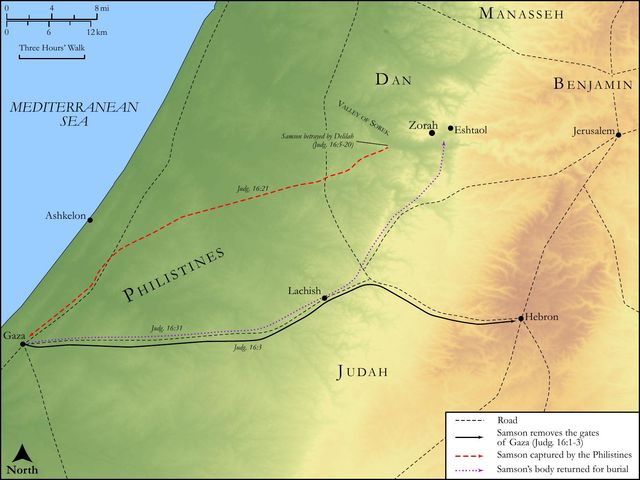
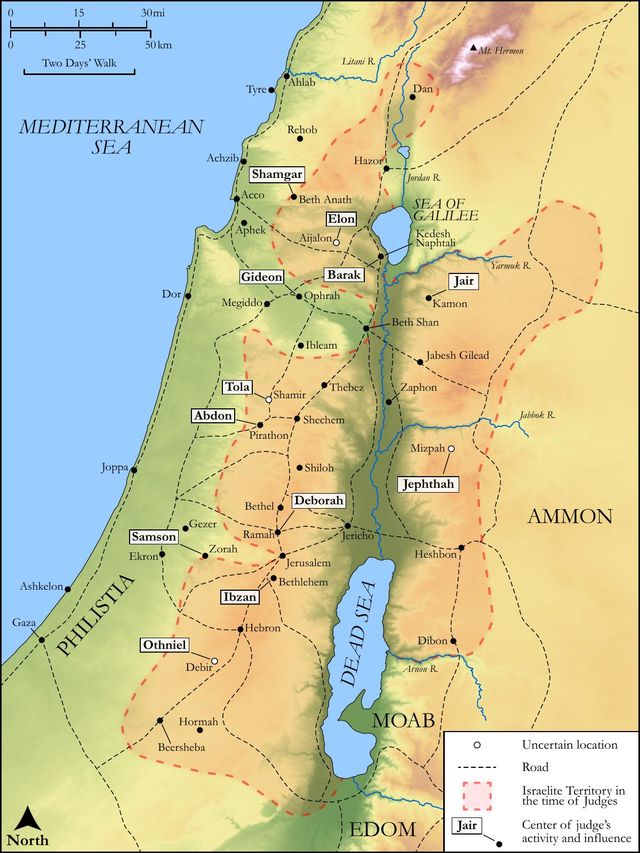
See on the biblical-era maps
Study this verse
Public-domain commentary
Matthew Henry
From his Commentary on the Whole Bible. Henry comments on passages, not single verses — this entry covers Judges 16:18–21.
We have here the fatal consequences of Samson's folly in betraying his own strength; he soon paid dearly for it. A whore is a deep ditch; he that is abhorred of the Lord shall fall therein. In that pit Samson sinks. Observe, 1. What care Delilah took to make sure of the money for herself. She now perceived, by the manner of his speaking, that he had told her all his heart, and the lords of the Philistines that hired her to do this base thing are sent for; but they must be sure to bring the money in their hands, Jdg 16:18. The wages of unrighteousness are accordingly produced, unknown to Samson. It would have grieved one's heart to have seen one of the bravest men then in the world sold and bought, as a sheep for the slaughter; how does this instance sully all the glory of man, and forbid the strong man ever to boast of his strength! 2. What course she took to deliver him up to them according to the bargain. Many in the world would, for the hundredth part of what was here given Delilah, sell those that they pretend the greatest respect for. Trust not in a friend then, put no confidence in a guide. See what a treacherous method she took (Jdg 16:19): She made him sleep upon her knees. Josephus says, She gave him some intoxicating liquor, which laid him to sleep. What opiates she might steal into his cup we know not, but we cannot suppose that he knowingly drank wine or strong drink, for that would have been a forfeiture of his Nazariteship as much as the cutting off of his hair. She pretended the greatest kindness even when she designed the greatest mischief, which yet she could not have compassed if she had not made him sleep. See the fatal consequences of security. Satan ruins men by rocking them asleep, flattering them into a good opinion of their own safety, and so bringing them to mind nothing and fear nothing, and then he robs them of their strength and honour and leads them captive at his will. When we sleep our spiritual enemies do not. When he was asleep she had a person ready to cut off his hair, which he did so silently and so quickly that it did not awake him, but plainly afflicted him; even in his sleep, his spirit manifestly sunk upon it. I think we may suppose that if this ill turn had been done to him in his sleep by some spiteful body, without his being himself accessory to it, as he was here, it would not have had this strange effect upon him; but it was his own wickedness that corrected him. It was his iniquity, else it would not have been so much his infelicity. 3. What little concern he himself was in at it, Jdg 16:20. He could not but miss his hair as soon as he awoke, and yet said, "I will shake myself as at other times after sleep," or, "as at other times when the Philistines were upon me, to make my part good against them." Perhaps he thought to shake himself the more easily, and that his head would feel the lighter, now that his hair was cut, little thinking how much heavier the burden of guilt was than that of hair. He soon found in himself some change, we have reason to think so, and yet wist not that the Lord had departed from him: he did not consider that this was the reason of the change. Note, Many have lost the favourable presence of God and are not aware of it; they have provoked God to withdraw from them, but are not sensible of their loss, nor ever complain of it. Their souls languish and grow weak, their gifts wither, every thing goes cross with them; and yet they impute not this to the right cause: they are not aware that God has departed from them, nor are they in any care to reconcile themselves to him or to recover his favour. When God has departed we cannot do as at other times. 4. What improvement the Philistines soon made of their advantages against him, Jdg 16:21. The Philistines took him when God had departed from him. Those that have thrown themselves out of God's protection become an easy prey to their enemies. If we sleep in the lap of our lusts, we shall certainly wake in the hands of the Philistines. It is probable they had promised Delilah not to kill him, but they took an effectual course to disable him. The first thing they did, when they had him in their hands and found they could manage him, was to put out his eyes, by applying fire to them, says the Arabic version. They considered that his eyes would never come again, as perhaps his hair might, and that the strongest arms could do little without eyes to guide the, and therefore, if now they blind him, they for ever blind him. His eyes were the inlets of his sin: he saw the harlot at Gaza, and went in unto her (Jdg 16:1), and now his punishment began there. Now that the Philistines had blinded him he had time to remember how his own lust had blinded him. The best preservative of the eyes is to turn them away from beholding vanity. They brought him down to Gaza, that there he might appear in weakness where he had lately given such proofs of his strength (Jdg 16:3), and be a jest to those to whom he had been a terror. They bound him with fetters of brass who had before been held in the cords of his own iniquity, and he did grind in the prison, work in their bridewell, either for their profit or his punishment, or for both. The devil does thus by sinners, blinds the minds of those who believe not, and so enslaves them, and secures them in his interests. Poor Samson, how hast thou fallen! How is thy honour laid in the dust! How has the glory and defence of Israel become the drudge and triumph of the Philistines! The crown has fallen from his head; woe unto him, for he hath sinned. Let all take warning by his fall carefully to preserve their purity, and to watch against all fleshly lusts; for all our glory has gone, and our defence departed form us, when the covenant of our separation to God, as spiritual Nazarites, is profaned.
Historical interpretation
Historical reception
2 surviving comments on this verse. Each one is dated, so this reads as a timeline rather than a list.
Select a marker to jump to its quote. Markers stagger vertically where authors wrote within a few decades of each other.
But the one who has taken root as “a fruitful olive tree in the house of God” composes those words against the tyrant which we have heard in the psalm, saying, “Why do you glory in evil, you who are mighty in iniquity,” whose “tongue” is “like a sharp razor.” It was by means of these two things that [Samson] was led off, after [Delilah] had removed the beauty of his hair and cut off the “seven locks of curls” in which our strength lies. Now you will by all means understand the meaning of the spiritual curls from the number seven, just as Isaiah has enumerated the grace which comes from the Spirit in seven parts. If these are cut off, as happened in the case of Samson, the destruction of the “eyes” follows, and one becomes a laughing stock to foreigners when they are drunk.
Now what does it mean that Samson possessed strength in his hair? Notice this carefully, too, brothers. He did not have strength in his hand, his foot, his chest, not even in his head, but in his hair. What is hair? If we perceive it, the apostle answers us after being questioned, “Hair is a covering”; and Christ had strength in a covering, when the shadows of the old law protected him. For this reason the hair of Samson was a covering, since it was seen and understood in Christ at different times. What does it mean that Samson’s secret was betrayed and his head was shaved? The law was despised and Christ suffered. They would not have killed Christ if they had not contemned the law, for they knew that it was not right for them to kill him. They told the judge, “It is not lawful for us to put anyone to death.” Samson’s head was shaved, the secrets were exposed, the covering was removed; Christ who lay hidden was revealed. Moreover, the hair was restored and again covered the head, because the Jews were unwilling to recognize Christ when he was risen. He was in a mill, blinded and in a prison house. The prison or mill is the labor of this world. The blindness of Samson indicates people who are blinded by their infidelity and do not recognize Christ exercising his power or ascending into heaven.
Continue studying Judges 16:20 across the web’s major study libraries — every link below opens this exact verse, chapter, or book on the destination site.
Read & Compare
 BibleGatewayThis verse in more than 200 translations and 70 languages.
 Bible.comThe YouVersion reader — hundreds of translations, reading plans, and highlights.
 ESV.orgCrossway's official English Standard Version reader.
 NET BibleThe NET translation with 60,000+ translators' notes on every rendering decision.
 STEP BibleTyndale House's free study tool — original text, vocabulary, and scholarly resources.
 BibliaLogos Bible Software's free web reader.
 USCCBThe New American Bible (Revised Edition) with the U.S. bishops' study notes.
Commentaries
 BibleHub CommentariesDozens of classic commentaries on this verse, gathered on one page.
 StudyLightMore than 100 commentary sets — the largest collection on the web.
 BibleRefPlain-English commentary on what this verse means, verse by verse.
 Enduring WordDavid Guzik's free commentary on this chapter, widely used by Bible teachers.
 Bible Study ToolsVerse commentary alongside Greek and Hebrew study aids.
Original Language & Research
- BibleHub InterlinearThe verse word by word — original language, transliteration, and English.
- BibleHub LexiconEvery word's original-language definition and Strong's entry.
 Blue Letter BibleDeep-study tools — Strong's numbers, concordance, and word studies.
 SefariaThe Hebrew text with Rashi and centuries of Jewish commentary.
Sermons, Hymns & Audio


TrulyRandomVerse is not affiliated with these sites and doesn’t control their content. They’re linked because they’re genuinely useful.
Summary
Judges 16:20 serves as the tragic and pivotal climax of Samson's narrative, powerfully illustrating the devastating consequences of persistent spiritual compromise and unfaithfulness. As Delilah delivers him into the hands of the waiting Philistines, Samson awakens with a deluded confidence, presuming he can effortlessly reassert his supernatural strength as he had countless times before. Unbeknownst to him, the empowering presence of the LORD, the true source of his extraordinary power, had withdrawn due to his repeated violation of his Nazirite vow and his profound spiritual decline. This verse stands as a solemn testament to the perils of spiritual blindness, the conditional nature of divine anointing, and the critical importance of covenant fidelity.
Context
ShowHideLiterary Context
Judges 16:20 marks the devastating culmination of Samson's final encounter with Delilah, which itself represents the apex of a lifelong pattern of moral compromise and spiritual failure. Samson was consecrated as a Nazirite from birth, set apart to the LORD with specific vows, including the prohibition against cutting his hair, which symbolized his consecration and the empowering presence of the Spirit of God (Judges 13:5). Chapters 14-16 meticulously detail Samson's repeated dalliances with Philistine women, his disregard for his sacred vows, and his consistent reliance on his supernatural strength for personal vengeance rather than for Israel's deliverance. Delilah, bribed by the Philistine lords, relentlessly sought the secret of his strength. After three deceptive answers, Samson, worn down by her persistence, finally reveals the truth—that his strength is tied to his uncut Nazirite hair (Judges 16:17). While he slept, his hair was shaved, setting the stage for the ambush described in this pivotal verse. The preceding verses detail the shaving of his hair and the Philistines lying in wait, making verse 20 the moment of direct confrontation and the shocking revelation of his profound spiritual loss.
Historical & Cultural Context
The book of Judges chronicles a tumultuous period in Israelite history, characterized by a cyclical pattern of apostasy, foreign oppression, and subsequent deliverance through divinely appointed judges. The Philistines, a formidable "Sea People" who had settled along the southwestern coast of Canaan, were a dominant military and cultural force, posing a constant threat to Israel's borders and sovereignty. Samson's era (likely the 11th century BCE) was marked by severe Philistine oppression, and his role as judge was specifically to begin Israel's deliverance from them. The Nazirite vow, detailed in Numbers 6, was a temporary or lifelong commitment of special devotion to God, involving abstinence from wine, not cutting hair, and avoiding contact with the dead. For Samson, his hair was not the source of his strength itself, but rather the visible sign of his covenant commitment and consecration, through which the Spirit of the LORD empowered him. The Philistines' fervent desire to capture Samson was not merely for revenge but to neutralize a significant threat to their dominion, likely culminating in a public humiliation and sacrifice to their god, Dagon, as seen later in Judges 16:23-24.
Key Themes
ShowHideJudges 16:20 powerfully encapsulates several major themes woven throughout Samson's narrative and the broader book of Judges. Foremost is the consequence of disobedience and compromise, vividly illustrating how persistent sin, particularly the disregard for sacred vows and divine consecration, can lead to the withdrawal of God's empowering presence. Samson's repeated spiritual dalliances and his pursuit of personal gratification over his divine calling ultimately severed his connection to the source of his power. This leads directly to the critical theme of the loss of divine presence, a stark reminder that God's Spirit and enabling power are not guaranteed but are contingent upon faithfulness and obedience. The chilling phrase "the LORD was departed from him" underscores the gravity of this spiritual separation, highlighting God's holiness and His unwillingness to continually empower unrepentant sin. Finally, Samson's response, "I will go out as at other times before, and shake myself," highlights a tragic spiritual blindness and overconfidence. He was so accustomed to his supernatural gift that he failed to discern the spiritual decay within himself and the resulting absence of God's active presence, presuming upon God's grace and past experiences without current spiritual vitality or genuine repentance. This theme resonates with the broader pattern of Israel's spiritual decline in the book of Judges.
Exposition and Analysis
ShowHideKey Word Analysis
ShowHideThis archaic King James Version term translates the Hebrew verb H3045 (yâdaʻ), meaning "to know," "to perceive," or "to be aware." The phrase "he wist not" emphasizes Samson's profound and tragic ignorance of his true spiritual condition. It was not merely a lack of information, but a deep spiritual insensitivity and blindness that prevented him from discerning the departure of God's empowering presence, even as his physical strength waned. This highlights a dangerous spiritual complacency that can afflict those who presume upon God's grace.
The Hebrew verb H5493 (çûwr) means "to turn off," "to remove," or "to withdraw." This is not a passive fading of strength but an active, deliberate withdrawal by the LORD. It signifies God's righteous response to Samson's repeated and unrepentant violation of his sacred Nazirite vows and his continued pursuit of unholy relationships. The departure of the LORD's Spirit was a direct consequence of Samson's actions, a divine judgment upon his unfaithfulness, demonstrating God's holiness and His unwillingness to empower persistent sin.
The verb H5287 (nâʻar) means "to tumble about," "to shake off," or "to rouse oneself." Samson's use of this phrase reveals his ingrained habit and presumption. He had grown accustomed to his strength being an automatic, almost reflexive action, believing he could simply "shake himself" free from any constraint, as he had done countless times before. This phrase underscores his overconfidence and his failure to recognize that his power was a divine gift, not an inherent ability he could activate at will, regardless of his spiritual state or the presence of the Giver.
Verse Breakdown
ShowHide"And she said, The Philistines [be] upon thee, Samson."
This clause marks the moment of the successful ambush, the culmination of Delilah's persistent betrayal and the Philistines' strategic patience. Her declaration is the pre-arranged signal for the waiting enemy, signifying that the trap has finally sprung. It is a moment of profound dramatic irony, as the audience is fully aware of the extent of Samson's vulnerability, while he remains tragically oblivious to his true spiritual and physical state.
"And he awoke out of his sleep, and said, I will go out as at other times before, and shake myself."
Samson's immediate response upon waking reveals his tragic spiritual delusion and overconfidence. He presumes upon past experiences, confident that his strength is an intrinsic, habitual power he can simply activate at will. This statement highlights his profound lack of discernment, demonstrating how accustomed he had become to his supernatural ability, failing to recognize its true divine source and the conditional nature of its presence. He assumed his past successes guaranteed future power, irrespective of his current spiritual condition.
"And he wist not that the LORD was departed from him."
This is the devastating revelation and the core theological insight of the verse. The KJV's archaic "wist not" (knew not) underscores Samson's complete ignorance of his spiritual condition. His strength was not gone merely because his hair was cut; it was gone because the divine empowering presence, the Spirit of the LORD, had actively withdrawn due to his persistent sin and disregard for his vows. This clause serves as a solemn warning about the spiritual consequences of unfaithfulness and the extreme danger of presuming upon God's grace while living in unrepentant disobedience.
Literary Devices
ShowHideJudges 16:20 is rich in literary devices that amplify its tragic message and underscore its theological weight. The most prominent is Dramatic Irony, where the audience is fully aware of Samson's true, vulnerable state, having witnessed the shaving of his hair and the Philistines lying in wait, while Samson himself remains tragically ignorant. His declaration, "I will go out as at other times before, and shake myself," is steeped in this irony, highlighting his profound spiritual blindness and self-deception. There is also a strong element of Pathos, evoking pity and sorrow for Samson's downfall, as his immense potential and divine calling are tragically squandered through his own choices and moral failures. The narrative employs Foreshadowing throughout Samson's story, as his earlier compromises with Philistine women (Judges 14:1-3) and his repeated disregard for his Nazirite vows hint at the eventual and inevitable consequences of his actions. The cutting of his hair serves as powerful Symbolism, not as the source of his strength itself, but as the visible representation of his broken vow and the resulting loss of divine favor and empowering presence. Finally, the repeated pattern of Samson's encounters with Delilah, where he continually gives away more of his secret, builds a sense of Suspense leading to this inevitable and tragic climax, making the revelation in verse 20 all the more impactful.
Theological and Thematic Connections
ShowHideJudges 16:20 serves as a profound theological warning, underscoring the holiness of God and the conditional nature of His empowering presence in the Old Covenant. It teaches that while God is faithful to His promises, His active anointing and enabling power can be withdrawn when His people persistently and presumptuously disregard His covenant and commands. Samson's story illustrates that spiritual gifts and abilities are not inherent or automatic; they are divine endowments sustained by an ongoing, obedient relationship with the Giver. His spiritual blindness highlights the danger of becoming so accustomed to God's blessings that one forgets the source, leading to a perilous state of self-reliance and spiritual decay. This verse emphasizes that true strength comes from God alone and is maintained through faithfulness, humility, and a vigilant walk with Him, demonstrating that divine power is tied to divine purpose and purity, not merely personal prowess.
Reflection and Application
ShowHideSamson's tragic downfall in Judges 16:20 offers a sobering and timeless warning for believers today. It compels us to critically examine our own spiritual lives, guarding against the insidious creep of compromise and complacency. Are we, like Samson, presuming upon God's grace or past experiences, believing that His presence and power are guaranteed regardless of our current obedience and faithfulness? This verse challenges us to cultivate a vigilant spiritual discernment, regularly assessing the health of our relationship with God and the vibrancy of the Holy Spirit's work within us. Our spiritual gifts, talents, and effectiveness in ministry are not inherent; they are divine endowments sustained by an ongoing, humble, and obedient walk with the Lord. To neglect our spiritual disciplines, to harbor unconfessed sin, or to prioritize worldly desires over our consecration to God is to risk grieving the Holy Spirit and diminishing His empowering presence in our lives, leading to a state of spiritual weakness and ineffectiveness, much like Samson's. Let us strive to remain acutely aware of God's active presence, never taking His grace for granted, and always seeking to live in a manner worthy of His calling.
Questions for Reflection
ShowHideFAQ
ShowHideWas Samson's strength literally in his hair?
ShowHideNo, Samson's strength was not inherently in his hair itself, but rather it was a supernatural endowment from the Spirit of the LORD. His uncut hair was the visible sign and condition of his Nazirite vow, a sacred covenant of consecration and obedience to God (Numbers 6). The hair symbolized his set-apartness and commitment to the Lord. When his hair was cut, it signified the breaking of his vow and the violation of his covenant with God. It was this act of unfaithfulness and the persistent pattern of disobedience that led to the withdrawal of the divine empowering presence. The text explicitly states, "the LORD was departed from him," indicating that the loss of strength was a direct consequence of God's Spirit withdrawing, not a magical property of his hair.
Can God's Spirit depart from believers today as it did from Samson?
ShowHideIn the Old Testament, the Holy Spirit "came upon" individuals for specific tasks and could depart (e.g., the Spirit departing from King Saul in 1 Samuel 16:14). In the New Covenant, established through Christ's sacrifice, the Holy Spirit permanently indwells every true believer from the moment of conversion (Ephesians 1:13-14). Therefore, the Spirit does not "depart" from a true believer in the sense of abandoning them or revoking their salvation. However, persistent and unrepentant sin can "grieve" the Holy Spirit (Ephesians 4:30) and "quench" His work and power in a believer's life (1 Thessalonians 5:19), diminishing their spiritual effectiveness, joy, and conscious sense of God's active presence and fellowship. While salvation is secure, the experiential reality of God's empowering presence and intimate fellowship is conditional upon obedience and holiness.
Christ-Centered Fulfillment
ShowHideSamson's tragic story, culminating in Judges 16:20 with the devastating revelation that "the LORD was departed from him," profoundly foreshadows and contrasts with the perfect obedience and enduring strength found in Jesus Christ. Samson, a judge appointed by God to deliver Israel, ultimately failed due to his own spiritual blindness, moral compromise, and persistent disobedience, leading to the withdrawal of the divine presence that empowered him. In stark contrast, Jesus is the true and ultimate deliverer, the Son of God who perfectly fulfilled His mission. Unlike Samson, whose strength was conditional and ultimately withdrawn, Jesus was empowered by the Holy Spirit without measure (John 3:34) and never experienced the Father's departure, even in the depths of His suffering on the cross when He cried out, "My God, my God, why have you forsaken me?" (Matthew 27:46). He was "set apart" not by a temporary vow, but by His very nature as the sinless Lamb of God (John 1:29), perfectly obedient even unto death (Philippians 2:8). While Samson was betrayed and weakened, Christ willingly laid down His life (John 10:18), demonstrating ultimate divine power even in apparent weakness on the cross, where He conquered sin and death for all humanity. Samson's story is a sobering warning against spiritual complacency and presuming upon God's grace; Christ's life is the perfect example of unwavering faithfulness and the inexhaustible source of true, enduring spiritual strength for all who believe in Him (Philippians 4:13). He is the one who never "wist not" the Father's presence, but always walked in perfect communion and obedience, offering us a new covenant where the Spirit permanently indwells His followers, enabling them to live lives of power and purpose, not based on their own flawed strength, but on His perfect work and resurrection power (Romans 8:11).