


Judges 16:21
- וַיֹּאחֲזוּהוּvai·yo·cha·Zu·huand they seized himH270Conj-w ¦ V-Qal-ConsecImperf-3mp ¦ 3msVerb Qal Consecutive Imperfect 3rd Plural Masculineוַandיֹּאחֲזוּthey seizedהוּhim
- פְלִשְׁתִּיםfe·lish·Tim[the] PhilistinesH6430N-mpNoun Gentilic Plural Masculine Absolute
- וַיְנַקְּרוּvay·na·ke·Ruand they gouged outH5365Conj-w ¦ V-Piel-ConsecImperf-3mpVerb Piel Consecutive Imperfect 3rd Plural Masculineוַandיְנַקְּרוּthey gouged out
- אֶת'et<obj.>H853DirObjMParticle Object Indicator
- עֵינָיו'ei·Navhis eyesH5869N-fdc ¦ 3msNoun Dual Feminine Constructעֵינָיeyesוhis
- וַיּוֹרִידוּvai·yo·Ri·duand they brought downH3381Conj-w ¦ V-Hiphil-ConsecImperf-3mpVerb Hiphil Consecutive Imperfect 3rd Plural Masculineוַandיּוֹרִידוּthey brought down
- אוֹתוֹ'o·To<obj.> himH853DirObjM ¦ 3msParticle Object Indicatorאוֹת<obj.>וֹhim
- עַזָּתָה'a·Za·tahGaza towardsH5804N-proper ¦ SfxNoun Proper LocationעַזָּתָGazaהtowards
- וַיַּאַסְרוּהוּvai·ya·'as·Ru·huand they bound himH631Conj-w ¦ V-Qal-ConsecImperf-3mp ¦ 3msVerb Qal Consecutive Imperfect 3rd Plural Masculineוַandיַּאַסְרוּthey boundהוּhim
- בַּנְחֻשְׁתַּיִםban·chush·Ta·yimwith <the> bronze fettersH5178Prep-b ¦ N-fdNoun Dual Feminine Absoluteבַּwith <the>נְחֻשְׁתַּיִםbronze fetters
- וַיְהִיvay·Hiand he wasH1961Conj-w ¦ V-Qal-ConsecImperf-3msVerb Qal Consecutive Imperfect 3rd Singular Masculineוַandיְהִיhe was
- טוֹחֵןto·ChengrindingH2912V-Qal-Prtcpl-msVerb Qal Participle Singular Masculine Absolute
- בְּבֵיתbe·Veitin [the] house ofH1004Prep-b ¦ N-mscNoun Singular Masculine Constructבְּinבֵית[the] house of
- הָאֲסוּרִיםha·'a·si·rimthose imprisonedH631Art ¦ V-Qal-PassPrtcpl-mpVerb Qal Participle Passive Plural Masculine Absoluteהָthoseאֲסוּרִיםimprisoned
English is a literal word-by-word gloss of the Hebrew, not the KJV's wording. Why?
This is the original text the KJV's translators worked from — each Hebrew word with its own literal English meaning in this verse, prepared by scholars at Tyndale House, Cambridge. The KJV translates whole sentences, not word by word, so its wording differs: one Hebrew word can become several English words, and the KJV may choose “the LORD” where the gloss reads “Yahweh”. Both are faithful — they answer different questions. For the KJV's own rendering, switch to the KJV text.
Details
See on the biblical-era map
Study this verse
Public-domain commentary
Matthew Henry
From his Commentary on the Whole Bible. Henry comments on passages, not single verses — this entry covers Judges 16:18–21.
We have here the fatal consequences of Samson's folly in betraying his own strength; he soon paid dearly for it. A whore is a deep ditch; he that is abhorred of the Lord shall fall therein. In that pit Samson sinks. Observe, 1. What care Delilah took to make sure of the money for herself. She now perceived, by the manner of his speaking, that he had told her all his heart, and the lords of the Philistines that hired her to do this base thing are sent for; but they must be sure to bring the money in their hands, Jdg 16:18. The wages of unrighteousness are accordingly produced, unknown to Samson. It would have grieved one's heart to have seen one of the bravest men then in the world sold and bought, as a sheep for the slaughter; how does this instance sully all the glory of man, and forbid the strong man ever to boast of his strength! 2. What course she took to deliver him up to them according to the bargain. Many in the world would, for the hundredth part of what was here given Delilah, sell those that they pretend the greatest respect for. Trust not in a friend then, put no confidence in a guide. See what a treacherous method she took (Jdg 16:19): She made him sleep upon her knees. Josephus says, She gave him some intoxicating liquor, which laid him to sleep. What opiates she might steal into his cup we know not, but we cannot suppose that he knowingly drank wine or strong drink, for that would have been a forfeiture of his Nazariteship as much as the cutting off of his hair. She pretended the greatest kindness even when she designed the greatest mischief, which yet she could not have compassed if she had not made him sleep. See the fatal consequences of security. Satan ruins men by rocking them asleep, flattering them into a good opinion of their own safety, and so bringing them to mind nothing and fear nothing, and then he robs them of their strength and honour and leads them captive at his will. When we sleep our spiritual enemies do not. When he was asleep she had a person ready to cut off his hair, which he did so silently and so quickly that it did not awake him, but plainly afflicted him; even in his sleep, his spirit manifestly sunk upon it. I think we may suppose that if this ill turn had been done to him in his sleep by some spiteful body, without his being himself accessory to it, as he was here, it would not have had this strange effect upon him; but it was his own wickedness that corrected him. It was his iniquity, else it would not have been so much his infelicity. 3. What little concern he himself was in at it, Jdg 16:20. He could not but miss his hair as soon as he awoke, and yet said, "I will shake myself as at other times after sleep," or, "as at other times when the Philistines were upon me, to make my part good against them." Perhaps he thought to shake himself the more easily, and that his head would feel the lighter, now that his hair was cut, little thinking how much heavier the burden of guilt was than that of hair. He soon found in himself some change, we have reason to think so, and yet wist not that the Lord had departed from him: he did not consider that this was the reason of the change. Note, Many have lost the favourable presence of God and are not aware of it; they have provoked God to withdraw from them, but are not sensible of their loss, nor ever complain of it. Their souls languish and grow weak, their gifts wither, every thing goes cross with them; and yet they impute not this to the right cause: they are not aware that God has departed from them, nor are they in any care to reconcile themselves to him or to recover his favour. When God has departed we cannot do as at other times. 4. What improvement the Philistines soon made of their advantages against him, Jdg 16:21. The Philistines took him when God had departed from him. Those that have thrown themselves out of God's protection become an easy prey to their enemies. If we sleep in the lap of our lusts, we shall certainly wake in the hands of the Philistines. It is probable they had promised Delilah not to kill him, but they took an effectual course to disable him. The first thing they did, when they had him in their hands and found they could manage him, was to put out his eyes, by applying fire to them, says the Arabic version. They considered that his eyes would never come again, as perhaps his hair might, and that the strongest arms could do little without eyes to guide the, and therefore, if now they blind him, they for ever blind him. His eyes were the inlets of his sin: he saw the harlot at Gaza, and went in unto her (Jdg 16:1), and now his punishment began there. Now that the Philistines had blinded him he had time to remember how his own lust had blinded him. The best preservative of the eyes is to turn them away from beholding vanity. They brought him down to Gaza, that there he might appear in weakness where he had lately given such proofs of his strength (Jdg 16:3), and be a jest to those to whom he had been a terror. They bound him with fetters of brass who had before been held in the cords of his own iniquity, and he did grind in the prison, work in their bridewell, either for their profit or his punishment, or for both. The devil does thus by sinners, blinds the minds of those who believe not, and so enslaves them, and secures them in his interests. Poor Samson, how hast thou fallen! How is thy honour laid in the dust! How has the glory and defence of Israel become the drudge and triumph of the Philistines! The crown has fallen from his head; woe unto him, for he hath sinned. Let all take warning by his fall carefully to preserve their purity, and to watch against all fleshly lusts; for all our glory has gone, and our defence departed form us, when the covenant of our separation to God, as spiritual Nazarites, is profaned.
Historical interpretation
Historical reception
2 surviving comments on this verse. Each one is dated, so this reads as a timeline rather than a list.
Select a marker to jump to its quote. Markers stagger vertically where authors wrote within a few decades of each other.
But the one who has taken root as “a fruitful olive tree in the house of God” composes those words against the tyrant which we have heard in the psalm, saying, “Why do you glory in evil, you who are mighty in iniquity,” whose “tongue” is “like a sharp razor.” It was by means of these two things that [Samson] was led off, after [Delilah] had removed the beauty of his hair and cut off the “seven locks of curls” in which our strength lies. Now you will by all means understand the meaning of the spiritual curls from the number seven, just as Isaiah has enumerated the grace which comes from the Spirit in seven parts. If these are cut off, as happened in the case of Samson, the destruction of the “eyes” follows, and one becomes a laughing stock to foreigners when they are drunk.
Now what does it mean that Samson possessed strength in his hair? Notice this carefully, too, brothers. He did not have strength in his hand, his foot, his chest, not even in his head, but in his hair. What is hair? If we perceive it, the apostle answers us after being questioned, “Hair is a covering”; and Christ had strength in a covering, when the shadows of the old law protected him. For this reason the hair of Samson was a covering, since it was seen and understood in Christ at different times. What does it mean that Samson’s secret was betrayed and his head was shaved? The law was despised and Christ suffered. They would not have killed Christ if they had not contemned the law, for they knew that it was not right for them to kill him. They told the judge, “It is not lawful for us to put anyone to death.” Samson’s head was shaved, the secrets were exposed, the covering was removed; Christ who lay hidden was revealed. Moreover, the hair was restored and again covered the head, because the Jews were unwilling to recognize Christ when he was risen. He was in a mill, blinded and in a prison house. The prison or mill is the labor of this world. The blindness of Samson indicates people who are blinded by their infidelity and do not recognize Christ exercising his power or ascending into heaven.
Continue studying Judges 16:21 across the web’s major study libraries — every link below opens this exact verse, chapter, or book on the destination site.
Read & Compare
 BibleGatewayThis verse in more than 200 translations and 70 languages.
 Bible.comThe YouVersion reader — hundreds of translations, reading plans, and highlights.
 ESV.orgCrossway's official English Standard Version reader.
 NET BibleThe NET translation with 60,000+ translators' notes on every rendering decision.
 STEP BibleTyndale House's free study tool — original text, vocabulary, and scholarly resources.
 BibliaLogos Bible Software's free web reader.
 USCCBThe New American Bible (Revised Edition) with the U.S. bishops' study notes.
Commentaries
 BibleHub CommentariesDozens of classic commentaries on this verse, gathered on one page.
 StudyLightMore than 100 commentary sets — the largest collection on the web.
 BibleRefPlain-English commentary on what this verse means, verse by verse.
 Enduring WordDavid Guzik's free commentary on this chapter, widely used by Bible teachers.
 Bible Study ToolsVerse commentary alongside Greek and Hebrew study aids.
Original Language & Research
- BibleHub InterlinearThe verse word by word — original language, transliteration, and English.
- BibleHub LexiconEvery word's original-language definition and Strong's entry.
 Blue Letter BibleDeep-study tools — Strong's numbers, concordance, and word studies.
 SefariaThe Hebrew text with Rashi and centuries of Jewish commentary.
Sermons, Hymns & Audio


TrulyRandomVerse is not affiliated with these sites and doesn’t control their content. They’re linked because they’re genuinely useful.
Summary
Judges 16:21 vividly recounts the tragic downfall of Samson, detailing his brutal capture and subsequent humiliation by the Philistines. After losing his divine strength due to his persistent disobedience and Delilah's betrayal, he is cruelly blinded, transported to the Philistine stronghold of Gaza, bound with heavy bronze chains, and forced into the demeaning labor of grinding grain in the prison house. This pivotal verse marks the lowest point in Samson's life, serving as a stark and sobering illustration of the severe consequences that arise from spiritual compromise and a disregard for divine consecration.
Context
ShowHideLiterary Context
This verse immediately follows the devastating betrayal of Samson by Delilah, where the visible sign of his Nazarite vow—his long hair—was cut while he slept, causing his divine strength to depart from him, a fact he tragically did not immediately perceive (Judges 16:19-20). It represents the nadir of Samson's narrative arc, a stark and painful contrast to his earlier exploits of immense strength and miraculous victories against the Philistines. The narrative of Samson, which begins with his miraculous birth and divine calling as a Nazarite dedicated to God from the womb (Judges 13), progressively details his repeated compromises with Philistine women and his consistent disregard for the terms of his consecration. This moment of profound humiliation and incapacitation sets the stage for his eventual repentance and final, redemptive act, where God, in His sovereign wisdom, uses even Samson's weakness and suffering to accomplish His overarching purposes for Israel's deliverance.
Historical & Cultural Context
The Philistines were a powerful, technologically superior, and long-standing adversary of Israel, frequently oppressing them during the chaotic period of the Judges. Gaza was one of their five major city-states, serving as a significant economic and military stronghold in the region. Samson had previously visited Gaza and famously demonstrated his strength by carrying away its city gates (Judges 16:1-3). The act of "putting out his eyes" was a common, brutal, and permanent form of incapacitation and humiliation in the ancient Near East, employed to render a dangerous captive harmless and to serve as a public display of dominance by the victor. Forcing a man, especially one renowned for his strength and a former judge of Israel, to "grind in the prison house" was the ultimate indignity. Grinding grain was typically a laborious and menial task performed by women, slaves, or animals, often blind, making it a powerful symbol of complete subjugation, reversal of status, and loss of dignity for a former warrior and leader.
Key Themes
ShowHideJudges 16:21 powerfully illustrates several profound themes prevalent throughout the book of Judges and the broader biblical narrative. Firstly, it underscores the severe consequences of disobedience and spiritual compromise. Samson's persistent pursuit of forbidden relationships and his disregard for his divine calling, despite numerous warnings and divine interventions, directly led to this devastating outcome. This vividly demonstrates the biblical principle that "whatever one sows, that will he also reap" (Galatians 6:7). Secondly, the verse highlights the loss of power and profound humiliation that inevitably results from straying from God's path. The mighty Samson, who once single-handedly defeated a thousand Philistines with a jawbone (Judges 15:15), is reduced to a sightless, enslaved laborer, a stark portrayal of a fall from grace. Thirdly, Samson's literal blinding serves as a potent metaphor for his spiritual blindness. Despite divine empowerment and clear warnings, he consistently failed to discern the dangers inherent in his choices and the true nature of his enemies, his physical state mirroring his earlier spiritual inability to perceive God's will and the implications of his compromises. Finally, while the Philistines were the immediate agents of his suffering, this event is also understood within the context of divine discipline, a severe but ultimately redemptive act by God to humble Samson and bring him to a place of repentance, ultimately fulfilling God's sovereign purposes.
Exposition and Analysis
ShowHideKey Word Analysis
ShowHideThe Hebrew verb נָקַר (nâqar) literally means "to bore out," "to gouge out," or "to dig out." This is not merely an injury resulting in blindness but a permanent, brutal, and irreversible act of mutilation. It signifies a complete and cruel incapacitation, ensuring Samson could never again see or effectively fight, transforming him from a feared warrior into a helpless, dependent spectacle.
The Hebrew word עַיִן (ʻayin) refers to the physical organ of sight, but it also carries significant metaphorical weight, often representing perception, understanding, and even one's outlook or disposition. In Samson's case, the physical loss of his eyes powerfully symbolizes his earlier spiritual blindness and lack of discernment, which led him into compromising situations and ultimately to his downfall.
The verb טָחַן (ṭâchan) means "to grind meal," referring to the laborious process of grinding grain with a millstone. This task was considered extremely arduous and was typically performed by women, slaves, or animals. For Samson, a man of immense strength and a judge of Israel, being forced to perform such a menial, degrading, and feminized labor in a prison house represented the ultimate humiliation and reversal of his former glory, freedom, and masculine power.
Verse Breakdown
ShowHide"But the Philistines took him"
This phrase immediately establishes the Philistines' long-awaited triumph over their formidable adversary. It highlights the sudden and decisive capture of Samson, emphasizing the immediate and direct consequence of his lost strength and the departure of divine favor. This moment marks a dramatic shift in power.
"and put out his eyes"
This is the most shocking and brutal act described in the verse. Beyond mere physical incapacitation, it signifies a profound act of humiliation, dehumanization, and a deliberate effort to render Samson utterly dependent and vulnerable. The loss of sight for a man who once "saw" and acted with divine power is deeply ironic and symbolic.
"and brought him down to Gaza"
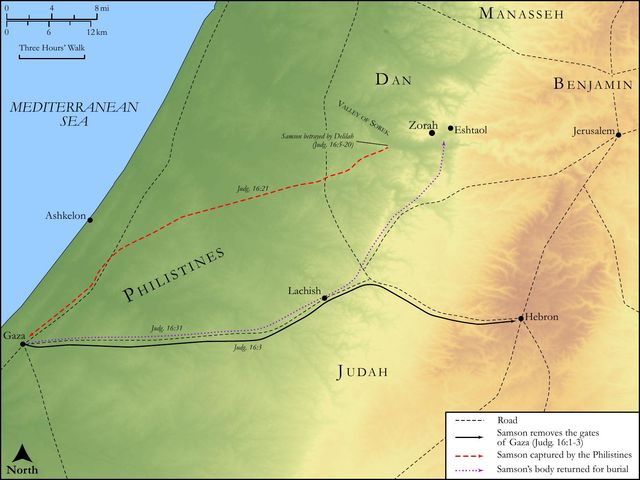
The choice of Gaza, a major Philistine city and stronghold, is highly significant. Samson had previously demonstrated his power by escaping from Gaza with its city gates (Judges 16:1-3). His return there as a blind, bound captive symbolizes the complete reversal of his fortunes and the Philistines' ultimate victory over him on their own territory, turning his former triumph into a public spectacle of their dominance.
"and bound him with fetters of brass"
This detail emphasizes the secure and inescapable nature of his bondage. The "fetters of brass" (or bronze) signify the heavy, strong, and durable chains used to ensure his captivity and prevent any further escapes. This underscores his complete loss of freedom, power, and the Philistines' determination to keep him subjugated.
"and he did grind in the prison house"
This describes the ultimate indignity and degradation imposed upon Samson. Reducing a judge and a man of unparalleled strength to the laborious and demeaning task of grinding grain, a task typically performed by women, the lowest slaves, or animals, represents the complete stripping away of his honor, status, and masculinity. It is a powerful symbol of his utter subjugation, repetitive futility, and profound humiliation.
Literary Devices
ShowHideJudges 16:21 is profoundly impactful due to its masterful use of literary devices. Irony is powerfully evident: Samson, who once wielded immense physical strength to blind and defeat Philistines and escape their cities, is now literally blinded by them and brought back to a Philistine city as a captive. His earlier dramatic escape from Gaza by carrying away its city gates (Judges 16:3) stands in stark contrast to his return as a bound prisoner, highlighting the complete reversal of fortune. Symbolism pervades the verse; Samson's physical blindness is a potent symbol of his spiritual blindness, his inability to discern the true nature of his enemies or the dangers inherent in his repeated compromises. The "fetters of brass" symbolize the unbreakable bonds of sin and the inescapable consequences of his choices. The act of "grinding in the prison house" is a powerful symbol of degradation, repetitive futility, and the complete loss of purpose and freedom for a man once called to deliver Israel. The entire scene serves as a stark pathos, evoking deep pity and sorrow for Samson's tragic fall, while simultaneously serving as a powerful cautionary tale about the devastating consequences of spiritual compromise.
Theological and Thematic Connections
ShowHideJudges 16:21 stands as a sobering testament to the immutable principle of divine justice and the dire consequences of persistent disobedience. While God's gifts and calling are indeed irrevocable, the effective exercise of those gifts and the experience of divine favor are often contingent upon faithfulness and obedience. Samson's physical and spiritual decline vividly illustrates that even those divinely chosen and powerfully gifted are not exempt from the painful repercussions of sin. This verse underscores the profound reality that sin, when indulged and unrepented of, leads to a loss of spiritual power, a darkening of spiritual vision, and ultimately, a form of bondage and public humiliation. It serves as a powerful reminder that God's discipline, though severe and often painful, is ultimately intended to humble, purify, and bring about repentance, thereby working towards His sovereign purposes even through human failure and brokenness.
Reflection and Application
ShowHideSamson's tragic fall in Judges 16:21 serves as a profound and timeless warning for believers today, compelling us to engage in honest self-examination. It challenges us to identify any areas of compromise, spiritual complacency, or persistent disobedience in our own lives that might lead to similar devastating consequences. The narrative powerfully illustrates that even great strength, gifting, or a divine calling, if not coupled with spiritual discernment, humility, and unwavering faithfulness, can lead to a loss of purpose and a state of spiritual bondage. We are reminded that our "eyes"—our spiritual perception, understanding, and focus—must remain open and fixed on God's will and His truth, lest we, like Samson, become blind to the subtle deceptions of the enemy and the dangers inherent in our own desires. This verse challenges us to cultivate a deep sense of humility, to cherish and guard our spiritual consecration, and to understand that true freedom and sustained power come not from self-reliance or inherent strength, but from consistent reliance on God and obedient submission to His commands. Even in the depths of our failures, Samson's eventual repentance and final act of faith offer a glimmer of hope that God can redeem even the most broken circumstances, transforming humiliation into a platform for His glory.
Questions for Reflection
ShowHideFAQ
ShowHideWhy did God allow this to happen to Samson, His chosen judge?
ShowHideGod's sovereignty operates in conjunction with human free will and its consequences. While Samson was indeed chosen by God and endowed with extraordinary strength for a divine purpose, he repeatedly disregarded his Nazarite vow and indulged in sinful compromises, particularly with Philistine women (Judges 14-16). His capture and humiliation were a direct and painful consequence of his persistent disobedience and the breaking of his covenant with God, specifically the cutting of his hair, which was the visible sign of his vow and the condition for the manifestation of his strength (Judges 16:19-20). This event served as divine discipline, a severe but necessary measure intended to humble Samson, bring him to a place of repentance, and cultivate renewed dependence on God. Ultimately, God, in His infinite wisdom, used even Samson's weakness and suffering to accomplish His larger redemptive purpose for Israel, demonstrating that His plans prevail even through the failures of His servants (Hebrews 12:6).
What is the significance of Gaza as the location of Samson's imprisonment?
ShowHideGaza was one of the five major Philistine city-states, serving as a significant stronghold and a symbol of their power and oppression over Israel. The choice of Gaza for Samson's imprisonment was highly symbolic and deeply humiliating. Samson had previously visited Gaza and, in a dramatic display of immense strength, escaped by carrying away the city gates (Judges 16:1-3). His return to Gaza as a blind, bound slave, forced to perform the most degrading labor, represented a complete and public reversal of his former triumphs. It was a strategic choice by the Philistines to maximize his humiliation, to parade their perceived victory, and to celebrate their dominance over the man who had terrorized them for years, thereby crushing the morale of the Israelites.
Christ-Centered Fulfillment
ShowHideSamson's tragic story, culminating in his blinding and humiliation in Judges 16:21, powerfully foreshadows the profound need for a perfect deliverer who would not succumb to sin's temptations and consequences. Samson, though a divinely appointed judge and a type of deliverer for Israel, ultimately failed due to his own spiritual blindness and moral compromise. In stark contrast, Jesus Christ, the true Son of God, was not bound by sin but willingly humbled Himself, taking on the form of a servant. He was not physically blinded by His enemies, but rather, He came into the world precisely to open the eyes of the blind—both physically and, more importantly, spiritually, bringing light to those who sat in darkness (Luke 4:18). Jesus endured the ultimate humiliation and degradation, not for His own sin, but for ours, becoming the Lamb of God who takes away the sin of the world by suffering a brutal death on the cross. His strength was not merely physical, but divine and spiritual, enabling Him to conquer sin and death through His glorious resurrection (Romans 6:9-10), thereby offering true and eternal freedom from the fetters of sin that bind humanity. Unlike Samson, whose strength departed, Jesus' power is eternal, His deliverance complete, and His victory over sin and death absolute, perfectly fulfilling God's will and providing the ultimate salvation that Samson could only imperfectly prefigure.