


Judges 16:3
- וַיִּשְׁכַּבvai·yish·Kavand he lay downH7901Conj-w ¦ V-Qal-ConsecImperf-3msVerb Qal Consecutive Imperfect 3rd Singular Masculineוַandיִּשְׁכַּבhe lay down
- שִׁמְשׁוֹןshim·shOnSamsonH8123N-proper-mNoun Proper Masculine
- עַד'aduntilH5704PrepPreposition
- חֲצִיcha·Tzi[the] middle ofH2677N-mscNoun Singular Masculine Construct
- הַלַּיְלָהha·lay·Lahthe nightH3915Art ¦ N-msNoun Singular Masculine Absoluteהַtheלַּיְלָהnight
- וַיָּקָםvai·Ya·komand he aroseH6965Conj-w ¦ V-Qal-ConsecImperf-3msVerb Qal Consecutive Imperfect 3rd Singular Masculineוַandיָּקָםhe arose
- בַּחֲצִיba·cha·Tziin [the] middle ofH2677Prep-b ¦ N-mscNoun Singular Masculine Constructבַּinחֲצִי[the] middle of
- הַלַּיְלָהha·Lay·lahthe nightH3915Art ¦ N-msNoun Singular Masculine Absoluteהַtheלַּיְלָהnight
- וַיֶּאֱחֹזvai·ye·'e·Chozand he took holdH270Conj-w ¦ V-Qal-ConsecImperf-3msVerb Qal Consecutive Imperfect 3rd Singular Masculineוַandיֶּאֱחֹזhe took hold
- בְּדַלְתוֹתbe·dal·Toton [the] doors ofH1817Prep-b ¦ N-fpcNoun Plural Feminine Constructבְּonדַלְתוֹת[the] doors of
- שַׁעַרsha·'ar[the] gate ofH8179N-mscNoun Singular Masculine Construct
- הָעִירha·'Irthe cityH5892Art ¦ N-fsNoun Singular Feminine Absoluteהָtheעִירcity
- וּבִשְׁתֵּיu·vish·Teiand on [the] twoH8147Conj-w ¦ Prep-b ¦ N-fdcNoun Dual Feminine Constructוּandבִonשְׁתֵּי[the] two
- הַמְּזוּזוֹתha·me·zu·Zotthe doorpostsH4201Art ¦ N-fpNoun Plural Feminine Absoluteהַtheמְּזוּזוֹתdoorposts
- וַיִּסָּעֵםvai·yi·sa·'Emand he pulled up themH5265Conj-w ¦ V-Qal-ConsecImperf-3ms ¦ 3mpVerb Qal Consecutive Imperfect 3rd Singular Masculineוַandיִּסָּעֵhe pulled upםthem
- עִם'imwithH5973PrepPreposition
- הַבְּרִיחַha·be·Ri·achthe barH1280Art ¦ N-msNoun Singular Masculine Absoluteהַtheבְּרִיחַbar
- וַיָּשֶׂםvai·Ya·semand he put [them]H7760Conj-w ¦ V-Qal-ConsecImperf-3msVerb Qal Consecutive Imperfect 3rd Singular Masculineוַandיָּשֶׂםhe put [them]
- עַל'alonH5921PrepPreposition
- כְּתֵפָיוke·te·Favhis shouldersH3802N-mpc ¦ 3msNoun Plural Masculine Constructכְּתֵפָיshouldersוhis
- וַיַּעֲלֵםvai·ya·'a·Lemand he carried up themH5927Conj-w ¦ V-Hiphil-ConsecImperf-3ms ¦ 3mpVerb Hiphil Consecutive Imperfect 3rd Singular Masculineוַandיַּעֲלֵhe carried upםthem
- אֶל'eltoH413PrepPreposition
- רֹאשׁrosh[the] top ofH7218N-mscNoun Singular Masculine Construct
- הָהָרha·Harthe mountainH2022Art ¦ N-msNoun Singular Masculine Absoluteהָtheהָרmountain
- אֲשֶׁר'a·SherwhichH834RelParticle Relative
- עַל'al[is] onH5921PrepPreposition
- פְּנֵיpe·Nei[the] face ofH6440N-mpcNoun Plural Masculine Construct
- חֶבְרוֹןchev·RonHebronH2275N-properNoun Proper Location
English is a literal word-by-word gloss of the Hebrew, not the KJV's wording. Why?
This is the original text the KJV's translators worked from — each Hebrew word with its own literal English meaning in this verse, prepared by scholars at Tyndale House, Cambridge. The KJV translates whole sentences, not word by word, so its wording differs: one Hebrew word can become several English words, and the KJV may choose “the LORD” where the gloss reads “Yahweh”. Both are faithful — they answer different questions. For the KJV's own rendering, switch to the KJV text.
Details
See on the biblical-era map
Study this verse
Public-domain commentary
Matthew Henry
From his Commentary on the Whole Bible. Henry comments on passages, not single verses — this entry covers Judges 16:1–3.
Here is, 1. Samson's sin, Jdg 16:1. His taking a Philistine to wife, in the beginning of his time, was in some degree excusable, but to join himself to a harlot that he accidentally saw among them was such a profanation of his honour as an Israelite, as a Nazarite, that we cannot but blush to read it. Tell it not in Gath. This vile impurity makes the graceful visage of this Nazarite blacker than a coal, Lam 4:7, Lam 4:8. We find not that Samson had any business in Gaza; if he went thither in quest of a harlot it would make one willing to hope that, as bad as things were otherwise, there were no prostitutes among the daughters of Israel. Some think he went thither to observe what posture the Philistines were in, that he might get some advantages against them; if so, he forgot his business, neglected that, and so fell into this snare. His sin began in his eye, with which he should have made a covenant; he saw there one in the attire of a harlot, and the lust which conceived brought forth sin: he went in unto her. 2. Samson's danger. Notice was sent to the magistrates of Gaza, perhaps by the treacherous harlot herself, that Samson was in the town, Jdg 15:2. Probably he came in a disguise, or in the dusk of the evening, and went into an inn or public-house, which happened to be kept by this harlot. The gates of the city were hereupon shut, guards set, all kept quiet, that Samson might suspect no danger. Now they thought they had him in a prison, and doubted not but to be the death of him the next morning. O that all those who indulge their sensual appetites in drunkenness, uncleanness, or any fleshly lusts, would see themselves thus surrounded, waylaid, and marked for ruin, by their spiritual enemies! The faster they sleep, and the more secure they are, the greater is their danger. 3. Samson's escape, Jdg 16:3. He rose at midnight, perhaps roused by a dream, in slumberings upon the bed (Job 33:15), by his guardian angel, or rather by the checks of his own conscience. He arose with a penitent abhorrence (we hope) of the sin he was now committing, and of himself because of it, and with a pious resolution not to return to it, - rose under an apprehension of the danger he was in, that he was as one that slept upon the top of a mast, - rose with such thoughts as these: "Is this a bed fit for a Nazarite to sleep in? Shall a temple of the living God be thus polluted? Can I be safe under this guilt?" It was bad that he lay down without such checks; but it would have been worse if he had lain still under them. He makes immediately towards the gate of the city, probably finds the guards asleep, else he would have made them sleep their last, stays not to break open the gates, but plucks up the posts, takes them, gates and bar and all, all very large and strong and a vast weight, yet he carries them on his back several miles, up to the top of a hill, in disdain of their attempt to secure him with gates and bars, designing thus to render himself more formidable to the Philistines and more acceptable to his people, thus to give a proof of the great strength God had given him and a type of Christ's victory over death and the grave. He not only rolled away the stone from the door of the sepulchre, and so came forth himself, but carried away the gates of the grave, bar and all, and so left it, ever after, an open prison to all that are his; it shall not, it cannot, always detain them. O death! where is thy sting? Where are thy gates? Thanks be to him that not only gained a victory for himself, but giveth us the victory!
Historical interpretation
Two Centuries of Reception
3 surviving comments on this verse. Each one is dated, so this reads as a timeline rather than a list.
Select a marker to jump to its quote. Markers stagger vertically where authors wrote within a few decades of each other.
Having, in the course of events closed his war with the Philistines, and shunning the sloth of his countrymen, Samson now betook himself to Gaza, which was in the region of the Philistines, and lodged there. When the men of Gaza knew this they did not dissemble or pass it over, but beset his lodging in haste, and guarded all the doors of the house that he might not escape by night. But Samson knowing their design, in the middle of the night forestalling the snare which had been laid for him, took the pillars of the house in his arms, and carried the whole structure and the weight of the roof on his back, up to a high hill above Hebron, a city inhabited by the Hebrews.
When Samson went in to the harlot, he was impure if he did so without reason, but if he did so as a prophet it is a mystery. If he did not enter in order to lie with the woman, perhaps he did so because of a mystery. We do not read that he was intimate with her.… See how it is not recorded in Scripture that he was united to the harlot whom he had visited, but it is written that he slept.… He took away the city gates through which he had gone in to the harlot and carried them to a mountain. What does this mean? Hell and love for a woman Scripture joins together; the house of the harlot was an image of hell. It is rightly considered as hell, for it rejects no one but draws to itself all who enter. At this point we recognize the actions of our Redeemer. After the synagogue to which he had come was separated from him through the devil, they shaved his head, that is, they crucified him on the site of Calvary, and he descended into hell. Then, his enemies guarded the place where he slept, that is, the sepulcher, and wanted to seize him although they could not see him.… The words “he arose and left at midnight” signify that he arose in secret. He had suffered openly, but his resurrection was revealed only to his disciples and certain other people. Thus, all saw the fact that he went in, but the fact that he arose just a few knew, remembered and felt. Moreover, he removed the city gates. That is, he took away the gates of hell. What does it mean to remove the gates of hell, except to take away the power of death? He took it away and did not return it. Furthermore, what did our Lord Jesus Christ do after he had taken away the gates of death? He went up to the top of a mountain. Truly, we know that he both arose and ascended into heaven.
Samson, in the book of Judges, foreshadowed this by his deeds. When he had entered Gaza, a city of the Philistines, they immediately knew of his entry. They quickly surrounded the city with a blockade and assigned guards, and they rejoiced at having now apprehended Samson who was so extremely strong. But we know what Samson did. At midnight he carried off the gates of the city and ascended to the top of the hill. Whom, dearly beloved, whom does Samson foreshadow by his deed but our Redeemer? What does the city of Gaza signify if not the lower world? What is indicated by the Philistines except the faithlessness of the Jews? When they saw that the Lord was dead and his body had been laid in the sepulcher, they assigned guards there. They were happy that they caught and held him, who shone out as the creator of life, behind the defense of the lower world, as Samson had been held in Gaza. Samson not only went out at midnight but even carried off the gates of the city, because our Redeemer, rising before it was light, not only went out free from the lower world but even destroyed its very defenses. He bore the gates and went up to the top of the hill, because by rising he carried off the defenses of the lower world, and by ascending he passed into the kingdom of heaven.
Continue studying Judges 16:3 across the web’s major study libraries — every link below opens this exact verse, chapter, or book on the destination site.
Read & Compare
 BibleGatewayThis verse in more than 200 translations and 70 languages.
 Bible.comThe YouVersion reader — hundreds of translations, reading plans, and highlights.
 ESV.orgCrossway's official English Standard Version reader.
 NET BibleThe NET translation with 60,000+ translators' notes on every rendering decision.
 STEP BibleTyndale House's free study tool — original text, vocabulary, and scholarly resources.
 BibliaLogos Bible Software's free web reader.
 USCCBThe New American Bible (Revised Edition) with the U.S. bishops' study notes.
Commentaries
 BibleHub CommentariesDozens of classic commentaries on this verse, gathered on one page.
 StudyLightMore than 100 commentary sets — the largest collection on the web.
 BibleRefPlain-English commentary on what this verse means, verse by verse.
 Enduring WordDavid Guzik's free commentary on this chapter, widely used by Bible teachers.
 Bible Study ToolsVerse commentary alongside Greek and Hebrew study aids.
Original Language & Research
- BibleHub InterlinearThe verse word by word — original language, transliteration, and English.
- BibleHub LexiconEvery word's original-language definition and Strong's entry.
 Blue Letter BibleDeep-study tools — Strong's numbers, concordance, and word studies.
 SefariaThe Hebrew text with Rashi and centuries of Jewish commentary.
Sermons, Hymns & Audio


TrulyRandomVerse is not affiliated with these sites and doesn’t control their content. They’re linked because they’re genuinely useful.
Summary
Judges 16:3 powerfully depicts Samson's audacious escape from the Philistine city of Gaza, a feat of supernatural strength that profoundly humiliated his enemies. After the Philistines planned to ambush him at the city gate, Samson, supernaturally empowered, arose at midnight, tore out the massive city gates, including their posts and bar, and carried them a significant distance to a hilltop overlooking Hebron. This dramatic display served as a potent testament to God's continued, though paradoxical, work through His flawed chosen instrument, demonstrating divine protection and the potential for Israel's deliverance despite Samson's moral compromises.
Context
ShowHideLiterary Context
This verse marks a pivotal, albeit brief, moment of triumph for Samson within the broader narrative of Judges, a book that chronicles Israel's cyclical pattern of apostasy, oppression, repentance, and deliverance through divinely appointed judges. Judges 16 opens with Samson's continued moral decline, as he goes to Gaza and associates with a harlot, a clear violation of his Nazirite vows and a continuation of his pattern of seeking companionship outside of God's covenant people, first seen with his marriage to a Philistine woman in Judges 14. The Philistines, Israel's oppressors, seize this opportunity, planning to ambush him at the city gate at dawn. Samson's pre-emptive and overwhelming response in Judges 16:3 serves as a final, spectacular display of his God-given strength and God's continued, albeit conditional, favor before his ultimate capture and tragic end, which is detailed later in Judges 16:4-31. This act highlights the tension between Samson's personal failings and God's unwavering purpose to deliver Israel through him.
Historical & Cultural Context
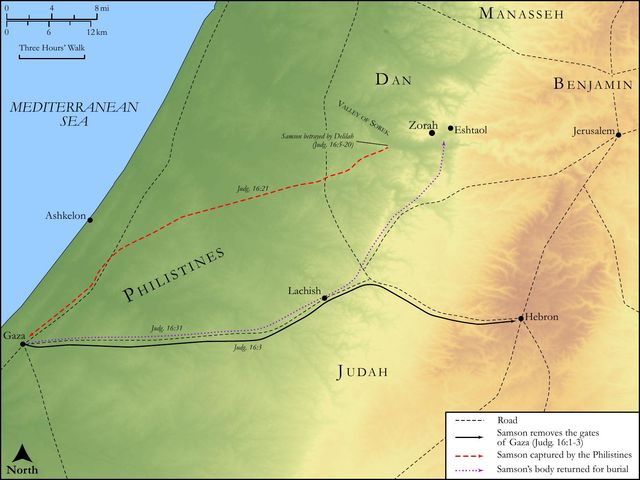
Gaza was one of the five major Philistine city-states (the Philistine Pentapolis), a heavily fortified and strategically vital stronghold on the coastal plain. City gates in the ancient Near East were not merely doors; they were massive, multi-layered defensive structures, often reinforced with metal, and secured by heavy wooden or iron bars. They were the primary point of entry and defense, symbolizing the city's security, power, and control over its inhabitants and trade routes. For Samson to physically remove these gates, along with their deeply set posts and the securing bar, was an act of profound public shaming and military humiliation for the Philistines. The destination, "a hill that is before Hebron," is significant. Hebron was a prominent Israelite city in the Judean hills, approximately 40 miles (64 km) inland from Gaza. Carrying such an immense load that distance, and then up a hill, was an utterly impossible human feat, designed to be a public spectacle that would leave no doubt about the source of Samson's power and the Philistines' utter inability to contain him.
Key Themes
ShowHideJudges 16:3 powerfully underscores several key themes prevalent in the book of Judges and the broader biblical narrative. Foremost is the theme of Supernatural Strength and Divine Empowerment, demonstrating that Samson's power was not inherent but a direct gift from God, as seen when the Spirit of the Lord rushed upon him. This strength is paradoxically displayed even amidst Samson's moral compromises, highlighting God's Divine Sovereignty and Purpose—His plan for Israel's deliverance would proceed despite the flaws of His chosen instruments. The act also emphasizes the Humiliation of Enemies, as Samson's public removal of Gaza's gates served as a symbolic and literal dismantling of Philistine authority and security, a direct challenge to their dominance over Israel. Finally, it subtly reinforces the theme of God Working Through Imperfect Vessels, a recurring motif throughout Scripture, where God often uses the weak or flawed to accomplish His mighty purposes, thereby ensuring that the glory belongs to Him alone, a principle echoed in 1 Corinthians 1:27.
Exposition and Analysis
ShowHideKey Word Analysis
ShowHideThis term (H1817) refers to the massive, swinging leaves or panels of the gate. In ancient cities, these were exceptionally large, thick, and heavy, often constructed of multiple layers of wood and reinforced with metal. Samson's act of taking them signifies not merely opening them, but physically detaching the entire entry system, a monumental task.
These (H4201) were the massive, vertical doorframes, deeply set into the ground and foundational to the gate structure. To remove them implies an even greater exertion of force than merely the doors, as they would have been firmly anchored to support the immense weight of the doors and withstand siege attempts, demonstrating the complete dismantling of the gate's integrity.
This (H1280) refers to the heavy crossbar, typically made of wood or iron, that would slide into sockets on the gateposts to secure the doors from the inside, effectively locking the city. The phrase "bar and all" emphasizes the completeness of Samson's act—he took the entire locking mechanism, rendering the gate utterly useless and the city defenseless at that point.
Verse Breakdown
ShowHide"And Samson lay till midnight, and arose at midnight"
This detail highlights Samson's awareness and strategic timing. The Philistines were planning to ambush him at dawn, assuming he would be asleep and vulnerable. By rising at midnight, Samson demonstrates his cunning and pre-empts their plot, turning their intended trap into an opportunity for his escape and their profound humiliation. It underscores his proactive rather than reactive posture.
"and took the doors of the gate of the city, and the two posts, and went away with them, bar and all"
This clause describes the extraordinary feat itself. It's not just the doors, but the entire defensive apparatus—the massive doors, their deeply embedded posts, and the securing bar—that Samson removes. This underscores the sheer impossibility of the act for any ordinary human, emphasizing the supernatural strength bestowed upon him by God. It was a complete and utter dismantling of Gaza's primary security feature, leaving the city exposed.
"and put [them] upon his shoulders, and carried them up to the top of an hill that [is] before Hebron"
This final part of the verse details the incredible display of power and the public nature of Samson's act. Carrying such an immense load a significant distance (approximately 40 miles) and then up a prominent hill is a testament to his unparalleled strength. Placing them "before Hebron" (an Israelite city) suggests a visible location, making the Philistines' humiliation a public spectacle and a clear declaration of God's power over their oppressors, serving as a sign to both Israel and Philistia.
Literary Devices
ShowHideThe narrative of Judges 16:3 employs several powerful literary devices. Hyperbole is vividly evident in the description of Samson carrying the entire city gate, posts, and bar for a distance of 40 miles up a hill; while the precise distance and physical logistics push the boundaries of literal human capability, the effect is to magnify the incredible, superhuman nature of his strength, emphasizing divine intervention rather than mere human prowess. Symbolism is central, as the city gates themselves symbolize the strength, security, and authority of Gaza; Samson's act of tearing them down and carrying them away symbolizes the dismantling of Philistine power and their utter inability to contain God's chosen deliverer. This act serves as a powerful visual metaphor for Israel's potential liberation from their oppressors. Furthermore, there is a strong element of Irony, as Samson, despite his ongoing moral failings and association with a harlot, is still the vessel through which God's mighty power is displayed, highlighting God's sovereignty and His ability to work through imperfect individuals to achieve His purposes, even when those individuals are disobedient.
Theological and Thematic Connections
ShowHideJudges 16:3 stands as a profound testament to God's extraordinary power and His unwavering commitment to His redemptive plan, even when His chosen instruments are deeply flawed. Samson's strength is a direct manifestation of the Spirit of the Lord, demonstrating that divine empowerment can transcend human weakness and moral compromise for God's sovereign purposes. This act of tearing down the gates of Gaza foreshadows a greater spiritual victory, illustrating God's capacity to break through any stronghold—physical or spiritual—that opposes His will and His people. It reminds us that ultimate power and deliverance reside with God, not with human might or fortified cities, and that He can use even the most unlikely means to accomplish His will.
Reflection and Application
ShowHideSamson's incredible feat in Judges 16:3 offers a complex yet deeply encouraging message for believers today. It reminds us that God's power is not limited by our circumstances or even our personal failings. While Samson's moral choices were clearly disobedient and ultimately led to his downfall, God's divine purpose for him as a deliverer of Israel remained, and His strength continued to manifest through him. This challenges us to consider that God can and does work through imperfect people, not because He condones their sin, but because His sovereignty is greater than human weakness. This narrative encourages us to trust in God's limitless power for deliverance from seemingly insurmountable "gates" or obstacles in our lives, whether they be spiritual strongholds, personal struggles, or external pressures that seem to trap us. However, it also serves as a poignant reminder that divine gifting does not negate personal responsibility; Samson's story is a cautionary tale about the dangers of repeatedly testing God's grace and the inevitable consequences of unrepentant sin, even for those greatly used by God. Our obedience, though not the source of God's power, is essential for sustained blessing and effective ministry.
Questions for Reflection
ShowHideFAQ
ShowHideHow far was Hebron from Gaza, and why is that significant?
ShowHideHebron was approximately 40 miles (64 kilometers) inland from Gaza. This distance is highly significant because it underscores the utterly impossible nature of Samson's feat for any ordinary human. Carrying massive city gates, posts, and a bar for such a distance, and then up a hill, was a superhuman act, clearly indicating divine intervention. The location "before Hebron" (an Israelite city) suggests a visible, public display. This act was designed not just as an escape, but as a profound public humiliation for the Philistines and a clear, undeniable demonstration of God's power working through Samson, leaving no doubt about the source of his strength and the Philistines' inability to contain him or Israel's God.
What was the symbolic significance of taking the city gates?
ShowHideIn the ancient world, city gates were far more than mere entryways; they were the primary defensive structures, symbols of a city's strength, security, and authority. They were also centers for legal proceedings, public gatherings, and trade. For Samson to physically remove the entire gate structure of Gaza was an act of profound public humiliation and a direct challenge to Philistine dominance. It symbolized the stripping away of their security and power, making the city vulnerable and publicly shaming its inhabitants and rulers. This dramatic act was a powerful declaration that the Philistines could not contain God's chosen deliverer, foreshadowing the eventual breaking of their power over Israel. It was a visible sign that their strength was no match for the God of Israel.
Did God approve of Samson's actions with the harlot in Gaza?
ShowHideNo, the Bible does not indicate God's approval of Samson's moral compromises, including his association with a harlot in Gaza. Samson's Nazirite vow required separation and holiness, and his actions were a clear violation of these principles. However, the narrative in Judges consistently demonstrates God's sovereignty and His ability to work through imperfect, disobedient, and even sinful individuals to accomplish His divine purposes. In this instance, God used Samson's presence in Gaza and the Philistines' plot as an opportunity for another display of His power and to bring judgment upon Israel's oppressors. It's crucial to distinguish between God's use of a person despite their sin and God's approval of their sin. God's ultimate plan for Israel's deliverance continued, even as Samson's personal choices led him down a path of increasing moral decline, serving as a cautionary tale.
Christ-Centered Fulfillment
ShowHideSamson's astonishing act of tearing down and carrying away the gates of Gaza, a symbol of human strength and security, serves as a powerful Old Testament foreshadowing of Christ's ultimate victory over the spiritual strongholds that imprison humanity. While Samson's deliverance was physical and temporary, a flawed human effort empowered by God, Jesus Christ, the true and perfect Deliverer, utterly destroyed the gates of sin, death, and hell. Samson's strength, though supernatural, was a gift to an imperfect man; Christ's power is inherent, divine, and absolute. Just as Samson burst forth from the Philistine ambush, Christ, through His death and resurrection, broke the power of the grave and triumphed over the spiritual forces of darkness, disarming principalities and powers and leading captivity captive, as celebrated in Colossians 2:15. His victory ensures that "the gates of Hades will not overpower" His Church (Matthew 16:18), for He is the "stronger man" who has bound the strong man and plundered his house (Luke 11:22). Samson's carrying of the gates to a hill before Hebron, a public spectacle of triumph, points to Christ's public victory on the cross and His glorious resurrection, which forever opened the way to true freedom and eternal life, delivering all who believe from the power of sin and the fear of death (Hebrews 2:14-15).