


Judges 14:6
- וַתִּצְלַחva·titz·Lachand it rushedH6743Conj-w ¦ V-Qal-ConsecImperf-3fsVerb Qal Consecutive Imperfect 3rd Singular Feminineוַandתִּצְלַחit rushed
- עָלָיו'a·Lavon himH5921Prep ¦ 3msPreposition Definiteעָלָיonוhim
- רוּחַRu·ach[the] spirit ofH7307N-fscNoun Singular Feminine Construct
- יְהוָהYah·wehYahwehH3068N-properNoun Proper Title
- וַיְשַׁסְּעֵהוּvay·sha·se·'E·huand he tore apart itH8156Conj-w ¦ V-Piel-ConsecImperf-3ms ¦ 3msVerb Piel Consecutive Imperfect 3rd Singular Masculineוַandיְשַׁסְּעֵhe tore apartהוּit
- כְּשַׁסַּעke·sha·Sa'as tears apartH8156Prep-k ¦ V-Piel-InfVerb Piel Infinitive Constructכְּasשַׁסַּעtears apart
- הַגְּדִיha·ge·Di<the> kidH1423Art ¦ N-msNoun Singular Masculine Absoluteהַ<the>גְּדִיkid
- וּמְאוּמָהu·me·'U·mahand [was] anythingH3972Conj-w ¦ N-fsNoun Singular Feminine Absoluteוּandמְאוּמָה[was] anything
- אֵין'einthere notH369N-mscNoun Singular Masculine Construct
- בְּיָדוֹbe·ya·Doin his handH3027Prep-b ¦ N-csc ¦ 3msNoun Singular common gender Constructבְּinיָדhandוֹhis
- וְלֹאve·Lo'and notH3808Conj-w ¦ NegParticle Negativeוְandלֹאnot
- הִגִּידhi·Gidhe toldH5046V-Hiphil-Perf-3msVerb Hiphil Perfect 3rd Singular Masculine
- לְאָבִיוle·'a·Vivto his fatherH1Prep-l ¦ N-msc ¦ 3msNoun Singular Masculine Constructלְtoאָבִיfatherוhis
- וּלְאִמּוֹu·le·'i·Moand to his motherH517Conj-w ¦ Prep-l ¦ N-fsc ¦ 3msNoun Singular Feminine Constructוּandלְtoאִמּmotherוֹhis
- אֵת'et<obj.>H853DirObjMParticle Object Indicator
- אֲשֶׁר'a·Sher[that] whichH834RelParticle Relative
- עָשָׂה'a·Sahhe had doneH6213V-Qal-Perf-3msVerb Qal Perfect 3rd Singular Masculine
English is a literal word-by-word gloss of the Hebrew, not the KJV's wording. Why?
This is the original text the KJV's translators worked from — each Hebrew word with its own literal English meaning in this verse, prepared by scholars at Tyndale House, Cambridge. The KJV translates whole sentences, not word by word, so its wording differs: one Hebrew word can become several English words, and the KJV may choose “the LORD” where the gloss reads “Yahweh”. Both are faithful — they answer different questions. For the KJV's own rendering, switch to the KJV text.
Details
See on the biblical-era maps
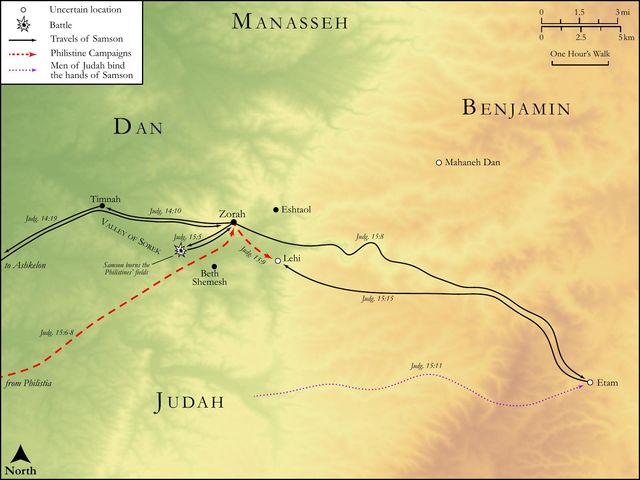
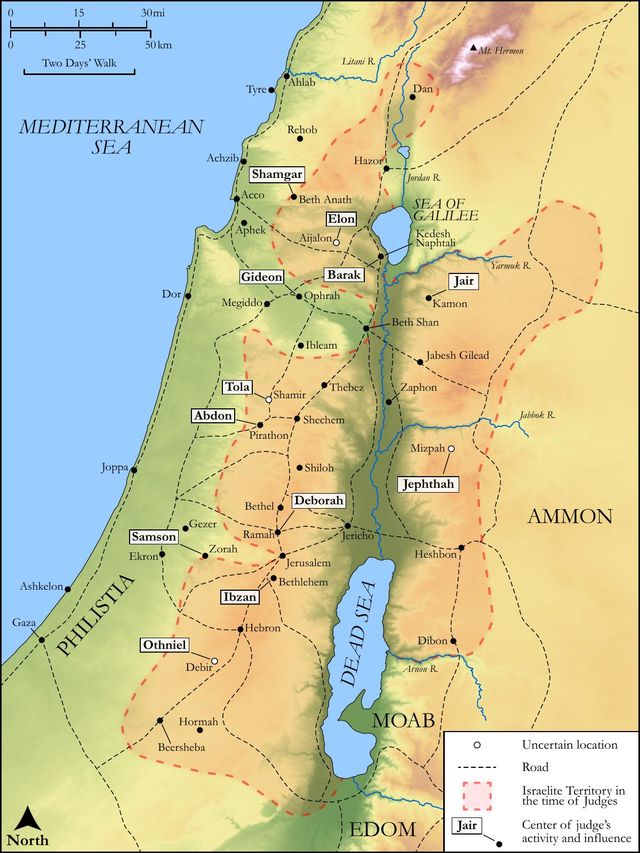
Study this verse
Public-domain commentary
Matthew Henry
From his Commentary on the Whole Bible. Henry comments on passages, not single verses — this entry covers Judges 14:1–9. His three-level outline is real structure in the source text, so it is rendered as structure.
Here, I. Samson, under the extraordinary guidance of Providence, seeks an occasion of quarrelling with the Philistines, by joining in affinity with them - a strange method, but the truth is Samson was himself a riddle, a paradox of a man, did that which was really great and good, by that which was seemingly weak and evil, because he was designed not to be a pattern to us (who must walk by rule, not by example), but a type of him who, though he knew no sin, was made sin for us, and appeared in the likeness of sinful flesh, that he might condemn and destroy sin in the flesh, Rom 8:3.
1.As the negotiation of Samson's marriage was a common case, we may observe,
(1.)That is was weakly and foolishly done of him to set his affections upon a daughter of the Philistines; the thing appeared very improper. Shall one that is not only an Israelite, but a Nazarite, devoted to the Lord, covet to become one with a worshipper of Dagon? Shall one marked for a patriot of his country match among those that are its sworn enemies? He saw this woman (Jdg 14:1), and she pleased him well, Jdg 14:3. It does not appear that he had any reason to think her wise or virtuous, or in any way likely to be a help-meet for him; but he saw something in her face that was very agreeable to his fancy, and therefore nothing will serve but she must be his wife. He that in the choice of a wife is guided only by his eye, and governed by his fancy, must afterwards thank himself if he find a Philistine in his arms.
(2.)Yet it was wisely and well done not to proceed so much as to make his addresses to her till he had first made his parents acquainted with the matter. He told them, and desired them to get her for him to wife, Jdg 14:2. Herein he is an example to all children. Conformably to the law of the fifth commandment, children ought not to marry, nor to move towards marrying, without the advice and consent of their parents; those that do (as bishop Hall here expresses it) wilfully unchild themselves, and exchange natural affections for violent. parents have a property in their children as parts of themselves. In marriage this property is transferred; for such is the law of the relation that a man shall leave his father and his mother and cleave to his wife. It is therefore not only unkind and ungrateful, but very unjust, to alienate this property without their concurrence; whoso thus robbeth his father or mother, stealing himself from them, who is nearer and dearer to them than their goods, and yet saith, It is no transgression, the same is the companion of a destroyer, Pro 28:24.
(3.)His parents did well to dissuade him from yoking himself thus unequally with unbelievers. Let those who profess religion, but are courting an affinity with the profane and irreligious, matching into families where they have reason to think the fear of God is not, nor the worship of God, let them hear their reasoning, and apply it to themselves: "Is there never a woman among the daughters of thy brethren, or, if none of our tribe, never a one among all thy people, never an Israelite, that pleases thee, or that thou canst think worthy of thy affection, that thou shouldest marry a Philistine?" In the old world the sons of God corrupted and ruined themselves, their families, and that truly primitive church, by marrying with the daughters of men, Gen 6:2. God had forbidden the people of Israel to marry with the devoted nations, one of which the Philistines were, Deu 7:3.
(4.)If there had not been a special reason for it, it certainly would have been improper in him to insist upon his choice, and in them to agree to it at last. Yet their tender compliance with his affections may be observed as an example to parents not to be unreasonable in crossing their children's choices, nor to deny their consent, especially to those that have seasonably and dutifully asked it, without some very good cause. As children must obey their parents in the Lord, so parents must not provoke their children to wrath, lest they be discouraged. This Nazarite, in his subjection to his parents, asking their consent, and not proceeding till he had it, was not only an example to all children, but a type of the holy child Jesus, who went down with his parents to Nazareth (thence called a Nazarene) and was subject to them, Luk 2:51.
2.But this treaty of marriage is expressly said to be of the Lord, Jdg 14:4. Not only that God afterwards overruled it to serve his designs against the Philistines, but that he put it into Samson's heart to make this choice, that he might have occasion against the Philistine. It was not a thing evil in itself for him to marry a Philistine. It was forbidden because of the danger of receiving hurt by idolaters; where there was not only no danger of that kind, but an opportunity hoped for of doing that hurt to them which would be good service to Israel, the law might well be dispense with. It was said (Jdg 13:25) that the Spirit of the Lord began to move him at times, and we have reason to think he himself perceived that Spirit to move him at this time, when he made this choice, and that otherwise he would have yielded to his parents' dissuasives, nor would they have consented at last if he had not satisfied them it was of the Lord. This would bring him into acquaintance and converse with the Philistines, by which he might have such opportunities of galling them as otherwise he could not have. It should seem, the way in which the Philistines oppressed Israel was, not by great armies, but by the clandestine incursions of their giants and small parties of their plunderers. In the same way therefore Samson must deal with them; let him but by this marriage get among them, and he would be a thorn in their sides. Jesus Christ, having to deliver us from this present evil world, and to cast out the prince of it, did himself visit it, though full of pollution and enmity, and, by assuming a body, did in some sense join in affinity with it, that he might destroy our spiritual enemies, and his own arm might work the salvation.
II.Samson, by a special providence, is animated and encouraged to attack the Philistines.
That being the service for which he was designed, God, when he called him to it, prepared him for it by two occurrences: -
1.By enabling him, in one journey to Timnath, to kill a lion, Jdg 14:5, Jdg 14:6. Many decline doing the service they might do because they know not their own strength. God let Samson know what he could do in the strength of the Spirit of the Lord, that he might never be afraid to look the greatest difficulties in the face. David, who was to complete the destruction of the Philistines, must try his hand first upon a lion and a bear, that thence he might infer, as we may suppose Samson did, that the uncircumcised Philistine should be as one of them, Sa1 17:36.
(1.)Samson's encounter with the lion was hazardous. It was a young lion, one of the fiercest sort, that set upon him, roaring for his prey, and setting his eye particularly upon him; he roared in meeting him, so the word is. He was all alone in the vineyards, whither he had rambled from his father and mother (who kept the high road), probably to eat grapes. Children consider not how they expose themselves to the roaring lion that seeks to devour when, out of a foolish fondness for liberty, they wander from under the eye and wing of their prudent pious parents. Nor do young people consider what lions lurk in the vineyards, the vineyards of red wines, as dangerous as snakes under the green grass. Had Samson met with this lion in the way, he might have had more reason to expect help both from God and man than here in the solitary vineyards, out of his road. But there was a special providence in it, and the more hazardous the encounter was,
(2.)The victory was so much the more illustrious. It was obtained without any difficulty: he strangled the lion, and tore his throat as easily as he would have strangled a kid, yet without any instrument, not only no sword nor bow, but not so much as a staff or knife; he had nothing in his hand. Christ engaged the roaring lion, and conquered him in the beginning of his public work (Mat 4:1, etc.), and afterwards spoiled principalities and powers, triumphing over them in himself, as some read it, not by any instrument. He was exalted in his own strength. That which added much to the glory of Samson's triumph over the lion was that when he had done this great exploit he did not boast of it, did not so much as tell his father nor mother that which many a one would soon have published through the whole country. Modesty and humility make up the brightest crown of great performances.
2.By providing him, the next journey, with honey in the carcase of this lion, Jdg 14:8, Jdg 14:9. When he came down the next time to solemnize his nuptials, and his parents with him, he had the curiosity to turn aside into the vineyard where he had killed the lion, perhaps that with the sight of the place he might affect himself with the mercy of that great deliverance, and might there solemnly give thanks to God for it. It is good thus to remind ourselves of God's former favours to us. There he found the carcase of the lion; the birds or beasts of prey, it is likely, had eaten the flesh, and in the skeleton a swarm of bees had knit, and made a hive of it, and had not been idle, but had there laid up a good stock of honey, which was one of the staple commodities of Canaan; such plenty there was of it that the land is said to flow with milk and honey. Samson, having a better title than any man to the hive, seizes the honey with his hands. This supposes an encounter with the bees; but he that dreaded not lion's paws had no reason to fear their stings. As by his victory over the lion he was emboldened to encounter the Philistine-giants, if there should be occasion, notwithstanding their strength and fierceness, so by dislodging the bees he was taught not to fear the multitude of the Philistines; though they compassed him about like bees, yet in the name of the Lord he should destroy them, Psa 118:12. Of the honey he here found,
(1.)He ate himself, asking no questions for conscience' sake; for the dead bones of an unclean beast had not that ceremonial pollution in them that the bones of a man had. John Baptist, that Nazarite of the New Testament, lived upon wild honey.
(2.)He gave to his parents, and they did eat; he did not eat all himself. Hast thou found honey? eat so much as is sufficient for thee, and no more, Pro 25:16. He let his parents share with him. Children should be grateful to their parents with the fruits of their own industry, and so show piety at home, Ti1 5:4. Let those that by the grace of God have found sweetness in religion themselves communicate their experience to their friends and relations, and invite them to come and share with them. He told not his parents whence he had it, lest they should scruple eating it. Bishop Hall observes here that those are less wise and more scrupulous than Samson that decline the use of God's gifts because they find them in ill vessels. Honey is hone still, though in a dead lion. Our Lord Jesus having conquered Satan, that roaring lion, believers find honey in the carcase, abundant strength and satisfaction, enough for themselves and for all their friends, from that victory.
Historical interpretation
Historical reception
2 surviving comments on this verse. Each one is dated, so this reads as a timeline rather than a list.
Select a marker to jump to its quote. Markers stagger vertically where authors wrote within a few decades of each other.
This request was granted; and Samson on his return to visit his promised bride, turned a little way out of the road, and straightway there met him a lion from the wood, fierce in its savage freedom. Samson had no companion, nor any weapon in his hand; but he felt ashamed to fly, and conscious power gave him courage. He caught the lion as it rushed upon him in his arms, and strangled it by the tightness of his embrace, leaving it near the wayside lying upon the underwood, for the spot was clothed with luxuriant herbage, and planted with vineyards. The skin of the beast he thought would be little esteemed by his beloved bride, for seasons such as these derive their grace not from savage trophies, but rather from gentle joys and festal garlands. On his returning by the same road he found an honeycomb in the belly of the lion, and carried it off as a gift to the maiden and her parents; for such gifts befit a bride. And having first tasted the honey, he gave them the comb to eat, but was silent as to whence it came.
Many of the fathers have spoken a great deal about this lion, beloved brothers, and all of them have said what is fitting and in accord with the facts. Some have said that the lion prefigured Christ our Lord. Truly, this is very appropriate, for to us Christ is a lion in whose mouth we found the food of honey after his death. What is sweeter than the Word of God? Or what is stronger than his right hand? In whose mouth after death is there food and bees, except his in whose word is the good of our salvation and the congregation of the Gentiles? The lion can further be understood as the Gentiles who believed. First, it was a body of vanity, but is now the body of Christ in which the apostles like bees stored the honey of wisdom gathered from the dew of heaven and the flowers of divine grace. Thus, food came out of the mouth of the one who died; because nations which were as fierce as lions at first, accepted with a devout heart the word of God which they received and produced the fruit of salvation.
Continue studying Judges 14:6 across the web’s major study libraries — every link below opens this exact verse, chapter, or book on the destination site.
Read & Compare
 BibleGatewayThis verse in more than 200 translations and 70 languages.
 Bible.comThe YouVersion reader — hundreds of translations, reading plans, and highlights.
 ESV.orgCrossway's official English Standard Version reader.
 NET BibleThe NET translation with 60,000+ translators' notes on every rendering decision.
 STEP BibleTyndale House's free study tool — original text, vocabulary, and scholarly resources.
 BibliaLogos Bible Software's free web reader.
 USCCBThe New American Bible (Revised Edition) with the U.S. bishops' study notes.
Commentaries
 BibleHub CommentariesDozens of classic commentaries on this verse, gathered on one page.
 StudyLightMore than 100 commentary sets — the largest collection on the web.
 BibleRefPlain-English commentary on what this verse means, verse by verse.
 Enduring WordDavid Guzik's free commentary on this chapter, widely used by Bible teachers.
 Bible Study ToolsVerse commentary alongside Greek and Hebrew study aids.
Original Language & Research
- BibleHub InterlinearThe verse word by word — original language, transliteration, and English.
- BibleHub LexiconEvery word's original-language definition and Strong's entry.
 Blue Letter BibleDeep-study tools — Strong's numbers, concordance, and word studies.
 SefariaThe Hebrew text with Rashi and centuries of Jewish commentary.
Sermons, Hymns & Audio


TrulyRandomVerse is not affiliated with these sites and doesn’t control their content. They’re linked because they’re genuinely useful.
Summary
Judges 14:6 vividly recounts the initial, dramatic manifestation of Samson's divinely endowed strength. As he journeys to Timnath, the Spirit of the LORD powerfully descends upon him, enabling him to effortlessly tear apart a young lion with his bare hands, an act performed without any weapon. This extraordinary feat underscores the supernatural source of his anointing, yet Samson chooses to conceal this profound display of God's power from his parents, revealing an early glimpse into the complex and often secretive nature that would characterize his tumultuous narrative.
Context
ShowHideLiterary Context
Judges 14:6 is a pivotal moment within the unfolding narrative of Samson, serving as the inaugural, albeit secretly performed, public demonstration of the supernatural strength prophesied at his birth. This event immediately follows Samson's controversial decision to seek a Philistine wife in Timnath, a choice that initially displeases his parents but is ultimately revealed as part of God's sovereign plan to instigate conflict with the Philistines, Israel's oppressors at the time (Judges 14:4). The lion encounter occurs en route to Timnath, strategically positioning it as a divine equipping or affirmation for the larger mission of delivering Israel from Philistine domination, a task for which Samson was set apart from the womb as a Nazirite (Judges 13:5). This incident establishes the precedent for Samson's subsequent exploits, consistently linking his extraordinary strength directly to the empowerment of the Spirit, often in response to personal provocations rather than strategic military campaigns.
Historical & Cultural Context
The era of the Judges (approximately 1200-1000 BC) was a turbulent period for Israel, marked by a cyclical pattern of spiritual apostasy, subsequent foreign oppression, Israel's cries for deliverance, and God raising up charismatic leaders, or "judges," to rescue them. The Philistines, a formidable group of "Sea Peoples" who had settled the southwestern coastal plain of Canaan, were a technologically advanced and militarily organized adversary, possessing superior iron weaponry. Their constant presence posed a significant threat to Israel's territorial integrity and religious purity. While marriage alliances with foreigners were often discouraged in Israelite law due to the risk of idolatry, they were not entirely uncommon. However, Samson's deliberate choice of a Philistine woman was particularly provocative given the ongoing oppression. In Israel, lions were a very real and terrifying threat to both livestock and humans, as David later told of the lion and the bear that took a lamb out of the flock, and they symbolized immense danger, ferocity, and untamed power. Therefore, the act of tearing a lion apart with bare hands, while supernatural, would have been perceived as an astonishing and almost unbelievable display of power.
Key Themes
ShowHideThis verse powerfully encapsulates several overarching themes prevalent within the book of Judges and the broader biblical narrative. Firstly, Divine Empowerment is central, highlighting God's direct intervention through His Spirit to equip individuals with extraordinary abilities for specific, divinely appointed tasks. This is a recurring motif seen in other judges, such as Othniel (Judges 3:10) and Gideon (Judges 6:34), demonstrating God's active involvement in human history. Secondly, Supernatural Strength is vividly displayed, emphasizing that Samson's power was not inherent, physical, or weapon-dependent, but a miraculous gift from God, showcasing His ability to work beyond natural human limitations. Thirdly, the theme of Samson's Flawed Heroism begins to emerge; despite being divinely chosen and empowered, his personal choices and secretive nature, exemplified by his decision to conceal this monumental feat from his parents, foreshadow the complex and often problematic trajectory of his judgeship, where personal desires frequently intertwine with, and sometimes compromise, divine purposes.
Exposition and Analysis
ShowHideKey Word Analysis
ShowHideDerived from H7307, this term, often translated as "wind," "breath," or "spirit," here specifically refers to the "Spirit of the LORD" (rûwach Yĕhôvâh). It denotes a divine, supernatural empowering presence that equips individuals with extraordinary abilities for specific tasks, particularly for leadership, prophecy, or deliverance. In the context of Judges, it signifies a special anointing that transforms an ordinary person into an instrument of God's power, enabling feats far beyond human capability.
The verb tsâlach conveys a dynamic sense of bursting forth, rushing upon, or prevailing over. When used with "Spirit," as here, it implies an overwhelming, sudden, and effective divine force that seizes control of the recipient, enabling them to accomplish a task that is humanly impossible. It describes an active, dynamic, and irresistible empowerment that propels the individual forward in their divinely appointed mission.
This primitive root means to split, tear, or rip apart. The imagery of Samson tearing the lion "as he would have rent a kid" (H1423, gᵉdîy) emphasizes the incredible ease and swiftness with which he dispatched the powerful beast. The comparison to a "kid" (a young goat) highlights the immense disparity between the lion's natural strength and the Spirit-empowered Samson's effortless victory, underscoring the supernatural nature of his strength.
Verse Breakdown
ShowHide"And the Spirit of the LORD came mightily upon him"
This clause serves as the theological bedrock of the verse, unequivocally attributing Samson's extraordinary strength and subsequent action directly to divine intervention. It signifies a special, supernatural anointing from God, indicating that his power was not an inherent physical attribute but a miraculous, enabling presence. This phrase underscores God's active and direct involvement in the lives of His chosen servants, transforming an ordinary man into an instrument capable of performing feats far beyond human capability.
"and he rent him as he would have rent a kid"
This vivid simile powerfully illustrates the astonishing ease and overwhelming power with which Samson subdued the lion. By comparing the tearing of a formidable lion to the tearing of a vulnerable young goat, the text emphasizes the effortlessness of the act. This highlights the immense disparity between the lion's natural ferocity and the Spirit-empowered Samson's effortless victory, demonstrating the sheer magnitude of the divine force at work through him, making the seemingly impossible, simple and immediate.
"and [he had] nothing in his hand"
This crucial detail further magnifies the miraculous nature of the event. Samson was completely unarmed, possessing no weapon, tool, or external aid to assist him in this deadly encounter. This emphasizes that his victory was solely due to the supernatural power of God, not any human preparation, skill, or equipment. It serves to underscore that the power was entirely from the LORD, removing any possibility of human agency or ingenuity being the source of his success.
"but he told not his father or his mother what he had done."
This final clause introduces a significant and often problematic character trait of Samson: his secrecy and independent nature. Despite performing such an incredible feat, a clear sign of divine favor and power, he chooses to keep it hidden from his parents. This secrecy hints at a certain self-reliance, a desire to control his own narrative, or perhaps a lack of accountability. It foreshadows future instances where his secrets and personal choices will play a crucial, sometimes detrimental, role in his story, complicating his divine mission and ultimately contributing to his downfall.
Literary Devices
ShowHideJudges 14:6 is rich in Imagery and Simile, vividly portraying Samson's supernatural strength. The phrase "rent him as he would have rent a kid" employs a striking Simile to convey the effortless nature of Samson's act, comparing the powerful and dangerous lion to a vulnerable young goat. This comparison also functions as a form of Hyperbole, emphasizing the extraordinary, almost unbelievable, ease with which the feat was accomplished, thereby underscoring the overwhelming divine power at work. The entire encounter serves as a significant Foreshadowing of Samson's future exploits, establishing his characteristic strength and its direct link to the Spirit of the LORD, as well as his tendency towards independent and often secretive actions. The narrative also subtly employs Irony in Samson's decision to conceal such a monumental act of divine power, hinting at the complex and often contradictory nature of his character, which will later lead to his downfall through the revelation of his secrets.
Theological and Thematic Connections
ShowHideJudges 14:6 profoundly illustrates the biblical theme of divine empowerment for specific purposes, demonstrating God's sovereign ability to equip and use individuals, even those with significant flaws, to accomplish His will. Samson's strength is not a product of his own physical prowess or training, but a direct, supernatural infusion of God's Spirit, highlighting that true power for God's work originates from Him alone. This event establishes a pattern of divine enablement that will characterize Samson's judgeship, where his personal actions, though often driven by self-interest, are paradoxically woven into God's larger plan for Israel's deliverance from Philistine oppression. The secrecy surrounding this act also introduces the tension between divine calling and human autonomy, a recurring motif in Samson's life that ultimately contributes to his tragic narrative.
Reflection and Application
ShowHideJudges 14:6 offers profound insights for contemporary believers, reminding us that God's power is not limited by our natural abilities or the magnitude of our challenges. Samson, despite his personal weaknesses and eventual failures, was powerfully used by God. This should encourage us to recognize that our effectiveness in God's kingdom is not contingent upon our inherent strength, wisdom, or righteousness, but upon the empowering presence of the Holy Spirit. When we face "lions" in our lives—overwhelming obstacles, spiritual battles, or seemingly impossible tasks—we are called not to rely on our own limited resources, but to trust in the boundless strength that God provides. This verse also subtly challenges us to consider the nature of our "secrets." While Samson's secrecy here might seem benign, it foreshadows a pattern that ultimately leads to his downfall. It prompts us to reflect on areas where we might be tempted to operate outside of accountability or to hoard the glory for divine accomplishments, rather than openly acknowledging God's hand. Ultimately, it calls us to humble dependence on God's Spirit and to use His gifts for His glory, not our own.
Questions for Reflection
ShowHideFAQ
ShowHideWas Samson's strength magical, or was it divine?
ShowHideSamson's strength was unequivocally divine, not magical. The text explicitly states, "the Spirit of the LORD came mightily upon him." This phrase is a recurring motif in the book of Judges and elsewhere in the Old Testament, signifying a special, supernatural empowering by God for a specific purpose. It was not an inherent ability Samson possessed, nor was it derived from any pagan or occult source. Rather, it was a direct manifestation of God's power working through him, enabling him to perform feats far beyond normal human capability. His strength was a miraculous gift, contingent upon his adherence to the Nazirite vow, which symbolized his consecration to God (Judges 13:5). When he broke that vow, the Spirit departed, and his strength left him (Judges 16:20). This clearly indicates its divine origin and conditional nature, distinguishing it sharply from any concept of magic or inherent power.
Christ-Centered Fulfillment
ShowHideSamson's divinely empowered act of tearing apart a lion foreshadows the ultimate victory of Christ over the forces of evil and death. Just as the Spirit of the LORD "came mightily upon" Samson, enabling him to overcome a physical threat with supernatural ease, so too was Jesus "anointed with the Holy Spirit and with power" (Acts 10:38) to confront and conquer the spiritual "lion," Satan, who "prowls around like a roaring lion seeking someone to devour" (1 Peter 5:8). Samson's unarmed victory over the lion points to Christ's triumph on the cross, where He disarmed the powers and authorities (Colossians 2:15) not with physical weapons, but through His sacrificial love and resurrection power. Furthermore, Samson's secrecy, while a character flaw, can be seen as a dim reflection of Christ's "messianic secret" in the Gospels, where He often commanded silence about His identity or miracles until the appointed time of His full revelation, particularly leading up to His passion (Mark 8:30). Ultimately, Samson's strength, though flawed in its application, points to Jesus, the true and perfect deliverer, who by the power of the Spirit, truly takes away the sin of the world and defeats its ultimate enemy, leading His people to ultimate freedom and victory (John 1:29).