


Isaiah 42:2
Bible text: King James Version (1769 Blayney text) · Public domain
Bible text: Berean Standard Bible · Public domain
Bible text: American Standard Version (1901) · Public domain
Bible text: World English Bible, Messianic edition · Public domain
Bible text: Geneva Bible (1599) · Public domain
Bible text: Young's Literal Translation · Public domain
- לֹאlo'notH3808NegParticle Negative
- יִצְעַקyitz·'Akhe will cry outH6817V-Qal-Imperf-3msVerb Qal Imperfect 3rd Singular Masculine
- וְלֹאve·Lo'and notH3808Conj-w ¦ NegParticle Negativeוְandלֹאnot
- יִשָּׂאyi·Sa'he will lift upH5375V-Qal-Imperf-3msVerb Qal Imperfect 3rd Singular Masculine
- וְלֹאve·lo'and notH3808Conj-w ¦ NegParticle Negativeוְandלֹאnot
- יַשְׁמִיעַyash·Mi·a'he will make heardH8085V-Hiphil-Imperf-3msVerb Hiphil Imperfect 3rd Singular Masculine
- בַּחוּץba·Chutzin the streetH2351Prep-b ¦ N-msNoun Singular Masculine Absoluteבַּin theחוּץstreet
- קוֹלוֹko·Lohis voiceH6963N-msc ¦ 3msNoun Singular Masculine Constructקוֹלvoiceוֹhis
English is a literal word-by-word gloss of the Hebrew, not the KJV's wording. Why?
This is the original text the KJV's translators worked from — each Hebrew word with its own literal English meaning in this verse, prepared by scholars at Tyndale House, Cambridge. The KJV translates whole sentences, not word by word, so its wording differs: one Hebrew word can become several English words, and the KJV may choose “the LORD” where the gloss reads “Yahweh”. Both are faithful — they answer different questions. For the KJV's own rendering, switch to the KJV text.
Details
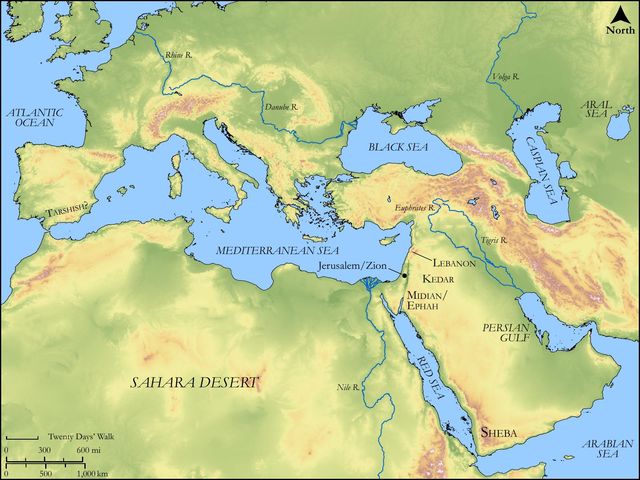
See on the biblical-era map
Study this verse
Public-domain commentary
Matthew Henry
From his Commentary on the Whole Bible. Henry comments on passages, not single verses — this entry covers Isaiah 42:1–4. His two-level outline is real structure in the source text, so it is rendered as structure.
We are sure that these verses are to be understood of Christ, for the evangelist tells us expressly that in him this prophecy was fulfilled, Mat 12:17-21. Behold with an eye of faith, behold and observe, behold and admire, my servant, whom I uphold. Let the Old Testament saints behold and remember him. Now what must we behold and consider concerning him?
I.The Father's concern for him and relation to him, the confidence he put and the complacency he took in him.
This put an honour upon him, and made him remarkable, above any other circumstance, Isa 42:1.
1.God owns him as one employed for him: He is my servant. Though he was a Son, yet, as a Mediator, he took upon him the form of a servant, learned obedience to the will of God and practised it, and laid out himself to advance the interests of God's kingdom, and so he was God's servant.
2.As one chosen by him: He is my elect. He did not thrust himself into the service, but was called of God, and pitched upon as the fittest person for it. Infinite Wisdom made the choice and then avowed it.
3.As one he put a confidence in: He is my servant on whom I lean; so some read it. The Father put a confidence in him that he would go through with his undertaking, and, in that confidence, brought many sons to glory. It was a great trust which the Father reposed in the Son, but he knew him to be par negotio - equal to it, both able and faithful.
4.As one he took care of: He is my servant whom I uphold; so we read it. The Father bore him up, and bore him out, in his upholding him; he stood by him and strengthened him.
5.As one whom he took an entire complacency in: My elect, in whom my soul delights. His delight was in him from eternity, when he was by him as one brought up with him, Pro 8:30. He had a particular satisfaction in his undertaking: he declared himself well pleased in him (Mat 3:17; Mat 17:5), and therefore loved him, because he laid down his life for the sheep. Let our souls delight in Christ, rely on him, and rejoice in him; and thus let us be united to him, and then, for his sake, the Father will be well pleased with us.
II.The qualification of him for his office:
I have put my Spirit upon him, to enable him to go through his undertaking, Isa 61:1. The Spirit did not only come, but rest, upon him (Isa 11:2), not by measure, as on others of God's servants, but without measure. Those whom God employs as his servants; as he will uphold them and be well pleased with them, so he will put his Spirit upon them.
III.The work to which he is appointed; it is to bring forth judgment to the Gentiles, that is, in infinite wisdom, holiness, and equity, to set up a religion in the world under the bonds of which the Gentiles should come and the blessings of which they should enjoy. The judgments of the Lord, which had been hidden from the Gentiles (Psa 147:20), he came to bring forth to the Gentiles, for he was to be a light to lighten them.
IV.The mildness and tenderness with which he should pursue this undertaking, Isa 42:2, Isa 42:3. He shall carry it on,
1.In silence, and without noise: He shall not strive nor cry. It shall not be proclaimed, Lo, here, is Christ or Lo, he is there; as when great princes ride in progress or make a public entry. He shall have no trumpet sounded before him, nor any noisy retinue to follow him. The opposition he meets with he shall not strive against, but patiently endure the contradiction of sinners against himself. His kingdom is spiritual, and therefore its weapons are not carnal, nor is its appearance pompous; it comes not with observation.
2.Gently, and without rigour. Those that are wicked he will be patient with; when he has begun to crush them, so that they are as bruised reeds, he will give them space to repent and not immediately break them; though they are very offensive, as smoking flax (Isa 65:5), yet he will bear with them, as he did with Jerusalem. Those that are weak he will be tender of; those that have but a little life, a little heat, that are weak as a reed, oppressed with doubts and fears, as a bruised reed, that are as smoking flax, as the wick of a candle newly lighted, which is ready to go out again, he will not despise them, will not plead against them with his great power, nor lay upon them more work or more suffering than they can bear, which would break and quench them, but will graciously consider their frame. More is implied than is expressed. He will not break the bruised reed, but will strengthen it, that it may become a cedar in the courts of our God. He will not quench the smoking flax, but blow it up into a flame. Note, Jesus Christ is very tender toward those that have true grace, though they are but weak in it, and accepts the willingness of the spirit, pardoning and passing by the weakness of the flesh.
V.The courage and constancy with which he should persevere in this undertaking, so as to carry his point at last (Isa 42:4):
He shall not fail nor be discouraged. Though he meets with hard service and much opposition, and foresees how ungrateful the world will be, yet he goes on with his part of the work, till he is able to say, Is is finished; and he enables his apostles and minsters to go on with theirs too, and not to fail nor be discouraged, till they also have finished their testimony. And thus he accomplishes what he undertook.
1.He brings forth judgment unto truth. By a long course of miracles, and his resurrection at last, he shall fully evince the truth of his doctrine and the divine origin and authority of that holy religion which he came to establish.
2.He sets judgment in the earth. He erects his government in the world, a church for himself among men, reforms the world, and by the power of his gospel and grace fixes such principles in the minds of men as tend to make them wise and just.
3.The isles of the Gentiles wait for his law, wait for his gospel, that is, bid it welcome as if it had been a thing they had long waited for. They shall become his disciples, shall sit at his feet, and be ready to receive the law from his mouth. What wilt thou have us to do?
Historical interpretation
Four Centuries of Reception
3 surviving comments on this verse. Each one is dated, so this reads as a timeline rather than a list.
Select a marker to jump to its quote. Markers stagger vertically where authors wrote within a few decades of each other.
And when he was departed thence, he went into their synagogue: And, behold, there was a man which had his hand withered. And they asked him, saying, Is it lawful to heal on the sabbath days? that they might accuse him. And he said unto them, What man shall there be among you, that shall have one sheep, and if it fall into a pit on the sabbath day, will he not lay hold on it, and lift it out? How much then is a man better than a sheep? Wherefore it is lawful to do well on the sabbath days. Then saith he to the man, Stretch forth thine hand. And he stretched it forth; and it was restored whole, like as the other. Then the Pharisees went out, and held a council against him, how they might destroy him. But when Jesus knew it, he withdrew himself from thence: and great multitudes followed him, and he healed them all; And charged them that they should not make him known: That it might be fulfilled which was spoken by Esaias the prophet, saying, Behold my servant, whom I have chosen; my beloved, in whom my soul is well pleased: I will put my spirit upon him, and he shall show judgment to the Gentiles. He shall not strive, nor cry; neither shall any man hear his voice in the streets. A bruised reed shall he not break, and smoking flax shall he not quench, till he send forth judgment unto victory. And in his name shall the Gentiles trust. [Isaiah 42:1-4]
What does it mean that it is written in Matthew: 'A bruised reed shall he not break, and smoking flax shall he not quench' (Matthew 12:20). For the explanation of this passage, the whole testimony that Matthew takes from the Prophet Isaiah must be set forth, even the words of Isaiah (Isaiah 42): according to the Septuagint interpreters and the Hebrew itself, to which Theodotus, Aquila, and Symmachus agree. Thus of the four Evangelists, only Matthew relates: "And Jesus knowing it, retired from thence: and many followed him, and he healed them all. And he charged them that they should not make him known. That it might be fulfilled which was spoken by Isaias the prophet, saying: Behold my servant whom I have chosen, my beloved in whom my soul hath been well pleased. I will put my spirit upon him, and he shall shew judgment to the Gentiles." (Chapter 12, verses 15-18) He will not strive, nor cry out, nor will anyone hear his voice in the streets. A bruised reed he will not break, and smoking flax he will not extinguish, until he brings forth judgment unto victory. And in his name the Gentiles will hope" (Matthew 12:15 and following). For which in Isaiah, according to the Septuagint interpreters, it is thus written: "Jacob my servant, I will uplift him. My chosen one, my soul has received him. I have given my spirit upon him, he shall bring forth judgment to the Gentiles. He shall not cry, nor have respect to person, neither shall his voice be heard abroad. The bruised reed he shall not break: and smoking flax he shall not extinguish: but he shall bring forth judgment unto truth. He shall shine, and shall not be broken, until he set judgment in the earth: and the countries shall wait for his law." However, we translate it from Hebrew like this, "Behold my servant, I will uphold him; my chosen, my soul has delighted in him. I have given my spirit upon him: he shall bring forth judgment to the Gentiles. "He will not cry out, nor raise his voice, nor make it heard in the street. A bruised reed he will not break, and a smoldering wick he will not snuff out. In truth he will bring forth justice. He will not grow faint or be discouraged till he has established justice on the earth; and the islands will put their hope in his law." This shows that the Gospel writer Matthew, not bound by authority of the old interpretation, dismissed the Hebrew truth and brought forth to the nations, educated in the Law of the Lord, the things he had read in Hebrew as if he were a Hebrew among Hebrews. For if it is to be taken thus, as the Seventy Interpreters have given it: Jacob is my servant, I will receive him; Israel is my chosen, my soul has received him, how do we understand that it has been fulfilled in Jesus, what has been written concerning Jacob and Israel? We read that Blessed Matthew did this not only in this testimony, but also in another place: Out of Egypt I called my son (Hosea 11:2): for which the Seventy translated: Out of Egypt I called his sons. Certainly, if we do not follow the Hebrew truth, it is evident that it does not pertain to the Lord and Savior. For it follows: but they sacrificed to Baalim. And that which is less in the assumed testimony in the Gospel: it shall shine and not be shaken, until he shall place judgment upon the earth, seems to have happened by the error of the first writer who, reading the higher sentence to be finished in the word judgment, thought that the final word of the lower sentence was judgment, and he omitted a few words which were in the middle, that is, between judgment and judgment. And again, that which is read among the Hebrews: And in his law shall the islands hope, Matthew, interpreting the sense rather than the words, put for law and islands, a name and nations. And not only in the present place, but wherever the testimonies of the Evangelists and Apostles from the old Instrument have been brought forth, it should be observed more diligently: not that they followed words, but the sense: and where they differ from the Hebrew in the Septuagint, they expressed the Hebrew sense in their own words. Therefore, the Child of the almighty God, according to the dispensation of assumed flesh, which is sent to us, is called the Savior. To whom and in another place the Father says: It is great for you to be called my child, to gather the tribes of Jacob (Isai. 49.3). This is the vineyard of Sorec, which is interpreted as chosen. This is the beloved son, in whom the soul of God is pleased; not because God has a soul, but because every affection of God is shown in the soul. And it is not surprising if the soul is named in God, when all the members of the human body, according to the laws of tropology, and various intelligences, are said to have it. He also placed his spirit upon him: the Spirit of Wisdom and Understanding, the Spirit of Counsel and Strength, the Spirit of Knowledge and Piety, and the Spirit of the Fear of the Lord (Isaiah 11): He who descends upon him in the form of a dove, about whom John the Baptist narrates having heard from God the Father: "The One upon whom you see the Holy Spirit descending and remaining upon, He is" (John 1:33). And He will announce judgment to the Gentiles; concerning whom it is also written in the Psalms: "Give the king your justice, O God, and your righteousness to the son of a king" (Psalm 71:1). He Himself speaks about it in the Gospel: "For the Father judges no one, but has given all judgment to the Son" (John 5:22). He will not contend: like a lamb led to the slaughter: He will not argue in the hearing. Nor will he cry out, in accordance with what the Apostle Paul writes: Let all clamor, and anger, and bitterness be taken away from you (Ephesians 4:31). He will not cry out: because Israel did not do justice, but cry out. Nor will anyone hear his voice in the streets or outdoors. For all the glory of the daughter of the king is within (Psalm 44:14): And, Narrow, and cramped is the way that leads to life (Matthew 7:14). Therefore his voice is not heard in the streets, where wisdom confidently acts, not entering a broad and spacious way, but accusing and condemning. And so he spoke to those who were outside, not in his own voice, but in parables: 'The reed, he said, shaken does not break; or, as the Septuagint translated, the broken reed not to be crushed. The broken reed that was once vocal, and sang in praise of the Lord, is called Israel, who, because he stumbled on a corner stone and fell on it, was broken in it; therefore it is said of him: Rebuke, O Lord, the beasts of the reed (Ps. 67. 31): and in the volume of Jesus he is called the torrent of the cane, that is, of the reed; who has turbid waters, which Israel chose, despising the purest streams of the Jordan: and turning his mind back to Egypt, and desiring the marshy and swampy region, and pumpkins, and onions, and garlic, and cucumbers, and the pots of Egyptian flesh, is rightly called a broken reed by Isaiah: he who wants to lean on which, his hand will be pierced. For whoever, after the advent of the Lord and Savior and leaving behind the spirit of interpreting the Gospel, rests in the death of Jewish literature, all the works of that person are harmed. Even smoking linen will not extinguish a people gathered from the nations who, with the ardor of natural law extinguished, are wrapped in the bitter smoke, which is hurtful to the eyes, and enveloped in the darkness of errors. He who not only did not restrain and reduce to ashes, but on the contrary, from a small spark, and almost dying, raised the greatest fire; so that the whole world burned with the fire of the Lord and Savior, whom he came to send upon the earth, and in all desires to burn (Luke 12:49). According to the tropology, what we see in this place, we have briefly noted in the Commentaries of Matthew. But he who has not broken the bruised reed, and has not extinguished the smoking flax, has also brought judgment unto victory (Isai. 42:3), whose judgments are true, justified in themselves (Psalm 18), so that he may be justified in his words and may overcome in judgment (Psalm 50), and so that the light of his preaching may shine in the world, not be crushed by anyone, and may overcome all snares, until he establishes judgment on earth and that which is written may be fulfilled: 'Thy will be done on earth, as it is in heaven' (Matthew 6:10). And, in his name shall the Gentiles hope (Isaiah 11:10); or the islands shall hope in his law (Ibid. 42:4). For just as the islands are struck by the blast and rush of winds and frequently buffeted by storms, but they are not overturned, as an example of the Gospel house built on a sturdy foundation of rock (Matthew 7; and Luke 6), so the Churches, which hope in the law and in the name of the Lord and Savior, speak through Isaiah: I am a strong city, a city that cannot be taken (Isaiah 27:3, LXX).
(Chapter 42, Verses 1 onward) Behold my servant, I will uphold him: my chosen one, my soul is pleased with him. I have put my spirit upon him: he will bring justice to the nations. He will not cry out or raise his voice: his voice will not be heard in the streets. A bruised reed he will not break: a smoldering wick he will not put out: he will faithfully bring forth justice. He will not be sad or discouraged, until he establishes justice on earth: and the coastlands will wait for his law. LXX: Jacob my servant, I will take him: Israel my chosen, my soul has received him. I have put my spirit upon him: he will bring forth justice to the nations: he will not cry out, nor raise his voice, nor will his voice be heard in the streets. A bruised reed he will not break, and smoking flax he will not extinguish: he will bring forth justice in truth: he will shine and not be broken, until he establishes justice upon the earth: and the nations will hope in his name. Jacob and Israel are not mentioned in the current chapter, nor did Matthew the Evangelist include them, following Hebrew truth. We say this as a rebuke to those who despise us. This matter was discussed in more detail in the little Commentary on Matthew, and in the book we recently wrote to Algasia. And in the meantime, it should be noted that when the chorus of the Apostles is mentioned, both Jacob and Israel are called the seed of Abraham: to whom, as if to men and servants, it is subsequently said: Fear not, you worm Jacob, and you little one of Israel. But when it comes to Christ's prophecy, it is read without Jacob and Israel: Behold my servant, I will uphold him; my chosen, my soul is pleased with him. And in the following: I have given you as a testament to the race, as a light to the nations: to open the eyes of the blind, and to bring out prisoners from confinement, and those who dwell in darkness from the house of the prison. It is not surprising if he is called a servant, being made from a woman, and being made under the law (Galatians 4); who, although being in the form of God, he humbled himself, taking the form of a servant, and being found in human form (Philippians 2). In whom the soul of God was pleased, seeing in him all the virtues: indeed, seeing him as the power and wisdom of God. He said: 'I will send my Spirit upon him, who will come down in the form of a dove. He will bring judgment to the nations, which they did not know before. He will not cry out, for he will be gentle and meek. He will not show favoritism in judgment, nor will he raise his voice in the streets. According to Symmachus, he will not be deceived, understanding all the schemes of the devil. Or according to the Septuagint, he will not leave the people of the Jews, but will call them to repentance.' Nor will his voice be heard outside of Galilee and Judea, for he did not preach the Gospel among the other nations. And if we read that he was in the region of Tyre and Sidon (Matt. XV), or in the vicinity of Caesarea Philippi, which is now called Paneas, it should be understood that it is not written that he actually entered those cities. A bruised reed he will not break, and a smoldering wick he will not snuff out. For he will be merciful to all and will grant forgiveness to sinners, saying to the woman: Have confidence, daughter, your sins are forgiven (Luke VII, 48). And the smoking flax, or as the others have translated it, dim and gloomy, will not be extinguished: those who were near to being extinguished were saved by the mercy of the Lord (which we have discussed about the Jews and the nations in the aforementioned writings); but with truth He will judge all things; not fearing the Scribes and Pharisees, whom He boldly called hypocrites (Mat. VII, XV, XXII, XXIII throughout, and Luc. VI, XII): But what follows: It will shine, and will not be crushed, until He establishes judgment upon the Earth, the Evangelist Matthew did not include (Mat. XII): or perhaps between judgment and judgment, they were omitted due to an error by the writer. But it signifies that, rising from the dead, he enlightened all, and was not crushed by death, until he placed judgment upon the earth: of whom it is spoken in the Gospel: I have come into this world for judgment, that those who do not see may see, and those who see may become blind (John 9:39). Concerning which we have interpreted: He will not be sad, nor troubled; but will always maintain an equal countenance: which they falsely boast about Socrates the Philosopher, that he was never, more than usual, either sad or joyful. For which reason Aquila and Theodotius are interpreted: It will not hide, and it will not run, until it establishes judgment on earth. And the meaning is: no sadness will deter the face, nor will it hurry to punishment, who has reserved the truth of judgment for the last time. What follows: and the law of that island they will expect, the nations, clearly, put hope in its name: which in the Scriptures are called islands, because they are open to incursions of persecutors from every side. But let us understand his law, not the one given through Moses, but the Gospel: For from Zion a law shall go forth, and the word of the Lord from Jerusalem (see above, II). Concerning this law, Jeremiah also prophesies: Behold, the days are coming, says the Lord, and I will establish a new covenant, not like the covenant which I made with their fathers in the day that I took them by the hand to bring them out of the land of Egypt (Jeremiah 31:31, 32).
Continue studying Isaiah 42:2 across the web’s major study libraries — every link below opens this exact verse, chapter, or book on the destination site.
Read & Compare
 BibleGatewayThis verse in more than 200 translations and 70 languages.
 Bible.comThe YouVersion reader — hundreds of translations, reading plans, and highlights.
 ESV.orgCrossway's official English Standard Version reader.
 NET BibleThe NET translation with 60,000+ translators' notes on every rendering decision.
 STEP BibleTyndale House's free study tool — original text, vocabulary, and scholarly resources.
 BibliaLogos Bible Software's free web reader.
 USCCBThe New American Bible (Revised Edition) with the U.S. bishops' study notes.
Commentaries
 BibleHub CommentariesDozens of classic commentaries on this verse, gathered on one page.
 StudyLightMore than 100 commentary sets — the largest collection on the web.
 BibleRefPlain-English commentary on what this verse means, verse by verse.
 Enduring WordDavid Guzik's free commentary on this chapter, widely used by Bible teachers.
 Bible Study ToolsVerse commentary alongside Greek and Hebrew study aids.
Original Language & Research
- BibleHub InterlinearThe verse word by word — original language, transliteration, and English.
- BibleHub LexiconEvery word's original-language definition and Strong's entry.
 Blue Letter BibleDeep-study tools — Strong's numbers, concordance, and word studies.
 SefariaThe Hebrew text with Rashi and centuries of Jewish commentary.
Sermons, Hymns & Audio


TrulyRandomVerse is not affiliated with these sites and doesn’t control their content. They’re linked because they’re genuinely useful.
Summary
Isaiah 42:2 prophetically unveils the distinctive character and methodology of God's chosen Servant, portraying a figure whose profound influence and work for justice are achieved through quiet humility and gentle dignity, rather than through boisterous public display, clamor, or self-promotion. This verse emphasizes that the Servant's impact will not stem from contentious arguments or overt attention-seeking in public spaces, but from an unassuming, deeply impactful approach that stands in stark contrast to worldly expectations of power and authority.
Context
ShowHideLiterary Context
This verse is a foundational component of the first of four "Servant Songs" within the Book of Isaiah (Isaiah 42:1-4; Isaiah 49:1-6; Isaiah 50:4-9; Isaiah 52:13-53:12). These songs collectively delineate the identity, mission, and eventual suffering of a unique individual divinely appointed to bring salvation and justice to the world. Isaiah 42:1 introduces the Servant as one upheld by God, chosen, delighted in, and endowed with the Spirit to bring forth justice to the nations. Isaiah 42:2 immediately follows, elaborating on the manner in which this justice will be executed—not with loud proclamations or public spectacles, but with a quiet, gentle authority. The subsequent verses, such as Isaiah 42:3 and Isaiah 42:4, further reinforce this gentle yet resolute nature, describing a Servant who will not break a bruised reed or quench a dimly burning wick, and who will not falter until justice is firmly established on the earth.
Historical & Cultural Context
The Book of Isaiah, particularly chapters 40-55 (often referred to as Deutero-Isaiah), was written to offer comfort, hope, and prophecies of restoration to the Jewish exiles in Babylon. In this historical setting, the people yearned for a powerful, conquering Messiah who would overthrow their oppressors with military might and public fanfare, much like earthly kings or deliverers who would announce their presence with trumpets and declarations in public squares. The prophetic description of the Servant in Isaiah 42:2 directly challenges these prevailing expectations, presenting a radically different model of leadership and divine intervention. It speaks to a time when public discourse often involved loud debates and proclamations in city gates or streets, making the Servant's quiet approach even more striking and profoundly counter-cultural.
Key Themes
ShowHideThis verse contributes significantly to several key themes within Isaiah and broader biblical theology. Firstly, it highlights the theme of Divine Humility and Gentleness, portraying a God who works through quiet, unassuming means rather than overt displays of overwhelming power, a characteristic later embodied perfectly by Christ, who invites us to take His yoke upon us, for He is "meek and lowly in heart" as seen in Matthew 11:29. Secondly, it emphasizes Justice through Quiet Influence, suggesting that true, lasting justice is not achieved through coercion, public clamor, or contentious debate, but through steadfast, compassionate action. This contrasts sharply with the typical methods of worldly power and foreshadows the nature of God's kingdom, which grows quietly and pervasively, much like a mustard seed or leaven, as described in the parables found throughout Matthew 13. Finally, it underscores the theme of Suffering Servanthood, implicitly linking the Servant's non-confrontational approach to a path of quiet endurance and sacrifice, which becomes more explicit and central in later Servant Songs, particularly in Isaiah 53.
Exposition and Analysis
ShowHideKey Word Analysis
ShowHideA primitive root meaning "to shriek" or "to proclaim (an assembly)." In this context, the negation ("He shall not cry") signifies an absence of a loud, public outcry, a clamor, or a boisterous, attention-grabbing declaration. It denotes a deliberate avoidance of aggressive vocalization.
A primitive root meaning "to lift" in a variety of applications, including "to raise (up)," "exalt (self)," or "magnify." Here, "nor lift up" implies not raising one's voice in a prominent, arrogant, or self-promoting manner, thereby avoiding any form of self-exaltation or public boasting. It speaks to a humble posture.
Meaning "outside," "outdoors," or "street." This word specifically refers to public thoroughfares, open spaces, or common areas where people gather, conduct business, and engage in public discourse. The Servant's absence of public clamor is specifically localized to these highly visible and audible public arenas, emphasizing a deliberate non-engagement in worldly methods of influence.
Verse Breakdown
ShowHide"He shall not cry"
This clause indicates that the Servant's ministry will not be characterized by loud, attention-demanding shouts or desperate pleas. It suggests a calm, composed, and non-clamorous approach to his work, standing in stark contrast to the often boisterous public figures or prophets of that day who sought to command attention through volume.
"nor lift up"
This phrase complements the first, implying that the Servant will not elevate his voice in a prominent or self-exalting manner. It speaks to an absence of arrogance, self-promotion, or any attempt to dominate public discourse through sheer volume or aggressive rhetoric. His influence will not derive from a position of self-proclaimed superiority or a desire for public acclaim.
"nor cause his voice to be heard"
This further reinforces the idea of quietness and a lack of public spectacle. The Servant will not intentionally project his voice or seek to make himself heard in a way that draws widespread public attention or creates a commotion. His message and actions will not be delivered through sensationalism, grandstanding, or contentious public debates.
"in the street"
This final phrase specifies the public setting where this quiet demeanor will be observed. The "street" represents the public square, the marketplace, or any common area where people gather and where loud proclamations or debates would typically occur. The Servant's work will not be performed with public fanfare or contentious arguments in these highly visible settings, highlighting a ministry that operates outside the conventional modes of worldly power.
Literary Devices
ShowHideIsaiah 42:2 masterfully employs several potent literary devices to convey its profound message. Negative Parallelism is prominently featured, with each successive clause ("He shall not cry, nor lift up, nor cause his voice to be heard") building upon the previous one to emphasize the comprehensive absence of public clamor and self-promotion. This repetitive negation powerfully underscores the Servant's quiet demeanor and non-confrontational method. There is also a strong element of Understatement, as the profound and transformative impact of the Servant's work is described through what he will not do loudly, rather than what he will do ostentatiously. This creates an Implicit Contrast with the typical expectations of a powerful leader or prophet, who might be expected to operate with great public display and overt declarations. Finally, the "street" functions as potent Symbolism, representing the public arena, the realm of human clamor, worldly power, and conventional influence, against which the Servant's gentle, unassuming method is deliberately set apart.
Theological and Thematic Connections
ShowHideThis verse profoundly shapes our understanding of divine power and the very nature of God's kingdom. It reveals that God's chosen method for establishing justice and redemption is not through worldly might, loud declarations, or public contention, but through quiet, humble, and steadfast service. This challenges human notions of effectiveness, suggesting that true spiritual impact often stems from a gentle, unassuming presence rather than boisterous self-promotion. It aligns with the pervasive biblical theme that God often works through the weak and lowly, confounding the wise and strong, to demonstrate His unique power and wisdom, ensuring that the glory belongs to Him alone.
Reflection and Application
ShowHideIsaiah 42:2 offers a profoundly counter-cultural paradigm for influence and ministry, challenging believers to critically re-evaluate their understanding of power and effectiveness in God's kingdom. In a world that often values loudness, self-promotion, and public spectacle as measures of success, this verse calls us to embrace the quiet humility and gentle strength exemplified by the Servant. It reminds us that our most profound and lasting impact for the Kingdom of God may not come from striving for public recognition, engaging in contentious debates, or commanding attention, but from consistent, compassionate acts of service, quiet integrity, and a gentle witness to the truth. True spiritual authority and transformative influence are often manifested through meekness, patience, and a willingness to serve without fanfare, allowing our actions and character to speak more powerfully than any loud declaration. This approach fosters genuine connection, builds deep trust, and profoundly reflects the very nature of God, who quietly sustains creation, patiently pursues His redemptive purposes, and works through subtle yet powerful means.
Questions for Reflection
ShowHideFAQ
ShowHideDoes this verse mean that Jesus never spoke loudly or publicly?
ShowHideNo, not entirely. While Isaiah 42:2 emphasizes a general characteristic of the Servant's ministry—one of profound humility and a lack of self-promotion—it does not imply that Jesus was silent or never spoke in public. The Gospels record many instances where Jesus taught large crowds (e.g., the Sermon on the Mount in Matthew 5), debated vigorously with religious leaders (e.g., Matthew 22:15), and even overturned tables in the temple with righteous indignation (e.g., John 2:13). The crucial point of Isaiah 42:2 is that His ministry was not characterized by self-aggrandizing clamor, contentious shouting matches for personal gain, or seeking public fame and adoration. His voice was indeed heard, but not in a way that sought attention for Himself, but rather to proclaim the truth of God's kingdom. His authority was inherent and divine, not derived from boisterous display or worldly methods of power.
Christ-Centered Fulfillment
ShowHideIsaiah 42:2 finds its ultimate and most profound fulfillment in the person and redemptive ministry of Jesus Christ. The New Testament explicitly identifies Jesus as the Servant foretold in Isaiah, most notably in Matthew 12:18, which directly quotes Isaiah 42:1-4 in describing Jesus's humble and gentle approach. After healing many, Jesus often commanded them not to make Him known, demonstrating His consistent refusal to engage in public fanfare, political contention, or self-promotion, thereby perfectly fulfilling the prophecy that "He shall not cry, nor lift up, nor cause his voice to be heard in the street." His kingdom was decidedly not of this world, and His methods consistently reflected that truth, demonstrating divine power through quiet humility rather than outward display or coercive force. He taught with unparalleled authority, yet He was truly "meek and lowly in heart" (Matthew 11:29). His transformative influence spread not through boisterous self-promotion or worldly campaigns, but through compassionate service, sacrificial love, and the quiet, pervasive power of the Holy Spirit, ultimately culminating in His redemptive work on the cross—a silent yet infinitely powerful act of salvation (Philippians 2:5). Jesus's entire life and ministry perfectly embody the quiet dignity, profound impact, and counter-cultural nature of the Servant described in Isaiah 42:2, offering humanity a radical model of leadership and divine power.