


Zechariah 9:10
- וְהִכְרַתִּיve·hikh·ra·tiand I will cut offH3772Conj-w ¦ V-Hiphil-ConsecPerf-1csVerb Hiphil Consecutive Perfect 1st Singular common genderוְandהִכְרַתִּיI will cut off
- רֶכֶבRe·khevchariotryH7393N-msNoun Singular Masculine Absolute
- מֵאֶפְרַיִםme·'ef·Ra·yimfrom EphraimH669Prep-m ¦ N-proper-mNoun Proper MasculineמֵfromאֶפְרַיִםEphraim
- וְסוּסve·Susand horse[s]H5483Conj-w ¦ N-msNoun Singular Masculine Absoluteוְandסוּסhorse[s]
- מִירוּשָׁלִַםmi·Ru·sha·Limfrom JerusalemH3389Prep-m ¦ N-properNoun Proper LocationמִfromירוּשָׁלִַםJerusalem
- וְנִכְרְתָהve·nikh·re·Tahand it will be cut offH3772Conj-w ¦ V-Niphal-ConsecPerf-3fsVerb Niphal Consecutive Perfect 3rd Singular Feminineוְandנִכְרְתָהit will be cut off
- קֶשֶׁתKe·shetbow ofH7198N-fscNoun Singular Feminine Construct
- מִלְחָמָהmil·cha·MahwarH4421N-fsNoun Singular Feminine Absolute
- וְדִבֶּרve·di·Berand he will speakH1696Conj-w ¦ V-Piel-ConsecPerf-3msVerb Piel Consecutive Perfect 3rd Singular Masculineוְandדִבֶּרhe will speak
- שָׁלוֹםsha·LompeaceH7965N-msNoun Singular Masculine Absolute
- לַגּוֹיִםla·go·Yimto the nationsH1471Prep-l ¦ N-mpNoun Plural Masculine Absoluteלַto theגּוֹיִםnations
- וּמָשְׁלוֹu·ma·she·Loand his dominionH4915Conj-w ¦ N-msc ¦ 3msNoun Singular Masculine Constructוּandמָשְׁלdominionוֹhis
- מִיָּםmi·Yam[will be] from seaH3220Prep-m ¦ N-msNoun Singular Masculine Absoluteמִ[will be] fromיָּםsea
- עַד'adtoH5704PrepPreposition
- יָםYamseaH3220N-msNoun Singular Masculine Absolute
- וּמִנָּהָרu·mi·na·Harand from [the] riverH5104Conj-w ¦ Prep-m ¦ N-msNoun Singular Masculine Absoluteוּandמִfromנָּהָר[the] river
- עַד'adtoH5704PrepPreposition
- אַפְסֵי'af·sei[the] ends ofH657N-mpcNoun Plural Masculine Construct
- אָרֶץ'A·retz[the] earthH776N-fsNoun Singular Feminine Absolute
English is a literal word-by-word gloss of the Hebrew, not the KJV's wording. Why?
This is the original text the KJV's translators worked from — each Hebrew word with its own literal English meaning in this verse, prepared by scholars at Tyndale House, Cambridge. The KJV translates whole sentences, not word by word, so its wording differs: one Hebrew word can become several English words, and the KJV may choose “the LORD” where the gloss reads “Yahweh”. Both are faithful — they answer different questions. For the KJV's own rendering, switch to the KJV text.
Details
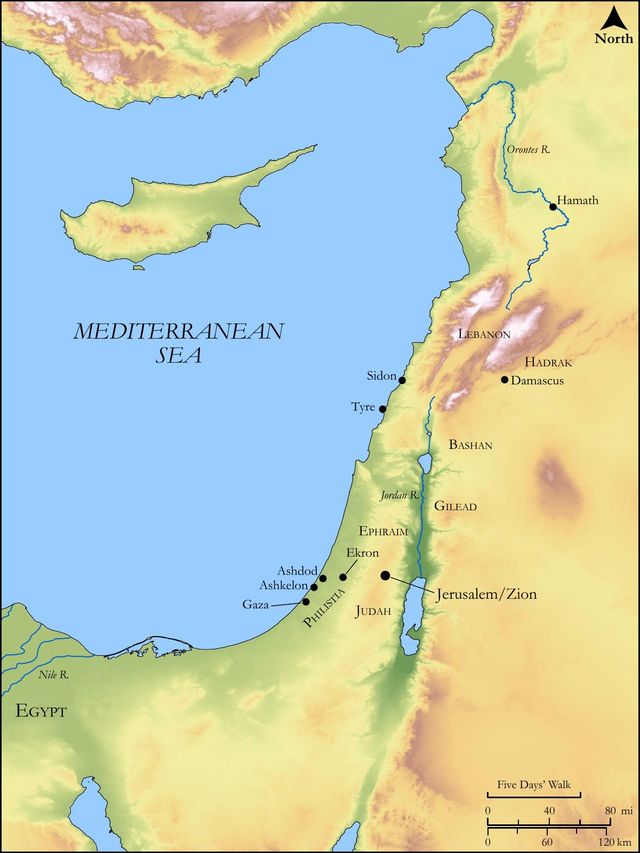
See on the biblical-era map
Study this verse
Public-domain commentary
Matthew Henry
From his Commentary on the Whole Bible. Henry comments on passages, not single verses — this entry covers Zechariah 9:9–11. His two-level outline is real structure in the source text, so it is rendered as structure.
That here begins a prophecy of the Messiah and his kingdom is plain from the literal accomplishment of the ninth verse in, and its express application to, Christ's riding in triumph into Jerusalem, Mat 21:5; Joh 12:15.
I.Here is notice given of the approach of the Messiah promised, as matter of great joy to the Old Testament church:
Behold, thy king cometh unto thee. Christ is a king, invested with regal powers and prerogatives, a sovereign prince, an absolute monarch, having all power both in heaven and on earth. He is Zion's king. God has set him upon his holy hill of Zion, Psa 2:6. In Zion his glory as a king shines; thence his law went forth, even the word of the Lord. In the gospel-church his spiritual kingdom is administered; it is by him that the ordinances of the church are instituted, and its officers commissioned; and it is taken under his protection; he fights the church's battles and secures its interests, as its king. "This King has been long in coming, but now, behold, he cometh; he is at the door. There are but a few ages more to run out, and he that shall come will come. He cometh unto thee; the Word will shortly be made flesh, and dwell within thy borders; he will come to his own. And therefore rejoice, rejoice greatly, and shout for joy; look upon it as good news, and be assured it is true; please thyself to think that he is coming, that he is on his way towards thee; and be ready to go forth to meet him with acclamations of joy, as one not able to conceal it, it is so great, nor ashamed to own it, it is so just; cry Hosanna to him." Christ's approaches ought to be the church's applauses.
II.Here is such a description of him as renders him very amiable in the eyes of all his loving subjects, and his coming to them very acceptable.
1.He is a righteous ruler; all his acts of government will be exactly according to the rules of equity, for he is just.
2.He is a powerful protector to all those that bear faith and true allegiance to him, for he has salvation; he has it in his power; he has it to bestow upon all his subjects. He is the God of salvation; treasures of salvation are in him. He is servatus - saving himself (so some read it), rising out of the grave by his own power and so qualifying himself to be our Saviour. (3.) He is a meek, humble, tender Father to all his subjects as his children; he is lowly; he is poor and afflicted (so the word signifies), so it denotes the meanness of his condition; having emptied himself, he was despised and rejected of men. But the evangelist translates it so as to express the temper of his spirit: he is meek, not taking state upon him, nor resenting injuries, but humbling himself from first to last, condescending to the mean, compassionate to the miserable; this was a bright and excellent character of him as a prophet (Mat 11:29, Learn of me, for I am meek and lowly in heart), and no less so as a king. It was a proof of this that, when he made his public entry into his own city (and it was the only passage of his life that had any thing in it magnificent in the eye of the world), he chose to ride, not upon a stately horse, or in a chariot, as great men used to ride, but upon an ass, a beast of service indeed, but a poor silly and contemptible one, low and slow, and in those days ridden only by the meaner sort of people; nor was it an ass fitted for use, but an ass's colt, a little foolish unmanageable thing, that would be more likely to disgrace his rider than be any credit to him; and that not his own neither, nor helped off, as sometimes a sorry horse is, by good furniture, for he had no saddle, no housings, no trappings, no equipage, but his disciples' clothes thrown upon the colt;' for he made himself of no reputation when he visited us in great humility.
III.His kingdom is here set forth in the glory of it.
This king has, and will have, a kingdom, not of this world, but a spiritual kingdom, a kingdom of heaven.
1.It shall not be set up and advanced by external force, by an arm of flesh or carnal weapons of warfare. No; he will cut off the chariot from Ephraim and the horses from Jerusalem (Zac 9:10), for he shall have no occasion for them while he himself rides upon an ass. He will, in kindness to his people, cut off their horses and chariots, that they may not cut themselves off from God by putting that confidence in them which they should put in the power of God only. He will himself undertake their protection, will himself be a wall of fire about Jerusalem and give his angels charge concerning it (those chariots of fire and horses of fire), and then the chariots and horses they had in their service shall be discarded and cut off as altogether needless.
2.It shall be propagated and established by the preaching of the gospel, the speaking of peace to the heathen; for Christ came and preached peace to those that were afar off and to those that were nigh; and so established his kingdom by proclaiming on earth peace, and good-will towards men.
3.His kingdom, as far as it prevails in the minds of men and has the ascendant over them, will make them peaceable, and slay all enmities; it will cut off the battle-bow, and beat swords into plough-shares. It will not only command the peace, but will create the fruit of the lips, peace.
4.It shall extend itself to all parts of the world, in defiance of the opposition given to it. "The chariot and horse that come against Ephraim and Jerusalem, to oppose the progress of Zion's King, shall be cut off; his gospel shall be preached to the world, and be received among the heathen, so that his dominion shall be from sea to sea, and from the river even to the ends of the earth, as was foretold by David," Psa 72:8. The preachers of the gospel shall carry it from one country, one island, to another, till some of the remotest corners of the world are enlightened and reduced by it.
IV.Here is an account of the great benefit procured for mankind by the Messiah, which is redemption from extreme misery, typified by the deliverance of the Jews out of their captivity in Babylon (Zac 9:11): "As for thee also (thee, O daughter of Jerusalem! or thee, O Messiah the Prince!) by the blood of thy covenant, by force and virtue of the covenant made with Abraham, sealed with the blood of circumcision, and the covenant made with Israel at Mount Sinai, sealed with the blood of sacrifices, in pursuance and performance of that covenant, I have now of late sent forth thy prisoners, thy captives out of Babylon, which was to them a most uncomfortable place, as a pit in which was no water." It was part of the covenant that, if in the land of their captivity, they sought the Lord, he would be found of them, Lev 26:42, Lev 26:44, Lev 26:45; Deu 30:4. It was by the blood of that covenant, typifying the blood of Christ, in whom all God's covenants with man are yea and amen, that they were released out of captivity; and this was but a shadow of the great salvation wrought out by thy King, O daughter of Zion! Note, A sinful state is a state of bondage; it is a spiritual prison; it is a pit, or a dungeon, in which there is no water, no comfort at all to be had. We are all by nature prisoners in this pit; the scripture has concluded us all under sin, and bound us over to the justice of God. God is pleased to deal upon new terms with these prisoners, to enter into another covenant with them; the blood of Christ is the blood of that covenant, purchased it for us and all the benefits of it; by that blood of the covenant effectual provision is made for the sending forth of these prisoners upon easy and honourable terms, and proclamation made of liberty to the captives and the opening of the prison to those that were bound, like Cyrus's proclamation to the Jews in Babylon, which all those whose spirits God stirs up will come and take the benefit of.
Historical interpretation
Historical reception
3 surviving comments on this verse. Each one is dated, so this reads as a timeline rather than a list.
Select a marker to jump to its quote. Markers stagger vertically where authors wrote within a few decades of each other.
For peace and tranquillity of the soul is above all glory of any house; for peace passeth all understanding. This is that peace above all peace which shall be granted after the third shaking of the heaven, the sea, the earth and the dry land, when He shall destroy all Principalities and Powers. For heaven and earth shall pass away, and all the fashion of this world; and every man shall rise up against his brother with the sword, that is, with the word piercing the marrow of the soul, that whatever opposes itself, the chariot from Ephraim and the horse from Jerusalem may be cut off, as Zechariah says. And thus there will be peace over all, the passions of the body offering no resistance, and the unbelieving mind no obstacle, that Christ may be all in all, offering in subjection to the Father the hearts of all men.
(Verse 5 onwards) Ascalon will see it and be afraid; Gaza will writhe in agony, and Ekron too, for her hope will wither. Gaza will lose her king and Ashkelon will be deserted. Foreigners will occupy Ashdod, and I will cut off the pride of the Philistines. I will take the blood from their mouths, the forbidden food from between their teeth. Those who are left will belong to our God and become a clan in Judah, and Ekron will be like the Jebusites. And I will surround my house with those who fight for me, going and returning, and no oppressor will pass over them anymore, for now I have seen with my own eyes. Ascalon will see and be afraid; Gaza will be very sorrowful; and Ekron, because her hope is confounded, and her king will perish from Gaza, and Ascalon will not be inhabited. Foreigners will dwell in Ashdod; and I will remove the injustice of the foreigners, and take away their blood from their mouths, and their abominations from the midst of their teeth. And they will be for our God, and they will be like a leader in Judah; and Ekron will be like the Jebusites. And I will make my house a place of honor, so that no one will pass through or return, and no oppressor or oppressor will come upon them, for now I have seen with my own eyes. Ascalon is interpreted as lowly fire, or weighed down: Gaza, strong, or empire: Accaron, barren, or uprooted: Azotus, which in Hebrew is called Esdod, fire generating, or uncle's fire, or breast's fire; Jebusaeus, it signifies trampled. We have expressed the etymologies of the names in order to briefly go through their meaning. Seeing that Ascalon and Gaza and Accaron, since Emath was in the borders of Damascus, and Tyre and Sidon, after they were struck from all sides, and all of their hay, wood, and straw burned in the fire, were possessed by the Lord, and they themselves, terrified by fear and grief and confusion, began to hope for better things. Finally, Ascalon, in which the devil had been earlier, a lowly fire, and had come to the measure and weight of sins, trembled with fear, because it had ceased to have inhabitants. And Gaza mourned greatly, repenting of its former crimes, which had once been strong and hard to tame, and had promised itself the kingdom of all, because its king and prince, contrary speech and the power of the enemy, had lost its own rule. Accaron also is barren because it had no children without the Law and knowledge of God, it was uprooted, so that it might hear that prophetic saying: Rejoice, barren one, who does not bear; burst forth and cry out, you who are not in labor; for more are the children of the desolate than of her who has a husband (Isai. LIV, I). And when Ascalon and Gaza and Accaron were terrified, and mourned, because they had no inhabitants, or had lost their king, or their former hope had been frustrated, strangers shall dwell in Azotus, where fire begets, which the Lord has sent upon the earth, and desires to burn (Luc. XII). For he will baptize with the Holy Spirit and fire (Matt. 3), where 'fratruelis' and 'patruus' are translated as 'brother-in-law' and 'paternal cousin', whom the bride desires in the Song of Songs: where there is the fire of the breast and the abundant udder, of which we read in the same Song: 'He will rest among my breasts' (Song of Songs 1:12). And in the Apostle: 'I gave you milk to drink, not solid food' (1 Cor. 3:2). Because, as we said according to the LXX: 'Aliens shall dwell in Ashdod', in Hebrew it is written, 'he shall dwell' or 'sit', the 'Mamzer' shall dwell in Ashdod, for which we have substituted 'separator' shall sit in Ashdod. Understand the Lord as the separator, who separates the grain from the chaff (Matthew 3 and 13), and the good fish from the bad fish, and discern silver and gold from dirt and slag. And when he has done this, he promises other things: I will destroy the injustice or the pride of the Philistines. For this, the 70 foreigners were brought in. Philistines are translated in our language as 'falling to the cup,' because they drank from the cup of Babylon and fell down drunk. Therefore, at the time of the calling of the Gentiles and the coming of Christ, they will not have pride, but they will follow Jesus with humility and meekness. And he will take from their mouth the blood, the blasphemy, and the abominations, the worship of idols, and the eating of things sacrificed to idols, from between their teeth. So that after these things have been removed, the Philistines themselves, that is, the foreigners, will be abandoned to the Lord, and he will be the leader in Judah, that is, in the people confessing the Lord, so that the former people who were in the head, will be turned into the tail, and the last one who was in the tail, will pass into the head. And once barren Accaron, therefore, uprooted, will be as Jebus, that is, as Jerusalem. For this city is called by three names, Jebus, Salem, and Jerusalem. And I will surround, he says, my house, that is, the Church, with those who fight for me, that is, with those who serve me in various ministries and come and go at my command. Or: I will surround my house with the protection of angels, about whom it is also written elsewhere: The angel of the Lord will encamp around those who fear him, and he will deliver them (Ps. 34:7), so that there is no one who can attack and return, that is, who can plot against my people. Nor shall there pass over him any more the exactor, of whom Isaiah speaks: The exactor hath ceased (Isaiah 14:5), or surely one who drives out, that is, leading outwards, and dragging the bound captives into captivity: because with his own eyes, which we can understand as the prophets and all the saints, the Lord has seen the calling of the nations and the security of the Church.
Rejoice greatly, O daughter of Zion; shout, O daughter of Jerusalem: behold, thy King cometh unto thee: he is just, and having salvation; lowly, and riding upon an ass, and upon a colt the foal of an ass. And I will cut off the chariot from Ephraim, and the horse from Jerusalem, and the battle bow shall be cut off: and he shall speak peace unto the heathen: and his dominion shall be from sea even to sea, and from the river even to the ends of the earth. LXX: Rejoice greatly, O daughter of Zion; proclaim, O daughter of Jerusalem: behold, thy King cometh unto thee, just, and a Saviour, he is meek, and riding upon a young ass, and he shall destroy the chariots out of Ephraim, and the horse out of Jerusalem, and the battle bow shall be destroyed, and he shall speak peace to the Gentiles, and his dominion shall be from the sea to the rivers, and from the rivers to the ends of the earth. The Evangelists write that this prophecy was fulfilled when the Lord entered Jerusalem, sitting on a donkey and the foal of a donkey, and a crowd of children with palm branches came out to meet Him, shouting: Blessed is He who comes in the name of the Lord, hosanna in the highest (Matthew XXI); and when the Pharisees reproached Him for not rebuking the children who were shouting, He replied: Have you not read: Out of the mouth of babes and sucklings you have perfected praise (Psalm VIII, 3)? Therefore, Sion exults and Jerusalem rejoices, the same city (for Sion is the citadel of Jerusalem), because its king has come, who was promised by the prophecies of all the prophets: He himself is just, the Savior, that is, Jesus, as the angel interpreted, speaking to the Virgin: And he shall be called Jesus, for he shall save his people from their sins (Mat. I, 21). Also, poor or, as the LXX translated, meek, who, though rich, became poor for us, and says in the Gospel: Learn from me, for I am meek and humble of heart (Mat. XI, 29). And, riding upon a domestic ass or a young foal, that is, the people of both Circumcision and Uncircumcision, of whom the former had borne the heavy yoke of the Law, as it is written in the Acts of the Apostles: Neither we, nor our fathers, were able to bear the heavy yoke of the Law (Acts 15). Therefore, Paul also writes to the Galatians who wanted to be circumcised: Stand fast, and do not be held again under the yoke of bondage (Galatians 5:1). But the new chick, a multitude of gentiles, having no reins of the Law, nor being straightened by anyone, but always falling into precipices and whirlpools of idolatry, has learned to walk and enter the straight path by the session of the Lord. And I will destroy, he says, the chariot of Ephraim. Moreover, it is said in the person of God the Father, that the chariot, or the chariot, of Ephraim may perish, and the horse from Jerusalem. And in the meantime, according to the letter, he speaks thus: There will be no battles, with the advent and birth of Christ pacifying all. Furthermore, according to a higher understanding, Ephraim is referred to as a multitude of heresies, which is interpreted as bearing fruit, that is, abundance and plentiful crops. This is written in the seventy-seventh psalm: The children of Ephraim, being armed and carrying bows, turned back in the day of battle. About these chariots and charioteers, we read: Some trust in chariots and some in horses, but we trust in the name of the Lord our God. They have bowed down and fallen, but we have risen and stand upright (Psalm 20:7-9). The horse that is lost from Jerusalem, that is whom we read about: A deceitful horse for salvation (Psalm 32:17), And in Jeremiah, those who indulged in luxury and lust, they hear: The horses have gone mad, they have become like females to me: each neighed after his neighbor's wife (Jeremiah 5:8). Hence they are called to repentance, as the Psalmist says: Do not be like a horse or a mule, which have no understanding (Psalm 32:9). When God has destroyed the chariots of Ephraim and the horse from Jerusalem, which were freed from such horses and chariots; they will be brought into the service of the Lord, and will become cherubim, and it will be said of them: The chariots of God are ten thousandfold, thousands of rejoicing (Psalm 68:18). And: I have likened you, my beloved, to my horse in Pharaoh's chariots (Song of Solomon 1:8). And: Ride on horses, and let your riding be salvation (Habakkuk 3:8). The bow of war will be dispersed, so that no burning arrows may be launched, which could strike the hearts of the pleasure seekers. And he will speak peace to the nations, of whom it is written: He shall be the expectation of the nations (Gen. XLIX, 10). And again: The nations shall hope in him (Isai. XI). And: His dominion shall be from sea to sea, and from the rivers to the ends of the earth (Ps. LXXI, 8). This is not to be weakened by allegory, but truly believed to be fulfilled, according to what we read: Ask of me, and I will give you the nations for your inheritance, and the ends of the earth for your possession (Ps. II, 8). In the seventy-first psalm, under the person of Solomon and the true peacemaker, it is said: And he shall rule from sea to sea, and from the river to the ends of the earth (Verse 8).
Be glad, therefore, O Jerusalem, since of such a kind is a king appointed for you by God, and he has come to you, capable of saving his own on account of the divine influence accruing to him and justly inflicting total punishment on the adversaries. While he is riding a lowly animal for the reason that he has just arrived back from captivity, he assumes great power through divine grace, and so from Ephraim and from Jerusalem he will remove all the chariots of the adversaries, every war horse and every battle bow—that is to say, he will drive off all enemies so that there will be no longer any adversary against the country of Judah. He will also wipe out a great multitude of the adversaries and completely deprive them of peace, crushed and destroyed in a war waged by him.
Continue studying Zechariah 9:10 across the web’s major study libraries — every link below opens this exact verse, chapter, or book on the destination site.
Read & Compare
 BibleGatewayThis verse in more than 200 translations and 70 languages.
 Bible.comThe YouVersion reader — hundreds of translations, reading plans, and highlights.
 ESV.orgCrossway's official English Standard Version reader.
 NET BibleThe NET translation with 60,000+ translators' notes on every rendering decision.
 STEP BibleTyndale House's free study tool — original text, vocabulary, and scholarly resources.
 BibliaLogos Bible Software's free web reader.
 USCCBThe New American Bible (Revised Edition) with the U.S. bishops' study notes.
Commentaries
 BibleHub CommentariesDozens of classic commentaries on this verse, gathered on one page.
 StudyLightMore than 100 commentary sets — the largest collection on the web.
 BibleRefPlain-English commentary on what this verse means, verse by verse.
 Enduring WordDavid Guzik's free commentary on this chapter, widely used by Bible teachers.
 Bible Study ToolsVerse commentary alongside Greek and Hebrew study aids.
Original Language & Research
- BibleHub InterlinearThe verse word by word — original language, transliteration, and English.
- BibleHub LexiconEvery word's original-language definition and Strong's entry.
 Blue Letter BibleDeep-study tools — Strong's numbers, concordance, and word studies.
 SefariaThe Hebrew text with Rashi and centuries of Jewish commentary.
Sermons, Hymns & Audio


TrulyRandomVerse is not affiliated with these sites and doesn’t control their content. They’re linked because they’re genuinely useful.
Summary
Zechariah 9:10 is a profound Messianic prophecy that foretells a future era of universal peace and boundless dominion under the reign of a divine King. This verse describes the cessation of all instruments of war, symbolizing a radical shift from human military might to divine sovereignty. The King, identified as the one who "speaks peace," extends this transformative peace not only to Israel but also to all nations, establishing a global dominion that spans from one end of the earth to the other, signifying a comprehensive and eternal reign.
Context
ShowHideLiterary Context
Zechariah 9:10 immediately follows the celebrated Messianic prophecy of Zechariah 9:9 which depicts the humble, righteous King entering Jerusalem on a donkey. Verse 10 expands upon the nature of this King's reign, contrasting His peaceful, universal dominion with the earthly, militaristic powers that previously dominated the region. Chapters 9-14 of Zechariah form a distinct section often referred to as "the burdens" or "oracles," shifting in tone and focus from the earlier chapters concerning the Temple's rebuilding. This latter section primarily concerns eschatological events, including the coming of the Messiah, the judgment of nations, the restoration of Israel, and the establishment of God's eternal kingdom. Within this prophetic sweep, Zechariah 9:1-8 details God's judgment on surrounding nations, setting the stage for the arrival of the King who brings a different kind of power and peace.
Historical & Cultural Context
Zechariah prophesied to the Jewish exiles who had returned to Judah after the Babylonian captivity (538 BC onwards). They were a small, vulnerable community rebuilding their temple and their lives under Persian suzerainty. The historical context was one of political instability, with various empires (Persian, then Greek) vying for control, and Israel often caught in the middle. Military strength was paramount for national security and survival. The imagery of "chariot," "horse," and "battle bow" represents the pinnacle of ancient military technology and power, symbolizing reliance on human might. Jerusalem and Ephraim (representing the southern and northern kingdoms, respectively, or Israel as a whole) had historically relied on such armaments, often to their detriment. The prophecy of cutting off these instruments of war would have been counter-cultural, pointing to a radically different source of security and authority than the world understood.
Key Themes
ShowHideThis verse significantly contributes to several overarching themes in Zechariah and the broader prophetic tradition. Firstly, it emphasizes Divine Disarmament and Peace, portraying a future where reliance on human military power is utterly abolished, replaced by a divinely established peace. This theme anticipates a new world order where conflict ceases, a vision echoed in other prophetic books like Isaiah 2:4. Secondly, the verse highlights the Nature of the Messianic King as a bringer of peace, not through conquest but through His word and presence. His mission is not to wage war but to "speak peace," transforming the very fabric of human interaction. Lastly, the prophecy underscores the Universal Extent of God's Kingdom, asserting that the King's "dominion" will not be limited to Israel but will stretch "from sea even to sea, and from the river even to the ends of the earth." This global scope points to a kingdom that transcends ethnic and geographical boundaries, encompassing all peoples and places, a concept foundational to the New Testament's understanding of the church and the ultimate reign of Christ, as seen in Psalm 72:8.
Exposition and Analysis
ShowHideKey Word Analysis
ShowHideThis primitive root signifies a decisive and permanent severance. While it can mean to "cut down" or "destroy," it also carries the specific implication of "to covenant" (originally by cutting flesh and passing between pieces). Here, its use in "cut off the chariot... and the battle bow" denotes a complete and irreversible cessation of military instruments. It's not a temporary truce but a divine act of disarmament, indicating that the source of true peace is not the absence of war, but the removal of its very instruments and the mindset that relies on them.
Far richer than merely the absence of conflict, shalom encompasses wholeness, completeness, well-being, prosperity, health, harmony, and security. When the King "speaks peace," it implies He actively establishes this comprehensive state of well-being, not merely declares it. This is a holistic, divinely-initiated peace that transforms relationships and conditions, extending beyond individual tranquility to societal and cosmic restoration.
This term refers to a "foreign nation" or "Gentile." Its inclusion is crucial, as it expands the scope of the King's peace and dominion beyond the traditional boundaries of Israel. The King's reign is not ethnocentric but universal, embracing all peoples. This foreshadows the inclusion of Gentiles into God's covenant blessings, a radical concept for the original audience, highlighting the expansive nature of God's redemptive plan.
Verse Breakdown
ShowHide"And I will cut off the chariot from Ephraim, and the horse from Jerusalem, and the battle bow shall be cut off:"
This opening clause declares God's initiative in dismantling the instruments of war. "Ephraim" and "Jerusalem" represent the northern and southern kingdoms, respectively, symbolizing the entirety of Israel. The "chariot," "horse," and "battle bow" are potent symbols of military might and human reliance on strength for security. Their "cutting off" signifies a divine act of disarmament, indicating that in the coming Messianic age, human military power will be rendered obsolete and irrelevant. True security and peace will not derive from human armaments but from the King's reign.
"and he shall speak peace unto the heathen:"
This clause introduces the King and His primary characteristic and mission. The King, the subject of Zechariah 9:9, will "speak peace." This is not merely a declaration but an active establishment of shalom (wholeness, well-being). Crucially, this peace is extended "unto the heathen" (the gôwy, or nations/Gentiles), signifying that the King's reign transcends ethnic and national boundaries, bringing His transformative peace to all peoples. This anticipates a universal, inclusive kingdom.
"and his dominion [shall be] from sea [even] to sea, and from the river [even] to the ends of the earth."
This final clause describes the boundless extent of the King's authority. "From sea to sea" typically refers to the Mediterranean Sea to the Persian Gulf, and "from the river" usually denotes the Euphrates. However, the addition of "to the ends of the earth" expands this to a truly global and ultimate sovereignty. This is a merism, using two extremes to denote totality, emphasizing that the King's dominion will be absolute, comprehensive, and universal, leaving no part of the earth outside His righteous rule.
Literary Devices
ShowHideZechariah 9:10 employs several powerful literary devices. Parallelism is evident in the initial declaration: "I will cut off the chariot from Ephraim, and the horse from Jerusalem," which effectively emphasizes the comprehensive nature of the disarmament across all of Israel. Symbolism is central, with "chariot," "horse," and "battle bow" serving as potent symbols of human military might and self-reliance, which are contrasted with the King who "speaks peace." This highlights a fundamental shift from earthly power to divine authority. The phrase "from sea even to sea, and from the river even to the ends of the earth" is a classic example of Merism, a rhetorical device where two contrasting parts of a whole are used to represent the whole, conveying the idea of a boundless, universal dominion. Finally, the verse presents a stark Contrast between the world's reliance on instruments of war and the King's reign characterized by peace and universal authority, underscoring the radical nature of the Messianic kingdom.
Theological and Thematic Connections
ShowHideZechariah 9:10 is a cornerstone prophecy for understanding the nature of the Messianic kingdom. It paints a picture of a world transformed by divine intervention, where the instruments of human conflict are abolished, and a King reigns whose power is expressed through peace rather than military might. This peace, shalom, is comprehensive, encompassing well-being, wholeness, and harmony, and it extends universally to all nations. The boundless dominion described here underscores God's ultimate sovereignty and His plan to establish a kingdom that transcends all earthly limitations, bringing justice and peace to the entire cosmos. It challenges human notions of power and security, redirecting faith towards God's appointed King as the true source of lasting peace and authority.
Reflection and Application
ShowHideZechariah 9:10 offers profound hope in a world perpetually plagued by conflict and division. It reminds us that true and lasting peace does not originate from human efforts, political treaties, or military superiority, but from the sovereign reign of God's appointed King. For believers, this verse affirms the ultimate authority of Jesus Christ, who has already inaugurated His kingdom of peace through His first coming and will fully establish it upon His return. This prophecy challenges us to re-evaluate our own sources of security and to trust in God's power rather than earthly might. It calls us to embody the peace of Christ in our daily lives, to be agents of reconciliation, and to live as ambassadors of His universal dominion, extending His shalom to a broken world. It encourages us to pray for the full realization of His kingdom and to participate in its advance through non-violent means, proclaiming the good news of the King who speaks peace.
Questions for Reflection
ShowHideFAQ
ShowHideDoes Zechariah 9:10 refer to a literal disarmament of all nations in the future?
ShowHideWhile the imagery of "cutting off the chariot, horse, and battle bow" certainly points to a literal cessation of warfare, the primary emphasis is on the spiritual and theological reality of the Messianic kingdom. It signifies that in this King's reign, human reliance on military might will be rendered obsolete and unnecessary. The peace He brings is so comprehensive and divinely secured that instruments of war become irrelevant. This does not necessarily mean every weapon will physically disappear overnight, but rather that the spirit of war and the need for human armaments will be fundamentally removed by the King's sovereign peace and justice. It points to a future where the conditions for war no longer exist under His perfect rule.
How does the King "speaking peace unto the heathen" relate to the New Testament?
ShowHideThis phrase is a powerful foreshadowing of the inclusion of Gentiles (the "heathen" or nations) into God's redemptive plan, a central theme in the New Testament. In the Old Testament, God's covenant was primarily with Israel, though His ultimate global purpose was always hinted at (e.g., Genesis 12:3). The King "speaking peace unto the heathen" directly anticipates the universal scope of the Gospel, where salvation and peace are offered to all peoples, regardless of their ethnic or national origin. This finds its ultimate fulfillment in Jesus Christ, who broke down the dividing wall between Jew and Gentile (Ephesians 2:14) and commissioned His followers to make disciples of all nations (Matthew 28:19).
Christ-Centered Fulfillment
ShowHideZechariah 9:10 finds its profound Christ-centered fulfillment in Jesus of Nazareth, the humble King foretold in Zechariah 9:9. His triumphal entry into Jerusalem on a donkey, as recorded in Matthew 21:5 and John 12:15, directly fulfills the preceding verse and sets the stage for His reign of peace. Unlike earthly kings who conquer with chariots and bows, Jesus, the "Prince of Peace" (Isaiah 9:6), established His kingdom not by military might but through self-sacrificial love and the proclamation of the Gospel. He disarmed the spiritual powers of darkness through His death and resurrection (Colossians 2:15), offering a peace that the world cannot give (John 14:27). His commission to His disciples was to go and make disciples of "all nations" (Matthew 28:19), extending His message of peace and reconciliation to the "heathen" (Gentiles), thereby breaking down the dividing wall between Jew and Gentile and creating one new humanity in Himself (Ephesians 2:14-18). Ultimately, His "dominion from sea even to sea, and from the river even to the ends of the earth" will be fully realized when He returns as King of kings and Lord of lords (Revelation 19:16), establishing His eternal kingdom over all the earth, where true peace and righteousness will reign supreme.